Yesterday, the Iraqi parliament approved a new government headed by Prime Minister Haideral-Abadi. While John Kerry calls the swearing-in a “major milestone”, Juan Cole advises us not to get our hopes up:
Although al-Abadi is a more congenial and less paranoid figure than his predecessor, Nouri al-Maliki, he derives from the same fundamentalist Shiite political party, the “Islamic Call” or “Islamic Mission” (al-Dawa al-Islamiya), founded around 1958 with the aim of creating a Shiite state. The Dawa Party did very well in securing cabinet appointments. The cabinet lacks a Minister of the Interior (akin to the US FBI or Homeland Security director) and a Defense Minister, because the parties could not agree on the names that had been put forward. Hadi al-Ameri, the head of the Iran-backed Badr Corps militia, had been bruited as an Interior Minister, but apparently calmer heads prevailed (or perhaps there was severe American pressure). The Badr Corps in the past has been accused of involvement in torture, and it is despised by many of the Sunni Arabs.
Given the revolt of the Iraqi Sunni Arabs this summer, that anyone even considered al-Ameri for such a sensitive position is astonishing. During the first Ibrahim Jaafari government, the Badr Corps was accused of abuse and the extra-judicial jailings of Sunni Arab rebels. If the Iraqi elite were smart they’d put a Sunni Arab in as head of the Department of Defense.
But Jill Carroll asserts that no amount of representation in a failed political system will assuage the fears of Iraq’s Sunni Arab minority. Only autonomy, she argues, will solve the problem that enabled the rise of ISIS:
Sunni trust in the political process and central government is broken beyond repair. Sunnis do not see the Shiite-led government as a political opponent they disagree with. They see it as an existential threat. The local Iraqi players who aid the Islamic State — Sunni tribesman and former Saddam Hussein regime military elements — need to be enticed to turn against the organization. Getting them to “buy back in” will require a powerful incentive, and what this Shiite-dominated government in Baghdad currently has to offer is not enough.
It is time for a bold solution. Baghdad should offer the Sunni tribes some sort of political autonomy, or perhaps even independence in the territory the Islamic State has carved out, on the condition that they ruthlessly eject the jihadists. This new Iraqi Sunni political entity could be a new country, a semi-autonomous regional government like Kurdistan, or a federation of tribal powers under a loose national framework like the United Arab Emirates.
On the other hand, Michael Rubin blames a lack of Sunni leadership for Iraq’s governance problems:
The real problem facing Iraq—and the reason why no amount of military reform or imposed political quotas will succeed—is that the Arab Sunni community is leaderless. Like them or hate them, the Shi‘ite community has established political parties like Da’wa and the Islamic Supreme Council of Iraq and, if political infighting grows too great, the clerical hierarchy will use their offices to kick the Shi‘ite politicians into gear. The Kurdistan Regional Government is far from democratic, but its parties are well established: Kurds may resent their political leadership, but they do not doubt it.
The Iraqi Sunni Arab community has no real leadership. There is no religious structure among Iraqi Sunni Arabs (or Sunnis in general) that approximates what exists in Najaf. Those assisting the U.S. military and diplomats new to the Iraq issue often talk about the importance of tribes, but there is hardly a tribe in Iraq whose leadership is uncontested. Former President Saddam Hussein—and, indeed, almost every leader before him–promoted rivals to tribal sheikhs in order to better control the tribes. The result is often a mess. Make a Dulaim minister of defense? Don’t count on assuaging the Dulaim because chances are few will recognize the individual as legitimate, or will criticize him as coming from the wrong sub-clan.
Josh Rogin observes that the president isn’t showing much interest in getting Congress’s permission to go to war with ISIS:
The president and his staff have made clear that they don’t feel they need congressional authorization to go after ISIS, but leaders in both parties disagree, and a long list of congressional figures believes the president must come to Congress for explicit authorization within 60 days of when he began striking ISIS in Iraq, on August 8.
But some of the hawks in Congress aren’t eager for a vote, Tim Mak finds:
Hawkish Sen. Lindsey Graham (R-SC) offered the frank assessment Monday that a congressional vote could hinder presidential power at a time when Obama most needs it to counter ISIS, putting him on the same page as senior Sens. Carl Levin (D-MI) and Dianne Feinstein (D-CA), both of whom indicated an interest in deferring to the president on war strategy. The Daily Beast asked Graham if the absence of a vote reflected congressional acquiescence to the president’s will on war strategy. A vote would be nice, he said, but bringing the issue to Congress could mean all sorts of measures that blunt the president’s response. “What if [Obama] comes here and [Congress] can’t pass it? That would be a disaster. And what if you put so many conditions on it that it makes any military operations ineffective? That’s what I worry about,” the senator said. “I think the president has an abundant amount of authority to conduct operations. It would be good to have Congress on board… if Congress doesn’t like what he’s doing, we can cut the money off.”
Still, some Senators are rightly insisting that the new war come to a vote:
On Monday, Sens. Bill Nelson (D-Fla.) and Jim Inhofe (R-Okla.) introduced resolutions to authorize military action in Syria, as did Rep. Frank Wolf (R-Va.). Speaking on the Senate floor, Nelson said he believes Obama already has authority to act, “but there are some who disagree, so rather than quibble about legalities, I have filed this legislation.” Inhofe said that an authorization vote would attract widespread, bipartisan support “because people realize — even [Defense Secretary Chuck] Hagel and others have made the statement — that the threat facing us is unprecedented.”
The Florida Panhandle? This is somewhere south of the Mason-Dixon Line.
Another heads west:
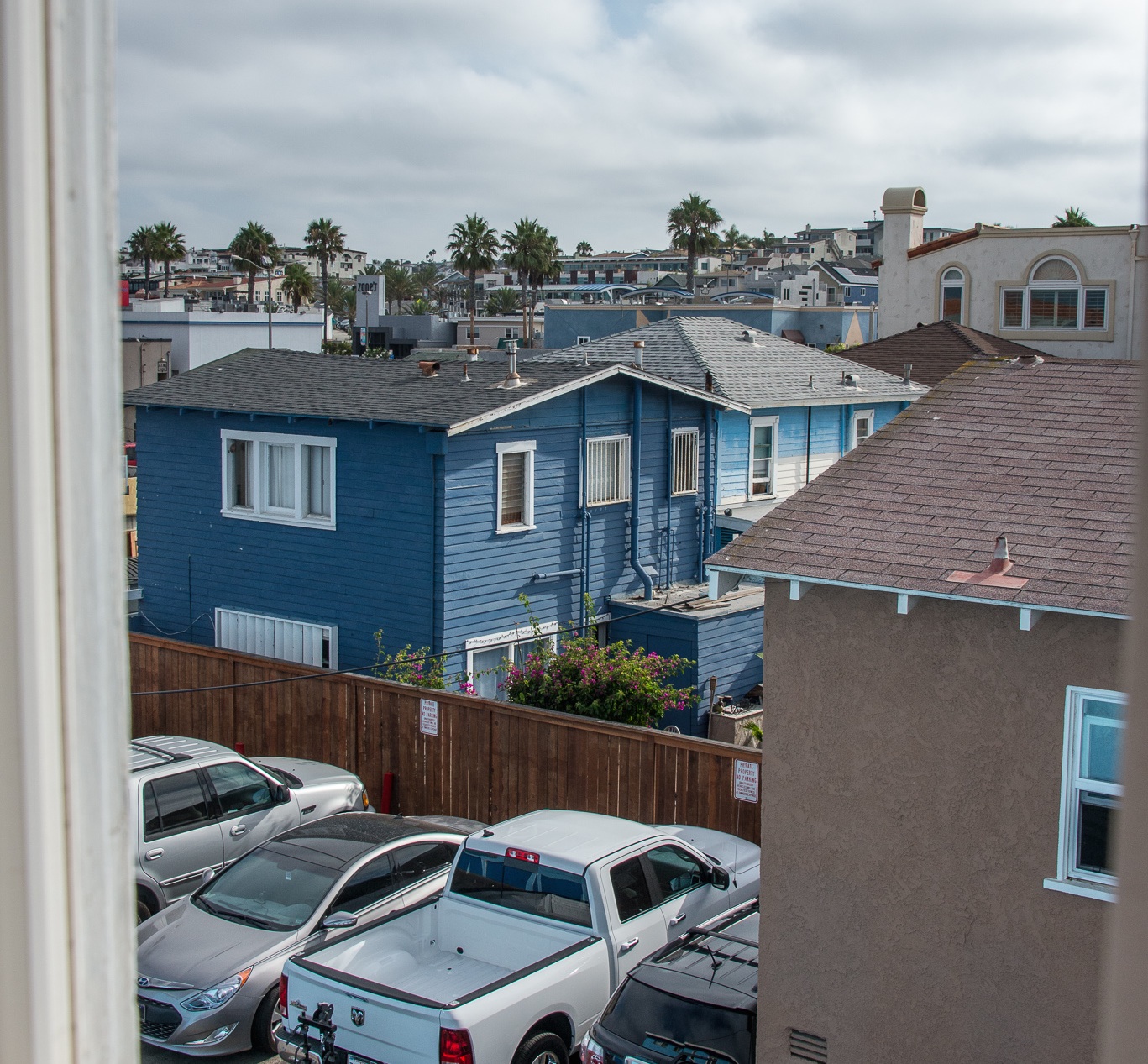
Definitely on the West Coast with a temperate climate that allows both exposed plumbing and palm trees. I could find nothing about “Zone’s” other than it’s a tech company and also a catering firm on the East Coast. The rounded blue roofs look like they may cover platforms for a lite-rail system. It might be San Francisco, but I’ll bet on Portland, Oregon.
Just south, actually:
We’re in the US (“Private Property, No Parking” signs on the fence). The combination of cloudy skies, tightly packed buildings, tightly packed cars, and sparse palm trees screams Southern California to me, and particularly reminds me of the Pacific Beach neighborhood in San Diego.
Another gets closer:
Los Angeles? Boy, I could be totally wrong about this, but it looks so much like an early painting of Richard Diebenkorn’s.
One key clue led to hundreds of correct entries:
Thanks for the ridiculously easy contest. It’s a good opportunity to let the incorrect guessers know that they need an eye exam.
Another explains:
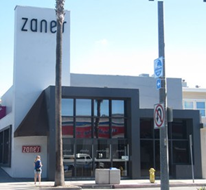
A building in the distance labeled either “Zane’s” or “Zone’s.” I’d searched these terms, along with words like restaurant, gym, store, and nightclub by themselves with little success. Once I deduced it was in California, I searched, “zanes california” and found this: It’s a restaurant located in Hermosa Beach, California.
Correct! A happy rookie:
OH MY GOD I ACTUALLY GOT ONE! Have tried several times in the past, but always ended giving up relatively quickly and lamenting the apparent futility of it all. Never even bothered submitting a guess. Now I know this isn’t the trickiest one in the world. No doubt I will be one of dozens to get it (or at least get the building right). No matter. To me, it is huge.
This picture screams SoCal. After that, the two biggest clues are the sign in the background and the building with the curved chimney. I decided to focus on the sign. And, after a fruitless search for “Zone’s” in various search engines and databases, I realized the “o” was an “a.” Zane’s. So a simple “Zane’s SoCal” led me to Hermosa Beach. After that, focusing on finding two blue houses side by side, Google Street View walked me to the Sea Sprite Motel and Apartments.
Thanks for the great work and for picking one us mere mortals had a fighting chance at!
Playing the contest is like Nintendo, it seems:
It finally happened. Dozens of such VFYW contests and humbled each time, until now. The best analogy I can think of takes me back to playing Super Mario Brothers on the original NES as a child. I could get to the final level, but time and time again I’d fail to best the evil boss at the end to save the princess. And then, one fateful day, it all came together. Perhaps through sheer luck, or maybe by logging enough hours to hone my skills, I made it through King Koopa and rescued Princess Peach.
My reward? A brief thank-you from that ungrateful princess. Then, the option to get sent off on a new quest altogether!! What the hell? Mario had risked fire-spewing lava and defeated a series of mutant reptiles, and all he gets is a mere “thanks” and an invitation for more life-risking adventures?! I’d assume if you get the title of “princess” one’s family could offer a little more in the tangible reward department.
I digress.
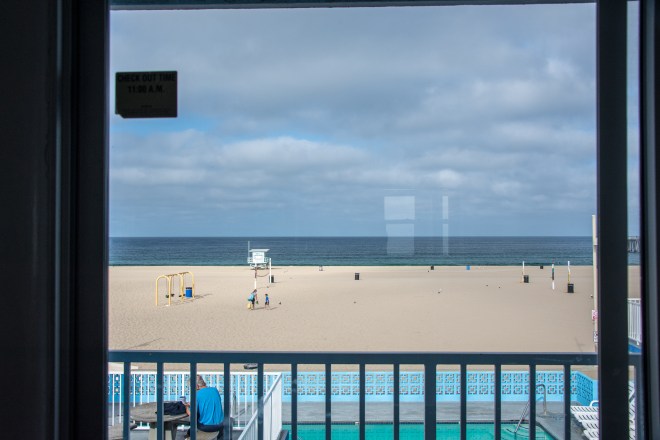
This view is from the Sea Sprite Motel (& Apartments) in Hermosa Beach, CA. It’s taken from the top floor, but I cannot tell which unit. Interestingly enough, the view from the other side of the building would be of the Pacific Ocean.
Fortunately, in the last 25 years I have learned to enjoy the satisfaction of a job completed as reward unto itself.
Another agrees:
Husband: “But if it’s that easy, won’t everyone else guess that too? You won’t win.”
Me: “Yes, but it’s not about winning, it’s just exciting to get one right!”
A detailed visual walkthrough:
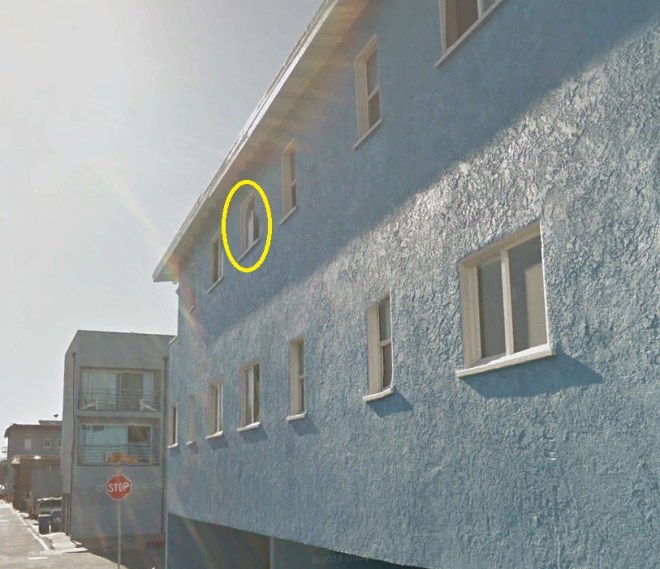
Using the awnings in the midfield of vision, and the blue house with small parking lot, it can be traced back to the second floor of Sea Sprite Motel and Apartments at 1016 The Strand. Because the window doesn’t seem to have a horizontal split, I am going with the window with the vertical split, circled below.
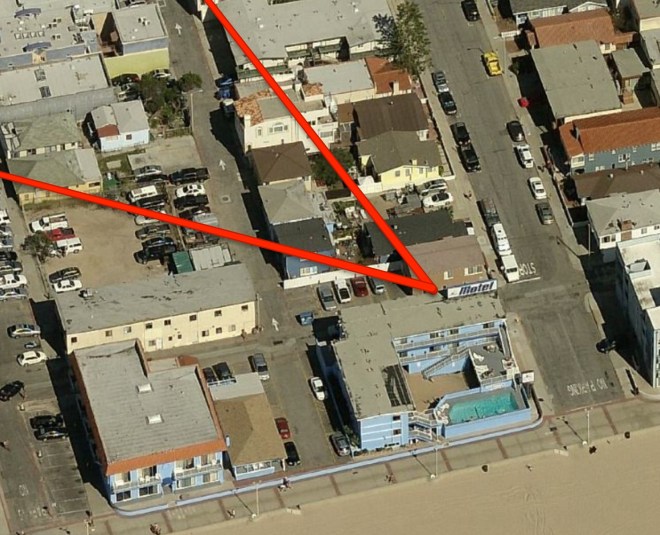
The map view is below showing the hotel, the building with the curved awnings, and Zane’s in the background:
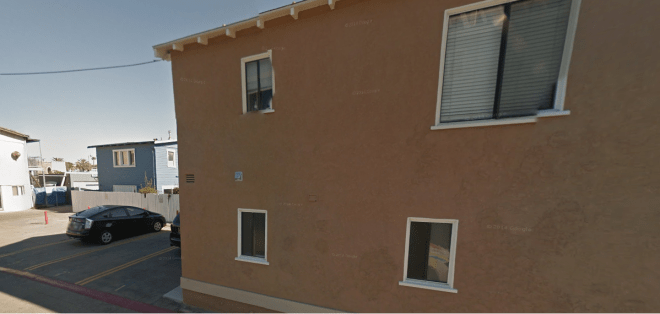
Here is the view from the alley looking at the small parking lot and the tan building in the rear with the darker blue house behind that:
Another rags on LA:
The vague location came to me immediately. It was the general seaside atmospherics – the low cloudy sky of the Los Angeles beach areas that I grew to know years ago when I lived out there. Hunter Thompson once called it “the shitmist,” but I never thought of it that way. That gentle overcast was just a relief from the usual relentless sun.
Another reader looks to Hollywood:
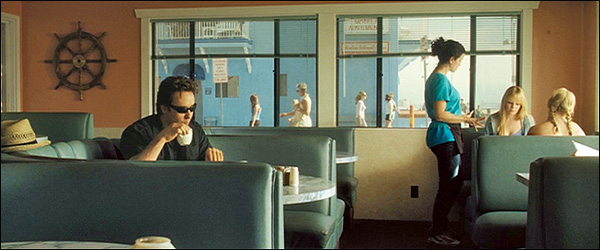
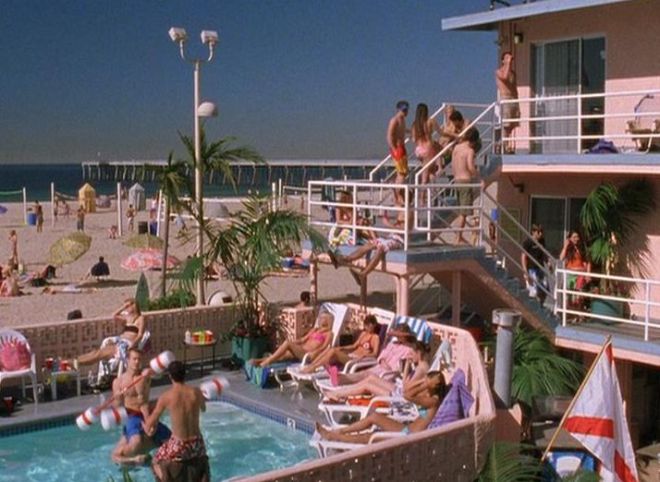
This one might be a gimme for movie and TV buffs, since all kinds of things are shot in Hermosa Beach, given its proximity to LA. John Cusack ate in a diner across the street in Steven King’s 1408 and the Sea Sprite is visible through the windows behind him:
It also starred in a pool party scene from Gilmore Girls:
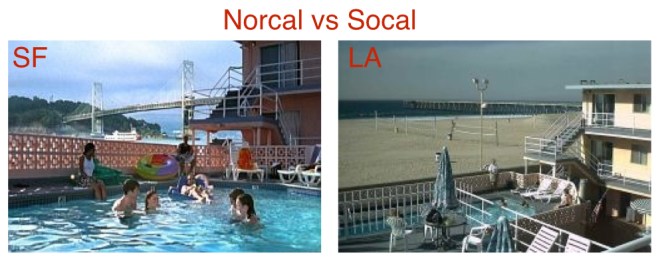
And, bizarrely, in a scene from Monk set in San Francisco but shot 400 miles to the south and photoshopped into the Bay Area via a digital Bay Bridge:
This is an obvious fraud, since there are only 2-3 days per year one might throw a pool party next to the Bay Bridge. In SF, everyone in that scene would be hypothermic.
And you can’t have LA without pulp:
Marlowe crawled back to consciousness and tried to remember what it was that Zane had told him last night just before somebody put his lights out. Who was it swung the sap? Eddie Mars’ boys? They were waiting for him outside that steakhouse, the one on the corner of Pier and Hermosa Avenues, where he’d dropped in to get the lowdown from the kid (not the one looking for the black bird, the other one).
The bar there was nice and dim and they poured a decent gimlet, but still Marlowe hadn’t been ready to believe that it could be this easy. “Hell,” he reflected, “that dame didn’t need a private dick. Type ‘Zane’s California’ in any search engine and she gets the motherload. It’s Hermosa Beach, not Santa Monica or Hollywood, but this is still Raymond Chandler country: sunburnt stucco and palm trees.”
It took nothing to retrace steps from the steakhouse to the Sea Sprite Motel at 1016 The Strand and to wait there for the hard guys to make their next move. “Next time I’ll get a window facing the beach,” he thought. “The surf’s loud enough, you might as well get to see it.”
Another player finally found a way to incorporate a teen soap opera into a contest entry:
Palm trees. California! But WHERE in California?? Oh no!
It’s in times of need just like this that I humbly turn to the “World’s Greatest Compendium of Locations where The O.C. was Filmed“. And, as always, TWGCOLWTO.C.WF puts the competition to shame. What you need to know about the Sea Sprite Motel at 1016 The Strand, Hermosa Beach, CA:
A cheap motel where pornographer Lance Baldwin stays.
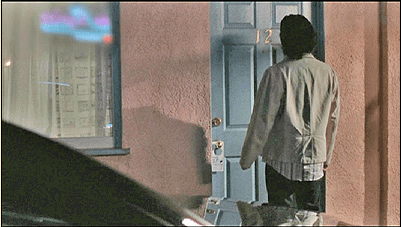
Episode 16 (of season 2), when Sandy Cohen goes to the blackmailer Lance’s apartment to try to negotiate the ransom for the porno tape which Julie made when she was young. We see it again later when, after Julie has confessed her sordid past to Caleb, Caleb also goes to Lance’s apartment at the Sea Sprite motel and shows him the extortion money. But after getting his hands on the tape, Caleb double-crosses Lance, takes back the $500,000 cash, and has two thugs beat Lance up.
I have no idea what room, but let’s say … 12, because my research indicates that’s where all the shit went down:
And I choose to believe that our photo submitter was this guy:
Readers truly went to extraordinary lengths to distinguish themselves this week:
Since you will undoubtedly have lots of correct answers, I better up my game, here’s more info:
Trivia: Dizzy Gillespie, Tito Puente and Mose Allison stayed there, as did Ice Capades performers.
Personal Connection: I’ve now spoken to the desk clerk on the phone, as I called the hotel to ask for the room number of my guess. Sounds like quite a few Dishheads are calling and even stopping by to scout it out! End unit is #17, my guess is #16, he said some folks were guessing #15. Pretty certain the right answer is the window I indicated in my original post which I now know is in room #16.
Given the apparent on-site investigations, I expect the winner will provide at least one of the following: (a) a picture of themselves at the window posing with the motel’s owner and/or (b) a DJI drone video fly-through out the window showing the view, circling over the hotel for some areal footage, ending with a stunning sunset shot over Hermosa Beach (roll credits).
Another shares a story from their eventful stay at the Sea Sprite:
My wife and three young kids stayed at the Sea Sprite for July 4th in 1998. We had just moved to California and wanted to see the fireworks (and we did not drive on the Jewish sabbath, thus the need for a local hotel – as well as local parking). We did not realize that the Strand in Hermosa Beach was a central vortex for 20-somethings gone wild. We survived the interesting cultural experience, and my wife’s car survived the partying that occurred in the parking lot and everywhere else.
The problem surfaced when we drove just a few short miles home. Our other car was stolen off our street in Redondo Beach. So I called the Redondo Beach police and told them that my car was stolen. The officer replied, “Why do you think that your car was stolen?” I replied, “I went to where it was parked, and it is no longer there!” Without missing a beat, he replied, “In the police business, that is what we call a clue.”
Turns out, it was just taken for a joy ride. About ten days later, as another Redondo Beach police officer was writing a second ticket for illegal parking, they gave me a call and said if I could pick it up in the next 20 minutes, they would tear up the tickets. And so it was.
A visual entry:
There’s also a good jazz scene in town:
The VFYW this week looked immediately familiar, as this is an area I have spent a lot of time visiting over the years. As a certifiable jazz nut, I have spent a lot of time just down the block at the famous Lighthouse Cafe, arguably the home and birthplace for the type of “cool” jazz that defined the “West Coast” jazz as opposed to the hard bop made famous in New York and locales further east. While the Lighthouse is now a venue for a wide range of musical styles, it was made most famous during the 60s and later years as a fantastic venue to hear the very best West Coast jazz musicians:
Another reader:
I finally know what Chini must feel like. This was a five-minute window, and it only took five minutes because I was working out which of the windows it must have been taken from. In fact, my nine year old took one look and told me to start looking in California. I found myself frustrated that it wasn’t more difficult, seeing as how I planned to devote a full day to the search. Crazy, eh? I get frustrated when I can’t find it, and frustrated when I do. Madness, this.
And here’s the Chini, the myth, the almost-screwed-up-this-week legend:
So the only real trick with this one is how you read the store sign at left. If you read it properly, as “Zane’s,” you were a four-second Google search away from finding the right spot. If, like some people I know real well, you looked at it on your iPhone and thought it said “Zone’s” you instead spent a nice chunk of time searching for a business that doesn’t exist. Epic. Chini. Fail. Thankfully, the uber LA-ness of the scene and the Bank of America sign rescued me later on Saturday.
This week’s view comes from Hermosa Beach and looks northeast along a heading of 38.99 degrees from the second floor of the Sea Sprite Motel, most likely room 16. As an aside, kudos to your viewer for picking a motel straight out of my Jersey Shore childhood. Most Dish readers stay at posh hotels and fancy B&B’s. Nice to see someone kicking it old school for once.
A tie-breaking idea:
Since this week’s contest features such an easy clue, I think the winner should be the person who guesses nearest to the number of correct entries. 162!
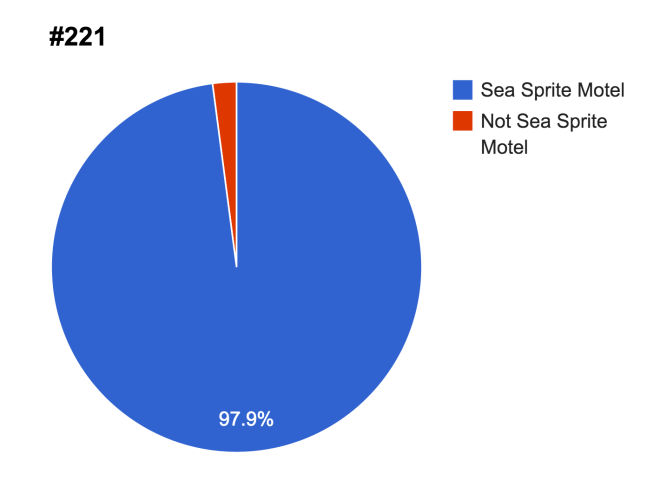
More than twice that actually. In fact, here is a relatively accurate pie chart for this week’s guesses:
And as is usually the case in an incredibly easy contest like this one, our winner comes from our prestigious list of winless guessers of difficult contests from the past:
Sea Sprite Motel, back of the building, second floor looking northeast, second room from the south end of the building. Got it from the Zane’s restaurant sign, which I mistook for Zone’s. It’s either room 16 or 17. I’m going with 16 based on the angles.
Congrats! From the reader who submitted the view:
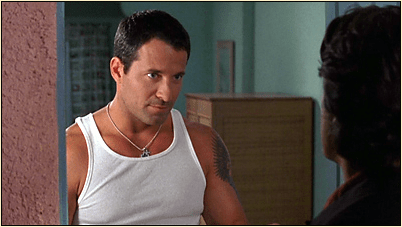
Looking east from the third floor bathroom window of room 16, Sea Sprite Motel, Hermosa Beach, California. Here’s another view from the motel:
Lastly, a reader figures out our dastardly plan:
So, I’ve never entered a VFYW contest before, because I never really had any clue how to start. I always counted myself lucky if I guessed the right continent. And since I figured this out, I’m sure virtually everyone did. But now you’ve got me hooked. There go my Saturdays.
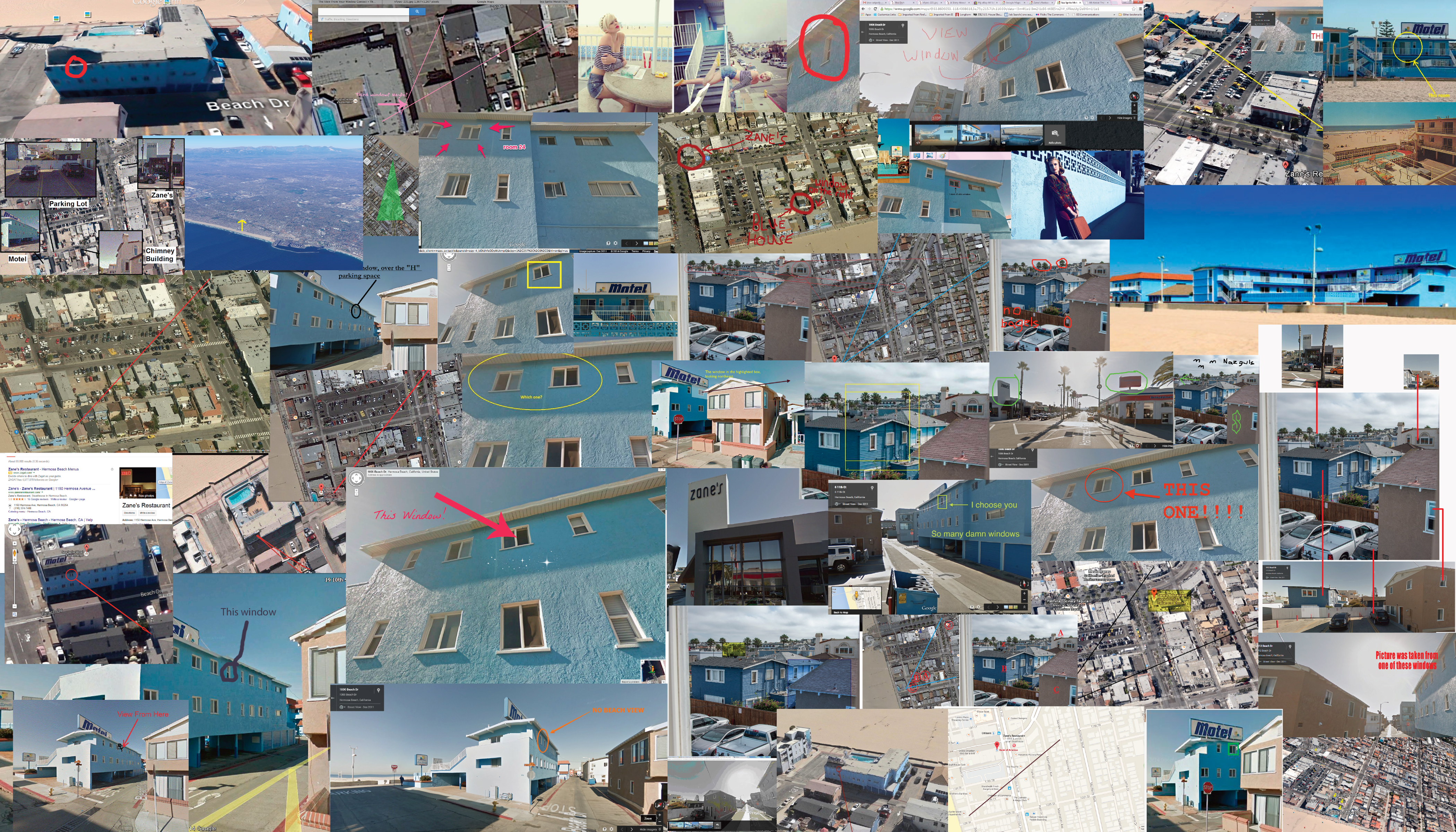
See you then! Until then, see if you can spot your entry in this comprehensive collage:
Heaping scorn on Obama for delaying action on immigration, Beutler fears that the decision will come back to bite the president and his party should Democrats lose the Senate:
Obama will have placed himself in an incredibly awkward position. He will still be bound by his modified pledge to announce deportation relief before the end of the year, but will have to act in the aftermath of an election Republicans just won opposing what they tendentiously describe as “executive amnesty.” They’ll rewrite the story of their victory around their position on deportation.
The delay might also motivate some Democrats to stay home in November, Suderman suggests:
The potential flip side … is the move could depress turnout amongst pro-immigration Democrats. And it’s clear that immigration activists are not happy. The administration says the move is still coming, but there’s skepticism that it could be put off permanently.
“All the progress we’ve made over two years was destroyed in six weeks,” ImmigrationWorks USA head Tamar Jacoby toldThe New York Times. “Given the string of broken promises from this president to the Latino community on immigration, there is a real question as to whether he will follow through,” America’s Voice director said to the paper. But the administration seems to have decided it’s worth the risk. Basically, the White House is betting that the GOP’s negative response to a pre-election announcement would be more significant than whatever effect this has on Democratic turnout.
Sargent, on the other hand, sees Democrats playing a long game:
Democrats have an interest in seeing this happen just before the GOP presidential primary, because it makes it more likely the GOP candidates will out-demagogue one another in calling for Obama’s protections from deportation for millions to be rolled back, pulling the GOP field to the right of Mitt Romney’s “self deportation” stance in 2012.
Byron York shakes his head at the way Obama has punted on this issue for years:
During the days when his power was at its peak, Obama pursued higher-priority issues even as he led immigration activists to believe they were up next. Which leads to the conclusion that perhaps immigration reform — the substance of it, not the politics — has never been all that important to the president. Now, there’s still something more important: protecting vulnerable Democrats from voter disapproval of unilateral presidential action on immigration. Obama says he will finally act, after the election, after voters can no longer hold him or his party accountable. But who knows? Maybe something more important will come up yet again.
[T]here is another possibility, which is that Caesarism delayed will eventually become Caesarism eschewed altogether … or else that Obama will eventually do something unilaterally on immigration, but it will be much more modest (a down payment on reform, the White House can tell activists) than what’s been floated and promised these last few months. Maybe the politics will keep looking somewhat ugly, maybe Democrats up for election in purple states in 2016 will pressure Obama to keep punting — or maybe the president will actually heed some of the criticism of his plan and revert to a more modest conception of how presidential power should be exercised on this issue. I’m not such a cynic that I don’t believe the last scenario is impossible, and it’s a good reason for the White House’s critics to be pleased with this delay: Sure, it could be setting us up for an even balder power grab in four months, but where there’s procrastination there’s hope, and a journey away from executive overreach could begin with exactly this kind of step.
Josh Marshall is bug-eyed at the possibility that the union of England and Scotland may soon end. The Sunday Times poll last weekend gave the markets the willies, and prompted what looked to me like a panicky bunch of last-minute concessions from London. My old chum Boris Johnson had a very Boris defense of Britain and “British” as core identities for a multicultural country in the Telegraph yesterday. Money quote:
The entity under mortal threat next week is Britain itself. You cannot refer to a state called “Britain” unless you include Scotland, because it is a basic fact of geography that Britain comprises everything from Land’s End to John o’Groats.
Look at the map – so often rendered by cartoonists from the 18th century onwards as Britannia sitting down: rump in east Anglia, feet in Cornwall, and topped off with that sweeping Scottish cerebrum and helmet. Chop it off – decapitate Britain at Carlisle and you can no longer call it Britain; and what goes for geography must go for politics, too. Take Scotland away from England and you are losing a critical part of our political nomenclature. There was no British government before the union with Scotland; there was no British electorate; there were no British interests. There was England and Wales, and there was Scotland. Take away Scotland, and we destroy Britain.
He’s not wrong – and part of the alchemy of Britain has always been the mixture of the shire and the highlands, the Angles and the Celts. Blair and Brown were both Scots. BoJo notes that the great Englishman, Samuel Johnson, needed his Scottish side-kick, James Boswell, to be fully who he is in our collective civilization. That’s the kind of national chemistry that independence might destroy. And it was a Scot, “Queen” James I, who cemented England’s religious settlement for a while after the death of Elizabeth I.
And yet … I have to say, I find myself a little emotionally indifferent, even as I am rationally persuaded by the argument that an independent Scotland with the pound as its currency could be headed for Greece-like status. And it’s that conflict between emotion and reason that will determine the result. Maybe it helps Americans to understand those emotions if I examine my own. So why the indifference?
For one thing, Scotland is not like, say, California. It’s an ancient nation, and, unlike England, was never pacified by the Romans. It’s a prickly country, bristling often at England, its exports to London often having more than a bit of a chip on their shoulders. More to the point, it gets to have its own parliament and yet also have a full presence in the London parliament – an arrangement not accorded to the English. It’s politically well to the left of middle England, and is a big net beneficiary of British Treasury. After a while, if you’re English, and right-of-center, and taxed to the hilt, endlessly subsidizing the Scots in return for their thinly veiled disdain, you get a bit irritated. Deep, deep down in my Sussex soul, there’s a “fuck ’em” urging to come out, even as my own Irish ancestry gives me some emotional accord with the Scots.
And since “Britain” is at stake, why should one small part of it be the only part that has a say? What do the English think about Scottish independence? Or the Welsh? Or the Northern Irish? Why shouldn’t they be a part of the deliberation? I guess it says a huge thing about British democracy, decency and fairness that Scotland is being allowed this no-fault divorce option (one only has to look at Ukraine to see the alternative) – but it also says a lot about the way Scotland often wants to eat its cake and have it too.
“Britain” as an entity, moreover, is indistinguishable from empire. From 1707 on, the Scots played an outsize role in creating and sustaining that empire across the world – and I can understand why a thoroughly post-imperial country doesn’t quite have the collective martial spirit to keep it all together any more. A long while back, I saw this coming. Back in 1999, I wrote, after re-visiting my homeland, that:
As the century ends, it is possible, I think, to talk about the abolition of Britain without the risk of hyperbole.
The United Kingdom’s cultural and social identity has been altered beyond any recent prediction. Its very geographical boundaries are being redrawn … To begin with, Blair is proposing what amounts to the end of the unitary government of the United Kingdom. Scotland’s new Parliament will be elected in May, a symbol of self-government not known since the 16th century. In the referendum that sanctioned it, 74 percent of Scots voted in favor. More significant, a full 64 percent supported the notion that such a Parliament should have tax-raising powers, essentially replacing Westminster.
Blair has allowed the Scottish Parliament the leeway to lower or raise the British rate of income tax by only 3 percentage points. But the direction is clear enough. Blair clearly believed that by devolving some power to Scotland he would defuse the independence movement. Instead, the opposite could happen. The latest polls suggest that in the new Edinburgh Parliament the largest single party may well be the Scottish Nationalists, who see the new Parliament as a way station to full independence. Of the dozens of conversations I had in London about the future of the United Kingdom, literally no one I spoke with believed that Scotland would be a part of Britain in 10 years’ time…
What Blair has ushered in, in other words, may well turn out to be a return to a political Constitution last seen in the late Middle Ages: an English state with an almost independent European metropolis on the Thames, a feisty neighbor to its north and a half-heartedly controlled province to its west.
You end the empire, you unravel – through a new cosmopolitanism – the cultural power of Britishness, you see London emerging as essentially a separate country as well, and you devolve power more and more to Scotland … and, well, you can see why we are where we are. The logic of recent history – and ancient history – points solidly to an amicable divorce. This is not some sudden, unforeseen act of madness. It is the result of history and culture and economics.
And then there’s English nationalism as well. By far the most striking new development I saw in Britain at the turn of the century was the adoption of the English flag over the Union Jack:
When I left for America, the clear, simple symbol of England was the Union Jack. It is now increasingly the bare emblem of St. George: a red cross on a white background. You see it in soccer stadiums and emblazoned into the skulls of East End skinheads. In 1995, the biggest greeting-card distributor introduced a card to celebrate St. George’s Day on April 23. Within two years, as the journalist Jeremy Paxman pointed out, the number of cards sold had grown to 50,000.
And when I hoisted a flag on my cottage in Ptown during last year’s Olympics, it was the English flag, and not the British one, that I flew. For it is England I truly love. Scotland? Best of luck to them.
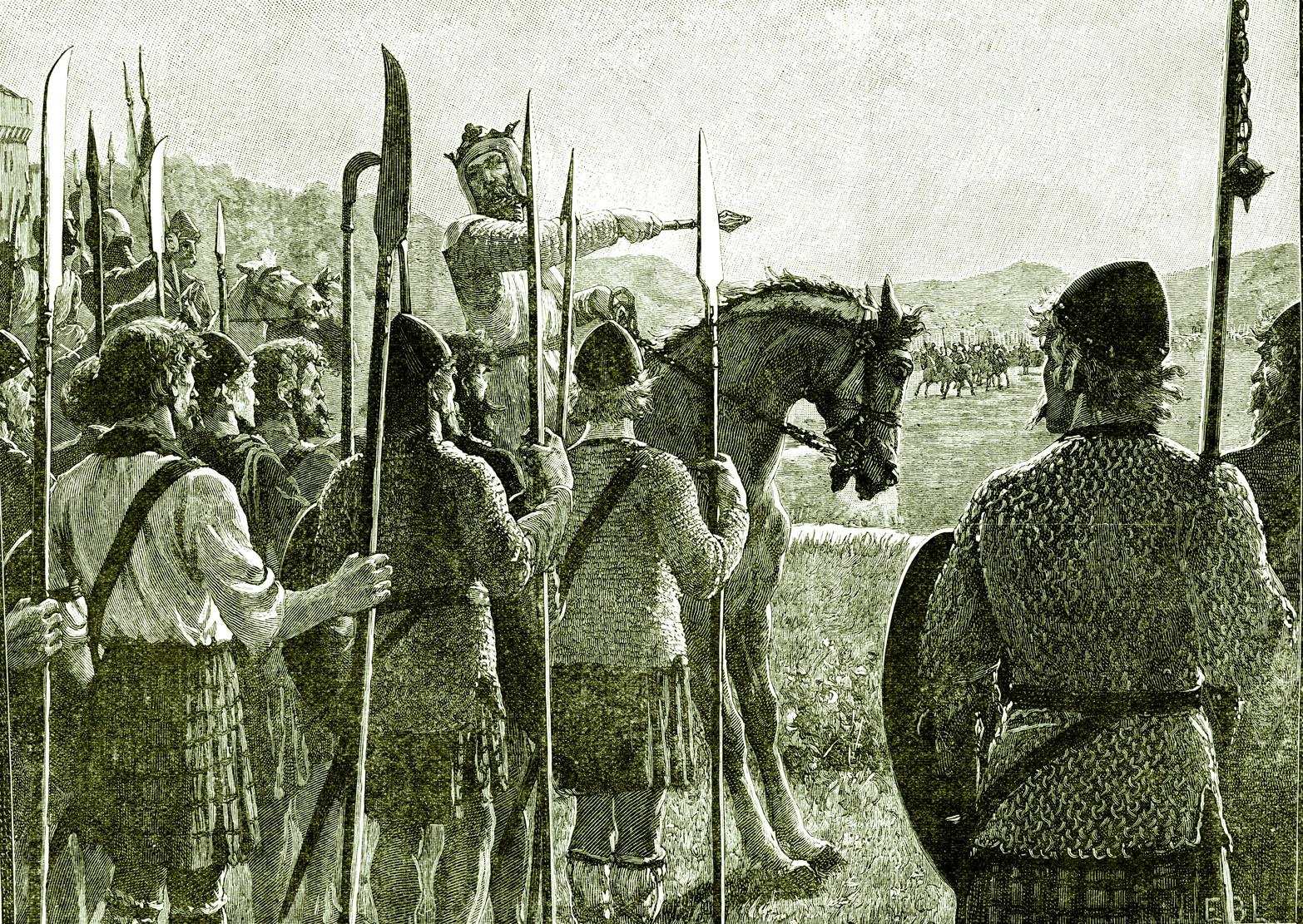
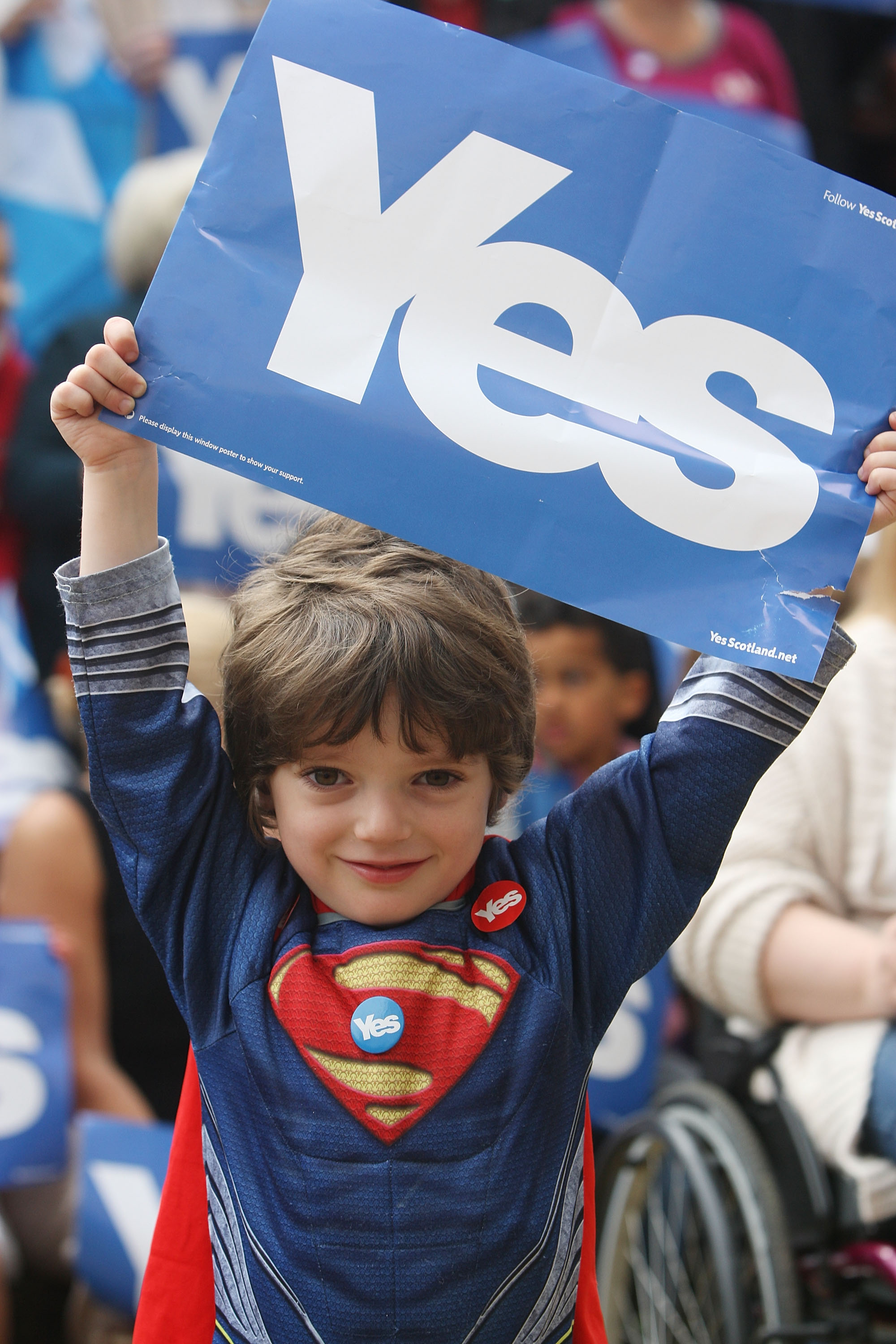
(Painting: Battle of Bannockburn – Robert the Bruce reviewing his troops before battle, 24 June 1314. Significant Scottish victory in the Wars of Scottish Independence and the decisive battle in First War of Scottish Independence. By Culture Club/Getty Images; Photo: Danny Barbieri, 4-years old, dressed in a Superman superhero outfit, holds aloft a Pro-Scottish independence ‘Yes Scotland’ campaign sign, as he and other supporters await the start of a press event in Glasgow, Scotland on September 8, 2014. By Jeremy Sutton-Hibbert/Getty Images)
It’s starting to take shape. One high-profile example is Republican Senate candidate Cory Gardner actively campaigning on over-the-counter contraception:
Other Republicans are taking similar positions. Byron York names names:
The idea is to make the birth control pill available over the counter, to all, 24/7, without a prescription. It’s becoming a trend among Republican candidates in Senate races around the country. In North Carolina, GOP candidate Thom Tillis recently embraced it. So has Ed Gillespie in Virginia. Mike McFadden in Minnesota. Gardner in Colorado. And one of the leading proponents of the move is a potential 2016 GOP presidential candidate, Louisiana Gov. Bobby Jindal.
Kilgore understands the political logic of this move:
There’s no question it’s clever—even sort of a threefer: (1) taking The Pill out of the Rx drug equation protects those “pharmacists of conscience” who don’t want to fill prescriptions if they don’t approve of the marital status or lifestyles of the women involved; (2) it also makes the fight against Obamacare’s contraception coverage mandate less portentous and controversial; and (3) most obviously, lets Republicans claim a “centrist” position on reproductive rights: pro-contraception, anti-abortion.
But he rejects the idea that Republicans now “have the high ground on reproductive rights.” Rebecca Leber agrees with that:
For some time, some doctors and reproductive health advocates have argued that an over-the-counter pill is good policy, because it would make the pill easily accessible to more women. The American College of Obstetricians and Gynecologists endorsed it in 2012, and so do two-thirds of American women polled.
But there’s a catch. Doctors aren’t the only hurdle between women and contraceptive access. For low-income women, cost can be what’s most prohibitive. Under the Affordable Care Act, the pill and other forms of contraception count as preventative care, which means insurance covers them completely—without any out-of-pocket expenses. This is not a position the Republicans have endorsed.
[A]ffordability isn’t the only factor in making something accessible. Those championing the contraception mandate as a way to increase access assume everyone always has insurance coverage. What about undocumented women? Or those between jobs and temporarily uninsured? What about young women who can’t let their parents know they’re on the pill? Or domestic abuse victims who want to keep this information from their husbands? These are just a few of the situations in which a woman would find OTC pills much more accessible and affordable than the prescription-only kind, even if those prescription pills came with no co-pay.
It’s one thing for progressives to question the sincerity of support that male GOP politicians have for OTC birth control (some of it’s definitely a bit suspect), but trying to diminish the good OTC birth control could do in order to prop up Obamacare’s contraception mandate is inexcusable. Those who claim they want to increase contraception access while panning OTC birth control entirely look a lot more like partisan hacks than people with women’s best interests in mind.
And so ISIS’ medieval brutality and horrifying videos have worked like a charm:
Support for military action has risen dramatically in just the past few weeks, coinciding with the beheadings of two American journalists, James Foley and Steven Sotloff, which were recorded on video and released to the world by Islamic State terrorists. Today, 71 percent of all Americans say they support airstrikes in Iraq — up from 54 percent three weeks ago and from 45 percent in June. Among those who say Obama has been too cautious, 82 percent support the strikes; among those who think his handling of international affairs has been about right, 66 percent support them.
Nearly as many Americans — 65 percent — say they support the potentially more controversial action of launching airstrikes in Syria, which Obama has not done. That is more than double the level of support a year ago for launching airstrikes to punish the Syrian regime for using chemical weapons … Nine in 10 Americans now see the militants as a serious threat to vital U.S. interests, and roughly 6 in 10 say they are a very serious threat.
But I have yet to see or be shown any solid intelligence that suggests that these fanatics are aiming at the US. We may well have a problem of home-grown Jihadists returning and wreaking havoc – but that is a manageable threat. And direct military intervention by the West could easily increase these losers’ incentives to strike us here at home. So, in that narrow sense, this return to fighting other people’s civil wars in the Middle East may actually increase the risks to us. That’s what I mean by “taking the bait“.
More worryingly, the president appears to be choosing September 11 to make the case for a war against ISIS in Iraq and Syria. The fear factor is thereby evoked all the more powerfully – and any return to normality, or restraint, or prudence that we have slowly achieved since then will be wiped away. I just ask you: did that fear and terror help us make wise decisions about foreign policy back then? Do we really want to recreate that atmosphere – with no solid evidence of a tangible threat to the US?
I await the president’s proof of ISIS’ threat to America and the West. And not the kind of intelligence that gave us the Iraq War. I await the proof of an eager coalition of every Iraqi sect to destroy ISIS – and a broad regional coalition united to prevent its consolidation of gains. Then, it seems to me, there must be a declaration of war by the Senate if this open-ended, unknowable military intervention is to be embarked upon. Every Senator and House member should be on record, ahead of the November elections, on this question. If they want war, they must take full responsibility for it, and not play partisan games to score points off it.
Maybe it’s because I was not exposed to the news cycle of the last few weeks that I still see things this way. Maybe I’m wrong and ISIS really does have the means and the will to attack the US or the West.
But in this march to another war in Mesopotamia, I recall that almost every US military intervention in the Middle East has backfired. Even the first Gulf War, deemed a great success, helped give us al Qaeda, as Lawrence Wright reminds us today in the New Yorker. Our intervention in Iraq eventually gave us ISIS. Our intervention in Libya gave us chaos and terror. The only intervention in that region that worked was a peaceful one, the UN-sponsored, Russia-brokered elimination of Syria’s WMD arsenal.
Notice also that this would be another pre-emptive war. We have not been attacked, as we were on 9/11. We are pro-actively entering a civil war in two countries simultaneously … because one malevolent group of Islamist terrorists threaten the region and because the regional actors have yet to take it on. This kind of responsibility is indeed neo-imperial. It’s open-ended and revives the delusion that we can change that part of the world more than it will change us.
But here we go again. Under this president. Into the unknown, propelled by fear and panic. The change we hoped for is evaporating into thin air. And the war drums get louder and louder every day, as if nothing, nothing, was learned in the past decade.
Scotland’s independence movement has the wind at its back. But the increasing likelihood of a Yes victory sent the Pound tumbling yesterday. And the economic consequences of independence don’t end there:
Douglas Flint, the Scottish-born chairman of HSBC (HSBC), predicted that uncertainty over Scotland’s currency arrangements could “prompt capital flight from the country, leaving its financial system in a parlous state.” Independence advocates haven’t said whether Scotland would establish its own currency or maintain an informal link to the British pound. Whatever approach is taken, Flint wrote in a recent column for the Telegraph, “Scotland’s borrowing costs and those of its businesses and consumers would rise, at least in the near term.”
Should Scotland secede, Drum suspects the country will get its own currency soon enough:
The pro-independence forces probably feel like they need to support continued use of the pound for now, just to take it off the table as a campaign issue. But if independence succeeds, there’s a good chance that Scotland will adopt its own currency within a few years for all the reasons Krugman brings up. Being stuck in a currency union is so obviously dangerous that it will probably be abandoned once things shake down in an independent Scotland and the new government has time to focus on it.
Yglesias agrees that “the most sensible option might well be for independent Scotland to have its own central bank and its own currency that would trade freely on global markets”:
Other small developed countries (Norway, Iceland, New Zealand, Sweden) do this successfully, and it appeared to work well enough for Denmark and Finland in the past. Small countries are inevitably very exposed to developments in the global economy that are outside their control, and currency flexibility can help cope with that. … The downside of creating a new currency is that it would have no track record, and might be catastrophically mismanaged and destroy the value of everyone’s savings. Independence campaigners appear to feel that these fears are widespread, and have not made the creation of a new currency part of their proposal for Scottish independence.
But this all assumes the Scots vote for independence in the first place. Justin Wolfers has doubts:
In contrast with the polls, traders at the British betting exchange Betfair.comcurrently assess the “No” vote as the likely favorite, assigning it a 72 percent chance of winning. To be sure, that still suggests a sizable 28 percent chance that a majority of Scots will vote for independence, but the odds that it will happen seem a lot weaker than polls would suggest.
And, even if the polling is taken at face value, the goodies Westminster is promising Scotland might boost the No vote. But Fraiser Nelson wouldn’t bet on it:
So Gordon Brown has spoken, and the unionist parties are in agreement: if there’s a ‘no’ vote then more powers will be given – we’re told – ‘to Scotland’. And why? Because there’ll be another commission and another Scotland act and the Great Broon announces that the results will come out on Burns Night! Neeps and haggis all round! To me, this is only a little better than the Treasury telling Scots that they should vote ‘no’ because they’ll be able to afford more bags of chips. It’s patronizing, not credible and I doubt will make very much difference. This so-called Devo Max should have been offered six months ago; to offer it in the last few days of the campaign smacks of desperation.
Indeed it does. Peter Geoghegan remarks that the “No side might still be the favorite to stumble across the finish line first in the coming referendum, but it has singularly failed to make an emotional case for the United Kingdom”:
A Better Together activist told me recently, “It is like a business transaction. I look at the sums, they don’t add up, so you don’t do it.” This might be a good reason to reject independence, but such instrumentality hardly bodes well for the union’s future health — and such sentiments leave plenty of room for uncertainty about what will happen on September 18. Nationalists have won the argument that Scotland could be a separate state. The question now is whether they can persuade their fellow Scots that it should be. If they can, what seemed unimaginable just a few months ago could become a reality.
Should that happen, Robert Kuttner imagines that other independence movements around Europe will take notice:
If the Scots actually become independent, it’s not Britain alone that is affected. Also threatened are such venerable unitary nations as Spain, France and Italy. That’s why the leaders of the E.U. have signaled that an independent Scotland would not be welcome as a member. If Scotland secedes, Catalonia will be next. And if Catalonia, why not Brittany and Northern Italy? Why not Wales? Not to mention Quebec.
Most major nations were created by acts of conquest and often brutal suppression of ethnic and linguistic minorities. Irish schoolchildren got their knuckles rapped for speaking Irish in school. In Catalonia, kids caught speaking Catalan were warned, “Habla Cristiano!“—as if Castilian Spanish were the language of Christ and Catalan the idiom of Satan. But it is absolutely startling to see hundreds of years of political history unwinding.
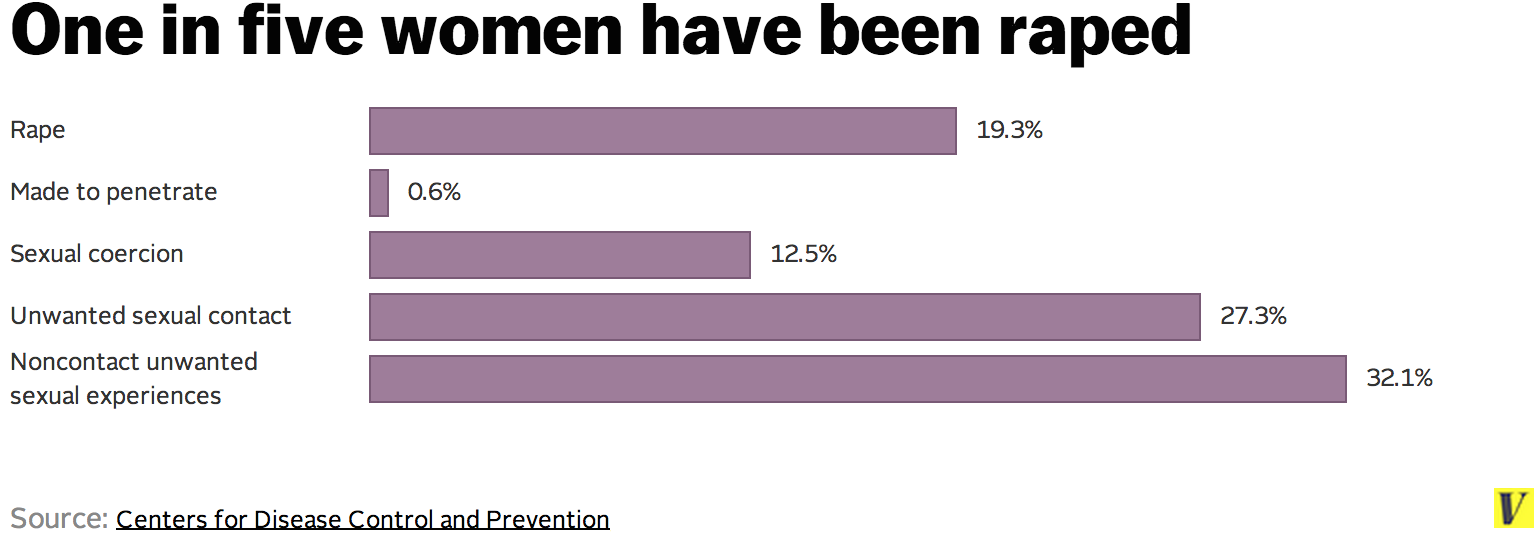
After polling over 12,000 participants in a randomized, nationally representative telephone survey, the CDC found that an estimated 19.3 percent of women and 1.7 percent of men have been raped during their lifetimes. 19.3 percent — nearly 1 in 5 American women — have been raped. Just let that sink in. The study also yielded some shocking statistics about other forms of sexual violence, defined as “being made to penetrate, sexual coercion, unwanted sexual contact, and noncontact unwanted sexual experiences.”
Other surveys have found significantly fewer rape victims. Claire Groden explains the discrepancies:
The CDC … did not mention any legal terms in the survey queries, instead asking questions like, “How many people have ever used physical force or threats to physically harm you to make you have vaginal sex?” Because of this, the CDC included cases in which the victim might not have been aware or willing to identify her experiences as rape.
This difference made the CDC’s survey broader, especially in the case of victims who were under the influence during the attack. The CDC counted alcohol- and drug-facilitated rape, asking if the respondents had ever experienced various sex acts while “drunk, high, drugged, or passed out and unable to consent.” But, as Scott Berkowitz at RAINN, the Rape and Incest Abuse National Network, pointed out, not all of those 1.2 million cases in 2011 would be considered rape by the Department of Justice. A person who was drunk might have still been lucid enough to give consent, but the CDC would have counted that experience as “alcohol-facilitated rape.”
Still, the CDC numbers are a reminder of how many sexual assaults and rapes go unreported. The total number of rapes reported to police in 2011 was 83,425—far lower than either the NCVS or CDC numbers.
Today new video surfaced of NFL player Ray Rice hitting his now-wife. Dara Lind provides the backstory:
In February, TMZ posted a video of Baltimore Ravens running back Ray Rice dragging his apparently unconscious then-fiancée (now his wife Janay Rice) from an elevator at the Revel casino in Atlantic City. The incident led to Ray Rice’s arrest for domestic violence, though he was assigned to a pre-trial diversion program rather than being charged with a crime. It also led him to receive a two-game suspension from the NFL. League commissioner Roger Goodell, after facing harsh criticism for the relatively light punishment (first-time marijuana offenders generally get suspended for more games), he announced a new, much stricter league domestic-violence policy in August.
But the original video didn’t show exactly what had happened inside the elevator, leaving an opening for Rice supporters to assume that he was acting in self-defense. Janay Rice apologized for her role in the incident, which seemed to confirm this suspicion. Now, TMZ has released a second video (warning: it’s very graphic) from inside the casino elevator. It shows Rice punching Palmer — and makes it clear that what happened wasn’t a “fight,” but an attack.
After the release of this new video, Rice’s contract was terminated. Jonathan Cohn hopes some good comes from this episode:
The footage is not easy to watch, but it shouldn’t be. Domestic violence is violent. Maybe if more people realize that, more people will take it seriously.
[I]f no one is going to talk about the welfare of the person who is actually subjected to the violence on that tape, let’s talk about it here. I spent the morning communicating with people who work on issues involving domestic violence and violence against women nearly every day of their lives. They all said the same thing, without dissent: releasing this tape to the world is incredibly damaging to Janay Rice. Just as we would protect the name of an alleged rape victim, just as we would not show a video of Ray Rice committing a sexual assault, we should not be showing this video like it’s another episode of Rich People Behaving Badly. If Janay Rice wanted to show this tape to the world, in other words if she had offered her consent, that is a different matter. But showing and reshowing it just because we can is an act of harm.
Josh Marshall is not settled on the ethics of showing images of domestic violence. But he does “have a general stance against those who think news reporters should be in the business of not reporting certain things to advance various purportedly good ends”:
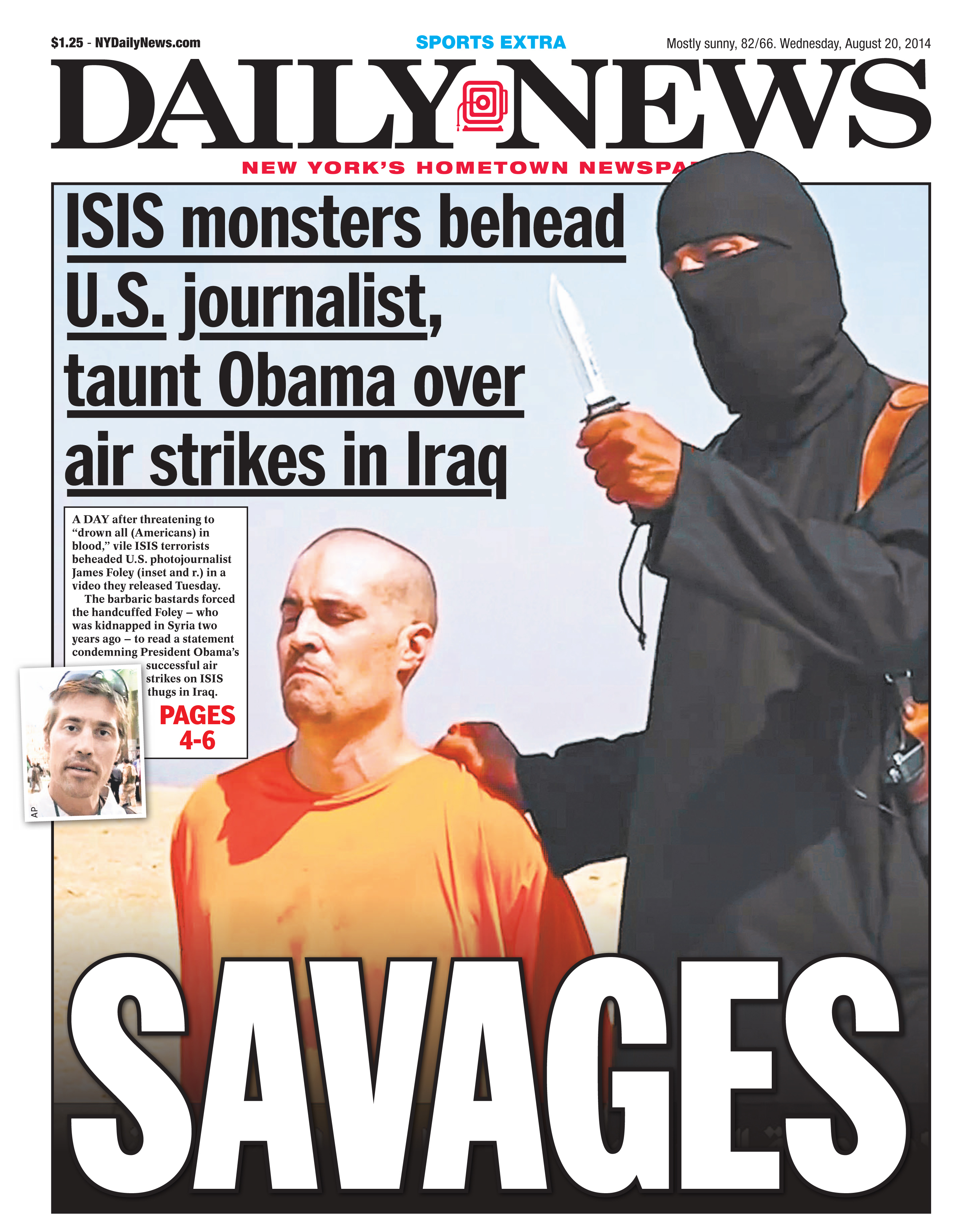
Two examples. Recently we have used still photos from the videos of the beheadings of the two American reporters by ISIS. Not stills of the actual killings but from the parts before that happens. Like many other press organizations, we’ve never published the videos themselves. In recent days I’ve heard from a number of readers who’ve said we should not be publishing any of these photos, even in stories which directly relate to the videos themselves because this is somehow too upsetting or doing ISIS’s work for it.
Similarly, I know there’s a move afoot to refrain from publishing the names of mass shooters on the theory that this just gives them the notoriety they crave and which led to their atrocities. I disagree. These killings are facts. The ISIS beheadings are facts. There’s no reason to publish imagery of mutilated bodies. But within certain bounds, these things happened. And withholding critical information about what happened just doesn’t make sense. I’d go further and say that it’s actually wrong. Ugly things happen. We shouldn’t play games about reporting them. We shouldn’t get into mind-games about what a mass murderer might or might not have wanted. Journalists should just focus on doing their jobs.
Meanwhile, Coates thinks the “idea that it took today’s release to understand the gravity of things is insupportable.” He feels the NFL is simply in damage control mode:
The league suspended Rice for a meager two games for knocking his wife unconscious. The league now propose to suspend him indefinitely for….the same thing. This suspension only indirectly relates to the protecting women. It mostly relates to protecting the shield.


 desk clerk on the phone, as I called the hotel to ask for the room number of my guess. Sounds like quite a few Dishheads are calling and even stopping by to scout it out! End unit is #17, my guess is #16, he said some folks were guessing #15. Pretty certain the right answer is the window I indicated in my original post which I now know is in room #16.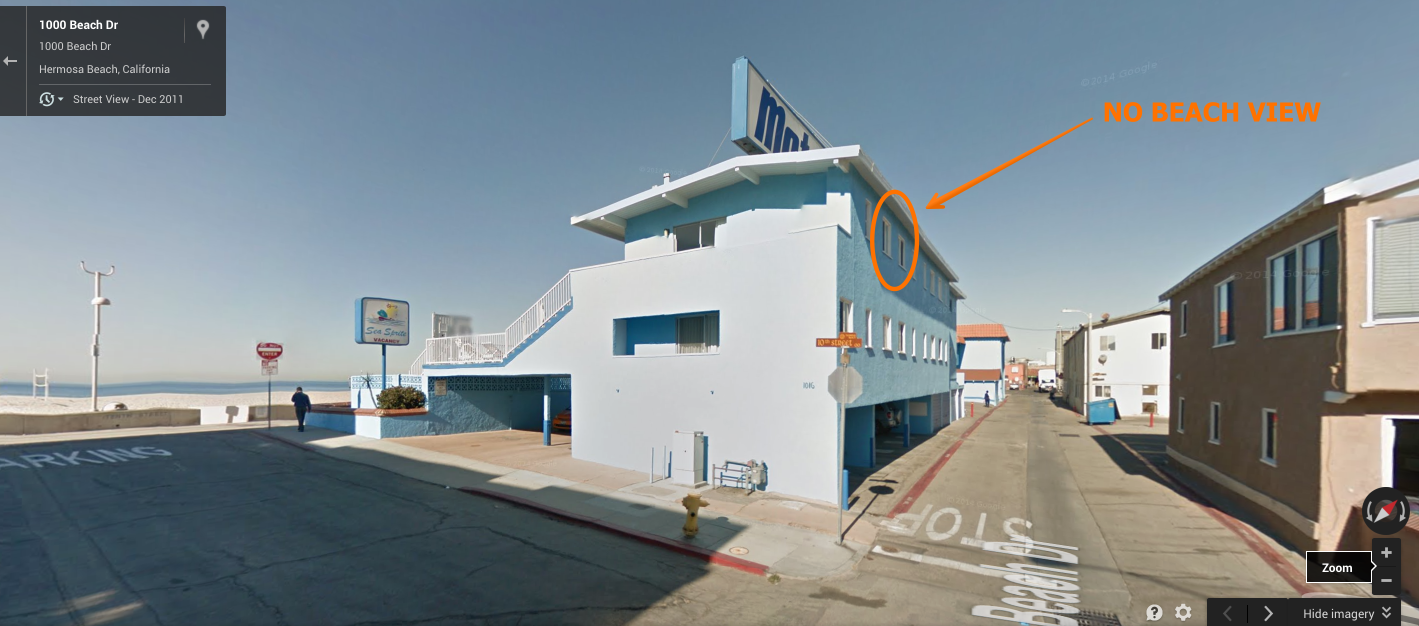
 The Dish