
Back From The Desert, Ctd

shirts

From an assortment of emails that came in during the past month of guest-blogging:

Freddie deBoer’s blogging is the reason I finally renewed, specifically his Gaza posts, because he was saying such obvious things that no one else was saying, and I wanted to keep reading after the jump. He’s a really, smart clear writer whom I’d never heard of before. Nothing was annoying me about the Dish previously; it’s just that I’ve been reading Andrew since he started, and while I obviously like his writing, I’ve been reading him long enough to know what he’s going to say or think about most things, so I rarely feel the need to know what he’s going to add after the jump. In general, the guest bloggers have been better this summer than past years. If you’re looking for suggestions on how to improve the blog, you might think about having guest bloggers more often, even when Andrew isn’t on vacation.

Another joins the readers pictured above:

I have missed you. I wore my brand new shirt today (Meep Meep) and my subscription was renewed. I hope that you are renewed as well. Your sous chefs did a fine friggin job, so don’t sweat wearing the big hat again. The ball is still rolling, and in my opinion, it’s in your court.

You can buy your own Dish shirt here. More props to the guest-bloggers:

I’ve really enjoyed the posts from Elizabeth Nolan Brown and Phoebe Maltz Bovy. Andrew is great, but the thing I love most about the Dish has always been the different points of view and openness to those different points of view that show up everyday. That’s the magic that keeps me coming back again and again. In a media filled with people acting in bad faith, the Dish is a breath of fresh air. Seeing different people honestly engaging with their critics is a great example for the world.

On that note, a critic writes:

Although I’d been following Andrew since discovering him on Bill Maher’s show, his contempt for Hillary Clinton signaled to me that it was time for a divorce.

I’ve loved the Dish wherever I found it.  I bought the Atlantic magazine subscription when Andrew asked, kept the Dish in the first spot on my Google favorites bar even when it was at the Daily Beast, and I regret none of the thousands of hours of non-billable time I’ve spent here. Because of my long and happy fanboy relationship with Andrew, I’m glad I was an original subscriber and when I re-upped, it felt like I was doing my part to maintain my sanity and that of hordes of other Disheads.

But the Clinton contempt is too ugly, too personal, too unhinged.  I can’t make myself like her, but at least I understand she is a pol and hold her to the standard of pols, not the absolutes Andrew applies to her.

I’d been making mental preparations to find another site to check the ten times a day I’d otherwise be here. I was trying out Rolling Stone and Outside magazine.  And then you brought on Bill McKibben and Alex Pareene as back to back subs.  Climate change has never been covered enough here, even if you count the thought-provoking series about eating farm animals which is generally presented as an ethical, not environmental issue. But you brought on America’s foremost climate change writer and pretty well made my August. And, well, Pareene is a terrific and incisive writer and I’m glad he’s getting more exposure here than he gets at Salon.  When he criticizes what some pol thinks rather than what they’ve said, he really offers a sparkling grasp of history and policy.

So, I may not keep the Dish as my first favorite on my bar and I may not even stop by very often once the 2016 campaign begins, but out of respect of the editorial decision to bring on McKibben and Pareene, I’ll re-up again in February.

More criticism from a different angle:

I hope you are having a great time on your break. I would never begrudge you your hard earned vacation time … but, it comes at some cost. I read the Dish virtually every day. It is a site unlike any other I know. The mix of politics, culture, art, science, and pure whimsy make it a joy to experience. I opened it today and was struck by what a difference your absence makes. I know your replacements are doing their best, but when you are gone, The Dish becomes just another rag. The whole feel and look of the site changes dramatically when your touch is absent. You have a brevity and economy of expression which is very rare. Your fill-ins write like they are paid by the word. I don’t mean to be harsh. The difference is just so stark … and inferior.

When you are gone, it’s like someone left the door open in mid-winter. Although, as I have said, I want you to have time off and thoroughly enjoy yourself, I am very much looking forward to your coming back and closing that damn door.

I’m both glad to be back and thrilled that the Dish can thrive – and even improve – in my absence. This blog is about the conversation, not me. But I can’t wait to be a full part of it again.
“Where Is The Republican Wave?”

That’s Charlie Cook’s question:

For Democrats, the good news is that there doesn’t appear to be an overwhelming Republican tide this year; the bad news is that Democrats could well lose the Senate even without such a wave. Six of the most competitive races are Democratic-held seats in states that Mitt Romney carried by 14 points or more. With a map like that, Republicans don’t need to dominate the country; they just have to win some select states.

Sean Trende adds his forecast to the pile:

I can emphatically say: It’s not certain that a big Republican wave is coming. Rather, the data we have are currently consistent with a wide range of potential outcomes, with a very good Republican year being the most likely result.

This is because our recent elections suggest that when a party holds the presidency, its candidates have a very difficult time winning over the votes of individuals who disapprove of the job that that president is doing. That could absolutely change in this election, but I believe the burden is on people who believe this time will be different.

Waldman talks up the Democrats chances of keeping the Senate:

For most of the year, the assumption among political observers has been that Republicans are likely to take control of the Senate in this November’s elections. … But in the last week or so, nearly all the well-respected predictive models are showing the Democrats with a better chance of keeping their majority than people thought. Republicans still have an advantage in most of the models, but in many cases it’s a smaller one than it was. What’s going on?

Let’s run down them quickly:

While two out of the five models show the GOP with an edge, it is not as large as it used to be in either — and three out of the five show it either very close to a toss-up or (as Princeton’s does) leaning Democratic.

But a recent poll on the Alaska race contains bad news for the Democrats. Nate Cohn analyzes it:

The only significant shift came in Alaska, where the result flipped from Mark Begich, the Democrat, who used to lead by 12 points, to the Republican Dan Sullivan, who now leads by six. Alaska, however, is a state where there are reasons to have reservations about the quality of the data. The panel had less than 500 respondents, despite recruitment efforts. There should be fairly low confidence in the exact finding.

Silver examines a bunch of new polls. His view:

The bottom line is not much has changed. The FiveThirtyEight forecast model gives Republicans a 65.1 percent chance of winning the Senate with the new polling added, similar to the 63.5 percent chance that our previous forecast gave them on Friday. … Republicans can win the Senate solely by winning Alaska, Arkansas, Louisiana, Montana, South Dakota and West Virginia, states which voted for Mitt Romney over Barack Obama by an average of 19 percentage points in 2012.

The End Of Britain?

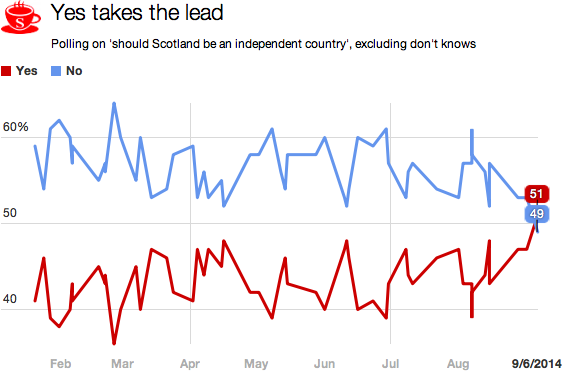
It’s looking more and more likely:

Scotland

Daniel Berman takes a close look at polling on the referendum. Why there is reason to question it:

British polling is problematic at the best of times, as anyone who observed Fivethirtyeight.com’s efforts to extend their successful model to the 2010 General Election, an effort I played a role in can testify. The Cleggmentum that dominated polling and media coverage of the campaign failed to materialize in practice. Was the media wrong? Only to the extent they focused on the polling.

Why then was the polling off? There are several reasons why UK polling is generally less reliable than its American equivalent. For one thing, “partisan weighting” the effort to ensure that your sample is politically and not just demographically representative of the electorate is an obsession for British pollsters, and has been ever since John Major’s surprise victory in the 1992 elections prompted a search for the “shy Tory” voter.

On the issue at hand:

YouGov’s Yes lead is the result of changes in sample composition rather than a clear shift, though a substantial shift in the preferences of Labour supporters was detected.

Angus Roxburgh, a Scot, is in favor of independence:

Independence is not about erecting barriers. The Scots and English would still be the closest allies. Yet independence would give us a chance to build a country that better reflects the identity and prioritiesthe political culture, if you willof the majority of those who live here (both “ethnic” Scots and those who have come here and taken the land to heart).

James Forsyth, on the other hand, wants to keep the union intact:

Given the closeness of the polls in Scotland, I suspect that the result might be determined by how clearly the Scots hear the rest of the UK saying ‘please, stay’. So, if you believe in this country and want to save it, pick up the phone and call your Scottish friends and family and urge them not to leave us.

The announcement that William and Kate are having a second child could be an additional factor. Hayes Brown explains:

[T]he as-of-yet-unnamed pending addition to the Royal Family could be just the boon needed to help turn back the tide against a surge of support for Scottish independence. Last year, William and Kate welcomed their first child — George — into the world amid a media blitz that even the media itself would later say was somewhat excessive. But George’s birth had some tangible benefits for the Windsor dynasty. A poll taken last year by British firm ComRes showed that since the wedding of the two young royals, and especially after the first appearance of Prince George, the popularity of the British Crown has skyrocketed. Beating out even the Diamond Jubilee and London Olympics in terms of support, last year’s Royal Birth led to two-thirds of Britons supporting the monarchy.

Krugman tells Scotland to think twice about independence:

In short, everything that has happened in Europe since 2009 or so has demonstrated that sharing a currency without sharing a government is very dangerous. In economics jargon, fiscal and banking integration are essential elements of an optimum currency area. And an independent Scotland using Britain’s pound would be in even worse shape than euro countries, which at least have some say in how the European Central Bank is run.

Daniel Clinkman, an American living in Scotland, shares his perspective on the forthcoming vote:

I am not Scottish, but the country became my home for many years and I am passionately in favor of what is best for Scotland’s people, whatever they decide. I think that the activism and thought given to this by Scots of both nationalist and unionist persuasions is very different from the stereotype of the emotional, skiving Scot put out by the Better Together campaign and its sympathizers in the press.

Last but not least, Alex Massie feels that “that Yes had an easier job  – and perhaps a better story to tell – in this campaign”:

Perhaps Scots will peer over the edge and think, jings, that’s a long way down. Perhaps we’ll conclude that, despite everything, all things still aren’t busy being equal but right now, this morning, that seems about the best the Union can hope for. Still time for things to change, right enough – only one poll and all that –  but, you know, there are peer and herd effects here: the more thinkable an idea becomes the more popular it is likely to prove. People say: Bloody hell, if you’re going to jump I’ll jump too. Even if it is a long way down.

I have to say that Krugman’s column, while pertinent, had a bit of the “What’s The Matter With Kansas?” about it. This decision is not only about economics; it’s about history, identity and the nation-state. At this point, I wouldn’t be shocked if the Yes’s win the day. These pressures have been building for some time.

The Immigration Can Gets Kicked Down The Road

ICE Detains And Deports Undocumented Immigrants From Arizona

Obama is delaying his executive order on immigration deportations until after the elections. Jonathan Cohn spells out the political logic of the move:

Vulnerable Democrats seeking reelection let the White House know, publicly and privately, that they feared an executive order would deal serious, maybe fatal, blows to their candidacies: While the ensuing debate would energize immigration reform supporters, particularly Latinos, it would also energize the conservative base. Given the political geography of the 2014 midterm elections, in which control of the Senate will depend on the ability of Democrats to hold seats in red states like Arkansas and North Carolina, the political downside seemed bigger than the political upside.

But Ezra Klein has a hard time squaring this political calculation with the White House’s former rhetoric:

This is the problem with the White House’s decision — and, to some degree, the way they’ve managed this whole issue. If these deportations are a crisis that merits deeply controversial, extra-congressional action, then it’s hard to countenance a politically motivated delay. If they’re not such a crisis that immediate action is needed, then why go around Congress in the first place?

Cillizza sees signs of political malpractice:

[W]hat Obama and his senior aides failed to account for — or underestimated — was the blowback from within his own party to a major executive action by an unpopular president on an extremely hot-button issue.  (Worth nothing: Obama’s approval numbers eroded steadily over the summer and into the early fall; his political standing today is weaker than it was when he pledged action on June 30.)  The move, it became clear, would have been seen as bigger than just immigration as well; it would have been cast (and was already being cast) by Republican candidates and strategists as simply the latest example — Obamacare being the big one — of federal government overreach.

This disconnect between the long-term legacy building prized by Obama and the near-term political concerns of many within his party is not new but, quite clearly, became a major point of tension.

Beutler is puzzled:

The political reasoning sounds incredibly straightforward. Most of the Senate Democrats running in tightly contested elections represent conservative states with low immigrant populations and deep hostility to “amnesty.” So why introduce more uncertainty into those campaigns, and potentially ignite a fire under the GOP base, when you could just as easily wait six weeks?

But it also seems suspiciously simple to me. That’s in part because I don’t entirely understand how much cover you buy for vulnerable Democrats if you put off the official announcement, but tell the press that the dreaded amnesty is coming just a few weeks later.

PM Carpenter is befuddled by the White House “political operation’s second-term bumbling”:

Now, everybody is pissed off. Immigration activists are screaming “betrayal” and “broken promise;” a major labor union is “deeply disheartened”; the nation’s most influential Spanish-language news anchor has denounced the delay as “the triumph of partisan politics”; Republicans are gleefully outraged; and Democrats are stuck with defending an executive action that never was, but still will be–“I’m going to act because it’s the right thing for the country,” said the president [Sunday] on “Meet the Press”–thus it might as well have been.

Gabriel Arana takes the president to task:

Given how long immigrants have had to wait for any sort of relief from the fear of deportation, another few weeks may seem like no big deal — that is, of course, if you’re not one of the tens of thousands of people who’ll be kicked out of the country while the president waits out the midterms.

But for many immigrant-rights supporters, the delay shows the president doesn’t understand the moral crisis at the heart of the immigration debate, in which those looking to escape poverty get branded as parasites, their children as “anchor babies.” Our dysfunctional immigration system has created a powerless class of millions of people; without the ability to vote or to advocate on behalf of themselves in public, they have no choice but to wait for our politicians to take sympathy. Lawmakers all “play politics,” but extending the suffering of this vulnerable population because it might save you a few votes at the ballot box is yet another sign you don’t fully consider them Americans.

How Tomasky sees this playing out:

Despite whatever acidic rhetoric Latino leaders are dishing out toward Obama today, I would expect that will change this fall. He’ll announce his unilateral moves on immigration after the election. The Republicans will boil with rage. In all likelihood, they’ll move to impeach. So then we’ll have the spectacle of one party—the party that has blocked the passage of an immigration bill in the first place—seeking to throw a president of the other party out of office for trying to do something on immigration that he wouldn’t have had to do if the first party hadn’t spent two years refusing to pass a bill. It’s pretty clear which side of that fence the vast majority of Latinos are going to come down on.

(Photo: A Honduran immigration detainee, his feet shackled and shoes laceless as a security precaution, boards a deportation flight in Mesa, Arizona to San Pedro Sula, Honduras on February 28, 2013. By John Moore/Getty Images)

A New Kind Of School Segregation?

Liza Long, author of The Price of Silence: A Mom’s Perspective on Mental Illness, objects to her psychologically troubled son being taught separately from the other kids:

At first glance, this might seem like an ideal solution: the neurotypical kids get to learn without disruptions, and the students with mental illness and/or developmental disabilities have a safe environment with additional dedicated support from teaching assistants. And since it’s a contained program, it saves the district money in the short term—and we all know how thin most school districts are stretched.

But I would suggest there is an uglier word for this approach to education: segregation.

What is the logical consequence of taking 100 students with behavioral and emotional symptoms between the ages of 12 to 21, 95% of whom are male, and putting them together in a program that will not allow them to earn a high school diploma or to learn to interact with neurotypical peers? In our society, too often the consequence is prison. … By not integrating children with mental illness, which admittedly sometimes manifests through challenging behavioral symptoms like unpredictable rage, into the general school population, we are contributing to the ongoing stigma of mental illness.

Meanwhile, Hyper: A Personal History of ADHD author Timothy Denevi meditates on raising a child while struggling with mental health problems himself:

One of the most difficult aspects of mental illness, especially within the context of parenthood, is finding a way, when it comes to your life and its influence on the people you love, to do more good than harm. In the end you can’t possibly predict what’s really coming: the moment in the future that will dislodge you from the balance you’ve worked so hard to achieve. It might be a random calamity, or one you’ve personally brought about. But the incredible truth is that it’s already on the way. And against such a prospect, what good can something like a therapist or exercise or a low-dosage psychostimulant actually do?

This isn’t to dismiss the idea of effort. In fact it’s the opposite: imagining all the things that could go wrong or right for my family, I can’t help but find solace in action. I’m lucky that there are steps I can take, and that often enough they do tend to help. What matters is the act itself: an expression of love for the most important people in my life. After all, there are many ways to show how you feel; is it so terrible that one of mine happens to take the form of self-preparedness?

Update from a reader:

I think someone at the Dish should have vetted the author before posting the latest Time fluff sympathy piece from Liza Long.  She has a well-documented history of being a mother of a significantly troubled son who writes about him and her experiences extensively, namely with her controversial piece “I am Adam Lanza’s Mother.”

I don’t waste time objecting to how much she’s exposed of her son and her life, because frankly, she bears a huge burden.  But I do object to her advocating for including significantly troubled children in a regular education setting to the disruption of other students, many of whom bear their own burdens of life and trying to get a decent education in school, and also because children who are significantly troubled require a different environment.  Those padded isolation rooms?  They are often used as a last resort for children who are so out of control they throw chairs at other students, hit their teachers, or yell, rock, or endlessly try other ways to calm themselves.

The school staff members who work with these children on a daily basis are uniquely qualified and incredibly devoted to working with these children.  They are required by law to be with a child during their time spent in a seclusion room.  Many times they sit in the room and wait for the children to calm down, they talk to the child and encourage them to express their feelings in a socially appropriate way (because depending on their individual needs, many of these children spend the majority of =their time trying to manage their own emotions and relate to others.  They are not sitting in their seats learning French.)  The staff members will remove themselves from the room – sitting outside maintaining visual contact to make sure the child isn’t hurting himself – if they can see that their presence is merely escalating the child’s behavior.  People who work in these positions are incredible.  They can read the child and they respond differently to different children in whatever way will help that child.

The laws that Liza Long denigrates – because it may interrupt an “important work presentation” – are two federal laws that are designed to provide every child with a way to receive an education in a way that recognizes and works with each child’s individual limitations and needs.  These laws have changed the lives of millions of children and parents.  Before these laws existed, children – who now have a legal right to the least restrictive environment in the school that their peers attend – were relegated to mental institutions, schools for the blind or deaf, or home.  And they have this right with no extra expense of their own (except to advocate for their rights, a cost that every person must bear) – school districts and public taxpayers pay all costs of these educations.  Parents pay NOTHING more than any other child who attends the school in regular education classrooms.

And frankly, from the way Liza Long describes her son and her own reaction to him, he should be in a place where his uniquely dangerous and difficult needs can be assisted by adults who are trained, and kept separate from other children who need to be able to attend school and learn in a safe environment.  She is absolutely the wrong person to advocate for the position in this incredibly shallow Time essay that is light years behind an actual discussion of the merits of these children’s needs.

Intellectualism At Odds With Democracy

800px-TeaPartyDC2009Sept12PennAve

Nicholas Lemann looks back at Richard Hofstadter’s Anti-Intellectualism in American Life, first published just over fifty years ago in 1963. He appreciates that Hofstadter “does not see anti-intellectualism as the corrupting serpent in the American Eden … as he demonstrates, it has been deeply ingrained in the national culture from the very beginning”:

[T]o Hofstadter, intellectualism is not at all the same thing as intelligence or devotion to a particular set of ideas. It is a distinctive habit of mind and thought that actually forbids the kind of complete self-assurance that we often associate with very smart or committed people. You can see how the all-out quality of fundamentalist religion, or of salesmanship, or of ideologically driven politics, would have been anathema to Hofstadter. Being himself an exemplar of his conception of the intellectual, he saw the essential problem that is the subject of the book as being an unresolvable tension between intellectualism and democracy:

Anti-intellectualism . . . is founded in the democratic institutions and the egalitarian sentiments of this country. The intellectual class, whether or not it enjoys many of the privileges of an elite, is of necessity an elite in its manner of thinking and functioning . . . . Intellectuals in the twentieth century have thus found themselves engaged in incompatible efforts: They have tried to be good and believing citizens of a democratic society and at the same time to resist the vulgarization of culture which that society constantly produces. It is rare for an American intellectual to confront candidly the unresolvable conflict between the elite character of his own class and his democratic aspirations.

Because Hofstadter does confront the conflict candidly, he winds up in a very small category. It’s interesting to think of him in contrast to, for example, Walter Lippmann, who wrestled with the same problem for years and wound up becoming more and more unsympathetic to democracy. Hofstadter’s position is far more morally attractive, because it acknowledges the appeal of both sides and proposes a continual struggle between them, rather than the establishment of an American version of Plato’s Republic. That has the advantages of descriptive accuracy, and of realism. Hofstadter’s lesson is that those who oppose anti-intellectualism should conceive of their lives as a struggle that will never conclude in victory but that also need not ever end in total defeat.

(Image: Tea Party rally, Pennsylvania Avenue, Washington DC, September 2009, via Wikimedia Commons)

Should Looks Be On A Resume?

Deborah L. Rhode addresses the persistence of appearance-based job discrimination:

In one national poll, 16 percent of workers reported that they had been subject to such bias, a percentage that is slightly greater than those reporting gender or racial prejudice (12 percent). Most women do not believe that employers should have the right to discriminate based on looks. The reasons are straightforward. Such discrimination compromises principles of individual dignity and equal opportunity to the same extent as other forms of bias that are now illegal. Yet only a small number of jurisdictions explicitly ban discrimination based on appearance. What accounts for the difference in treatment?

To many observers, appearance discrimination seems a rational response to customer preferences. Employees’ attractiveness can often be an effective selling point, and part of a strategy to “brand” the seller through a certain look. According to a spokesperson for the Borgata Hotel Casino & Spa, its weight limits and periodic “weigh-in” requirements for “Borgata Babes” cocktail waitresses responded to market demands: “Our customers like being served by an attractive cocktail server.”

Rhode argues for new employment laws:

Part of the problem is that attractiveness and grooming standards fall along a continuum.

How would employers or courts determine when an individual is unattractive enough to warrant protection? Critics worry that appearance discrimination laws will result in “litigiousness run wild,” impose “untold costs” on businesses, and erode support for other legislation prohibiting “truly invidious discrimination.” As one trial judge noted, courts “have too much to do” to become embroiled in petty grooming code disputes about where women can and can’t wear pants. …

[It is not] likely that prohibitions on appearance discrimination would unleash a barrage of loony litigation. The few jurisdictions that have such laws report relatively few complaints. Cities and counties average between zero and nine a year, and Michigan averages about 30, only one of which ends up in court. Given the costs and difficulties of proving bias, and the qualifications built into current legal prohibitions, their enforcement has proven far less burdensome than opponents have feared.

From a review of Rhode’s book The Beauty Bias, Emily Bazelon highlights a success story from such laws:

In 2002, Jennifer Portnick taught exercise classes and worked out almost every day. But the fitness company Jazzercise turned her down for a franchise because she weighed 240 pounds (height 5-foot-8). Jazzercise told Portnick that its instructors “must have a high muscle-to-fat ratio and look leaner than the public.” Portnick complained to the San Francisco Human Rights Commission, under a law the city had passed in 2000 to prevent discrimination on the basis of appearance. She won. And Jazzercise changed its tune nationally, saying it would no longer demand thinness from its instructors.

A Timely Read

by Dish Staff

James Wood summarizes David Mitchell’s appeal in a review of his new book, The Bone Clocks:

He has a marvellous sense of the real and of the unreal, and his best work keeps these elements in nice tension—a balancing of different vitalities. One of the reasons he is such a popular and critically lauded writer is that he combines both the giddy, freewheeling ceaselessness of the pure storyteller with the grounded realism of the humanist. There’s something for everyone, traditionalist or postmodernist, realist or fantasist; Mitchell is a steady entertainer. Pleasing his readership, he has said, is important to him: “One of the questions I always try to keep in the front of my mind is to ask why would anyone want to read this, and to try to find a positive answer for that. People’s time, if you bought it off them, is expensive. Someone’s going to give you eight or ten hours of their life. I want to give them something back, and I want it to be an enjoyable experience.”

Derek Thompson hails the novel an “almost-masterpiece”:

For diehard Mitchell fans, The Bone Clocks is another six-part, globe-trotting, time-traveling performance in literary ventriloquism. For the unconverted, it offers everything you could possibly want from a conjurer at the height of his powers—a ludicrously ambitious, unstoppably clever epic told through a chorus of diverse narrators that is both outrageous in scope and meticulous in execution.

The story begins with Holly Sykes, a love-struck teenager gushing over her first boyfriend in 1984 England. After a vicious fight with her mother, Holly runs away from home and reveals that she has a history of hearing voices and seeing what may be ghosts. Wandering the countryside in self-exile, she encounters strangers whose clues, threats, and mystic wisdom hint at a fantasy universe that remains present but often unseen for the rest of the novel, coursing under the main narrative like an underground river.

Alan Jacobs recommends the book with more measured praise:

The Bone Clocks is a massive achievement, and allows us for the first time to see just how ambitious a writer David Mitchell is. He is not stylistically ambitious as, say, James Joyce was — as I’ve noted, Mitchell shares Joyce’s love of pastiche, but it’s fairly pedestrian vocabularies that he likes to imitate. His books don’t quite amount to novels of ideas, at least not in a conventional sense. In fact, it’s hard to describe Mitchell’s ambition. But while it has long been noted that Mitchell tends to recycle characters — people who appear as minor figures in one novel reappear as major ones in another — only with The Bone Clocksare we able to see that this is not just a little novelistic quirk but rather a central feature of Mitchell’s imagination. All of his books are starting to look like a single vast web of story, with each significant character a node that links to other nodes, across space and time. And the essential insight, or image, or hope that provides structure to the whole web is the immortality of the human soul.

Kathryn Schulz is also impressed:

You could call Mitchell a global writer, I suppose, but that does not quite capture what he is doing. It is closer to say that he is a pangaeic writer, a supercontinental writer. What is for geologists a physical fact—that the world is everywhere interconnected, bound together in a cycle of faulting and folding, rifting and drifting, erosion and uplift—is, for Mitchell, a metaphysical conviction. Immensity alone, he knows, is psychologically and morally risky; it makes our own lives so comparatively insignificant that it can produce fatalism, or depression, or unimpeded self-interest. To counter that, his fiction tries again and again to square the scale of the world with the human scale, down to its smallest and inmost components. The human conscience matters because it leads to action—a captain holds his fire, a free man saves a slave—and human action matters because, if everything is interconnected, everything we do tugs on the web of space and time.

But David Plotz finds the scope tiresome:

Mitchell hurls people, places, and ideas at us; so many that none stick. From a single page: Noongar, Moombaki, Ship People, Pablo Antay, Five Fingers, Lucas Marinus, Nagasaki, Whadjuk, Horology, Nineveh, Ur, the Deep Stream, the Schism, the genocide in Van Diemen’s Land, Xi Lo, Esther, spirit-walk, the oldest Atemporal, Freemantle, the Swan river, Shakespeare, Rome, and Troy.

Mitchell has written a book about immortality that mimics immortality itself. It feels like it takes forever.

And Emily Temple strikes a middle ground, remarking that though The Bone Clocks isn’t Mitchell’s best, “you should really read it anyway”:

The Bone Clocks suffers from the same essential problem that Cloud Atlas has, which is this: under all the language play and virtuosic storytelling, under all that delight, what is Mitchell really telling us? Surely not simply, in Cloud Atlas, that we are all connected; surely not simply, in The Bone Clocks, that life is precious, that death is scary and inevitable, or that good is preferable to evil. Big ideas, but not complex concepts, at least not as presented here.

For all its many characters and styles, Cloud Atlas wrapped itself up with a bow: we began where we started, having hit all the same steps on the way down, and it felt whole. The Bone Clocks feels somewhat more than whole — it feels exploded, or maybe like one very good novel that invaded the consciousness of another very good novel. Or four.

Even Preachers Lust For Power

by Dish Staff

Alissa Wilkinson reflects on the Amazon pilot, Hand of God, pointing to the way the show grapples with “how the practice of religion … can be not just a place for people to meet God and seek salvation, but also a place for people to exercise corrupt power for their own ends.” Why she welcomes the realism:

There are lousy, manipulative, lazy, boneheaded portrayals of Christians on TV and in the movies—the conniving Bible-thumping vice president on Scandal springs to mind, for starters—but let’s be honest: there are many wonderful pastors and priests and ministers in the world, and there are also some real doozies out there who can cause a great deal of harm, and unfortunately they are the ones who get a lot of attention both before and after the fall.

If we have seen anything in the last year, in which a large number of formerly highly-respected celebrity pastors have taken a very public tumble (not that it’s anything new!), it’s that power is a dangerous, dangerous thing to handle. So while I hope we keep getting great portrayals of ministers who do God’s work well (here’s a few from the last ten years), let’s not be too quick to wish for these other characters to go away. Like the broader antihero type, who almost inevitably reach a gruesome end, the power-hungry minister serves as a reminder that power corrupts.

To those in positions of spiritual authority, they remind us to be careful. To Christians, they remind us that not everyone who cries “Lord, Lord” will enter the kingdom of heaven. And to those who are sitting in the pews, they remind us that things are not always what they seem.

Derrik J. Lang, talking with show’s cast and creators, emphasizes the show is about more than religion:

Despite the show’s subject matter and title, a reference to a fringe religious group led by [Julian] Morris’ smarmy soap star turned preacher, the creators of “Hand of God” are quick to note that Amazon isn’t moving into faith-based programming. The show’s conceit is more about characters grasping for power in the fictional town of San Vicente than it is about religion.

“The religion in the show is like the science in ‘Breaking Bad,’ ” said writer-producer Ben Watkins, who previously worked on “Burn Notice.” “It’s an important part, but it’s just a thread — a great one because there’s so many compelling themes to explore. For me, this is more about the contradictions of our lives and our ambivalence toward life in general.”

One Nation, Without Reference To God

by Dish Staff

A recent poll indicates that 34 percent of Americans support removing “under God” from the Pledge of Allegiance:

The study, conducted in May of 2014, responded to a 2013 poll by Lifeway Research, which stated that only 8 percent of American adults felt that “under God” should be removed from the Pledge. Unlike the Lifeway Research poll, the survey done by The Seidewitz Group included a brief description of the history of the Pledge of Allegiance, including the information that “under God” was only added as recently as 1954 in response to the Cold War and that some Americans feel that the Pledge should focus on unity rather than religion.

“The current wording of the Pledge marginalizes atheists, agnostics, humanists and other nontheists because it presents them as less patriotic, simply because they do not believe in God,” said Roy Speckhardt, executive director of the American Humanist Association. “We are encouraged by these findings, which suggest with even a small amount of education, more Americans are in favor of restoring the Pledge to its original wording.”

Noting, however, that “it’s pretty clear no court is going to rule the Pledge unconstitutional any time soon,” Ronald A. Lindsay suggests a way to accommodate those who object to the phrase “under God” – make saying it explicitly optional:

Bear in mind that the defenders of the Pledge, and many of the courts that have upheld its legality, have maintained that the Pledge is not only a patriotic exercise, but an important patriotic exercise: it’s considered a critical part of a student’s formation as a good citizen. Therefore–at least according to defenders of the Pledge–some students are being denied a critical component of their education merely because they refuse to abjure their religious beliefs. Students who want to obtain the benefit of participating in the Pledge exercise should not be denied this important aspect of their education merely because they cannot honestly affirm there is a God.

Frankly, it’s difficult to see how a request for making the religious avowal in the Pledge optional could be refused. Compare it to other situations where religious avowals were once employed as a pretext for barring atheists from participating in important civic activities. Until the mid-twentieth century, some states barred atheists from testifying, serving in public office, or serving on juries on the ground that they could not take a religious oath. All such provisions are now recognized as unconstitutional. Witnesses, for example, have the option of swearing on some sacred book to tell the truth “so help me God” or of simply making a solemn affirmation to tell the truth under penalties of perjury. If this country no longer requires witnesses, jurors, or public officials to affirm belief in God to participate in civic activities, how can a state require schoolchildren to affirm belief in God to participate in an important civic activity?