Margaret Talbot examines the role of political correctness in the sexual exploitation scandal taking place in Rotherham, England:
One explanation for why these crimes went on for so long, more or less unchecked, is that police officers didn’t believe what they were hearing: they thought that the social workers who reported a pattern of sexual abuse involving Pakistani gangs and young girls were exaggerating or misinterpreting. The scale of it could have seemed implausible—an understandable human response, perhaps, though not the most useful one for law enforcement.
The other leading explanation is that, because most of the perpetrators were Pakistani and most of the victims were white, local officials were reluctant to proceed, worried about inflaming ethnic tensions. Last week, the British Home Secretary, Theresa May, denounced what she called “an institutionalized political correctness” at work in this case.
Though this might sound like a rhetorical flourish, there seems to be some truth to this claim.
Rotherham is an economically stressed city of two hundred and fifty-eight thousand people, with an ethnic minority population of about eight per cent. The Labour Party has long controlled the town council, but, in recent years, the Party has been joined by a few members of the populist right-wing faction U.K.I.P. When investigating individual cases, the Rotherham report found no evidence that ethnic consideration had determined outcomes for children. But, when it came to setting policy, a certain skittishness seems to have played a role. According to the report, “Several councillors interviewed believed that by opening up these issues they could be ‘giving oxygen’ to racist perspectives that might in turn attract extremist political groups and threaten community cohesion.” Perhaps that, too, is a concern that deserves some sympathy—though because its immediate result was a failure to rescue children from brutal circumstances, the sympathy only goes so far.
A few days ago, Hugh Muir challenged that interpretation:
[C]an it really be true – as the tabloids and the right robustly claim – that a significant contributor truly was political correctness; the fear of officials that by intervening appropriately in cases where the suspects were Pakistani Muslims, they themselves would be castigated as racist? If it is, it is outrageous. It is also ludicrous.
Political correctness – if we are to persist with that hackneyed term – required members of a diverse society to accord to others the level of dignity they would want for themselves. The right conflated its meaning so as to describe any prescription on its behaviour that it didn’t like. Everything, from the description of coffee to adoption policy, became “political correctness gone mad”. Perhaps the idea was to discredit the concept by hoisting it into the realm of absurdity. But even then, the concept never, ever required anyone to turn a blind eye to the mass abuse of the vulnerable by criminals. And anyway, to do so on grounds of political correctness would never have made sense.
If a backlash was feared, where would it have come from? There is no minority lobby for criminals and paedophiles. So long as communities knew the issue was one of law enforcement rather than an assault on those communities themselves, they would have supported tough action by the authorities.
As the NATO summit gets underway in Wales, David Francis highlights the alliance’s major challenges, chief among which is getting members to pay their fair share of collective defense spending:
[E]ven with open combat in a country bordering several NATO members, the summit is likely to be dominated by dollars and cents. For years, top officials in the Bush and Obama administrations have angrily called on Europe to spend more on defense so Washington wouldn’t be responsible for the lion’s share of the alliance’s funding. Taken as a whole, the defense budgets of NATO members are down some 20 percent in the last five years. Only three European NATO members — the United Kingdom, Greece, and Estonia — meet the alliance’s threshold of spending 2 percent or more of their GDP on defense. … In 2011, then-Secretary of Defense Robert Gates said that the alliance faced “collective military irrelevance” without an increase in European defense spending. In June, as the Ukraine crisis raged on, Defense Secretary Chuck Hagel warned that Europe had to stop playing lip service to defense spending and upgrade out-of-date equipment.
Yet Gordon Adams argues that NATO’s weaknesses can’t be papered over with more euros:
What is at issue in Europe is capability. If the Europeans ever actually reached the 2 percent defense spending threshold across the Alliance, they would still produce an excess of the kind of defense capability that is not needed (heavy ground combat units or very small air forces) that do not work together well), and militaries that duplicate, rather than complement each other. They spend enough to create up-to-date, deployable forces, but the ones too many of them build are nationally based and static. And they do not build them to a common, trans-European, integrated plan.
And Robin Wright observes that despite having a combined troop strength of over 3.3 million and accounting for well over half the world’s defense spending, “NATO seems to have less nerve and energy than it once did”:
It has focussed more on preventing or containing new fires than on putting out existing blazes raging in Europe, the Middle East, and South Asia. Its recent stats aren’t encouraging, either. Since 2001, NATO has spread its wings beyond the European theatre (its original mandate), into the Middle East, Asia, and Africa. The first of these deployments was in Afghanistan, after the September 11th attacks, when NATO invoked Article 5 of the North Atlantic Treaty. (“An attack on one is an attack on all,” as Obama put it in a speech in Tallinn this morning.) In 2004, NATO formed a training mission for Iraqi security forces. And in 2011 it authorized warplanes to intervene in Libya. That air campaign was pivotal in ousting Muammar Qaddafi. But today Afghanistan teeters. Iraq and its military are in a shambles. Libya is a virtual failed state.
The race for U.S. Senate in Kansas no longer has a Democrat in it. In a stunning development, candidate Chad Taylor asked Wednesday that his name be removed from the ballot, paving the way for independent candidate Greg Orman to face U.S. Sen. Pat Roberts head-on in November.
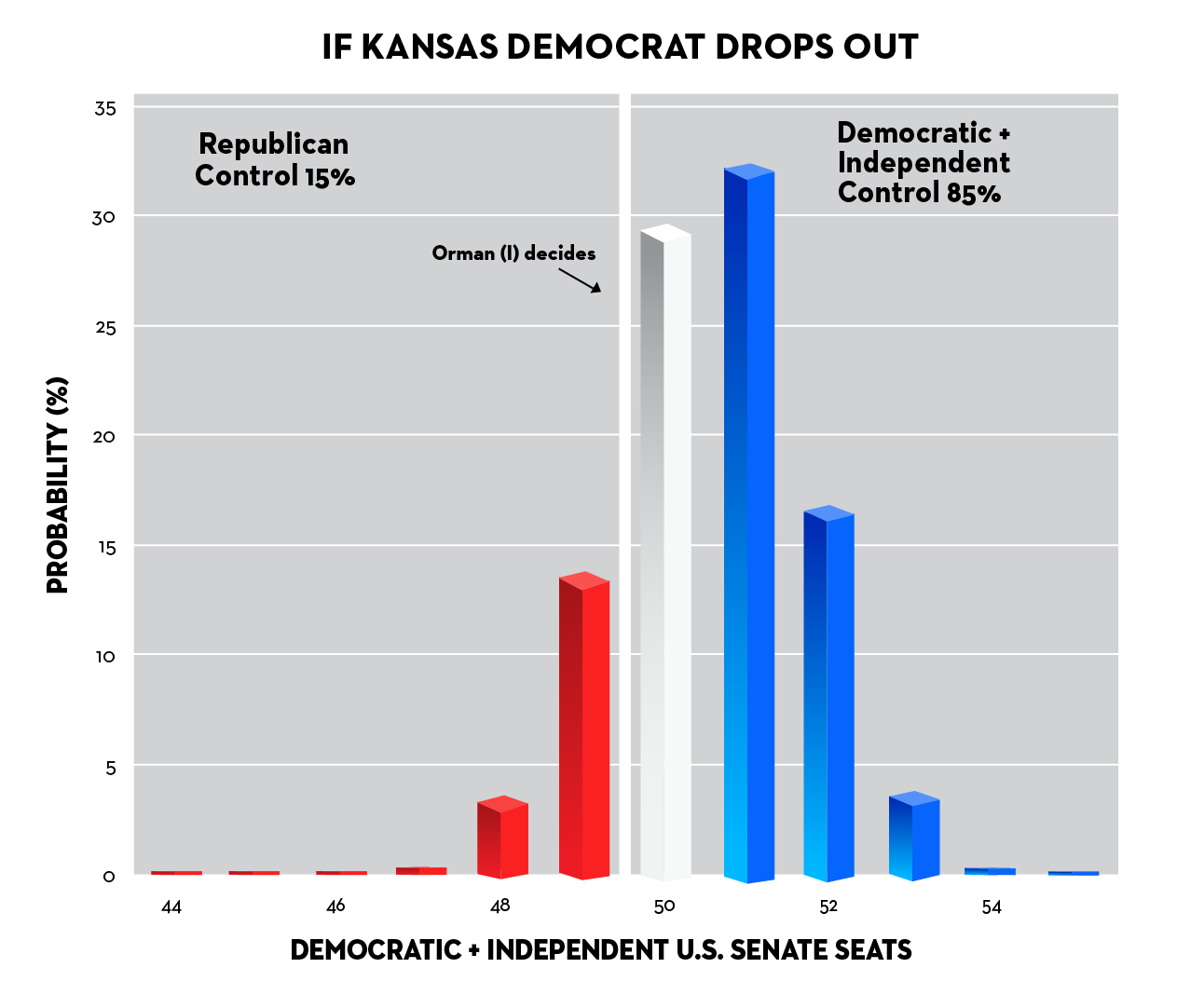
Sam Wang, who posts the above chart, calculates that the Democrats’ odds of keeping the Senate have skyrocketed:
Right before Taylor’s announcement yesterday, according to data from the Princeton Election Consortium, the Democrats had a sixty-five per cent chance of retaining control of the Senate. (Polling wonks will notice that this number is significantly different than what has been put out by outlets like theWashington Post’s Monkey Cage, the New York Times’ Upshot, and Nate Silver’sFiveThirtyEight, all of whom give an edge to the Republicans. The Princeton Election Consortium, which I founded, only relies on polling data and does not factor in so-called “fundamentals,” such as campaign finances and incumbency. In the past, our purely poll-based approach has yielded extremely accurate results.) As noted here, with Orman facing off alone against Roberts, the probability of Democratic control shot up to eighty-five per cent.
Silver’s analysis is less favorable to the Democrats. He remarks, that “if Roberts winds up beating Orman by a few percentage points, it wouldn’t be so surprising”:
Another question is which party Orman might caucus with should he win. The default answer would be the Democrats. Orman was formerly a Democrat, he’s mostly taken the political positions of a moderate Democrat, and the Democratic candidate just dropped out of the race. But the more Orman appears to be affiliated with the Democratic Party, the less attractive he might be to Kansas’s red-leaning electorate. … If we do program the model to treat an Orman win as a Democratic pickup, then the Democrats’ chances of retaining the Senate would improve to 38 percent from 35 percent.
Andrew Prokop also wonders who Orman will caucus with:
Orman has said that if he wins, and if one party ends up clearly in the majority, he will “seek to caucus” with that party. But if the Democrats end up with 49 seats to the Republicans’ 50, a victorious Orman would be the vote deciding Senate control, and would be intensely courted by both sides. “Ultimately, I’m going to caucus with the party that’s … most willing to address some of the biggest issues we have,” Orman said Wednesday, according to Politico’s Manu Raju and Kyle Cheney.
Orman describes himself as “someone who is fiscally responsible and socially tolerant,” and has criticized both parties and their leaders. However, he is pro-choice, a critic of the Citizens United decision, and a supporter of comprehensive immigration reform. And, as McCaskill’s actions indicate, Democratic support will likely coalesce behind Orman, while Republicans will try very hard to help Roberts keep his seat, which seems like it could have some impact on Orman’s decision about who to caucus with.
Our Kansas sources stressed two things Wednesday evening. First, Republicans are absolutely furious at Roberts for turning in such a clumsy, second-rate primary performance and allowing this contest to linger in a year when every Senate battle could determine control of the chamber. Second, these same sources — when pressed — believed that ultimately Roberts would be able to fight off the challenge with enough outside assistance.
We’ll see whether the latter view turns out to be realistic or optimistic. For the moment, we’ll put a thumb on the scale for “realistic.” However, Orman has gone to great lengths to emphasize his independence by noting his vacillation between the two parties. He obviously hopes that Kansans will be more amenable to voting for him if they don’t think of him as a Democrat. Republicans, inevitably, are going to try to make Orman as much of a Democrat as possible. Conservative journalists on Twitter are already discussing attack ads aimed at Orman with this theme: “The O in Orman stands for Obama.” In fact, Orman considered running as a Democrat in the 2008 Senate race against Roberts before declining to become a candidate.
Before the Kansas news broke, Nate Cohn looked more broadly at the Senate landscape:
Anything, of course, is still possible. Labor Day is traditionally the start of the campaign, not the end. But what may be more likely than a Republican rout is that 2014 ends up somewhere between 2010 and 2012. Not a Republican landslide or a Democratic victory, but a fairly neutral if Republican-tilting year in which the G.O.P. benefits from a large number of competitive races in red and purple states.
John Sides’ model now gives Democrats nearly a 50-50 chance of keeping the Senate:
[It’s] not that races have narrowed, but that the model has begun weighting information differently — mainly by (a) incorporating polling data (where possible) after the relevant primaries, and by (b) increasing the weight that polls have in the forecast. What this suggests is that in several states, Democrats are arguably ‘out-performing’ the fundamentals. This doesn’t always translate into a high chance of the Democrat actually winning (see: Kentucky) but it does help the Democrats’ overall chances of retaining a majority.
A new George Washington University “Battleground” poll shows that, on the list of things that people think are wrong with this country, Obamacare actually ranks pretty low. As in behind-“other” low. The poll shows seven in 10 likely voters think the country is off on the wrong track. But unlike other pollsters, it then asked a follow-up question about why people were unhappy. Of the 70 percent who said the country was off on the wrong track, just 5 percent offered a reason having to do with Obamacare. In other words, only about 3.5 percent of all Americans think Obamacare is the bane of American existence right now.
Chait passes along other good news for the ACA – the DC Circuit court will re-hear Halbig:
The short explanation of what this means is that it has closed off the easiest path to crippling Obamacare. … What happens next is that the entire D.C. Circuit will hear the case. Since the logic of the lawsuit is so ludicrous only a wildly partisan Republican jurist would ever accept it, it stands zero chance of success.
The entire D.C. circuit is expected to uphold subsidies through the federal-run exchanges, which would eliminate conflicting decisions in the appellate courts. That makes it less likely that the Supreme Court will eventually take the subsidy challenges, though the justices can still decide to do so.
Most legal experts I know think the justices will, at the very least, wait to see how the full D.C. Circuit rules before taking the lawsuits seriously. The D.C. Circuit rehearing is set for November and that court probably won’t issue a ruling until spring or summer of next year. If those judges end up reversing the decision, the Supreme Court justices might pass on the case altogether, although two other cases are in much earlier stages of the judicial process and could still produce conflicting rulings. As Andrew Koppelman, a constitutional law expert at Northwestern University, notes, “If the Court was going to blow up Obamacare, it would have done so in the big case in 2012. After Roberts paid a big political cost for doing that, why would he now adopt this hyper-technical and unpersuasive legal argument, yanking away benefits that a lot of people are already receiving?”
But remember: It takes only four Supreme Court justices to vote in favor of hearing a case. We know, from that 2012 Obamacare case, that four conservative justices were prepared to throw out not just the individual mandate but also the rest of the law.
Yesterday, a Louisiana judge upheld the state’s marriage ban:
Throughout his thirty-two-page opinion, the judge noted the near unanimity that has prevailed in other courts on the same-sex marriage issue, and he did not criticize other courts for having done so. He said those rulings amounted to “a pageant of empathy” for same-sex couples. But he concluded his opinion with an essay on the virtue of leaving such a vigorously debated topic to the choice of the people, acting as legislators at the ballot box or through their state legislative representatives.
An appeal of this decision to the U.S. Court of Appeals for the Fifth Circuit is nearly certain.
Mark Joseph Stern notes that Judge Martin Feldman, “is not the first judge since 2013’s United States v. Windsorto uphold a gay marriage ban. He is, however, the first federal judge, a key distinction that gives his ruling significant clout”:
The thrust of Feldman’s ruling rests on a misinterpretation of the so-called animus doctrine. According to the Supreme Court, laws motivated exclusively by anti-gay animus toward gay people violate the equal protection clause of the 14th Amendment. After the court struck down a federal gay marriage ban in Windsor, the vast majority of judges have concluded that all gay marriage bans are presumptively motivated by animus. That’s a logical conclusion, given the Windsor court’s assertion that the federal ban’s “principal purpose and necessary effect” was to “demean” and “degrade” gay people.
But as I’ve written before, the animus doctrine has a weak spot: It’s pretty easy for an eager judge to put a fig leaf over the hostility that motivates anti-gay laws. Feldman, for instance, is shocked that gays would even suggestsuch a motive, berating them for insisting that Louisiana’s ban “could only be inspired by hate and intolerance.” Rather, denying gay people the right to marry is a perfectly reasonable way “to achieve marriage’s historically preeminent purpose of linking children to their biological parents.” To insinuate that the law was passed to “vilify” gays, Feldman scoffs, is absurd and insulting.
[A]bout that societal interest in ensuring that fundamental social change be cultivated via the ballot or legislature instead of the courts: this is an invitation never to find any law unconstitutional, no matter how great an affront to the Constitution it may be. Feldman hedges his way out of this with the qualifier, “in this case.” But why, in this case? He never explains. The closest he comes is in his comments about linking children to their biological parents. But this is inadequate. Such a policy goal explains why the state permits biological parents to marry. It explains not at all why other marriages should be banned. This is a huge hole in Feldman’s reasoning, and I suspect there really is nothing that could fill it.
Preventing same-sex couples from marrying does not prompt opposite-sex couples to marry. If the state has an interest in “intact” families headed up by “two biological parents,” it would make more sense—and come far closer to achieving the state’s supposedly legitimate interest—if the state made pre-marital sex illegal, compelled straight men to marry the women they’ve impregnated, and banned divorce for straight couples with children.
Garrett Epps suggests that “not coincidentally, [the ruling’s] heart is drawn from an opinion written earlier this year by Justice Anthony Kennedy—whose vote will very likely determine the result when the marriage issue reaches the Court”:
Kennedy is a man with a large but complex heart. On the one hand, it tugs him toward his beloved “dignity” for gay couples and their children; on the other, it draws him toward the privileges of the states and the newly discovered “fundamental right” of majorities. The outcome of that contest is still in doubt, and Feldman’s opinion shows why.
One of the core points in Kennedy’s prior landmark opinions in gay-rights cases, especially the case striking down sodomy laws, is that gays are entitled to the same constitutional protections for intimate behavior that straights are. It would be odd if he followed that up by reading the right to marriage the way Feldman does, as a right inherently limited to people of different genders. And it’s not just RINOs who think so: Scalia, dissenting in the Windsor case, laughed at Kennedy’s opinion for being a transparent precursor to eventually finding that the Due Process Clause grants citizens the right to marry another person, not a right to marry only a person of the other gender. I think Feldman’s destined to be overturned, but this is a hopeful note at least for opponents of SSM.
David Frum applauds Obama’s remarks on the Ukraine crisis from Estonia yesterday, calling them “the sharpest language any U.S. president has used toward Russia since Ronald Reagan upbraided the Evil Empire” and “the most important speech about European security … of the post-Cold War era”:
One by one, President Obama repudiated the lies Vladimir Putin has told about Ukraine: that the Ukrainians somehow provoked the invasion, that they are Nazis, that their freely elected government is somehow illegal. He rejected Russia’s claim that it has some sphere of influence in Ukraine, some right of veto over Ukrainian constitutional arrangements. And he forcefully assured Estonians—and all NATO’s new allies—that waging war on them meant waging war on the United States. “[T]he defense of Tallinn and Riga and Vilnius is just as important as the defense of Berlin and Paris and London,” Obama said. “Article 5 is crystal clear. An attack on one is an attack on all. So if, in such a moment, you ever ask again, who’ll come to help, you’ll know the answer: the NATO alliance, including the armed forces of the United States of America, right here, present, now.” This is the ultimate commitment, given by the ultimate authority, in the very place where the commitment would be tested—and would have to be honored. There’s no turning back from that. Today, for the first time perhaps, Eastern Europeans have reason to believe it.
Max Fisher, who passes along the above map, interprets the speech as signaling that the US will not go to war to save Ukraine:
This does not mean that the US and Europe are indifferent to Ukraine’s plight. They have sanctioned Russia’s economy repeatedly and heavily, sending it to the precipice of recession. They have isolated Russia politically, for example by booting it from the G8. But these sanctions are about punishing Russia to deter it from future invasions, or at best an attempt to convince Putin that invading Ukraine is not worthwhile.
But Putin’s actions have demonstrated very clearly that he is willing to bear Western economic sanctions for his Ukraine invasion, and the US is not escalating further, so the invasion continues. The US is taking some tougher steps in Ukraine, but they are not very much. Obama, in his speech, called for “concrete commitments” to help Ukraine modernize its military, but it’s not clear what he meant, and even if Ukraine were armed to the teeth it would still lose any open war with Russia, which has the second-largest military in the world. So building up the Ukrainian military, while a nice symbolic gesture, will not stop Putin.
“NATO must send an unmistakable message in support of Ukraine,” Obama said. “Ukraine needs more than words.” The rhetoric hit its marks. The message, however, was muddled. As he finished his speaking engagements, several questions remained about how he intends to deal with the multiple foreign policy crises facing his administration. He again condemned Russian incursions into Ukraine, and promised new U.S. and European help to train, modernize and strengthen the Ukrainian military. But his “unmistakable message” of support stopped short of defining or ruling out any additional U.S. military role should Russian aggression continue. While he pointedly promised to defend those countries in the region who are signatories to the North Atlantic Treaty Organization (NATO), Obama offered no similar assurances to Ukraine, even as he highlighted that country’s voluntary contributions to NATO military efforts. … This was not the only issue on which he left gray areas.
For excellent reasons, foreign policy statements nearly always include gray areas, so it would hardly be news if that were the case here. But it’s not. Obama’s statement was unusually straightforward. He said the same thing he’s been saying for months about Ukraine, and it’s really pretty clear:
We are committed to the defense of NATO signatories.
Ukraine is not part of NATO, which means we will not defend them militarily.
However, we will continue to seek a peaceful settlement; we will continue to provide military aid to Ukraine; and we will continue to ratchet up sanctions on Russia if they continue their aggression in eastern Ukraine.
You might not like this policy. And maybe it will change in the future. But for now it’s pretty straightforward and easy to understand. The closest Obama came to a gray area is the precise composition of the sanctions Russia faces, but obviously that depends on negotiations with European leaders. You’re not going to get a unilateral laundry list from Obama at a press conference.
But Michael Brendan Dougherty worries that even these limited commitments involve us too deeply in another crisis we can’t really fix:
If Ukrainians want to maintain control of Donetsk, they must make compromises with its population, or get on with the ugly business of subjugating or murdering them while retaining control of their own border. But the United States should not be a party to it, no matter how satisfying it is for American hawks to defeat a rebel group that symbolically represents Russian power. Indeed, it is precisely the sense that the Ukraine is a cathartic proxy war that fuels the sentiments of Russian nationalism there. The hawks will say that it will never come to hard questions about whether our sons and daughters will die for Estonia or Donetsk. We can just create deterrents with arms shipments and paper promises forever. But these are the credit-default swaps of national security, a moral hazard that jeopardizes more than our retirement plans.
Among the many pieces written in memory of Steven Sotloff since the news of his death broke on Monday, a few of them struck a particular chord with me, touching on the dangerous, precarious, but potentially greatly rewarding life of a freelance war correspondent: a job in which many young journalists cut their teeth and often make their careers. Michael Totten, who corresponded with Sotloff but never met him in person, remarks that he was “a hell of a lot braver than I am”:
I have not for even a second considered going to Syria during this conflict, and I doubt I’d be willing to go there even a couple of years from now if the conflict were to miraculously end later today. When he lived in Benghazi and everyone was heading for the exits, he told me—and I believed him—that Benghazi was the same old Benghazi, by which he meant mostly fine aside from some unfortunate incidents. Dangerous places are often, though not always, less dangerous than they appear in the media. At least they appear that way. Maybe that’s just a trick of the mind.
Joe Klein didn’t know Sotloff at all, but praises his ilk of freelancers:
I’ve known many stringers like Steve Sotloff and admired almost all of them. They turn up in war zones or other difficult places, looking for adventure and hoping to make a splash…or just tell a compelling story. Many of the brilliant war correspondents whose words and photos have graced Time’s pages started off as stringers. Other stringers can also be academics, with a language skill or a love for the country in question. (Believe me, it is easy to fall in love with Syria and Syrians, or the Yemenis or, in a different era, the Vietnamese.) Still others are local nationals, who risk everything to work for the American media for a variety of reasons–money, truth, patriotism, professional pride. But they all have one thing in common: they are lovers of freedom, personal freedom, their right to pursue the news.
Recalling her time as a stringer in Moscow, Julia Ioffe wrestles with the question of why young journalists take these risks:
[I]f we’re honest with ourselves, we journalists are not just doing it to inform the reader. We’re also taking these risks for ourselves, making the calculation that, stringing and freelancing in places where papers and magazines are either too scared or too cheap to send permanent correspondents, going to iffy places and often for a pittance, someone will notice our labors and reward us with more work, and maybe even a job. It is a bright and risky way to launch a career. It’s also a way to discover that, even if it’s hard to break in, if this is what journalism is, you don’t want to do anything else for the rest of your life. … But the gambit never paid off for Sotloff. His beheading will be, for most anyone who hears his name, the sum total of his career. That is so immensely crushing and disappointing. It’s also, for us journalists, a reminder of the gambit’s downside, the shortness and slipperiness of the future, and the utter fragility of our plans.
I came into journalism through a side door, never having intended to enter the profession until a job as an sub-editor at The Jordan Times simply fell into my lap, mainly by dint of my ability to write in English. I did a little reporting, but nothing very substantial. What I liked about the job was getting to know the country through what my colleagues reported, as well as what our stories left out, which came to me in editorial meetings and cigarette breaks with the reporters. Friends advised me to do what my colleague Taylor Luck later managed to do and offer myself as a stringer to American newspapers. I e-mailed a high school friend who works at the WaPo to find out how to do that, but never followed through with the editor she referred me to.
The reason, to be perfectly honest, is that I never really had the disposition of a reporter. I love the news, but digging it up requires a certain fearlessness that I never really had. And I certainly could never hack it as the sort of reporter who travels to a war zone: I just don’t have the guts. I could never, like Nir Rosen once did, disguise myself as a member of the Taliban to get an angle on the Afghanistan war that those who followed the US Army could not.
So while Taylor immersed himself in his reporting, learning to speak Arabic 100 percent fluently and making such deep connections in Islamist circles that we joked around the office that he had become one of them, I sat at my desk and got to know Jordan mainly through the stories I edited and by becoming close friends with some of my Jordanian colleagues. By no means is that a bad way to get to know a country, but I always felt a little guilty that I wasn’t taking advantage of the opportunity to go deeper, and worried that I was missing that extra insight that comes from “being there” in the middle of the riot or the battle or the aftermath of the natural disaster.
It takes a great deal of courage, or at least much more than I have, to travel to a foreign war zone and report directly from the rubble and carnage, to embed among rogue militias, to see the destruction firsthand and actually look the widows and orphans in the eye and give them a voice with one’s writing. It’s especially brave to do so without a net. Dedicated war reporters like Foley and Sotloff, to say nothing of their Syrian colleagues who risk imprisonment, torture, and death to get the story, are heroes to humanity in that respect. Bravery like theirs is hard to come by.
Speaking of cops: Two illuminating stories of officer-involved citizen interactions came across my Twitter feed within a few hours of each other. They occurred at opposite ends of the country, only one ended in an arrest, and neither ended in any serious injury or death, but they both illustrate what happens when urban cops apply their usual treatment of marginalized communities to people with actual power.
The first is from DNAinfo. Last month, following a pro-Palestinian rally in Times Square, Chaumtoli Huq was waiting outside a Ruby Tuesday in Midtown Manhattan while her husband and children used the bathroom inside. Two police officers approached and asked her to clear the sidewalk. She declined. They pinned her against the wall and arrested her. She was charged with obstructing governmental administration, resisting arrest and disorderly conduct. The resisting arrest charge was because she allegedly “flailed her arms and twisted her body” while the officer was attempting to handcuff her for waiting on a sidewalk for her family to come out of a restaurant. (A “resisting arrest” is frequently an indicator that a cop just really wanted to arrest someone but couldn’t come up with any actual crimes to justify it.)
She added that officers went through her purse without probable cause before taking her to the Midtown South Precinct — all while her family was still inside the restaurant. Huq’s husband and children were notified by another officer and eventually came looking for her at the precinct, according to her federal civil rights suit, which is expected to be filed Tuesday. Officers offered to deliver Huq’s purse and personal items out to her husband, but then became suspicious when she told the officer his last name was different than hers, according to the lawsuit. “In America wives take the names of their husbands,” the officer told her according to court papers.
The second story is from KPIX 5. In Oakland, California, not long after Huq’s arrest, a police officer pulled a gunthreatened to pull a gun on Keith Jones and his two sons:
It was 10:45 p.m., after a recent Raiders game. Veteran firefighter Keith Jones and his two sons, ages 9 and 12, were walking back to their SUV at Station 29. A fire crew responding to an emergency had forgotten to close the garage door. Jones went in to make sure everything was secure. As Jones walked out, he said a police officer, responding to a possible burglary in progress, yelled “Don’t move, put your hands up.”
“And his hand is on his gun. He was crouched, he was low, and he was basically in a shooting stance,” Jones said. Jones complied, but noticed his 9-year-old son Trevon was starting to cry. The officer saw the two kids first and had already told them to raise their hands. Jones said he told the officer that he was an Oakland firefighter, that he worked at the station and that they were his kids. He asked the officer to allow his kids to lower their hands and tell them everything is OK. Jones said the officer told them to keep their hands up and not to move. The firefighter said this lasted for a few minutes.
Jones was eventually allowed to reach into his pocket and present his firefighter ID.
Jones, you have probably guessed, is black. Huq is Muslim and South Asian, and was dressed, at the time of her arrest, in “a traditional Indian tunic and pants.”
What Jones and Huq have in common is that they have the resources and connections necessary to get people in positions of authority to care. Huq is an attorney who formerly worked with Letitia James, New York City’s public advocate. Keith Jones is a firefighter, part of a tight-knit organization, beloved by the media, with a great deal of municipal power (not unlike most police departments). Huq is filing a federal lawsuit. Jones had the Oakland fire chief complain to the police chief on his behalf, and Internal Affairs is now investigating the incident.
I have no doubt that the interactions Huq and Jones had with those police officers are repeated multiple times a day, in cities across the country. (A police trainer tells KPIX 5 that the officer was “following protocol” but should have apologized to Jones and his children, which, ha ha, sir, good one.) Most of the time, people harassed or threatened by cops for no good reason have no recourse. Falsely arresting a human rights attorney and pointing a gun at a goddamn firefighter are just about two of the dumbest mistakes a cop can make. But most of the people they’re doing that sort of thing to aren’t human rights attorneys or firefighters. That’s why it continues to be “protocol” to point a gun at a guy for leaving work with his kids.
Update and a correction: The Oakland officer didn’t have his gun drawn, as I wrote. Jones described the officer as “in the crouch position” with his hand on his gun, “ready to pull his weapon,” but the weapon wasn’t actually drawn. I apologize for the error. (Additionally, the officer did say “I’m sorry for the scare,” despite my skepticism about cops apologizing.)
President Obama’s statement yesterday that the US intends to “degrade and destroy” ISIS raised a few questions about just what he meant by that. Spencer Ackerman observes that the statement adds to the conflicting rhetoric coming from the administration:
Obama’s goals have caused confusion in recent weeks. The chairman of the Joint Chiefs of Staff has said in the short term Isis can be contained, while Obama’s secretary of state, John Kerry, said the group must be “crushed”. Each of those endpoints require different military approaches for achieving them. Degrading and destroying an adversary are also two different goals. Degradation is a line short of destruction, a difference Obama appeared to split by suggesting his desired end state is a neutralized, unthreatening Isis.
As Keating points out, if the goal is indeed to “destroy” ISIS, that strongly implies that our air war in Iraq will expand to Syria:
It seemed obvious that continued videotaped killings of U.S. citizens would provoke a more steadfast response than what we’ve seen so far. The goal of the U.S. operation has now expanded from averting a “potential act of genocide”—or recapturing control of a critical dam, or even propping up the Iraqi government—to eliminating ISIS as a force entirely. The thing is, Obama’s own military commanders say that destroying ISIS is impossible without strikes against its strongholds in Syria, a step this administration has been extremely reluctant to take. U.S. strikes on Syria probably aren’t imminent—for one thing,more intelligence gathering is probably needed before the military would take such a step—but eventual military action against ISIS on the other side of the border is starting to feel inevitable.
But Hassan Hassan calls that an opportunity, arguing that the US can leverage it to effect a solution to the Syrian civil war, provided we don’t sell out the opposition and work with the Assad regime:
Local communities and armed groups, even if many of them might be currently displaced, have a direct stake in fighting the Islamic State. However, there are already voices within the anti-jihadist opposition condemning the potential airstrikes against the Islamic State because the perception is that they will be coordinated with Assad. An activist who led a campaign against the jihadist group for months, for example, said he would join the Islamic State if intervention comes at the expense of the rebels. … If Washington plays its cards right, it can use the fight against the Islamic State to spur broader political change in Syria. There is already regional will to defeat the jihadists — American action has the power to unite disparate groups around a solution that could end the bloodshed. As Obama develops his strategy to combat the Islamic State, he would do well to keep that in mind.
That would be the ideal outcome, of course: it’s certainly preferable to the massive PR disaster of an alliance with Bashar al-Assad, and that might even be what Obama’s thinking as he looks to build a regional coalition to fight this war. I’m not as sanguine as Hassan that it will work, though, and I suspect the president himself is leery of “owning” the effort to resolve the Syrian crisis, lest it fail. Rand Paul, on the other hand, thinks an alliance with Damascus (and Tehran) is a no-brainer:
In addition to Iran and Syria, Paul said he believes “the Turks should be enjoined” in the fight. … Paul charged that the chain reaction of U.S. involvement in the Middle East is what, in part, led to the rise of ISIS: “I think part of the reason they’ve gotten so large is that we have armed Islamic allies of theirs, Islamic rebels, in Syria, to degrade Assad’s regime, and Assad, then, couldn’t take care of ISIS. Really, I think what we’ve done, the unintended consequences of being involved in the Syrian civil war, have been to encourage the growth of ISIS by supporting their allies… I think it’s our intervention that really held Assad at bay, and Assad would have wiped these people out long ago.”
But Larison rejects the premise that we should, or even can, fight this battle at all:
When people talk about “destroying ISIS,” they are setting a goal that doesn’t seem to be realistic at an acceptable cost, and their policy would require committing the U.S. to a war in Iraq and Syria that would almost certainly ensnare the U.S. in that country’s ongoing civil war for years to come. Opposing such a poorly thought-through and ill-defined policy doesn’t amount to pacifism, as [Richard] Epstein tendentiously claims, and one doesn’t need to be anything close to a pacifist to see the dangers of overreacting to potential threats with military action on a regular basis. ISIS and other groups like it thrive on such militarized overreaction, which is one reason why it is doubtful that such a group can ever be thoroughly “destroyed” without creating more like it in the process.
Waldman, meanwhile, monitors the outrage machine as it combs through Obama’s rhetoric for signs of weakness and perfidy:
[M]embers of the media (and conservatives, of course) were jumping all over Obama for another line: “We know that if we are joined by the international community, we can continue to shrink ISIL’s sphere of influence, its effectiveness, its military capability to the point where it is a manageable problem.” The sin here was apparently the word “manageable.” If Obama had said, “My plan is to go over there and punch Abu Bakr al-Baghadi in the face, whereupon all his followers will disappear in a puff of smoke and we’ll never have to worry about them again,” he would have been praised for being “tough.” But because he is acknowledging that dealing with ISIS is going to be a complex process that will play out over an extended period of time, Obama will get pilloried.
Obama’s rhetoric on ISIS is confused because his administration’s policy on ISIS is confused by internal contradictions. On the one hand, Obama really does have long term ambitions to destroy ISIS. On the other hand, he recognizes that this is impossible in the near term, and that the best the US can do is lay the groundwork for ISIS’ eventual collapse. This essential tension in American objectives explains why Obama’s rhetoric and actual policy on the group are so at odds.
Anyway, Goldblog argues, Obama is much more of a hawk than he gets credit for being:
It is important to remember that Obama is perhaps the greatest killer of terrorists in American history. … Obama has launched strikes against Islamist terror targets in several countries. He has devastated the leadership of core al Qaeda, and just this week — as Washington opinion-makers collectively decided that he was hopelessly weak on terror — the president launched a (quite possibly successful) strike in Somalia against the leader of al-Shabab, a terror group nearly as bloodthirsty as Islamic State. And here’s the important bit — at the same time the White House is the target of relentless complaints that it has not done enough to combat Islamic State, Obama is actually combating Islamic State, launching what appear to be, at this early stage, fairly effective strikes against Islamic State targets in Iraq. The rhetoric is not inspiring, but the actions should count for something.
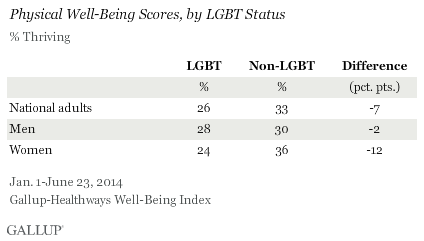
Shannon Keating flags a recent Gallup survey on well-being that shows “queer women lag behind straight women where queer men do not lag behind straight men as much – or even at all”:
Differences in physical well-being between straight and queer men, for example, are too small to be statistically significant; the overall deficit in physical well-being for the LGBTQ community at large is driven entirely by the low scores of queer women (24 percent to straight women’s 36 percent). Gallup indicates that reportedly high levels of smoking and drinking among lesbians and bi women could be a potential contributor to the discrepancy. I’ve seen from accompanying girlfriends on many a smoke break outside of bars how cigarettes and alcohol remain an obstinate fixture of queer girl culture.
Further, where queer men assess their communities with close to as much contentedness as straight men, queer women feel less connected to where they live than their straight female counterparts. Just 31 percent of queer women feel they are thriving in terms of community involvement, safety, and security, a full 9 percent less than straight women.
A federal study to determine why 75 percent of lesbian women are obese and gay men are not has totaled nearly $3 million. … Researchers at Brigham and Women’s Hospital have come to several conclusions since studying “the striking interplay of gender and sexual orientation in obesity disparities,” which is slated to last until 2016. They have determined that gay and bisexual males had a “greater desire for toned muscles” than straight men, lesbians have lower “athletic self-esteem” that may lead to higher rates of obesity, and that lesbians are more likely to see themselves at a healthy weight even though they are not, the Free Beacon reported.
Update from a reader:
It astonishes me that anyone can look at those numbers and only see a crisis for gay women. True, they are the worst off by a big margin – I am not trying to minimize the main point of the article at all. But almost as shocking is the 6- to 8-point gap between men and straight women. Why is it not even mentioned that men generally are much worse off than women in this regard? (At ~5% of the female population, the lesbian numbers would bring women’s overall score down by about half a percent.)
Possibly because the suffering of men tends to get erased in favor of focusing on the suffering of women? Just saying, the fact that the male population as a whole is significantly less healthy than the female is also a big. fucking. deal, and one that affects far more people in absolute numbers. I guess us dudes are just so privileged to get to live sicker and die sooner.


 The Dish