Beheading, Baiting, Backfiring

by Dish Staff

In response to ISIS’s brutal murder of American journalist Steven Sotloff in a video released yesterday, the Obama administration is vowing justice for both Sotloff’s death and that of James Foley, with Obama announcing in Estonia this morning that “we will not be intimidated” and “justice will be served”. Bearing in mind that these atrocities against Americans makes an escalated US military operation against ISIS more likely, not less, Keating wonders what the group expects to accomplish by killing these hostages:

ISIS may be ruthless and fanatical, but it would be impossible to expand as quickly as it has thus far without an understanding of strategy. The group’s leaders surely know that they are likely drawing the U.S. military further into this conflict and believe this is to their advantage. Kurdish and Iraqi forces, with help from the U.S. and Iran, seem to be rolling back ISIS’s territorial gains in Iraq, so the group’s best hope of remaining a viable and prominent militant group may be to go underground and continue to inflict terror on its enemies. And those enemies aren’t just American. ISIS also recently released videos showing the beheading of a Kurdish peshmerga fighter and a Lebanese soldier. Hopefully this strategy will backfire before any more hostages are killed.

He follows up with some speculative answers, including the possibility that ISIS really thinks it can deter the US:

ISIS may believe that it can continue to demonstrate that it can strike the U.S. by executing these prisoners, and that the U.S. isn’t going to do anything about it. If this really is their thinking, they don’t have a very good grasp of history. Americans are traditionally reluctant to go to war right up until they do. Saddam Hussein didn’t think the U.S. would really attack him either.

Shane Harris and Kate Brannen suspect that by threatening to kill a British hostage, the jihadists are baiting the UK into getting involved militarily:

At the end of the Sotloff video, the killer threatens to execute another captive, who, the killer claims, is British citizen David Cawthorne Haines. That claim couldn’t be immediately verified. But if true, it would show that the Islamic State is broadening its terrorism campaign to include British civilians, a move that could well prompt a military response by the United Kingdom. This week, British Prime Minister David Cameron said he is weighing whether to join the United States in carrying out airstrikes against the Islamic State in Iraq, and potentially in Syria. Without naming Cameron specifically, Sotloff’s killer warns “governments that enter this evil alliance of America against the Islamic State to back off and leave our people alone.” That threat seemed timed to coincide with deliberations in London.

Jamie Dettmer argues against suppressing reporting about ISIS hostages, saying it only amplifies the value of these videos:

Openness would take away some of the control the jihadists have to administer shock as they go on killing. The U.S. and U.K. with their blackouts are handing ISIS the propaganda initiative, leaving it to the jihadists to decide when captives should be named, allowing them to add to the drama of the unveiling when they first threaten hostages with execution on camera and then carrying out the brutal deed. At least this power of naming could be taken from the jihadists, who already are in the position to taunt their foes and turn their slaughtering of Westerners into a global spectacle.

But Dexter Filkins asks whether ISIS’s snuff films are about something other than propaganda:

It’s hard to watch the video of Steven Sotloff’s last moments and not conclude … the ostensible objective of securing an Islamic state is nowhere near as important as killing people. For the guys who signed up for ISIS—including, especially, the masked man with the English accent who wielded the knife—killing is the real point of being there. Last month, when ISIS forces overran a Syrian Army base in the city of Raqqa, they beheaded dozens of soldiers and displayed their trophies on bloody spikes. “Here are heads that have ripened, that were ready for the plucking,” an ISIS fighter said in narration. Two soldiers were crucified. This sounds less like a battle than like some kind of macabre party.
The Taking Of The Media

by Alex Pareene

The Awl’s John Herrman brings us his take on Takes, the online media phenomenon wherein nearly every single outlet that produces “content” finds itself compelled to produce some sort of content related to some sort of news (or pseudo-news), despite having no original reporting or intelligent analysis to add. The problem is that generating actual news is difficult, time-consuming and expensive. Writing incisive analysis requires time to process, reflect, and refine one’s arguments. But the Internet needs those Takes now, while the topic is trending:

Take creators might have caught themselves saying things like “that, my friends, is why you never take nude photos of yourself,” or “just a reminder that, actually, sex is natural.” There were Takes on privacy and gender and consent and free speech issued with and without conviction. Everyone with an outlet—or, really, everyone, since the great democratization of Take distribution tools coaxed previously private Takes out from bars and dining rooms and into the harsh sunlight—found themselves under the spell of that horrible force that newspaper columnists feel every week, the one that eventually ruins every last one: the dreadful pull of a guaranteed audience.

The “we need to have something on this” impulse leads to the worst (professional) writing on the web. We all learn this anew each time some poor 20-something content producer writes some exceptionally dumb take, and everyone spends a few hours piling on the outlet that published it. But the attention-grabbing Offensive Takes only obscure the fact that all the inoffensive takes – the ephemeral, aggregated, feather-light blog posts telling people who already know that something happened that something happened, produced solely in the hopes that the post will, through luck and a bit of dark magic, win the Facebook algorithm lottery – are the most depressing pieces of writing on the web, for the reader and the writer.

The Internet media is exploitative and unkind to its greenest employees. Most of the Takes are written by 20-somethings making a (comparative) pittance. The Take is barely, if at all, edited. The young Take-producer is given no time to learn to report, or to read anything other than Everyone Else’s Takes. Dozens of aspiring journalists now have clips files that consist of hundreds of these awful aggregated units of completely disposable Content. Here’s 80 words on something James Franco did. Here’s 100 words on ISIS. This is my link to a Daily Mail story about long-lost twins who married each other.

The Takes wouldn’t be produced if they weren’t profitable – or at least aspirationally, potentially profitable – to the publishers, but the defining feature of modern web publishing is that the Takes are ruining the Brands. When your worst, laziest, least-polished writing is also the most frequently published content at your publication, that writing defines the voice of your site. BuzzFeed would love to be known for its journalism, but the economics of journalism mean that there will simply always be more quizzes than reported stories. And BuzzFeed is actually an outlier: They have a lot of money and a massive editorial staff, meaning no one is holding a gun to anyone’s head forcing them to churn out lists. (In other words, the most alarming thing about BuzzFeed is that its dumbest material isn’t produced in haste out of necessity.)

This isn’t simply a problem for fast-and-cheap New Media – your Mediaites, Daily Callers, and (yes) Salons – it’s an issue at nearly every print publication with a regularly updated web site. Rolling Stone still produces a lot of Quality (expensive) journalism. Its politics page does its best to highlight it. But there, over in the siderail, are the aggregation and takes, published far more frequently than the actual magazine: “Watch George W. Bush Get Doused for ALS Ice Bucket Challenge.” “T.I. Writes Powerful Posts on Ferguson Aftermath.” “Kevin Spacey Pranks Clintons in ‘House of Cards’ Spoof.” “John Boehner Uses Billy Joel Pubs to Blast Obama’s Jobs Plan.” All of that stuff was already everywhere else before each of those posts was published (indeed, the fact that they were everywhere else is why they were published). Amusingly, it is all under the utterly dishonest rubric “BREAKING.”

A large number, if not a majority, of editors and publishers understand how untenable and embarrassing this is. But the Takes won’t stop until Facebook turns off the traffic fire-hose for good, at which point we’ll all be out of work anyway.


Update: Pareene’s Round Two on the subject is here.

Let The End Times Roll

by Dish Staff

Bob Marshall warns that in Louisiana, “one of the greatest environmental and economic disasters in the nation’s history is rushing toward a catastrophic conclusion over the next 50 years”:

At the current rates that the sea is rising and land is sinking, National Oceanic and Atmospheric Administration scientists say by 2100 the Gulf of Mexico could rise as much as 4.3 feet across this landscape, which has an average elevation of about 3 feet. If that happens, everything outside the protective levees – most of Southeast Louisiana – would be underwater.

The effects would be felt far beyond bayou country. The region best known for its self-proclaimed motto “laissez les bons temps rouler” – let the good times roll – is one of the nation’s economic linchpins. This land being swallowed by the Gulf is home to half of the country’s oil refineries, a matrix of pipelines that serve 90 percent of the nation’s offshore energy production and 30 percent of its total oil and gas supply, a port vital to 31 states, and 2 million people who would need to find other places to live. The landscape on which all that is built is washing away at a rate of a football field every hour, 16 square miles per year.

Brad Plumer notes that climate change is only one of the environmental problems facing the region:

The land in southeast Louisiana was built up over thousands of years from sediment washed down by the Mississippi River and anchored by plant life in the marshes and wetlands. Without this replenishing, the soil would simply sink into the Gulf of Mexico. And over the past century, various human activities have disrupted this ecosystem. After the Great Flood of 1927, the US Army Corps of Engineers built up a series of levees along the Mississippi that controlled springtime flooding but also blocked sediment from washing down the river and replenishing the delta.

At the same time, the Louisiana coast became a major source of oil and gas during the 20th century. That meant two things. Energy companies dredged thousands of miles of canals through the wetlands to transport equipment through – and those canals allowed shoreline to crumble and saltwater to seep in, killing off plants. Meanwhile, some scientists argue that the land itself has sunk after companies extracted oil and gas from underground wells.

Can Burger Flippers Unionize?

by Dish Staff

Jonathan Cohn relays the latest on tomorrow’s fast food industry strikes:

On Thursday, fast food workers across the country are planning to walk off the job and, in at least a few places, engage in civil disobedience. It’s part of a two-year-old campaign, backed by the Service Employees International Union (SEIU), to lift the wages of fast food workers and to make it possible for them to join unions. Presently, jobs in the fast food industry are the lowest paying in the country: The mean hourly salary for a cook is $9.07 an hour, which works out to a little less than $19,000 a year for full-time employment. But many people in fast food don’t work full time and, naturally, many of them make less than the mean.

He sees this as a fight worth fighting:

SEIU’s president, Mary Kay Henry, has apparently taken some grief for spending so much of the union’s money on an effort unlikely to swell the organization’s ranks anytime soon. But labor has always been at its best when it was an advocate for all working people, not just those paying dues.

Megan McArdle is skeptical:

I would like to believe in the possible success of this effort. But I find it hard to suspend my disbelief. The classic union successes were in mass industries that enjoyed large economies of scale and few ready substitutes for their products. That meant a union only had to organize a handful of firms with workers concentrated in a few large plants. Once they had unionized those plants, it was easy to extract wage and benefit gains for the workers, because when economies of scale are high, so is worker productivity. The average auto worker generates hundreds of thousands of dollars’ worth of output; the average fast food worker, much less. That matters a lot. …

If unions want to turn fast-food operations into “good union jobs,” there may be a way through the government: getting the National Labor Relations Board to help them unionize McDonald’s rather than picking away at its franchisees, or pushing governments at various levels to pass a much higher minimum wage. I’m skeptical of either plan, for reasons I have outlined before. But they seem much more likely to work than another high-publicity, low-participation walkout.

Michael Sam Joins America’s Team

by Dish Staff

He snagged a spot on the Cowboys’ practice squad. Sam Laird approves:

Why the Cowboys are an ideal fit for Sam’s quest to build an NFL career is simple: They suck, especially on defense. If Sam is going to work his way from a practice squad to a regular 53-man roster, Dallas is as good a place as any to do so. Their defensive line is full of holes, and the loss of highly touted rookie DeMarcus Lawrence for at least six weeks creates another. Lawrence’s replacement, Jack Crawford, is no great shakes either, having been cut by the lowly Oakland Raiders just last week.

Other reasons to cheer the news:

You don’t get much more #America than Dallas, a red state where the steak is rare, the whiskey’s strong and the dudes sure as hell don’t kiss other dudes. The Cowboys are even nicknamed “America’s Team,” for crying out loud. … [H]aving America’s first gay NFL player in the middle of conservative Texas, on America’s Team, amid the league’s brightest media spotlight is pretty amazing.

Jay Caspian Kang also sees the logic of the move:

In many ways, Dallas is a perfect fit—the team has enough problems to be too worried about a practice-squad player. Aside from the on-field problems—and there are many—owner Jerry Jones has become a big-tent circus unto himself, with an alleged tampering scandal involving Adrian Peterson, of the Vikings, and a set of leaked photos—which are, frankly, bizarre—that showed Jones cavorting with two younger women. The Cowboys are a big-tent show, and if Sam indeed has a circus around him, it shouldn’t be more than a sideshow.

But Scott Shackford points out that Sam could get cut again:

Whether he eventually gets elevated to the roster and actually take to the field of a game, or even lasts on the practice squad, is a whole other question. For those who want to read the technical analysis of how Sam does and doesn’t fit in NFL play with only minor emphasis on Sam’s pioneering identity, ESPN’s Kevin Seifert has some explanations here.

Recent Dish on Sam losing his spot on the Rams here. Update from a reader:

While the Dallas Cowboys marketing team has done a great job of trying to brand them as “America’s Team,” the rest of the country hasn’t seen fit to go along with it. The most recent polling data seems to indicate they are the most hated team in the league.

Another:

In your post, Sam Laird writes, “You don’t get much more #America than Dallas, a red state where the steak is rare, the whiskey’s strong and the dudes sure as hell don’t kiss other dudes.” Gracefully, I would like to protest. As a resident of Dallas I like rare steaks and strong whiskey. But, I sure as hell like to kiss other dudes. There’s a saying of what Texas is really like: “Nothing but steers and queers.”

Gridlock Deflated The Democrats

by Dish Staff

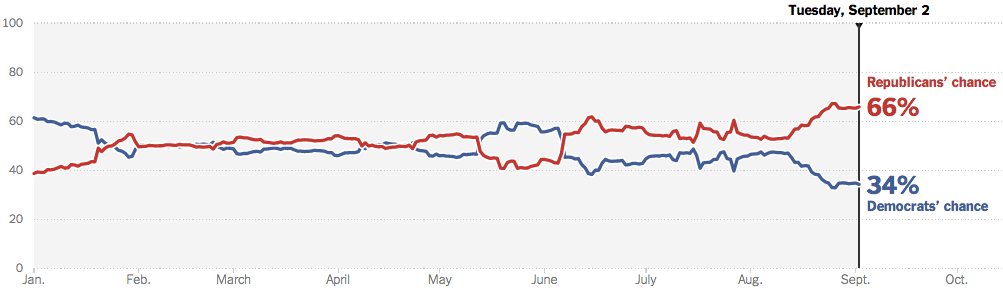
Senate Chances

Steinglass assesses the damage:

In the face of the far rights effective veto over the congressional GOP, Democrats have given up on passing any significant legislation either until they regain control of the House, an impossibly remote prospect, or until the Tea Party somehow withers away, which shows no signs of happening. The Democrats acceptance of their inability to accomplish anything significant has left them unable to campaign on big themes. The party feels exhausted, still convinced of the need for immigration reform, climate change legislation and expanded benefits for the middle class, but unable to imagine a political pathway to get there. If the Democrats lose the Senate this fall, it may be technically due to an unlucky roster of elections and the traditional midterm setback for the party in power. But it will also be a verdict on the partys inability to conjure a sense of élan or vision in the face of the political paralysis tea-party Republicans have induced.

Tomasky agrees that, thus far, DC’s dysfunction has harmed Democrats more than Republicans:

Too much of Obama’s America is just too worn down. In that sense, the scorched-earth campaign has won. But Republicans should remember that in 2016, that America will be back, and bigger by a few percentage points than before, and still hungry to win the fights the obstructionists have blocked.

In other midterm analysis, Bernstein recommends taking Senate forecasts with a big pinch of salt:

I’ll continue to emphasize that the headline numbers suggest unearned precision. Most of these modelers, most of the time, don’t really make unsupported claims – but the numbers often suggest more certainty than the prose claims, and both the headline writers and the chart designers rarely include important caveats.

So we shouldn’t trust any single model, or even a single average of the various models. Instead, the best way to read all of this is to focus on the range, both in individual models when supplied by the authors, and across models. That’s going to give smart readers uncertainty, and that’s exactly what we all should be experiencing right now. If you want certainty, try the U.S. House: It’s going to stay Republican. But we don’t know who is going to win the Senate, and there’s a very good chance we won’t on Election Day morning, or on Election Day night – until Alaska comes in, and even then we may have to wait for Louisiana to hold a runoff to really know.

(Image: the latest Senate forecast from The Upshot.)

Celebrities: They Sext Like Us, Ctd

by Dish Staff

The photo leak scandal wages on. Alyssa Rosenberg raises an eyebrow at some of the advice these celebrities have received:

The theft and release of the photos are callous enough. These periodic violations suggest a sense of extreme entitlement to famous people’s bodies, a contempt for the idea that people in public life have the right to define any zone of privacy and a sense of glee about the possibility of exposing famous individuals as human and vulnerable.

But the response to these sorts of leaks comes with its own sort of cruelty. Rather than casting a jaundiced eye at large corporations that fail to keep their clients’ data safe or railing against the impulse to pry into other people’s intimate lives, we see sentiments such as the one expressed by New York Times technology columnist Nick Bilton. “Put together a list of tips for celebs after latest leaks: 1. Don’t take nude selfies 2. Don’t take nude selfies 3. Don’t take nude selfies,” Bilton tweeted on Monday.

As tech reporter Kashmir Hill pointed out in Forbes, this kind of response is the digital equivalent of abstinence-only sex education, which is divorced from the realities and expectations of contemporary relationships. And it shares a smug moralism with that sort of thinking: Anyone who experiences a bad outcome from bowing to a partner’s request (much less acting for his or her own pleasure) deserves it and ought to be held up as a cautionary lesson for everyone else.

Amanda Hess compares the controversy to one of an earlier era:

…BuzzFeed‘s Anne Helen Petersen has proposed that Lawrence should counter the incident by laughing off the violation and acting as if she’s so devoid of hangups that it’s impossible for anyone to truly embarrass her. Petersen—author of the forthcoming Hollywood history Scandals of Classic Hollywood—advises Lawrence to hew to the example of Marilyn Monroe, who was affronted with a similar “scandal” when topless photographs she had posed for pre-stardom in exchange for a flat $50 fee were later republished without her consent in a 1952 pinup calendar.

Petersen notes that, in the face of the puritanical Hollywood climate of the early 1950s, Monroe was able to overcome the potential stigma of the photos by not “denouncing the images” but instead taking “control” of the narrative by facing them with her trademark sexy giggle and wink. Monroe told the press that she was “not ashamed” of the photos and had “done nothing wrong.” Then, she flipped the incident into a self-deprecating joke: “I’ve only autographed a few copies of it, mostly for sick people,” she told the the Saturday Evening Post. “On one I wrote, ‘This might not be my best angle.’ ” By laughing it off, Monroe contributed to “what came to be known as thePlayboy philosophy,’ that sex is only dirty when suppressed,” Petersen writes. …

What Petersen doesn’t mention is that Monroe never agreed to be the face of Playboy’s ostensible revolution—in 1953, Hugh Hefner bought photos of Monroe from that same old nude shoot and published them in his magazine’s first issue without her consent, and without paying her a dime. (With his Playboy fortune, Hefner later bought the funeral plot next to Monroe’s crypt, ensuring that they’d be laid side by side forever—again, not her call.) Similarly, Lawrence never agreed to share these images of her “beautiful body” with the world. Why would anyone want her to shrug that off?

Update from a dissenting reader:

Alyssa Rosenberg calling the advice to “just say no” to sexting the same as abstinence-only education is laughable. A better example is unsafe sex, which (at least in my book) is poor judgement and not the result of some act of shaming by society. Really, nobody is telling these narcissists celebrities to not Instagram, Tweet, etc. Just use some reasonable judgment. Be aware that you’re going to be a target for this kind of thing. I mean, is your life really going to start to suck if you can’t take nude pics on your telephone?  ’80s me is puzzled.

The Short Shrift, Ctd

by Dish Staff

Screen Shot 2014-09-01 at 8.02.25 PM

A reader writes:

I enjoyed Phoebe’s commentary regarding Jezebel’s Disney character nude-rendering piece. However, I don’t agree with the generalized notion that women are purported, or at least depicted, to not care about men’s looks. I think Phoebe slightly underplays the spectatorial role of women that women have obtained in hetero-normative dating. The height thing is a real thing; in my experience, it’s the most likely deal breaker to be found on most online dating websites (it’s certainly the most verbalized one). Perhaps online dating contains a different dynamic than dating in general, but the general gawking, ogling and just plain fantasizing about ideal men and their bodies types seems rather abundant at this point.

Another:

Your post interrupted my work and dragged me out of my “Andrew’s on vacation” lethargy and back into Post Mode. Women and men’s height: really? You’re shocked that women are interested, concerned – no – even fixated on height?

I’m a whopping 5′ 6″ (plus a 1/2″ on a good day).

It’s never bothered me, and I’ve been extremely happily married for 22 years to an incredible, beautiful, powerful, successful woman, but … I oh so remember my high school-college-pre-marriage days of dating. Do you know how many times I was told to my face that I wasn’t tall enough? How many times I was set up on dates only to see the woman’s face fall when she met me saw and I wasn’t (much) taller than her? How many female friends said they would never date men their height or shorter, that is was “weird,” and lived by the mantra of “TALL, dark, and handsome?” (BTW: I’m considered good looking, smart, and have a terrific sense of humor, so it’s not that I’m a hideous looking asocial troll. Just for the record!)

There are SO many women who worry about a man’s height, who want someone to be taller than they are even when wearing heels, who worry what their friends will think. Ah! There it is. If it’s true that only a minority of women really insist on taller men, then I’m sure there is a larger, sizable group that is concerned about what other women would think of them dating someone who was “short.” (I’m not going to address the “Daddy” thing, as I have no idea if needing a “Big, strong man” is related to daddy-fixation or not.)

And, I have to ask you: how many times do you see women walking hand-in-hand with men on the street and yet towering over them? Like the idea that no one complains about Harrison Ford’s love interest being in her 30s while he is in his 70s – it may be  wrong, but no one complains about the “law” that men must be taller than their women. Sorry, but it’s way too common to be a “fetish.” It’s more the rule I believe.

And another:

As a 5’10” straight guy who is single and looking, I think the issue isn’t that women prefer tall men to short men. The issue is what women consider “short.” I saw a recent study that found that 80% of women prefer a man who is 6 feet tall or taller. Well, only 15% of men in the US are that height. Do the math.

Let’s look at male sex symbols who aren’t tall enough for most girls by that standard: George Clooney, Johnny Depp, Brad Pitt, Matt Damon, Daniel Craig, Sam Worthington, James Franco, Colin Farrell, Jeremy Renner, Zac Efron, Joseph Gordon-Levitt, Tom Hardy, Taylor Lautner, Joaquin Phoenix, Orlando Bloom, and Mark Wahlberg – just to name a handful of sub-6 foot “shorties.” And throw in the actor whom many consider the most beautiful man who ever lived: Paul Newman, a sad 5’10”. And that little wimp, Steve McQueen, also 5’10”. And that midget, James Dean, at 5’8″. And all of The Beatles.

I blame the Internet. 6 feet is a nice round number for your online search preferences. At 5’10” (average male height in the US), it never occurred to me that my height could be an obstacle for me – after all, I look down at as many guys as I look up at – until I started online dating. Suddenly a number was put on my height for all to see, and that little 2-inch gap between me and 6 feet apparently makes me far less of a man to the female height-shamers, many of whom probably wouldn’t consider my height an issue if we met in person rather than online.

For a lot more reader input on the subject, check out the long Dish thread, “The Bias Against Short Men“.

(Screenshot from an OKCupid profile)

Can NATO Stop Putin?

by Jonah Shepp

Michael Peck doubts the new rapid response force NATO is proposing to establish in Eastern Europe would be much of a deterrent to Russian aggression:

[A] NATO quick-reaction force is unlikely to actually deter Russia. For starters, a deterrent is only as effective as it is credible. And military credibility is what the new force will lack. Prepositioning mechanized units in Eastern Europe is a possibility. But as U.S. troops discovered when moving from Germany to Bosnia in 1995, it’s hard moving tracked armor long distances. Harder when you have to move fast. It seems more likely that the new force will include light infantry, wheeled armor and special forces—all easier to move by air or road than heavy tanks. While these light troops might have a fighting chance against irregular troops such as Ukraine’s eastern rebels, they wouldn’t stand a chance against a Russian tank regiment. To say nothing of Russian warplanes.

Judy Dempsey also suspects that the new strategy won’t pose much of a challenge to Putin, and that the real threat comes from elsewhere:

NATO strategy still leaves Eastern Europe highly vulnerable. The last thing that Poland, Sweden, Finland and the Baltics want is for Eastern Europe to be turned into a new cordon sanitaire. It would, in fact, create a new, divided and highly unstable Europe, which is why these countries are determined that the EU prevent this from happening. …

What could deter him is his own combustible southern flank and Islamic State, which Russia would be very unwise to ignore. It is these threats that are far, far more dangerous to Russia than NATO’s limited intentions in Poland and the Baltic states. These threats are also more dangerous than the EU, whose openness has hugely profited Russian companies and ordinary Russian citizens. If Putin thinks NATO and the EU are his big threats, competitors and enemies, he hasn’t seen anything yet.

Dempsey alludes to something important here regarding the relationship between the Russia-Ukraine and Iraq-Syria conflicts, and I wish her article explored it in greater depth. ISIS may be a threat to Europe, and even to the US, but it threatens Russia more directly. Could that threat be leveraged to talk Putin down from his war horse? I don’t know, but it will be interesting to see whether the NATO summit touches on it. These crises don’t exist in bubbles. The War on Terror divided NATO, but John Cassidy argues that Putin is helping the alliance overcome its post-9/11 sclerosis:

American officials charged that the Europeans weren’t carrying their weight. (Alliance members are supposed to spend two per cent of their G.D.P. on defense, but few of them do.) European officials muttered about the United States using its hegemony to destabilize things rather than calm them down. Looking ahead, the future of the alliance seemed increasingly uncertain. A 2013 brief from the Atlantic Council warned, “The world is changing rapidly, and if NATO does not adapt with foresight for this new era, then it will very likely disintegrate.” Then, along came the reëlected Putin, singlehandedly providing the NATO members with what all allies need: a common threat. And not only a common one but a familiar one, too: a Russia itching to expand its power and influence.

Meanwhile, Eli Lake highlights some new American sanctions legislation that “would amount to an economic nuclear bomb against the Russian federation” (My goodness. Phrasing!):

The Daily Beast has obtained a draft of proposed legislation from Sen. Mark Kirk, the Republican lawmaker who co-authored the crippling sanctions against Iran. In short, Kirk proposes to do to Russia what he and his Democratic colleague, Sen. Robert Menendez, did to Iran: make it all-but-impossible for any Western bank to do business with the state. If passed, the draft legislation would essentially make Moscow a pariah economy. Specifically, Kirk’s legislation, still circulating among his colleagues, would impose strict limits on any bank that does business with Russia’s central bank to participating in the U.S. banking system. In an interview with The Daily Beast, Kirk also said he supported moves to compel President Obama to support kicking Russian banks out of the SWIFT interbank payment system, a move that would stymie the ability of Russian businesses to efficiently pay foreign companies for goods and services.

Harder sanctions on Russia make sense, and might even be more effective than beefing up the NATO presence in the Baltic countries. My fear, though, is that we will end up with another “all stick, no carrot” approach that does a lot of economic damage without offering the Kremlin a way out. Coercive diplomacy is all well and good, but putting pressure on an aggressive state only goes so far when that state doesn’t see any benefit to behaving more responsibly. After all, we still don’t know for sure that the sanctions we imposed on Iran worked, and every time the nuclear talks have broken down it’s been because the Iranians didn’t think we were serious about lifting the sanctions if they played nice. Rewarding a bad actor for being less bad isn’t exactly justice, but war is much worse.

Weed Growers Of The Corn

by Dish Staff

Several years ago, while inspecting a cornfield,  Kaitlin Stack Whitney discovered five marijuana plants “each standing about eight feet tall, in the middle of our survey plot and bursting with buds ready to harvest.” Apparently, this isn’t unusual:

Once a corn field is planted and herbicide applied, many farmers don’t return to a given field until harvest time. The biotechnological and labor-saving innovations that have reduced costs for corn farmers mean that literally no one walks into the average corn field during the growing season. Which presents a major opportunity for marijuana growers. Indeed, entire Internet forums devoted to sharing tips for growing marijuana in other people’s corn fields have sprouted. …

Growing marijuana in cornfields keeps it better hidden than growing in remote forests, albeit in plain sight. Helicopters and thermal imaging are only able to detect large patches of marijuana by color difference. So marijuana growers use GIS technology and handheld GPS devices to spread out their growing into distributed networks of small patches, like the one I stumbled across. This tactic also reduces the risk of losing one’s marijuana crop: If one patch is found and destroyed, the rest of the plants are in other locations, known only to the GPS and the marijuana grower. Man-made patterns in natural areas are a telltale sign of marijuana to enforcement agencies; growing it in corn renders that giveaway moot, as everything is in rows. The growing conditions for marijuana are also better in cornfields than remote forested land: Every input that corn farmers carefully measure and apply to maximize their crop growth—fertilizer, herbicide, irrigation—benefits the marijuana plants, too.