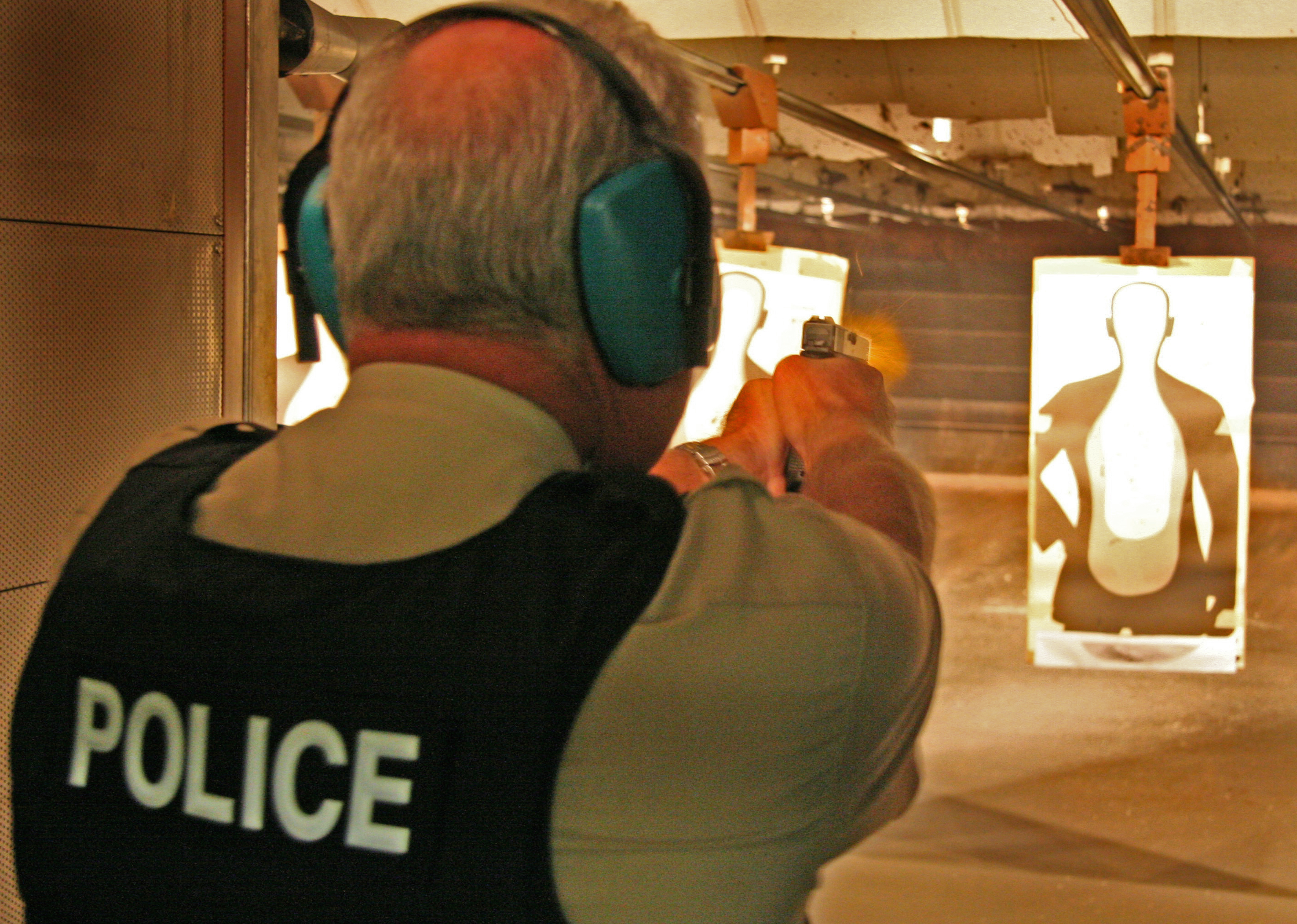
Stop Saying “Officer-Involved Shootings”

by Alex Pareene

SLUG: ME-Ammo DATE: August 23, 2007 CREDIT: James M. Threshe

Let’s talk about “officer-involved shootings.” That is the formal term, used by seemingly all American local news broadcasts, for when a cop shoots someone. Instead of saying “‘Cops’ crew member killed by police officer,” the headline is, “‘Cops’ crew-member killed after officer-involved shooting.” (It just sort of happened, after that shooting.) There is also “police involved shooting,” a term I first noticed being used by the local New York evening news team last May.

These terms are terrible and journalists should not use them. They are cop-speak. Local news reporters love nothing more than adopting cop-speak, because local news is built on manufacturing fear of crime and venerating of police officers, but both of these terms fail the crucial test of actually being coherent explanations of what happened. Of course police would invent an obfuscatory euphemism for when they shoot people – they would be fools not to try to come up with a nice way of saying “we killed someone” – but the press’ job is supposed to be to translate those euphemisms into plain English.

“Officer-involved shooting” absolves the person who actually pulled the trigger of responsibility, turning the shooting into an apparently inevitable act. The officer was just involved! As Natasha Lennard at Vice News puts it:

The phrase “police-involved shooting” is a careful construction, which, like the criminal justice system more broadly, tends to point blame away from cops. It is code for “the cops shot someone.”

To a reporter, “officer-involved shooting” should sound as grating to the ear as “bear-involved large mammal attack.”

The two terms, now ubiquitous, appear to be very successful modern coinages. Neither phrase seems to have been in usage at all before the 1970s. Usage of “officer involved shooting” soared during the 1980s and 1990s, with “police involved shooting” not catching on until the 2000s.

Screen Shot 2014-09-02 at 6.50.10 PM

Where did the term come from? The LAPD has, for years, produced an annual “Officer Involved Shooting” report (NYT) and has had an “officer involved shooting unit” since 1987 or earlier. I wouldn’t be surprised if the phrase made its way into the press’ lexicon via former LAPD chief (and racist paramilitary policing pioneer) Daryl Gates, a man who rarely shied from television cameras. (If anyone knows the actual origin of the phrase, please let us know: dish@andrewsullivan.com)

The International Association of Chiefs of Police, by the way, publishes “Officer-Involved Shooting guidelines” (pdf). The guidelines aren’t about how not to shoot someone, but more about what to do once you have shot someone. The entire document is sort of incredible in its careful consideration of the emotional and mental state of the officer, and its complete silence on the status of the person the officer actually shot. For example:

Following a shooting incident, officers often feel vulnerable if unarmed. If an officer’s firearm has been taken as evidence or simply pursuant to departmental policy, a replacement weapon should be immediately provided as a sign of support, confidence, and trust unless there is an articulable basis for deviating from this procedure. Officers should be kept informed of when their weapon is likely to be returned. Care should be taken to process and collect evidence from the officer as soon as practicable to provide an opportunity to change into civilian clothing.

It is vital that you give the officer his gun back as soon as possible, or else he might feel bad, about shooting someone.

I can’t say this definitively, because, as we’ve learned this month, there is no national database of police shootings, but American cops seem to shoot other people far more often than people shoot cops. The number of police killed by firearms peaked in the early 1970s, and has steadily declined since. It hasn’t cracked 100 officers in any year over the last decade. Meanwhile, around 400 people a year are killed in “justifiable police homicides,” according to the only official numbers available for police homicides. (And that report doesn’t even pretend to be a complete account of everyone killed by police officers.) “Police involved shooting” may not be quite as obfuscatory a phrase as it was designed to be, simply because the majority of American shootings “involving” cops seem to be shootings by cops.

(Photo: Montgomery County police officers qualifying at their indoor shooting range in Rockville, Maryland on August 23, 2007. For story on ammunition rationing due to the war in Iraq. By James M. Thresher/The Washington Post/Getty Images.)

The Death Rattle Of Islamism?

by Jonah Shepp

Graeme Wood isn’t the first writer to touch on the significance of Abu Bakr al-Baghdadi’s declaration of a “caliphate”, but his substantial exploration of the meaning of the term gets to why it’s so weird that Baghdadi has chosen it to describe his so-called Islamic State when other radical Islamist groups have steered clear of such declarations:

Mostly … caliphate declarations have been rare because they are outrageously out of sync with history. The word conjures the majesty of bygone eras and of states that straddle continents. For a wandering group of hunted men like Al Qaeda to declare a caliphate would have been Pythonesque in its deluded grandeur, as if a few dozen Neo-Nazis or Italian fascists declared themselves the Holy Roman Empire or dressed up like Augustus Caesar. “Anybody who actively wishes to reestablish a caliphate must be deeply committed to a backward-looking view of Islam,” says [University of Chicago historian Fred] Donner. “The caliphate hasn’t been a functioning institution for over a thousand years.”

And it isn’t now, either. The designation of the ISIS “caliphate” still smacks of delusional grandiosity more than anything else. There is no downplaying its brutality or denying that it would do great violence to the West if given the chance, but the Islamic State is no superpower: more than anything else, its sudden rise owes mainly to the fact that Syria and Iraq are fragile states, and its savagery has alerted the sleepwalking states of the Arab world to the threat of jihadism like never before. The enemies it is making on all sides, especially among other Muslims, would seem to suggest that ISIS may burn out nearly as quickly as it caught fire. Could the madness of ISIS be the final fever of a dying ideology?

What seems most promising to me in the backlash against ISIS is the extent to which that backlash relies on the genuine principles of Islam itself. We know that some of the fighters traveling from the West to fight alongside ISIS know next to nothing about the religion. We have evidence that jihadist movements like Boko Haram and the Taliban are widely despised in their spheres of influence. Here, Dean Obeidallah takes a look at how leaders of Muslim countries and communities are more or less unanimously condemning the false Islam of the jihadists:

The religious and government leaders in Muslim-dominated countries have swiftly and unequivocally denounced ISIS as being un-Islamic. For example, in Malaysia, a nation with 20 million Muslims, the prime minister denounced ISIS as “appalling” and going against the teachings of Islam(only about 50 have joined ISIS from there). In Indonesia, Muslim leaders not only publicly condemned ISIS, the government criminalized support for the group. And while some allege that certain Saudi individuals are financially supporting ISIS, the Saudi government officially declared ISIS a terrorist group back in March and is arresting suspected  ISIS recruiters. This can be a helpful guide to other nations in deterring ISIS from recruiting.  A joint strategy of working with Muslim leaders in denouncing ISIS and criminalizing any support appears to be working. And to that end, on Monday, British Muslim leaders issued a fatwa (religious edict) condemning ISIS and announcing Muslims were religiously prohibited from joining ISIS.

This all has me wondering if ISIS, the reductio ad absurdum of radical Islamism, doesn’t herald the downfall of that ideology altogether. Bear in mind that political Islam hasn’t always been exclusively reactionary: the first avowedly Islamic politics of the modern era, first articulated before the Muslim Brotherhood’s founders were even born, was the Islamic Modernism of Muhammad Abduh, Rashid Rida, and Jamal al-Din al-Afghani. Here were pious Muslims arguing that Islam was fully compatible with rationalism and making arguments for universal literacy and women’s rights from the same Muslim revivalist standpoint from which Hassan al-Banna and Sayyid Qutb would later espouse a more conservative vision of Islamic politics in modernity.

The illiberal strain of Arab Islamism, its Iranian counterpart, and the more radical jihadist movements that grew out of these movements (or alongside them, depending on which historian you ask) have been the major representatives of political Islam in the late 20th and early 21st centuries. There’s no reason, however, to believe that this condition is permanent or that a less reactionary form of Islamic political thought, or even an Islamic liberalism after the model of the Modernists, could not take hold in the Muslim world given the right set of circumstances. Islamism, particularly in its more extreme varieties, has long articulated an Islamic state operating under a “pure” interpretation of Islamic law as a utopian vision. Now, here is an Islamic State, a “caliphate” no less, that claims to do just that, and the outcome is rather dystopian. Torture, gang rape, slave brides, beheadings, crucifixions, and child soldiers are not what most Muslims have in mind when they imagine the ideal Islamic society. I would wager that these horrors will turn more Muslims against radical Islamism than toward it.

This is all by way of saying, as a reminder, that “Caliph Ibrahim” (Baghdadi) represents Muslims about as thoroughly as Tony Alamo represents Christians. The fact that he has attracted enough funding and followers to run roughshod over northern Iraq and eastern Syria is nothing to brush off, but it’s not winning him any friends, and it doesn’t make his ideology any less ridiculous. It’s certainly not “Islam”, at least not as any Muslim I know practices it. That’s why I suspect it will fail, like most grandiose visions of world domination do. And by radicalizing the Islamic heartland against radicalism, as it were, perhaps ISIS will take the entire edifice of radical Islamism down with it.

The Game Of Life

by Dish Staff

Simon Parkin appreciates Spermania, a video game in which “players assume the role of a plucky sperm that must navigate the kinks and curves of an undulating fallopian tube,” as a “good joke that’s well told.” He describes how the game’s creators at the Ramallah-based PinchPoint, Inc. had to overcome the barrenness of the gaming industry in Palestine:

PinchPoint is, according to the company’s co-founder and C.E.O., Khaled Abu Al Kheir, the first venture-capital-backed Palestinian video-game studio. Despite recent efforts to grow the I.T. sector in the Palestinian territories with incubators, accelerators, and venture-capital firms, there are only a handful of video-game developers in the area. Partly, this is due to the unique challenges of establishing a startup in a turbulent region. “Local events here definitely affect our focus and stress us out,” Basel Nasr, one of the game’s developers, told me. “We have no airport or control over our land borders, so travel costs extra time and money. This makes it more challenging to plan overseas trips, as well as to connect with foreign video-game studios around the world in order to learn and share our experiences.” Likewise, the lack of a vibrant industry in the region makes expanding the studio a tremendous challenge. “There’s an almost non-existent talent pool in Palestine for video-game development,” Kheir said.

As for whether the game has proven controversial in Palestine:

Contrary to the team members’ expectations, most of their friends and families supported Spermania’s subject matter. “The theme itself might be a bit controversial,” [developer Basel] Nasr, who designed the game’s cartoonish aesthetic, said. “But the art style gives the game a light and humorous feel. Most people laugh about the idea, and we haven’t received any threats. My two sons, who are five and two, enjoy the game, although they don’t know what it’s really about.”

Eric Cantor Cashes In

by Dish Staff

He’s got a plum job at Moelis, an investment bank:

Since he was elected Majority Leader in 2011, Cantor earned $193,400 a year, around $20,000 more annually than a rank-and-file member. But as Vice Chairman and Managing Director at Moelis, he will receive a $1.4 million signing bonus, $1.6 million in incentive compensation next year and a $400,000 base salary — plus reimbursement for the reasonable cost of a New York City apartment for his first 12 months, and a hotel equivalent rate thereafter.

Annie Lowrey talks about the move with Dennis Kelleher, “a former corporate lawyer and longtime Senate staffer who now heads the nonprofit Better Markets, the banking lobby’s lonely public-interest opposition in Washington.” How Kelleher understands the hire:

“Wall Street is after what it’s always buying in Washington: access, influence, and unfair advantage. And Cantor is a big catch for anybody who wants access.

Look, if you’re in congressional leadership for X number of years, you know plenty that’s worth a lot of money. If you’re the majority leader, who’s in charge of the agenda and vote counting? One of your jobs is to make sure you’re doling out favors to people. There are dozens and dozens of House members indebted to Eric Cantor for the things he’s done for them. You’re worth a lot.

“In addition, Eric Cantor knows why some things got done and other things didn’t get done. He knows why someone voted for or against a bill or amendment. He knows how to strategically target everybody in the House on the issues that anybody cares about in a way that’s close to unique. He’s not going to crudely do it in a way that puts the scarlet-L lobbyist on his lapel. He and the rest of the influence peddlers at the highest level of government work the shadows and do indirectly what the law prohibits them from doing directly.”

But Matt Levine doubts that this was primarily about avoiding regulation. He notes, “Regulatory life is already pretty easy for Moelis”:

Cantor is there as a show of importance. Important people like to deal with other important people, and every important person Moelis hires makes it more likely that other important people will deal with them. Important people with important piles of money to be spent on important advisory fees.3 It’s a simple business, but it’s the business they’ve chosen.

Beyond the importance peddling, is there influence peddling? Ehh sure probably. “Hire us for your merger because our vice chairman is important” is a perfectly reasonable sales pitch. “Hire us for your merger because our vice chairman knows a lot of people in Washington and can probably get you through antitrust approval” is … also a good pitch, no? That’s probably some part of what “advise clients on strategic matters” means.

Patrick Caldwell remarks that such career moves are commonplace for politicians of all stripes:

Democrats sell out, too. In 2010, former Indiana Sen. Evan Bayh announced his plans to retire in 2010 in a New York Times op-ed that bemoaned the the lack of bipartisan friendships in the modern Senate and attacked the influence of money in politics. Yet shortly after he left Congress, Bayh signed up with law firm McGuireWoods and private equity firm Apollo Global Management and began acting as a lobbyist for corporate clients in all but name. Less than a year later, he joined the US Chamber of Commerce as an adviser. Sen. Chris Dodd (D-Conn.) pulled a similar trick, promising “no lobbying, no lobbying,” before taking a $1-million-plus job as the head of the Motion Picture Association of America, Hollywood’s main lobbying group.

According to the Center for Responsive Politics, 417 ex-lawmakers hold lobbyist or lobbyist-like jobs.

Dogs vs Cats: The Great Debate, Ctd

by Dish Staff

In response to this post, a reader writes:

Domestic cats are very diffident companions indeed, but they are still the most popular pet in the world. Probably because they require less maintenance than dogs both psychically and physically. This makes them one of the most successful mammalian species on Earth in terms of population. They are thought to be the only animal to self domesticate. As a predator small enough to be prey they scoped the opportunity represented by humans early on and some of the Felis genus threw in their lot with us. Some behaviorists have said that cats hang around humans simply because we have better food and we share it.

Some see total opportunism in all a cat’s actions. Manipulations masked as affection so we give them what they want. It is a highly successful strategy. They probably work and/or sacrifice the least for their standard of living than any other creature on Earth. The best last word on cats was summed up by a refrigerator magnet that said “Dogs have Owners, Cats have Staff”. Cats are wired differently than dogs for sure but, in spite of their obvious temperamental differences, are also known to defend a human when retreat would be the wiser course. Maybe they value us for something more than the obvious food, warmth and safety we offer after all.

To underscore that point, the reader sends the above video of a badass cat confronting a despicable dog. Another cat lover:

Rilke was describing a cat that was also an outside hunter.  Those who have indoor cats enjoy a completely different experience.  I’ve shared the last 25 years of my life with two separate felines.

Although having completely different personalities (and I consciously do not put quotation marks around that word), they were and have been nothing but completely devoted.  It’s been very easy to read their their “emotions”, and it is very clear that most of the time they have been very attuned to mine.  My first cat, Charcot, could easily tell when I was displeased and gave me plenty of verbal sass.  In fact, it got to the point that a simple gesture on my part would result in back talk.  I even thought of trying to get her in commercials, because I could elicit that talk with a simple hand movement.

My current cat, Merlot, is the most affectionate cat I have ever met.  Upon my arrival home she greets me with a loud and extensive welcome.  When I retire at night, she is quickly up on the bed after verbally announcing her intent to jump up and join me.  And then, every night, upon arrival, she pussy-foots up to my face and starts licking the tip of my nose until I start to giggle from the “tough love” from her rough tongue.  EVERY night!  When she awakens from what I call one of her “night terrors” after a daytime nap, she begins to make crying sounds, and crawls toward me while still half-asleep, then jumps up into my arms for comfort.  Where did she learn these behaviors/responses?  While they have obviously been reinforced, they had to start on their own from somewhere.  (BTW, my ex knew better than to try and take this cat from me when we split.)

Today, people who denounce cats for their “aloofness” have no one to blame but themselves.  It’s obvious to cat lovers that these people have taken very little, if any, time and effort in creating a bond.  Dogs will bond with their owners in spite of horrendous treatment.  They are a species whose behavior very easily demonstrates the Stockholm Syndrome.  Blind loyalty, or loyalty earned?  While many appreciate the former, I’ll take the latter every time.

Blue Suede Yarmulke

by Dish Staff
https://twitter.com/jetpack/status/506072863481528320

J.J. Goldberg recalls something he learned about Elvis during a tour of Graceland back in the mid-’90s:

The very last display case, before you left the building to roam the grounds, featured the things Elvis was wearing the night he died. Included were his religious paraphernalia, which he “always wore,” the docent told me: a cross and a Chai pendant (visible [here]). Curiouser and curiouser.

When I got back to my hotel I called Memphis blues historian Robert Gordon, whom I knew vaguely, to find out what the heck this was all about. He said there were stories about Elvis having had some Jewish ancestry, but I would do well to call disc jockey George Klein, the elder statesman of Memphis rock ’n’ roll. It seems Klein had been lifelong friends with Elvis, starting in junior high. He was a member of the Memphis Mafia, the gang of childhood buddies who surrounded Elvis, traveled and partied with him and handled his affairs on the road.

I got Klein on the phone right away. He couldn’t have been nicer. He explained to me that Elvis’s great-great-grandmother had been Jewish and Elvis was very proud of it. Oh, I said, you mean his father’s father’s …

“No,” Klein said. “His mother’s mother’s mother’s mother.”

“So Elvis was —“

He cut me off. “You said it, bubba, not me.”

He told me that Elvis had put a Star of David on his mother’s gravestone. You can see it [here]. You won’t see it on her grave at Graceland, though. She was originally buried at Memphis’ Forest Park Cemetery, but after Elvis died in 1977 there was an attempt to rob his grave, and so he and his mother were reinterred at Graceland. The new gravestone, lacking Elvis’s active attention, didn’t get a star. According to Sid Shaw, the controversial British Elvisologist who runs the Elvisly Yours fansite, it was Elvis’s father Vernon who saw to it that there wouldn’t be a star on the new, elaborately Christian stone. One of Elvis’s closest lifelong friends, Marty Lacker, claimed in an interview years later that Vernon was “anti-Semitic.” …

Another Jewish member of the Memphis Mafia was Marty Lacker, sometimes described as his personal sounding board and, along with Elvis’s cousin Billy Smith, the closest Elvis had to “true friends.” Yet another member was Larry Geller, Elvis’s hairdresser and spiritual guru in the study of Zen Buddhism and Kabbalah.

Apparently Elvis’s manager and image-maker, Colonel Tom Parker, didn’t think much of Elvis surrounding himself with Jews, particularly with Larry Geller’s Kabbalah teachings. Unlike Vernon, Colonel Tom had nothing against Jews, I’ve been told. It was just that the colonel didn’t think it would help Elvis’s image as an American idol in the heartland if it were known that he identified himself in some fashion as Jewish.

Syria’s War At Israel’s Door

by Jonah Shepp

The Syrian civil war took an interesting turn late last week as fighters from the al-Qaeda-affiliated Jabhat al-Nusra overran the Quneitra checkpoint between Syria proper and the Israeli-occupied Golan Heights and captured or surrounded dozens of UN peacekeepers from Fiji and the Philippines. Juan Cole finds precisely none of this surprising:

The London-based Al-`Arabi al-Jadid reports that Israeli Gen. Aviv Kochavi, now head of the Northern Command but until recently chief of military intelligence, has for two years been warning that the Syrian civil war could spill over onto Israel. Haaretz has also shown alarm at the developments. Not only is the Succor Front consolidating its hold on Golan, but the so-called Islamic State of Iraq and the Levant (ISIL or ISIS) is alleged to be infiltrating Syrian villages near Israel in the north. The Syrian army, once responsible for Israel-Syria border security, has “evaporated” after losing battles with the militants. The likelihood that Israel could in the long run be completely insulated from a raging civil war right next door, which has displaced 3 million abroad and more millions internally, was always low. The view that it is good for Israel when the Arabs fight one another is a glib and superficial piece of cynicism challenged by seasoned observers such as Gen. Kochavi.

One of the many side effects of Israel’s regional isolation is that it tends to treat conflicts in and among its neighbors as the Arabs’ problems and pay them relatively little mind, compared to the interest one might expect a country to take in violence so close to its borders. This isolation emerges from the intractability of the conflict and, to my mind, represents a noteworthy obstacle to regional peace.

The concept of linkage, i.e., that the Israeli-Palestinian conflict is the “core conflict” of the Middle East from which most or all other chaos derives, is too facile and reductive to account for the region’s many and manifold problems, but it’s not complete bullshit either. And even if Israel is not the proximate cause of these external conflicts, it certainly ought to be worried about them, especially considering that the plight of the Palestinians has served as an excellent recruiting and propaganda vehicle for Islamist radicals throughout the greater Middle East.

Because Israel remains technically at war with most of its neighbors, because its leadership expects to remain so indefinitely, and because overt cooperation with Israel remains anathema to Arab governments, the most powerful military in the Middle East has little involvement, or even interest, in addressing regional security challenges like the Syrian civil war, the failure of the Iraqi state, and the ISIS menace that emerged from the confluence of these crises. One of the often overlooked benefits of a permanent peace settlement is that it would enable Israel to function in regional diplomacy and politics as something other than a pariah state. You may believe that “the Arabs” would never do business with “the Jews”, but of course, Jordan, Egypt, and Saudi Arabia already do, albeit quietly and probably not as effectively as if they could do so openly.

Just imagine how quickly the well of ill will toward Israel would evaporate if Israel were able to participate in facing the threats endemic to the region, whether that means Islamist militancy or water and food scarcity. But of course, as long as the Palestinians remain under occupation, without a state, and with no closure or reparations for the refugees, that sort of cooperation can never happen. Maybe Netanyahu and his allies prefer it that way, but if so, they are awfully short-sighted. That’s why I stand by my suggestion that Israel, not America, offer to assist in ridding the region of ISIS. If nothing else, it would be very interesting to see how such an offer would be received. And it’s also why I think Israel has more to gain than to lose in negotiating a permanent peace deal that is maximally generous to the Palestinians. Goodness knows some things are more valuable than land.

Is The Ukraine War All About NATO?

by Jonah Shepp

The war between Ukraine and Russia continues to escalate as heads of NATO member states arrive in Wales for a summit on the crisis. Russia has announced (NYT) that it is revising its military strategy in response to what it sees as belligerent behavior on the part of NATO, including the prospect of expanding the alliance to include Ukraine. Of course, Putin doesn’t help matters by telling European officials that he could “take Kiev in two weeks”, as he apparently did in a recent phone conversation with José Manuel Barroso. Marc Champion takes him seriously:

Earlier this year it was only those on the lunatic nationalist fringe in Moscow who talked about taking Kiev. Now it’s Putin. This is part of a disturbing pattern. For a long time, only ultranationalists talked about a place called Novorossiya, or New Russia. In April, Putin took that up, and by June the separatists in Ukraine had merged their self-proclaimed republics to found Novorossiya. So what are the Russian lunatics talking about now? Ethnic cleansing of Ukrainians in Novorossiya, and attacking Poland and the Baltic states.

I have no idea where Putin is going with this, and I think it’s wiser not to speculate too much, but he seems to be in the thrall of an ideology that lends itself to the logic of imperial aggression, as do his soaring poll numbers, so I wouldn’t be surprised if he continued to escalate. On the other hand, as John Mearsheimer puts it in an essay (paywalled) on the origins of the Ukraine crisis, Putin’s belligerence didn’t come from nowhere:

Washington may not like Moscow’s position, but it should understand the logic behind it. This is Geopolitics 101: great powers are always sensitive to potential threats near their home territory. After all, the United States does not tolerate distant great powers deploying military forces anywhere in the Western Hemisphere, much less on its borders. Imagine the outrage in Washington if China built an impressive military alliance and tried to include Canada and Mexico in it. Logic aside, Russian leaders have told their Western counterparts on many occasions that they consider NATO expansion into Georgia and Ukraine unacceptable, along with any effort to turn those countries against Russia — a message that the 2008 Russian-Georgian war also made crystal clear.

This is a very important point that even Ukrainian chauvinists ought to grapple with: we would not be where we are if Western leaders had not chosen to ruffle Russian feathers by inching the NATO umbrella steadily eastward since the end of the Cold War. That is not the same as saying that this is all America’s fault, but it does acknowledge the basic facts that actions have consequences, that countries tend to respond rationally to real or perceived threats, and that Putin had every reason to believe that Ukraine would eventually join NATO absent some kind of Russian intervention. Putin’s ethno-religious and political ideologies should be judged independently on their merits (or lack thereof), but his belief that the Cold War never ended is readily borne out by NATO’s expansion, as well as other signs, such as the IMF’s misguided handling of post-Soviet Russia in the 90s. Putin can be a bad dude in general and not solely to blame for this crisis in particular, just as surely as he can ride a horse shirtless and chew gum at the same time.

On the ground, meanwhile, pro-Russian separatist forces are advancing closer to the port city of Mariupol. The situation seems terribly precarious, and it’s not clear how NATO will respond. In the same piece cited above, Marc Champion previews what plans will be on the agenda at the NATO summit and offers his take on whether they will work:

It appears that the NATO summit this week will do two things. First, the alliance is expected to agree to equip bases in Poland and the Baltic states and begin a “persistent rotation” of a few thousand troops through them. That wording amounts to Putin-like double-speak, to get around commitments the alliance made in 1997 not to position permanent bases in eastern Europe. Second, it seems NATO will devote a 10,000-strong rapid reaction force to deploy eastward at short notice. This would all be good, but it needs to be done in such a way that Putin clearly gets that when it comes to the Baltic states in particular, NATO’s commitment is ironclad. If not, he will test it.

Jakub Grygiel and A. Wess Mitchell advocate a more muscular response:

Russia’s assault on Ukraine is certainly not an invasion of a NATO country, but it cannot but be seen also as a test run of sorts. It is a violent way of asking: What would NATO, and the U.S., do when a small group of unmarked armed men takes over a border village in Latvia or Poland? What is the response to a few Russian tanks getting “lost” in Lithuania? And more broadly, what is NATO’s response to Russian power suddenly coming much closer to its eastern frontier? A simple restatement of NATO’s Article 5 is not sufficient: extended deterrence was not designed to counter such threats. A readjustment of NATO bases and U.S. presence in Europe is needed.

Matthew Gault argues that the alliance’s strategies, developed during the Cold War to repel a traditional invasion, are useless against the covert tactics of Russian maskirovka:

It’s no wonder that Latvia and other Baltic area NATO countries asked the alliance to deploy more troops within their borders—and NATO agreed. Secretary General Anders Fogh Rasmussen told The Guardian that NATO would build more bases in Eastern Europe. But new bases and extra troops will do little to deter maskirovka. If Russia can badly undermine a country without actually invading—withholding direct military force until the conditions are just right—then NATO troops could end up just standing around while the society around them disintegrates. The collapse could slowly render a traditional allied military presence politically unsustainable—it might look like an occupation—while simultaneously giving Russia an excuse to eventually send in “peacekeepers” whose true intentions are anything but peaceful. That’s how 21st-century maskirovka beats dated Cold War thinking.

Reid Standish wonders if Putin’s popularity will take a hit as more Russian soldiers turn up dead in Ukraine. He also notes that the Kremlin is trying to keep such casualties under wraps:

Putin has seen his approval ratings sky-rocket amid the fighting in eastern Ukraine, but mounting casualties are likely to undercut the political benefits Putin has accrued from his stand-off with the West. “Short, bloodless, victorious wars are popular everywhere,” Steven Pifer, a former U.S. ambassador to Ukraine and the director of the Arms Control and Non-Proliferation Initiative at the Brookings Institution, told Foreign Policy. “It’s only afterwards, when the casualties begin to mount, that people start to ask, ‘Was that really worth it?’” Russia’s unwillingness to honestly report on the deaths of its soldiers harkens back to the days of the Soviet Union, where the fate of servicemen returning from Afghanistan was covered up.

The Passing Of A Pigeon

by Dish Staff

The last passenger pigeon died 100 years ago yesterday. Elizabeth Kolbert mulls over the mystery of the bird’s extinction:

In his recent book “Lost Animals: Extinction and the Photographic Record,”MarthaErrol Fuller, a British author, argues that an “additional factor” must have been at work in the species’ extinction, because “in a land as vast as the United States there can be no mopping-up hunting for a species as small as a pigeon.” (Fuller’s book contains a grainy and not particularly flattering photo of Martha standing in her cage in Cincinnati.)

Some have argued that the “additional factor” was deforestation; by this account, it’s no coincidence that the passenger pigeon went extinct right about the same time that land clearing in the eastern U.S. reached its maximum extent. Others speculate that the passenger pigeon was one of those animals that require great densities to survive.

She adds that, whatever the answer, “the mystery should give us pause” because “species that seem today to be doing fine may be sensitive to change in ways that are difficult to foresee.” Carl Zimmer is on the same page:

[David Blockstein, a senior scientist at the National Council for Science,] sees many lessons in its disappearance that apply to protecting threatened species today.

It’s a mistake to assume that a species with a big population is immune to extinction, for example. “The endangered species category is really all based on numbers, rather than biology,” he explains. Even a species with billions of members may have a biological Achilles’ heel that makes it vulnerable to human pressure.

To appreciate a species’ true risk, we have to understand not just its biology, but also our own technological advances. In the 1800s, the new technology included the telegraph and trains. Now it includes global positioning systems, cell phones, and huge fishing vessels. “We have factory ships that can vacuum up the ocean,” says Blockstein.

Mark Fischetti highlights efforts to resurrect the species:

The hundredth anniversary of Martha’s death is a sad occasion but it is also marked by an intriguing possibility. Ben Novak, a researcher at the University of California, Santa Cruz, is trying to use genetics to bring them back from the dead. As a recent article by my colleague David Biello explains, Novak has sequenced the genomes of 32 birds that are preserved at various museums and labs and is inserting edited version of those genomes into living band-tailed pigeons, a close relative.

If he succeeds—and that’s a big if—Martha’s newly created kin could one day darken the skies again.

Update from a reader:

Just last week I heard Joel Greenberg, author of A Feathered River Across the Sky, speak about extinction at the Field Museum in Chicago.  I have no idea why anyone would be confused about the factors that combined to lead to the extinction of what was once the most numerous vertebrate on the planet.  Its forests were indeed diminished, but human predation did the species in (as we probably did in prehistoric megafauna across the Americas and Eurasia).  And to relate it to our contemporary world:

The passenger pigeon went extinct in part due to … lack of government regulations for hunting.  They were hunted relentlessly (and hunters used technology like telegraphs to locate the flocks), because they were so numerous.  They laid one egg a year per nesting pair, but were not allowed time off from hunting to breed, and so billions became zero.  Their extinction, along with the near-extinction of the American bison (aka buffalo) was one of the leading causes of laws regulating hunting and habitat in the US.

The Guardian review of Greenberg’s excellent book is here.

(Photo: The last passenger pigeon, Martha, named after George Washington’s wife, died in her cage at the Cincinnati Zoo in 1914. From Wikimedia Commons)

Our Microbes, Ourselves

Ed Yong reviews the first results from the Home Microbiome Project, which seeks to “map” the ecologies of microbes we carry with us wherever we go. What researchers learned after analyzing six weeks’ worth of participants’ swabs from around their homes:

[I]t rapidly became clear that each home has a distinctive microbiome, which comes largely from the people who live in it. Light switches and doorknobs look like hands. Floor looks like feet. Kitchen countertops look like skin. We turn our homes into microbial reflections of ourselves.

This happens quickly. As soon as we move into a space, we inject microbes into it, and those bugs colonise the area within 24 hours. One of the young couples demonstrated this in the starkest way:

at the start of the study, they were staying in a hotel. After they moved, their new home was microbially indistinguishable from the hotel room. “People always say, “Ewwwww, someone else was in this room and it has their microbes all over it.” That’s irrelevant,” says [researcher Jack] Gilbert. You are constantly overwriting the microbes in the world around you with your own. When you move house, your microbial aura moves too.

Yong shares why Gilbert decided to welcome a new addition to his family – a shelter dog named Captain Bo Diggley – after seeing the study’s results:

Dogs supercharge the flow of microbes between people and their homes. If two people share a house, they also tend to share their microbes, and couples do so more than mere roommates. But if there’s a dog around, that traffic surges. Dogs also increase the microbial diversity of a home by bringing in bacteria from the outside world. In a world where the presence of bacteria is equated to filth and squalor, some people might see that as a bad thing. Gilbert saw it as a plus. We need microbes to help train our immune systems and to ensure that they develop properly. “We wanted to make sure that our kids had that capacity,” he says.