God In The Hands Of American Sinners

by Dish Staff

In an interview about his new book, Our Great Big American God, Matthew Paul Turner dissects the problems with an all-too-Americanized God, our habit of “affecting, reimagining, shaping, and changing God’s story”:

God was never meant to be a nationalized deity. The very idea that God would showcase geographical favorites or advance the kingdom of one at the expense of another or several others goes against many of Jesus’s basic teachings. Moreover, our relationship with God has caused a large majority of America’s Christians to posses an elitist attitude or worldview, at times even imperialistic. Rather than humility, mercy, and redemption, God seems to have made us controlling, know-it-alls, materialistic, and far too certain of what God thinks about political, social, and spiritual issues.

Throughout our history we’ve branded God into a deity that works for us, one that mixes well with American values, one that agrees with our wars, and one who not only adheres to our way of life, in many cases, our way of life is God’s ideal, which we often suggest is one of the reasons he blesses us with prosperity. The biggest issue perhaps is that many of us are so comfortable with our American God, so certain of his ways, that to believe that we might be wrong is impossible.

In an excerpt from the book, Turner explores the complex legacy of Jonathan Edwards, the theologian and preacher most famous for his hellfire and brimstone sermon, “Sinner in the Hands of an Angry God,” and whom he identifies as one of the key influences on the American understanding of the divine:

Jonathan Edwards changed the story of America’s God. He changed how the people of his time engaged God, editing a theology that was often portrayed harshly and dogmatically. He made strides to shape it with words into an almost beloved relationship between a grandiose God and a broken and depraved American heart. His words set the stage for what would become a steady foundation for America’s God to revolt against the Old World and bring about revolution. Historian Perry Miller suggests that America’s Enlightenment began and ended with Jonathan Edwards. And Edwards played a most defining role in bridging the space between Puritanism and what would eventually become American evangelicalism.

It was Edwards’s talent as a writer that, on one hand, makes him unforgettably important to so many still today. Preachers like John Piper, Tim Keller, Mark Driscoll, and others wouldn’t have much to write or preach about without Edwards dedicating the majority of his existence to literally emoting his version of John Calvin’s God onto the page. But it’s that same talent, that profound ability to create rich imagery with sentences and paragraphs, that would ultimately backfire on him. Rather than his gift becoming defined by his thoughts on God’s glory or God’s beauty, Edwards’s words helped to Americanize God’s hell, turning this country’s doctrines about fire and brimstone into HELLTM, an idea that would eventually become a method for introducing millions to God.

His thoughts on the future of this American God:

We’re beginning to see conservative and progressive ideas about God morphing together. We’re seeing younger Christians shift their ideas about God’s thoughts on homosexuality, and other social justice issues. We’re seeing, perhaps, more understanding of how God come to be. On the flip side, there’s this Tea Party God: they’ve dug in their heels, and created this God. It’s like they’re saying, ‘You didn’t like our evangelical God? OK, then wait until you get to know our Tea Party God!’ In some ways, this God is an asshole.

But again, what you’re seeing — is it God that you’re seeing or just reflections of people? We change, and God changes with us. We should be careful about what our actions and words suggest about God. Rather than forcing God to be in politics, or to be the middleman on social issues, we should bring God back to our communities, and invite everyone to the table.

Dogs vs Cats: The Great Debate, Ctd

by Dish Staff

Henri Cole cites Rilke’s thoughts on the age-old divide:

Look at the dogs: their confident and admiring attitude is such that some of them appear to have renounced the oldest traditions of dogdom in order to worship our own customs and even our foibles. It is just this which renders them tragic and sublime. Their choice to accept us forces them to dwell, so to speak, at the limits of their real natures, which they continually transcend with their human gazes and melancholy snouts.

But what is the demeanor of cats?—Cats are cats, briefly put, and their world is the world of cats through and through. They look at us, you say? But can you ever really know if they deign to hold your insignificant image for even a moment at the back of their retinas. Fixating on us, might they in fact be magically erasing us from their already full pupils? It is true that some of us let ourselves be taken in by their insistent and electric caresses. But these people should remember the strange, abrupt manner in which their favorite animal, distracted, turns off these effusions, which they’d presumed to be reciprocal. Even the privileged few, allowed close to cats, are rejected and disavowed many times.

Montaigne’s take:

“When I play with my cat”, he wrote, “who knows if I am not a pastime to her more than she is to me?”

He borrowed her point of view in relation to him just as readily as he occupied his own in relation to her. And, as he watched his dog twitching in sleep, he imagined the dog creating a disembodied hare to chase in its dreams – “a hare without fur or bones”, just as real in the dog’s mind as Montaigne’s own images of Paris or Rome were when he dreamed about those cities. The dog had its inner world, as Montaigne did, furnished with things that interested him.

Meanwhile, Jessica Love ponders why dogs are “so good at reading our nonverbal cues—so much better, even, than chimpanzees and bonobos, to whom we’re more closely related”:

Researchers now believe that dogs’ ability likely evolved during domestication, probably due to selective breeding. There’s some disagreement about whether our own ancestors were selecting for communicative skills specifically (perhaps to create better hunters, retrievers, or herders), or whether this prowess was merely a by-product of selecting for something else, like tameness.

But though the sensitivity dogs exhibit is truly impressive, it nonetheless falls short of what humans—even very young ones—are capable of. Infants will communicate information to their adults when they know that it is of interest to the caregivers; dogs will only do so if they are the ones interested. Young children also pick up on information conveyed to a third party; dogs, not so much. And a brand new study finds that two-year-old humans are much better than dogs at gauging from a situation whether a communicative signal is unintentional (and thus ignorable).

Meanwhile, the cat—mere feet away from a tuna treat, and despite the best efforts of an insistent pointing hand—does nothing.

Thoughts from Andrew and Dish readers here.

A Founder Left Behind By The Left

by Dish Staff

640px-Alexander_Hamilton_portrait_by_John_Trumbull_1806

Christian Parenti advises liberals to look to Alexander Hamilton for inspiration, not Thomas Jefferson. He especially praises Hamilton for his far-reaching economic insights:

Hamilton was alone among the “founding fathers” in understanding that the world was witnessing two revolutions simultaneously. One was the political transformation, embodied in the rise of republican government. The other was the economic rise of modern capitalism, with its globalizing networks of production, trade, and finance. Hamilton grasped the epochal importance of applied science and machinery as forces of production.

In the face of these changes, Hamilton created (and largely executed) a plan for government-led economic development along lines that would be followed in more recent times by many countries (particularly in East Asia) that have undergone rapid industrialization. His political mission was to create a state that could facilitate, encourage, and guide the process of economic change — a policy also known as dirigisme, although the expression never entered the American political lexicon the way its antonym, laissez-faire, did.

Parenti goes on to suggest how an appreciation of Hamilton might connect with a pressing contemporary issues – climate change:

Even today, Hamilton’s ideas about state-led industrialization offer much. Consider the crisis of climate change. Alas, we do not have the luxury of making this an agenda item for our future post-capitalist assembly. Facing up to it demands getting off fossil fuels in a very short time frame. That requires a massive and immediate industrial transformation, which must be undertaken using the actually existing states and economies currently on hand. Such a project can only be led by the state — an institution that Hamilton’s writing and life’s work helps us to rethink.

Unfortunately, many environmental activists today instinctively avoid the state. They see government as part of the problem — as it undoubtedly is — but never as part of the solution. They do not seek to confront, reshape, and use state power; the idea of calling for regulation and public ownership, makes them uncomfortable.

(Portrait of Hamilton by John Trumbull, 1806, via Wikimedia Commons)

The Disparities In Dining Out

by Dish Staff

Screen Shot 2014-08-29 at 1.42.10 PM

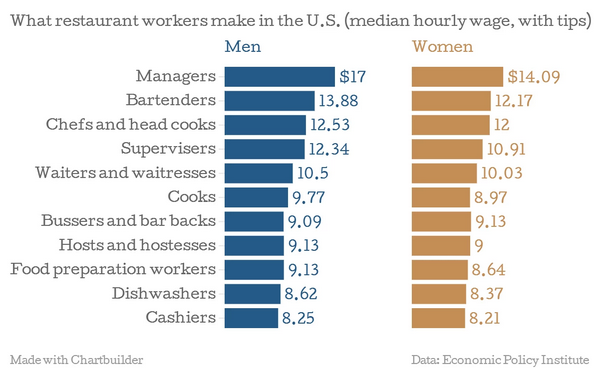
Roberto Ferdman flags a report that reveals gender wage gaps in the restaurant industry, even when tips are accounted for:

The median hourly wage paid to women is less than it is for men in all but one of the eleven jobs surveyed in a report by the Economic Policy Institute. In some cases, the gap is slight—for cashiers, dishwashers, food preparation workers, and hosts and hostesses, it’s a matter of cents. But in others, including supervisors and bartenders, the difference is well over a dollar. For managers, the highest earning occupation, the disparity was nearly three dollars per hour.

“This is what we identify as pay discrimination,” said Valerie Wilson, an economist at the Economic Policy Institute. “The work women are doing is being valued at less than the work men do in the same job.” Women, however, aren’t merely being paid less to do the same job—they’re being paid less and less compared to men as they move up in the ranks, too. Some of the highest earning occupations—managers, bartenders, and supervisors—are also the ones with the largest gender pay gap.

Drum adds his two cents:

There are other reasons besides gender for pay gaps, and the EPI report lists several of them. Whites make more than blacks. High school grads make more than dropouts. Older workers make more than younger ones. You’d need to control for all this and more to get a more accurate picture of the gender gap.

But in a way, that misses the point. There are lots of reasons for the gender gap in pay. Some is just plain discrimination. Some is because women take off more time to raise children. Some is because women are encouraged to take different kinds of jobs. But all of these are symptoms of the same thing. In a myriad of ways, women still don’t get a fair shake.

But that’s not to say that the business is especially kind to men, either. Tom Philpott pulls some other salient findings from the EPI report, which paints a grim portrait of restaurant workers overall:

Restaurant workers’ median wage stands at $10 per hour, tips included—and hasn’t budged, in inflation-adjusted terms, since 2000. For nonrestaurant US workers, the median hourly wage is $18. That means the median restaurant worker makes 44 percent less than other workers. Benefits are also rare—just 14.4 percent of restaurant workers have employer-sponsored health insurance and 8.4 percent have pensions, vs. 48.7 percent and 41.8 percent, respectively, for other workers. …

As a result, the people who prepare and serve you food are pretty likely to live in poverty. The overall poverty rate stands at 6.3 percent. For restaurant workers, the rate is 16.7 percent. For families, researchers often look at twice the poverty threshold as proxy for what it takes to make ends meet, EPI reports. More than 40 percent of restaurant workers live below twice the poverty line—that’s double the rate of nonrestaurant workers.

Off With Their Heels

by Phoebe Maltz Bovy

https://twitter.com/BuzzFeedFashion/status/497013670472589314

Rebecca Willis ponders the eternal question of why (some) women wear high heels:

We’ve heard it all before and it is, of course, a conundrum. Women say they feel empowered in heelsperhaps because they can look men in the eyewhen in reality they are physically handicapped by them. A lot of ink has been spent over the years trying to explain why we still wear them. To summarise: a high heel is sexual, changing the way we move, signalling passivity and availability. It’s misogynist, rendering women decorative and in need of a strong arm to hold. It’s a sign that we’ve escaped the prison of domesticityhave you tried doing housework in heels? And it’s a status symbol, as tallness is associated with privilege and good nutrition. Even so, many women, women with brains enough to understand that feet are a feminist issue, still want to wear heels. The long view may be that we’re going through a patch of cultural turbulence, but the close-up is that we really want that sense of lift. So for now let’s accept the existence of that desire, however ideologically unsound it may be. …

You have only to go to the chemist’s and stand in front of the shelves of gel insoles, corn pads, blister plasters and heel grips to see that footwear can be torture. And women are more tortured than men: according to the American Academy of Orthopaedic Surgeons, women are two to four times more likely to have hallux valgus (that’s bunions to you and me) and four to five times more likely to have hammer toes. If we could make ourselves immune to fashion and novelty, we’d be better off spending our money on a couple of custom-made pairs of shoes rather than lots of the off-the-shelf, one-shape-fits-all variety.

But what if this question is not, in fact, eternal? In a piece accompanied by a sketch by Konstantin Kakanias of fashion’s A-list in their preferred flats, Sadie Stein (NYT) announces a new, hobble-free era:

Today, all the old tropes and even the recent ones (Birkenstocks, Tevas, shower sandals) have been taken out of the box and made to look fresh and new. You can find driving moccasins, once an icon of staid WASPiness, bristling with ironic attitude, deck shoes in the farthest reaches of Brooklyn.

In the summer heat, urban women resembled Greek goddesses in strappy sandals. On runways from Marc by Marc Jacobs to Chanel, the look was bright sneakers and flat boots. Rather than teetering to their town cars, top fashion editors and stylists were suddenly able to hop on Citi Bikes or toodle through the Tuileries. From Lanvin’s laceless oxfords to the Row’s crocodile brogues, Marni’s tasseled loafers to riffs on Dr. Martens at Céline and Alexander McQueen — these are shoes you want to walk in. Nothing could feel more grown-up right now.

So, could this be it? If Fashion says heels are done, does that mean the next big thing will be higher heels than ever before? Most likely. But as a short, shoe-loving woman who was avoiding heels before it was cool, I vote for the flat-shoe trend to go on indefinitely (oxymoronic as that wish may be).

Looking Forward to Labor Day

by Bill McKibben and Sue Halpern

dish_beachchairs

We used to think we worked pretty hard, but that was before we agreed to help out this week in Andrew’s absence. As Dish guest-bloggers we were each doing three posts a day, and the pressure seemed unrelenting – we’d sigh the minute one went up on the site because it felt like the countdown clock was ticking already. It felt like Lucy on that chocolate assembly line. We’ve always admired this place, but now we’re in a kind of awe: we have no idea how the staff and the proprietor keep it up day after day (and we think Maureen Dowd et al are living the high life – I mean, once every three days? Come on.)

We realized, too, that though we’ve always thought of ourselves as opinionated, there are actually vast swaths of current events on which we have no useful thought at all. Vladimir Putin is clearly a bad guy, but God knows what we should do about him. Ditto Libya. There are other questions, happily, where we can subcontract our opinion-forming to each other: anything to do with computers and internets, for instance, is Sue’s domain, for instance. Ditto butterflies, dogs, and how the brain works. Bill, as you may have noticed, is good on climate change and also climate change. But that leaves a little uncovered; which is why the crowd wisdom that comes with a Dish subscription seems like such a good value.

The one other thing we both know a little about is journalism.

We’ve written for pretty much everyone there is to write for over the years. It’s an honor to have added the Dish to that list: there’s good work going on here, and in quantity. We always knew Andrew was remarkable;  now we have a sense of the depth of the bench. Thanks to them for making this week so smooth for us.

Since we’re good Vermonters, we’ll conclude with a small going away present, our very own (and very simple) granola recipe, which we make each and every week. Since soon the days will start to cool, you might want to make it too:

Preheat oven to 250

In big bowl, mix 10 cups oats with a cup or two or even three of chopped pecans and cashews

Mix in 1/2 cup oil, 1 cup maple syrup, and 1/2 cup water

Spread over two lightly greased cookie sheets

Bake 30 minutes, turn over with a spatula

Return to over for 30 minutes and then, when the timer goes off, simply turn off the heat and let it sit in the over for a few hours till it cools

In our experience, if you eat this, you will start to favor single-payer health insurance, despise big oil companies, and hope Bernie Sanders runs for president. It’s our second-favorite morning Dish.

(Photo by Robert S. Donovan)

Lessons From A Long-Time Loner

by Dish Staff

dish_mainemoonlight

Christopher Knight spent nearly three decades living alone in the woods of Maine, earning him the nickname “the North Pond Hermit,” before getting caught for theft and sentenced to prison. Michael Finkel asked Knight about what he learned from a solitary, hardscrabble existence:

Anyone who reveals what he’s learned, Chris told me, is not by his definition a true hermit. Chris had come around on the idea of himself as a hermit, and eventually embraced it. When I mentioned Thoreau, who spent two years at Walden, Chris dismissed him with a single word: “dilettante.”

True hermits, according to Chris, do not write books, do not have friends, and do not answer questions. I asked why he didn’t at least keep a journal in the woods. Chris scoffed. “I expected to die out there. Who would read my journal? You? I’d rather take it to my grave.” The only reason he was talking to me now, he said, is because he was locked in jail and needed practice interacting with others.

“But you must have thought about things,” I said. “About your life, about the human condition.”

Chris became surprisingly introspective.

“I did examine myself,” he said. “Solitude did increase my perception. But here’s the tricky thing—when I applied my increased perception to myself, I lost my identity. With no audience, no one to perform for, I was just there. There was no need to define myself; I became irrelevant. The moon was the minute hand, the seasons the hour hand. I didn’t even have a name. I never felt lonely. To put it romantically: I was completely free.”

That was nice. But still, I pressed on, there must have been some grand insight revealed to him in the wild. He returned to silence. Whether he was thinking or fuming or both, I couldn’t tell. Though he did arrive at an answer. I felt like some great mystic was about to reveal the Meaning of Life.

“Get enough sleep.”

He set his jaw in a way that conveyed he wouldn’t be saying more. This is what he’d learned. I accepted it as truth.

(Photo by Flickr user Ctd 2005)

Stick To Fiction?

by Dish Staff

Paul Seaton pans novelist Marilynne Robinson’s political commentary, claiming that her “high intelligence and humane sensibility seem to flee her when she looks to her right”:

In literary terms, Marilynne Robinson is a national treasure. In political terms, not so much. “When she was good, she was very, very good, but when she was bad she was horrid,” as the nursery rhyme has it. Robinson might not even mind my saying that, by the way. As an essayist she deliberately tries to make countercultural moves, intellectually and spiritually.

Unfortunately, Robinson’s political views as expressed in her latest collection, When I Was a Child I Read Books, are far from countercultural if by that we mean unusual. They’re off-the-shelf liberal. Like her hero, President Obama, she is disinclined to be fair to those who disagree with her—social conservatives, Tea Partiers, Republicans, the Right. Social conservative concerns for the moral standards and social fabric of the country, reasonable apprehensions about entitlements, the national debt, the injustice of burdening following generations because of our shirking of responsibility, and serious concerns about constitutional infidelity, become distorted by her into ungenerosity and rank partisanship.

Carl Scott adds:

Robinson, a Calvinist, is arguably a product of an earlier time, but it remains significant that our liberal churches provide a religious home for people like her. It is out of such churches, I dare to hope, that there may come the leaders necessary to reform/moderate/cleanse the Democratic Party, or at least one wing of it, if the hour for that long-needed movement ever arrives. And she is of course right that there is a deep connection between modern democracy and Calvinism, as our Ralph Hancock has explored.

Peter Lawler also offers measured appreciation for some of her ideas:

Robinson’s narrative is about the authentically Puritanical American Left, which wouldn’t, of course, be embraced by most of our liberals today. I wish more of today’s Christian leftists would at least join her battle against scientism, against those who deny the real existence of the wondrous love that’s at the foundation of the truth about human exceptionalism. The ”social justice” emphasis of our liberal churches these days gives little to no attention to the actual theology she’s recovered that once justified generous political progressivism.

The Senior Gypsy Economy

by Sue Halpern

dish_trailerpark

Every so often a random confluence of articles makes it possible to see into the future with the clearest of crystal balls. In this case, the articles come from The New York Times and Harper’s, and the story they tell together should give us all pause. For years we’ve heard about how Americans were lousy savers, and how a significant segment of the population had done a poor job of planning for retirement. We heard less about what was going to happen to those people when they were no longer steady earners. But now we know.

Writing in the Times’ money column, David Wallis puts a romantic sheen on it: “Increasingly, Retirees Dump Their possessions and Hit the Road.” Shedding the house and mortgage and sleeping on other people’s couches in one’s late middle age is shown to be a wonderful adventure. One can travel the world, help others, live unencumbered. Here’s fifty-year-old Stacy Monday, who used to be a paralegal:

“I sold everything I had,” Ms. Monday recalled earlier this summer from San Francisco before she headed to Las Vegas, Dallas, Memphis and Knoxville. “I paid off all of my debt. I have no bills and no money.” She estimates that she now spends $150 a month — sometimes less if she is saving up for a flight — and earns a modest income through “odds-and-ends jobs,” as well as the tip jar on her blog.

To stick to her tight budget, Ms. Monday volunteers for nonprofits and organic farms in exchange for room and board or finds free places to stay through Couchsurfing.org. The company puts its membership of people 50 and older at about 250,000.

So that is one vision of the future: American retirees, unrooted, becoming, in the words of one of them, “Bedouins.”

And here is another:

older Americans who can’t retire, and don’t have a house and possessions to sell, also roaming around, putting miles on their vehicles as they look for work here and there. According to yet another Times piece, “the number of workers employed through temp agencies has climbed to a new high — 2.87 million, according to the Bureau of Labor Statistics, and they represent a record share of the nation’s work force, 2 percent.” And some of them, it turns out, according to Jessica Bruder in Harper’s (subscribers only), live hand-to-mouth in their trailers, in Joad-like encampments, having been recruited to harvest beets or pull items for Amazon packages at barely minimum wages. According to Bruder, “Amazon first hired a handful of migrant full-time RVers in 2008 through a program the company later named CamperForce. As of 2014, it had expanded to employ some 2,000 workers, according to a recruiter I met in Quartzsite, Arizona.”

And she goes on:

The ads [for CamperForce] are surreal. They sound like an invitation to summer camp, and not just the ones for Amazon jobs. “Feel like a kid again!” and “Hey workamper, it’s time for fun!” are a couple slogans used by recruiters for Adventureland, a theme park in Altoona, Iowa where migrant workers run the rides, games and concessions for $7.25 to $7.50 an hour. Recruitment materials for the beet harvest, with 12-hour overnight shifts in subzero temperatures, refer to the work as “an unBEETable experience!”

This stuff is propaganda, pure and simple. It panders to the illusion that older Americans are free to retire, working only for fun, rather than acknowledging the reality that many folks need to keep bringing in money to survive.

The Harper’s article is not online for non-subscribers, but a haunting interview with Bruder is, and is worth reading.

Happy Labor Day!

(Photo of trailer park by Matthew Hester)

Three Weeks From Now

by Bill McKibben

10580115_324524057725389_314289287239856218_n

A lot of us who care about climate change will be marching through the streets of New York. If you want information, it’s here.

Several people have written in to ask me what good it does to march. Wouldn’t it be better to have a carbon tax? And there are people – some of them sincere, some of them concern trolls – writing in to say, “you’ll be using fossil fuel to get all those buses full of people to New York.” It would be better to have a price on carbon, and we will be using diesel to bus people to New York – all true.

But 25 years after I started writing about climate change, I’ve come to believe a few basic things.

One, we have long known much that we need to do to start addressing the issue (job one is to put a serious price on carbon, and stop letting Exxon use the atmosphere as a free sewer). Two, we won’t do these things as long as the power of the fossil fuel companies remains so powerful – we will continue to move in the direction of renewable energy because it makes sense, but we will do so too slowly to make a dent in climate change. Three, the power of the fossil fuel companies is a function of their money, which buys more influence than their arguments deserve; in fact, scientists long ago won the argument on climate change, they’ve just lost the fight. Four, the only thing that can match the power of that money is the power of movements. They’re hard and slow work to build, but when they reach a certain point they can change the zeitgeist, and suddenly segregation is obviously disgusting, gay marriage is obviously common sense, and so on.

I’m not certain we’ll get to that point – movements don’t always work. But I am certain that we won’t get there without one. And I’m certain too that even if we knew the odds were low we should march. Part of it is simply to bear witness, to say: when scientists issued their warnings, some portion of our species paid attention. It would be fun to see some of you there.

(Image: MIT students posing as science superheroes yesterday as they recruit their colleagues for the climate march)