Philosophize Hard

by Dish Staff

Tom Hawking is “100 percent serious” about acknowledging Andrew W.K. (of “Party Hard” fame) as a philosopher for our times. He cites W.K.’s recent response to a reader of his Village Voice advice column who asked him why he’s so obsessed with “partying”:

In his answer to the question, Andrew W.K. took the opportunity to set out his views on life: “I take joy very seriously, and partying is the formal pursuit of celebration itself.” He argues that expression of joy is fundamental to our nature: “Believing that joy is wrong is the most violent disrespect to our inherent nature as loving, pleasure seeking creatures. Let us elevate ourselves and embrace our highest and mightiest capacity for happiness.” And, ultimately, he suggests that it’s from this that one can derive some sort of meaning for existence: “This life is our chance to unleash as much joy onto the world as we can.” Y’know what that is? That’s philosophy.

He evaluates W.K. as a “secular humanist”:

His idea of partying recalls the pleasure principle one of the very earliest humanists, Epicurus (although, in fairness, Epicureanism would probably frown on partying ’til you puke). There’s also a healthy dose of existentialism in there: when he asks “What’s all the rest of this madness for otherwise?”, he’s confronting the concept of the absurd, and in suggesting that the meaning we derive from our lives is “to remain at play and in awe, not to mock the severity of our collective plight, but to truly stay engaged in the bewildering and ferocious grandeur of this adventure we’re on together,” he’s come up with a strategy that sounds a lot more fun than embracing Kierkegaard’s answer (religious faith, basically) or resigning yourself to pushing a Sisyphean rock up a hill for all eternity. … [T]he point is that Andrew W.K. is addressing very similar questions to those that get addressed in philosophy departments around the world every day — and he’s doing so for a much larger audience (including, by the way, that of the student union at Oxford University, where he gave a talk titled “The Philosophy of Partying” a couple of months back.)

Reading Your Way Through Life: One More Round Of Responses

by Matthew Sitman

Readers continue to tell us about the books, stories, and poems, that have meant the most to them in their lives, and a number of you have asked us to keep the thread going. So here’s another round, beginning with this reader’s appreciation of a classic novel by Alan Paton:

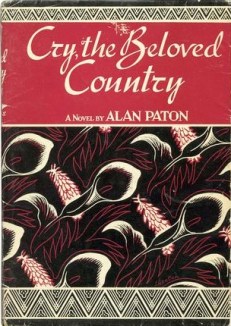
I appreciate Cry, the Beloved Country as I suspect only a Christian – maybe even only a quasi- CryBelovedCountrypostmillennial Calvinist – can. There is much that could and should be said about it as social commentary and criticism and the like, and this does somewhat to make it sweet to me. The lyricism of much of the language is also a cup to be savored and delighted in. There is, I suppose, much else that could be lodged against it as objectionable because of the empowerment it denies to the blacks of South Africa in themselves, but this is not a view I think of often and I think it would have been dishonest for Paton to have attempted it. But what I chiefly remember is the day I finished it, sitting on our apartment balcony on a sunny Sunday afternoon, weeping at the beauty of its content and the boundless hope of its eschatology: all is not saved (though much is), but all is safe, because all is in the hand of God. Injustice may be at hand, and much evil may remain to run its course, but faith will help us to persevere in their despite. Pain is real, suffering is real, and there is no pretending they are not. But God is real, His knowledge and guidance of all the intricacies and the final end of all things is real, and there is likewise no pretending they are not.
Another shares a story about how reading can reveal who we are:

Permit a little spin on the theme, “Reading Your Way Through Life.” I’m a clinical social worker, and in therapy sessions with clients (I work in a public mental health agency, so most of them are poor and poorly educated), I routinely ask, “What have you read lately?” I ask that of any client, regardless of age. Most clients will report they’ve read something – for teens, maybe a textbook that they struggled through; for kids, maybe only a comic book. Adults may have read a romance novel, or a magazine in a doctor’s office. Whatever they report reading, I ask, “What in it appealed to you?” The answer may be profound, or may seem cursory; but the point is, it’s the client’s answer, because it’s the client’s life – and I glean something that may help him. Perhaps the client identifies an interest that’s worth exploring, or a hope she wants fulfilled; a child reading a Harry Potter book – her eyes light up describing a character she likes. Some therapists engage in bibliotherapy, inviting clients to read books (novels, not only self-help) that have a therapeutic theme (many of the book your readers have described fit this). For me, whatever the client is reading invites me to learn something about them – and, if I do my job well, if we talk about it, they might learn something about themselves, too, that can help them in their present struggle.

This reader shares a favorite poem:

“Among School Children,” W.B. Yeats

This has been a favorite poem of mine for many years and I had the privilege of talking about it for many years. I love the richness of Yeats’s fine mind listening to itself, the interiority, the intertwining of memory and learning reaching towards understanding.

The first stanza ends:

“the children’s eyes
In momentary wonder stare upon
A sixty-year-old smiling public man.”

The second begins, “I dream of a Ledaean body,”

My favorite stanza break ever. As he stands smiling before the children, he falls into his deepest self as longing for his lost love breaks over him. His heart feels the gulf between his public image and his private inwardness. And at the end of the last stanza, – a riddle that is an answer: “How can we know the dancer from the dance?”

I taught this poem for many years. One day I looked around the classroom and realized I was a “sixty year old smiling man.” Now, I’ve outlived Yeats, that great poet of old age.

Another poetry selection:

Stanley Kunitz, “The Testing Tree”

A story before the poem. I went to see him read at Harvard, it was a tour for his newest book on turning 90. After the reading, those of us who wanted to buy his book stood in line to purchase it and have him sign it. I stood there in line chatting for quite a while with the guy in front of me as we were the last two in line. As we approached the table, there were nine books left, and this guy in front of me grabbed all nine! I asked him if I couldn’t have just one, and he refused. Mr. Kunitz and those surrounding him were in disbelief, as was I . After signing all those nine copies for this jerk, Mr. Kunitz started to rise from his chair, but I was clutching probably his most famous poetry book, a book which had become an anthem for me. I asked if he wouldn’t mind signing it, and he obliged. He knew who the real fan was.

The last nine lines are the real anthem – so important to me still. And how perfect the number nine!

“The Testing-Tree”

1

On my way home from school
up tribal Providence Hill
past the Academy ballpark
where I could never hope to play
I scuffed in the drainage ditch
among the sodden seethe of leaves
hunting for perfect stones
rolled out of glacial time
into my pitcher’s hand;
then sprinted lickety-
split on my magic Keds
from a crouching start,
scarcely touching the ground
with my flying skin
as I poured it on
for the prize of the mastery
over that stretch of road,
with no one no where to deny
when I flung myself down
that on the given course
I was the world’s fastest human.

2

Around the bend
that tried to loop me home
dawdling came natural
across a nettled field
riddled with rabbit-life
where the bees sank sugar-wells
in the trunks of the maples
and a stringy old lilac
more than two stories tall
blazing with mildew
remembered a door in the
long teeth of the woods.
All of it happened slow:
brushing the stickseed off,
wading through jewelweed
strangled by angel’s hair,
spotting the print of the deer
and the red fox’s scats.
Once I owned the key
to an umbrageous trail
thickened with mosses
where flickering presences
gave me right of passage
as I followed in the steps
of straight-backed Massassoit
soundlessly heel-and-toe
practicing my Indian walk.

3

Past the abandoned quarry
where the pale sun bobbed
in the sump of the granite,
past copperhead ledge,
where the ferns gave foothold,
I walked, deliberate,
on to the clearing,
with the stones in my pocket
changing to oracles
and my coiled ear tuned
to the slightest leaf-stir.
I had kept my appointment.
There I stood in the shadow,
at fifty measured paces,
of the inexhaustible oak,
tyrant and target,
Jehovah of acorns,
watchtower of the thunders,
that locked King Philip’s War
in its annulated core
under the cut of my name.
Father wherever you are
I have only three throws
bless my good right arm.
In the haze of afternoon,
while the air flowed saffron,
I played my game for keeps–
for love, for poetry,
and for eternal life–
after the trials of summer.

4

In the recurring dream
my mother stands
in her bridal gown
under the burning lilac,
with Bernard Shaw and Bertie
Russell kissing her hands;
the house behind her is in ruins;
she is wearing an owl’s face
and makes barking noises.
Her minatory finger points.
I pass through the cardboard doorway
askew in the field
and peer down a well
where an albino walrus huffs.
He has the gentlest eyes.
If the dirt keeps sifting in,
staining the water yellow,
why should I be blamed?
Never try to explain.
That single Model A
sputtering up the grade
unfurled a highway behind
where the tanks maneuver,
revolving their turrets.
In a murderous time
the heart breaks and breaks
and lives by breaking.
It is necessary to go
through dark and deeper dark
and not to turn.
I am looking for the trail.
Where is my testing-tree?
Give me back my stones!

This reader appreciates a poet we featured recently:

Thanks for this thread. Reading about why specific books matter to different readers is incredibly interesting. My contribution to the thread is a poet you recently featured: Ron Padgett. What always makes me return to his work is the way he makes the most mundane aspects of life seem so interesting and beautiful. His poems are filled with found objects, overlooked phrases, forgotten expression that he turns sideways and upside-down and juxtaposes to almost anything else. I don’t want to say that he breathes new life into them so much as that he finds the life that was always there but we got tired of seeing. Padgett is a master of defamiliarization with a great sense of cornball humor. The other thing that impresses me is the way many of his poems unfold the way the mind unfolds and you watch it stumble upon a great discovery or insight that was never looked for, but there it is. His aesthetic and influences are very French, but his outlook and language is fully American. Here is a prose poem of his (my apologies if it is one of the ones you published earlier; but even if they are, Padgett is always worth returning to):

Prose Poem

The morning coffee. I’m not sure why I drink it. Maybe it’s the ritual of the cup, the spoon, the hot water, the milk, and the little heap of brown grit, the way they come together to form a nail I can hang the day on. It’s something to do between being asleep and being awake. Surely there’s something better to do, though, than to drink a cup of instant coffee. Such as meditate? About what? About having a cup of coffee. A cup of coffee whose first drink is too hot and whose last drink is too cool, but whose many in-between drinks are, like Baby Bear’s porridge, just right. Papa Bear looks disgruntled. He removes his spectacles and swivels his eyes onto the cup that sits before Baby Bear, and then, after a discrete cough, reaches over and picks it up. Baby Bear doesn’t understand this disruption of the morning routine. Paper Bear brings the cup close to his face and peers at it intently. The cup shatters in his paw, explodes actually, sending fragments and brown liquid all over the room. In a way, it’s good that Mama Bear isn’t there. Better that she rest in her grave beyond the garden, unaware of what has happened to the world.

Another reader notes a much-loved essay discovered through the Dish:

If you’re still taking posts about this, I thought I’d recommend the incredible essay, “Some Thoughts on Mercy,” by Ross Gay, which appeared in the July 2013 issue of The Sun. Gay’s meditations on bee keeping and race make this a must-read for anyone interested in how personal essay can tackle the big issues.

For the past year, I’ve taught this essay to my incoming first-year students in my sections of a Introduction to College Writing course. I’ll teach it again this year with an even firmer belief in its resonance and relevance in the wake of Ferguson. Gay says at the end of the essay, when describing a panic attack when facing the bees of his new hive:

“…the possibility of the hive turning on me was all I could feel. I saw myself pouring gasoline on this hive that I loved and torching it. And I saw a billowing, and I felt such relief at their being no more. I saw cinders of the box and the sooty concrete blocks it sat on and the charred patch of grass beneath smoldering and the few bees not inside lost and circling in wider and wider loops. I saw myself standing with the pack of matches in my hand and the red fuel canister at my feet.”

These words came back to me as I watched news footage of the protests and looting after Michael Brown’s murder, all the smoke and fire and rage of those weeks. What it must feel like for the citizens to be penned in by he fear and suspicion of others, the at-once terrifying and preposterous notion that just being a young black man is akin to being armed with a deadly weapon. The rage with which you might want to greet the world and the rage with which it would greet you back, no matter how you’d acted, no matter how restrained because it is acceptable for law enforcement in your community look at you and “see murder.”

In Gay’s essay, the bees feel some agitation but manage to rely most on what’s before them–Gay’ actual actions, not his fear– and they do not attack him. He says with relief and awe that they “knew inside me was a truth other than murder.”

Ross pleads in the essay when describing the racial profiling he’s endured: “Look how this has made me.” I want my students to see this, too. That we make each other through our interactions. I want them to make a better world for each other, and to have for themselves the role model of Gay and especially his bees.

It seems pitifully small, to ask that we look at each other and not see murder and considering the magnitude of the problem (how it encodes our voting laws, housing policies, legislation, even how preschool teachers discipline black students), nowhere near enough, but as Gay points out, this is the first step to actually seeing each other, the first step towards mercy, and. “When we have mercy, deep and abiding change might happen. The corrupt imagination might become visible. Inequalities might become visible. Violence might become visible. Terror might become visible. And the things we’ve been doing to each other, despite the fact that we don’t want to do such things to each other, might become visible.”

I’m indebted to The Dish for finding this essay. You linked to it last summer. Since then, I’ve read it at least six times and will read it many more in the year ahead to prepare for teaching but also to marvel at Gay’s gifts as a writer, the sense of kindness that emanates from his words even as he illustrates the maddening mental work required to see himself as good in a world that repeatedly wants to write him off as bad.

Another reader mentions a treasured passage from a novel:

From The Lost Scrapbook by Evan Dara:

“…but still, I continued on, looking for the bathroom; passing doors, and swatches of wall, and a mail chute; then walking still further; yet I couldn’t seem to find it, the bathroom; I wasn’t even in a place where a bathroom seemed likely to be; so I decided to turn down another hallway, which led to a quiet area ­thinking that I would have better luck in that direction; and so I wandered into a darker stretch of the building, and I continued searching doors for the appropriate emblem; but I only came across signs offering Dubbing, and Post-Produc­tion; and then, without forewarning, I saw Chomsky, standing in a shadowy recess in the wall; he was just standing there, facing away from the corridor, in towards a dense stack of cardboard boxes; they were empties that were waiting to be thrown out, I believe; but Chomsky was just tucked in there among them, alone in the dark recess, holding his glasses in his left hand; and with his posture somewhat bent-so I touched his sleeve, and he turned around rapidly, and said Oh; and then he emerged from the recess, while putting his glasses back on; and then he quickly gathered himself together, he became himself again; Here, he then said, while looking down the hallway; Here: I think what you may be looking for is over here; though when I heard the wavery tone in his voice a part of me dissolved; in silence I let him walk me on; and point out the door; very graciously; then he turned away when I went in; and then, when I was finished, there were no more paper towels by the sinks, so I couldn’t dry my hands…”

Another appreciates all the poems this thread has featured:

Just loving the gifts of moving poetry. I laid in bed for an hour this morning remembering passages, one after the other. So many… the floodgates are open!

Beloved literature is a thread that runs way back through my family. My father could recite long passages from hundreds of favorites til the end of his life.

He gave each of his five grandsons, my boys, a copy of 101 Famous Poems when they could barely read. The connection lives on..

When my youngest was homeschooling we memorized what appealed to us, from Lakota speeches to Tennyson; he’s studying neurobiology in grad school now – and has a love for and way with words.

I’m sending one more favorite.

“Reverse Living”

Life is tough,
It takes a lot of your time,
All your weekends,
And what do you get at the end of it?
Death, a great reward.
I think that the life cycle is all backwards.
You should die first, get it out of the way.
Then you live twenty years in an old age home.
You’re kicked out when you’re too young.
You get a gold watch, you go to work.
You work forty hears until you’re
Young enough to enjoy your retirement.
You go to college,
And you party until you’re ready for high school.
You become a little kid, you play,
You have no responsibilities,
You become a little boy or girl,
You go back into the womb,
You spend your last nine months floating.
And you finish off as a gleam in someone’s eye.

This is from Jack Kornfield’s excellent book, After the Ecstasy the Laundry.

And one last poem:

“The Cowpath” by Samuel Walter Foss! It always makes me understand ‘where we are at’ in any situation. And it also makes me lighthearted about it. Think about it: you can apply this to the Gaza mess, the Iraq mess, the Ferguson mess, the mess in my house, the mess in my marriage – a one size fits all explanation:

One day thru the primeval wood
A calf walked home, as good calves should,
But made a trail all bent askew,
A crooked trail, as all calves do.
Since then three hundred years have fled,
And I infer, the calf is dead;
But still behind he left his trail,
And thereon hangs my mortal tale.
The trail was taken up next day
By a lone dog that passed that way,
And then a wise bell-weather sheep
Sliding into a rut now deep,
Pursued that trail over hill and glade
Thru those old woods a path was made.
And many men wound in and out,
And dodged and turned and bent about,
and uttered words of righteous wrath
Because “twas such a crooked path”
But still they follow-do not laugh-
The first migrations of that calf.
The forest became a lane
That bent and turned and turned again;
This crooked lane became a road
where many a poor horse with his load
Toiled on beneath the burning sun,
And traveled some three miles in one.
The years passed on in swiftness fleet,
The village road became a street,
And this, before the men were aware,
A city’s crowded thoroughfare.
And soon a central street was this
In a renowned metropolis;
And men two centuries and a half
Followed the wanderings of this calf.
Each day a hundred thousand strong
Followed this zigzag calf along;
And over his crooked journey went
The traffic of a continent.
A hundred thousand men were led
By one poor calf, three centuries dead.
For just such reverence is lent
To well established precedent.
A moral lesson this might teach
Were I ordained and called to preach.
For men are prone to go it blind
Along the calf paths of the mind;
And work away from sun to sun
To do what other men have done.

Read the entire thread here.

Imaginary Eats

by Dish Staff

In a review of Sandra Gilbert’s The Culinary Imagination, Bee Wilson traces the history of fictional food:

In a chapter on food in children’s fiction, Gilbert suggests that food fantasies originate in children’s dreams of never-ending bounty. “Lollipop trees and gingerbread houses. Bottles of cherry-tarts mingled with custard, roast turkey, toffee and other goodies. Spoonfuls of sugar.” For most of history, while communities lived in constant fear of the next famine, the culinary imagination was dominated by Rabelaisian excess. In children’s books, we are all still ravenous. We share the hunger of Laura Ingalls Wilder for maple sugar and candy canes. In real life, sugar is now almost as freely available as the gingerbread on the cottage in “Hansel and Gretel,” yet in our bedtime stories it remains a precious commodity. The sweets in the Harry Potter series, whose release coincided with an inexorable rise in childhood obesity, are no less lavish and no less lusted over than those in “Charlie and the Chocolate Factory.”

Wilson continues, “The nonfiction food writing now aimed at adults contains somewhat different fantasies”:

Gilbert writes of the “postmodern pastorals,” which, rather than inviting us to indulge in rivers of chocolate, create a fantasy of simple self-sufficiency wherein one never eats anything one hasn’t grown or at least cooked oneself, in an imagined recreation of the lifestyle of great-grandmothers. Now the dream is not of plenty but of scarcity: the make-believe idea that we are still governed by the constraints of the seasons. These utopias allow us to pretend that peaches in summer or squash in the fall still have the same force they once did. What is forgotten, Gilbert suggests, is the uncomfortable fact that many peasant great-grandmothers ate “a monotonous and often dangerous diet.”

Words For The Wasted

by Dish Staff

Planning to get blotto, schnockered or plonked this Labor Day weekend? David Crystal reflects on assembling an “almost complete list of every word we’ve ever used to mean ‘drunk'”:

Being drunk cuts across barriers. The list … shows only the occasional indication of a class preference (such as genteel whiffled vs thieves’ cant suckey), and occupational origins are seen only in some nautical expressions (three sheets, oversparred, up the pole, tin hat, honkers), though the etymology is not always definite. There are very few formal terms in the list, apart from a few expressions fostered by the law (intoxicated, over the limit), and some early scholarly words (inebriate(d), temulent, ebrious). Local regional variations are sometimes apparent, such as from Scotland (fou, strut, swash, blootered, swacked), England (bottled, pissed, rat­arsed), and Australia (blue, rotten, shickery, plonked, on one’s ear); and since the eighteenth century most new words in this semantic field have started out in the United States. But it’s rare to find a word that stays in one country for long, and these days online slang dictionaries have largely broken down geographical boundaries.

Why has this field developed to the extent that writers regularly make a special collection of these words?

We see it early on in John Ray’s collection of proverbs (1678) or Benjamin Franklin’s Drinker’s Dictionary (1737), and artful classifications of degrees of drunkenness antedate these (see fox­drunk, 1592). It’s tempting to think that the linguistic innovation is a direct result of the uninhibited behaviour which follows a bout of drinking. Certainly there are some highly idiosyncratic (and often inexplicable) coinages in the list, such as pepst, pottical, fap, paid, muckibus, stocious,and schnockered. Many words are represented by just a single citation. And several seem to be motivated by the sound of the word as much as by any meaning it might have: jingled, whift, whiffled, squiffy, whittled, spiflicated, zonked. 

Here Today, Gone Forever?

by Sue Halpern


dish_bitcoins2

Buried – sorry – in Biz Carson’s fascinating obituary of Hal Finney, who died this week from ALS, is a small aside with large implications. Finney, who was 58, was the first owner of bitcoins besides developer Satoshi Nakamoto (not his real name). This was in 2008, in a somewhat serendipitous turn of events, which Finney chronicled last year, typing via an eye tracker.

When Satoshi announced the first release of the software, I grabbed it right away. I think I was the first person besides Satoshi to run bitcoin. I mined block 70-something, and I was the recipient of the first bitcoin transaction, when Satoshi sent ten coins to me as a test. I carried on an email conversation with Satoshi over the next few days, mostly me reporting bugs and him fixing them. After a few days, bitcoin was running pretty stably, so I left it running… I mined several blocks over the next days. But I turned it off because it made my computer run hot, and the fan noise bothered me.

So the question is, now that he has died, what happens to Finney’s virtual currency?

It’s the same question any one of us can ask, looking ahead, about our virtual “possessions,” whether they are documents stored on Dropbox, or passwords to our email accounts, or game characters.

Finney, who has been cryogenically preserved, was clearly a forward-looking guy. Before he died, he secured his bitcoins in a safe deposit box. But will it be enough to ensure that his son and daughter inherit them? And what about our stuff, stored “up there,” somewhere, “in the cloud,” where there is no safe deposit box?

Last month, in an unprecedented move, Delaware became the first state to enact a digital inheritance law. The Digital Assets and Digital Accounts Act is meant to give authorized individuals brief, “peek and copy” access to third-party accounts. Apparently, the tech companies are not pleased and have formed the “State Privacy and Security Coalition” to fight it. They will be even less pleased when some version of the law is adopted in other states, as it is expected to be:

Jim Halpert of DLA Piper, a law firm that represents the coalition, told the Wall Street Journal that the group opposes the laws because accounts may contain information the deceased do not want to disclose, and because they may “conflict with a 1986 federal law forbidding consumer electronic-communications companies from disclosing digital content without its owner’s consent.”

But Jeff John Roberts thinks this is weak:

Neither of these explanations are particularly convincing, however. Despite the companies’ profession of privacy concerns for their late users, the reality is that people have been dying — and leaving behind artifacts for relatives and others to find — for a very long time. The digital dimensions of our personal lives don’t change that.

[Note to self: do not leave will on iCloud.]

(Photo of bitcoins by Steve Garfield)


Brilliant Women Who Explain Things To Me

by Phoebe Maltz Bovy

Rebecca Mead describes the challenges Cambridge classics professor Mary Beard has faced as a prominent female academic:

At Cambridge [in 1972], the inequities of gender began to dawn on Beard. “Most of the people who taught us in the faculty were blokes,” she says. “There were only twelve per cent women among the students, and you thought, Actually, there is an issue here. You go into a dining hall of a men’s college, and everybody’s portrait was a bloke. Well, perhaps some female founder back in 1512, some lady who gave the cash—and everyone else was a bloke. For the first time I saw that, somehow, I was there as sort of a favor.” She attended women’s groups and joined campaigns to open the university further to women. The women of Cambridge were undertaking more personal voyages of discovery, too: in a drawer somewhere in Beard’s house is a plastic speculum that she acquired at one consciousness-raising gathering.

Beard left Cambridge in 1979, for King’s College London. She completed her Ph.D. in 1982; two years later, she returned to Newnham as a fellow. At the time, she says, she was one of only three women on the classics faculty, out of a total of twenty-six; before long, both of her female colleagues left. (Now there are roughly four men to each woman.)

That was then. Today, explains Mead, Beard is active on social media, and holds her own in an ongoing battle with the ubiquitous misogynistic troll contingent. Mead addresses the particularity of how Beard, whom “the Queen recently appointed … to the Order of the British Empire,” battles lesser names (or the altogether anonymous):

There is, [Beard] acknowledges, an irony in the imbalance of power: as a prominent scholar, she does have a voice, however unpleasant the threats to silence her may be. Most of her Twitter detractors are grumbling to only a handful of followers, at least until she amplifies their audience.

Mead’s article brought to mind a pattern I’ve noticed within feminism, which I’ve called the Second After Sartre problem, namely that of women who aren’t merely privileged but are major leaders of their age, who call out the obstacles that prevent them from achieving what their male equivalents can, or from doing so as easily. It’s in reference to… I’ll let LisaAppignanesi explain the story I’m referencing:

De Beauvoir and Sartre met in 1929 when they were both studying for the aggregation in philosophy, the elite French graduate degree. De Beauvoir came second to Sartre’s first, though the examiners agreed she was strictly the better philosopher and at the age of 21 the youngest person ever to have sat the exam. But Sartre, the future author of Being and Nothingness, was bold, ingenious, exuberant in his youthful excess, the satirical rebel who shouted, “Thus pissed Zarathustra” as he hurled water bombs out of classroom windows.

Being second after Sartre, when you should have been first, is indeed an injustice. Injustices that occur at the top – ones well beyond the First World Problem-ness of having-it-all feminism – are instructive (if even the most elite, confident women face sexism, perhaps sexism is actually a thing!), and of course it matters if the tippy-top of whichever hierarchy is open to all who qualify. But the trouble is that we end up hearing a wildly disproportionate amount about such injustices, because, well, who gives lectures at the British Museum? It can start to feel as if feminism is primarily about recognizing the achievements of the most accomplished women. That’s part of what feminism should be, but perhaps not quite so big a part.

See also (my grievances with) “mansplaining.” Rebecca Solnit’s article, “Men who explain things,” which more or less launched the concept, was about a man trying to explain to Solnit a topic she had just written a book about. That is… not the usual situation. More often, in cases where a man conflates maleness with superior expertise, the man and the woman know approximately as much (or as little) about the topic. Neither is likely to be a certified expert. What if a woman wishes to speak and she isn’t the world’s greatest genius? Men who fail to meet that standard have been known to say their piece.

This is my roundabout way of saying why I’m so curious about Roxane Gay’s writing. From Lucy McKeon’s review of Gay’s two new books:

Amidst Anne-Marie Slaughter’s talk of “having it all” and Sheryl Sandberg’s talk of “leaning in,” Gay’s Bad Feminist, a collection of essays of cultural criticism, offers a complex and multifarious feminism to answer the movement’s ongoing PR issues, its flaws and its failures. Gay’s is a feminism for the ignorant and misinformed as much as for the historically excluded and ignored. Analyzing a wide range of material—from 12 Years a Slave to the Sweet Valley High series, from the reality TV trope “I’m not here to make friends” to the gendered politics of likeability in fiction, from professional sports to Tyler Perry, from the fallout of mass tragedy to legislative control of women’s reproductive rights—Bad Feminist surveys culture and politics from the perspective of one of the most astute critics writing today.

Yes, the time has come for “a feminism for the ignorant and misinformed as much as for the historically excluded and ignored.” It couldn’t have come soon enough.

Auto-Admiration?

by Dish Staff

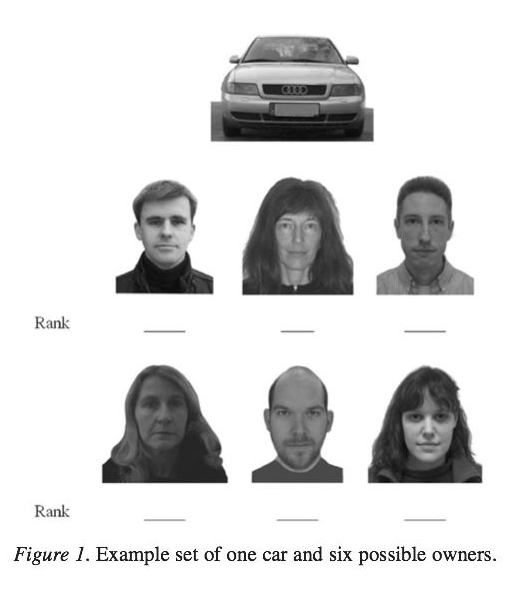
Jesse Bering reviews research suggesting that not only can people accurately match dogs’ faces to their owners, but also that “our faces also bear an uncanny resemblance to the frontend views of our automobiles.” Participants in a study were given a picture of a car and asked to rank its possible owners on a scale of 1 to 6:

[T]he authors suspected that the judges in their study would be able to match cars dish_carfaces3 with their correct owners above chance levels. And that’s what they found. “The real owner was in fact assigned rank 1 most frequently,” they write, “and rank 6 least frequently.” This proved true regardless of the subjects’ sex and age. There were an equal number of male and female judges, and they ranged widely in age—from 16 to 78 years. In case the sheer bizarreness of these data hasn’t quite registered, let me put it to you more bluntly: The average person can detect a physical similarity in the “faces” of cars and their owners. …

Implied in these results is the startling fact that most car owners are unwittingly purchasing cars that look like them. If that’s the case, figured [researchers Stefan] Stiegar and [Martin] Voracek, then is it possible that judges can even take it one step further, matching dogs to their masters’ cars? After all, we know now that it’s not a myth: dogs really do look like their owners. And since we choose both cars and dogs that physically resemble us, shouldn’t our dogs and our cars look alike too? Here, frankly, the data just get weird. Nevertheless, they’re genuine. In their third and final study, the authors added 36 portraits of dogs into the mix. Half of these were of purebreds, and the others were mutts. In a twist to the previous studies, a new group of judges saw an image of a car (again, either the front, side, or rear view) and beneath that, six individual dogs. Subjects ranked each dog on the likelihood of its master being the owner of the car shown. Amazingly, the participants were able to pull this feat off as well.

Meanwhile, Laura Bliss considers the oddly human attachments people form to their vehicles:

To many of us, [cars] are beloved, person-like companions. More than 70 percent of respondents to a recent AutoTrader survey were at least “somewhat” if not “very attached” to their cars, with 36 percent describing their vehicle as “an old friend.” In another study, nearly half of all drivers assigned a gender to their cars, and about one-third actually name them.

For many car-owners, emotional attachment can also come hand-in-hand with socio-economic mobility. For example, there’s research that suggests for certain low-income families, owning a car is linked to the ability to live in neighborhoods with lower poverty rates and lower health risks, as well as higher neighborhood satisfaction and stronger chances of employment.

Car-owners often assign human-like attributes to our cars, too. A 2006 study found significant differences between how participants understood their own personality and how they described their cars’.  And in that same AutoTrader report, more than a quarter said they felt “sad” when they thought about parting ways with their internally combusting pal.

The Essential Creepiness Of DFW Fandom, Ctd

by Dish Staff

dish_dfwlego2

An 11-year-old DFW superfan recreated Infinite Jest with Legos:

[English professor Kevin] Griffith and his son [Sebastian] had the idea to “translate” Infinite Jest into Lego after reading Brendan Powell Smith’s The Brick Bible, which takes on the New Testament. “Wallace’s novel is probably the only contemporary text to offer a similar challenge to artists working in the medium of Lego,” they write, grandly, on their website. …

Sebastian didn’t read Infinite Jest himself. “Let me be clear – Infinite Jest is not a novel for children,” says Griffith. “Instead, I would describe a scene to him and he would recreate it in a way that suited his vision.  All the scenes are created by him and he then took photos of them using a 10-year-old Kodak digital camera he received for a present long ago.  I think that having the scenes reflect an 11-year-old’s perspective gives them a little extra poignancy, maybe.”

The caption for the above image is from page 409 of Infinite Jest: “Clipperton plays tennis with the Glock 17 held steadily to his left temple.” Meanwhile, Matthew Nolan looks for lessons from DFW about why American men aren’t playing the sport better:

Wallace’s discerning tennis essays and fiction made it clear that elite tennis players cannot simply be manufactured through training by academies and player development programs. The fact that there are aspects of success that go beyond the academy helps to explain why the current top 20 players in the world represent 14 different countries, and almost all come from different training backgrounds. The recent success of junior male players, like U.S. Open Wild Card Noah Rubin from the training facility run by John McEnroe (another Wallace favorite), will excite Americans, but enthusiasm needs to be tempered with Wallace-ian recognition of the nature of the game. Wallace would not likely have lamented the state of American men’s tennis but instead would have probably sympathized with the ongoing struggles of all players, regardless of national origin. Likening tennis to life itself, a veteran player and coach in Infinite Jest respectfully sums up the game: “It is tragic and sad and chaotic and lovely.”

(Image via Brickjest)

The Slums Of The Future, Ctd

by Dish Staff

We know that the world’s slums are growing, but are the world’s major urban centers growing into slums? Joel Kotkin details the massive social, economic, and environmental challenges facing most emerging megacities:

Emerging megacities like Kinshasa or Lima do not command important global niches. Their problems are often ignored or minimized by those who inhabit what commentator Rajiv Desai has described as “the VIP zone of cities,” where there is “reliable electric power, adequate water supply, and any sanitation at all.” Outside the zone, Desai notes, even much of the middle class have to “endure inhuman conditions” of congested, cratered roads, unreliable energy, and undrinkable water.

The slums of Bangladesh’s capital, Dhaka, swell by as many as 400,000 new migrants each year. Some argue that these migrants are better off than previous slum dwellers since they ride motorcycles and have cellphones. Yet access to the wonders of transportation and “information technology” don’t compensate for physical conditions demonstrably worse than those endured even by Depression-era poor New Yorkers. My mother’s generation at least could drink water out of a tap and expect consistent electricity, if the bill was paid, something not taken for granted by their modern-day counterparts (PDF) in the developing world. … Over these environmental problems loom arguably greater social ones. Many of the megacities—including the fastest growing, Dhaka—are essentially conurbations dominated by very-low-income people; roughly 70 percent of Dhaka households earn less than $170 (U.S.) a month, and many of them far less. “The megacity of the poor,” is how the urban geographer Nazrul Islam describes his hometown.

The Relentless Warmongers

by Dish Staff

Matt Steinglass sighs at the aimless hawkishness of American foreign policy elites when it comes to the Middle East:

William Kristol, as ever, manages to distill the rot down to its ludicrous essence: “What’s the harm of bombing them at least for a few weeks and seeing what happens? I don’t think there’s much in the way of unanticipated side effects that are going to be bad there. We could kill a lot of very bad guys!” No doubt the Americans could. Drop enough bombs and you are guaranteed to kill some very bad guys, and probably some good guys, as well as a lot of guys who, like most, fit somewhere in between. But simply bombing areas when the emerging powers prove bloodthirsty, and hoping that a better sort of power replaces them, isn’t very promising.

Conor Friedersdorf outlines the many questions interventionists aren’t bothering to ask, let alone answer:

After the decade-long, $6-trillion debacle in Iraq, you’d think Congress and pundits would be pressing the Obama administration for figures:

If the U.S. fights ISIS in Iraq and Syria, what would be the odds of victory? How much would it cost? How many U.S. troops would be killed? How would it effect nearby countries like Iran? And how much of a threat does ISIS actually pose to the U.S. “homeland”? Yet much coverage of Syria is narrowly drawn. Vital questions are studiously ignored, as if they have no bearing on the merits of intervention, while dire warnings are presented with too much hype and too little rigor.

And Steve Chapman remarks on how ISIS’s global threat is, in his view, being wildly oversold:

We are supposed to be impressed that the Islamic State controls a swath of land, which al-Qaida never did. But Ohio State University political scientist John Mueller says that’s not the advantage it appears to be. “The fact that they want to hold territory and are likely to deeply alienate the people in their territory means that, unlike terrorists, they will present lucrative targets while surrounded by people who are more than willing to help with intelligence about their whereabouts,” he told me. It’s often forgotten that al-Qaida proclaimed its own state in Iraq in 2007, but its brutal ways alienated fellow Sunni insurgent groups so completely that they switched to our side. The Islamic State is equally vulnerable to a backlash. As for the prospect that it could hit the homeland, our usual problem in deterring terrorists is that their bombs have no return address. The Islamic State, by contrast, is adorned with a neon bull’s-eye.