“Overlook Their Annoying Talk”

Harris Zafar reminds us that, whether dealing with specific insults or with the freedom of speech more generally, Muhammad’s teachings fly in the face of what modern-day Islamists purport to believe:

Islam does not support people who violently censor free speech. Freedom of speech is guaranteed in the MuhammadQur’an both through direct instruction as well as recalling how Muhammad was insulted to his face and never retaliated. The Qur’an records that he was called crazy, a victim of deception, a liar, and a fraud. Through this all, the Prophet Muhammad never retaliated or called for these people to be attacked, seized, or executed. This is because the Qur’an says to “overlook their annoying talk” and to “bear patiently what they say.” It instructs us to avoid the company of those who continue their derogatory attacks against Islam. There simply is no room in Islam for responding to mockery or blasphemy with violence.

But perhaps most pointedly, the Qur’an tells believers not to be provoked by those who seem to attack Islam, stating very clearly “let not a people’s enmity incite you to act otherwise than with justice.” This is supported by the actions of the Prophet Muhammad himself. When he was once returning from an expedition, an antagonist used insulting words against him. Although a companion suggested that the culprit be killed, the Prophet Muhammad did not permit anyone to do so and, instead, instructed they leave him alone.

Readers on Friday underscored that incident and the same overall point – which can’t be reiterated enough. So where did the practice of not depicting Muhammad come from? Amanda Taub voxplains:

According to [scholar Reza] Aslan, the Koran does not explicitly prohibit depicting the Prophet Mohammed, and there have been images of Mohammed, his family, and other prophets throughout history. “The history of Islam teems with images of the Prophet Mohammed. You see this in the 7th, 8th, 9th, 10th, 11th, 12th, 13th, 14th, 15th, 16th, 17th, 18th, 19th, and 20th centuries.”

Still, the idea that depictions of Mohammed are disallowed didn’t come out of nowhere. Islam, Aslan explained, like Judaism, is an iconoclastic religion that does not permit God to be anthropomorphized — that is, portrayed as a human being — and prizes textual scripture instead.

Over time, Islamic scholars extended that tradition to cover Mohammed and the other major prophets as well, and discouraged artists from depicting them in images. That has created a strong cultural norm against images of Mohammed, even in the absence of a religious law against them.

Back in 2010, Omid Safi passed along the above image, “one of the classic images of the Prophet Muhammad’s Heavenly Ascension”:

In my recent biography of the Prophet, I have taken care to produce about 20 of the pietistic and sacred images produced by Muslim artists over the centuries. These are as far from the Danish cartoon images as one can get: they are works of devotion, illuminated by faith, and imbued with a deep sense of love. There are other options available to Muslims than either accepting the Danish Cartoonist caricatures of the Prophet or responding in pure anger and hatred. One such answer is a return to the rich pietistic Islamic tradition of depicting the Prophet who was sent, according to the Qur’an, as a mercy to all the Universe.

Poseur Alert

William Giraldi, the novelist, teaches at Boston University and was given paternity leave after his wife delivered their first child. He shares how those nine months of relative leisure transformed him into a near-alcoholic:

When Pascal suggested that humanity’s strife stems from our inability to sit quietly in a room by ourselves, he neglected to specify what happens when one rolls a few barrels of alcohol in for company. I cannot say precisely why my “workload reduction” coincided with my “drinking problem,” except suddenly I had so much time. Okay, the university made me sign a document that swore I’d be incurring more than 50 percent of parental duties. But let’s be honest: even in self-consciously progressive households, it’s a rare new father who does as much baby work as a new mother. …

There came, of course, the medieval hangovers that vanquished entire days. Sleep interrupted by migraines and dehydration that felt downright malarial. Iffy decisions involving the diaperless infant on an antique couch. Puffy face and puffier physique. Aches in the liver region, nights in the living room. A first-name basis with the Visigoth at the liquor store. A propensity to click “send” without reading what I’d written. Friends just itching for an intervention. I kept waiting for a knock on the door from the university officials who had so generously granted me a workload reduction. But they never came for me.

This isn’t his first time Giraldi has written about his hard-knock life. Back in October, he lamented the way his fiction was favorably compared to Pulitzer Prize-winning novelist Cormac McCarthy:

If most of the McCarthy comparisons have been favorable, all of them have been facile. This is testament to the McCarthy hegemony, to how wholly he dominates an entire sector of American fiction, and to how he has usurped our understanding of a certain literary pedigree. Write a novel with a specific poetical register adequate to the task of addressing nature and redemption, one which includes the sanguinary madness of men, and McCarthy is the artist languidly at hand for every reader itching to make a connection.

But McCarthy’s prominence is such that another novelist interested in the primitive flux and flex of violence, and in that crossroad where this world grinds against the other, would have to be outright masochistic to attempt to emulate him. Neither the novelist nor the novel could ever get away with it. Every page would carry its own proof of transgression, and thus its own guarantee of detection. ‪Let’s remember, too, Walker Percy’s perfect warning to writers who attempt to channel Faulkner: “There is nothing more feckless than imitating an eccentric.”‬

Rabbi Jesus

Jan_Wijnants_-_Parable_of_the_Good_Samaritan

In an interview about her new book, Short Stories by Jesus: The Enigmatic Parables of a Controversial Rabbi, Amy-Jill Levine emphasizes Jesus’ Jewish identity as a key to understanding what he taught:

Jesus is the first person in literature called “rabbi,” which at the time–the late first century–meant “teacher.” The term “rabbi,” today thoroughly associated with Judaism, signals for Jesus his own particular Jewish identity.

For Christians, Jesus should be more than a Jewish teacher. But he must be that Jewish teacher as well. If his teachings were not of import to the Church, the Gospels would have skipped right from the Nativity stories to the Passion–right from Advent to Lent. To see Jesus as a rabbi, a Jewish teacher, is to take seriously what he had to say: his parables, interpretation of the Scriptures of Israel, apocalyptic pronouncements, ethical guides–and all of these teachings can only be fully appreciated if we see how they fit into their own historical context.

She goes on to claim the parable of the Good Samaritan is perhaps the most misunderstood:

Today, we hear that the “Good Samaritan” is about accepting the marginalized. Samaritans were not “marginalized” by Jews; to the contrary, they were the enemy. This fact also shows why the modern tendency to identify with the Samaritan is, although affirming for the Christian today, not what a first-century Jewish audience would do.

Or, we hear that priest and Levite ignore the injured fellow because they were following Jewish law concerning ritual impurity. The parable has nothing to do with purity laws; to the contrary, burying a corpse is one of the highest commandments in Judaism, a point made in sources ranging from the Deuterocanonical Book of Tobit to the writings of the first-century historian Josephus to the Mishnah and Talmud. Unless we know what the terms “priest,” “Levite,” and “Samaritan” suggested to that original audience, we’ll not only miss the parable’s profundity, we’ll promote negative stereotype of Jewish practice and ethics.

Recent Dish on the Jewishness of Jesus here.

(“The Parable of the Good Samaritan” by Jan Wijnants, 1670, via Wikimedia Commons)

Intelligent Design 2.0?

800px-Schnorr_von_Carolsfeld_Bibel_in_Bildern_1860_001

That’s what Damon Linker calls Eric Metaxas’ claim (behind a WSJ paywall, alas) that science increasingly makes the case for God. His summary of Metaxas’ argument:

Metaxas’ argument is quite simple. As recently as a few decades ago, physicists presumed that life had most likely emerged and evolved spontaneously on planets throughout the galaxy and universe, producing a cosmos veritably teeming with intelligent beings. But in more recent years, scientists have become far more circumspect, noting the enormous number of factors that must be present — on specific planets, in particular star systems, and in the universe as a whole — for life to emerge and evolve. These factors — sometimes called “anthropic coincidences” — are so numerous and involve such stupefyingly improbable outcomes that they point toward the existence of a cosmic designer who established the precise conditions for the emergence and evolution of life on Earth. And perhaps only on Earth.

The problem with such arguments? Linker holds that all Metaxas has done is update natural theology, which stretches back to Plato and Aristotle, and “doesn’t demonstrate the existence of the God of the Bible”:

The biblical God actively creates the universe and each specific form of life, with human beings created in his own image. He is a jealous, and sometimes angry, God.

He regularly intervenes in human lives and history, even selecting the Jews to be his chosen people. He promises rewards and punishments (while often leaving the criterion of judgment mysterious). In two New Testament passages (Matthew 10:30; Luke 12:7), Jesus Christ claims that God cares about every hair on every single human head. The Christian theological tradition even goes so far as to propose that the creator of the universe became incarnate in human form, living and dying an excruciating death in a gratuitous act of love that makes possible the redemption of humanity.

What Metaxas is really showing in his column is a simplified form of natural theology, and not at all an example of theological reflection based on divine revelation. That isn’t a criticism. It’s a statement of fact — a fact that severely complicates any attempt to treat his scientifically based speculations as providing evidence for the God that most Americans profess to believe in.

The Roman Catholic philosophy Francis J. Beckwith likewise urges believers to resist the temptation to latch onto scientific evidence that seems – for the moment, at least – to support God’s existence:

God – as understood by the Catholic Church and by most other theistic traditions – is not a being in the universe, a superior agent whose existence we postulate in order to explain some natural phenomenon, but rather, Being Itself, that which all contingent reality depends for its existence.

In order to appreciate how this understanding differs from Metaxas’ Watchmaker God, suppose in a few years scientists tell us, after further research, new discoveries, and confirmed theories, that the arising of life in the universe is not that improbable after all. What then happens to Metaxas’ God? He is now superfluous, and Metaxas would have to concede that theists are once again irrational, as they apparently were when the (temporarily obsolete) God hypothesis was down for the count the last time science threw its best punch.

Given the arguments Metaxas summarizes in his essay, it is tempting for the theist to confidently tout such evidence. When faced with a cadre of globally accessible, and endlessly annoying, village atheists who posit the findings of science as defeaters to belief in God, there is nothing quite like the Schadenfreude of pointing out to the self-appointed guardians of reason that they have been hoisted upon their own petard. But you should not acquiesce to this temptation. For in doing so, you concede to the atheist his mistaken assumption that the rationality of belief in God depends on the absence of a scientific account of whatever phenomenon is in question.

Dreher nods, adding that “order in creation does not prove God, but it is a sign pointing to God”:

Even if God’s existence could be proved, it changes nothing; even the devil believes in God, but rejects Him. God desires to live in communion with us. Recognizing His existence with the intellect is only a start. He wants not our minds, but our hearts. In Kierkegaardian terms, God is a subjective truth — a truth that can only be known by appropriating it with the most passionate inwardness. We don’t know God like we know the Second Law of Thermodynamics; we know God like we know the love of our father.

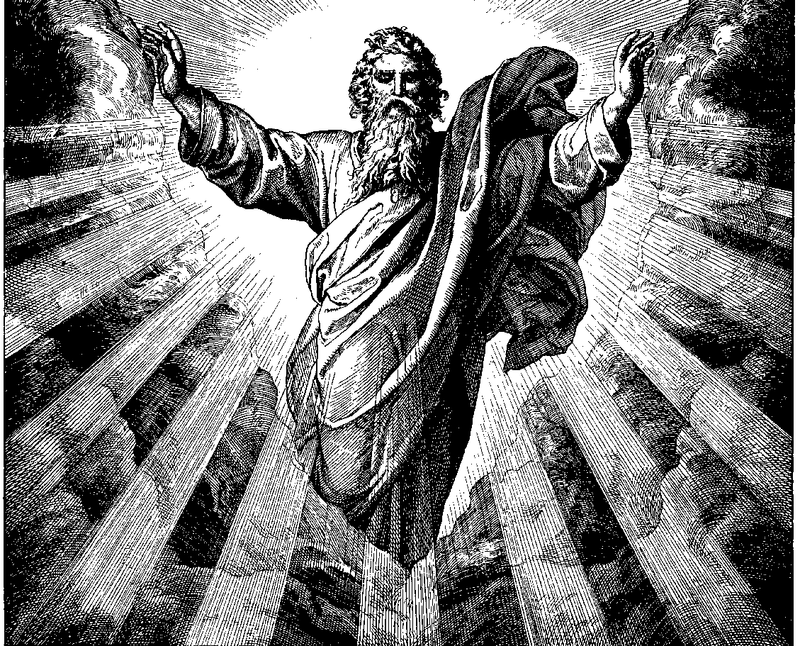
(Julius Schnorr’s sketch of God the Father, circa 1860, via Wikimedia Commons)

Taking A Stand On The Can, Ctd

god-stall

Some bathroom graffiti for Sunday:

On the inside of the door of a stall in the ladies’ room a Korean Presbyterian church in Philadelphia:

Psalm 139:1
Lord, you have searched me out and known me; you know my sitting down and my rising up.

Another:

One I first saw about a year ago; fun for a 56-year-old to learn new grafitti. In one handwriting: “John 3:16“. Below it in a different handwriting: “Bill, about 4:30“.

Another:

From a Canadian university in the mid-1980s: “Jesus Saves”.  Written underneath: “but Gretzky scores on the rebound!”

Many more below:

My favorite (and only) graffiti I remember from college is: “Jesus saves … Moses invests … Mongol hordes”.

Another:

When I was at the University of Iowa back in the ’90s I saw this gem:

Jesus lives!

Followed by:

In my penis!

Trumped by:

So it takes your penis three days to rise again?

Another:

During the 1970s, the preacher/faith healer/television evangelist Oral Roberts had a very successful ministry, but he was widely seen as a huckster by “mainline” Christians. Thus, a stall in a men’s room in Speer Library at Princeton Theological Seminary had the following graffiti: “Do you believe in Oral Roberts between consenting adults?”

Another shifts away from the porcelain god:

My favorite bathroom stall wisdom is this nugget seen in a stall in Peabody Hall, home of the University of Georgia philosophy department. It stated, quite simply: “I shit, therefore I am.”

More philosophy:

From a stall in Oxford:

“God is dead.” – Nietzsche

With the addition:

“Nietzsche is dead.” – God

Another reader:

Men’s room stall, UNC-Chapel Hill philosophy department: “Heisenberg may have been here.”

And another:

A reader wrote about the incongruity of writing to an erudite blogger about bathroom graffiti, but a few years ago I wondered into a bathroom at St. John’s College in Annapolis and had to take a picture of the graffiti that read “πολλὰ τὰ δεινὰ muthafucka” and honor the wisdom of whoever wrote them. As a classics PhD, I knew those words to be adapted from a chorus in Sophocles’ Antigone “There are many terrible things [but none worse than man]” (line 332). This citation shows the contexts where πολλὰ τὰ δεινὰ  usually shows up.

One more:

Found in a men’s room on the 4th floor of the Philosophy Building at UCLA (circa 1968):

To be is to do—Sartre
To do is to be—Hegel
Do be do be do—Sinatra

When Faith Is Not An Escape

In a personal essay, Laura Turner reveals the way her “anxiety frequently blossoms at the intersection of uncertainty and powerlessness,” resulting in the fear that she “can never feel at home.” How that connects to her religious faith:

The common misperception of religion as a crutch would have us believe that people are faithful because they want to escape the problems of the world and the realities of everyday life. But my faith tells me the importance of staying put. In one way it asks me to grow roots, but in another it is nothing deeper than what the words say: Stay put. Sit with the worries and fears and discomfort. Recognize it as a part of you and of the world. Recognize you can’t run from it, as much as you want to.

When I am anxious, I am filled with a powerful wanderlust that makes leaving home so tempting and makes it seem like travel will allow me to escape my churning mind. I hold the lesson of my faith in one hand and my desire to bolt in the other. I try to make sense of them. My discomfort surfaces when I have to navigate the world of adulthood for too long. Maybe I should go somewhere so utterly familiar that it does not challenge me, or else somewhere so new that it jolts me out of myself.

There’s an old hymn, Come Thou Fount of Every Blessing, with these lyrics: “Prone to wander, Lord I feel it, prone to leave the God I love.” When I get tired and the inspiration to travel—to plan another trip, to look impatiently forward to what is next on the calendar, to move out of the present moment—strikes up (and partly I blame that on God for making the world such a very interesting place to explore) that lyric “prone to wander” hits me hard. I find myself thinking that maybe running away is like leaving God. Sometimes I want to run backward, back to a deeper set of roots I did not put down myself, back to my parents’ house where everything is easy and safe. And this, I think, is maybe like leaving God too.

(Video: Sufjan Stevens sings “Come Thou Fount of Every Blessing”)

Houellebecq’s Nightmare, Ctd

We recently noted that the massacre at the offices of Charlie Hebdo coincided with the publication of Michel Houellebecq’s latest novel, Submission, which had been featured on the satirical weekly’s cover. In a recent interview with The Paris Review, Houellebecq spoke about why he believes the novel’s premise – a Muslim candidate is elected President after defeating the the far right candidate Marine Le Pen – is a thought experiment worth conducting:

Well, Marine Le Pen strikes me as a realistic candidate for 2022—even for 2017 … The Muslim party is more … That’s the heart of the matter, really. I tried to put myself in the place of a Muslim, and I realized that, in reality, they are in a totally schizophrenic situation. Because overall Muslims aren’t interested in economic issues, their big issues are what we nowadays call societal issues. On these issues, obviously, they are very far from the left and even further from the Green Party. Just think of gay marriage and you’ll see what I mean, but the same is true across the board. And one doesn’t really see why they’d vote for the right, much less for the extreme right, which utterly rejects them. So if a Muslim wants to vote, what’s he supposed to do? The truth is, he’s in an impossible situation. He has no representation whatsoever. It would be wrong to say that this religion has no political consequences—it does. So does Catholicism, for that matter, even if the Catholics have been more or less marginalized. For those reasons, it seems to me, a Muslim party makes a lot of sense.

In a helpful review of the novel, Steven Poole asserts that its real aim is not to offer “a splenetic vision of the Muslim threat to Europe or a spineless ‘submission’ to gradual Islamic takeover”:

Some in France have already complained that the novel fans right-wing fears of the Muslim population, but that is to miss Houellebecq’s deeply mischievous point. Islamists and anti-immigration demagogues, the novel gleefully points out, really ought to be on the same side, because they share a suspicion of pluralist liberalism and a desire to return to “traditional” or pre-feminist values, where a woman submits to her husband – just as “Islam” means that a Muslim submits to God.

But Soumission is, arguably, not primarily about politics at all. The real target of Houellebecq’s satire – as in his previous novels – is the predictably manipulable venality and lustfulness of the modern metropolitan man, intellectual or otherwise. François himself happily submits to the new order, not for any grand philosophical or religious reasons, but because the new Saudi owners of the Sorbonne pay much better – and, more importantly, he can be polygamous. As he notes, in envious fantasy, of his charismatic new boss, who has adroitly converted already: “One 40-year-old wife for cooking, one 15-year-old wife for other things … no doubt he had one or two others of intermediate ages.”

The Mysterious World Of Female Ejaculation, Ctd

It just got a little less so:

Researchers are now saying that squirting is essentially involuntary urination.

Female ejaculate is technically the small amount of milky white fluid that’s expressed when climaxing, New Scientist explains. Squirting, on the other hand, results in a much larger gush of a clear fluid, which comes from the urethra, the duct where urine is conveyed from the bladder. The findings, which combine biochemical analyses with pelvic ultrasounds, were published in the Journal of Sexual Medicine on Christmas Eve.

More details from that New Scientist piece:

To investigate the nature and origins of the [milky white fluid purportedly from the Skene glands], Samuel Salama, a gynaecologist at the Parly II private hospital in Le Chesnay, France, and his colleagues recruited seven women who report producing large amounts of liquid – comparable to a glass of water – at orgasm. First, these women were asked to provide a urine sample. An ultrasound scan of their pelvis confirmed that their bladder was completely empty. The women then stimulated themselves through masturbation or with a partner until they were close to having an orgasm – which took between 25 and 60 minutes.

A second pelvic ultrasound was then performed just before the women climaxed. At the point of orgasm, the squirted fluid was collected in a bag and a final pelvic scan performed. Even though the women had urinated just before stimulation began, the second scan – performed just before they climaxed – showed that their bladder had completely refilled. Each woman’s final scan showed an empty bladder, meaning the liquid squirted at orgasm almost certainly originated from the bladder.

A chemical analysis was performed on all of the fluid samples. Two women showed no difference between the chemicals present in their urine and the fluid squirted at orgasm. The other five women had a small amount of prostatic-specific antigen (PSA) present in their squirted fluid – an enzyme not detected in their initial urine sample, but which is part of the “true” female ejaculate

As a parting thought, Salama “believes every woman is capable of squirting ‘if their partner knows what they are doing'”. You can head to YouTube for that. Previous Dish on the subject here. Update from a reader:

Thank you for officially ruining female ejaculation for me. I cringed when I read the first sentence of your post and realized that all those years I was getting peed on and loving it. Dammit. Good thing I was always coming from swim practice and had my swim goggles handy!

Another:

I would dearly love to read the grant proposal for that research. Especially the informed consent form.

The World’s Best Beer Pong Player

Is a robot:

But the major innovation is how the machine grips the ball:

In the video above, you’ll see that the mechanized arm picks up each ping-pong ball in a green sphere. That sphere is known as a Versaball and it’s filled with sand. When the Versaball is pumped with air, the sand granules can move around freely and form an impression around the objects on which the sphere is placed. Once the ball is in place on top of an object, the system sucks the air out of it, causing the sand grains to tighten around the object, thereby allowing it to be lifted.

David Pescovitz covered this technology last year:

Many of tomorrow’s robots may have more in common with beanbag chairs and bouncy houses than the hulking industrial arms in factories today. Breakthroughs in the nascent field of soft robotics, in which steel skeletons and power-hungry motors make way for textiles, are beginning to move from the laboratory to the startup world. Imagine an octopuslike robot that can squirm through rubble at a disaster site but has the strength to pull bricks off an injured person. Or a machine that can safely place an elderly person in bed. Several companies are working on these problems, frequently working from research sponsored by the U.S. Defense Advanced Research Projects Agency (Darpa), the Pentagon arm that seeks and funds futuristic technology. “Soft robotics has the potential to influence all kinds of robotic and machine design,” says Gerald Van Hoy, an analyst at market research firm Gartner. “It’s a key development in the evolution of robotics.”

An Annual Dry Spell

dish_drynuary

John Ore explains Drynuary, the tradition of giving up alcohol for the month following New Year’s:

Make no mistake: If you like drinking, Drynuary is hard, and it’s supposed to be. I’m not particularly religious, but I appreciate the Lenten aspect of giving up something I enjoy for an extended period of time just to say I can. (My birthday falls during Lent, so no way am I giving up drinking then.)

Drynuary forces us to consider the the role alcohol plays in our everyday lives, especially when its absence is the most obvious or stark. My wife and I don’t hibernate for a month, sipping herbal teas and avoiding glances at the stemware and the three neglected beers left in the fridge. There are still the NFL playoffs, and the college football championship, and concerts and recreational beer-league ice hockey. Our first Drynuary we met friends at a sports bar to watch football, and the amount of club soda we downed led to plenty of speculation that we were expecting. Ive been the designated driver for post-snowboarding pub crawls and I’ve had to explain to business associates why I’m not having wine with dinner while traveling for work. Half of the point of Drynuary is to live your life as you normally do, just without drinking.

For last year’s Drynuary, Jolie Kerr created a guide for the uninitiated:

If it’s so hard, doesn’t that mean you have a problem?

Yes and no. But more no than yes. Think of it this way: If you decided to give up chocolate for a month—or sourdough bread, or Irish butter, or picking at ingrown hairs, or whatever it is that you love most in this world—it would probably suck. You would probably say, “Gosh, this is hard!” Would that mean you had a problem with chocolate or sourdough bread or Irish butter or picking at ingrown hairs? Maybe. But probably not.

And what about the health effects of a month on the wagon? Amy Guttman looks at what happened when staffers at New Scientist experimented with foregoing drinking for five weeks:

Dr. Rajiv Jalan, a liver specialist at the Institute for Liver and Digestive Health at University College London, analyzed the findings. They revealed that among those in the study who gave up drinking, liver fat, a precursor to liver damage, fell by at least 15 percent. For some, it fell almost 20 percent.

Abstainers also saw their blood glucose levels — a key factor in determining diabetes risk — fall by an average of 16 percent. It was the first study to show such an immediate drop from going dry, Dr. James Ferguson, a liver specialist at Queen Elizabeth Hospital Birmingham in England, told us last year.

Update from a reader:

I really enjoyed your post on Dryanuary. As it happens, I do the same thing – go 30 days or more without consuming any alcohol – but I do it in August, instead of January. I like to joke that I am “giving my liver a break” before football season starts, but it’s become a tradition that I’ve maintained for over a dozen years now.

I originally gave it the boring name of “abstinence month,” but several years ago a friend of mine my friend started calling it “Tomadan,” a portmanteau of my first name and the Islamic holy month of fasting. And the name has since stuck so that now all my friends understand “Thomas can’t drink with us tonight because he’s on Tomadan.”

It’s not always easy. There are times when the Texas heat is such that there is nothing more I want than an ice cold beer. But I’ve always managed to resist, and at the end of the month I come away with a feeling of satisfaction that makes that first beer of football season taste so much better.

Plus, I’m a little thinner and my wallet is a little fatter.

(Photo by Flickr user Apionid)