Every Sex Worker Is Somebody’s Daughter, Ctd

by Dish Staff

A reader adds his two cents to the discussion:

I wouldn’t want my daughter to make her living in porn, but not because I have a moral objection to it. My problem is with the career trajectory. A porn actress’s earning power peaks fairly early on. And after that happens and she wants to get a job outside of the adult industry, that porn history will put a pretty low glass ceiling over her head.

Another has a more philosophical objection:

We already make certain moral, qualitative distinctions between free commerce and other sectors of life.  You are not allowed to sell your enfranchisement, for example. Why not? Most people don’t use nearly all the votes to which they are entitled as citizens. Why can’t they offer a price to someone who wishes to make use of them? It’s easy enough to argue that votes are already bought when politicians vow certain breaks or benefits for their election. But that’s not the same thing as selling the vote itself before the fact.

You’re also not allowed to sell yourself into slavery, however much that might benefit your family or designated beneficiaries financially. Again, one may argue that all labor relations are just attenuated versions of precisely that already, but that’s not the same thing as selling the sum of one’s liberty and labor as such.

If we agree that there are already certain domains of life (e.g. enfranchisement, liberty, citizenship) where no amount of economic necessity can validate the commercialization thereof, then why is it hard to see sex as something similar? You don’t need to be a prude and you don’t need to see public law and family law as the same thing in order to recoil at legalized prostitution. If sex doesn’t rank up there with citizenship and the vote as a special, non-commercial endowment, then what principle would prevent a world of indentured servitude and commodified enfranchisement?

Counting The Poorest Among Us

by Dish Staff

Jordan Weissmann highlights some recent attempts to ascertain how many Americans live in extreme poverty—under $2 a day—that came up with very different numbers:

According to H. Luke Shaefer of the University of Michigan and Kathryn Edin of Johns Hopkins, the number of families living under that low, low line has grown 159 percent since 1996. … Part of the reason Shaefer and Edin’s headline number was so startlingly high—they calculated that the extreme poverty rate among households with children was a chilling 4.3 percent—could be attributed to a very narrow definition of income that ignored all noncash safety net benefits. Today, most of the government’s poverty-fighting efforts don’t involve straightforward cash. Food stamps? Housing vouchers? Tax credits? None were included. Once they accounted for those programs, only 613,000 families were living below the $2-a-day mark in 2011—still up by about half since the Clinton years.

At a bare minimum, then, hundreds of thousands of American households are living in true destitution. (For a family of three, the federal poverty line works out to about $17 per day, per person.) According to the new Brookings report, however, even Shaefer and Edin’s most conservative estimates of extreme poverty might have been too high. If you look at data on income, the pair’s estimates essentially hold up. But Brookings fellow Laurence Chandy and MIT Ph.D. student Cory Smith found that if you examine U.S. consumption statistics, then the number of families surviving on less than $2 each per day falls close to zero.

Chandy explains how he arrived at that conclusion:

Part of the reason for this is that even the poorest people surveyed in America appear to find a way to meet their most basic material needs (valued above $2 a day) even if their reported income is zero or close to zero. Furthermore, the poor in America have access to public goods—public education, criminal justice and infrastructure—that would be the envy of the poor in the developing world.

However, poverty is manifested in different ways in the U.S. and developing countries. Focusing narrowly on material needs means missing other critical components of welfare that may be especially lacking among America’s poorest people. For instance, those whose survival depends on in-kind assistance may be assured that their most basic material needs are met, but the absence of a reliable source of income makes it extremely difficult to cope with the unexpected, such as replacing broken or stolen assets or emergency travel. These individuals face a virtual exclusion from the cash economy implying a dearth of agency that directly affects their welfare.

An Apple A Year

by Sue Halpern


Apple

What do I (think I) know about the new iPhone 6? That it’s going to have a bigger screen. That’s it’s going to have two bigger screens since there will be two models. That the model with the even bigger screen is not going to be available right away. That both screens are going to be made from “stronger than steel” sapphire glass. That it is going to have rounded edges, just like the old days. That it is going to have a whole new operating system. That it will be able to measure my heart rate and count my steps. That it will be my e-wallet. That it is being unveiled on September 9th. That it is going to be cool. Really cool. So very cool that something on the order of 80 million people will ditch their previously really cool phone and buy one of these new, cooler, ones.

What do I know about the new iPad? That’s going to have a bigger screen. Way bigger than the iPad mini, which the company was finally compelled to produce after Samsung, Asus and Google showed that a segment of the population wanted to downsize. And it was great. But this new iPad is going to be greater. Literally. By about four inches greater. Why is bigger better? Bigger is always better, except when smaller is better. (Let’s hear it for the diminutive 11 inch MacBook Air on which I am typing this!)

What do I know about the new iWatch? That Apple hired a marketing executive from an actual watch company, which must mean that it is finally about to enter the wearable tech sector. That the iWatch is going to be announced along with the new iPhones on September 9th. Maybe.

And how do I know these things? I couldn’t tell you, exactly. There is an ambient quality to “information” about new Apple products. They swirl through the atmosphere. They are traded like bits of intelligence among children anticipating Christmas morning. Apple hardly needs a marketing department. The marketing department is us. This, among other things, is the legacy of Steve Jobs.

And since Jobs studied zen, here is a koan in anticipation of September 9: Why do Apple products cost more? Because they do.

As Leonid Bershidsky points out:

As long as the Cupertino company is able to sell millions of devices at prices that reflect nothing but the brand’s cachet, it doesn’t have to care about its shrinking market share: it will continue to skim the cream while rivals sweat every dollar.

And, he goes on:

After receiving hundreds of insulting messages every time I have the gall to question Apple’s superiority, I am convinced its products are cult objects made in heaven as far as its fans are concerned. Apple adherents don’t care about the Samsung provenance of the “revolutionary” 64-bit processors in their phones: to them, anything the company touches is sanctified, be it a Qualcomm camera module or a Bosch accelerometer.

Apple would be stupid not to use this incredible — and, after three years without a truly innovative product, inexplicable — competitive advantage. Its devotees will believe anything: That a $1,200 phone costs so much because it has a sapphire screen, because it’s bigger than before, simply because it’s the new iPhone. Tell them that using sapphire only adds about $15 to the cost of the phone, or that the Galaxy S5’s 5-inch screen costs $63 compared to $41 for the iPhone 5s’s 4-inch one — not a major difference considering the fat margins — and they will shrug: Apple wins.

(Image: Apple’s press invite to its Sept. 9th event.)

The Spiral Of Silence

by Sue Halpern

Pew Silence

When I read this Pew report last week, about how social media does not foster meaningful dialog about public policy among people who might not share one’s own view, I can’t say that I was surprised. Researchers, interested in finding out if Facebook and Twitter encouraged people to engage with each other on divisive current events, interviewed slightly less than 2000 Americans, asking them if they would share their views about Edward Snowden’s NSA revelations with their social media “friends.” Apparently, in the pre-Internet olden days, people were shy about voicing an opinion on controversial topics when they weren’t sure of the viewpoint of their listeners. This reticence was deemed “the spiral of silence.” Might social media turn that around?

The survey reported in this report sought people’s opinions about the Snowden leaks, their willingness to talk about the revelations in various in-person and online settings, and their perceptions of the views of those around them in a variety of online and off-line contexts. This survey’s findings produced several major insights:

People were less willing to discuss the Snowden-NSA story in social media than they were in person. 86% of Americans were willing to have an in-person conversation about the surveillance program, but just 42% of Facebook and Twitter users were willing to post about it on those platforms.

Social media did not provide an alternative discussion platform for those who were not willing to discuss the Snowden-NSA story. Of the 14% of Americans unwilling to discuss the Snowden-NSA story in person with others, only 0.3% were willing to post about it on social media.

In both personal settings and online settings, people were more willing to share their views if they thought their audience agreed with them. For instance, at work, those who felt their coworkers agreed with their opinion were about three times more likely to say they would join a workplace conversation about the Snowden-NSA situation.

That people behave on social media much the same that they do in other parts of their lives probably should not surprise us. Social media is a platform; most likely it doesn’t change our instinctive behaviors when a real name is put to an opinion. (The kinds of behaviors encouraged by social media anonymity is another thing altogether.)

Writing about the Pew study, Jamie Condliffe observes:

Our social networks are increasingly powered by algorithms designed to feed us news that aligns with what we want to see and hear. It’s only natural that the upshot of that kind of tuned information delivery would make us worry about sharing opinions that were out of step.

It seems counter-intuitive–if we’re getting only what Facebook thinks we want to get based on everything they know about us, which is a lot, shouldn’t we assume we are always among friends? But it makes sense. We’re worried about losing friends, which is to say that we’re worried our number of friends will diminish.

What’s peculiar about the Pew study is how the questions were asked. Though the survey took place in the months after Snowden’s revelations, the subjects were asked will you and would you… not did you. Using the conditional to report on behavior that already might or might not have happened tends to make the whole exercise, well, an exercise.

It turns out, too, that the spiral of silence does not only extend to individuals. Take this week’s revelation about the NSA’s Google-like search engine that shares something on the order of 850 billion data points such as private emails obtained without a warrant from ordinary American citizens among numerous government agencies. This is a big deal for many reasons, not the least of which is that it may enable the FBI or the DEA to illegally obtain evidence and cover their tracks while so doing. Yet the mainstream media almost uniformly ignored the story. When I searched ICREACH today, only the online tech media had picked it up and run with it. Is it possible that the mainstream media is afraid of losing friends, too?

Teaching A Fish To Walk

by Dish Staff

Carl Zimmer unpacks a fascinating new study on bichirs (a type fish that “mostly live in lakes and rivers” but “will sometimes crawl across dry land with their fins”):

McGill scientists wondered what would happen if they forced the fish to grow up out of the water. To find out, they reared eight bichirs in a terrarium with a pebble-strewn floor. To prevent the bichirs from drying out, the scientists installed a mister to keep their skin moist. The fish grew for eight months, clambering around their terrarium instead of swimming.

Then the scientists examined these fish out of water. They found that eight months on dry land (or at least moist land) had wreaked profound changes to the bichirs.

For one thing, they now walked differently. Overall, they were more efficient. In each step, they planted their fins on the ground for less time, and they took shorter strides. Instead of flapping their fins out to each side, they placed their fins under their bodies. Their fins slipped less when they pushed off of them. They made smaller movements with their tails to go the same distance as a bichir raised underwater. Aquatic bichirs walk on land with an irregular gait. The terrestrial bichirs, on the other hand, walked more gracefully, planting their fins in the same spot relative to their bodies time after time.

Noah Baker adds that, beyond the fishes’ new walking style. “their bone structure and musculature changed to be more suited to a walking lifestyle”:

The results provide evidence for developmental plasticity, in which organisms alter their anatomy and behaviour in response to environmental change. The team suggests that this process, as demonstrated by the bichir, could have given the earliest tetrapod ancestors the ability to venture onto land. In doing so, claims [lead author Emily] Standen, they would have become exposed to the selective pressures of a terrestrial environment, thereby speeding up the evolutionary transformation from fins for swimming into limbs for walking.

The Path To Legalization In DC

by Dish Staff

Jon Walker finds a silver lining to gridlock on the Hill:

[L]ast month the House approved the Financial Services and General Government Appropriations bill with a policy rider from Rep. Andy Harris (R-MD) which would prevent D.C. from using funds to implement marijuana reform. It was designed to stop Initiative 71, a local marijuana legalization ballot measure which is expected to win with strong support from D.C. voters this November.

Because of this historic level of dysfunction in Congress this particular appropriations bill is likely to die and all its policy riders will die with it. Instead Rep. Paul Ryan (R-WI) expects that when Congress briefly returns next month they will just pass a clean (meaning policy rider-free) continuing resolution to cover all funding issues until after the election. Professional budget watcher Stan Collender expects that continuing resolution to be followed by yet another one in November to maintain the status quo well into 2015.

He adds that, “At minimum, pushing any final fight about Congress interfering in D.C.’s marijuana laws until after the election should make it politically more difficult to do so.” In a post from earlier this month, Walker laid out why he’s looking forward to DC’s legalization fight:

Racial justice will be front and center – “The overarching theme of the campaign is Legalization Ends Discrimination,” Dr. Malik Burnett, the D.C. Policy Manager from the Drug Policy Alliance told me. “We are looking to have Washington D.C. be the first jurisdiction to legalize marijuana in a racial justice context.”

The huge racial disparity in marijuana arrests has helped galvanize support for reform across the country, but while the issue has played a role in the other legalization initiative campaigns so far it hasn’t been the top message other places for a simple reason. In Colorado (4.4%), Washington State (4.0%), Oregon (2.0%) and Alaska (3.9%) the African-American population is well below the national average of 13.2%. By comparison roughly half the people living in D.C. are black. In addition D.C. has a history of some of the worst racial disparity in marijuana arrests anywhere in the country. The ACLU found that nationally Blacks were 3.73 times more likely to be arrested for marijuana than whites, but in D.C. the disparity was an incredible 8 to 1.

Nine-Year-Olds And Uzis Don’t Mix

by Dish Staff

Uzi

Dish alum Katie Zavadski brings us up to speed on a tragic story:

A young girl sporting pink shorts and a long braid fatally shot her gun instructor on Monday, after the weapon she was firing recoiled in her hands. Charles Vacca, 39, died at a Las Vegas hospital that night. The 9-year-old child, whose name has not been released, was on vacation with her parents when they stopped by a gun range. The range allows children as young as 8 to shoot weapons, provided that they are accompanied by an adult.

Charles Cooke, no enemy of the second amendment, observes that normally “smaller people — especially children — are restricted to smaller weapons that are commensurate with their size”:

When American children used to go to school with a rifle slung over their back, it was almost certainly a low-powered .22. There weren’t many Tommy Guns in American classrooms. An Uzi, on the other hand, seems to be the worst of both worlds – especially when it is chambered in a larger caliber. Because their recoil tends to push the weapon upwards, handguns are inherently more difficult for young people to control. This is especially so when they keep firing upon a single trigger pull. Frankly, it is difficult to imagine a gun less suited to a small girl.

Paul M. Barrett joins the conversation:

Does the Arizona episode mean we live in a whacko gun culture? Those saying yes are going to remind you of a 2008 case in which an 8-year-old Massachusetts boy—under adult supervision at a gun club—accidentally shot himself in the head with an Uzi and died. Those saying no, guns are as American as apple pie, will point out, accurately, that for years, the number of accidental shootings has been declining, along with overall gun deaths. By those measures, we’re becoming a safer country, even as some parents defy common sense and put machine guns in the hands of little kids.

The range in question is now considering (yes, merely considering) a height requirement:

Arizona has no age restrictions on firing guns, and Scarmardo’s Last Stop shooting range typically allows kids 8 and older to fire its array of automatic weapons. “It is pretty standard in the industry to let children shoot on the range,” the owner told the Times. “We are working with the Mohave County Sheriff’s Office, and we’ll make a decision if we’ll make any changes after we review all the facts.” The Guardian reports that children are temporarily barred from shooting during the investigation.

(Screenshot from a video released by the police “of shooting instructor Charles Vacca, of Lake Havasu City, moments before he was accidentally shot by a 9-year-old girl he was teaching.”)

Yep, This Sure Looks Like An Invasion, Ctd

by Dish Staff

image_thumbnail

Evidence is mounting that Russia has launched an outright invasion of Ukraine:

In Brussels, a Nato military officer told Reuters that the alliance believes there are now more than 1,000 Russian soldiers fighting in Ukraine. Russia has repeatedly denied it is fighting in Ukraine, and speaking after the Minsk negotiations, Putin said that a solution to the crisis in east Ukraine is “not our business; it is a domestic matter for Ukraine itself”. He said all Russia could do was “support the creation of an environment of trust”. … Russia’s denials appear increasingly flimsy.

When the Guardian saw a Russian armoured column cross the border two weeks ago, the foreign ministry and local security services denied any incursion had taken place, saying it was a border patrol that had not strayed into Ukrainian territory. Earlier this week, when Russian paratroopers were captured well inside Ukraine, sources in the defence ministry also said they had been part of a border patrol that had got lost and entered Ukraine “by accident”. The head of the self-declared Donetsk People’s Republic, Alexander Zakharchenko, admitted on Thursday that there are serving Russian soldiers among his fighters, but claimed they were volunteers who were taking a holiday in the region.

The Interpreter’s live blog flags a NATO release of satellite imagery purporting to show Russian artillery in Ukrainian territory a week ago:

Dutch Brigadier General Nico Tak, director of the Comprehensive Crisis and Operations Management Centre (CCOMC), Allied Command Operations said the images confirmed what NATO and its Allies had been seeing for weeks from other sources. “Over the past two weeks we have noted a significant escalation in both the level and sophistication of Russia’s military interference in Ukraine,” said Brigadier General Tak. “The satellite images released today provide additional evidence that Russian combat soldiers, equipped with sophisticated heavy weaponry, are operating inside Ukraine’s sovereign territory,” he said. These latest images provide concrete examples of Russian activity inside Ukraine, but are only the tip of the iceberg in terms of the overall scope of Russian troop and weapons movements.

Lest anyone forget, Ilya Somin stresses that Russia already invaded Ukraine a while ago:

In the discussion over whether Russia has “invaded” eastern Ukraine in recent months, few mention that it already invaded Ukraine in a more blatant way months ago, and continues to occupy a large swath of Ukrainian territory. While Putin’s efforts to aid the brutal separatists in Eastern Ukraine are reprehensible, at least the West continues to oppose them, and Ukrainian forces may well defeat the separatists before Russia is willing or able to provide them enough assistance to save them. By contrast, little effort is being made to challenge Putin’s annexation of Crimea -a much more flagrant invasion that has largely become a fait accompli. It may be that nothing can be done to reverse it, at least in the short term. But we should at least remember the true nature of what has happened, and look for opportunities to change it in the future.

Dmitri Trenin hopes a peace deal is in the offing sooner rather than later:

Any future settlement would probably have to include Kiev engaging in a serious political dialogue with the eastern regions, and adjusting its nation-building policies to take into account Ukraine’s diversity. Wide-ranging amnesty would be granted to the participants in the conflict. It would also need to include Russia’s acceptance of Ukraine’s European choice, and specifically its association with the EU. NATO membership for Ukraine, by contrast, would remain out of reach to Kiev—more as a result of a German veto than a product of Ukraine’s federalization. Ukraine would not become a formal federation, but the “unitary nature” of its state would allow a significant degree of decentralization, including in economic, financial and linguistic issues. At some point, Russia and Ukraine would settle for a mutually acceptable gas price, with the EU guaranteeing the gas transit across Ukraine, and the case against Gazprom would be withdrawn from the Stockholm arbitrage.

A deal along the lines described above may look too unpalatable to many people. However, the absence of any deal deemed minimally acceptable to all sides would steer Europe toward an abyss.

An Actual Exit from Climate Hell

by Bill McKibben

Earlier today I went after libertarians for their troubles with climate change. But it’s conservatives in general that have been the real hypocrites here, given that the least conservative thing you can possibly imagine would be running the temperature of the earth way out of the range where human civilization has previously thrived. And the irony is, some of the most obvious ways out are… kinda conservative. Or at least should appeal to conservatives who are not, in reality, shills for the fossil fuel industry. Yes, given that we’ve delayed  as long as we have we need a big government effort to put in renewable energy, and yes we need wholesale shifts in who holds power (the key new text on climate change will be Naomi Klein’s This Changes Everything, due for release next month). We also need to provide massive aid for the countries we’ve endangered by our unchecked carbon emissions.  But one of the big changes we require is remarkably conservative in nature.

It’s called Cap and Dividend, long proposed in one form or another by the great climate scientist James Hansen and by an excellent advocacy group called the Citizens Climate Lobby. It derives from the work of Peter Barnes, who has a fine new book called With Liberty and Dividends for All. Let today’s Washington Post editorial page explain:

A prominent member of Congress has proposed a comprehensive national climate-change plan. It’s only 28 pages long, it’s market-based, and it would put money into the pockets of most Americans.

His proposal would put a limit on the country’s greenhouse-gas emissions, a cap that would decline each year. Beneath that cap, companies would have to buy permits for the emissions their fuels produce. The buying and selling of permits would set a market price for carbon dioxide. The government would rebate all of the revenue from selling permits back to anyone with a Social Security number,more than offsetting any rise in consumer prices for 80 percent of Americans. Most upper-income people, who use more energy, and government, which would get no rebate, would pay more under the plan.

Every time you ratcheted down the cap on carbon (in order to keep the planet from being wrecked, which would be… expensive) the dividend check would rise; therefore there’d be far less political opposition to doing the right thing. And this plan posits a different understanding of the world: if anyone owns the atmosphere, it’s us, not Exxon. Since the fossil fuel industry currently gets to use the atmosphere as a free dump, there will doubtless be opposition from the likes of the Kochs. But this is a sensible, straightforward plan.

Don’t Speak, Memory

by Sue Halpern

Cross-Section

I’ve been reading various reports (like this one) of the success of a research group at MIT in taking the sting out of bad memories by switching the bad ones with good ones:

“In our day to day lives we encounter a variety of events and episodes that give positive or negative impact to our emotions,” said Susuma Tonegawa, Professor of Biology and Neuroscience at the Riken-MIT Centre for Neural Circuit Genetics.

“If you are mugged late at night in a dark alley you are terrified and have a strong fear memory and never want to go back to that alley.

“On the other hand if you have a great vacation, say on a Caribbean island, you also remember it for your lifetime and repeatedly recall that memory to enjoy the experience.

“So emotions are intimately associated with memory of past events. And yet the emotional value of the memory is malleable. Recalling a memory is not like playing a tape recorder. Rather it is like a creative process.

Granted, the experiments are on mice, but mouse models tend to transfer well-enough to humans that the scientists are hopeful that they are on to something useful. But will it be?

I realize this sounds crazy. Given the chance, who wouldn’t want to erase or in some way circumvent the memory of being mugged? And what about PTSD? The MIT group is hopeful that their technique, when applied to humans, will counter the effects of post traumatic stress.

If the MIT group fails, there still may be hope, courtesy of DARPA, the research arm of the Defense Department, which is developing an implantable chip that intended to lessen the effects of post traumatic stress. According to the Washington Post:

It’s part of the Obama administration’s larger “BRAIN Initiative,” which involves the National Institutes of Health, DARPA, the National Science Foundation and the Food and Drug Administration, among other organizations.

Officials say the BRAIN Initiative — which stands for Brain Research through Advancing Innovative Neurotechnologies — includes a related DARPA effort to build new brain chips that will be able to predict moods to help treat post-traumatic stress. It’s known as the SUBNETS program, short for Systems-Based Neurotechnology for Emerging Therapies. Teams at both the University of California, San Francisco, and Massachusetts General Hospital in Boston are involved.

“Instead of relying only on medication, we envision a closed-loop system that would work in concept like a tiny, intelligent pacemaker,” said Doug Weber, the program’s manager. “It would continually assess conditions and provide stimulus patterns tailored to help maintain healthy organ function, helping patients get healthy and stay healthy using their body’s own systems.”

(If I am a little suspicious of this technique, it may be because a few years ago, while writing about the use of virtual reality to help veterans overcome PTSD, I also learned that the military was interested in using the technique in the field, to get psychologically damaged soldiers quickly back into action, which seemed both dangerous and creepy to me.)

We are made of memories and formed by experience. I keep wondering what kind of people we would be, and what kind of world this would be, if when bad things happened we could erase them, or somehow make them sweet. Consider Anna Whiston-Donaldson, author of the just published memoir Rare Bird, whose 12-year-old son died in a freak accident, drowning during a rainstorm. One imagines what she’d wish for is that her son did not die, not that she didn’t remember it, and not, even, that it wasn’t as painful as it was.  Wouldn’t that impair grieving? Wouldn’t it dishonor–for lack of a better word–her son? I am not presuming to know. I don’t know. But I do know that meaning comes from many places.

So here is my question: if you could forget or erase that bad thing that happened to you, whatever it is, would you? Another way of asking this question is this: how has that bad thing made you who you are? Is there value–not in grief, but in grieving?

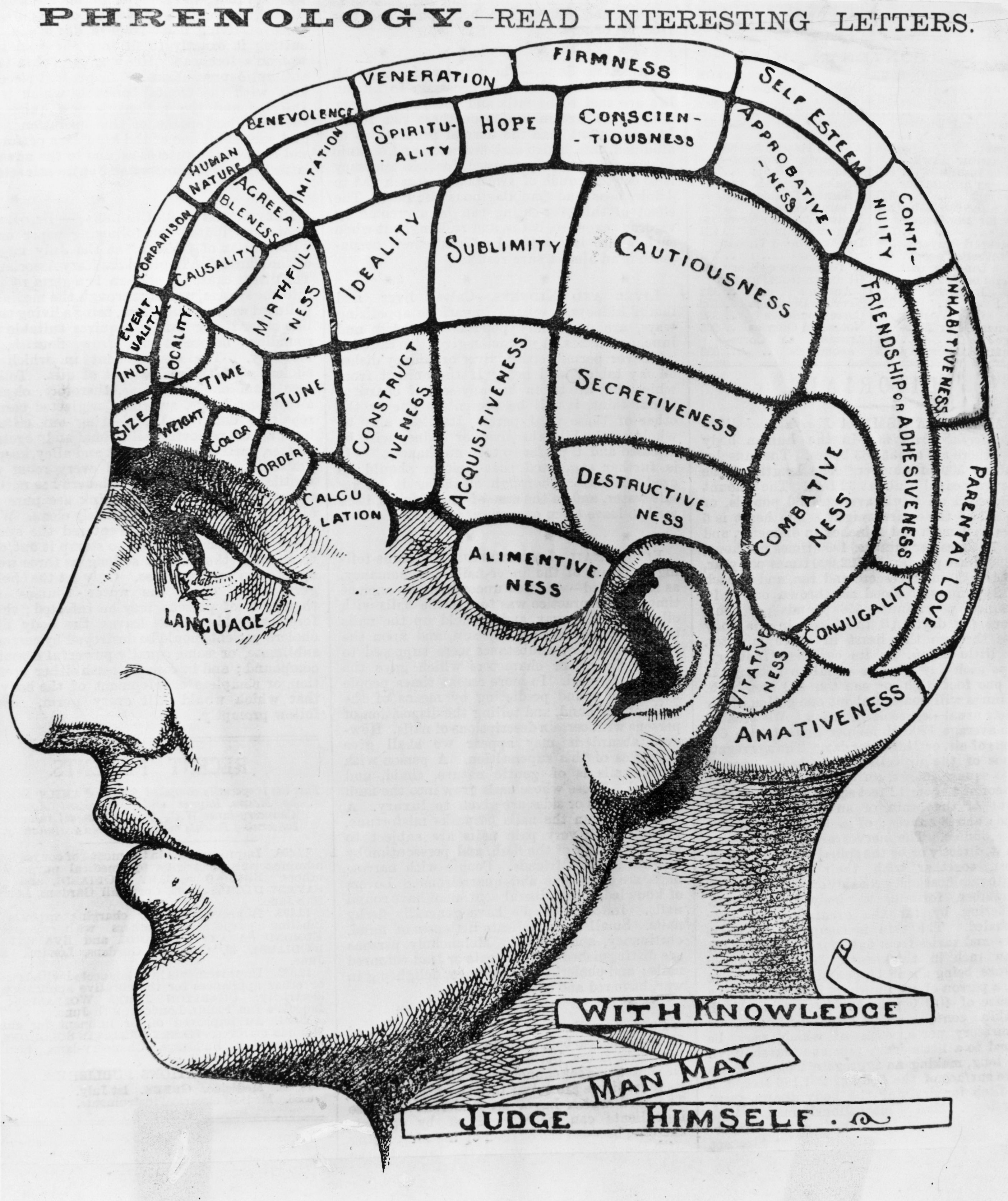
(Photo: circa 1880: A phrenological cross-section of a man’s head, illustrating the idea that the brain processes thoughts in different locations according to their type. By Hulton Archive/Getty Images)