Jay Newton-Small doubts an authorization would pass Congress in the run-up to midterm elections. For that reason, she argues, Obama probably won’t bother asking for one:
“Congress does not have the political will to approve a War Powers Resolution when the American people have very little appetite for war,” said Ron Bonjean, a former senior Republican congressional aide. “Getting the approval of Congress before the November elections to bomb ISIS targets in Iraq would likely require an attack on American soil or a very imminent threat of danger. Members of Congress want to secure their own re-elections and this type of vote could be the defining factor in several tight Senate races across the country.” …
The most likely path here is that Obama will continue to do what he’s been doing, and probably expand attacks into Syria, using the Article II justification. As the White House has argued, he’s protecting Americans in Erbil, the Kurdish capital in northern Iraq. By that measure, wherever America has an embassy, or citizens in peril, Presidents in the future will now have the precedent to engage in hostilities to protect them.
Damon Linker is dismayed, if not exactly surprised, that members of Congress are putting political considerations before Constitutional duty here:
Bombing a nation — even when it’s mainly to attack substate actors operating within it — is unquestionably an act of war. And debates about whether to go to war should be taking place in Congress, with our elected representatives taking a stand one way or another. The refusal to take that stand is a monumental evasion of Congress’s constitutionally delineated responsibility. That this shirking of responsibility is a product of abject cowardice and self-protectiveness makes it especially contemptible.
Serving in Congress has become so cushy that our representatives would rather protect their jobs than take a risk in defense of the public good or the prerogatives of their branch of government. Sure, they’ll support demagogic partisan stunts, like House Speaker John Boehner’s lawsuit against President Obama. But actually take responsibility for war and peace? Nah. Much better to stay silent now and then reserve the right to attack the president if military action goes badly — or benefit from the outpouring of national good will if it goes well.
Conor Friedersdorf lists some more reasons why a Congressional authorization would be a good idea, other than, y’know, how it’s required by law and all:
• The legislature is in a better position than the executive branch to carry out the will of the American people, which ought to dictate United States foreign policy.
• A congressional debate can help to test the arguments for intervention, which may well be wanting given the dearth of public scrutiny they’ve gotten.
• Every two years, Americans decide whether to keep or oust their representatives in the House. Knowing where they stand on hugely consequential matters of national policy is integral to the American system functioning.
• A war to defeat ISIS would be a huge undertaking. Embarking without the support of the citizenry casts doubt on whether the country would see the effort through.
• It is dangerous to give a single man the power to take a nation to war without anyone being able to do a thing to stop him. It is, in fact, anti-Madisonian.
As a good Dish reader, I know I’m supposed to take libertarianism seriously, and so I try, even if every time I contemplate Ayn Rand I find myself wishing I’d been born to a different species. It’s possible that my trouble stems from the fact that dealing with climate change is notoriously difficult for libertarians: if you burning the coal in your coal mine raises the sea level around my continent, something’s amiss. So too many theoretically rational and science-minded libertarians have tended towards denying the physics of global warming, just to avoid dealing with the implications for the philosophy. (There are of course honorable exceptions, like Ronald Bailey at Reason).
But this is really rich. Writing from his perch at the Cato Institute, Charles “Chip” Knappenberger explains why the U.S. should avoid taking a leadership role in any climate negotiation: because others have more at stake:
Such information is carefully concealed in Obama Administration reports, such as the one issued recently by the Council of Economic Advisors that predicts escalating costs the longer we delay serious climate change mitigation efforts. Instead of focusing on domestic costs of climate change, the report is built around an estimation of the global cost for carbon dioxide emissions—which, by the Administration’s numbers—is some 4 to 14 times greater on a per ton of emitted CO2 basis than those projected for the U.S.
Translated: climate change is going to be worse for Bangladesh, so let them deal with it. And it is going to be worse–it already is. People are starting to evacuate their island nations as seas rise. It’s true we may lose Miami, but we’re well off enough, perhaps, to take the hit. Asks Knappenberger sweetly:
Why should the President’s rush to restrict U.S. carbon dioxide emissions, which even his own officials say raises concerns about domestic energy costs and grid reliability, be justified upon supposed benefits which will largely accrue to foreign nations?
That would be piggish enough right there–but of course what Knappenberger doesn’t even mention in his column is that we’re the reason that Bangladesh has a problem. They hardly emit any co2–they’re a rounding error in any calculation. Whereas the United States has contributed more by far than any nation to the concentration of greenhouse gases in the atmosphere (China won’t match us even by 2030, and on a per capita basis, we’ll be champs forever).
Knappenberger’s logic will doubtless play well in the GOP as it stymies any nascent Obama administration effort to lead the world in a new direction. But if the libertarian creed is about people taking responsibility for their actions, as opposed to getting away with what they can, this is crass.
(Chart from the PBL Netherlands Environmental Assessment Agency)
After listening to Obama’s recent interview with Tom Friedman, Greg Djerejian wishes the president’s foreign policy showed “more transformative greatness”:
It is very easy to take cheap pot-shots at Obama. We must recall the alternatives would have been tragically worse. Even within his own party, as Hillary Clinton’s recent comments to Jeffrey Goldberg make clear, breezy certitudes around play-pretend muscularity are meant to showcase greater foreign policy gravitas, but actually too often indicate precisely the opposite. Indeed, we should commend Obama his caution, his rationality, his use of scalpels rather than hammers. By this I mean that a period of American retrenchment was well needed—almost inevitable—after the gross excesses of the post 9/11 Bush years. But Obama’s tragedy is that he has not accompanied a period of American retrenchment, even decline, with strategic panache (for instance, Nixon and Kissinger’s opening to China on the heels of the disastrous Vietnam War). He does not seem seized of the possibilities his office affords.
Due to his lack of an overarching strategy, Paul Saunders objects to those who would label Obama a “realist”:
The principal reason that Obama’s critics and defenders considered him a realist for so long has been his administration’s generally pragmatic policies. But realism is much more than pragmatism; confusing the two is one of the most fundamental and enduring errors in America’s foreign-policy debates. Realism is pragmatism rooted in awareness of international anarchy, infused with a deep understanding of American power and in service of a strategy based on American national interests. Obama is not a realist because his policies typically start and stop with the pragmatic and even the opportunistic. He appears to have excessive faith in international norms, little real appreciation of power’s uses and limits, and minimal interest in foreign policy, much less American international strategy.
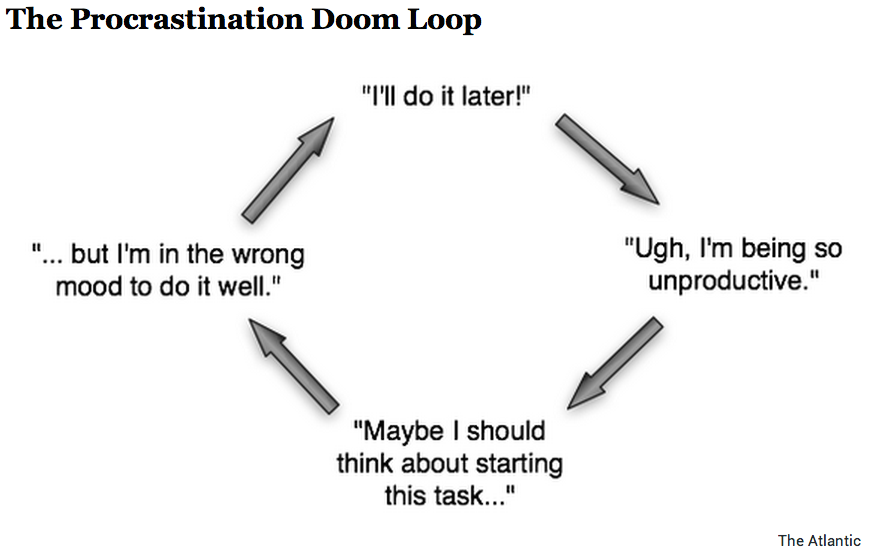
In the last few years … scientists have begun to think that procrastination might have less to do with time than emotion. Procrastination “really has nothing to do with time-management,” Joseph Ferrari, a professor of psychology at DePaul University, toldPsychological Science. “To tell the chronic procrastinator to just do it would be like saying to a clinically depressed person, cheer up.”
Instead, Ferrari and others think procrastination happens for two basic reasons: (1) We delay action because we feel like we’re in the wrong mood to complete a task, and (2) We assume that our mood will change in the near future.
So, how does one become more productive?
To hack your way to productivity, you could schedule one-shot reminders as late as possible—even slightly after you were supposed to start the project. Not only will the last-second reminder and looming deadline break the doom loop and shock you into action, but also it won’t give you time to put off—and, potentially, forget about—the task.
For pathological procrastinators, recognizing that we need deadlines to bind ourselves to our responsibilities is the first step. The second step is recognizing that our own deadlines are less effective than other people’s deadlines.
And that’s what Pascal-Emmanuel Gobry believes is missing from most analyses of China’s involvement in the continent:
For sure, China’s drive into Africa is mainly motivated by natural resources. But this is merely the catalyst of a broader phenomenon, which is really driven by the frustration of so many Chinese with the unbearably stifling and corrupt Chinese system.
From a slow-growth West myopically hypnotized by China’s largely meaningless growth figures (and a bizarre envy of authoritarianism), we don’t actually see China for what it is, which is a very unhealthy society. The limitation on births. The ruthless and ineffective education system, which now no longer provides the jobs it promised. The omnipresent corruption and inflation. The stifling (literally) pollution. No wonder everyone who can is running for the exits.
For Chinese who cannot find advancement or fulfillment in a tottering system, Africa is actually enticing. Chinese are more at home than Westerners in cultures where clientelism (understood non-judgementally as a system where networks of interpersonal reciprocal relations are very important) is more important than legalism, and in Africa they can find a world where opportunities are more available for the taking for the driven and hard-working who are shut-out of the best networks in China. And, of course, we cannot discount the fact that most of the Chinese doing business in Africa are men coming from a country with an increasing shortage of women to a continent where there is not. It is this social phenomenon which is driving China’s scramble for Africa, more than “neo-colonialism” or a mere geopolitical grab for oil and soybean fields.
[T]o qualify as pathological, narcissistic tendencies must impair functioning in real and painful ways. The self-absorption must not be explicable by age (toddlers are notorious tyrants) or socio-cultural environment (football stars are encouraged to act like Roman emperors). A true narcissist is all ego, unfettered and clumsy—he sees only himself, and yet the vision is opaque to him. He thrashes around in desires he can’t understand. Perhaps he loves No. 1 uncomplicatedly, or perhaps there is loathing mixed in. In her Harper’s piece “Me, Myself, and Id,” Laura Kipnis writes that the narcissist “lives as though surrounded by mirrors, but he doesn’t like what he sees.”
As Waldman explains, narcissism’s classification remains contested:
For psychiatrists, the question isn’t really “do narcissists exist” or “are narcissists any different from the rest of us.” It’s “are narcissists mentally ill?”
Behind this question lurks another one: What do we gain, and lose, from picking out a psychic phenomenon and declaring it “sick”? Are we needlessly stigmatizing ordinary behavior? Absolving jerks of responsibility for their trespasses? Conversely, given our more advanced understanding of mental illness as biological—a complicated interweaving of genetic, developmental, and environmental factors—are we being more humane? Making it easier for people who are suffering to find treatment? …
[I]t seems strange to insist that, because small-N narcissism lives in everyone, narcissistic personality disorder can’t inhabit its own pathological real estate on the far end of the continuum. Anxiety disorders exist, though we all get anxious. And just as mental illness itself has undergone a transformation from perceived moral failing to medical ailment, perhaps we can begin to see certain persistent dispositions as disabilities rather than spiritual flaws.
Reading all the reader responses to my question about the books, poems, and stories that have meant the most to you has been such a rewarding experience. My reading list certainly has grown even more unmanageable. What I’ve appreciated the most, in addition to the gratitude for books on display, are the anecdotes that have accompanied many of your suggestions. Not only can a story or poem be a consolation, but they remain connected to what we were going through when we read them – and perhaps even shaped how we perceived and understood what was happening. Thank you all for sharing. Here’s more of your responses, with this reader reminding us of a recent classic:
I nominate David Foster Wallace’s Kenyon commencement address. Though a commencement speech, I encountered it as essay. I’ve been rather amazed at how it has stuck with me. “This is water. This is water,” has become a personal mantra, a constant reminder to practice mindfulness.
Another:
I’m late to the thread (as usual!), but I’ll throw on the pile anyway – Theses on the Philosophy of History by Walter Benjamin. Its theme, and the famous passage that reflects it, is undoubtedly dark, but in a way I have always found liberating rather than depressing:
A Klee painting named Angelus Novus shows an angel looking as though he is about to move away from something he is fixedly contemplating. His eyes are staring, his mouth is open, his wings are spread. This is how one pictures the angel of history. His face is turned toward the past. Where we perceive a chain of events, he sees one single catastrophe which keeps piling wreckage upon wreckage and hurls it in front of his feet. The angel would like to stay, awaken the dead, and make whole what has been smashed. But a storm is blowing from Paradise; it has got caught in his wings with such violence that the angel can no longer close them. This storm irresistibly propels him into the future to which his back is turned, while the pile of debris before him grows skyward. This storm is what we call progress.
At a time when I was always looking for an answer, a solution, a neat narrative to tie everything together – I read this book and realized that I could (obviously) be wrong, that there are no answers, no fix, no solution to magically make things whole, to return to whatever came before. Understanding that that’s not possible helped me, in its own way, face forward.
By the way, I didn’t actually see Angelus Novus until years later, in Jerusalem. To say it wasn’t what I was expecting would be putting it mildly.
Another reader writes:
Matthew Sitman wrote that he read when feeling lonely. When C. S. Lewis was asked why he read, he replied, “I read to know that I am not alone.”
My favorites are poems, especially by Robert Frost and William Butler Yeats. One of which is this one by Yeats, written when he was a young man:
“When You Are Old”
When you are old and grey and full of sleep,
And nodding by the fire, take down this book,
And slowly read, and dream of the soft look
Your eyes had once, and of their shadows deep;
How many loved your moments of glad grace,
And loved your beauty with love false or true,
But one man loved the pilgrim soul in you,
And loved the sorrows of your changing face;
And bending down beside the glowing bars,
Murmur, a little sadly, how Love fled
And paced upon the mountains overhead
And hid his face amid a crowd of stars.
Another praises this poem:
I heard David Whyte recite “Lost,” by David Wagoner, 12 years ago, and it has been my favorite ever since. It’s about how the elders of the tribe instructed children to act if they ever got lost in the woods. It’s really a lesson on what to do whenever you feel lost.
“Lost”
Stand still. The trees ahead and bushes beside you
Are not lost. Wherever you are is called Here,
And you must treat it as a powerful stranger,
Must ask permission to know it and be known.
The forest breathes. Listen. It answers,
I have made this place around you.
If you leave it, you may come back again, saying Here.
No two trees are the same to Raven.
No two branches are the same to Wren.
If what a tree or a bush does is lost on you,
You are surely lost. Stand still. The forest knows
Where you are. You must let it find you.
Here’s another poetry selection:
I guess I am a shallow sort, but I love this little ditty by Walker Gibson:
“Advice To Travelers”
A burro once, sent by express,
His shipping ticket on his bridle,
Ate up his name and his address,
And in some warehouse, standing idle,
He waited till he like to died.
The moral hardly needs the showing:
Don’t keep things locked up deep inside –
Say who you are and where you’re going.
Another describes Luc Sante’s phenomenal short story “The Unknown Soldier” as “a source of strange comfort.” An excerpt:
I stood yelling as he stabbed me again and again. I shot up the bag as soon as I got home, but thought it smelled funny when I cooked it. I was asleep in the park when these kids came by. I crawled out the window and felt sick looking down, so I just threw myself out and looked up as I fell. I thought I could get warm by burning some newspaper in a soup pot. I went to pieces very slowly and was happy when it finally stopped. I thought the train was going way too fast, but I kept on reading. I let this guy pick me up at the party, and sometime later we went off in his car. I felt real sick, but the nurse thought I was kidding. I jumped over to the other fire escape, but my foot slipped. I thought I had time to cross the street. I thought the floor would support my weight. I thought nobody could touch me. I never knew what hit me.
They put me in a bag. They nailed me up in a box. They walked me down Mulberry Street followed by altar boys and four priests under a canopy and everybody in the neighborhood singing the “Libera Me Domine.” They collected me in pieces all through the park. They laid me in state under the rotunda for three days. They engraved my name on the pediment. They drew my collar up to my chin to hide the hole in my neck. They laughed about me over baked meats and rye whiskey. They didn’t know who I was when they fished me out and still don’t know six months later. They held my body for ransom and collected, but by that time they had burned it. They never found me. They threw me in the cement mixer. They heaped all of us into a trench and stuck a monument on top. They cut me up at the medical school. They weighed down my ankles and tossed me in the drink. They named a dormitory after me. They gave speeches claiming I was some kind of tin saint. They hauled me away in the ashman’s cart. They put me on a boat and took me to an island. They tried to keep my mother from throwing herself in after me. They bought me my first suit and dressed me up in it. They marched to City Hall holding candles and shouting my name. They forgot all about me and took down my picture.
So give my eyes to the eye bank, give my blood to the blood bank. Make my hair into switches, put my teeth into rattles, sell my heart to the junkman. Give my spleen to the mayor. Hook my lungs to an engine. Stretch my guts down the avenue. Stick my head on a pike, plug my spine to the third rail, throw my liver and lights to the winner. Grind my nails up with sage and camphor and sell it under the counter. Set my hands in the window as a reminder. Take my name from me and make it a verb. Think of me when you run out of money. Remember me when you fall on the sidewalk. Mention me when they ask you what happened. I am everywhere under your feet.
Another:
I am a bit surprised no one has yet submitted Li Bai (also Li Po) and Du Fu (also Tu Fu), two of the most famous of the Chinese T’ang Dynasty poets. Perhaps I find their work consoling as their poems of distant friends and exile speak to my own state of mind (living far away from friends and family and the familiar for work).
Much like the poets and novelists of the 20th century, they wrote in a time of violent political and social chaos (the An Lushan Rebellion in the mid-eighth century) that divided friends, devastated the country, and drove writers and poets into exile. Their best work meditates on friendship, exile, poetry, the pleasures of drink, loss, and the mutability of things, while cultivating a deep reverence for nature as a source of beauty, even order, in a chaotic and unpredictable world. It’s not surprising that their poems, in translation, were deeply admired by many of the 20th century’s greatest poets, from H.D. to Pound to Rexroth to Carruth.
Two from Li Bai:
“Taking Leave of a Friend”
Here at the city wall
green mountains to the north
white water winding east
we part
one tumbleweed
ten thousand miles to go
high clouds
wandering thoughts
sunset
old friendship
you wave, moving off
your horse
whinnies
twice
(trans. David Young)
“Seeing That White-Haired Old Man Legend Describes in Country Grasses”
After wine, I go out into the fields,
wander open country – singing
asking myself how green grass
could be a white-haired old man
But looking into a bright mirror,
I see him in my failing hair too.
Blossom scent seems to scold me.
I let grief go, and face east winds.
(trans. David Hinton)
And two from his friend, Du Fu:
“For Li Po”
The cloud floats off
the way the sun went
the traveler doesn’t come back
three nights in a row
I dreamed of you, old friend
so real I could have touched you!
you left in a hurry
I’ll bet
you’re having a bad journey
storms come up fast
on those rivers and lakes
don’t fall out of your boat!
leaving, framed in the doorway
you scratched your snowy head
I knew you didn’t want to go
bureaucrats
fatten in the capital
while a poet goes cold and hungry
if there is justice in heaven
what sent you out
to banishment?
ages to come
will warm themselves
at your verses
but it’s
a cold, silent world
you left behind
(trans. David Young)
“Watching Fireflies”
Fireflies from the Enchanted Mountains
come through the screen this autumn night
and settle on my shirt
my lute and my books grow cold
outside, above the eaves
they are hard to tell from the stars
they sail over the well
each reflecting a mate
in the garden they pass chrysanthemums
flares of color agains the dark
white-haired and sad
I try to read their code
wanting a prediction:
will I be here next year
to watch them?
(trans. David Young)
I’ve been really enjoying the thread and all the readers’ submissions and the reminder of the consolations of literature. There are so many other authors I would submit if I had them ready to hand: Ovid, Montaigne, Bulgakov, Anne Carson, and on and on…
Another readers writes:
I’d like to add “Barter” by Sara Teasdale to the thread. I have known it since high school (more than 50 years ago) and the last stanza especially has stayed with me.
“Barter”
Life has loveliness to sell,
All beautiful and splendid things,
Blue waves whitened on a cliff,
Soaring fire that sways and sings,
And children’s faces looking up
Holding wonder like a cup.
Life has loveliness to sell,
Music like a curve of gold,
Scent of pine trees in the rain,
Eyes that love you, arms that hold,
And for your spirit’s still delight,
Holy thoughts that star the night.
Spend all you have for loveliness,
Buy it and never count the cost;
For one white singing hour of peace
Count many a year of strife well lost,
And for a breath of ecstasy
Give all you have been, or could be.
Another:
This is from Rilke’s Letters to a Young Poet (#7) – a high-school graduation present from my mother which I’ve had the pleasure of sharing with those fumbling in the darkness:
And you should not let yourself be confused in your solitude by the fact that there is some thing in you that wants to move out of it. This very wish, if you use it calmly and prudently and like a tool, will help you spread out your solitude over a great distance. Most people have (with the help of conventions) turned their solutions toward what is easy and toward the easiest side of the easy; but it is clear that we must trust in what is difficult; everything alive trusts in it, everything, in Nature grows and defends itself any way it can and is spontaneously itself, tries to be itself at all costs and against all opposition. We know little, but that we must trust in what is difficult is a certainty that will never abandon us; it is good to be solitary, for solitude is difficult; that something is difficult must be one more reason for us to do it.
It is also good to love: because love is difficult. For one human being to love another human being: that is perhaps the most difficult task that has been entrusted to us, the ultimate task, the final test and proof, the work for which all other work is merely preparation. That is why young people, who are beginners in everything, are not yet capable of love: it is something they must learn. With their whole being, with all their forces, gathered around their solitary, anxious, upward-beating heart, they must learn to love. But learning-time is always a long, secluded time, and therefore loving, for a long time ahead and far on into life, is: solitude, a heightened and deepened kind of aloneness for the person who loves. Loving does not at first mean merging, surrendering, and uniting with another person (for what would a union be of two people who are unclarified, unfinished, and still incoherent?), it is a high inducement for the individual to ripen, to become something in himself, to become world, to become world in himself for the sake of another person; it is a great, demanding claim on him, something that chooses him and calls him to vast distances. Only in this sense, as the task of working on themselves (“to hearken and to hammer day and night”), may young people use the love that is given to them. Merging and surrendering and every kind of communion is not for them (who must still, for a long, long time, save and gather themselves); it is the ultimate, is perhaps that for which human lives are as yet barely large enough.”
And one more:
I don’t really have anything long-winded or insightful to say about this excerpt from Cloud Atlas by David Mitchell. The book is incredible, but it’s a heavy read that I’ve only read it twice. The passage below, however, I read several times a year. In particular, I tend to read it when a good friend of mine “bumps” it, which is usually when he senses that I’m becoming too cynical about life or the world. I always read it slowly at first, the fever-fast in the second voice (you’ll see). And then I stop just before the last line… and, somehow, afterward it feels like I just went to church. And I try to do something, however small, about all the gun violence in Chicago.
My recent adventures have made me quite the philosopher, especially at night, when I hear naught but the stream grinding boulders into pebbles through an unhurried eternity. My thoughts flow thus. Scholars discern motions in history & formulate these motions into rules that govern the rises & falls of civilizations. My belief runs contrary, however. To wit: history admits no rules; only outcomes.
What precipitates outcomes? Vicious acts & virtuous acts.
What precipitates acts? Belief.
Belief is both prize & battlefield, within the mind & in the mind’s mirror, the world. If we believe humanity is a ladder of tribes, a colosseum of confrontation, exploitation & bestiality, such a humanity is surely brought into being, & history’s Horroxes, Boerhaaves & Gooses shall prevail. You & I, the moneyed, the privileged, the fortunate, shall not fare so badly in this world, provided our luck holds. What of it if our consciences itch? Why undermine the dominance of our race, our gunships, our heritage & our legacy? Why fight the ‘natural’ (oh, weaselly word!) order of things?
Why? Because of this: – one fine day, a purely predatory world shall consume itself. Yes, the devil shall take the hindmost until the foremost is the hindmost. In an individual, selfishness uglifies the soul; for the human species, selfishness is extinction.
Is this the entropy written within our nature?
If we believe that humanity may transcend tooth & claw, if we believe divers races & creeds can share this world as peaceably as the orphans share their candlenut tree, if we believe leaders must be just, violence muzzled, power accountable & the riches of the Earth & its Oceans shared equitably, such a world will come to pass. I am not deceived. It is the hardest of worlds to make real. Tortuous advances won over generations can be lost by a single stroke of a myopic president’s pen or a vainglorious general’s sword.
A life spent shaping a world I want Jackson to inherit, not one I fear Jackson shall inherit, this strikes me as a life worth the living. Upon my return to San Francisco, I shall pledge myself to the Abolitionist cause, because I owe my life to a self-freed slave & because I must begin somewhere.
I hear my father-in-law’s response. ‘Oho, fine, Whiggish sentiments, Adam. But don’t tell me about justice! Ride to Tennessee on an ass & convince the red-necks that they are merely white-washed negroes & their negroes are black-washed Whites! Sail to the Old World, tell ’em their imperial slaves’ rights are as inalienable as the Queen of Belgium’s! Oh, you’ll grow hoarse, poor & grey in caucuses! You’ll be spat on, shot at, lynched, pacified with medals, spurned by backwoodsmen! Crucified! Naive, dreaming Adam. He who would do battle with the many-headed hydra of human nature must pay a world of pain & his family must pay it along with him! & only as you gasp your dying breath shall you understand, your life amounted to no more than one drop in a limitless ocean!’
Tim Dickinson is out with a superb piece of reporting in Rolling Stone today–a long investigation that picks up where yesterday’s headlines about Burger King and Tim Horton’s (and last month’s about Walgreens) left off. It turns out that these corporate “inversions” are huge business, and part of a trend that dates back at least to the Clinton administration where corporations have bent tax law to make sure their profits stay overseas and beyond the reach of the IRS. The numbers are staggering:
More than $2 trillion in U.S.-based multinational profits currently sit in offshore accounts, representing, by credible estimates, in excess of $500 billion in unpaid taxes. If that money were deposited in federal coffers tomorrow, it would wipe out the deficit for 2014. And every year that Congress dithers on a crackdown, America is forfeiting an approximate $90 billion in revenue.
The offshoring is a complete fiction. The money often comes from US sales, and even though it’s technically in Lichtenstein or the Jersey Islands or Ireland,
these untaxed profits are not stranded. “There’s this false notion that these funds are locked in a strongbox somewhere,” says Edward Kleinbard, a former chief of staff for Congress’ Joint Committee on Taxation. In reality, these untaxed foreign profits are often banked, by the offshore subsidiaries themselves, in Manhattan – where they’re used to invest in stocks and U.S. Treasury bonds. “The money,” says Kleinbard, “is already back in the U.S. economy.”
It’s worth reading the entire piece, especially for the unsurprising but infuriating denouement: lawmakers, even the ones rhetorically at odds with these practices (i.e., Democrats) are actually facilitating the whole process. This is the kind of comprehensive reporting we see too little of.
George Packer unpacks what the world lost in the murder of James Foley, and continues to lose as journalism in the Syria-Iraq war zone becomes ever more dangerous:
Among the many reasons to mourn Foley’s death is the loss of his reporting, and of reporting in general, from Syria. News of the civil war from Western media organizations has been dwindling as security has deteriorated, and it is now likely to dry up. Local Syrian reporters face an even greater threat. The Committee to Protect Journalists says that at least eighty journalists have been kidnapped since the start of the war and at least seventy have been killed, almost all of them Syrians, and almost all in 2012 and 2013. So far this year, the confirmed number of journalists killed is down to six, Foley being the most recent. (Solid information is increasingly difficult to get.) This cannot be because working conditions in Syria have improved. One likely explanation is that few reporters, and even fewer who reach Western audiences, are still covering the war. This would be disastrous under any circumstances, but it is especially calamitous now.
He also laments how thoroughly the chattering class has politicized the crisis:
The debate about ISIS almost automatically becomes a debate about who’s to blame for it: who started the Iraq War, who withdrew from it, who supported Nouri al-Maliki, who didn’t support the Syrian rebels, who helped to create ISIS, who failed to see ISIS coming, whose policies turned Muslims into jihadists, who has a right to say anything at all. These arguments are a sweet substitute for the thankless task of formulating honest answers to the questions raised by ISIS, which would inevitably mean advocating morally dubious actions with no certainty of a good outcome, as well as having to repudiate many of one’s earlier views.
Reflecting on his own experience as a war reporter, Tom Peter concludes that collecting facts that will only be doubted, disbelieved, and repackaged into partisan discourse is no longer worth risking one’s life for:
Covering wars for a polarized nation has destroyed the civic mission I once found in journalism. Why risk it all to get the facts for people who increasingly seem only to seek out the information they want and brand the stories and facts that don’t conform to their opinions as biased or inaccurate? And without a higher purpose, what is a career as a reporter? It may count among the so-called “glamor jobs” sought after by recent graduates, but one careers website has listed newspaper reporting as the second worst job in America, based on factors such as stress, pay, and employment uncertainty; toiling as a janitor, dishwasher, or garbage collector all scored better. Even if you love the work, it’s hard not to get worn down by a job that sometimes requires you to risk life and limb for readers who wonder if maybe you suffer all the downsides and hazards just to support some hidden agenda.
Naava Mashiah finds that as some European Jews, fearing anti-Semitism, move to Israel, some Israeli Jews are moving in the opposite direction.
So I see two sectors of the Jewish population, one in the diaspora, one in Israel, which believe the grass is greener on the other side of the fence. You wonder whom is deceiving themselves and whom will actually follow through and make the move. Will the exodus from Israel be larger than the inflow of immigrants from Europe? Will the immigration from North America still continue to make up the gap? Even as I write this, after the beginning of the cease-fire, a plane has landed with a planeload of new immigrants.
The Israelis whom move to Europe, as I did four years ago, will find out that the policy of the Israeli government will inevitably affect their life in Europe, even a small remote village. For the local population will remind you that you are Jewish and therefore connected to this homeland. It really doesn’t matter whether or not you agree with the Israeli government’s policies. … Many in Europe say that it reminds them of Europe in 1936, and are reminded of those whom were proactive and departed, ending up as survivors. Some do not think we have reached such a drastic situation. While in Israel, it is no longer considered ‘against the stream’ to emigrate as it was in the 70’s when the immigrants were considered traitors to the country.
Here in the States, though, surely things are different, right? Perhaps for the most part – and anyone who thinks anti-Semitism is this country’s principal bigotry has been living under one of those proverbial rocks – but then there are moments like this, in response to a NYT story about rising European anti-Semitism:
To the Editor:
Deborah E. Lipstadt makes far too little of the relationship between Israel’s policies in the West Bank and Gaza and growing anti-Semitism in Europe and beyond.
The trend to which she alludes parallels the carnage in Gaza over the last five years, not to mention the perpetually stalled peace talks and the continuing occupation of the West Bank.
As hope for a two-state solution fades and Palestinian casualties continue to mount, the best antidote to anti-Semitism would be for Israel’s patrons abroad to press the government of Prime Minister Benjamin Netanyahu for final-status resolution to the Palestinian question.
(Rev.) BRUCE M. SHIPMAN
Groton, Conn., Aug. 21, 2014
The writer is the Episcopal chaplain at Yale.
Permit me to spell out what makes a letter like this jump out. (And jump out it did, but there’s no way to link to personal Facebook pages here.) Shipman is not merely stating that there’s some relationship between tensions in the Middle East and anti-Jewish sentiment in Europe, but that poor behavior on the part of Israel excuses anti-Jewish acts in places other than Israel. He’s saying that Jews (sorry, “Israel’s patrons abroad” – nice little loophole of a possibility that he mostly means Evangelicals) are responsible for anti-Semitism, and have brought it upon themselves, as if the typical European (or, for that matter, American) Jew has some kind of influence on Netanyahu. Shipman, as David Bernstein points out in his posts on the letter, blames the victim. Shipman’s saying that if you’re in any sense a “patron” of Israel – a vague enough term that could, depending how one understands it, include nearly all Jews – you can expect continued bigotry until a permanent peace arrives in the Middle East, which is, dare I venture a guess, not imminent.
The reason a letter like this gets published in the NYT, and isn’t jumping out at everyone, is… basically what I was getting at earlier, namely that the commonplace definition of anti-Semitism excludes cases where a pretext is given. As in, there’s been this odd rounding-up, or rounding-down, or something, whereby it’s not just that we must recognize that criticism of Israel exists as a thing separate from anti-Semitism, as is sensible. It’s also that anti-Semitism somehow doesn’t count as such if it’s expressed by someone who also expresses legitimate criticisms. Which is, oh, maybe not so sensible if one stops and thinks about it.


 A Klee painting named
 The Dish