Climate Trial-Ballooning

by Bill McKibben

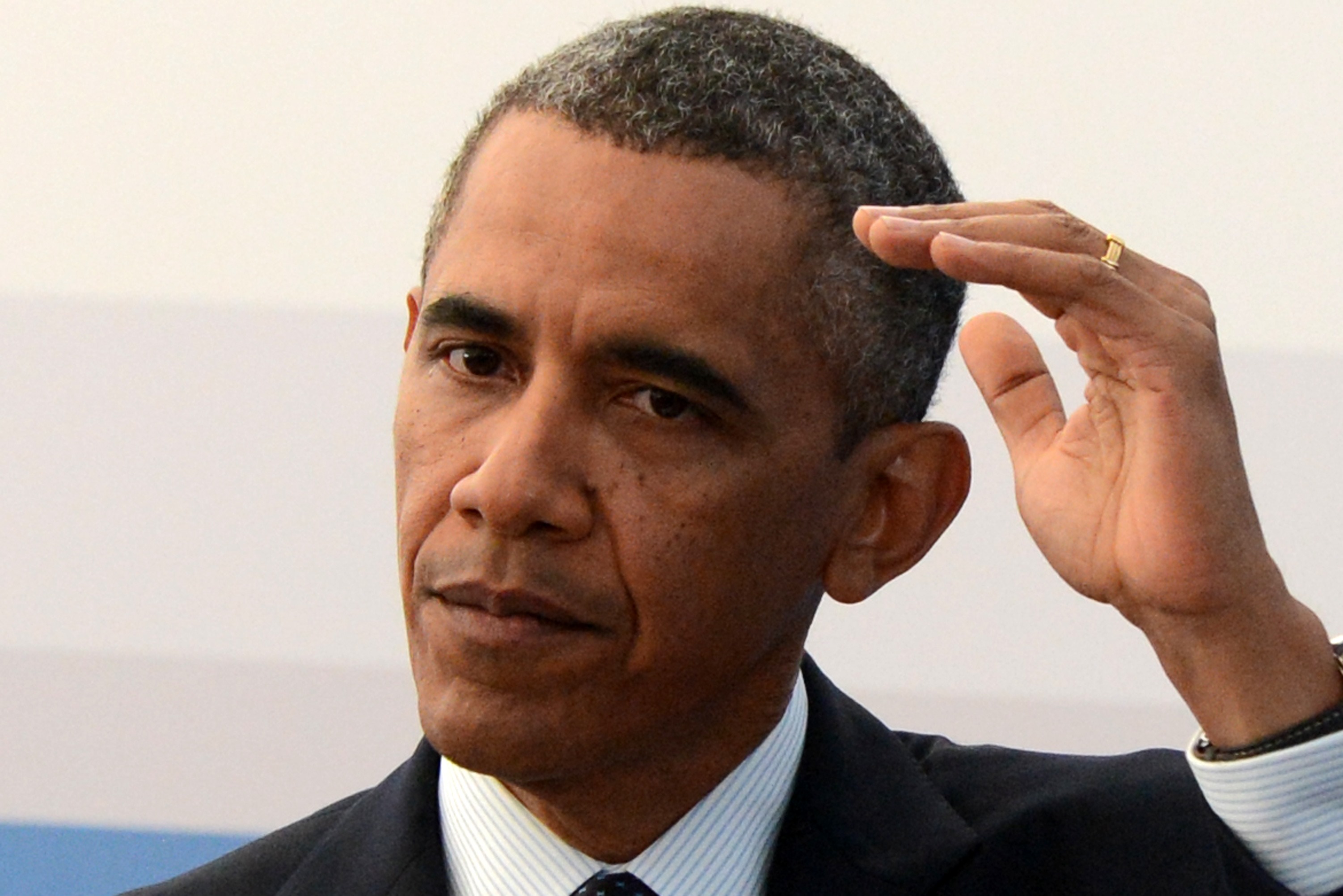
RUSSIA-G20-SUMMIT

The NYT is out with a story today that the Obama administration is “devising” a politically ingenious strategy to get around the fact that no Senate in the foreseeable future will ever muster a 2/3 vote to approve an actual treaty on global warming. The story really isn’t newseveryone has known this for years, though the Times adds a little more detail about how such a scheme might work:

American negotiators are instead homing in on a hybrid agreement — a proposal to blend legally binding conditions from an existing 1992 treaty with new voluntary pledges. The mix would create a deal that would update the treaty, and thus, negotiators say, not require a new vote of ratification.

Countries would be legally required to enact domestic climate change policies — but would voluntarily pledge to specific levels of emissions cuts and to channel money to poor countries to help them adapt to climate change. Countries might then be legally obligated to report their progress toward meeting those pledges at meetings held to identify those nations that did not meet their cuts.

If this sounds dubious to you, it will also sound dubious to those countries being hit hardest by climate change. At this point, however, the desperation of the rest of the world for any kind of leadership from the U.S. might convince them to cobble something together, especially since the French, who will have leadership of key negotiations in Paris in 2015, seem inclined to go along (they’re desperate not to come up empty, like the Danes after the Copenhagen climate fiasco):

There’s a strong understanding of the difficulties of the U.S. situation, and a willingness to work with the U.S. to get out of this impasse,” said Laurence Tubiana, the French ambassador for climate change to the United Nations.

The real questions, as always, will be less the form of any agreement than the content. The only concrete thing that international negotiators have ever agreed on is that the world can’t let the planet’s temperature rise more than two degrees Celsius. So far nothing that the US or most other nations have proposed would get us therewe’re solidly on track for four or five degrees. Unless the Obama administration sends a sharp signal that it wants serious–as opposed to face-savingaction, that course is unlikely to change. Keep an eye on that two-degree figure, and on the Keystone Pipeline, a bellwether for whether they’re willing to suffer any political pain.

(Photo by Kirill Kudryavtsev/AFP/Getty Images)

Breaking: Weed Smokers Less Violent

by Dish Staff

Who’da thunk it?

Past research has indicated that couples who abuse substances are at a greater risk for divorce, in part because substance abuse often leads to an increase in domestic violence. However, new research has found that when it comes to marijuana use, the opposite effect occurs: couples who frequently use marijuana are actually at a lower risk of partner violence.

Elizabeth Nolan Brown parses this research:

Obviously this doesn’t mean marijuana makes people less violent per se—maybe the types prone to pot-smoking are just inherently less violent individuals; or perhaps the types prone to partner violence are categorically less drawn to the drug. But it is interesting to contrast these stats with numbers on alcohol, which has frequently been linked to increased incidences of partner violence.

In one recent study, published in the journal Addictive Behaviors in January 2014, researchers found that “on any alcohol use days, heavy alcohol use days (five or more standard drinks), and as the number of drinks increased on a given day, the odds of physical and sexual aggression perpetration” by college-age men in relationships increased.

Christopher Ingraham looks at who paid for the study:

Perhaps most significantly, the Buffalo study was funded partially by a grant from the National Institute for Drug Abuse. Marijuana reformers have strongly criticized NIDA’s institutional biases against marijuana legalization in the past, including restrictions the agency has placed on the availability of marijuana for research purposes. But the fact that NIDA is funding studies like this one suggests that it, like much of the country, is beginning to change its tune.

Anxiety-Privilege And The Lena Dunham Question

by Phoebe Maltz Bovy

Lena Dunham was an anxious child:

My parents are getting worried. It’s hard enough to have a child, much less a child who demands to inspect our groceries and medicines for evidence that their protective seals have been tampered with. I have only the vaguest memory of a life before fear. Every morning when I wake up, there is one blissful second before I look around the room and remember my many terrors. I wonder if this is what it will always be like, forever, and I try to remember moments I felt safe: In bed next to my mother one Sunday morning. Playing with my friend Isabel’s puppy. Getting picked up from a sleepover just before bedtime.

One night, my father becomes so frustrated by my behavior that he takes a walk and doesn’t come back for three hours. While he’s gone, I start to plan our life without him. …

In our first session, Lisa sits on the floor with me, her legs tucked under her like she’s just a friend who has come by to hang out. She looks like the mom on a television show, with big curly hair and a silky blouse. She asks me how old I am, and I respond by asking her how old she is—after all, we’re sitting on the floor together. “Thirty-four,” she says. My mother was thirty-six when I was born. Lisa is different from my mother in lots of ways, starting with her clothes: a suit, sheer tights, and black high heels. Different from my mother, who looks like her normal self when she dresses as a witch for Halloween.

Lisa lets me ask her whatever I want. She has two daughters. She lives uptown. She’s Jewish. Her middle name is Robin, and her favorite food is cereal. By the time I leave, I think that she can fix me.

The difference between Dunham’s childhood fears and everyone else’s is, in part, that hers were met with old-time New York therapy sessions out of a New Yorker cartoon and are… now featured in the New Yorker.

Which brings us to another issue, namely the anxieties Dunham herself inspires in a certain segment of the population. That segment being, I suppose, those who feel that all of life’s unfairnesses can be summed up in the fact of Dunham’s success. It’s a bit like how, for committed anti-Semites, every last one of the world’s problems can be blamed on Jews, with the crucial difference being that Dunham has – as far as I can tell – shrewdly incorporated these perceptions into her act. Many before her have passively resigned themselves to being the face of ‘privilege’; Dunham’s innovation is to not merely own it (as someone like Gwyneth Paltrow does) but go with it.

One can never just appreciate a cultural product Lena Dunham has created. One must always defend doing so, in anticipation of the ‘but-all-that-privilege’ detractors. The latest – and possibly strongest – apology comes from Jacob Clifton, who hones in on the key issue in his response to the essay:

We have a propensity for taking women, young women especially, at face value. Young women are not alone here: Dave Chapelle quit comedy when he realized the racists weren’t laughing with him, but at him; Kurt Cobain killed himself in part because his rapist fans were winning. I get infinitely more laughs with jokes about theater than I do about football. Taylor Swift continues writing singles about the haters because we’ve convinced ourselves that she isn’t making conscious choices to write about love, an abiding subject in poetry for a while now, but in fact just writing her diary for our consumption.

Leonard Cohen, Bob Dylan, Lyle Lovett, Johnny Cash: Those are artists, because their experience—of white heterosexual masculinity—is after all universal. Everybody can identify with the love of a good woman, the vicissitudes that attain thereof, but nobody wants to hear about some dumb white girl getting dumped. …

Reading this first excerpt of Lena Dunham’s forthcoming book, preceded as it has been by a year’s worth of death knells and straight-up unadorned hating, I was irritated. Of course I was; it’s irritating as hell. But the funniest and loveliest thing about Dunham has always been, to me, the deadpan irony of exactly those choices. Tiny Furniture is every bit as self-excoriating as the first season of Girls was, and just as confusing for those of us (most of us) who find it hard to switch gears, to hear that register at all: The one where a woman telling you the worst things about herself is an attempt to bridge the gap, to create art that transcends selves, rather than to simply confess.

Is ISIS A Threat To Us? Ctd

by Dish Staff

Daniel Berman considers Obama’s assessment of the threat ISIS poses, and his response to it, pretty much spot-on:

Obama’s remarks express a sense of proportion missing from alarmist claims that ISIS is on the verge of taking over Iraq or establishing an Islamic Caliphate. Contrary to these absurd warnings, ISIS is, as the President noted, engaged in a “regional power struggle” one in which its support is capped by its Sunni sectarian nature, which limits its maximum appeal to the 20% of Iraqis who are Sunni. Furthermore, Obama is correct to note that ISIS is far less of a direct threat to the United States than it is to Iran, Damascus, and Riyadh, and by extension Moscow. All have a much greater strategic interest in preventing a collapse of the Iraqi state, and all will therefore intervene directly to prevent such an eventuality, provided the United States does not do it for them. That said, if the United States is willing to pay the financial and military burden of stopping ISIS, Tehran and Moscow will be overjoyed, though that pleasure will not stop them from attempting to extract a political payment for allowing the US to do their own work for them. Obama appears determined to ensure that the US will not be left alone for the bill for what is in reality a geopolitical public service for the region.

Jack Shafer chastises most of his colleagues in the American press for taking Defense Secretary Chuck Hagel’s war rhetoric as gospel and accordingly overhyping that threat:

Brookings Institution scholar F. Gregory Gause III assesses the Islamic State without panic in a Aug. 25 piece, nullifying Hagel’s scary “beyond and everything” pronouncement. He describes the Islamic State as the beneficiary of the “new Middle East cold war.” As existing state authorities in the region have lost control of their borders, proved unable to provide services (and protection) to their populations, and failed forge a common political identity, the Islamic State has risen.

But this rise does not necessarily make Islamic State strong and fearful as much as it showcases the relative weaknesses of the Syrian and Iraq governments. For all its ferocity, the Islamic State has acquired no regional or great power ally, Gause continues, no open patrons. It depends almost exclusively on banditry and protection rackets for its survival. The group’s great skill so far has been in uniting almost the entire world against it, making potential allies of nations that can’t stand each other, such as the United States and Iran. This knack for uniting countries that have “parallel, if not identical interests,” Gause predicts, will probably do the Islamic State in. Enemies exist, of course. But boogeymen don’t. Anyone who tells you otherwise is just trying to sell you something.

But John Gray takes the Islamic State’s global ambitions more seriously. And either way, he argues, we created this mess, so it’s up to us to clean it up:

So what is Isis essentially – violent millenarian cult, totalitarian state, terrorist network or criminal cartel? The answer is that it is none of these and all of them. Far from being a reversion to anything in the past, Isis is something new – a modern version of barbarism that has emerged in states that have been shattered by western intervention. But its influence is unlikely to be confined to Syria and Iraq. Isis is already attracting support from the Taliban in Pakistan, and there are reports that a caliphate has been declared by Boko Haram in a town in northeast Nigeria. In time – if only to confirm its superiority over al-Qaida – Isis will surely turn its attentions more directly to the west.

It would be easy to take the view that having blundered so disastrously, and so often, the west should withdraw from any further involvement and let events take their course. But having helped bring this monster into the world, the west cannot now turn its back. In ethical terms such a stance would be little short of obscene.

Walter Bernstein, Still Kicking

by Bill McKibben and Sue Halpern

Okay, admittedly, we can put a headline like that our post because we know Walter Bernstein, and chances are, so do you. Remember “You Were There?” (Probably not, you’re too young). Remember “Fail Safe?” “The Magnificent Seven?” Bernstein, who just turned 95, wrote the screenplays for all of them. How old is 95 in film years? Movies were just starting to talk when he would ditch school in Brooklyn to watch them.

Bernstein’s best known, though, for not working, at least under his own name: he was one of the many in Hollywood blacklisted during the 1950s for supposed communist ties. According to a remarkable encomium in Variety (the kind of thing that for once was published before someone dies, not after), his crimes included “supporting the Republican side in the Spanish Civil War, and advocating for the Russian War Relief Fund.” He spent those years trying to find work under pseudonyms, and he later wrote a memoir (“Inside Out”) and a great screenplay for “The Front”–which starred a then little known Brooklyn movie buff that other Brooklynite, Woody Allen.

He’s writing still: in addition to a biopic about the crusading lawyer William Kunstler, he’s finishing a project started by his late friend Sidney Lumet, working as an advisor at Sundance and teaching at the Tisch School, and on and on. And remains politically engaged, and unrepentant:

“If you want to attack someone in this country, you’re always safe to call them a socialist. It’s a word that’s been successfully demonized,” he says, noting the prevalence of the term in much anti-Obama rhetoric. And getting a script from page to screen? That remains as tricky as ever. “One of my sons has been a location manager and is now dipping his feet into producing,” he says. “So he’s on the phone talking to agents and people like that. The thing I keep trying to knock into his head, which is so hard, is that nothing is real until it’s real.”

NSA Overshare

by Sue Halpern

Back in March, in his virtual appearance at a TED conference in Vancouver, Edward Snowden said that the most shocking revelations from the documents he’d taken from the NSA were yet to come. On Monday, Ryan Gallagher and the team at First Look Media made good on that claim. Since at least 2010 and most likely before that, the NSA has been sharing 850 billion surveillance records with a dozen other government agencies including the DEA and the FBI through a Google-like search engine called ICREACH.  When an FBI agent enters a scrap of information like a phone number, for example, the ICREACH search engine sends back everything in the NSA archives associated with that number–private chats, phone logs, photos and so on. According to the Intercept report, “Information shared through ICREACH can be used to track people’s movements, map out their networks of associates, help predict future actions, and potentially reveal religious affiliations or political beliefs.” While the database for ICREACH is, in theory, restricted to material obtained from foreign surveillance operations, in practice many of those operations have netted information on American citizens with no ties to terrorism:

In a statement to The Intercept, the Office of the Director of National Intelligence confirmed that the system shares data that is swept up by programs authorized under Executive Order 12333, a controversial Reagan-era presidential directive that underpins several NSA bulk surveillance operations that monitor communications overseas. The 12333 surveillance takes place with no court oversight and has received minimal Congressional scrutiny because it is targeted at foreign, not domestic, communication networks. But the broad scale of 12333 surveillance means that some Americans’ communication get caught in the dragnet as they transit international cables or satellites—and documents contained in the Snowden archive indicate that ICREACH taps into some of that data.

In the words of Elizabeth Goitein of the Brennan Center for Justice at NYU Law School, “with ICREACH, the government ‘drove a truck’ through loopholes that allowed it to circumvent restrictions on retaining data about Americans”:

A key question, according to several experts consulted by The Intercept, is whether the FBI, DEA or other domestic agencies have used their access to ICREACH to secretly trigger investigations of Americans through a controversial process known as “parallel construction.”

Parallel construction involves law enforcement agents using information gleaned from covert surveillance, but later covering up their use of that data by creating a new evidence trail that excludes it. This hides the true origin of the investigation from defense lawyers and, on occasion, prosecutors and judges—which means the legality of the evidence that triggered the investigation cannot be challenged in court.

Here, again, is yet more evidence that collecting phone and Internet metadata is not a benign activity, as President Obama among others would like us to believe. But we knew that, didn’t we? It should give us pause, if nothing else, that the newly “strengthened” USA Freedom Act proposed last month by Senator Patrick Leahy, is not going to slow down traffic to ICREACH. And those 850 billion records? That number was from back in 2010. As Gallagher notes, “while the NSA initially estimated making upwards of 850 billion records available on ICREACH, the documents indicate that target could have been surpassed… .”

Legalize Opium?

by Dish Staff

800px-Special_Tax_Stamp_Opium_New_Orleans_1932

Gene Callahan suggests giving it a try:

My proposal offers the following advantages over the current situation:

  1. It allows us to test the waters of just how socially damaging full cocaine or heroin legalization might be, without simply plunging in head first. If simply legalizing coca leaves and opium produces droves of drugged-out zombies (which I don’t think it would), we could rule out full cocaine and heroin legalization, and even consider repealing this halfway legalization. If the effects are that bad, we can be sure that they would have been worse if we had legalized the harder forms of these drugs.
  2. A strong libertarian argument for full legalization (I say ”strong,” and not “decisive,” because I think there are significant counter-arguments here), is that many people are able to use these drugs in moderation without destroying their lives. … Well, these moderate, responsible users ought to find a milder, safer, and legal form of the drug they use to be a very welcome thing indeed. They could avoid the risk of arrest, of unregulated and adulterated street products that may contain dangerous additives, of job loss, and would enjoy a much greater ability to control their dosage.
  3. The considerations in point number two indicate what I think would be the greatest potential upside of this idea: its impact upon the economics of the trade in hard drugs. The shift in consumption predicted above would greatly lessen the demand for the more dangerous forms of these drugs.

In other opioid news, Olga Khazan examines a study finding that “the 13 states that had legalized medical marijuana prior to 2010 had a 25 percent lower rate of opioid mortality than those that didn’t”:

This equates to roughly 1,729 fewer painkiller deaths, just in 2010. The results suggest, in other words, that people were choosing pot over Percocet.

There are a few limitations to keep in mind. The rate of opioid deaths increased in all the states, it just increased less in the states that allowed medical marijuana. It’s not as though everyone with a backache bought a water bong and lived stoned and pain-free ever after.

Marijuana is also not a perfect replacement for painkillers, though it does have some analgesic effects.

Sullum focuses on another finding from the study:

Notably, Bachhuber et al. found that state policies aimed at preventing nonmedical use of opioids, such as prescription monitoring programs, were not associated with lower overdose rates. “If the relationship between medical cannabis laws and opioid analgesic overdose mortality is substantiated in further work,” they write, “enactment of laws to allow for use of medical cannabis may be advocated as part of a comprehensive package of policies to reduce the population risk of opioid analgesics.”

(Image of 1932 opium tax stamp via Wikimedia Commons)

The Essential Creepiness Of DFW Fandom

by Dish Staff

Mike Miley owns up to it in a fascinating essay about his experiences at the David Foster Wallace Archive at the University of Texas, confessing, “I came to Austin as a stalker, the kind of person who ought to be the recipient of a restraining order, not a research fellowship”:

The fellowship faintly disguises the fact that I am here to invade David Foster Wallace’s privacy, and that I took advantage of the Mellon Foundation to satisfy my personal compulsion to get as close to the inside of Wallace’s literary head as I could possibly get. What I failed to anticipate during all my academic grifting was how much peering into the dark recesses of Wallace’s skull would give me the howling fantods. What I wanted, I learned, was much more than I bargained for.

This realization came fast and hard the moment I opened DFW’s copy of End Zone. I knew the DeLillo books would be juicy because DeLillo was pretty much Wallace’s favorite author, but that was no preparation for the words that greeted me when I carefully opened the book’s brittle paperback cover: “SILENCE = HORROR.”

My breath tripped in my throat. I was hoping for revealing annotations, and Wallace exceeded my expectations with his first gloss. Freaky things like “SILENCE = HORROR” are not the first thing a researcher stumbles across anywhere outside of a TV show. Wallace may have been talking about End Zone, but the context was totally different now; these were words from beyond the grave, written in a dead man’s hand, and even though I’d never met him, here I was holding his treasured book, staring his mind in the face, and his first utterance to me is “SILENCE = HORROR.”

Alan Jacobs marvels, “I don’t think I’ve seen, in my lifetime, a writer who has generated the kind and intensity of veneration that DFW has”:

We might contrast his fans to, say, Tolkien fans, who know a little bit about the author — enough to have an image of a man in a colorful waistcoat smoking a pipe – but who can’t spare much time for him because they are so fully absorbed in his legendarium. But the people I know who love every word of Infinite Jest are also fascinated by Wallace himself: they are constantly aware of him as its author, of its relations to the circumstances of his own life.

Montaigne said of his Essays that “It is a book consubstantial with its author,” and this seems to be true for everything DFW wrote. Absorption in his work seems almost necessarily to involve scrutiny of his life. And given how his life ended, it’s hard not to see this as a worrisome trend. What I wouldn’t give for a detailed and sensitive ethnography of DFW devotees – something like what Tanya Luhrmann did for charismatic evangelicals.

Unliking Facebook

by Sue Halpern

Dislike Facebook

Anyone who has ever read Facebook’s privacy policy–and that probably would not include you–understands that it is not meant to protect your privacy, but provide Facebook and its clients with access to you, your habits, your contacts, your life. This kind of access is the lifeblood of Facebook (read: money), so attempting to indemnify itself against any claims of invasiveness is crucial. This, of course, has not exempted the company from lawsuits, as well as from less formal but no less vociferous user discontent. A quick search on the website of the Electronic Frontier Foundation is a lesson in the thrust and parry around privacy that’s accompanied Facebook’s remarkable insinuation into the culture.

Earlier this summer, a young Austrian law student named Maximilian Schrems filed a class action lawsuit against Facebook which has draw an unprecedented number of claimants.

As Malarie Gokey writes, 60,000 people have now joined young Schrems:

According to the advocate’s site, the Vienna Regional Court in Austria has reviewed the case and commanded Facebook Ireland to respond to the charges within four weeks. Facebook’s international efforts are based in Ireland and serve 80 percent of its users worldwide.

Shortly after Schrems announced the lawsuit and called upon Europeans and anyone outside the U.S. and Canada to join him, the lawsuit reached its maximum number of claimants with 25,000 people joining the suit. An additional 35,000 pledged their support for the privacy lawsuit, should it be expanded to include more claimants, bringing the total number of people suing Facebook for violating privacy laws above 60,000.

Among other things, Schrems is suing Facebook for providing user data (including private messages) to the National Security Agency for its massive, data-mining PRISM program. He is also hoping to hold Facebook’s collective feet to the EU Data-Protection Directive fire, which is meant to protect European Union citizens from the very kinds of intrusive activities practiced by both the NSA and Facebook. (The US has nothing comparable.) “Our aim is to make Facebook finally operate lawfully in the area of data protection,” he said.

Another suit against Facebook, this one closer to home:

A Texas woman is suing Facebook for $123 million dollars. Allegedly, the social media company failed to take down a fake profile that was created with the intent to publicly humiliate her. The woman, Meryem Ali, claims that the profile displayed her name alongside photos of her face photoshopped onto pornographic images.

(Photo by zeevveez.)

Libya Just Keeps Getting Worse, Ctd

by Dish Staff

Juan Cole finds the US response to yesterday’s revelation that Egypt and the UAE had carried out airstrikes in Libya pretty ironic:

According to the BBC, “the US, France, Germany, Italy and the UK issued a joint statement denouncing “outside interference” in Libya.” Seriously, guys? Except for Germany, these are the NATO countries that intervened in Libya in the first place, in large part at the insistence of an Arab League led by Egypt and the UAE! It is true that the UAE and Egypt don’t have a UN Security Council Resolution, which authorized NATO involvement (I supported the then no fly zone on those grounds). But the newly elected Libyan House of Representatives has openly called for international intervention against Libya’s out-of-control militias and it is entirely possible that the Libyan government asked, behind the scenes for these air strikes. In any case, “outside interference” isn’t the issue!

Claims that the airstrikes caught us unawares are also beyond belief:

“With as many Aegis-class ships as the U.S. Navy has in the Persian Gulf and Mediterranean, there is no possible way the UAE could pull this off without the U.S. knowing it,” said Christopher Harmer, a former Navy officer and an analyst with the Institute for the Study of War.

Harmer said that he had no information about U.S. involvement, “but the U.S. government knows who bombed what,” he said. Egypt and the UAE are highly motivated to strike out at Islamist fighters, whose gains in Libya are only the latest reminder that a new wave of religiously aligned political groups and militias threaten secular regimes and monarchies across the region. … Despite denials from the Egyptians and American claims that the United States knew nothing of the airstrikes, there’s no doubt that the UAE’s Air Force, which is newer and more advanced than Egypt’s, could attack Tripoli.

But Keating wonders if this isn’t a sign that the US is no longer running the regional security show in the Middle East:

Despite all the various ways that regional powers have sought to influence each other’s internal politics, the U.S. and Europe (and on a few occasions Israel) have largely had a monopoly on airstrikes and direct military intervention. With crises elsewhere taking up diplomatic attention, U.S. involvement in the worsening situation in Libya has been limited. It shouldn’t be too surprising that others have stepped in to fill the void. The New York Times, which originally reported on the strikes, puts them in the context of a larger proxy battle in the Middle East between Egypt, the UAE, and Saudi Arabia—which have sought to roll back the gains made by Islamist groups—and Turkey and Qatar, which have largely supported them. This battle will mostly be fought within the region’s most unstable countries, including Syria, Iraq, and Libya

Michael Brendan Dougherty, meanwhile, blames the chaos in Libya on the failures of the “Responsibility to Protect” doctrine advanced by Hillary Clinton:

In the most obvious form of moral hazard, this pernicious “R2P” norm lowers the price of civil war in the developing world, encouraging rebels to make provocative attacks, then lobby for Western air support when the local bad guy punishes them for it. Uncle Sam or NATO deploys resources in a civil war these rebel groups could never win with their own blood and treasure. They often fail to win even when they do get help. The expectation of Western air power has exacerbated and intensified conflicts in Serbia, the Sudan, Libya, and Syria. As an international norm, R2P adds nothing but a noble-sounding gloss on getting more people killed than usual.