Parental Whoa-vershare, Ctd

by Phoebe Maltz Bovy

A reader writes:

Bless your heart, Phoebe, for attempting to curb the tide of parental overshare. I am a parent of young children, and I post pictures of them and the occasional adorable quip they make on Facebook. Honestly, I post more than I should of them, but I try very hard to limit it to only the nicest photos of my kids, and not too frequently, for the exact reasons you discussed. I do not want my kids to be searching for jobs and have a potential employer know about their childhood doctors appointments. I appreciate having someone out there pointing out the long term effects if parental oversharing, so thanks for… sharing.

The two genres of parental sharing you mentioned really only account for the high-end posts (I.e., the Times and the Atlantic are the publishers). There is a plethora of other parental overshares on the so-called mommy blogs. So many kids with digestive problems and mothers trying to help their kids understand God and stay-at-home dads trying to be clever and funny. And the larger blogs have sponsored content (albeit often clearly labeled). I once read a post by a woman whose blog received a sponsorship from a razor company, and she talked about the first time her tween daughter shaved. Ugh. And that doesn’t even begin to get to the quick shares on Facebook of potty training successes and failures. Please keep up the good work of reminding people not to start embarrassing their children until they are a little older, like our parents did.

Even with my limited knowledge of colloquial American English from places outside the Northeast, I know that “bless your heart” implies that my cause here is a futile one. Which, alas, it probably is. But this response is reminding me of an important clarification regarding just what that cause, as I see it, involves.

When it comes to parental overshare, two issues get confused. First, there’s the excessive-to-some presence of babies in one’s Facebook feed (a common complaint of many who don’t have kids, whether or not by choice). Second, there’s the question of large-scale privacy violation. “Mommy blog” complaints fall somewhere between the two. Sometimes people are offended by the mere presence online of content that isn’t news, opinion, or mansplanation about the serious issues of the day, and it’s basically part of the standing grievance that exists against all ‘lifestyle’ content. Other times, it’s that some of these blogs are sharing identifiable information about kids, including that which is embarrassing, medical, or both, and are – as this reader notes – doing so for profit.

Anyway, social-media sharing and “mommy blogs” are easier targets than serious publications taking on serious parenting-related issues. But the parental overshare that’s a real concern is precisely the sort that isn’t so readily declared irrelevant. The point here isn’t to dismiss certain types of (largely female-oriented-and-produced) content as boring or frivolous. It’s normal, in an age of online photo-sharing, that family photo albums would be digital, and would include kids. It’s normal to be some mix of bored or annoyed by what long-lost acquaintances put on Facebook, but – as Maureen O’Connor eloquently explained – it’s not unethical to post things others find uninteresting. The issue, as I see it, is not that children are owed a complete digital invisibility of the sort that’s near-unachievable in this day and age. Rather, it’s that parents shouldn’t be profiting from their children’s secrets. There shouldn’t be something to gain, professionally, by breaching that trust.

Another response gets it exactly right:

Tufekci is correct that change needs to come from editors. As it stands, someone with a toilet-training essay to sell will find an outlet; someone with an essay not about toilet-training will be nudged by the market to include an anecdote along those lines. The business model needs to change. Since the demand for really courageous articles of this nature appears insatiable, this will take an act of courage-in-the-non-sarcastic-sense from the gatekeepers themselves.

Every Sex Worker Is Somebody’s Daughter, Ctd

by Dish Staff

Noah Millman jumps in on Elizabeth’s sex-workers-as-daughters discussion:

You could call [Elizabeth’s take] a “moral libertarian” version of Rawls’s veil of ignorance. We don’t know what our daughter might decide to do when she is of age. She might decide to have sex for money. Therefore, we should examine our political (and moral) attitudes with a view to who would be most harmed by them – and the person most harmed by a morally condemnatory attitude is the daughter who decides to have sex for money, and would be condemned for it.

As with Rawls’s own perspective, this makes perfect sense if you take the existing distribution is a given – in Rawls’s case, of wealth; in Nolan Brown’s, of life choices. If you don’t assume that – if you assume instead that redistribution of wealth will lead to less production of wealth overall, or that a permissive moral attitude will lead to an increase in objectively poorer life choices – then you can’t blithely say that the only thing that matters is harm reduction for those who make those choices. You have to weigh the costs on all sides of the equation. This much should be obvious.

But I still think Nolan Brown’s critique has teeth, because she’s drawing a distinction between the daughter as thought experiment and the daughter in reality.

And Elizabeth responds:

I’m guessing not many people take forklift-driving positions because they just adore the work. People take jobs as forklift drivers for the same reason people take jobs in porn—to make a living—and we don’t hear complaints that this situation exploits forklift drivers because they are under economic pressure to accept dangerous work. Yet according to the Occupational Safety and Health Administration, there are about 85 deaths and 34,900 serious injuries related to forklifts each year, with 42 percent of these involving the forklift operator being crushed by a tipping vehicle. How many people are killed each year by porn?

A Bit Of Good News From Syria

by Dish Staff

In contrast to the brutal murder of James Foley, another American journalist held captive in Syria since 2012 was released over the weekend by al-Qaeda’s Syrian affiliate Jabhat al-Nusra:

Peter Theo Curtis was handed over to UN peacekeepers in the village of al-Rafid, Quneitra, on Sunday. He has since been turned over to representatives from the US government after undergoing medical check-up, the UN said. Curtis’ family thanked both the governments of the US and Qatar, as well as others who helped negotiate his release. According to a statement from his family, Curtis was captured in October 2012 and was reportedly held by the al-Nusra Front or by splinter groups allied with the al-Qaeda-affiliated group.

Elias Groll takes a closer look at Qatar’s role in securing Curtis’s release, which he calls part of the Gulf kingdom’s “double game”:

The beheading of Foley marked an ugly turn in the Syrian civil war, one that has already been marked by awful brutality on all sides of the conflict. Qatar has played a role in fueling that violence, by funneling arms and weapons to Islamist groups. Some of those weapons have ended up in the hands of hard-line radicals. Qatar also provides a home for a handful of influential Islamist leaders, including the leader of Hamas, Khaled Meshaal, and Abdul Rahman Omeir al-Naimi, an al Qaeda financier. At the same time, Qatar continues to serve as a vital ally of America in the region, playing host to key U.S. military installations and reveling in its role as a power broker.

Events like Foley’s execution inevitably upset the balance between Qatar’s competing impulses and force its leaders to compensate in one direction or another. Specifically, the gruesome beheading of Foley put intense pressure on the White House to answer for its efforts to secure his release — pressure that Qatar has now slightly relieved. Curtis’s sudden release provides Barack Obama’s administration with a piece of good news — and tangible evidence that Americans can be freed without Washington doling out ransoms.

Keating compares the treatment of Curtis and Foley to illustrate the longstanding, fundamental disagreement over tactics between al-Qaeda central and even more extreme rogue groups like ISIS:

The details of the deal have not been made public. According to the New York Times, Curtis’ family was told by Qatari mediators that no ransom was paid, though it seems likely the group received some concession for his release. Al-Qaida and its affiliates have turned the ransoming of Western hostages into quite a tidy business, taking in more than $125 million in revenue since 2008, mostly from European governments that are more willing than the U.S. or Britain to pay ransoms. Intercepted documents from al-Qaida leaders show how central this revenue has become to the network’s operations. [Jabhat al-]Nusra’s more pragmatic approach, a few days after an ISIS video that seemed deliberately evocative of Zarqawi-era beheadings, shows that the old disagreement over tactics still persists, and has only gotten more public since al-Qaida and ISIS formally severed ties earlier this year.

Will This Gaza Truce Hold?

by Dish Staff

The NYT reports that Israel and Hamas have agreed to an open-ended ceasefire proposed by Egypt:

People familiar with the agreement said it would ease but not lift Israeli restrictions on travel and trade, largely reviving the terms of a 2012 cease-fire agreement that ended an eight-day air war. It also will allow construction materials and humanitarian aid to enter Gaza in large quantities for a major rebuilding effort, with a monitoring mechanism to ensure that concrete and cement would go only to civilian purposes. “We’re not interested in allowing Hamas to rebuild its military machine,” the senior Israeli official said. Other issues — including Hamas’s demand for a Gaza seaport and airport, Israel’s demand for Gaza’s demilitarization, and the return of Israeli soldiers’ remains believed to be in Hamas’s hands — were to be addressed after a month if the truce holds, people familiar with the agreement said.

In an interview with David Rothkopf, Martin Indyk offers his view on how the Gaza war has altered the dynamics of the peace process:

I think it’s made it a lot more difficult — as if it wasn’t difficult enough already — because it has deepened the antipathy between the two sides.

The Israelis look at Gaza and what’s happened there and understandably say, “We cannot allow such a thing to happen in the West Bank.” And therefore, today there’s a lot more credibility to the argument that the Israel Defense Forces (IDF) have to stay in the West Bank, otherwise Israelis fear there will be tunnels into Tel Aviv and there will be rockets on Ben Gurion Airport, and Hamas will take over and they’ll face a disaster in the “belly” of Israel.

There are security answers to all of that, but I just think the Israeli public attitude is going to be far more concerned about any kind of Israeli military withdrawal from the West Bank. At the same time, the Palestinian attitude will be even stronger that there has to be an end to the occupation, which means a complete Israeli military withdrawal from the West Bank. And the process of negotiating peace does not have any credibility with them unless they have a date certain for when the occupation is going to end, and basically the Israeli attitude will likely be that the occupation is not going to end if that means a complete withdrawal of the IDF. So beyond all of the antagonism that conflict generates this Gaza war may have put another nail in the coffin of the two-state solution.

Rami Khouri suggests that the best way to a permanent peace is through the UN Security Council:

Pressure from the Security Council — where both sides enjoy significant support — would help Israeli and Palestinian leaders to sell their followers on otherwise difficult concessions. For example, assuming military attacks on both sides do stop, Israel could delay its demand to demilitarize Gaza. The Palestinians could similarly suspend their demand for an operational port and airport. Working through the UN could also ensure that any cease-fire holds better than previous ones did. The draft resolution proposed by France, Britain and Germany reportedly envisions an international monitoring presence in Gaza, to minimize violations by either party. This missing element was a major reason why previous cease-fires collapsed. If Hamas expects Israel to lift border restrictions on travel and imports, and if Israel expects Hamas to forswear attempts to rearm, U.N. observers trusted by both sides will have to be in place to ensure compliance.

Where The Taxes Are Less Of A Whopper

by Dish Staff

Inversions

Burger King wants to become Canadian:

Under the deal, America’s least-favorite burger makers would form a new company with Tim Hortons based in Canada. The two could reach a deal soon as this week.  Like a lot of American corporations, Burger King is considering casting off its U.S. citizenship because it’s really easy. Under current U.S. law, a company just has to buy 20 percent of a foreign corporation to transfer its base, through a process called a corporate inversion. Once the headquarters have moved, U.S. profits are subject to the 35 percent U.S. tax, but profits abroad are only subject to the lower rate. Canada lowered its corporate tax rate to 15 percent in 2012. And though that rate climbs to about 26 percent when you factor in provincial corporate taxes, that’s still lower than America’s 35 percent tax.

Vinik adds, “If it sounds ridiculous that an American company can purchase a foreign firm and suddenly avoid the U.S. corporate tax system, that’s because it is”:

It doesn’t matter that the vast majority of the shareholders are still American. Or that the management and control of the company remains in the U.S. Or that in making the deal, nothing about the company actually changes. You would still be able to grab a Whopper for lunch. Its thousands of American workers will all still have their jobs. But Burger King will have opted out of the U.S. corporate tax system.

But Matt Levine argues that “this merger, if it happens, is a real merger with real business and capital markets purposes”:

The merger is not mainly about taxes; in fact, Tim Hortons and Burger King’s effective tax rates are basically the same.

Tim Hortons, I am given to understand, sells a lot of coffee and donuts, most of them in Canada. (Out of 4,485 stores at the end of 2013, 3,588 were in Canada.) I don’t know, you could probably sell the coffee in the burger stores, or the burgers in the coffee stores, or good lord you could put a burger on a donut, that will probably win you cool points with millennials; millennials love things that are part donut and part thing that is not a donut. So there are business reasons for the deal. But if Burger King acquired Tim Hortons, the tax rate on all those Tim Hortons stores would go up: Instead of the regular 15 percent Canadian rate that they’re currently paying, they’d have to pay 35 percent combined to U.S. and Canadian authorities. From a Canadian company’s perspective, that hardly seems fair. Thus the inversion.

One more thing: This inversion is not all that inverted. Tim Hortons is actually bigger than Burger King, on revenue and net income though not on stock market capitalization. This is not just an aesthetic point.

But Daniel Gross suspects taxes are part of the rationale:

Sure, there may be valid business reasons for a combination. Tim Horton’s has a huge breakfast business, which Burger King lacks. But it’s easy to suspect that tax avoidance is a driving factor. (Burger King isn’t pursuing a U.S. doughnut chain like Dunkin’ Donuts.) That hedge fund sharpie William Ackman, who is backing Canada-based Valeant’s effort to acquire Allergan—another potential giant inversion—is one of Burger King’s biggest shareholders doesn’t help matters.

Yevgeniy Feyman uses the news to argue for tax reform:

Long-term tax reform should focus as much as possible on not just lowering, but replacing the corporate income tax (and perhaps the individual income tax as well) – with a progressive consumption tax. Short-run “fixes” that predicated on economic nationalism are likely to do more harm than good, and ultimately fail to actually address the problems with our tax system.

Mankiw made a similar argument over the weekend:

Let’s repeal the corporate income tax entirely, and scale back the personal income tax as well. We can replace them with a broad-based tax on consumption. The consumption tax could take the form of a value-added tax, which in other countries has proved to be a remarkably efficient way to raise government revenue.

But Jared Bernstein highlights the downside of eliminating the corporate income tax:

Those who would get rid of the corporate tax basically argue that the smart move is to go with this flow: As long as so many more businesses are setting themselves up to avoid the corporate tax, don’t fight ′em, join ′em. The problem is that to do so risks turning the corporate structure itself into a big tax shelter: If income generated and retained by incorporated businesses should become tax-free, then guess what type of income everybody will suddenly start making? Taxes delayed are taxes saved, and with no corporate tax, anyone who could do so would structure their earnings and investments to be “corporate earnings,” untaxed until they’re distributed.

Finally, Roberto A. Ferdman, who posts the above chart, points out that corporate inversion is something of a trend:

Burger King would hardly be the first large American corporation to move its headquarters—more than 70 U.S. companies have reincorporated overseas since the early 1980s. The practice has been especially popular lately—more than half of those inversions have come since 2003, or almost double the amount that did in the twenty years prior, according to data from Congressional Research Service (CRS).

Will Ukraine Talks Resolve Anything?

by Dish Staff

Vladimir Putin and Petro Poroshenko met face-to-face in Minsk today, for the first time since June, to discuss the crisis in Ukraine and how to resolve it:

Putin devoted most of his opening remarks to trade, arguing that Ukraine’s decision to sign an association agreement with the EU would lead to huge losses for Russia, which would then be forced to protect its economy. Russia had been counting on Ukraine joining a rival economic union that it is forming with Belarus and Kazakhstan. Ukraine is set to ratify the EU association agreement in September. On the fighting that began in April between Ukrainian troops and pro-Russia separatists, Putin said only that he was certain the conflict “could not be solved by further escalation of the military scenario without taking into account the vital interests of the southeast of the country and without a peaceful dialogue of its representatives.”

Poroshenko would be unlikely to agree to Russia’s frequent call for federalization — devolving wide powers to the regions from the central government — but could agree to allow them to have some expanded powers. He also has spoken against holding a referendum on Ukraine’s joining NATO; Russia’s desire to keep Ukraine out of the alliance is seen as one of Moscow’s key concerns.

Just prior to the start of the talks, Ukraine announced that it had captured ten Russian paratroopers on its territory, proving that Russian forces have been deployed on the ground there. The Kremlin admits the soldiers are Russian but claims they ended up in Ukraine accidentally:

“The soldiers really did participate in a patrol of a section of the Russian-Ukrainian border, crossed it by accident on an unmarked section, and as far as we understand showed no resistance to the armed forces of Ukraine when they were detained,” a source in Russia’s defence ministry told the RIA Novosti agency. Ukraine said it had captured 10 Russian soldiers, though it did not state how they were caught. Weapons and fighters are able to cross the porous border freely, but until now there has never been confirmation that serving Russian soldiers were active inside Ukraine, despite repeated claims from Kiev and some circumstantial evidence.

To Ed Morrissey, this revelation is just another sign that Putin is preparing for all-out war:

For most leaders, this would provide enough of an embarrassment to force a halt in their strategies. Not Vladimir Putin, though. If anyone believes that Putin will slow his roll into eastern Ukraine just because he’s been caught red-handed with paratroopers on the other side of the border, think again. Putin has taken his measure of the West and thinks he can live with the economic pain for the short period of time in which sanctions will bite. Fall is coming, and with it the need for Russian gas in eastern Europe. Nothing in the past few weeks other than the lack of an all-out invasion to relieve the rebels gives any indication that Putin’s plans have been deflected to any significant degree. Don’t expect a few POWs to shame Putin into backing down now.

Also yesterday, Poroshenko dissolved parliament and called for new elections in two months. Steve LeVine analyzes the political situation in Kiev:

While the country is more stable politically since the May elections that brought Poroshenko to power, it remains in a tremendous military and economic crisis. … The more elections Poroshenko gets under his belt, the more legitimacy he hopes he will have, as Russian president Vladimir Putin effectively challenges his right to rule. In the last couple of weeks, Putin has appeared to retreat from his most vitriolic rhetoric regarding Ukraine, but the likelihood is that he will only reluctantly stand down from his ultimate goal, which is to keep Ukraine so destabilized that it cannot join NATO or be a fruitful economic partner of Europe’s.

Belarus, meanwhile, hopes to benefit just from hosting the talks:

[Belarusian President Alexander] Lukashenko’s iron-fisted internal politics haven’t changed but he has always remained open to overtures from the west despite his close ties to Russia, said Fyodor Lukyanov, editor of the journal Russia in Global Affairs and chairman of the Council on Foreign and Defence policy. “The geopolitical situation has changed and now Lukashenko doesn’t seem as awful as he did a year ago,” Lukyanov said. Because of its relatively neutral position with regard to both Russia and Ukraine, Belarus has become essentially the only place where leaders from both sides can meet without losing face. “Being a country that’s connected with Russia but can preserve fairly independent politics makes Belarus an important player between Ukraine, the EU and Russia,” Lukyanov said. “The EU is forced to relate to [Lukashenko] differently.”

Libertarians In Name Only

by Dish Staff

Tim Fernholz highlights new Pew data on libertarianism in America, which shows that only 11 percent self-describe as libertarian and understand what the term means:

The survey showed a fairly even split among Americans considering whether the regulation of businesses does more harm than good, or if aid for the poor helps or hinders, though a majority does think that corporations make too much profit. Libertarians, meanwhile, leaned strongly against any interference in business or help to the poor, though not as strongly as you might think: 41% of libertarians saw government regulation of business as necessary, and 38% supported aid to the poor.

Indeed, perhaps the most interesting finding is that self-described libertarians favor US involvement in world affairs more than the average citizen, despite their reputation for an isolationist lean. And, even more weirdly, 16% of libertarians said US citizens need to be willing to give up some privacy in exchange for greater security.

Kilgore thinks that “Pew has at the very least cast some massive doubt on all that ‘libertarian moment’ polling from Reason“:

These findings of the non-particularity of “libertarian” views, mind you, is after Pew has melted the category down from 17% of the public to 11%, since a lot of “libertarians” could not accurately distinguish “libertarian” from “communist” or—get this—“Unitarian.”

Allahpundit’s analysis:

What you’re seeing in the poll results, I think, is a bunch of doctrinaire libertarians having their brand diluted by a bunch of conservatives/Republicans who are disgusted with those labels right now, for whatever reason, and are thus hoping to claim “libertarianism” for themselves. Do you support aggressive policing, a muscular foreign policy, and a social safety net but are disgusted with how big and intrusive the federal government’s gotten and how complacent the GOP has gotten about it? Congrats, you might be a “libertarian.” In fact, this reminds me of what David Frum said recently about the “libertarian moment”: It’s not so much that conservatives are turning into doctrinaire libertarians, he argued, as that they’re attracted in the age of Hopenchange to the broad libertarian critique that government is malignant, not merely inefficient and stupid. That’s how you get the sort of “libertarians” captured in the poll. They’re deeply distrustful of government writ large, but ask them about particular manifestations of government power — the welfare state, the police, etc — and they’re more simpatico.


The View From Your Window Contest: Winner #219

by Chas Danner

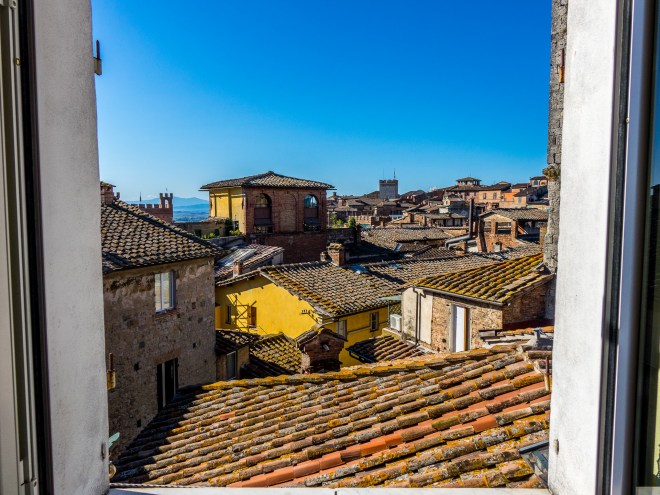
VFYWC-219

A reader thinks they’ve got it:

Mombasa, Kenya with Fort Jesus in the background.

Another reader:

Being new to this contest, I’d like you to know how much I enjoy reading all the comments that folks include. So much is really helpful to new participants like myself, BUT I really love the wisecracking comments and entries of the frustrated. Thank you!!

The View From Your Window Contest, driving readers to throw things our their windows since 2010:

I’ve never been more frustrated with a VFYWC than this week. Why? Because I’ve found this city before while searching for another week’s window, but I can’t for the life of me remember where it is. I can’t remember which window I was looking for when I found it, my cell browser history doesn’t go back more than a month, and I evidently wasn’t signed into Google Earth when I found it. Arrrrrgggggghhhhhh!!!!!!!!!!!  I await the inevitable frustration when you reveal the answer and I immediately remember every detail I’ve been grasping for for the last 72 hours.

That reader will happy to know that he did get the country, but for the sake of suspense, we’ll get to that a little further down. Another:

I hope that’s Dubrovnik! I’ve walked the wall before.

That was the location of our 200th contest actually. They do indeed look similar. Another is thinking South America:

This totally looks like a view of Cuzco, Peru that my cousin sent me last year. Surely the gods would not allow me to so immediately and confidently guess the right view. Still, I will persist with my answer: The flaky-looking barrel tile, the crowding, distant mountain vista and general proximity of the structures to one another smack of the hotel room scene that was sent to me. But, I’m certain that we’ll discover this to be some quaint and distant Italian village whose claim to fame is as a supplier of the purest most virginal olive oil. Before I digress into further sarcasm, I must point out it is indeed a beautiful view, the blueness of the sky is quite captivating. Who knows, I may be within the same latitude, at the very least…

Too far south. Inching up the globe, this player notes an important assortment of clues:

We have a densely built group of brick and adobe buildings, mostly with clay tile roofs, overlooking a mountain valley. It is impossible to know for sure, but I think the flag on the parapet in the center of the upper half of the picture is a green-white-red tricolor, either that of Italy or Mexico. Either country works with these buildings and landscape. I’ve managed to stare at the flag long enough to convince myself there is something on the white stripe, so I’m going to say Mexico.

There appears to yellow lichen (Xanthoria parietina) on some of the roofs which grows…basically all over the world, but seems to favor coastal areas. So, mountains, valley, near the coast, in Mexico. In other words, just about anywhere in Mexico. The yellow color of a couple of the buildings reminds me of Oaxaca, but I don’t think that is it. The older parts of that city are in a valley, not overlooking it. (The worst part about this challenge for me is that every time I type the name of a Mexican town into Google image search, I get pictures of food. You guys are killing me!) Once again, I am reasonably confident as to region, but I know when I’m beat. Plus I’m thinking it may be Italy after all. Blind guess in (vain) hope of proximity: Taxco, Mexico, because it is on a hillside and the tile roofs seem especially popular there.

Many readers correctly identified the lichen this week. Another gets us closer:

I dunno, but there’s something about that fortress in the background that reminds me of some of the towns you see near the Bosphorus, somewhere between Istanbul and the Black Sea. Is that specific enough for you? Yeah, thought not.

Continuing to circle in:

Definitely Mediterranean, but contests have recently featured Spain, southern France, Baleric Islands, Greece. There’s a nice view of water & mountains behind a castle turret. I’m just throwing a dart at the board and guessing Tunis, Tunisia.

Another was thinking Spain (again), but gave up when she instead “chose to spend [her] indoor time this weekend binging on the good-years episodes of the Simpsons marathon on FXX.  D’oh!” Speaking of mysteries, a few years ago Matt Groening finally revealed the actual location that inspired Springfield. Meanwhile, this homer gets the country:

A village somewhere in Tuscany. I know the turrets one sees is a clue but I’m not sure what the ancient influence is. I’m guessing it’s a village somewhere in Tuscany, Italy.

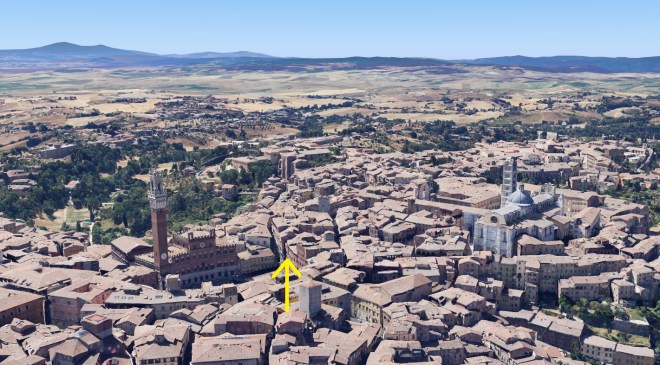
Nice job, a Tuscan hill town indeed. Which one? This week’s very first entrant guessed right:

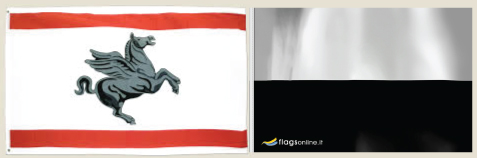
The lichen-stained clay roof tiles, the brick-and-stone architecture, and the gentle hills in the distance (love that deep blue color the mountain has) remind me of the touristy town of Siena, south of Florence. Plus, although the flags, hanging from poles on the two crenellated towers to the left and the center of the photo, are both limp (no wind…grr) I can make out faint red, white, and green stripes, with the red band hanging furthest to the ground—as it should as the red band goes on the right (away from the pole) if you fly it correctly.

This previous winner nails the exact location and window:
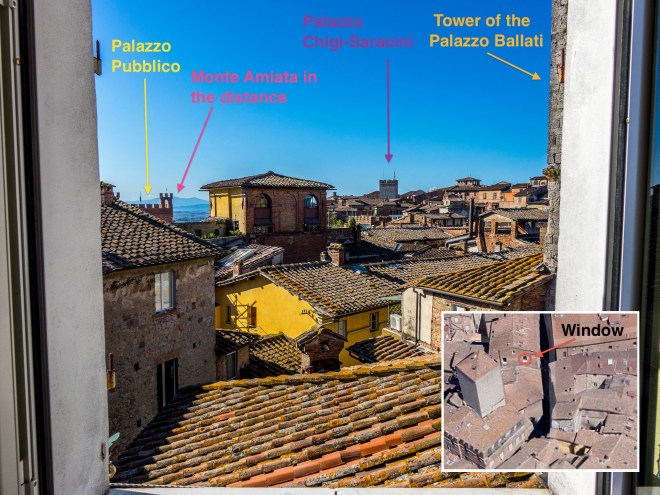
vfywc-219-with-labels

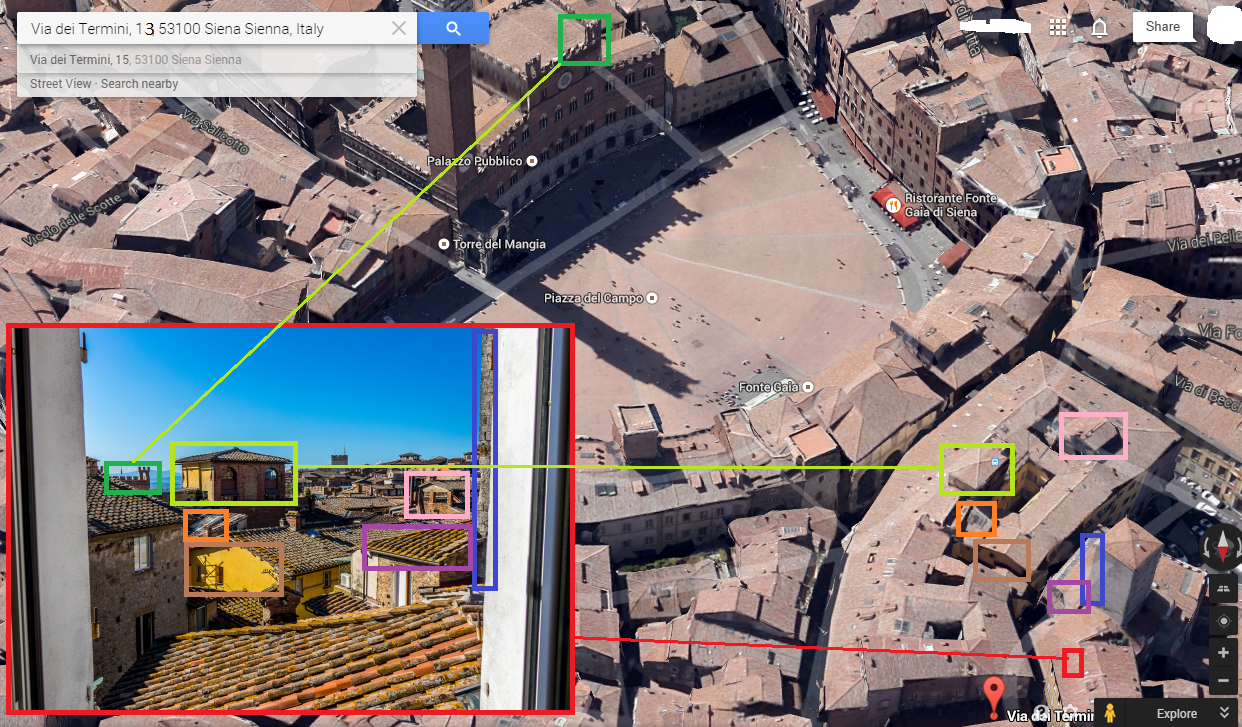
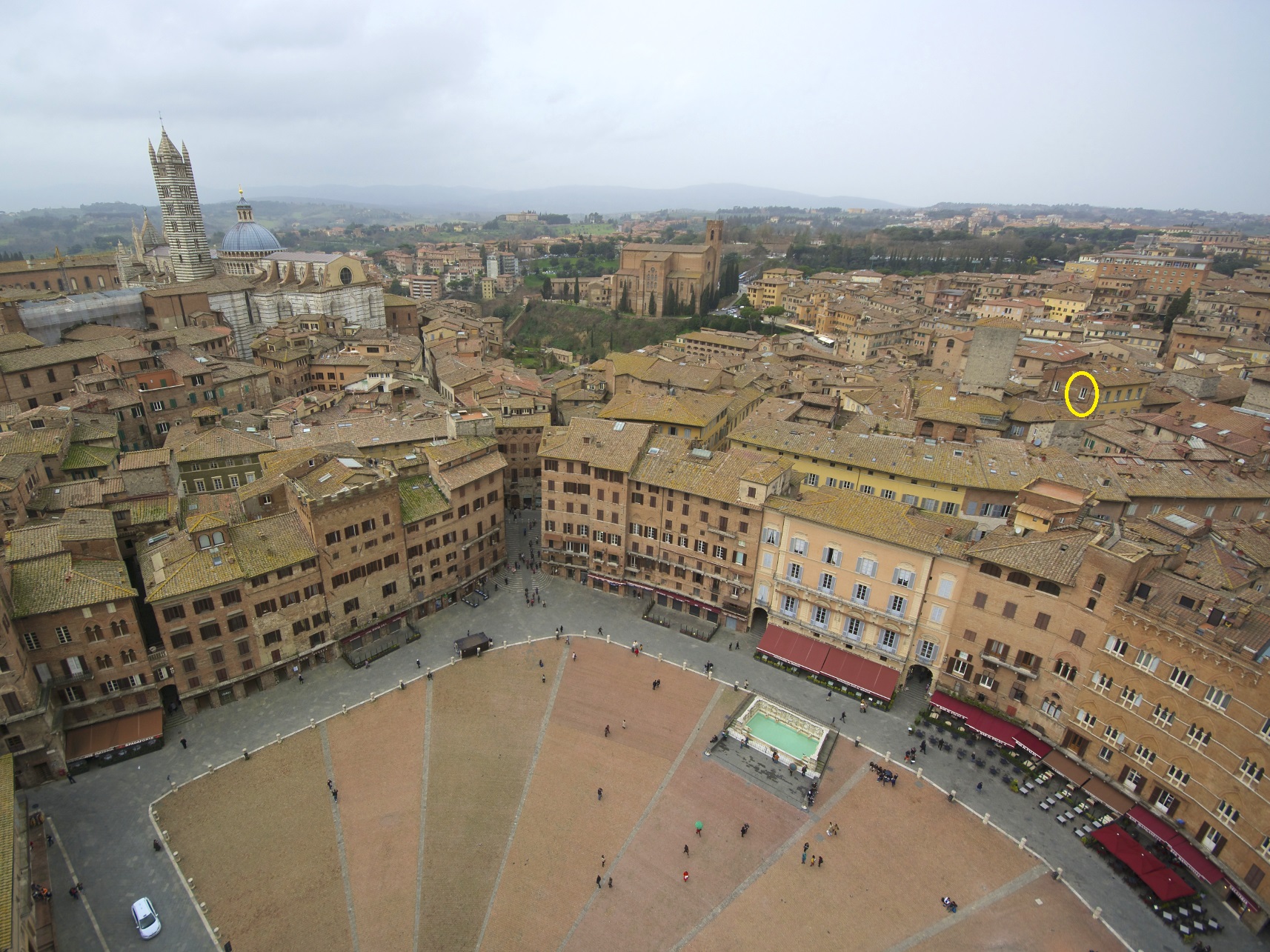
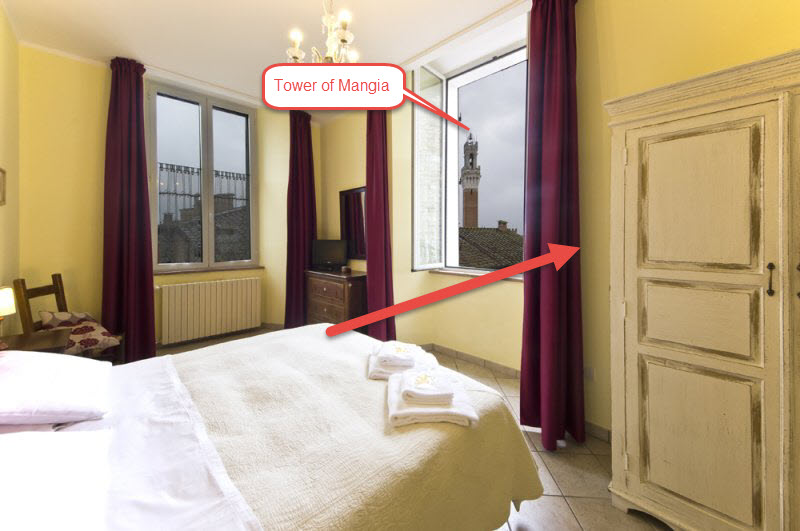
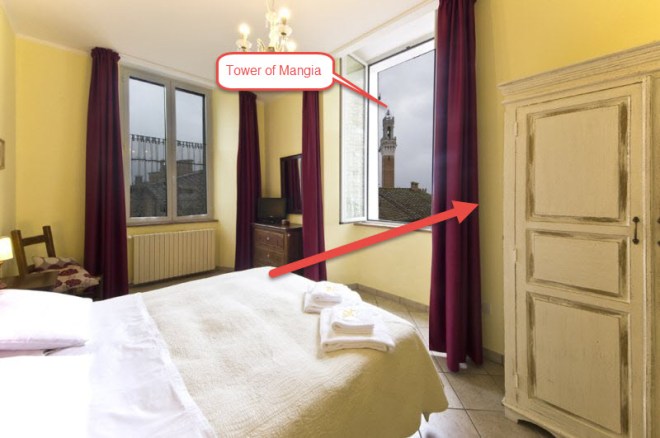
This week, we are in Siena, Italy, just a couple of blocks from the View From Your Window that you ran last summer. Unlike that unmistakable view, the submitter carefully framed the contest picture to avoid including the famous Mangia Tower to the left, leaving only some of the Palazzo Pubblico‘s merlons visible.  While the view screams Tuscany, those merlons were the clue I used to find this week’s window.  This photo from the hotel’s website and another from a travel website confirmed the location.   The contest window is in one of the apartment rooms at the I Terizi di Siena at Via dei Termini 13.  Although I could not find a room number, it is a south facing room on the fifth floor.

Bit of the Palazzo Pubblico

No heatmap this week as the vast majority of contestants got the town and window. And this one used a unique clue:

siena air conditioner

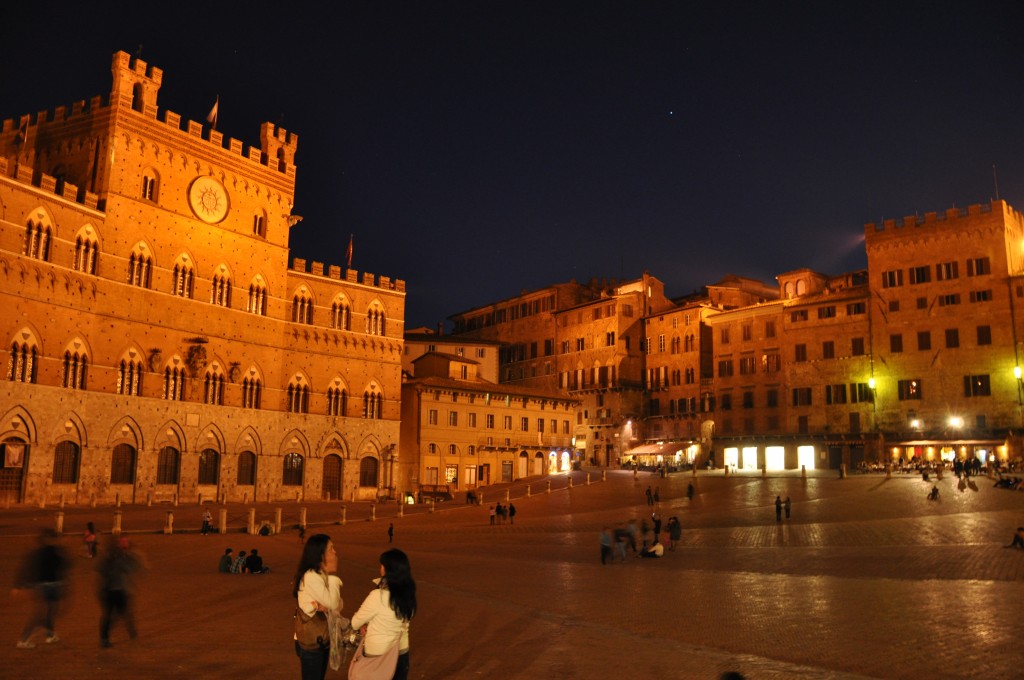
My initial reaction was that it wouldn’t be easy unless I got lucky. I got lucky. After searching for mossy terracotta and getting several Tuscany hits, I found the air conditioner shown on the next building appeared to be an Italian product. A search for “Tuscany fort village” led to the attached image of the Il Campo medieval piazza that can be seen from the opposite direction in the “view.”
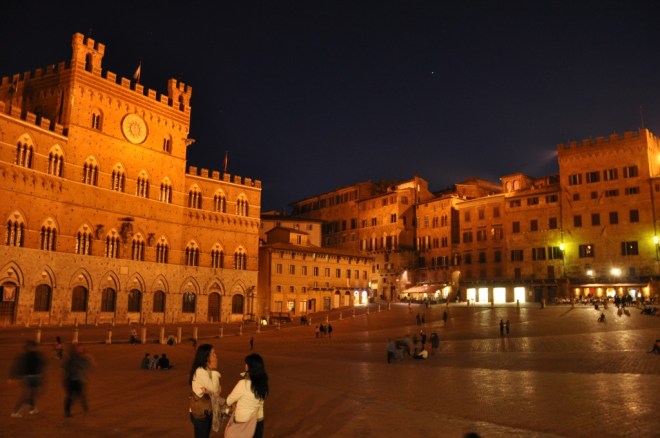
siena il campo

This reader nailed the flags on the tower in the background as well:

flags

The flag of Tuscany and the city flag of Siena.

A first-time reader and player chimes in:
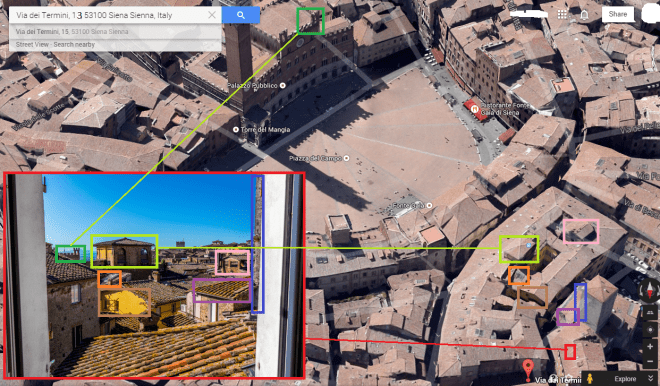
view2

I was using Google Image Search for keywords different keywords like “Italy”, “striped“, “wall”, “armament”, “merlon”, “tower”, “rooftops”, until I finally found the right sillhouette of the Palazzo Pubblico at Piazza del Campo. From there I used Google Earth and panned around until I found the right combination of roofs, chimneys, towers and the glass skylight, that is in the window. Hope my guess is right. First time I am taking part here, found VFYW Contest linked in this Der Spiegel report.

Glad to have you! Around 25K new visitors have checked out the contest thanks to that link. And we’ll have a post up on the amazing Bellingcat effort soon. (Update: here it is.) Moving on, many Dish readers have apparently been to Siena:

This image brings back that magnificent smell of wood-burning fires filling the air.  Walking the streets of Montepulciano looked like an ancient city, but smelled like camping.  It was the most delightful and unexpected surprise during my trip to Italy.

And love the dining:

I had one of my most memorable meals ever in Siena, right on the Piazza del Campo at sunset. Cinghiale in umido con polenta, a bottle of Brunello di Montalcino and cantuccini with Vin Santo for dessert. Fu meraviglioso!

And the influence on New England architecture:

I hope the photographer had a lovely time in Siena and climbed the Torre del Mangia, the tall bell tower at the Palazzo Pubblico. In a neat coincidence, Wikipedia says the bell tower was used as a model for Waterbury Union Station in Waterbury, Connecticut, site of one of last month’s VFYW contests.

Another:
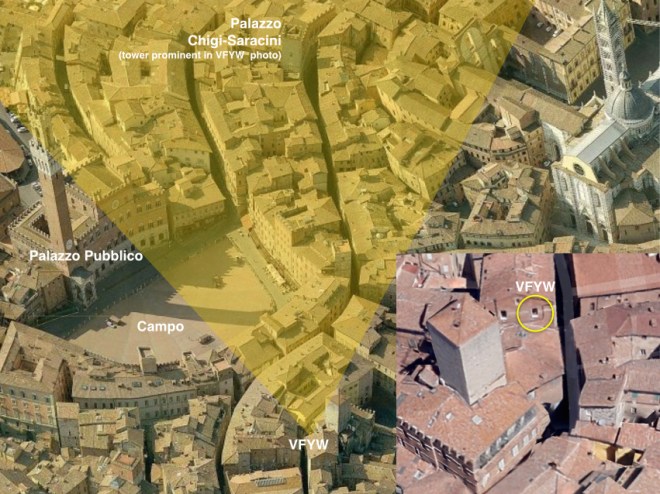
VFYWSiena copy.001

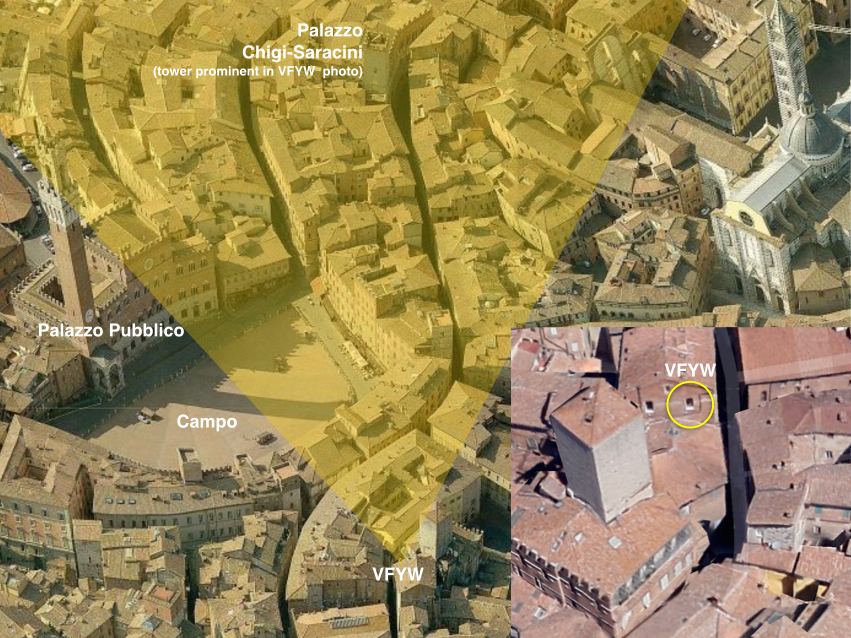
Ah, Siena! Hard to miss, with the famous Torre del Mangia just out of view but the false parapets giving away the Palazzo Pubblico. The Palazzo looks down on the stunning Campo, home of the crazy Palio horse race, last held only 10 days ago (was a VFYW reader in town for the Palio?)  Just to right of center, prominent on the horizen is the tower of the Palazzo Chigi-Saracini, now home to the Accademia Musicale Chigiana, an international centre for advanced musical studies. Nice gig if you can get it. Just out of view to the right lies the famous Cathedral of Siena.

That’s exactly when and why our submitter was there. More on the race:

Siena is a great town, incredibly overcrowded during the horse races which are held in the town square.  IIRC they are done bare-back so are quite challenging for the jockeys.  The bragging rights if your contrada (city section?) wins the race are hard to imagine for an outsider but very real for those involved. In the Spring and Fall when the mobs have left it is a lovely town to tour, amazing old architecture, wonderful restaurants. Thanks again for these wonderful chances to renew old memories (and more often to explore new worlds).

Another advises that one of their “best travel experiences so far is going to the winning contrada house after the Palio for the most amazingly hospitable and electrified party of the year; and don’t bring any money, it will just upset the hosts.” One more reader’s process:
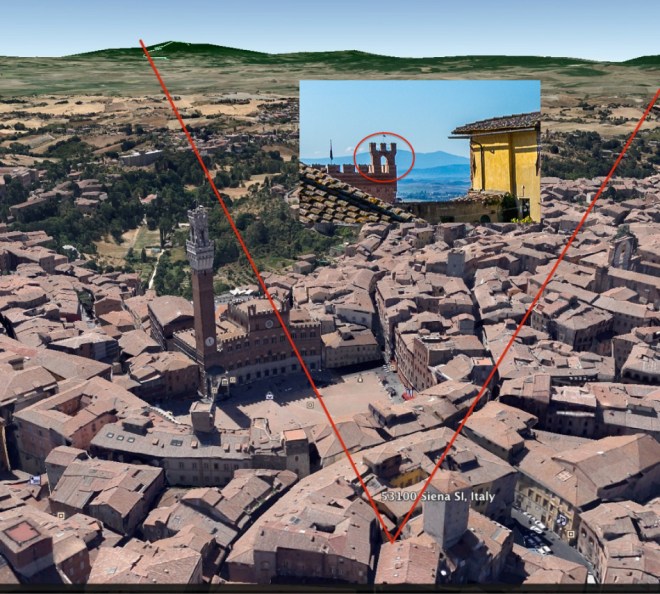
Siena

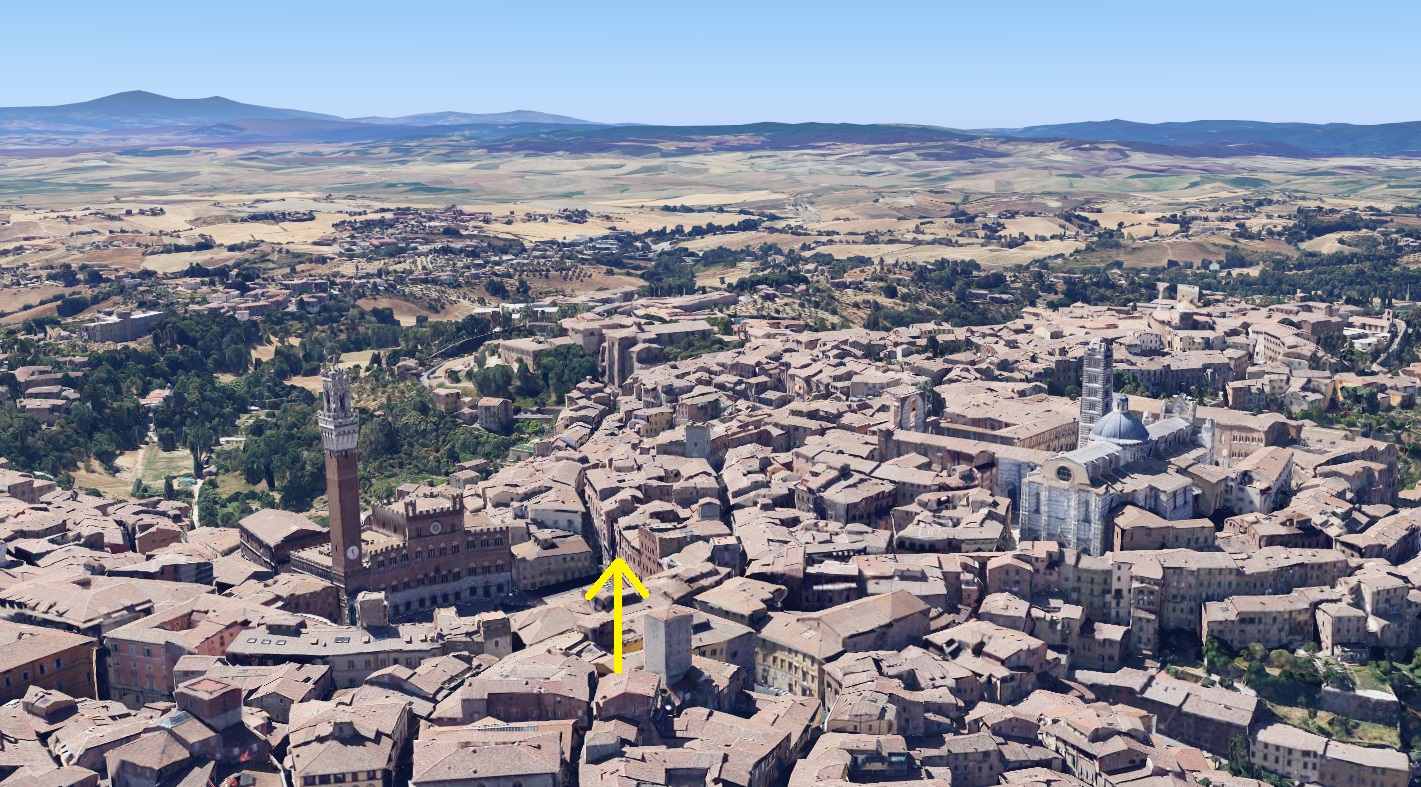
After a failed search of nearby hill towns such as Pienza and Montalcino, I cast my net further to the northwest (the only direction from which Monte Amiata has this profile) and happened upon Siena. Voila, I instantly saw a match with the corner feature of Siena’s famous Palazzo Pubblico. From there, I drew a line from Monte Amiata to the corner of the Palazzo Pubblico and looked for Hotels or B&B’s. Pretty quickly I converged on I Terzi di Siena.
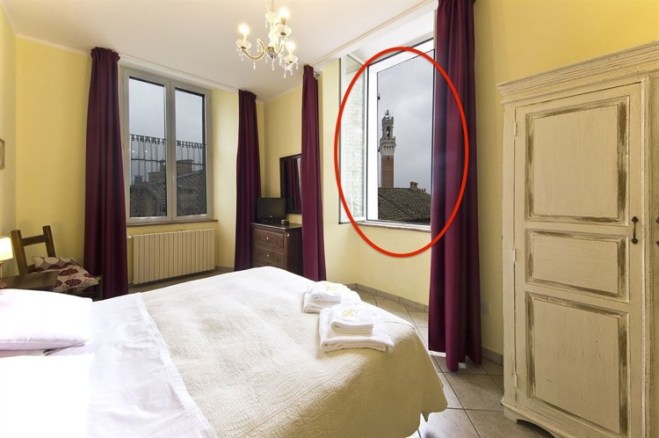
romana

Chini approves:

VFYW Siena Bird's Eye Marked - Copy

An easy view, for sure, but one that brings back nice memories. My junior year in college I studied in Florence and our program had us take day trips to just about every town in Tuscany. Lucca, San Gimignano, Pisa, Arezzo, pretty much all of them, and each more amazing than the last. So despite being 4,000 miles from the NYC, this week’s location is one of the few that I’ve been to, having sprawled out below your viewer’s window in the piazza as we ate lunch. Unfortunately, we were there in the fall so we didn’t get to see the Palio, but I’m betting your viewer just did…
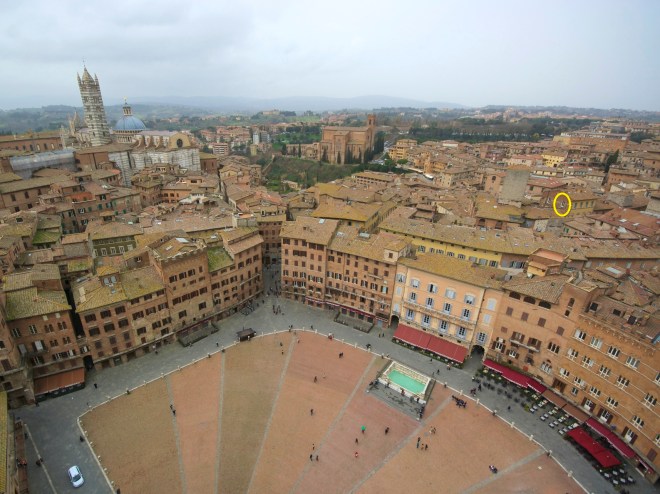
VFYW Siena Actual Window 4 - Copy

This week’s view comes from Siena, Italy and looks almost due south along a heading of 170.1 degrees. The iconic torre del mangia is just out of frame on the left and the piazza itself is hidden by a steep drop and the buildings in the foreground. The picture was taken from the Camera Romana (Roman room) on the fifth floor of a bed and breakfast called i Terzi di Siena.

This week’s winner, a 12-contest veteran, comes from our vaunted list of previously correct guessers of difficult views:
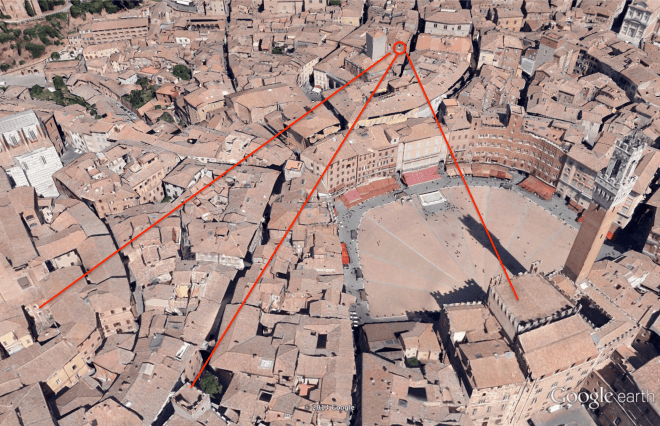
219-winner

Tougher this week. Learned a bit about mediterranean roof tiles to get me started and settled on Italy. After browsing photos of old towers in Italy, I came across the Palazzo Pubblico, which had the distinctive crenels in the upper left of the photo. Couldn’t get the view though until I came home from work and fired up Google Earth, which pegged the spot pretty quickly. The tower in the center right is the Fondazione Accademia Musicale Chigiana – Onlus, and just out of view is the Siena Cathedral, which otherwise dominates the skyline. The view is looking south from what appears to be Via Dei Termini, 17. See above for the window.

Congrats on the win! From the view’s original submitter:
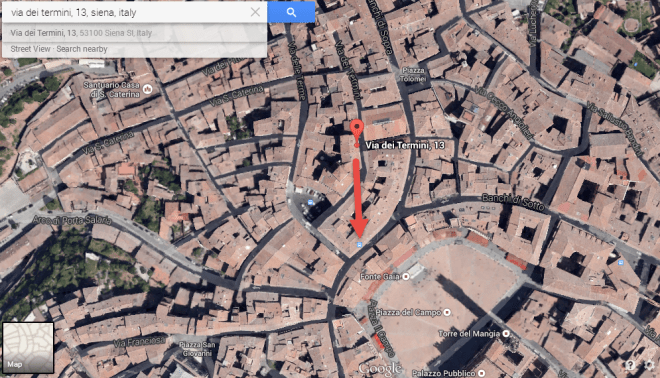
VFYW - Siena - Location on map

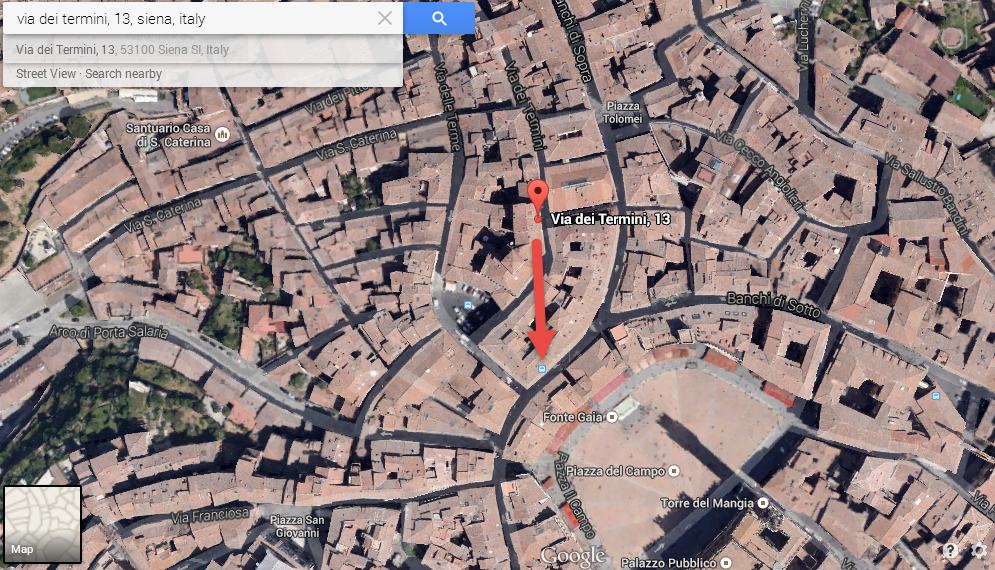
The image was taken in Siena, Italy the day after “Il Palio di Siena,” aka “the most dangerous horse race in the world.” It is a view looking southward from this address: Vie Dei Termini, 13 Siena, Italy. I was staying on the the fifth floor and had a view westward, which had an obstructed view of a busy street, and a view southward (towards Piazza del Campo), which was straight from my bed. I much preferred the southward view!  The best giveaway is the flag in the distance to the left. It is hard to see but is white and black, which denotes Siena itself.
VFWY - more details

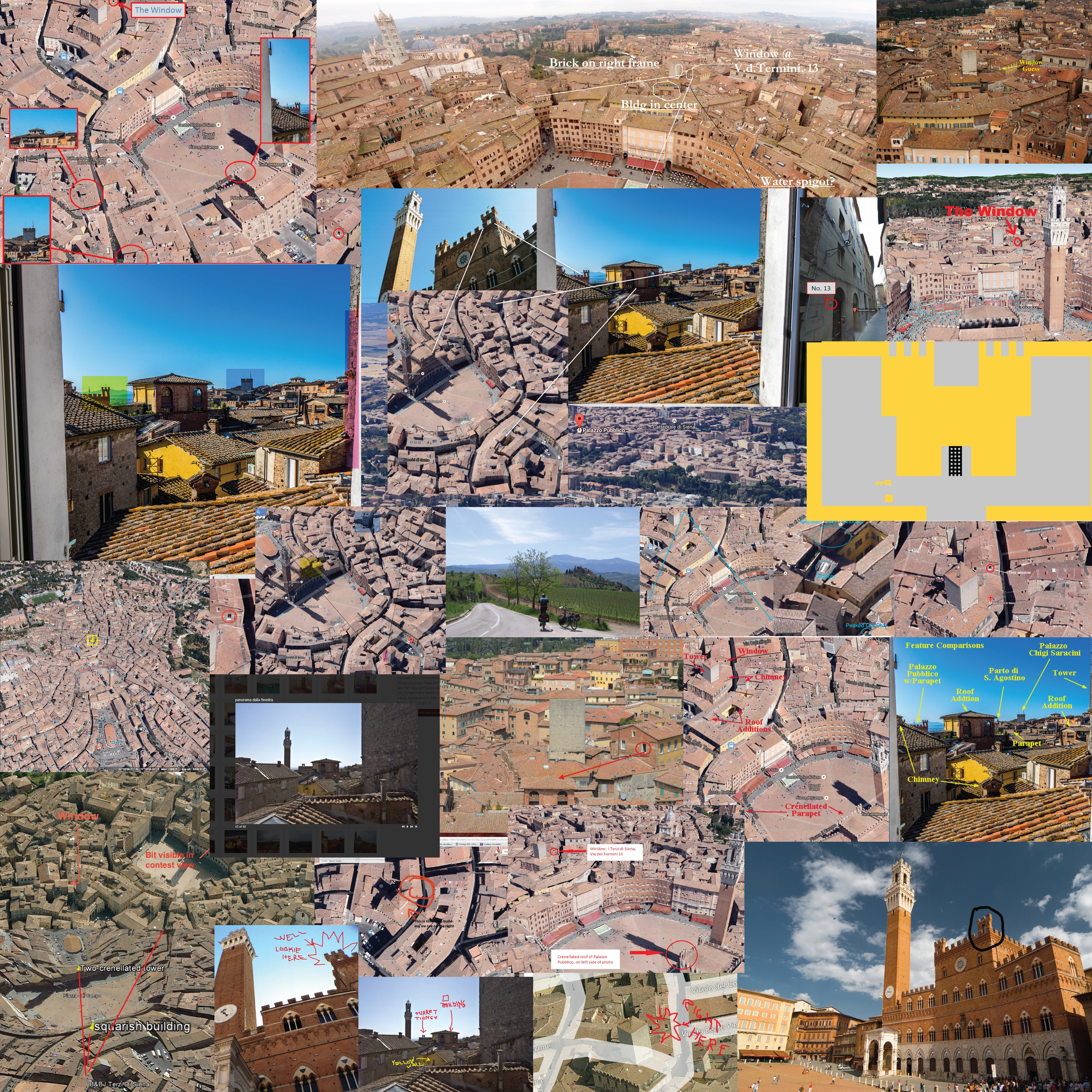
Update: Had some technical (Time Warner Cable) difficulties today, but still wanted to guess-collage many of the wonderful visuals we got from contestants this week:

vfywc-219-collage

(Archive: Text|Gallery)


Mission-Creeping Toward Syria

by Dish Staff

Obama has authorized surveillance flights over Syria, in what looks like a first step toward some kind of military engagement there:

On Monday evening defense officials said the reconnaissance flights had already started, and told the New York Times that they include both manned and unmanned aircraft. President Obama has yet to approve any military action in Syria, but White House officials said he wouldn’t notify Syrian President Bashar al-Assad if he was — though the country’s foreign minister warned that “any strike which is not coordinated with the government will be considered as aggression.” …

There’s no way that destroying the terrorist group won’t benefit Assad’s forces (and humanity in general), but the U.S. is trying to find a strategy that aids the moderate Syrian rebels more. The Pentagon is said to be working on options that would target ISIS near the Iraqi border, rather than deeper in Syria. The U.S. is also considering increasing its support for the moderate rebels. Rear Admiral John Kirby, the Pentagon press secretary, said Defense Secretary Chuck Hagel is “looking at a train-and-equip program for the Free Syrian Army.”

Aaron David Miller believes the Syria air campaign is coming, and lists a number of reasons why it’s a bad idea. For one thing, he says airstrikes simply won’t do what we want them to do:

To have a chance of hitting the right targets with any consistency, those 500-pound American bombs require local allies on the ground to provide forward spotters and good intelligence. Airstrikes, as we saw in the open desert of Libya during the 2011 intervention, are better suited against militaries concentrating and moving in open areas than against local militias that have taken root. Take [for] instance Raqaa, the headquarters of the Islamic State’s caliphate. There’s no way an air assault in that urbanized and populated environment would work.

The idea that a bombing campaign alone — even if it’s devastating and sustained — will seriously check, let alone defeat, IS in Syria is a flat-out illusion. And I say this knowing all of the Islamic State’s many weaknesses: a governing ideology that alienates; weak or nonexistent opponents; and the absence of deep roots and legitimacy in Syria.

Adam Taylor examines our options for local partners if we rule out an alliance with the Syrian regime:

Right now … its not clear exactly how plausible U.S. strikes against Islamic State within Syria would be without some kind of approval, tacit or otherwise, from Assad. The Syrian government has warned that unilateral strikes against Islamic State on Syrian soil would be seen as an act of “aggression,” though it has indicated it is open to some kind of cooperation. Assad’s regime has anti-aircraft capabilities and an air force which could be used to hinder any U.S. intelligence gathering or strikes in Syria. Another factor is Russia, a prominent supporter of the Assad regime, which has also voiced criticism.

Joshua Landis, director of Center for Middle East Studies at the University of Oklahoma, argues that a key problem is that the more secular rebel groups don’t have the support they would need to actually control Syria. … Ultimately, Landis argues that the only way for the U.S. to truly destroy the Islamic State and the sectarian extremism it espouses would be to offer some kind of two-state solution for Syria, or get involved in extensive (and extremely expensive) state building exercise. There’s little political support in the U.S. for either. Instead, Landis suspects the U.S. will likely end up “mowing the lawn” with the Islamic State – a reference to the Israeli policy for keeping Hamas weak with periodic and limited strikes. It’s a policy that may be far more acceptable than working with Assad and more practical than a wider intervention, but it won’t necessarily be any more successful.

On the other hand, Pat Buchanan thinks we should go all-in on an alliance of convenience with Assad, which he argues would negate the need for ground troops:

We need no boots on the ground in Syria, for it is the presence of “Crusaders” on Islamic soil that is the principal recruiting tool of the jihadists. What we need is diplomacy beyond the simple-minded, “Either you are with us or you are with the terrorists!” a diplomacy that invites old enemies into a coalition for a cause on which we all agree. If Assad is willing to go in for the kill on ISIS, let us work out a truce and amnesty for the Free Syrian Army and call off that part of the rebellion, so Assad’s army can focus on killing ISIS. George H.W. Bush made an ally of Hafez al-Assad in Desert Storm. Why not make an ally of his son against ISIS?

We should next tell the Saudis, Qataris, and Kuwaitis that any more aid to ISIS and they are on their own. We should inform the Turks that their continued membership in NATO is contingent upon sealing their border to ISIS volunteers and their assistance in eradicating the terrorist organization. We should convey to Iran that an end to our cold war is possible if all attacks on the West stop and we work together to exterminate the Islamic State. Why would they not take the deal? As for Abu Bakr al-Baghdadi, the self-proclaimed successor to Muhammad, my bet is that he closes out his brief career as caliph at an unscheduled meeting with Seal Team 6.

But Peter Beinart thinks such an alliance would be politically disastrous:

[G]iven that President Obama called on Assad to leave power three years ago and last year almost bombed him for using chemical weapons, even a tacit alliance with the Syrian dictator would make Obama’s past flip-flops look trivial. In Washington, the outcry would be massive, especially because of Syria’s close ties to Iran. Regionally, it might be worse. If relations between Washington and long-standing Sunni allies like Saudi Arabia are frayed now—in part because the U.S. hasn’t intervened against Assad strongly enough—it’s hard to imagine the impact on those relationships were the U.S. and Assad to actually join forces.

From Somalia to Kosovo to Libya, the problem with America’s humanitarian interventions has never been ascertaining the nastiness of the people we’re fighting against. It’s been ascertaining the efficacy and decency of the people we’re fighting for. That’s a particular challenge in the case of ISIS in Syria. I’d love to believe our government is wise enough to surmount that challenge. I’d love to, but I don’t.

In any case, John Cassidy stresses that the US “can’t bomb its way to victory over the jihadists”:

The real keys to success lie in mobilizing the Kurdish and Iraqi forces to repel the jihadist fighters, engineering some sort of resolution to the disastrous Syrian civil war, and closing down ISIS’s international support network. That means keeping up the pressure on Iraqi politicians to form a more representative national government, trying to resurrect the Syrian peace talks, and, perhaps, sending more U.S. military trainers into Iraq. It also means exerting some real pressure on U.S. allies in the region that have been enabling and financing the jihadists inside Syria: Qatar, Saudi Arabia, and Turkey come to mind. Without the support, or the tacit encouragement, of any sovereign state, ISIS would be a much weaker force.

“No Angel”

by Dish Staff

https://twitter.com/OrdinaryK/status/503913682506907648

Yesterday, the NYT took heat for using those words to describe Michael Brown. Yglesias fired back by recalling an experience he had when he was around Brown’s age:

I suppose that, when an undercover officer came upon me and two friends smoking cigarettes and drinking beer on a park bench that night, he could have shot us dead and then the Times could have reported that we were no angels. We weren’t.

But he didn’t shoot us. He wrote us citations for drinking alcohol in a New York City park. … We were teenagers. But since the officer who apprehended us managed to handle the situation without killing us, the NYPD and the New York Times never felt the need to air our dirty laundry in public. And, indeed, though I know plenty of white kids from fancy prep schools who did illegal stuff in high school — who even got caught doing it by the police — I don’t think I’ve ever heard a story where someone like me was killed and then proclaimed to the world to have been no angel. Angels, it turns out, are pretty rare. But if you look the right way, you don’t need to be one to survive into adulthood.

Ta-Nehisi Coates piled on:

[I]f Michael Brown was not angelic, I was practically demonic. I had my first drink when I was 11. I once brawled in the cafeteria after getting hit in the head with a steel trash can. In my junior year I failed five out of seven classes. By the time I graduated from high school, I had been arrested for assaulting a teacher and been kicked out of school (twice.) And yet no one who knew me thought I had the least bit of thug in me. That is because I also read a lot of books, loved my Commodore 64, and ghostwrote love notes for my friends. In other words, I was a human being. A large number of American teenagers live exactly like Michael Brown. Very few of them are shot in the head and left to bake on the pavement.

The NYT admitted that the choice of words was a mistake. But Alyssa Rosenberg was frustrated by another part of the piece, “the idea that dabbling in hip-hop represented something about Brown’s character”:

The Times could have published a different profile of Michael Brown, one that portrayed him as someone hopeful enough to imagine a career in hip-hop but practical enough to pursue technical courses that could give him more stable work. This could have been a story about a boy whose artistic interests were proof that his soul was sensitive, rather than coarse, whatever words rolled off his tongue. But an environment in which these were the associations that came easily to us would be one that saw Michael Brown very differently all along.