Will They Cease The Fire?

Keating thinks the 72-hour truce that went into effect in Gaza yesterday morning may actually hold:

While it never pays to be too optimistic in this part of the world, there’s reason to believe this time could be different. Last week I wrote that any internationally negotiated cease-fire agreement would be irrelevant until Israel decided its military goals had been achieved. As Reuters reports, that seems to have happened: Israeli armour and infantry withdrew from the Gaza Strip ahead of the truce, with a military spokesman saying their main goal of destroying cross-border infiltration tunnels had been completed. “Mission accomplished,” the military tweeted.

Signs point to Hamas also concluding that there’s nothing more to gain from fighting. Rocket fire into Israel had substantially diminished in the days leading up to the truce and, as the New York Times points out, the group has now agreed to an Egyptian-backed truce that is similar to “one that they had rejected earlier in the conflict.”

So both sides get their very own Pyrrhic victory. It’s win-win – over the corpses of 300 children. Beauchamp also gets the sense that both parties are ready to stop fighting:

Israel was very up-front about the primary goal of its ground offensive: destroy Hamas tunnels into Israel. It’s very close to having accomplished that:

Israel says that it has destroyed the tunnel network, presumably meaning all of the tunnels. Indeed, Israel is so confident that it’s telling evacuated Israelis who live in the south near Gaza to return to their homes because the tunnel threat has been “neutralized.” From Israel’s perspective, that’s a big win. … Moreover, Hamas may be in a position to win some partial concessions from Egypt during the Cairo ceasefire negotiations. According to Hussein Ibish, a senior fellow at the American Task Force on Palestine, Hamas is “hoping to get Rafah [the border crossing between Gaza and Egypt] open, and they’re hoping to get the Egyptians to allow the transfer of Qatari and other money, which the Egyptians have been blocking.” Getting a lifeline out of Gaza that Israel doesn’t control would be a big deal for Hamas, as it would allow them to at least somewhat circumvent the Israeli blockade, no matter how much Israel tightens it. But why is Hamas ready to negotiate for these concessions now? It seems, quite simply, that Hamas has likely determined it has nothing more to gain from the conflict.

Mitchell Plitnick assesses what both sides have gained and lost … mostly lost:

The tunnels are very frightening to Israelis and Israel appears to have eliminated them. But there are two big problems with this narrative. Firstly, destroying the tunnels was the main focus of the ground operation, but Egypt managed to destroy hundreds of them without a military attack; they simply flooded them from the Egyptian side. The second problem is that, while Israeli fears about the tunnels are understandble, it’s worth noting that Israel has known about them for quite a while and Hamas hadn’t used them until this round of fighting began.

So what, really, did Israel achieve? It caused Hamas to use about two-thirds of its rockets, but those can be replenished, and at the point of the ceasefire, Hamas and other factions were still firing at will. Israel destroyed Hamas’ tunnels, but they had been there for years and were posing only a potential threat. Israel meanwhile failed to destroy the unity agreement, at least for now. These gains were bought by Israel at the price of Palestinian blood, and a higher domestic death toll than Israel is accustomed to (67, including three civilians). As much as it appears like Tel Aviv doesn’t care about that price, it is clear that Israel’s image took a major hit in this engagement.
An Insider Attack In Afghanistan

In Kabul yesterday, two-star Major General Harold Greene was shot to death, becoming the highest ranking American military officer killed in a war zone since 1970:

The inside attack, which took place at Afghanistan’s National Defense University in Kabul, also injured more than a dozen members of the International Security Assistance Force (ISAF), defense officials said. A one-star German was wounded, the Bundeswehr German armed forces said. The shooter, allegedly a member of the Afghan military, was killed in the course of the attack, Pentagon spokesman Rear Adm. John Kirby confirmed Tuesday.

So-called “green-on-blue,” or insider attacks, when insurgents either disguised as or within the Afghan security forces turn their weapons on NATO-led international forces in Afghanistan, are common. But a number of factors, including measures implemented by ISAF, have diminished their prevalence in the last two years. The last confirmed green-on-blue incident occurred in February in Afghanistan’s Kapisa province, although, a June 23 attack involving an Afghan police officer and two injured ISAF soldiers is being investigated.

Eli Lake fingers the Taliban:

The Taliban have spent the last seven years trying to embed moles inside Afghanistan’s army and security services. At a press briefing Tuesday, Pentagon spokesman Adm. John Kirby was careful not to assign blame for the attack, describing the assailant only as an Afghan soldier. But the U.S. military has spoken publicly for years about its efforts to root out the Taliban infiltrators inside the military President Obama hopes will keep Afghanistan from becoming an al Qaeda haven. One congressional staff member told The Daily Beast, “Our view is: This is Taliban until proven otherwise.”

Even if the Taliban had nothing to do with Tuesday’s attack—and they might not have—the threat from the group and other Islamic extremists in Afghanistan is rising, current and former U.S. intelligence and military officials tell The Daily Beast. The new danger in Afghanistan reflects an optimism from the Taliban, al Qaeda, and the Pakistan-based Haqqani Network that Obama will remove U.S. forces from the country by the end of his presidency, leaving them an opportunity to re-establish havens within Afghanistan.

But Paul Rogers suggests that a spike in Taliban violence could cause the administration to reconsider the drawdown:

The Taliban may have increased their levels of action against Afghan forces, but they are unlikely to push this too far during the summer months – what is euphemistically called the “fighting season”. If they do, then the United States might decide to keep larger forces in the country in order to support the Afghan government beyond the end of this year.

The current intention is to keep those 10,000 or so troops in Afghanistan, partly to handle training missions but also to support the use of drones and maintain Special Forces for searching out groups that might link to al-Qaida elements in Afghanistan and north-west Pakistan. If the Taliban get so strong that they are threatening the very survival of the Kabul government, then the Pentagon will argue for keeping far more troops in the country.

Ugh.

The Government’s Bloated Watchlist

Watch List

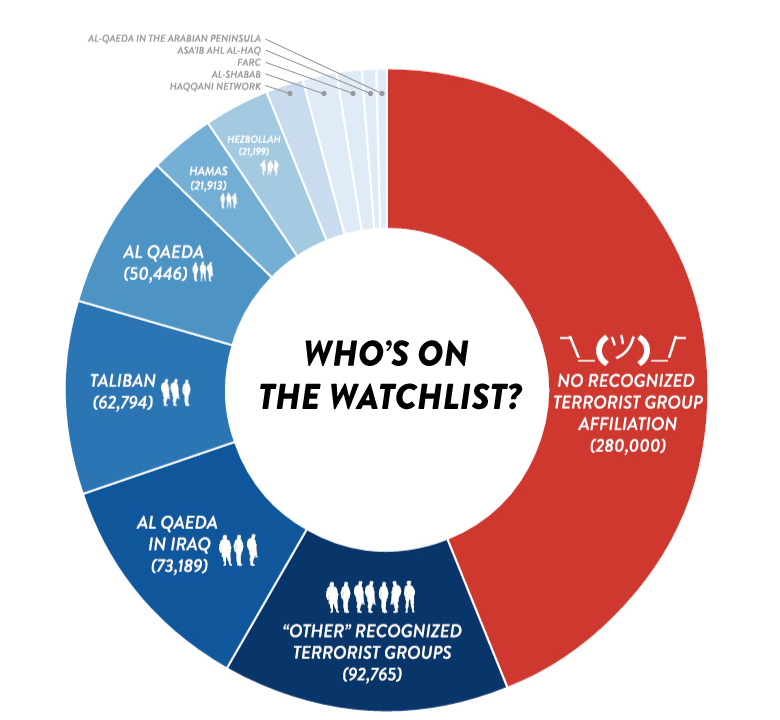
Yesterday, Jeremy Scahill and Ryan Devereaux reported that almost “half of the people on the U.S. government’s widely shared database of terrorist suspects are not connected to any known terrorist group, according to classified government documents obtained by The Intercept”:

Of the 680,000 people caught up in the government’s Terrorist Screening Database—a watchlist of “known or suspected terrorists” that is shared with local law enforcement agencies, private contractors, and foreign governments—more than 40 percent are described by the government as having “no recognized terrorist group affiliation.” That category—280,000 people—dwarfs the number of watchlisted people suspected of ties to al Qaeda, Hamas, and Hezbollah combined.

The documents, obtained from a source in the intelligence community, also reveal that the Obama Administration has presided over an unprecedented expansion of the terrorist screening system. Since taking office, Obama has boosted the number of people on the no fly list more than ten-fold, to an all-time high of 47,000—surpassing the number of people barred from flying under George W. Bush.

Timothy B Lee asks, “Is this a good way to fight terrorism?”

A lot of people don’t think so.

Critics point out that having too many people in a terrorism database can be just as bad as too few. If law enforcement and intelligence agencies are “watching” hundreds of thousands of people, that could mean they’re not actually watching anyone very carefully at all.

Civil libertarians also argue that the secret nature of these lists can run afoul of basic concepts of due process. If you’re put on a watchlist by accident, as the late Sen. Ted Kennedy once was, it can be extremely difficult to get off. And government critics such as Laura Poitras and Jacob Appelbaum have reported being detained and harassed by US officials when they’ve traveled to and from the United States.

The government counters that it can’t tell people who is on its lists and why without compromising intelligence sources and methods. But the result has been to turn airports into a kind of Constitution-free zone, where ordinary principles of due process don’t apply.

Ambinder’s take:

Watchlisting is fine; the uncertainty about the identities of terrorists implies that the list of suspected al Qaeda members will be much larger than the actual list. But providing to the National Counterterrorism Center bulk biometric data from all Americans in a certain number of states? The disproportionate targeting of Muslims in Dearborn, Michigan? The ease with which the government can open a file on you? Not only does the noise drown out the signal, but the actual harm done to people — inconvenience at airports, harassment at border crossings — is tangible.

Scott Shackford sighs:

[T]he first thing this report for 2013 (pdf) describes as an “accomplishment” is adding its one millionth person to its database:

On 28 June 2013, the Terrorist Identities Datamart Environment (TIDE) passed a milestone of one million persons in TIDE. While NCTC’s Directorate of Terrorist Identities (DTI) seeks to create only as many person records as are necessary for our nation’s counterterrorism mission, this number is a testament to DTI’s hard work and dedication over the past 2.5 years.

It’s a monument to the twisted incentives that drive bureaucracies. Having a watch list of a million people is considered an accomplishment even though it contains hundreds of thousands of people with no known ties to terrorist groups.

Iran’s Crackdown On The Press

The WaPo’s reporter in Tehran, Jason Rezaian, and his wife Yeganeh Salehi, also a journalist, were arrested a couple weeks ago:

As one of few foreign correspondents in based in Iran, Rezaian’s reporting hardly breached the sensitivities that the Iranian ruling apparatus is known to crackdown upon. His last two articles for The Washington Post covered baseball in Iran (“In Iran, a spark of enthusiasm for America’s national pastime”) and coverage of the nuclear negotiations from Vienna (“World powers agree to extend talks with Iran”). He was arrested in his home, alongside his wife, upon his return from Vienna. …

It is unclear on what charges the Iranian-Americans are detained, as official state media have verified the arrests but not the reasons behind them. An unconfirmed report by Tasnim news website, associated with Revolutionary Guards, claimed the arrests were on suspicions of spying.

The Economist notes that “Iran has long been hostile to the media”:

Twenty-seven journalists are currently in jail in Iran, according to the International Federation of Journalists, a Brussels-based lobby. But in the wake of the election last year of Hassan Rohani as president pressure on the media eased. Several journalists were freed in the days after he took office.

That now appears to have changed. Mr Rezaian and his wife (pictured above) are part of a worrying new spate of arrests. On May 28th Saba Azarpeik, an Iranian writer, was detained after Etemad (“Trust” in Farsi), a reformist newspaper, published a testy exchange between her and Muhammad Sadegh Kooshky, a professor at Tehran University and a member of an anti-Rohani pressure group. Two months later Marzieh Rasouli, a writer on arts and culture, was sentenced to 50 lashes and two years in prison. Reporters Without Borders, a Paris-based organisation, says she and two other Iranian journalists, Parastoo Dokouhaki and Sahamoldin Borghani, were accused of collaborating with the BBC, which is seen as part of Britain’s spy network by some hardliners.

No one knows why Iran feels the need to crack down now.

Last week, Saeed Kamali Dehghan heard that six Iranian judges are leading the new crackdown on journalists and political activists:

In their testimonies, many prisoners have accused the six judges of acting on the instructions of top security officials and prison interrogators, and collaborating with the country’s intelligence ministry or the elite Revolutionary Guards. Several prisoners said the sort of sentences they were threatened with in interrogation sessions were later handed down in their trials, which they say points to close collaboration between judges and the intelligence apparatus.

Earlier this week, Haleh Esfandiari argued that Iran’s hard-liners are using the arrests “to undercut other countries’ confidence in [Rouhani’s] ability to deliver on promises Iran might make in a negotiated deal”:

The security agencies manage to discover spies and foreign plots whenever an Iranian government seeks a rapprochement with the West. In 1999, when the reformist Mohammad Khatami was president, 13 Iranian Jews from Shiraz and Isfahan, including a 16-year-old boy, were arrested on fabricated charges of spying for “the Zionist entity” and “world arrogance.” Ten were eventually sentenced to prison terms — a carefully calculated decision that defied the concerns of members of the European Union, and chilled Iran’s relations with them.

Mr. Khatami’s failure to take a stand against a trial that was widely regarded as farcical left him looking weak, as did his earlier failure to speak up when a political ally, Gholamhossein Karbaschi, the mayor of Tehran, was tried and sentenced on fabricated corruption charges. Those two events only encouraged his opponents to thwart the president in other ways, further weakening faith abroad that he had the clout within Iran’s political system — and most important, with its supreme leader, Ayatollah Ali Khamenei — to withstand pressure from the hard-liners.

Growing Up Gazan, Ctd

In a brief post on Gaza’s demographics (43 percent of the population is under 15 years old), Yglesias makes a salient observation:

The election in which Gazans voted for Hamas … happened back in 2006 when most currently-alive residents of the Strip were too young to vote.

Andy Coghlan looks at why the Strip’s population is so young:

Demographers say it’s a combination of unusual factors.

One is that an unusually low proportion of Palestinian women hold jobs. “It’s the place in the world where the least women work outside the home,” says Jon Pedersen of the Fafo Institute, a centre for demographic and social research in Oslo, Norway. Latest figures from the Palestinian Central Bureau of Statistics show that 14.7 per cent of women are in the labour market.

“In most other countries, it’s much higher than that, between 70 and 80 per cent in Scandinavia, for example,” says Pedersen, who co-authored a comprehensive study a decade ago on the demography of Gaza. Even in other Middle Eastern countries with similar cultures to Gaza, the proportions working outside the home are significantly higher. In Jordan, for example, 16 per cent of women have jobs.

The data from Index Mundi show that the fertility rate in Gaza, 4.4 children per woman, is among the highest in the world. That has steadily fallen from a peak of 8.3 children per woman in 1991. This compares with a rate of 3 in Israel, although the overall rate there is elevated by higher rates of around 6 among the strictly orthodox Haredi Jews. In most European countries, it’s about 2.

Previous Dish on Gaza’s children here.

How Drugs Got A Bad Rap

“Drug addict,” “drug control,” “drug culture” – it wasn’t until around 1900 that we used these terms the way we mean them today, explains Mike Jay:

Largely couched in medical terms as it was, the whole notion of ‘drugs’ carried moral and cultural implications from the start. Within the temperance debate, intoxication was an evil in itself and abstinence a corresponding virtue. Also, a good many of the substances that caused concern in the West were associated with immigrant communities: opium in the Chinese districts of San Francisco or London’s docklands, cocaine among the black communities of the southern US. In the racially charged debates of the day, these substances were presented as the ‘degenerate habits’ of ‘inferior races’, a ‘plague’ or ‘contagion’ that might infect the wider population. Such ideas might no longer be explicit, but the drug concept certainly carries a murky sense of the foreign and alien even now.

That’s why it rarely applies to the psychoactive substances that we see as part of normal life, whether caffeine in the west, coca in the Andes, or ayahuasca in the Amazon.

During the first years of the 20th century, opium, morphine and cocaine became less socially acceptable, rather as tobacco has in our era. Their use was now viewed through the prism of medical harm, and their users correspondingly started to seem feckless or morally weak. The drugs themselves became, in a sense, ‘legal highs’: not technically prohibited but retreating into the shadows, available only under the counter or from those in the know. And then, once their sale was formally banned in the years around the Great War, ‘drugs’ became a term with legal weight: a specified list of substances that were not merely medically dangerous or culturally foreign, but confined to the criminal classes.

Putin’s Strategery

Michael McFaul views the Russian president as a failed statesman:

Putin’s failed proxy war in eastern Ukraine also has produced a lot of collateral damage to his other foreign policy objectives. If the debate about NATO expansion had drifted to a second-order concern before Putin’s move into Ukraine, it is front and center again now. Likewise, the strengthening of NATO’s capacity to defend its Eastern European members has returned as a priority for the first time in many years. Russian leaders always feared U.S. soldiers stationed in Poland or Estonia, yet that might just happen now. In addition, Putin’s actions in Ukraine have ensured that missile defense in Europe will not only proceed but could expand. And after a decade of discussion without action, Putin has now shocked Europe into developing a serious energy policy to reduce dependence on Russian gas and oil supplies. As a result of Putin’s actions in Ukraine, the United States is now likely to become an energy exporter, competing with Russia for market share. Some call Putin’s policies pragmatic and smart. I disagree.

Approaching the Ukraine conflict from a strategic studies perspective, Joshua Rovner outlines what scholars in that field can learn from it:

Ukraine raises at least two issues that may inspire new thinking on strategic theory. One is the problem of recognizing success when it involves something less than victory.

Ukraine has been on the offensive against the separatist fighters, rapidly driving them back into a handful of strongholds. But it’s unlikely the government can destroy them, given pro-Russian sentiment in the east and the possible existence of a large sanctuary for committed separatists across the border. Moreover, any durable settlement will require making concessions to groups that are extremely hostile to Kiev, as well as tacit promises to the Russian regime.

This might be a reasonable outcome, especially if Russia is badly bruised and if Ukraine comes away with increased Western economic and political support. But some Ukrainian leaders will bridle at any settlement that leaves their perceived enemies in place, especially after having lost Crimea. Not everyone will learn to live with Russian President Vladimir Putin and his proxies, and their unease may cause them to underrate important strategic gains. Such a scenario should resonate with American observers.

“Your Fixation On Good Intentions Is Blinding You To Your Recklessness”

Palestinians killed in an Israeli attack on a UN-run school

Saletan criticizes Israel for retreating to its intentions to explain away the death and destruction in Gaza:

When you focus on intentions, it’s easy to lose sight of tactical decisions that endanger civilians as a side effect. High on this list is the IDF’s shift from guided missiles to artillery. Based on the U.N. review and its own reporting, the Times says the fatal hits in Jabaliya “were likely to have come from heavy artillery not designed for precision use.” Such artillery is “considered effective if it hits within 50 yards of its target.” That margin of error obviously increases the risk to civilians.

A human rights lawyer tells the Times that no matter how hard you try, “You just can’t aim that weapon precisely enough in that environment because it’s so destructive.” From the standpoint of good intentions, that’s an excuse. But morality isn’t just about where you aim. It’s also about the weapon you use. It’s easy to tell yourself that you aimed as well as you could, when the fatal decision was to use a weapon you couldn’t have aimed any better.

Benjamin Wallace-Wells suggests that Israel may not be as capable as it claims to be of launching “surgical strikes” after all:

Last week, the just war theorist and liberal Zionist Michael Walzer published a pained, moving defense and critique of Israel’s military actions in Gaza. He argued that Israel must be allowed to defend itself against disproportionate attacks, but that the IDF must also take more “positive efforts” to limit civilian casualties in Gaza, even if it means asking its own soldiers to take more risks. The State Department’s harshly worded statement after the Rafah attack followed a similar logical line.

But this all assumes that the Israeli military can in fact do better — that it can precisely control what its rocket strikes destroy in Gaza. The details of the attacks on U.N. shelters suggest this is somewhat less true than we often acknowledge. … Perhaps Israel’s military precision was always overhyped. Or perhaps this conflict is simply too messy, on the ground, to expect precision. Either way, it is impossible to describe the strikes in this conflict as surgical. They are everything but.

And as John Cassidy points out, the question of whether Israel has committed war crimes hinges on a bit more than the nobility of its intentions:

In an interview with Mike Huckabee on Fox News last week, the executive director of Human Rights Watch, Kenneth Roth, said that Israel was guilty of war crimes, because it repeatedly launched attacks with the knowledge that the number of civilian casualties was likely to be disproportionate to the military gains. In a tweet on Monday, Roth said: “#Hamas still firing rockets indiscriminately at Israel. Those are war crimes. But they don’t justify #Israel’s own war crimes, killing many.”

Imposing collective punishment is also a war crime under the Geneva Conventions. The term refers to punitive sanctions of “any sort, administrative, by police action or otherwise,” that are imposed on targeted groups for actions which they themselves didn’t commit. Any postwar investigations are likely to focus on specific incidents and attacks that might fall under the collective-punishment rubric. For example, over the weekend, there were claims on social media that Israeli forces had shelled the marketplace in Rafah, causing numerous civilian casualties, after a Hamas attack in the city left two Israeli soldiers dead and one missing (and later declared dead). If such an attack did take place—and if it was intended to punish or terrorize the people of Rafah—it could be deemed a war crime.

(Photo: A Palestinian, injured by an Israeli military strike on a UN school, reacts as he lies on the ground, in Rafah, in the southern Gaza Strip on August 3, 2014. By Ali Hassan/Anadolu Agency/Getty Images)

Can The American Position On Israel Ever Change?

Beauchamp considers the implications of the Obama administration’s criticism of Israel:

In the past few days, after the sixth Israeli strike on a Gaza UN shelter for Palestinians fleeing the fighting, the Obama administration sent some pretty harsh words Israel’s way. The attack on the UN facility in Rafah was “indefensible,” according to Senior Adviser to the President Valerie Jarrett, who added that you “can’t condone the killing of all of these innocent children.” UN Ambassador Samantha Power called the Rafah strike “horrifying;” a longer State Department statement named it “disgraceful.”

It’s hard to imagine a clearer signal of administration outrage with Israel at the Gaza campaign, short of a personal statement from the president. The US is clearly upset with Israel, which isn’t all that rare, but this level of public criticism is very unusual. Given the US’s strong commitment to supporting Israel, the Obama criticism probably does not augur any substantive change in that pro-Israel US foreign policy. But it could still matter by impacting domestic Israeli politics, which are highly sensitive to fears of “losing” American support.

I hardly see fear of “losing” America in the current onslaught. I see an Israeli prime minister openly treating the president and secretary of state with contempt and derision, secure in the knowledge that in any battle between Obama and Netanyahu, the Congress will back Netanyahu every time. Waldman nonetheless sees the Gaza conflict contributing to a shift in how Americans think about the conflict:

[I]f this conflict drags on and the civilian casualties mount, more Americans could begin questioning their position on this issue. That doesn’t mean they’ll go from being “pro-Israel” to “anti-Israel,” a pair of perniciously simplistic ideas that discourage us from thinking rationally. It means that they might start seeing the issue as a complex one, where sometimes Israel’s government is right and sometimes it’s wrong, and a contest to see which politician can wave an Israeli flag with the most vigor doesn’t serve America’s interests (or Israel’s, for that matter). If that happens, politicians might actually feel free to enter into real debate on this topic.

Look at the contortions of Rand Paul to see how that will work out. He has had to renounce all his previous views on the subject and now backs Israel with a blank check and wants to cut aid from the only moderate group among Palestinians. And that’s just the price for even entering a nomination battle, let alone winning it. But the shift among the younger generations is a sign for a more balanced approach. Alas, by the time that gains real political clout, the West Bank will be all settlements. Jonathan Ladd believes that US public opinion on Israel has little to do with empirical reality anyway:

First, because Americans are so inattentive to the details of political controversies, and hold such consistent views on every Israeli-Palestinian violent clash, we shouldn’t see their opinions as a reflection on the details of any specific clash. The American public’s endorsement of current Israeli policy largely isn’t a reaction to that policy because most people aren’t following the details at all.

Second, the one thing that could change U.S. mass opinion would be if party elites changed their messages. The one group attachment powerful enough to potentially overwhelm group attitudes is party identification. For instance, if most Democratic politicians in Washington came out against an Israeli military operation, that could potentially lead ordinary Democrats to follow those cues rather than their group attitudes when forming an opinion. If that happened, American mass opinion would likely become much more split than it is today.

But the Democrats are as likely to do that as they are to re-invade Iraq. Just see what Harry Reid just said.

Fact-Check Those Insults, Mr. President

In an interview with The Economist published over the weekend, Obama got in this little dig at Russia:

Russia doesn’t make anything. Immigrants aren’t rushing to Moscow in search of opportunity. The life expectancy of the Russian male is around 60 years old. The population is shrinking.

But as Mark Adomanis points out, none of these statements is factually accurate. So why, then, did the president make them? Zenon Evans wonders:

It’s bizarre that Obama criticized Russia on these fronts when there’s plenty of legitimate issues – like Moscow’s crackdown on civil rights, the pro-Western political opposition, and independent media – that he could have addressed instead. These, of course, don’t have much bearing on the war Russia is waging against Ukrainian sovereignty or the mass killing of civilians on a Malaysian plane, but whether it’s due to a lazy team of fact-checkers or deliberate rah-rah nationalism to boost the U.S. by comparison, dubious talking points don’t help the Obama administration resolve the current crises.

Hearing the president say “Russia doesn’t make anything” will only inflame anti-American sentiment among Russian civilians, thereby reinforcing Putin’s own ballooning cushion of popular support. And, there’s need for healthy debate about the U.S.’s actions against the Kremlin throughout this war, but by spouting some easily-debunked information, Obama effectively invites skepticism of the accuracy of other White House claims about Russia.

But Dylan Matthews figures he was playing up the overall idea that Putinist Russia has no future:

[T]he fact that Obama felt compelled to say this — inaccuracies and all — is interesting. The implicit argument being countered here is the idea that, as TIME magazine recently put it, a “Cold War II” is afoot and Russia might present a real rival to the US. But one crucial thing that made the Soviet Union a plausible rival was that, for much of the world, Communism was an extremely attractive ideology, one embraced by guerrilla and resistance movements across the globe and thus capable of pulling numerous countries into the Soviet orbit. As Obama points out, there’s nothing so attractive about 2014′s Russia, which profoundly limits how successful it can be as a world power.