What’s Next For Uganda’s Gays?

Last week, a Ugandan court struck down the country’s draconian Anti-Homosexuality Act. Melina Platas Izama gives credit to “the vital role played by concerned citizens and the legal community in Uganda”:

Ten individuals and organizations — including a journalist, professor, doctor, activists and current and former legislators — petitioned the court to repeal the law on the grounds that it was passed illegally, having contravened parliamentary rules of procedure requiring quorum, and that it violated constitutional rights. Their efforts, combined with those of a robust legal team, were integral to the law’s repeal. Their victory demonstrates the power of domestic actors and the courts in promoting social and legal change.

But Uganda might get worse for gays before it gets better:

If we look at attitudes toward homosexuality over time using opinion polls, we find that it can take decades for attitudes to shift. Further, negative attitudes toward homosexuality sometimes increase before they decrease.

In South Korea, for example, one of the countries with the longest record of opinion polling on the topic, opposition to homosexuality, again, as measured by the percentage of respondents who say homosexuality is never justifiable, jumped from 60 percent in 1982 to 90 percent in 1990 before declining again. It’s worth noting that levels of anti-homosexuality sentiment in South Korea in 1990 are nearly the same as those in Uganda today. In South Africa too, anti-homosexual sentiment increased before declining. Meanwhile, in the U.S., opposition has fallen only gradually over time and has yet to dip below 20 percent.

Jay Michaelson fears an anti-gay backlash:

In the case of Uganda, records kept by Sexual Minorities Uganda show that violence against LGBT people has increased tenfold since the passage of the AHA. Add in fiery preaching by anti-gay zealots, often funded by American organizations, and you have a volatile brew ready to explode. Activists worry that this court decision could provide the spark. If the law won’t protect Uganda from Satan, people will have to take up arms themselves.

Hopefully, cooler heads will prevail. There are supportive African (and African-American) clergy calling for coexistence rather than violence. Maybe the Obama administration, instead of merely backpedaling reactively, could support these voices pro-actively as well. Maybe Museveni could call for a period of national reflection. Or maybe, things will continue to get worse.

Previous Dish on the predicament of Uganda’s gays here.

Blogging About Books

Rohan Maitzen revels in it:

Blogging allows for a wonderfully open-ended kind of criticism: there’s no pressure to account for or include everything, no need to position yourself theoretically or as part of a bookclub-beagle-trpre-existing critical argument. You can do any kind or degree of contextualizing or theorizing that you want, of course (it’s useless to generalize about blogging as a form, since there are no rules or norms), but you can also just look directly at the book in front of you and say what you think about it, show what you observe in it. Everything else you know—all your habits of reading and thinking—will affect what you think and see, of course, but for me there has been something very liberating about writing a post knowing that I’m just writing as myself, for other interested readers, not trying to establish anything definitive but rather to offer what I can to the broad conversation about books that the internet enables.

Maitzen goes on to discusses how her academic training in Victorian literature connects with writing for a broad, public audience:

Just as I was starting to blog in 2007, for instance, Cynthia Ozick wrote a piece in Harper’s on the current state of criticism in which she said:

Academic theorists equipped with advanced degrees, who make up yet another species of limited reviewers, are worthy only of a parenthesis. Their confining ideologies, heavily politicized and rendered in a kind of multi-syllabic pidgin, have for decades marinated literature in dogma. Of these inflated dons and doctors it is futile to speak, since, unlike the hardier customer reviewers, they are destined to vanish like the fog they evoke.

Even though I was restless with the pressure I felt to produce increasingly specialized kinds of criticism, comments like these struck me as depressingly (and insultingly!) mistaken. I began to hope that I could use my blog to show that academic expertise is valuable, and that it can be worn lightly and used to further good conversations about literature, which is really what I see as the fundamental purpose of all criticism. Because negative stereotypes about “politically correct idiots” overrunning “lit departments” are pretty widespread, I also wanted to counteract them in my own small way by showing what really happens in at least one person’s classroom: I blog regularly about my teaching, and I’d be surprised if anyone could conclude from these posts that I have “forgotten the text.”

For more, check Novel Readings, Maitzen’s blog about literature.

Torture-As-Execution, Ctd

This is extremely disturbing:

Documents released Friday afternoon in the case of Arizona’s  botched execution of Joseph Wood—who gasped for air and struggled, according to witnesses, repeatedly during the two-hour process—show that  executioners used 15 separate doses of a new drug cocktail before Wood finally died. Lawyers had warned that the combination of 50 milligrams hydromorphone (a pain killer) and 50 milligrams of midazolam (a sedative) was rife with potential problems. (The state also has a long history of failing to follow its own protocol.) The documents suggest they were right.

Ian Millhiser is stuck by the fact that “Wood received 750 milligrams of both drugs”:

To put that in perspective, an anesthesiologist told the Associated Press that patients sedated prior to surgery typically receive no more than 2 milligrams of either drug.

Midazolam is not considered a “true general anesthesia” because patients treated with this drug often retain awareness. Indeed, one anesthesiologist told the Wall Street Journal that the states that use this drug in executions “literally have no idea what they’re doing to these people.”

Karen Siberd MD backs up that anesthesiologist. Sibert declares that there’s “no mystery about why the July 23 execution of Joseph Wood in Arizona took so long”:

The convicted murderer didn’t receive one component of the usual mixture of drugs used in lethal injection: a muscle relaxant. The traditional cocktail includes a drug such as pancuronium or vecuronium, which paralyzes muscles and stops breathing. After anyone receives a large dose of one of these powerful muscle relaxants, it’s impossible to breathe at all. Death follows within minutes.

But for whatever reason, the Arizona authorities decided not to use a muscle-relaxant drug in Mr. Wood’s case. They used only drugs that produce sedation and depress breathing. Given enough of these medications, death will come in due time. But in the interim, the urge to breathe is a powerful and primitive reflex.

This sort of incompetence is all too common. Serwer talks with death penalty expert Austin Sarat about it:

Lethal injections, Sarat said, were more likely than other methods to result in botched executions. In a study of U.S. executions that took place between 1890 and 2010, Sarat said, 7% of executions by lethal injection were botched, compared to 3% for all executions.

Previous Dish on Wood’s botched execution here.


Are Russian Troops In Ukraine?

This embed is invalid

Last week, Buzzfeed reported that Russian soldier Alexander Sotkin (seen above) posted Instagram photos taken within Ukraine:

Instagram’s geolocating tool … is highly accurate. The only plausible way it could have misplaced Sotkin’s photos on the map is if he had used a trick called GPS ghosting to make his iPad think he was elsewhere.

throws cold water on the story:

Sotkin uploaded the first photograph ostensibly showing his location in Ukraine on June 30, after he posted two others complaining about boredom and lack of power for his tablet. The last photo was the one positioned in Ukraine. He tagged all three with #учения2014 which shows that he was on exercises when he snapped those selfies.

Most likely, the varying accuracy of cell tower triangulation meant that his device geotagged his photos with wildly different location coordinates based on whatever tower it could communicate with. At the least, the evidence is nowhere close to being reliable enough to say Sotkin was fighting in Ukraine.

Meanwhile, James Miller fears Russia is preparing to invade Ukraine:

Strong evidence suggests that a Russian-supplied and crewed Buk antiaircraft missile shot down MH17. The missile was deployed to this area in order to defend the road that links the separatists’ positions to each other and to Russia. These towns are so vital to the Russian-backed insurgents that the separatists decided to place their most advanced SAMs in the area to defend against Ukraine’s air force. This also means that the town has become one of the primary goals for both the separatists and the Ukrainian military.

How important is this area to the separatists? Earlier this week a large convoy was spotted moving toward the town. The video of the convoy, labeled “troops from Russia,” shows a large group of heavy armor—mostly BMPs, towed artillery and antiaircraft guns, troops transports… and two Strela-10 advanced antiaircraft systems. All of the vehicles have uniform paint configurations, but those paint configurations don’t match the Ukrainian military’s. These weapons very likely came from Russia.

Mark Adomanis takes a look at Ukraine’s big-picture problems:

There will likely be more deaths before everything is said and done. Just the other day 19 people died and 31 people were injured, and hundreds more have been killed since the violence began. The momentum of the conflict, which at one point seemed to lie with the Russian-backed rebels, has decisively shifted in Kyiv’s favor. The rebels’ most recent comments, accusing the Ukrainians of using chlorine gas, suggest a growing desperation, as do their ever more heated and extreme calls for Russian assistance. It looks as if Ukraine will escape one of the worst possible fates—a “frozen conflict” over a disputed territory, like those between Georgie and Russia or Armenia and Azerbaijan. Minus Crimea, it will be free of any enclaves directly controlled by Moscow.

It’s important, though, not to get too carried away. Even if, as now seems to be the case, Ukraine “wins” the war in the east, it’s in for a long, rough, and dangerous road. Regardless of what foreign policy Kyiv pursues or which agreements it signs with the European Union, there’s nothing that it can do to change Ukraine’s geographic position. And this position exposes it to all manner of direct and indirect Russian pressure, particularly in the economic realm.

Boehner’s Border Bill, Now With Cruz Control

Late Friday night, just before heading home for their August recess, House Republicans passed a bill to address the child migrant crisis. To do so they threw an abattoir of red meat to the right flank – pledging less than a fifth of the resources that Obama says he needs and simultaneously reinforcing deportation for the half a million DREAM Act kids. It won’t pass the Senate, of course, but it gives House Republicans a Potemkin vote they can cite when they face their Hannityed constituents this month. It’s hard to beat Weigel’s wit:

Just one year ago, Republicans were talking about passing their own version of the DREAM Act. Tonight, they put the party on record for the total cessation of Barack Obama’s quasi-DREAM Act. The arc of history is long, but it bends toward Steve King.

And a certain congresswoman from Minnesota, as Chait notes:

A party that began the Congressional term hoping to move left from Mitt Romney’s immigration stance has instead moved toward Michele Bachmann’s. (Bachmann — who, along with Steve King, helped draft the House bill — pronounces herself thrilled.) The party’s new dogma will potentially entangle its next nominee in an even less humane debate than the one that ensnared Romney. At the very least, it has put 216 House Republicans, many of whom will one day seek higher office, on record for a policy most Latino voters consider disqualifying. The aye votes include potential 2016 presidential candidate Paul Ryan, who is not likely to be greeted by friendly mariachi bands any time soon.

It is understandable that the party’s Congressional wing, based mostly in safe, deep-red districts, has failed to craft a national strategy for its 2016 candidate. But the House’s course of action has fallen well below “unhelpful” and instead verges on outright sabotage. How do they think this is going to work out for them?

Why the change of heart? A political system so gerrymandered and a country so demographically sorted no Republican need persuade a single Latino this fall in order to get re-elected. Nate Cohn elaborates:

Hispanic voters are all but absent from this year’s most competitive Senate battlegrounds. … Hispanic voters will have even less influence over the composition of the House, which is all but assured to remain in Republican hands. The clearest illustration of the extent to which the House G.O.P. is insulated from Hispanic voters is this: The party easily held the House in 2012, even though Republicans won only 30 percent of the Hispanic vote for Congress, and even though Hispanic turnout in that presidential year was higher than in a midterm election.

The reason is simple. In districts held by House Republicans, Hispanics represent only 6.7 percent of eligible voters. The Hispanic share of eligible voters is nearly as low in the House battlegrounds, 7.4 percent. Most of those Hispanic voters are only in a few districts; the G.O.P. could afford to lose them given their healthy edge in the House.

But Cillizza argues that their PR problem is bigger than that:

This is the latest in a string of incidents in which Republicans have been their own worst enemy — often because they simply can’t get out of their own way. Given their dismal approval ratings, the best way for Republicans to handle almost every issue — including this one — is to make as few waves as possible. Stay out of the news. Let President Obama do the heavy lifting on what the funding level ends up as. This issue is a no-win politically — people don’t like the idea of kids being shipped back to dangerous places but also don’t love people coming here illegally or spending billions of dollars that may or may not solve the problem.

And yet, Republicans found a way to make the story all about them in the dying days of this session of Congress. It’s remarkable — and not in a good way.

“Re-Purposed Bovine Waste”

John Oliver – peace be upon him – lays waste to the corruption and bullshit that is native advertising:

The piece is well worth watching in full when you get a second. And it says something that it takes a comedy show on a subscription based cable channel to lay it out. (Note to those of you who have not yet subscribed to the Dish: subscriptions are the only way the media is going to dig out of this giant, gaping, ethical hole.) Oliver targets the pimps and whores at Time Inc. with particular verve, and, as a cheery on top of the cake, Women’s Wear Daily has a hilarious gaffe today by Norman Pearlstine who has capped his illustrious career in journalism by burning down the entire house. In a Q&A, Pearlstine was bragging about a new “native advertising” lab, headed by a respected journalist:

N.P.: The Time Inc. Content Solutions model is one to follow in that it’s got some very experienced journalists working on those products but they don’t engage in magazines on editorial where they’d be covering the people that they are writing about.

WWD: So, journalists for the publications are working on native content?

N.P.: Chris is really the exception to that. He happens to be the creative director at Sports Illustrated, a magazine that doesn’t cover the people whom we’re working on. He’s a brilliant creative director with a wonderful commercial mind. The place we’ll have to be careful is if there are packages that he’s working on would somehow involve Sports Illustrated. He’s going to have to recuse himself from doing anything at the magazine itself that would raise conflict. It’s my job to ensure that it doesn’t happen.

WWD: Is native changing the culture of journalism?

I think we know the answer to that.

A Predator As Protagonist

Praising the above Kroll Show sketch about drone pilots as “smart and disturbing,” Sam Lipsyte offers a caustic take on how we might start incorporating drones into war lit:

Should we now envision drone protagonists for the new war fiction? One could portray the drone as a gung-ho robot that begins to question authority. It can work in a short satiric burst, but if it goes for too long, the technical questions (where did these feelings come from?) might overwhelm the narrative missile’s “arc.” The robots-turning-against-us motif, from Philip K. Dick’s “Second Variety” to 2001’s HAL, seems a little old hat now. Perhaps it’s time to revisit Joseph McElroy’s innovative ’70s novel Plus, which tracks the consciousness of a cyborg brain as it confronts its limits and its mortality. Maybe it’s time for a long-form meditative drone. Or something more parable-like: Jonathan Livingston Seadrone?

Or maybe not. We like to think we’re all sealed up safe in our technology, but it’s a delusion, and good war fiction tends to shred societal delusions. Drone pilots are often suicidal PTSD cases themselves, after all, and plenty of soldiers from all sides died in combat during the last few wars, not to mention the horrific slaughter of so many civilians. Even with Pentagon-issued joysticks, it’s still about boots and dead bodies on the ground. The drone as a fictional character might have some promise, but the grunt’s-eye view will continue to resonate. We’re all underpaid, overworked, underinsured first-person shooters now.

The Pro-Life Resurgence Has Peaked

mid-year_states_enacted_21_2014_490px

But Lane Florsheim suggests that’s a measure of its success:

Though the rate of passage for restrictive laws has slowed down this year, in certain states, this is because much of the damage has already been done. In these states, it seems, the pro-life movement is winning. Reproductive rights were one of many issues for which the 2010 midterms served as a turning point, thanks to the wave of newly elected conservative state legislators taking office around the country. “We’ve seen 226 abortion restrictions enacted over the past four years,” Elizabeth Nash, State Issues Manager at Guttmacher, told me. “That speaks to some states enacting multiple restrictions, and perhaps the urgency in some of those states to adopt further restrictions is just not there.”

Meanwhile, Amanda Marcotte notes that the abortion rate in Texas – where new regulations have forced more than half of the state’s providers to stop offering the procedure – has not fallen as much as many expected:

New regulations requiring Texas abortion providers to have hospital admitting privileges forced more than half of the clinics in that state to stop offering abortion services. This was expected, by both pro- and anti-choicers, to cause a significant drop in the abortion rate in the state. But as Amelia Thomson-DeVeaux reports at The Week, the drop was much less significant than expected. Research by the Texas Policy Evaluation Project at the University of Texas at Austin found a 13 percent drop in legal abortions over the previous year, which is significant, but not nearly as big a drop as you’d expect when half the clinics in the state shut down. “In some ways, we were expecting a bigger decline,” study author Daniel Grossman told the Texas TribuneAbortion rates have been falling on their own nationwide for decades, likely due to improved contraception use. That suggests that while most of this drop is due to the law, some of it might just be part of the larger national trend.

The findings demonstrate a fairly serious flaw behind the push for more and more restrictions on abortion laws. “If more clinics close, one might reasonably assume, the demand for abortion will also decline, either because wait times at the existing facilities are too long or because women will decide that an abortion isn’t worth the hassle or expense,” Thomson-DeVeaux writes. However, this thinking relies on the false belief that women enter into the abortion decision lightly, and that a few obstacles will deter them. Avoiding the expense and hassle of having a child when you don’t want one remains extremely motivating, more than many health care experts realized.

On that note, let’s revisit last week’s rousing reader debate over abortion regulations:

As I’m about to send this, I see you’ve posted more dissents, and you comment, “Who is making abortion impossible?”  Come on.  Really?  Please look up how many clinics around the country have closed in the past three years due to these obstructive “standards,” check out how far women might need to travel, and tell me that’s not putting safe, legal abortion out of reach for many, many women.  You also describe these laws as “a way to provide some sort of speed bump before human life is taken.” OK, if by “speed bump” you mean requirement after requirement, with new ones continually added.

Another continues:

To say that a “speed bump” is needed before choosing to have an abortion assumes that women have abortions as a lark, without prior discussions with partners, friends, family members, health care providers or clergy. Or maybe a woman doesn’t discuss her decision but just, you know, takes the time to think about it on her own. Do you think the federal or state government should put up “speed bumps” just in case a woman didn’t think about her decision long enough, or not long enough to suit you? This attitude also ignores the other “speed bumps” that already exist: getting the money, taking time off work or finding day care (most women who have abortions already have children), traveling the possible hundreds of miles to an abortion provider, much more likely now with with these disingenuous “safety” restrictions on clinics.

In fact, you bemoan later-term abortions, but there are already so many “speed bumps” in place that by the time a woman takes the time to make a decision and deal with the practical issues I listed, and then has to possibly put up with a government-imposed waiting period, more time has elapsed in her pregnancy. Wouldn’t you prefer that a woman who knows she wants to have an abortion have it as early as possible and not be forced to delay because of these “speed bumps”?

Another adds, “For most women, the speed bump doesn’t change their minds; it just pisses them off.” Another reader:

In your latest exchange with dissenters you end by saying, “I do not apologize for my belief that that there is a genuine moral issue with abortion – the fate of human life – that a fair argument would acknowledge rather than dismiss as self-evidently untrue.”

That is only one of the moral issues with the abortion issue, and I will concede that often those who fall into the pro-choice camp want to avoid talking about that. But the anti-abortion camp is equally (if not, more so) averse to acknowledging the moral implications of their position.  Specifically, what are the moral implications of forcing a woman to take an unwanted pregnancy to term?  What are the moral implications of bringing more unwanted children into this world, especially considering the fact that most unplanned and unwanted pregnancies occur in low-income populations?  What are the moral implications of the anti-abortion camp’s objections to contraception coverage, which has been clearly demonstrated to be the most effective way to reduce unwanted pregnancies?

One more:

With regards to the abortion questions at hand, perhaps it is best to meet in the middle.

Laws requiring counseling and wait periods might be okay, but those requiring admitting privileges are not.  While I disagree with both and firmly believe that abortion should be freely available, I can understand the moral concerns.  The issue with adding “medical” requirements on abortion clinics, however, is not about encouraging thoughtful decision making.  It is about closing clinics by way of overbearing regulation. As a conservative, I would think you would be against such tactics.  Fewer clinics farther away providing more costly procedures leads to unsafe abortions which is equally morally questionable.

If people want to make abortion illegal because of their moral or religious beliefs, fine.  Say that.  But over regulating a business in order to kill it under the auspices of making it safer is not conservative.  It’s lying.

A Cooler Iced Coffee

Alexis Madrigal buzzes about Blue Bottle New Orleans Iced Coffee, a brand “legendary in the Bay Area” which is now expanding east. He finds Blue Bottle “not aggressively artisan like so many Portlandia products,” but rather “a delicious, not financially ruinous luxury”:

Brewed with chicory, cut with whole milk, sweetened with cane sugar, it’s a cold coffee beverage that is at once sophisticated and unpretentious. It’s not an austere challenge to the Starbucks-trained palate like so much of high-brow coffee culture. It just tastes good in an interesting way. … This drink might let Blue Bottle challenge Starbucks, which controls the vast majority of the ready-to-drink market. It would be the latte of the 2010s….

He goes on to compare Starbucks founder Howard Schultz with Blue Bottle’s founder and CEO, James Freeman. Whereas Schultz started as primarily a salesman, says Madrigal, Freeman operates from a richer coffee philosophy:

It is impossible to read Freeman’s ode to the art of roasting coffee, included in the book he wrote with his wife Caitlin, and not believe that he cares about coffee. … “For me, no matter when I got to bed, I always felt a sense of dread when the alarm went off at 4 a.m.,” Freeman wrote of roasting. “Classic Kierkegaard, straight out of The Concept of Anxiety: animals are slaves to their instincts and hence feel no responsibility, but humans are free and therefore constantly aware of their failure to live up to their responsibilities to God—or to Coffee.”

The only thing that staves off the dread is to get up and make the coffee. … “That first decision to get up in the morning is a mirror of all the hard and lonely decisions that must be made for the rest of the roasting day.” … Freeman believes coffee makes us the people we want to be. “I am actually able to change the brain chemistry of my customers,” he has written. And his personal obsession has been perfecting the art of constructing coffee, not growing it. Making coffee is “a performance that lasts 90 seconds,” and that alters the people who experience it.

We Tortured. It Was Wrong. Never Mind.

I’ve wondered for quite a while what Barack Obama thinks about torture. We now know a little more:

Even before I came into office I was very clear that in the immediate aftermath of 9/11 we did some things that were wrong.  We did a whole lot of things that were right, but we tortured some folks.  We did some things that were contrary to our values.

torturefoia_page3_full.gifI understand why it happened.  I think it’s important when we look back to recall how afraid people were after the Twin Towers fell and the Pentagon had been hit and the plane in Pennsylvania had fallen, and people did not know whether more attacks were imminent, and there was enormous pressure on our law enforcement and our national security teams to try to deal with this.  And it’s important for us not to feel too sanctimonious in retrospect about the tough job that those folks had.  And a lot of those folks were working hard under enormous pressure and are real patriots.

But having said all that, we did some things that were wrong.  And that’s what that report reflects.  And that’s the reason why, after I took office, one of the first things I did was to ban some of the extraordinary interrogation techniques that are the subject of that report.

And my hope is, is that this report reminds us once again that the character of our country has to be measured in part not by what we do when things are easy, but what we do when things are hard.  And when we engaged in some of these enhanced interrogation techniques, techniques that I believe and I think any fair-minded person would believe were torture, we crossed a line.  And that needs to be — that needs to be understood and accepted.  And we have to, as a country, take responsibility for that so that, hopefully, we don’t do it again in the future.

What to make of this?

I don’t think it’s that big a deal that he used the English language to describe what was done, in any fair-minded person’s judgment. He’s said that before now. And his general position hasn’t changed. Let me paraphrase: We tortured. It was wrong. Never mind. So he tells the most basic version of the truth – that the US government authorized and conducted war crimes – and hedges it with an important caveat: We must understand the terribly fearful circumstances in which this evil was authorized. But equally, he argues that the caveat does not excuse the crime: “the character of our country has to be measured in part not by what we do when things are easy, but what we do when things are hard.”

This latter point is integral to the laws against torture – but completely guts his first point. As I noted with the UN Convention, the prohibition is absolute:

No exceptional circumstances whatsoever, whether a state of war or a threat of war, internal political instability or any other public emergency, may be invoked as a justification of torture.

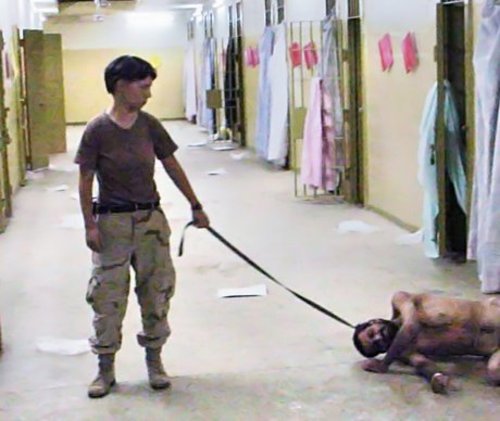
Cheney, Bush, Tenet, and Rumsfeld all knew this from the get-go. That’s why they got their supine OLC to provide specious justifications for the legally prohibited. That’s why they won’t use the word “torture,” instead inventing an Orwellian euphemism. And, of course, the president’s excuse for them – that “in the immediate aftermath of 9/11,” we did wrong things – is deeply misleading. This went on for years abughraibleash.jpgacross every theater of combat. What about what Abu Ghraib revealed about the scope of torture in the battlefield much later on? What about 2005 when they secretly re-booted the torture program? This was a carefully orchestrated criminal conspiracy at the heart of the government by people who knew full well they were breaking the law. It cannot be legally or morally excused by any contingency. It cannot be treated as if all we require is an apology they will never provide.
Yet that’s what the president’s acts – as opposed to his words – imply. And that’s what unsettles me. It is not as if the entire country has come to the conclusion that these war crimes must never happen again. The GOP ran a pro-torture candidate in 2012; they may well run a pro-torture candidate in 2016. This evil – which destroys the truth as surely as it destroys the human soul – is still with us. And all Obama recommends for trying to prevent it happening again is a wistful aspiration: “hopefully, we don’t do it again in the future.” Hopefully?

Then there’s the not-so-small matter of the rule of law.

Call me crazy but I do not believe that the executive branch can simply allow heinous crimes to go unpunished just because they were committed … by the executive branch. It seems to me, to paraphrase the president on agabuse.jpgFriday, that the rule of law “has to be measured in part not by what we do when things are easy, but what we do when things are hard.” How many times does the United States government preach about international law and Western values? On what conceivable grounds can we do so when our own government can commit torture on a grand and brutal scale for years on end – and get away with it completely?

Either the rule of law applies to the CIA or it doesn’t. And it’s now absolutely clear that it doesn’t. The agency can lie to the public; it can spy on the Senate; it can destroy the evidence of its war crimes; it can lie to its superiors about its torture techniques; it can lie about the results of those techniques. No one will ever be held to account. It is inconceivable that the United States would take this permissive position on torture with any other country or regime. Inconceivable. And so the giant and massive hypocrisy of this country on core human rights is now exposed for good and all. The Bush administration set the precedent for the authorization of torture. The Obama administration has set the precedent for its complete impunity.

America has killed the Geneva Conventions just as surely as America made them.

(Photo: a page on enhanced interrogation techniques via a FOIA request.)