A Gift To Obamacare Foes

This 2012 video of Jonathan Gruber, a key Obamacare architect, is making the rounds:

The line of Gruber’s that stands out:

What’s important to remember politically about this is if you’re a state and you don’t set up an exchange, that means your citizens don’t get their tax credits—but your citizens still pay the taxes that support this bill.

Ed Morrissey pounces:

So is this a smoking gun in the Halbig case? Politically — yes. Legally? It certainly undermines one argument used by the administration to defend payment of subsidies through the federal exchanges, but it may not be entirely dispositive. What matters here is Congressional intent, not Gruber’s, to the extent that the statute itself appears ambiguous.

Aaron Carroll dismisses the video:

Is there a single CBO analysis which documents what would happen if states refused to set up exchanges and would therefore “lose” their subsidies? Were any of Gruber’s models set up in this manner? If not, then I don’t understand how anyone in Congress or who set up the law thought it was going to work. I accept that the law was written poorly. I accept that there may be individuals who thought it would work in the way the DC Circuit majority said. But there are tons of analyses, reports, interviews, and more that show that no one involved thought that way.

But Michael Cannon sees Gruber’s comments as a big deal:

Now why should we care about what this one health economist says about this hotly disputed feature of the PPACA? Gruber is not a member of Congress, so this isn’t direct evidence that Congress intended to offer tax credits only in state-established Exchanges. (The procedural path the bill took through Congress is dispositive evidence of that.) But he may be the next best thing.

Gruber was an architect of both the PPACA and its Massachusetts precursor, “RomneyCare.” In 2009 and 2010, he was a highly paid advisor to the Obama administration during the congressional debate that produced the PPACA. According to the New York Times, “the White House lent him to Capitol Hill to help Congressional staff members draft the specifics of the legislation.”Later the above video, Gruber boasts of having written part of the PPACA. He boasts to the Times, “I know more about this law than any other economist.” He’s probably right about that.

Suderman chimes in:

There can be no doubt, based on his record, that Gruber is a supporter of the law. He says so in the presentation. “I’m biased, I’m in favor of this type of law, I won’t hide that,” he says. He also explains early on that his entire presentation is made of “verifiable objective facts.”

And what he says is exactly what challengers to the administration’s implementation of the law have been arguing—that if a state chooses not to establish its own exchange, then residents of those states will not be able to access Obamacare’s health insurance tax credits. He says this in response to a question asking whether the federal government will step in if a state chooses not to build its own exchange. Gruber describes the possibility that states won’t enact their own exchanges as one of the potential “threats” to the law. He says this with confidence and certainty, and at no other point in the presentation does he contradict the statement in question.

McArdle adds:

To be sure, this was still two years after the law passed, and my understanding is that the court is not supposed to pay attention to post-facto statements about the law’s effect or intent. But unless this is some sort of elaborate hoax, I think this definitively puts to rest the notion that none of the bill’s architects could possibly have thought or intended that the law would have this effect. Gruber thought the law would have this effect — and if anyone would know, he would.

Cohn gets a response from Gruber:

Among those who say they are surprised by the statement is Gruber himself, whom I was able to reach by phone. “I honestly don’t remember why I said that,” he said, attempting to reconstruct what he might have been thinking at the time. “I was speaking off-the-cuff. It was just a mistake.” As evidence that it was not indicative of his beliefs, he noted that his projections of the law’s impact have always assumed that all eligible people would get subsides, even though, he said, he did not assume all states would choose to run their own marketplaces.

Previous Dish on Halbig here.

Really? No Benefit Cuts?

Suzy Khimm questions how Paul Ryan’s anti-poverty plan will pay for itself without them:

While Ryan says his plan is budget neutral, it does not appear to account for the additional cost of hiring case managers, imposing new work requirements, and creating a new bureaucracy to administer them. That could mean less money for benefits and more for services to administer them, said Donna Pavetti of the Center on Budget and Policy Priorities (CBPP). “There are things about it that sound good, but when you get to the reality of it, it just falls apart,” she said, adding that federal agencies have often struggled to allocate limited resources to staffing and find enough skilled case workers.

“This individualized case management, the work requirements – all of that is really resource intensive. How you’d do that without pulling from resources that help people meet their basic needs?” said Pavetti, CBPP’s vice-president for family income support policy. She points to a state-level program called Building Nebraska Families, which proved effective at moving more welfare recipients to work through intensive home visits, but which was also costly, averaging $7,400 to $8,300 per participant.

In a more comprehensive critique of the plan, Pavetti faults Ryan for ignoring the tradeoffs and limitations it implies:

The case of “Steven,” whom Ryan also highlights, makes the point as well.  A single 19-year-old non-custodial father, Steven is jobless and needs help to get off drugs.

Ryan’s proposal indicates that the Opportunity Grant would help him get drug treatment, move him into transitional housing (a form of subsidized housing), and get him help with attending parenting classes, finding work, and pursuing further education. These are all needed services, and limited funding keeps many people, particularly adults not living with children and who have the same needs as Steven, from obtaining that help.  But the Opportunity Grant structure would not provide additional resources (and as my colleague Robert Greenstein points out, could well provide fewer resources), so the only way to provide this richer set of supports for Steven is to cut the help that other families receive.

Running down how Paul Ryan proposes to keep the plan revenue neutral, Chuck Marr criticizes the cuts he would make to existing programs:

First, he would pay for it in part by eliminating the refundable part of the Child Tax Credit for several million children in low-income immigrant working families, including citizen children and “Dreamers,” thereby pushing many of them into — or deeper into — poverty. He would also eliminate the Social Services Block Grant, a flexible funding source that helps states meet the specialized needs of their most vulnerable populations, primarily low- and moderate-income children and people who are elderly or disabled.  (This program provides the kind of services and state flexibility that Ryan says we need more of when he promotes other parts of his plan that would enable states to cut food stamps and rental assistance and shift the resources to services.)

Also among the programs that Ryan would end is one that provides fresh fruits and vegetables primarily to children in schools in low-income areas.  By contrast, the President would pay for his EITC expansion by closing tax loopholes for wealthy taxpayers.

In Jared Bernstein’s take, the plan is a potentially costly solution in search of a problem:

The broader reason his plan is misguided is because Ryan starts from the mistaken assumption that the current U.S. anti-poverty system is broken, when in fact it’s actually quite effective, and not just in lowering market-based poverty rates, which it does by almost half, but also by investing in the longer term well-being of its beneficiaries. (Bob Greenstein provides the details here.)  That’s not good enough by a long shot, but neither is it motivation to radically change the system in ways that introduce a dangerous set of new risks, as this new plan does, I fear. …

The implication here is that while a faceless bureaucrat in D.C. can’t possibly evaluate your nutritional needs, for example, a bureaucrat in Albany or Sacramento can easily and efficiently do so. And while the plan requires state officials to use the resources for poverty reduction, and not, say, tax reduction, consolidation also raises serious risks of diverting funds to areas of anti-poverty interventions that state officials favor vs. areas of need.

It’s Time To Take A Break From Bombing Schools

PALESTINIAN-ISRAEL-CONFLICT-GAZA

It’s not just in American schools that they slaughter kids. To John Cassidy, the alleged shelling of an UNRWA school in Beit Hanoun yesterday underscores the need for an immediate ceasefire:

Alarmingly, hopes for a ceasefire faltered on Thursday. Secretary of State John Kerry left a meeting with Benjamin Netanyahu without securing an agreement. According to a report in the Washington Post, Netanyahu was furious about a ban on commercial airliners landing in Tel Aviv that the Federal Aviation Administration imposed earlier this week, suspecting that “it was an attempt by the Obama administration to squeeze Israel to end its Gaza campaign.” The flight ban was lifted on Thursday night, but Israel and Hamas gave no indication that they were ready to reach a deal. A senior official for Hamas reiterated that it wouldn’t halt its rocket attacks until Israel agreed to end its blockade of Gaza.

Meanwhile, Moshe Ya’alon, Israel’s defense minister, told troops preparing to enter the Strip that the I.D.F. was on the verge of broadening its offensive. “We are preparing the next stages of the fighting after dealing with the tunnels, and you need to be ready for any mission,” Yaalon told the soldiers, according to the Post. “You need to be ready for more important steps in Gaza, and the units that are now on standby need to prepare to go in.” After Thursday’s tragic strike, where can Gaza residents take shelter?

Colum Lynch puts the strike on the school in context:

The tragedy at Beit Hanoun came during a particularly grim week for the United Nations.

Three Palestinian teachers employed by the U.N. Relief and Works Agency (UNRWA) were killed this week, marking the first casualties for the international organization since fighting began 16 days ago. Chris Gunness, UNRWA’s spokesman, announced on Twitter: “1st UNRWA deaths in #Gaza war, all teachers, 2 killed while at home, another walking home after working in an UNRWA shelter.”

During his Tuesday videoconference with the Security Council, Ban praised UNRWA for carrying on in the midst of war. “I want to stress how deeply proud I am of our many U.N. colleagues, with UNRWA in the lead, courageously assisting the people of Gaza under such difficult circumstances.” He also said that the escalation in fighting was “acutely affecting” UNRWA’s operations and that 23 of its installations have been closed and 77 damaged during the latest round of fighting. Palestinian militants have taken advantage of those closures, turning vacant U.N.-administered schools into temporary arsenals for rockets, causing even more friction between the United Nations and Israel.

(Photo: A trail of blood is seen in the courtyard of a UN School in the northern Beit Hanun district of the Gaza Strip on July 24, 2014, after it was hit by an Israeli tank shell. By Marco Longari/AFP/Getty Images)

Why Am I Moving Left?

crashing-elephant-thumb

Tom Ricks penned a mini-manifesto of sorts yesterday on why he finds himself moving to the left. He’s always thought of himself as a centrist, but now finds himself drifting further away from American conservatism and Republicanism. Money quote:

I am puzzled by this late-middle-age politicization. During the time I was a newspaper reporter, I didn’t participate in elections, because I didn’t want to vote for, or against, the people I covered. Mentally, I was a detached centrist. Today I remain oriented to the free market and in favor of a strong national defense, so I have hardly become a radical socialist.

But since leaving newspapers, I have again and again found myself shifting to the left in major areas such as foreign policy and domestic economic policy. I wonder whether others of my generation are similarly pausing, poking up their heads from their workplaces and wondering just what happened to this country over the last 15 years, and what do to about it.

Good question, Tom. Like Ricks, I don’t believe my general inclinations politically have changed that much over the years. I prefer smaller government in general; I too believe in a robust defense; I have few issues with the free market; I think marriage and family are critical social institutions; I’m still a believing Christian; I have deep qualms about abortion and abhor affirmative action; I’m a fiscal conservative; want radical tax reform, cuts in unfunded entitlements, and culturally, I’m a libertarian, with a traditionalist streak alongside radical tendencies (so, for example, I both love the Latin Mass and intend to go to Burning Man next month). I haven’t renounced my precocious devotion to Thatcher and Reagan, even as I have out-grown them, as the world has as well.

But I am now regarded as a leftist by much of the right and to some extent, they’re right. In today’s polarized political climate, I have few qualms in backing president Obama over almost anyone in the opposition, and am genuinely insulted these days when some people call me a Republican. Tom laid out several critical issues which have now placed him on the left rather than the right in today’s environment. They’re well worth reading through. Here are my critical reasons, as of now, for wanting the Republicans defeated in any forthcoming elections.

The defense of torture.  As disturbing as the deployment of torture by the Bush-Cheney administration was, the continuing refusal of anyone on the right to cop to it and make amends for it is a clear and present danger to our core decency. Calling it something else doesn’t cut it. Violating the sacred honor of the United States and a founding principle of Western civilization because of one man’s panic and extremism cannot be put aside. Today’s conservatism – in stark contrast to Reagan and Eisenhower and every civilized nation on earth – is now intertwined with barbarism. Until they revoke this and become fully accountable for it, I cannot in good conscience be a member of the “right.”

Political brinksmanship. The conduct of the GOP during the Obama administration has been a nihilist disgrace. In 2009, Obama inherited crises on every front: an economy in terrifying free-fall, a bankrupted Treasury, an even more morally bankrupt foreign policy, and two failed wars. He deserved some measure of cooperation in that hour of extreme national peril and need. He got none. From the get-go, they were clearly prepared to destroy the country if it also meant they could destroy him.

In fact, from that first stimulus vote on, Obama faced a unanimous and relentless nullification Congress. If he favored something, they opposed it. Despite Obama’s exemplary family life, public grace and composure, and willingness to compromise, they decided to cast him as a tyrant, a radical, a traitor and an incompetent. Their demonization of a decent, pragmatic man simply disgusts me to the core. And, sorry, if you do not smell any whiff of racism in all of this, you’re a better person than I am.

Ideological blindness. Any party that can respond to the fact of yawning economic inequality in the 21st Century by blaming the 99 percent for not working hard enough has put ideology before reality. Any party that even now thinks slashing taxes below their current historically low levels will cure our economic ills is utterly delusional. Any party that is unconcerned with the social dangers of an economic system that increasingly rewards only the very very rich cannot be trusted with government. There has to be a pragmatic element to any conservatism and an ability too adjust to new circumstances and new problems. There are some hopeful signs among reformocons, but the tenor of the discourse remains absurdly doctrinaire, treating Reagan as some kind of god and compromise as the ultimate evil. Over the last decade, the GOP has seemed like a church rather than a political party, with dogma rather than policies, and beset by heresy-hunts rather than genuine debate.

Race, gender, sexual orientation. Yes, it’s hard to support a political party that harbors deep discomfort with racial and sexual minorities and many women. I’m a debater but I’m also a human being. I’ve enjoyed the back-and-forth over the last two decades on marriage equality – but to say I haven’t been affected by some of the rank bigotry displayed in that whole enterprise would be untrue. Listening to Republicans on race has also made me feel sick. The anger, the loathing, the condescension and the frustration are not things I want to associate with in any way, even though, for example, I’m sympathetic to many right-of-center positions – such as opposition to hate crimes or affirmative action. And the way in which women’s lives and sexuality are treated by the current right – the tone as much as the substance – repels me.

Anti-Intellectualism. I came of age when the right was bristling with new ideas and the left was pretty much exhausted. More important, the quality and civility of the conservative intellectual discourse encouraged eggheads like me to believe in a conservative future that was intelligent, reasoned and nimble. But it’s a long, long way from the heady days of Policy Review to the fulminations of the Daily Caller, a steep slope from Allan Bloom to Mark Levin, and a free-fall from the John McCain of the 1990s to the nomination of Sarah Palin as vice-presidential timber. Skepticism of a kind of liberal intellectual rationalism is one thing; scorn for the entire intellectual and academic exercise is quite another.

This is a rough and ready and short list. Longtime readers may be familiar with much more. The party of Lincoln, of Eisenhower and of Reagan still appeals. Which is why the party of Cheney, of Hannity and of Adelson so appalls.

The New (And Improved?) Paul Ryan

In his first take on Paul Ryan’s anti-poverty plan, Douthat welcomes the  Wisconsin congressman into the fold of the reform conservatives:

Taken as a whole, this document basically eliminates the daylight that existed between “Ryanism” and reform conservatism on safety net reform. As I discussed two weeks ago, the reformocon quasi-movement has tended to view some of the projected discretionary cuts in the Ryan budgets as implausible and/or unnecessary, and generally prefers a revenue-neutral overhaul of the safety net that spends more on some programs (an E.I.T.C. expansion or wage subsidy, most notably) while cutting others and devolving others to the states. That’s basically what Ryan is proposing here, in a more detailed form than we’ve seen from any other figure of his stature to date, which means that there is now pretty clear unity (on this set of issues) between the House Budget chairman and the wonks who have praised him on entitlement reform, health care reform and other issues in the past.

Yuval Levin also situates the plan within the reformocon agenda and argues that it speaks to the health of the GOP. “Indeed,” he remarks, “it is becoming harder all the time to sustain the proposition that congressional Republicans aren’t engaged in the country’s major policy debates”:

In just the past year, we have seen proposed two major tax reforms, several pro-market Obamacare alternatives, several major safety-net-reform proposals, a higher-ed-reform proposal, several fundamental federal transportation-funding reforms, and several sentencing-reform proposals, among others. Some Republicans have also begun at last to take on corporate welfare, to rethink financial regulation, and to propose piecemeal immigration reforms that would address key problems discretely rather than in an all-or-nothing package that looks worse than nothing. Some of these proposals have been offered as bills, some have been more like policy papers, and of course none has gotten anywhere near the president’s desk. But has there been another twelve-month period when the minority party in Washington has put forward so many elements of a comprehensive domestic agenda?

The Bloomberg View editors give Ryan a pat on the back for rethinking his views on poverty and the safety net:

With this proposal, Ryan has returned to the fold of the late Representative Jack Kemp of New York, his mentor, who wanted to cut spending but also reduce poverty. Like Kemp, Ryan wants the government to help the poor yet still hold them accountable. There is and always will be a tension inherent in government programs for the poor — between providing assistance and discouraging dependence. For too long, the Republican Party has paid too much attention to the latter at the expense of the former. One promise of Ryan’s plan is that it may shift his party’s focus.

Vinik is a bit suspicious of this sudden transformation, asking: “Who is the real Paul Ryan?”:

Is he a deficit hawk who panders to the far right? Or is he a pragmatic policymaker that wants to increase antipoverty spending? Ryan’s supporters say that he’s the latter and that his budget wasn’t his exact position, but represented the opinion of the entire House Republican caucus. … In effect, then, Ryan is saying, “Ignore my past four budgets and the radical spending cuts in them. That was a show for the far right. I actually want to increase spending on anti-poverty programs.” Of course, Ryan won’t actually admit that, because it would infuriate the far right. But make no mistake, that’s what Ryan was implicitly saying Thursday.

But Ezra Klein urges Democrats to play ball with the rebooted Ryan:

Ryan has a quality most reformers don’t: he is exceptionally good at building consensus within the Republican Party. And that’s what makes his poverty plan so important: Ryan is ratifying a shift in the GOP’s focus away from the kind of policies contained in his budgets and towards the kind of policies contained in his poverty plan (and that have also been offered by Sen. Marco Rubio, Sen. Mike Lee, and others). This is a conversation that should, in theory, offer much more opportunity for common ground with Democrats.

This plan, for instance, marks an important point of agreement between Ryan and the Obama administration: their proposals for expanding the EITC are almost identical — where, previously, the Obama administration wanted to expand the EITC and Ryan wanted to cut it. Their disagreement now is about how to pay for expanding the EITC. That’s a gap that should, under normal political circumstances, be bridgeable.

“It’s important to know,” Neil Irwin stresses, “that none of this is remotely a repudiation of conservative ideals”:

The E.I.T.C. is a version of a “negative income tax,” first imagined by the libertarian economist Milton Friedman as a way of helping the working poor with fewer downsides than conventional welfare programs, like large administrative expense and the creation of incentives for people not to work. Mr. Ryan even proposes paying for the increase in the tax credit by eliminating programs he calls ineffective, including the Fresh Fruits and Vegetables Program and the Farmers’ Market Nutrition Program. But a funny thing has happened over the past generation. What was once a conservative idea, created in the Gerald Ford administration and expanded by President Reagan and both Presidents Bush, is now more controversial on the right.

(Correction: this post originally referred to Ryan as a Senator. Not yet.)

Best Cover Song Ever?

The latest round of cover contest:

“All Along The Watchtower” is an answer that’s too perfect, too obvious, to be fun.  So I’ll go with Alien Ant Farm’s version of “Smooth Criminal”, which is nothing if not fun:

Another reader:

Thanks for the much-needed and timely mental health break! I usually just lurk and read, but I couldn’t help but send this one, since it came to mind immediately upon reading the contest description – Alanis Morissette covering Black Eyed Peas “My Humps in a slow ballad style:

Another genre-bender:

Obadiah Parker’s “Hey Ya!”:

What nobody hears in the original, very upbeat original is the devastating sadness of this song. It’s full of passages like:

If what they say is ‘Nothing lasts forever,’
Then what makes love the exception?
Oh why oh why are we so in denial
When we know we’re not happy here?

But everyone’s too busy dancing to notice. Then along comes this overweight hippy who gets what the song’s really about and captures the shit out of it.

And rocks one helluva beard.

How Ukrainian Rebels See The World

Noah Sneider provides a glimpse:

There was hope that the tragedy of MH17 would force Russia, Ukraine, and the rebels to wake up from their post-Soviet fever dream. But following the crash, the parallel realities that exist across eastern Ukraine only became sharper. Prospects for peace have all but disappeared. Among rebels, blaming the Ukrainian forces for downing MH17 is an article of faith. Most locals (fed by the Russian media) agree, seeing it as a plot concocted in Kiev to discredit the separatist movement. And the Ukrainian forces, meanwhile, have pressed their offensive further, both at Saur-Mogila and around the cities of Donetsk and Luhansk.

After the recent downing of two Ukrainian fighter jets, Max Fisher sees “no reason to believe that the rebels have become any more cautious or restrained about shooting down airplanes since the MH17 disaster”:

Crucially, the planes were flying at 17,000 feet, according to the Ukrainian government — meaning that shooting them down would, as with MH17, require a sophisticated and highly complicated surface-to-air missile system. That is just way too high to be shot down by amateur fighters wielding shoulder-fired missiles. Ukraine’s rebels have admitted to possessing such military hardware, the Buk (also known as SA-11) surface-to-air system.

The point is that these two most recent jets were shot down by people who had the professional military training necessary to operate complex, vehicle-based missile systems.

Meanwhile, Olga Kashin profiles separatist leader Igor Strelkov:

Through all the years of Putin’s rule, Russian politics had become a dull play, with fictitious political parties and a Parliament in Putin’s pocket. Political journalists were forced to write day after day about meaningless initiatives and empty statements. Everything changed when the Ukrainian crisis began: For the first time in many years, there was an epic drama involving imperial ambitions, business interests, history, geopolitics, and warfare. Reenactor Igor Strelkov became the main hero of this drama. He has, perhaps, more fans in Russia now than any politician of the older generation, of whom the Russian television viewer has long grown weary. The Russian journalist Andrei Arkhangelsky conducted a special study of Russian talk radio stations and has come to the conclusion that Strelkov’s name is mentioned even more frequently than Putin’s. Arkhangelsky even speaks of a “Strelkov generation” that has come to replace the “Putin generation”but this is an exaggeration. Putin needed Strelkov in order to rattle the new Ukrainian authorities. Thanks to him, part of the Ukrainian territory has remained volatile, and this has allowed Putin to claim that Kiev is not in control, that Ukraine’s revolution is a dead end.

But now that Strelkov is suspected of international terrorism, Putin will not need him much longer. Probably in the coming days, Vladimir Putin will do everything possible to get rid of an ally who has become a deadly danger, whose war games now force Putin to make midnight phone calls to Western leaders and to publically justify himself in a way unheard of in Putin’s Russia.

Anna Nemtsova also covers Strelkov:

An article published by Strelkov’s adviser, Igor Druzd, on Wednesday laid out the case that Putin, today, is facing the same choice that ousted Ukrainian President Victor Yanukovych faced a few months ago: either send in the army and win control over Novorossia territories in eastern Ukraine—or lose his presidency. “I hope that the Ukrainian tragedy will neither become the tragedy of Russia nor the personal tragedy of Putin,” wrote Strelkov’s adviser.

Ukrainian authorities insist that, in fact, Russian heavy weapons already are deployed and Russian personnel already are fighting in Donbass, as eastern Ukraine is known. The Ukrainian authorities say it was the Kremlin, specifically Russian Defense Minister Sergei Shoygu, which coordinated all Strelkov’s actions.

Paul Ryan Wants To Expand Your Opportunity

GOP caucus

Well, at least if you receive public assistance he does. Callie Gable outlines the main features of the anti-poverty plan Paul Ryan released yesterday, the centerpiece of which is the “Opportunity Grant”:

The Opportunity Grant would consolidate several existing aid programs into one funding stream to states, which states would then be required to offer to recipients of means-tested welfare benefits as part of a consolidated recovery and mobility plan. Disadvantaged Americans would each be [paired] with an individual case worker, with whom they would agree on personalized short and long-term goals (e.g., apply for child support or begin drug counseling) set out in “contracts.” Most important, Ryan is building on the success of the 1990s welfare-reform laws here: A key element of the contracts would be encouraging work, which, currently, only cash welfare requires. Food stamps, federal housing aid, utilities assistance, and more don’t have work requirements — this would essentially mandate that states opting for the Opportunity Grant implement work requirements.

Tyler Cowen is skeptical:

I’m not crazy about the complicated plan to monitor the lives of the poor in more detail (“…work with families to design a customized life plan to provide a structured roadmap out of poverty.”)  And my biggest conceptual objection is the heavy stress on block grants and letting the states figure things out. I’m not opposed to that in principle, and I might even favor it, but I think it’s often the lazy man’s way of avoiding talk about difficult trade-offs.

I’d like to see a possible plan for just a single state, or better yet two or three, that is supposed to represent an improvement.  That shouldn’t be too hard to do, or if it is maybe the states can’t do it either. It’s not as if fifty states are giving us a market-based discovery process, as the rhetoric sometimes implies.  Furthermore we have a bunch of large states with ongoing bad governance, such as CA, NY, and IL, and maybe the federal government really can do better for those places.

Other critics are less charitable. “Oh goodness,” Annie Lowrey exclaims, “let’s run through the ways that this is condescending and wrongheaded”:

First, it presupposes that the poor somehow want to be poor; that they don’t have the skills to plan and achieve and grow their way out of poverty. The truth is that many do have the skills, and what they lack are resources — say, enough money to pay for a decent daycare for your infant so you can work a full-time job, or cash to get your car fixed so you don’t have to take the bus to your overnight gig at Walmart. Ryan is not putting more resources on the table, as far as I can tell, and thus for many families he will not be addressing the root problem.

Second, it isolates the poor. Middle-class families don’t need to justify and prostrate themselves for tax credits. Businesses aren’t required to submit an “action plan” to let the government know when they’ll stop sucking the oxygen provided by federal grant programs. The old don’t need to show receipts demonstrating their attendance at water aerobics in order to get Medicare. Nope, it’s just the poor who need to answer for their poverty. That strikes me as flatly wrong.

To be fair, she adds, there’s “a lot for liberals to like in here, and there is a significant amount of evidentiary backing for some of his policy proposals”:

Ryan proposes a number of common-sense reforms with broad bipartisan appeal: reducing licensing requirements, getting rid of kinks in anti-poverty programs and the tax code that create a disincentive for families to earn more; prison and sentencing reform, as well as recidivism reduction; supporting evidence-based policies; moving to a system that addresses poverty individually and comprehensively. I especially like the idea of providing more aid to the poor in the form of cash. (Money is more valuable when it’s fungible, and the poor can decide how best to use it.)

Emily Badger expands on Lowrey’s criticism:

An incentive system like this assumes that end goals such as employment are entirely within the control of a poor people if they would just try hard enough. This notion fails to recognize that, while personal responsibility is important, so too are structural obstacles in the economy, in the education system, in the housing market. We can hardly expect personal effort alone to overcome poverty without systemic investment on society’s part on the fronts beyond a poor person’s control.

The idea of a contract with punitive benchmarks also ignores lessons that researchers have learned about the effects of poverty on cognition. Princeton psychologist Eldar Shfair and Harvard economist Sendhil Mullainathan have argued that the stress of living in poverty sucks up mental bandwidth the rest of us take for granted. That mental tax means that a mom may forget to take her medication, or to pay a utility bill on time, with each mistake yielding a cascade of other problems. This means that living in poverty is like living without room for error. It also means that we should design anti-poverty programs that are flexible and forgiving, not punitive and deadline-oriented.

But Reihan defends Ryan’s paternalistic approach:

But wait a second, you might say—Social Security beneficiaries aren’t required to present a plan! Why should poor people be treated differently than workers who’ve been making Social Security contributions for decades, and who are collecting benefits at the end of a long working life? There’s actually a pretty straightforward reason: Social Security is designed for old people. No two old people are the same, to be sure, but they all have the same basic problem: They are too old to work, or to work very long hours. That’s a problem we can deal with.

People with low or no earnings, in contrast, face diverse obstacles. Some need short-term help to, say, fix their car, which will allow them to commute to work, or to make a deposit on a rental apartment. Others don’t have the skills they need to earn enough to support themselves and, for whatever reason, will have a very hard time acquiring them. Sure, you could give both kinds of people food stamps and call it a day. Or you could recognize that one-size-fits-all programs don’t do justice to the ways in which individual circumstances vary.

Waldman’s beef, meanwhile, is with the concept of block-granting welfare funds:

This sounds reasonable until you start to think about how it would play out. In practice, it’s likely that the states most eager to sign on would be precisely those that aren’t too happy about the ways the federal government provides benefits now. The devil would be in the details; what if a state decided to take its entire block grant and devote it to giving lectures to poor people on why they should get married? There could be a lot of needs going unmet while states implement their ideologically-driven visions of how poverty ought to be addressed.

Drum also has his doubts:

Overall, my initial reaction is that I like the idea of more rigorously testing different anti-poverty approaches, but I’m pretty skeptical of Ryan’s obvious preference for eventually eliminating most federal anti-poverty programs and simply sending the money to the states as block grants. This is a longtime conservative hobbyhorse, and not because states are models of efficiency. They like it because it restricts spending, especially during recessions when federal entitlement programs automatically increase but block grants don’t. That may please the tea party set, but it’s bad for poor people and it’s bad for the economy, which benefits from countercyclical spending during economic downturns.

Dylan Matthews voxplains the other main component of the plan, which entails an expansion of the earned income tax credit. In another post on the subject, Reihan comments on this aspect:

Ryan has not only embraced expanding the EITC for childless workers — he has largely embraced President Obama’s proposal for doing so, the difference being that he favors funding it via different means, the details of which will (of course) have to be fleshed out in the future. The EITC is not a perfect program, and there is an ongoing debate over how exactly it impacts the labor market. There is room to reform the EITC. Yet it is hard to deny that for workers with modest skills who’ve found that the market value of their labor has been under severe pressure, it has been a lifeline. Ryan has, in this discussion draft at least, chosen to accept the EITC’s flaws for now and to expand it. When asked to put up or shut up on raising the returns to work for low-wage workers, he has decided to put up. That strikes me as a pretty big deal. Where Ryan leads, let’s hope other GOP lawmakers will follow.

Highlighting a less prominent feature of the plan, Sullum cheers Ryan’s embrace of sentencing reform:

Under current law, Ryan notes in the paper outlining his proposals, “a single gram of crack cocaine could be all that separates a convict from a less-than-five-year sentence and a 40-year sentence. Rigid and excessive mandatory sentences for low-level drug offenders, like these, may add to an already over-crowded prison system without appreciably enhancing public safety.” Ryan also endorsed the Public Safety Enhancement Act, which would let nonviolent offenders leave prison early if they complete evidence-based reintegration programs. “Here’s the point,” he said in his speech. “Nonviolent, low-risk offenders—don’t lock them up and throw away the key. Get them in counseling; get them in job training; help them rejoin and contribute to our society.”

(Photo: By Douglas Graham/CQ Roll Call via Getty)

All Wars Are Important, But Some Wars …

Goldblog wonders why the press is paying so much attention to Gaza and so little to Syria, when the implications of the latter conflict are, in his view, much broader (and the death toll much higher):

[T]he Arab Spring (or Awakening, or whatever word you choose) has given lie to the idea—shorthanded as “linkage”—that the key to American success in the broader Middle East is dependent on finding a solution to the Israeli-Palestinian conflict. This idea, that all roads run through  Jerusalem, has traditionally motivated a great deal of journalistic and foreign policy expert interest in this conflict. Finding a solution to this conflict is very important to the future of Israelis and Palestinians, of course, but not nearly so much to Americans. A peaceful resolution to this conflict would do little to bring about good governance in Arab states, or an end to Islamist extremism in the greater Middle East. Which brings me back to Syria. The war in Syria (and Iraq, since it is more or less a single war now) is of greater national security importance to the United States than the war in Gaza, and it should be covered in a way that reflects this reality.

It’s a familiar, ancient device for Israel apologists: there are worse massacres elsewhere; solving Israel-Palestine won’t help us much in foreign policy anyway; so let’s move right along, shall we? And don’t mention the settlements, except in asides that are designed to credentialize the writer as someone who naturally opposes them – even as he also opposes any serious pressure on Israel to stop the provocations. He attributes the discrepancy to the Western world’s weird obsession with criticizing Israel, which is subtler version of the accusation of anti-Semitism.

One reason, of course, which Goldblog mentions, is that the US is partly paying for the slaughter in Gaza and for the clean-up afterwards. More to the point, condemnation of Assad is universal in the US (while Netanyahu is lionized and egged on by one political party), and the conflict there is an evenly matched civil war, rather than one more relentless pounding of a weak mini-state under Israeli control with casualties massively lop-sided in one direction. This is not to say that what is going on in Syria isn’t unbelievably awful and worse in many ways than what’s occurring in Gaza. We noted the massacre here that Goldblog says the NYT ignored. It is simply to say that we would be far more involved if we were supplying the weapons that were killing Syrians en masse.

Keating, on the other hand, agrees that the world is paying attention to the wrong events, but thinks the reason has more to do with how we react to short-term vs. long-term conflicts:

One big problem with the now prevalent “arc of global instability” narrative is that it lumps together short-lived flare-ups of long-running local conflicts with much larger and more transformative events. Sooner or later, the violence in Gaza will be resolved by a cease-fire, though the question is how many more people will die before it happens. The violence in eastern Ukraine flares up and dies down, but despite the understandable wariness in Eastern Europe, it seems unlikely to spread beyond its immediate region.

The twin civil wars in Iraq and Syria are another story: a long-running and increasingly chaotic situation without an obvious political solution, even a short term one. The violence challenges long-standing borders in the region and could increase the risk of international terrorism, and the refugee crisis it has created will continue to place strain on surrounding countries. Given the Iraq war and the deepening U.S. involvement in Syria, I would also argue that it’s the crisis the U.S. bears the most direct responsibility for. This week’s most discussed tragedies will eventually come to an end. But the chaos in Iraq and Syria isn’t going anywhere.

Taxing Our Way To Equality

inequality-800x656

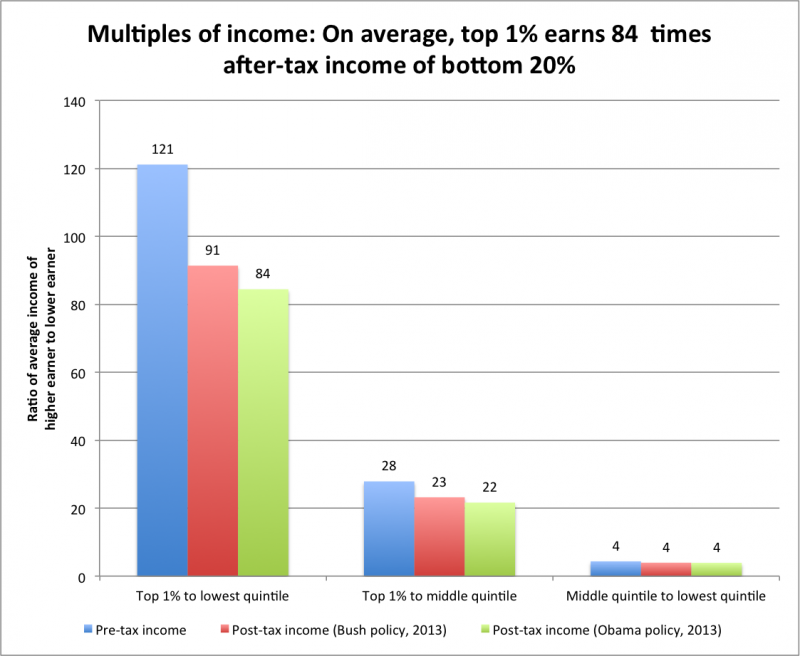
Zachary Goldfarb presents the findings of a Tax Policy Center analysis showing that by one measure, income inequality has declined appreciably in the Obama era:

Today, the average after-tax income of a member of the top 1 percent of earners is $1.12 million. The average after-tax income of someone in the bottom 20 percent is $13,300. That means the average person at the top takes home 84 times the income that the average person in the bottom takes home. Now, consider what it would be like if none of President Obama’s tax policy changes had happened: not the upper-income tax hikes negotiated at the beginning of last year, not the upper-income tax increases imposed by the Affordable Care Act, not the low-income tax credits enacted in the 2009 stimulus and later renewed.

In this alternative universe, the average member of the top 1 percent would take home $1.2 million, or 6.5 percent more in income, according to a new analysis. The average member of the bottom 20 percent would bring home $13,100, or 1.2 percent less in income. As a result, the average member of the 1 percent would take home 91 times what the average person in the bottom would bring home. If you’ve wondered whether Obama has made any headway at reducing income inequality, here’s evidence that he has.

For Jordan Weissmann, this finding illustrates the importance of measuring inequality both before and after taxes and transfers:

Between the tax changes and health reform, Council of Economic Advisers Chairman Jason Furman argues that the administration has undone “more than a decade” of growing inequality. And he has a point. Liberals prefer talking about pre-tax inequality in large part because it’s a raw reading of how egalitarian our economy is—it tells us how bad the income gap would be were it not for Washington’s intervention. But looking at post-tax-and-transfer inequality tells us how much more work needs to be done to even outcomes—and whether the government’s interventions are having an effect. Both sets of numbers tell us important stories. One says the rich are still pulling away from the rest of us. The other says that the administration has managed, ever so slightly, to pull them back.