Violence Triumphs Over Pluralism

That’s the essence of Shadi Hamid’s take on the aftermath of the Arab uprisings and the rise of armed Islamist groups throughout the Middle East:

The July 3, 2013 coup in Egypt has had a chilling effect beyond the country’s borders, strengthening one particular narrative among both regimes and their opposition: that the only currency worth caring about is force. With the relative decline (for now) of the Muslim Brotherhood and other mainstream Islamist groups that had made their peace with parliamentary politics, radicals and extremists have quickly moved to fill the vacuum. They do not counsel patience. They tell followers and fence-sitters that there is little need to wait 20, 30, or 80 years for the Islamic State, or something like it. The Islamic State can be realized now through brute, unyielding violence. Within the varied, often fractious world of political Islam, the radicals remain a minority, but their numbers belie an outsized influence.

We might not like to admit it, but violence can, and often does, “work” in today’s Middle East. This is not just a reference to the Islamic State of Iraq and Syria (ISIS), but also to less extreme militant groups that control territory throughout Syria, providing security and social services to local populations. From Libya to Palestine to parts of the Egyptian Sinai, armed—and increasingly hard-line—Islamist groups are making significant inroads.

William Dalrymple argues that the rise of ISIS and its persecution of Christians bode ill for secularism in the Arab world:

Certainly since the 19th century Christian Arabs have played a vital role in defining a secular Arab cultural identity. It is no coincidence that most of the founders of secular Arab nationalism were men like Michel Aflaq – the Greek Orthodox Christian from Damascus who, with other Syrian students freshly returned from the Sorbonne, founded the Ba’ath party in the 1940s – or Faris al-Khoury, Syria’s only Christian prime minister. Then there were intellectuals like the Palestinian George Antonius, who in 1938 wrote in The Arab Awakening of the crucial role Christians played in reviving Arab literature and the arts after their long slumber under Ottoman rule.

If the Islamic state proclaimed by Isis turns into a permanent, Christian-free zone, it could signal the demise not just of an important part of the Arab Christian realm but also of the secular Arab nationalism Christians helped create.

Relatedly, noting the unusually cold shoulder Hamas has gotten from some Arab states during the Gaza war, Juan Cole attributes this to the region’s recent political realignment around the struggle between states and Islamist non-state actors:

[Y]ou have a bloc of nationalist states– Egypt, Jordan, and Syria — facing off against movements of political Islam, and Hamas has to be counted among the latter. (Iraq, ruled by parties of Shiite political Islam, is trying to join the nationalists in the region in alliance against the “Islamic State”). It is therefore difficult for these states to intervene on behalf of Hamas, since they want the organization, and the whole tendency to political Islam, to drop dead. …

Even the so-called “Islamic State” turns out to be useless to Hamas. Its leadership says that it has to tackle the “hypocrites” among the Muslims before turning to “the Jews.” This is a reference to early Islam. When the Prophet Muhammad emigrated from Mecca to Medina, most people in the latter city came to embrace Islam, even if only pro forma. City notables who outwardly had become Muslims but inwardly resented and tried to undermine the Prophet, were termed “hypocrites” or “those in whose hearts there is a sickness”. The so-called Islamic State views all other Muslims this way. So the struggle between nationalism and political Islam has neutralized most of the Middle East if it hasn’t made them de facto allies of Israel.
The Able-Bodied Actor’s Handicap

Christopher Shinn, a playwright who underwent a below-the-knee amputation in his late 30s, discusses the limited depth that able-bodied performers bring to disabled characters and why actors with disabilities don’t get cast in these roles instead:

Able-bodied actors can listen to the disabled, can do research, can use imagination and empathy to create believable characters. But they can’t draw on their direct experience. That means that audiences will be able to “enjoy” them without really confronting disability’s deepest implications for human life. Often, one fears, that’s the point: Pop culture’s more interested in disability as a metaphor than in disability as something that happens to real people.

For example, in his review of Side ShowNew York Times theater critic Charles Isherwood wrote, “Of course, in some sense, we all know what it’s like to feel self-divided, or alienated from the world, which is what makes ‘Side Show’ emotionally stirring.” Disabled characters are often seen as symbolizing the triumph of the human spirit, or the freakishness we all feel inside. That may be another reason disabled actors are overlooked—they don’t allow disability-as-metaphor to flourish as easily.

I may not have been much bothered by any of this until my own disability asserted itself. But now I know that the physical pain and challenges that come in the wake of disability, alongside the insensitivity and lack of understanding one encounters, are profound experiences that cannot be truly known until they are endured. Perhaps the worst feeling is when people avert their eyes. Even someone gawking is better than their looking away.

(Video: Daniel Day-Lewis as Irish poet Christy Brown, who suffered from cerebral palsy, in the 1989 film My Left Foot. He won an Academy Award for his performance.)

The Islamic State In Iraq And Only Iraq

Jacob Siegel casts doubt on ISIS’s ability to extend the reach of its “caliphate” beyond Iraq, given that its Sunni rebel allies there don’t share its objective of world conquest:

There is a paradox to ISIS’s power. The caliphate has grown to rival al Qaeda for prestige in the global jihad movement but it becomes clearer with every day that, within Iraq, the Islamic State doesn’t extend very far outside of Mosul. As an attacking force, ISIS might be the most powerful army in Iraq, able to ambush the army in lightning assaults that have either scattered or slaughtered government and militia soldiers. But the skills and composition that have led to ISIS successes on the battlefield haven’t set them up to rule in any more than a handful of cities. They are too small to impose their authority over extended territory. For that they rely on their allies, using them until the day they are no longer needed, just as they, in turn, are being used.

ISIS’s victories and social media theatrics have won it a flock of Internet supporters and death-seeking recruits, but most of its potential followers in Iraq aren’t looking online to choose a cause, they take orders from tribal leaders or other local authorities.

Likewise, Yezid Sayigh contends that “in fact ISIS is following a well-worn path for taking power and consolidating it in the limited geographical space of a single nation-state where its true social base lies”:

To legitimize itself ideologically and acquire leverage over its partners and competitors, ISIS calls Muslims to jihad, labels western governments “crusaders,” and pledges to free Palestine. This again mimics Saddam, who appealed to pan-Arabism and the Gulf monarchies to support his war against revolutionary Islamist Iran in 1980, and in 1990 linked his invasion of Kuwait to the liberation of Palestine and evoked Islamic solidarity by having “Allahu Akbar” inscribed on the national flag.

But Saddam remained an Iraqi leader in the Iraqi setting, benefitting from the country’s oil wealth to cement his rule internally but remaining bound by its limitations, especially its deep social cleavages and weak national identity. ISIS is even more dependent than he was on its societal balances and alliances within the narrower domestic demographic base of the Arab Sunnis of Iraq, a vulnerability that is not seriously compensated by its partial extension into Syria.

Creepy Ad Watch

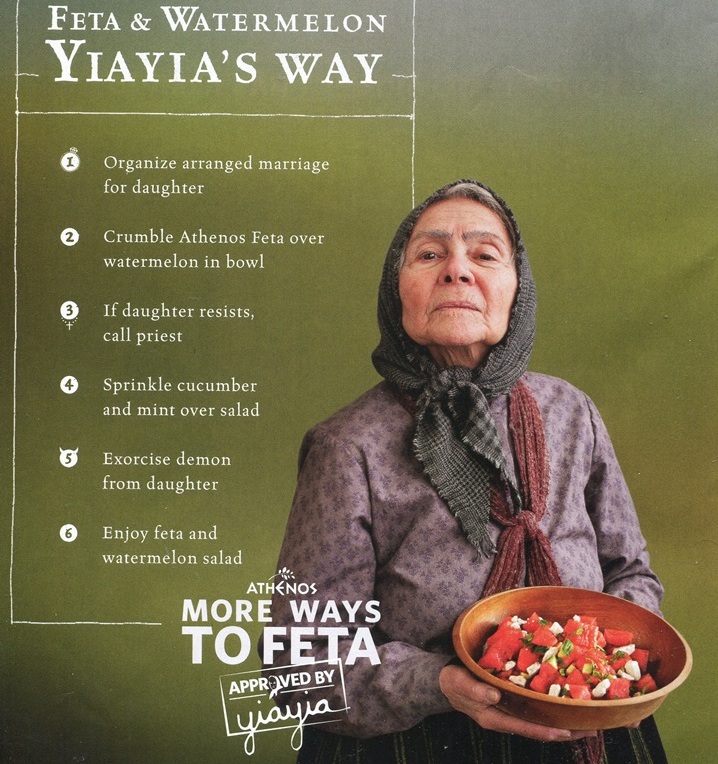
yiayiaad827

A reader flags it:

I received my August Bon Appetit magazine and as usual, eagerly sat down to read it as soon as it was delivered. I was dumbfounded when I came across this advertisement. To me, it seems like an overt case of ethnic stereotyping. I can understand the use of a traditional “yiayia” figure to advertise Greek food products, but to also have her include arranged marriage and exorcism on her to-do list seems outrageous. And oh yes, there are others ads in a similar vein – apparently in one, the yiayia calls her granddaughter a “prostitute.”

When I went to Athenos website and Facebook page, I am clearly not the only person who is offended by these ads. Athenos’ explanation (and boilerplate response to Facebook posts) is that they “didn’t intend to offend anyone” and were trying for a lighthearted approach, using a character “set in the old ways.” Apparently that means the traditional yiayia is a disapproving grump, putting her seal of approval only on the Athenos food items. As one of the Facebook commenters (with a Greek surname) said: “The only thing my yiayia would force anyone to do is eat a big plate of food.” I don’t know what is more offensive to me – the ad campaign, or Athenos’ dismissive “we didn’t mean to be offensive” responses.

Update from a reader:

I’m half-Greek (on my mother’s side) and HAD a Yiayia. Although my Yiayia was born in Greece, she emigrated when she was still a teenager and was Americanized enough in her thinking that she didn’t try to arrange marriages for her daughters, although HER marriage was, in fact, arranged by her family. Also, I have been to Greece and visited the very small village where my maternal grandfather grew up, and I can certainly envision contemporary Greek Yiayias who spent most of their lives living in that environment coming across pretty much like the Yiayia in the ad.

However, even if that were not true, I think the point of the ad is that “Feta and Watermelon Salad” would be something that a traditional Yiayia would approve of. Frankly, I think the ad is amusing, and as someone who loved his own Yiayia I can’t for the life of me understand what is so offensive about it.

One more thing, I am not at all sure that MY Yiayia would approve of Watermelon and Feta salad. It’s certainly not something that she ever served as far as I can remember. In fact, my sense is that she might actually be MORE LIKELY to disapprove of the Feta and Watermelon Salad than she would be to disapprove of arranged marriages.

Why Not A Two-Tiered Medical System? Ctd

A reader writes:

As a general proposition, I’m against the adoption of a two-tiered medical system. The best doctors will gravitate toward the concierge system, leaving the worst doctors to treat the masses. This is just another example of the widening split in this country between the haves and have-nots.

Another sighs:

It always makes my brain break when I read people who obviously don’t know much about the medical industry suggest things like “AMA guidelines” to deal with specialists who require cash payments. First, the AMA is not an oversight body. It’s a voluntary lobbying association representing solely the most conservative physicians, with a heavy focus on pure internal medicine – unspecialized physicians who only see adults.

The only regulatory body for medicine in the United States is the US government, and the only entities with any reliable power are Medicare and Medicaid, because they control the purse strings. (If you break their rules, you don’t get paid). The AMA has no authority, and these days a rapidly declining membership of cantankerous old men. By definition all AMA guidelines are vague, because nobody gives a hoot.

If you want good professional guidelines that are actually followed, look at the individual society for that field. In my case, as a pediatrician, it’s the American Academy of Pediatrics (AAP).

Finally, concierge practice is just the newest iteration of a very old form of practice, that of the “society” physician. Every city has its pediatrician and internists that the best people go to, with wait lists and other shenanigans. These doctors always went the extra mile, gave antibiotics when they weren’t indicated, and did all sorts of medically dubious things to keep their entitled patient population happy (and they still do). The concierge version of this just reflects the newer iteration, where doctors are not as attached to their titular independence, and are getting paid more to sacrifice their time and common sense.

Best Cover Song Ever?

This song nominee might win just based on the number of readers who submitted it so far – 84:

I’m writing in to nominate my favorite cover of an already well-known song. I’m sure I’m not the only person to submit this one, but it’s got to be the Jimi Hendrix cover of Bob Dylan’s “All Along the Watchtower:

Dylan’s poetry is at its best in the song’s lyrics, and it works musically, but you can’t ever go back and listen to the original once you’ve heard Hendrix’s. I don’t think I’ve ever heard a series of guitar solo so perfectly illustrate the drama and stormy environment of a song’s narrative. There are plenty of songs with instrumental sections that manage to paint an even more vivid picture than its lyrics, but this one just blows them all out of the water.

This is a really fun idea for a contest, by the way! Keep up the awesome work!

Another writes, “Hendrix’s version so great that I think people forget it’s actually a cover.” Another adds:

The Jimi Hendrix Experience’s cover of “All Along the Watchtower” is a classic (and easy) choice, but c’mon, even Dylan was impressed by this version. Per Wikipedia, Dylan described his reaction in an interview:

It overwhelmed me, really. He had such talent, he could find things inside a song and vigorously develop them. He found things that other people wouldn’t think of finding in there. He probably improved upon it by the spaces he was using. I took license with the song from his version, actually, and continue to do it to this day.

Live version here. Another points to the “story behind the song“. One more:

And on the subject of Hendrix/Dylan covers, Jimi’s version of Like a Rolling Stone isn’t half bad either. He did a few others, too. But nothing comes close to “All Along the Watchtower”. Play it loud.

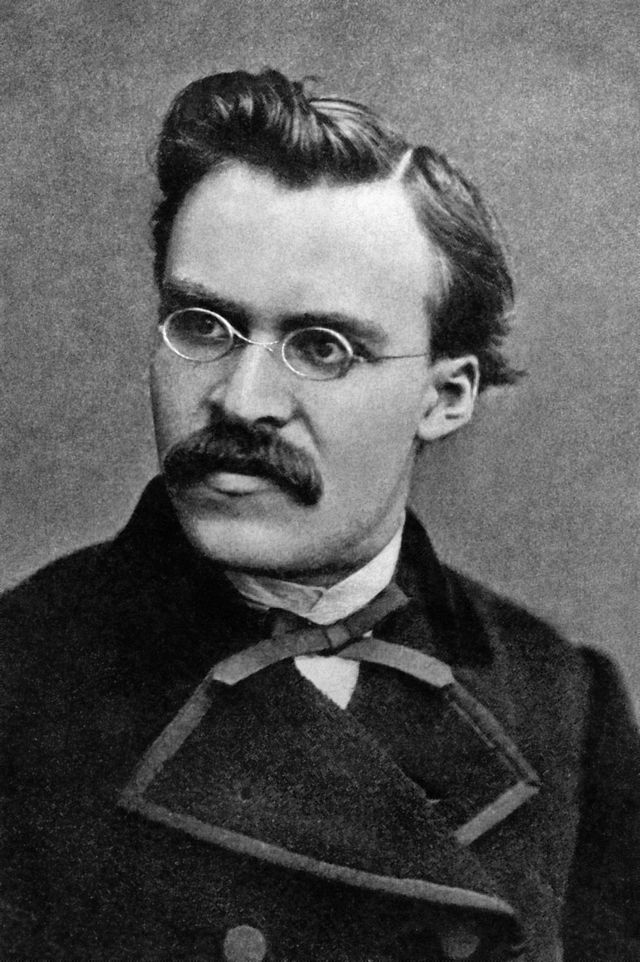
Nostalgic For Nietzsche, Ctd

Michael Robbins, whose review essay on the intellectual shallowness of the New Atheists sparked a number of reader dissents, writes in responding to his would-be critics:

It’s a good idea to at least try to get an argument straight before you attack it, but I’ve found that the people most likely to leave a comment or shoot off a huffy email are the least likely to do so. This is unsurprising – thoughtful people take time to consider different views and to consider how they challenge what they think. The huffy responders already know it all – they’ve got their preconceptions and assumptions armed for bear. For example, one of your readers writes:

If Michael Robbins wants us to worry that the decline of organized religion implies some loss of certainty about the foundations of our ethics, we will need some data showing that religiosity correlates with ethical behavior.

Well, I guess it’s a good thing I don’t want anyone to worry about that. I didn’t say a word about “organized religion.” I specifically denied that I was arguing that a coherent moralityNietzsche187c requires theism. And does this reader really suppose that Nietzsche believed that religiosity correlates with ethical behavior – or, I should say, does he not understand Nietzsche’s argument in On the Genealogy of Morality about what “ethical behavior” really is and where it comes from?

The point is simply that a morality predicated on Enlightenment rationalism retains its Christian foundations, at the expense of coherence. Therefore the moral codes we retain after the death of God are grounded in nothing, a point the Neo-Darwinians underscore every time they trumpet that article of faith, the “morality gene.” It is not enough to argue that we can simply ground our morals in ourselves, in our conceptions of the good (for one thing, it is self-evident that we don’t agree about what these conceptions should consist in).

That religious people of the past were often quite as murderous and duplicitous as we is beside the point, properly understood. We are talking about the loss of a coherent worldview, about grounds, not about practices. Anyone interested in the history of the shaping power of mental conceptions should understand why such a loss is a problem.

Alasdair MacIntyre’s After Virtue is still the best book to address this.

MacIntyre shows that Kant, Hume, Smith, and Diderot failed to provide justifications for their moral philosophy, because of their historical backgrounds, grounded in Christian morality. Morals unfold in time – their social and historical contexts matter. You can give a Rortyan shrug and say that it doesn’t make any difference whether we retain Christian conceptions of the good without Christian metaphysics – that we can simply consider them abstracted from their contexts -but you’re left in the shaky position of defending a concept of virtue without a first principle to prop it up. There is a real question of why anyone should agree with you.

Again, this has nothing to do with arguing for the retrievement of Christian metaphysics. MacIntyre himself, though a Catholic, calls for a revival of Aristotelian moral philosophy. These are the sorts of confusions that could be avoided by doing what I suggested – reading.

Which brings me to the readers who write in to inform me of the most obvious fact in the world, that some religious people believe crazy shit. (Although I have to laugh at the trend of quoting the extraordinarily metaphor-rich Jonathan Edwards to prove this.) One of your readers comments:

When Robbins writes: “Of course the dead in Christ don’t intervene with God to help you find your car keys, and of course the Bible is inconsistent and muddled (no matter what the Southern Baptists claim to believe), and of course I find it extremely unlikely that Mohammed flew to heaven on a winged horse”, that’s when he gets to criticize atheist focus.

I guess I get to criticize atheist focus, then, since I’ve explicitly written that such beliefs are superstitious nonsense, often, in Slate, the Chicago Tribune, and Commonweal. (The same reader has failed to note that “austere abdication of metaphysical premises” is a quote from David Bentley Hart in which he is praising science for its abdication.) I had assumed it was obvious that Origen and Augustine would hardly have taken the trouble to deny literalist readings of the Bible if such readings did not exist. And some of the more idiotic beliefs held by American Christians (such as young-earth creationism), are, of course, based on no readings of the Bible at all.

But as I have written elsewhere, religious fundamentalism is a soft target. You’ve figured out that Mohammed did not fly to heaven on a winged horse and that Rama’s bridge was not built by monkeys and that Noah did not build a giant ark to survive a heaven-sent deluge? Good for you.

But the New Atheists did not write books that simply attacked creationism. They wrote books that purport to challenge theistic belief as such. They therefore have a responsibility to address the best cases for God, not the dullest. When Dennett asks if super-God created God, and if super-duper-God created super-God, he is simply revealing a lack of acquaintance with the intellectual traditions of the major religions. If you want to argue against something, you have to understand what you’re arguing against. That’s axiomatic.

One of your commenters kindly informs me that Nietzsche was anti-democratic. Somehow I had already managed to pick that up even before I earned my PhD from the University of Chicago. This same reader believes that I want to claim for Christianity a monopoly on morality. Again, there are the words that I actually wrote, and the words that some people decided, on the basis of no evidence, I really meant.

What “American Christians” believe is diverse. Do most Catholics really reject “human rights, social justice, and egalitarianism”? Do most Episcopalians? Has this person met many American Christians? Has he or she decided that groups such as Sojourners are simply lying about their values?

Yes, many people believe things that are plainly untrue. Some atheists believe that their faith in scientific naturalism suffices to disprove the existence of God, for instance. Some Christians are mistaken about the age of the earth. Some religious believers don’t understand their own traditions. Some believers are better at explaining particle physics than some atheists.

So what? None of this has any bearing on what I wrote. But again, it’s no surprise that some folks decided to invent a caricature of my argument out of thin air. As Epictetus said, “If you say to somebody … ‘your opinions are ill-considered and mistaken,’ he immediately walks out, exclaiming, ‘You’ve insulted me!'”

Putin Isn’t Backing Down

Janine Davidson is distressed:

[T]he lack of de-escalation and the media war being conducted by Putin are both alarming signals to the international community that this tragedy has not fractured the resolve of the pro-Russian separatists, nor those in the shadows supporting them.  Since the downing of MH-17, pro-Russian separatists have used surface-to-air missiles to bring down two more Ukrainian military jets; for now, there seems no interest in dialing down hostilities.

Eugene Rumer advocates talking to Putin:

It is impossible to rewind this tape, but even at this late point in the crisis there is no substitute for talks and compromise. A military solution is out of the question. Putin has made it clear that he does not want to send his army into Ukraine. He has also made it clear that he can and fully intends to keep Kyiv from winning the war in Eastern Ukraine by sending more fighters and more weapons there. At this point freezing the conflict in place and then looking for a way out of it appears as the only possible option. But that requires talking by all parties to all parties without preconditions. Piling on sanctions and arming Ukraine will only prolong this crisis.

Heidi Hardt downplays the value of direct negotiations between Russia and NATO:

The least costly but least effective route would be for NATO to reopen formal communications with Russia. As of May 1, NATO officially suspended all cooperation with Russia, including cooperation on terrorism, proliferation and other areas related to peace and security. As James Goldgeier writes, Russian President Vladimir Putin ultimately ‘wants instability, not stability, in Ukraine,’ suggesting that pressure for a negotiated solution may have some value. Putin, however, has shown resilience to both diplomacy and targeted sanctions in past crises, such as the 2008 Georgia conflict. This suggests that a return to dialogue or even offering Russia the benefit of reengaging in civilian cooperation would have limited value for convincing the government to stop arming and supporting the separatists.

Masha Gessen posits that Putin “has not lost his resolve to take eastern Ukraine, nor has it been affirmed—Ukraine has very little to do with this story at all”:

It’s not Ukraine that Putin has been waging war against: It’s the West. And if you analyze the Russian president’s statements and actions in the past week through the prism of Putin’s great anti-Western campaign, you will find very few contradictions in them—and even less reason to hope for peace.

Over the course of two and a half years, since starting his third term as Russian president against the backdrop of mass protests, Putin has come to both embody and rely on a new, aggressively anti-Western ideology. It began with simple queer-baiting of protesters, which included accusing them of being agents of the U.S. State Department, and quickly transformed into an all-encompassing view of Russia and the world that proved shockingly powerful in uniting and mobilizing Russia. The enemy against which the country has united is the West and its contemporary values, which are seen as threatening Russia and its traditional values. It is a war of civilizations, in which Ukraine simply happened to be the site of the first all-out battle. In this picture, Russia is fighting Western expansionism in Ukraine, protecting not just itself and local Russian speakers but the world from the spread of what they call “homosfascism,” by which they mean an insistence on the universality of human rights.

Dissents Of The Day, Ctd

A reader scratches her head:

Wait, what? Am I missing something? You wrote:

What I’m saying is that it is not self-evident that an abortion has the same moral weight as a root canal. They may be equally legal, but they are not self-evidently equally moral. It is reasonable to treat it differently as a medical procedure for those reasons alone.

As others have repeatedly pointed out to you, no one advancing “admitting privilege” laws claims they’re doing so because of the “moral weight” of abortion. They say it’s about health and safety. Why is it wrong to take action to expose the falseness of this position? If it’s valid to “treat [abortion] differently as a medical procedure” because of its moral weight, then the advocates of these laws should stand on that terra firma.

It’s clearly a way to provide some sort of speed bump before human life is taken. Yes, you can argue that it’s disingenuous in its aims. And I take that point. But the proposed remedy is also a little disingenuous – dentists are not going to be forced to recite the same precautions that an abortionist does. The proposal is primarily a rhetorical point to argue that these delaying procedures for abortions should be removed entirely. What I objected to – and all this sturm and drang comes from two sentences – was the assumption that abortion should never be treated as different from other medical procedures.  And although I can full sympathize with my readers’ frustration and anger, I find the easy and glib equation of abortion with a visit to the dentist – which is the rhetorical force of Marcotte’s argument – the kind of absolutist position I’d rather avoid. And look: we didn’t have to air the idea at all. But we did so fully, with a caveat from me so that readers would not infer that I have no moral qualms about abortion, when I very much do. Another reader nods:

How does one read this: “Want to force abortion clinics to meet ambulatory surgical center standards and abortion providers to have hospital admitting privileges? Well, dentists will have to meet the same standards before they can drill a tooth,” and come up with a comment like yours without deliberate obtuseness? What does making abortion providers having to meet higher medical requirements have to do with a moral issue regarding abortion?

Then you go on to defend your comment with this:

“I was objecting to the breezy dismissal of any moral conundrum at all.” Which would be a reasonable thing to object to except that there was no such breezy dismissal. Rather, it was a discussion about specific laws that force people to present factually incorrect information and requiring doctors to meet higher medical standards if they are performing abortions than other doctors providing equally complex medical procedures.

But the point is not the complexity of the procedures, but their very nature. Abortions end human life. If a dentist ended a human life, he’d be disbarred. Another argues:

It is one thing to argue morally that abortion is murder and fight the case that therefore Roe (and Casey) should be overturned. It is another to publicly claim a different rationale and use that rationale to make abortion impossible because you cannot make it illegal.

Who is making abortion impossible? And it is not necessary to believe that abortion is “murder” to believe it is the taking of human life. Meanwhile, another considers the response to the reader who shared her story of ending a pregnancy:

Sometimes I wonder if you read the reader’s comment before you respond when you talk about abortion. You have comfortably settled into your “I think abortions before 20 weeks should be safe, legal, and rare.” But then, you defend yourself against readers who point out what that means in real lives and say, “But taking my HIV meds does not end human life, something that abortion as a medical procedure almost uniquely does.” Your reader’s entire story was about a specific situation, with a pregnancy which could not come to term (or would not last long if it did), and the entire informed consent script did not apply to her situation. As I read that, you value a dying fetus more than a grown woman, her health and her family.

Sigh. The Dish has long addressed the agonizing and highly sympathetic situations of women facing late-term abortions, namely the long-running “It’s So Personal” series. But, look, in a spirited debate, I understand I can sometimes come off as dismissive of the genuine concerns of my readers, and I was too curt in my response to my reader’s anguished email. I apologize for that. I do not apologize for my belief that that there is a genuine moral issue with abortion – the fate of human life – that a fair argument would acknowledge rather than dismiss as self-evidently untrue.

The Next Places To Legalize

OR Tax Revenue

The Beaver State is likely to be among them:

New Approach Oregon’s petition to make marijuana legal for adults has qualified for the ballot this coming November, Huffington Post reports. More than 87,000 valid signatures were collected for the petition, which allows adults age 21 and older in Oregon to possess up to eight ounces of marijuana privately and one ounce in public and would have the marijuana market regulated by the Oregon Liquor Control Commission. Any sales taxes collected would be distributed to schools, law enforcement, and drug prevention programs.

It is very likely that this initiative will pass in November, with a recent poll stating that 57% of Oregon’s likely voters support recreational marijuana use.

Jon Walker passes along the above graphic, which estimates the amount of tax revenue Oregon could collect:

new report by ECONorthwest for the New Approach Oregon campaign estimates that the marijuana excise tax contained in their initiative would generate $38.5 million during the first fiscal year of tax receipts. That money would come only from the newly legalized adult-use market. They assume most people using the current medical marijuana system will stay with it, which seems likely based on what has happened in Colorado so far. The initiative doesn’t tax medical marijuana.

German Lopez lists off other upcoming marijuana ballot initiatives. One close to home:

DC’s Initiative 71 would allow adults 21 and older to possess up to two ounces of marijuana, grow up to six plants, and gift marijuana to other adults 21 and older. It would not legalize sales, because voter initiatives in DC can’t deal with that issue.

The initiative is not yet confirmed to be on the ballot, although the campaign turned in more than double the number of petition signatures required to get approval. If it makes it on the ballot, it has a good chance of victory: a Washington Post poll found marijuana legalization is favored by DC residents almost two-to-one.

 Know dope. And heads up, hippies: