The Challenge Of Reform Conservatism, Ctd

Last week, in response to me, Douthat kicked off a conversation about reform conservatives’ foreign policy views. Ross, for his part, advocates for a “kind of unifying center for conservatives weary of current binaries (Tea Party versus RINOs in the domestic sphere, ‘isolationists’ versus ‘neocons’ in foreign policy), which would internalize lessons from the Bush and Obama eras (especially lessons about the limits of military interventions and nation-building efforts) without abandoning broad Pax Americana goals“:

I liked Ben Domenech’s way of framing this point, when he wrote [last week] in the Transom that the Republican Party “has always burke.jpgincluded realists and idealists, and there was in the past a degree of trust that elected leaders could sound more like idealists but govern more like realists.” It’s that trust that was forfeited by some of the Bush administration’s follies, and that needs to be recovered if the G.O.P. is to deserve anybody’s vote. But because it’s a trust, ultimately, in competence and caution, it’s a bit hard to say exactly what this kind of “new realism” or “realist internationalism” or “chastened idealism” (or whatever phrase you prefer) would look like case by case … beyond, I suppose, saying “let Robert Gates drink from the fountain of youth, and put him in charge of Republican foreign policy forever,” which is certainly an idea, but probably not a sufficient foundation for an actual agenda.

Justin Logan argues that a “big part of the problem here is the conservative donor class”:

To put it bluntly, the portion of the GOP donor class that cares about foreign policy is wedded to a militaristic foreign policy, particularly in but not limited to the Middle East. Tens of millions of dollars every year are pumped into an alphabet soup of magazines, think tanks, fellowships, lobby groups and other outfits in Washington to ensure that conservative foreign policy stays unreformed.

If we conceive of the Right broadly, comparatively dovish voices on the Right consist of Rand Paul, those writing at the American Conservative, and the foreign and defense policy staff at the Cato Institute, the latter of which Wall Street Journal editorial page editor Paul Gigot once derisively but not entirely inaccurately referred to as “four or five people in a phone booth.” (We have actual offices, for the record.) But until there is some larger countervailing force in the conservative movement, the well-financed and well-entrenched status quo will persist.

Suderman engages in the conversation:

Too much of our foreign policy conversation, on both sides of the aisle, is conducted with a kind of chest-thumping certainty about what we can know, what we should do, and what the results will be if we follow through. That attitude is perhaps understandable, given the context of war and international power, but it’s also frequently frustrating and unhelpful, especially given how difficult it can be to establish even the most basic facts on the ground when it comes to the particulars of many foreign policy conflicts and disputes.

A foreign policy of caution and humility, of uncertainty and wariness, might help help turn down the heat on foreign policy debates, by focusing on the limitations of America’s power and—even more—its ability to determine foreign policy outcomes, and by talking as much about what we don’t know as what we do.

Larison sees foreign policy as the GOP’s greatest weakness:

Bush-era foreign policy has been politically toxic for Republicans in three of the last four national elections. There is good reason to assume that it will continue to be an important liability in future presidential elections unless the party makes a clear break with at least some of its Bush-era assumptions and positions, and for the most part that isn’t happening at all. Until that happens, everyone outside the party will reasonably assume that the GOP hasn’t changed, that it has learned nothing, and that it still shouldn’t be trusted with the responsibility to conduct foreign policy. It seems unlikely that a domestic reform agenda will even get off the ground as long as the public doesn’t trust a Republican president to carry out some of his most important primary responsibilities.

But Drum remains skeptical that the GOP’s foreign policy split is real:

I’ve seen no evidence of change within the mainstream of the party. Aside from Paul, who are the non-interventionists? Where exactly is the fight? I don’t mean to suggest that everyone in the Republican Party is a full-blown unreconstructed neocon. There’s a continuum of opinion, just as there’s always been. But as near as I can tell they’re nearly all about as generally hawkish as they’ve ever been—and just as eager as ever to tar Democrats as a gang of feckless appeasers and UN lovers.

Kilgore is less dismissive of the GOP “civil war”:

I’m less interested in Paul’s own views than in the possibility that he will make it possible for other 2016 presidential candidates to break away from the old neocon and realist schools that share a commitment to higher defense spending and U.S. global hegemony. Already Ted Cruz has declared himself “half-way” between Paul and John McCain on foreign policy. And such potential candidates as Scott Walker, Bobby Jindal and even Mike Huckabee have the flexibility to position themselves at any number of points on the spectrum.

My concern is that their rubric for understanding Obama’s foreign policy is that he is weak, doesn’t call enough foreign leaders thugs and is too deliberative. It’s hard to see a response to that that doesn’t privilege the unreconstructed neocons and Cheneyites. Or, worse, the idiotic ramblings of Rubio.

The Last Great English Romantic

Reviewing Oakeshott’s recently published Notebooks, John Gray sketches a charming portrait of the idiosyncratic philosopher:

When I knew him towards the end of his life, the impression he made was of a Twenties oakeshottoutsidecaius.jpgfigure, whose values and attitudes – notably an uncompromising commitment to personal authenticity – echoed those of D H Lawrence, so I was interested to find a number of references to Lawrence in the notebooks. O’Sullivan comments that Oakeshott ‘was really the last great representative not only of British Idealism but also of English Romanticism’. It is a shrewd observation. Where he differed from Lawrence was in not expecting, or wanting, any wide acceptance of his view of things. Here Oakeshott’s aestheticism may have been important: if he praised and defended conventional morality, one reason could have been that he enjoyed contemplating a world composed of people unlike himself.

It is difficult, if not impossible, to imagine a figure like Oakeshott in academic life at the present time. For one thing, he had a wider experience of the world than most academics nowadays.

Joining the army on the fall of France and being rejected for SOE because he looked too unmistakably English to be parachuted into Germany, he ended up serving in Phantom, a reconnaissance unit that, among other tasks, supplied information to the SAS. For a time his work involved using pigeons, whose behaviour he studied assiduously: when the birds were released, he once told me with a smile, many of them ‘just flew off and got lost’. Finding comedy, even an element of absurdity, in the most earnest business, it was a remark characteristic of the man.

He would have found the industrial-style intellectual labour that has entrenched itself in much of academic life over the past twenty-odd years impossible to take seriously. He wrote for himself and anyone else who might be interested; it is unlikely that anyone working in a university today could find the freedom or leisure that are needed to produce a volume such as this. Writing in 1967, Oakeshott laments, ‘I have wasted a lot of time living.’ Perhaps so, but as this absorbing selection demonstrates, he still managed to fit in a great deal of thinking.

Previous Dish on Oakeshott’s notebooks here and here.

Book Club: A Guide To Living

The stroke of genius in Sarah Bakewell’s book about Montaigne is that she framed his biography as a guide to life. You could justify this as a way to appeal to a distracted 21st Century audience otherwise highly unlikely to read about a sixteenth century French essayist, but she makes that entirely unnecessary. What she shows is why Nietzsche had such a fondness for the diminutive and inquisitive skeptic: everything he wrote was really about his own life, and how best to live it, and he does it all with such brio and detail and humanity that you cannot help but be encouraged to follow his lead. He proves nothing that he doesn’t simultaneously subvert a little; he makes no over-arching argument montaigne.jpgabout the way humans must live; he has no logician’s architecture or religious doctrine. He slips past all those familiar means of telling other people what’s good for them, and simply explains what has worked for him and others and leaves the reader empowered to forge her own future – or, rather (for this is Montaigne), her own present.

It’s a philosophy rooted in the most familiar form of empiricism. It is resolutely down to earth. You can see its eccentric power by considering the alternative ways of doing what Montaigne was doing. Think of contemporary self-help books – and all the fake certainty and rigid formulae they contain. Or think of a hideous idea like “the purpose-driven life” in which everything must be forced into the box of divine guidance in order to really live at all. Think of the stringency of Christian disciplines – say, the spiritual exercises of Ignatius of Loyola – and marvel at how Montaigne offers an entirely different and less compelling way to live. Think of the rigidity of Muslim practice and notice how much lee-way Montaigne gives to sin. This is a non-philosophical philosophy. It is a theory of practical life as told through one man’s random and yet not-so-random reflections on his time on earth. And it is shot through with doubt. Even the maxims that Montaigne embraces for living are edged with those critical elements of Montaigne’s thought that say “as far as I know” or “it seems to me” or “maybe I’m wrong”. And of course it begs the question that Pascal posed: how can skepticism not be skeptical about itself? Is it, in fact, a self-refuting way of being?

Logically, of course it refutes itself. And you can easily torment yourself with that fact. When I first tried to grapple with philosophy, the need to force every text I read into the rubric of “is this the truth about the world?” dominated everything. And in retrospect, there’s nothing wrong with that. If you do not have a desire to figure out the truth about the whole, you’ll never start the philosophical project at all. And you can find in philosophy any number of clues about how to live; you can even construct them into an ideology that explains all of human life and society – like Marxism or free market fundamentalism or a Nietzschean will to power. But as each totalist system broke down upon how-to-live-sdmy further inspection, I found myself returning to Montaigne and the tradition of skepticism he represents (and that reached one of its modern high points in the thought of Michael Oakeshott). Maybe we need to start with what little we actually do know – through experience, narrative, anecdote and conversation.

And here’s what we do know. We are fallible beings; we have nothing but provisional knowledge; and we will die. And this is enough. This does not mean we should give up inquiring or seeking to understand. Skepticism is not nihilism. It doesn’t posit that there is no truth; it merely notes that if truth exists, it is inherently beyond our ultimate grasp. And accepting those limits is the first step toward sanity, toward getting on with life. This is what I mean by conservatism. You can see why it has scarcely any resemblance to the fanatics, ideologues and reactionaries who call themselves “conservative” in America today.

But what Bakewell helped me see better is that Montaigne’s Stoic disposition really was influenced by a couple of epiphanies. The first was the loss of his dear friend, Etienne de la Boétie. The second was his own near-death experience in a riding accident. What he’s grappling with in both cases is loss. And what he seeks to do with his friendship is to understand what he lost more completely, which makes his essay “On Friendship” the greatest treatment of that theme ever penned. But his near-death experience – which he subsequently wrote down with eerily modern skills of careful observation – could be seen as the window onto his entire body of work. He works back from this reality – our inescapable finitude – to construct a deeper and more humane understanding of what life is for. By seeing the limits, he seems to say, we actually live more vividly and well and can die at peace with the world.

If I were to single out one theme of Montaigne’s work that has stuck with me, it would be this staringbookclub-beagle-tr-2 of death in the face, early and often, and never flinching. It is what our culture refuses to do much of the time, thereby disempowering us in the face of our human challenges. I was lucky in some ways – and obviously highly unlucky in others – that I experienced something like this early in my life as well: the prospect of my own imminent death and the loss of one of my closest friends and soulmates to AIDS. There was Scripture to salve it all; there was friendship to shoulder it all; there was hope to sustain it all. But in the end, I found myself returning to Montaigne’s solid sanity, his puzzlement and joy at life’s burdens and pleasures, his self-obsession that never somehow managed to become narcissism.

Is this enough? Or is it rather a capitulation to relativism, a manifesto for political quietism, a worldview that treats injustice as something to be abhorred but not constantly fought against? This might be seen as the core progressive objection to the way of Montaigne. Or is his sensibility in an age of religious terror and violence and fanaticism the only ultimate solution we have?

Email your thoughts to bookclub@andrewsullivan.com. You can still buy the book here and join the conversation (or use the public library here). Update from our first participant:

As Sarah Bakewell points out in her wonderful book, people don’t just “read” Montaigne; they “meet” him. He’s not a classic author to tick off a personal must-read list but more like a good friend. Though I’ve never laid eyes on a word of his Essays, he has been my companion, my guru, my pal, my virtual best friend. My Michel has the friendly, bracing, comforting voice of an actor named Christopher Lane on my 49 hour, 39 minute audio book. For two months last year, Montaigne was alive, talking quietly to me, confiding in me his thoughts as I walked, drove, did household chores, rode the bus, and saw all my own fears and thoughts and immediate surroundings through his eyes.

I spend a great deal of time walking through Chicago with my son Walker, who has autism.

He’s now 28, a lively, happy, intelligent guy hobbled by a near inability to converse. I talk to him in frequent speeches about everything around us, but I also listen to audiobooks. The one rule in choosing them is that they must be funny or positive or somehow life-affirming. I don’t need any more angst, thank you, walking mile after mile as I fight anxiety about my son’s future life without me and his mother. P.G. Wodehouse’s Jeeves and Wooster books are my great standbys. I walk along laughing while Walker smiles his big appreciative grin.

But Montaigne is special. He calmly reminds me that nothing I fear or think is new. Just as he found all his wisdom in ancient authors, I find mine in him. This 16th-century French aristocrat sitting alone in his tower as the wars of religion swirled around him speaks to me with great immediacy. Never mind that it’s 2014 and I’m walking along Rush Street in Chicago or in the sand on Oak Street Beach in 2014. He’s as personal as say, Andrew Sullivan talking about God and war and life’s meaning.

One of the big challenges for us parents of autistic children is isolation. We often feel out of touch with friends, with the buzz of life. Most people have learned to not even ask my wife and me out to dinner – they know we’re, I have to say it, “trapped.” But Montaigne brings companionship right into my ears in a very personal way, as though he were walking alongside Walker and me, sitting in the car with us, smiling at Starbucks baristas with us.

Thanks to Sarah Bakewell and her lively book. She reminds all of us that Montaigne lives.

The View From Your Window Contest: Winner #214

VFYWC-214

Sherlock Holmes writes:

I’m gonna go with … America.

Another gets more specific:

Outskirts or small old town enveloped by Pittsburgh.

Another questions our motives:

Okay, you know you set me up. Sports Authority and Home Depot in the same center … should be easy, right? After screening out obvious “not possible” states: Utah, Oklahoma, Texas, Arizona, etc, I concentrated on all the others and did a Google Street view of each Sports Authority (they have fewer stores) and could not find one single match. I’m betting that was a red herring because you would never make it that easy …

Another also ended up empty-handed:

I thought I had a chance this week. Not to win, but at least, maybe, to get a location right and build up my credentials. I knew everyone would froth at the bit this week. So many clues! I started with the Sports Authority website and either cross referenced the location with Home Depot, or later, just started looking up the Sports Authority addresses on Google Maps. Do you know how often they are practically right next to each other like in your photo? Too many. Of course, none of those were the contest site. And FYI, other places that Sports Authority likes to cozy up next to are Best Buy and Target.

In the end, I failed. I couldn’t find it. Not even with all those clues. I must have missed one. The right one. But I bet you get a lot of right answers this week. Just not mine.

Another yawns:

The Home Depot, Sports Authority, Exxon? Really? Seldom have I been less inspired to make even my standard random guess.

But this one gets pretty close:

I was convinced this was in eastern Canada – an Esso gas station, deciduous trees, a one-way sign (so not Quebec). But a few searches convinced me Home Depots in Canada are built in sprawling power centres with no trees anywhere. And maybe that is an Exxon sign. I’m pretty sure it’s somewhere in the New England, an industrial-ish town, near a canal, in a place long-enough established to have an old stone church. Massachusetts.

It’s a beautiful day here in Montreal. I’m going for a walk.

Another nails the right city:

VFYWC-214-myguess

I was overwhelmed at first to find that there were 2,256 Home Depots in the United States, but relieved when Google revealed that there were only 450 Sports Authorities. Wheh. (Better than starting with the Exxon station on the corner – of which there are over 10,000 in the US – though I couldn’t find an official number for Exxon retail stores. It’s supposedly a practice ExxonMobil is abandoning in favor of supplying third-party owned/operated stations.)

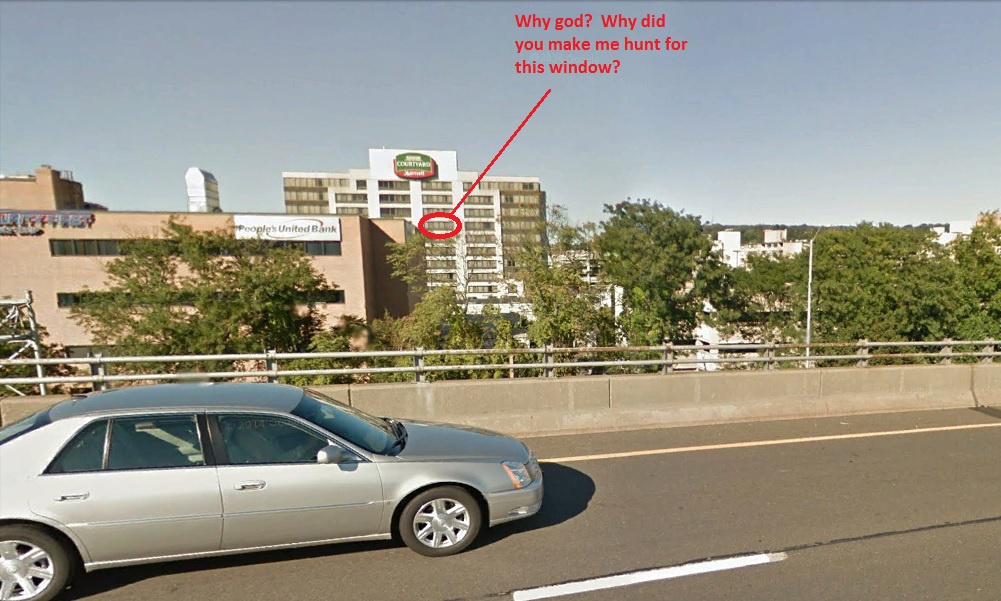
Fortunately this looked like the Northeast U.S. and that narrowed it down pretty quick. A Google Maps search finally revealed this view to be in Waterbury, CT – specifically the Courtyard Waterbury Downtown – Marriott located off I-84.

Another shares the details of his search:

This looked like a scene from the northeastern United States, so I checked out Sports Authority stores in Pennsylvania, New Hampshire, New York, then Virginia and North Carolina.  Somehow, I skipped Connecticut and I then went through a tour of Sports Authority stores in virtually all the states, including California, Texas, and far-flung Alaska and Hawaii.  When I finally decided to check Connecticut, my mind was in such a blur that I failed to properly recognize the location when it showed up.

What about the tower in the distance? I searched for “water towers” – that didn’t help.  The Waterbury Generationnext day, I decided to stick to the Northeast, and search for built-up cities with hilly profiles, which finally brought me to Waterbury, CT. I checked for Home Depot and it looked exactly like the one in the photo, with the Garden Center on the right and across the parking lot was the Sports Authority.  When I noticed that there was even an Exxon nearby, I started to believe that I was in the right place.

The funky tower turned out to be part of a power plant: Waterbury Generation.

It was then easy enough to locate the location from which the photo was taken – Courtyard Waterbury Downtown Marriott – I believe it’s the 6th floor in the window indicated in the image (note: the bottom floor is hidden in the image).

 Another recognized the terrain:

I got this one on a gut feeling. I grew up in Connecticut, and the general vibe instantly said New England. I am also a child of the big box era and remember when people looked in awe at Home Depot, Sport’s Authority and the like; these are clearly aged. As a teenager, I also drove around the state constantly assisting my father, who through much of that time was a self-employed commercial real estate appraiser. The topography, highways, and industrial and cultural markers of the city suggested something like Waterbury. The Sports Authority gable, it turns out, is relatively distinct for its kind. With Google street view I almost was able to go into the back parking lot of the bank.

Another adds:

The landscape and the depressing green paint on the highway bridges instantly spoke to this Connecticut native and I knew that we were looking at the perpetually depressed Naugatuck River valley.

A few readers could barely make out a Connecticut license plate as well.

Below is this week’s OpenHeatMap of everyone’s guesses (zoom in by double-clicking an area of interest, or drag your cursor up and down the slide):

This embed is invalid

Most players had a love/hate relationship with this week’s view:

For goodness’ sake, do you have any idea how many Sports Authority shops are located near Home Depots in the United States?  I didn’t until now.  I think it probably says something about the homogenization of American commerce to find so many big-box retailers in proximity to each other in so many places.

My method for this contest, after identifying the aforementioned superstores in the photo, was to use their own website store locators to narrow the list of states where they do business.  It turns out that Sports Authority does business in 45 states, so I only eliminated 10% of states.  The terrain is green and hilly, though, so that ruled out most of the dry western and flat plains states, and based on the architecture, I decided to focus on the northeastern United States.  I worked through New Jersey, Pennsylvania, New Hampshire and Massachusetts before I found Waterbury, Connecticut.  This view was taken from the Courtyard Waterbury Downtown at 63 Grand Street, looking south across Interstate 84 (Yankee Expressway) toward the shopping center.

Another:

VFYW-Waterbury Conn.

Do you know how many of the 420 US Sports Authority stores share a common street with a Home Depot? I never did. Do now. 80. Fortunately this one was in Connecticut, not Wyoming. I might still be working at it.

 Another

I’ve spent almost 2 hours looking at The Sports Authority’s website looking for the right building. (By the way, the photo of Bemidji, Minnesota’s store is taken in the snow, which amuses me.) I’m sure the webmaster is shocked by the increase in web traffic today on their locations site as I’m probably not the only one doing this.

Another player brought in the geeks:

We did this the ridiculous way: my brother and my fiance, both programmers, wrote scripts to take all the locations of Home Depots and Sports Authorities in the US, convert them to GPS coordinates, and spit out a list of all the ones that were close together. Then I got really good at evaluating Home Depots on Google satellite images until, finally, we got to this one, which had all the right elements: a Home Depot with three pointy greenhouses and four round ones, a Sports Authority across the way (with 0.34km between them, if you’re wondering), an Exxon off to the side, and a bank with a drive-through across the highway. And, bonus, a hotel behind the bank with just the right line of sight!

Another used his gut:

Never been there but lived in Connecticut as a child (1965 – 1970) and recognized the state right away. I guess you just imprint on the place where you grew up and even 40 years later it’s just instant recognition, like an ancestral memory.

Another wonders, “Is there a more American scene in the entire world?”

A lovely tree-filled hillside is punctuated with big box stores and a two-tiered highway. The bland office building in the foreground houses an insurance company. All that’s missing is a McDonald’s and a Starbucks.

Waterbury has a significant history in brass production and watch manufacturing, but I hope you’ll use this contest to educate your readers about the unusual theme park that was built there in the 1950s. “Holy Land USA” was built as an hommage to Bethlehem and Jerusalem as they existed in the Biblical era. It’s complete with a replica of the Garden of Eden, catacombs and Israelite villages (pre-Iron Dome, of course):

holyland

The Timexpo Museum is nearby as well:

We have visited with my in-laws. I love visiting any museum and this one combines the clock and Timex history in Waterbury with an exhibit about Easter Island and Thor Heyerdahl’s expeditions. It seems Heyerdahl was friends with the Timex owners and the Kon-Tiki expedition was partly funded by them.

In 2004, the Hartford Courant ran an interesting story about the “Radium Girls” of Timex. These young girls were paid for each piece produced; they painted the dial faces for the glow-in-the-dark wristwatches. Many died of radium poisoning as the girls “were told they could paint faster if they dipped their brushes into the radium-laden paint and sharpened the bristles with their lips.” This was known as lip pointing. Being good at your job was deadly.

Don’t expect this reader to visit any local attractions:

waterbury-courtyard-marriott

This week’s view was taken from a room in the back of the Courtyard Marriott at 63 Grand St, Waterbury, CT, overlooking I-84 and the desolate hellscape that is central Connecticut. Please pardon my crankiness … it’s just that I think I may have nightmares for months about the finishing details of Home Depot and the graphic design of the Sports Authority logo.  I’ve attached a picture with my best guess at the window circled.  I’m not sure what the room numbering system is, so I’ll just guess 815.

A former winner:

Waterbury looks like a nice place with a wonderful history of political corruption, including being the old stomping grounds for both a convicted lieutenant governor and a convicted governor. The former was T. Frank Hayes who, according to the New York Times, in the 1930s “invested some of his kickbacks in a company called the Electric Steam Sterilizer Company [and] had a bill introduced requiring the installation of electric steam sterilizers in all of Connecticut’s public toilets… Coincidentally, the only electric steam sterilizers were manufactured by Electric Steam Sterilizer.” John G. Rowland was the convicted governor, who upon his release from federal prison became Waterbury’s allegedly “no show” economic development coordinator before leaving to host a talk radio show.
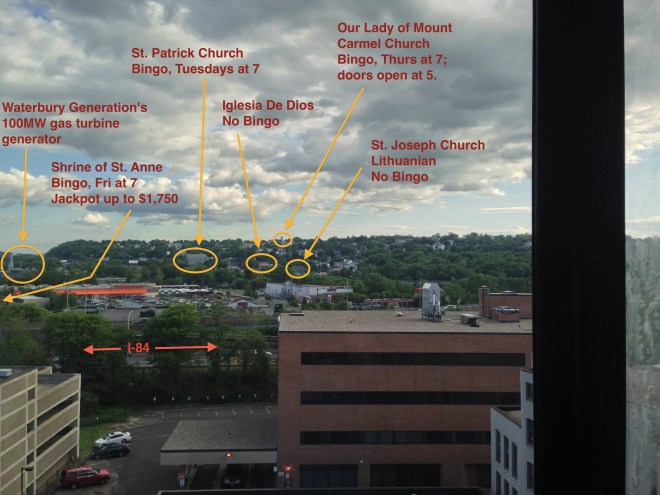
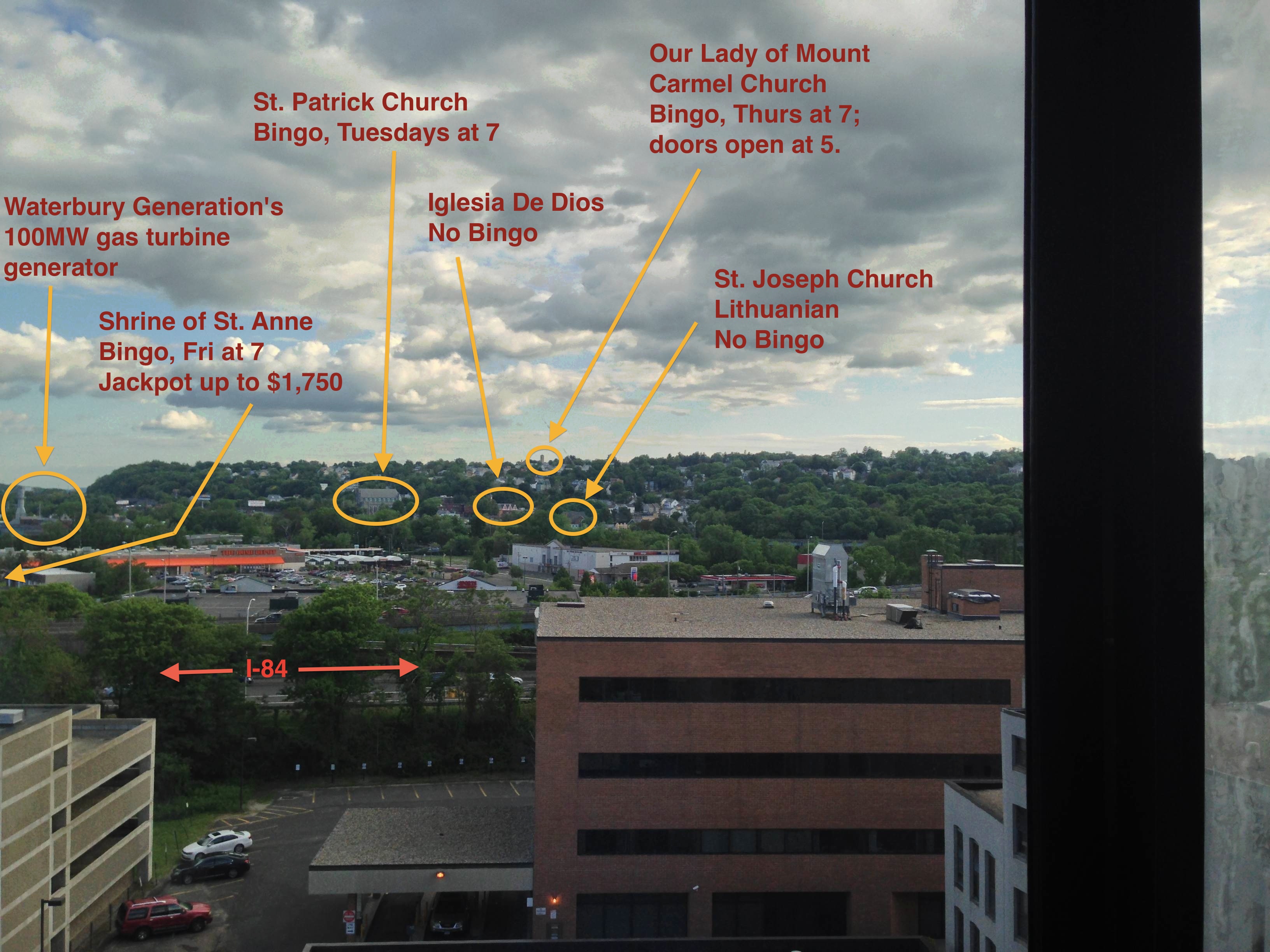
214 with labels

Above is the contest photo with some of the sights identified, including information on which churches host bingo nights in the vicinity. I know. Critical information. For some reason my wife thought I might have better things to do with my time than research area bingo options. Given the alternative was weeding in the garden, I thought otherwise.

We, and your weeds, are grateful. Meanwhile, Chini is not impressed:

Did you know that Waterbury, Connecticut is the “brass capitol” of the world? Well, it is and … dear lord, even the Wikipedia factoids are putting me to sleep with this one. This week’s pic was taken from roughly the eighth story of the Courtyard by Marriott and looks south by southwest along a heading of 212.23 degrees.

Missed the floor though, unlike this week’s winner, who had the most previous correct guesses among the handful who got this key detail right:

I would guess about the ninth floor!

Some other correct guessers are among these visual entries:

vfywc-collage-214

From the reader who submitted the contest’s view:

I was in Connecticut at the end of May for the wedding of my partner’s cousin. The bride is Portuguese and Italian American and the groom is of Irish descent; all three immigrant groups have a sizable presence in Waterbury.

As for the photo itself, it was taken from Room 915 of the Courtyard Marriott. If you search for “Waterbury Courtyard Marriott view” in Google Images, actually, you’ll find a very similar picture taken by someone else in the ninth row of results. I’m guessing that the triple combo of Home Depot, Sports Authority and the gas station is going to be the giveaway clue and there’ll be a swarm of correct identifications. Looking forward to seeing all the funny, impressive and obsessive answers that Dishheads will come up with!

The Dish has posted a few of my submissions as VFYWs in the past two years (which is about how long I’ve been a regular reader), but this is my first time being picked for the contest, so this is quite an honor. My next goal is to actually *win* the book–though I’m still a very long way off, thanks to those aforementioned funny, impressive and obsessive Dishheads.

(Archive: Text|Gallery)

Putin Creates His Own Reality

The Russian leader continues to deny any wrongdoing:

Putin’s government also held a news conference [yesterday], in which it denied that Russia had supplied the separatists with a BUK missile system “or any other weapons,” and suggested that the Ukrainian government is the prime suspect in the crash. Air Force Lieutenant General Igor Makushev said that Russian radar detected the presence of Ukrainian fighter jets close to the Malaysian flight, suggesting that one of them may have shot down the airliner.

Margaret Hartmann unspins Russia’s spin:

Unfortunately for Russia, the scant evidence available doesn’t appear to support its fighter-jet theory. Photographs of wreckage riddled with holes have begun surfacing on social media, and experts say that suggests the plane was targeted by a missile that exploded nearby. After analyzing photos taken by New York Times reporters, IHS Jane’s, a defense consultancy, concluded that the damage was consistent with that caused by a Buk system. The missiles are designed to explode below a target, increasing the likelihood that a fast-moving Western military aircraft will be damaged even if it avoids a direct hit.

Which makes the entire spectacle riveting. What happens when a Tsar’s propaganda becomes completely untenable in a porous media world? What he can get away with at home is not as possible when your drunken proxies take down a plane from the civilized world? Watching that video statement from Putin in the early hours of the morning gave me some solace. Just look at the body language, the deflected gaze, the nervousness:

A Tsar never had to do this, or felt compelled to. He’s hanging by a thread, and we should take some pleasure in watching him struggle. Alex Altman examines Russia Today’s absurdist coverage:

In the aftermath of the crash last week, the RT machine kicked into overdrive, churning out a steady stream of strange reports. In an effort to implicitly assign blame on the Ukrainians, it noted the proximity of Putin’s own plane. It quoted a Russian defense ministry source asking why a Ukrainian air force jet was detected nearby. And it quoted another anonymous Russian official, who volunteered the juicy claim that a Ukrainian anti-aircraft missile was operational in the vicinity at the time of the incident. This is how RT works, explains [former RT employee Sara] Firth: by arranging facts to fit a fantasy.

Kirchick piles on:

A particularly egregious example was the most recent episode of the inaptly named Truthseeker, a program devoted to conspiracy theories. Titled “Genocide in Eastern Ukraine,” the 14-minute segment accused the Ukrainian government of conducting a crime on par with the 1994 Rwandan genocide (which claimed anywhere from 500,000 to 1 million victims), which, for good measure, the host accused the United States of sponsoring. The Ukrainian government (“the most far-right wing government on the face of the Earth,” a description that far better suits the current Russian regime), whose leaders“repeat Hitler’s genocidal oath,”is “bombing wheat fields to ensure there’s famine,” a perverse claim in light of the Soviet-orchestrated Holodomor, the killing by starvation that took the lives of millions of Ukrainians in 1932 and 1933. The segment featured an interview with crank “historian” William Engdahl, a regular columnist for the virulently anti-Semitic website Veterans Today, where he has suggested that terrorist bombings in Russia earlier this year were conducted by Israel in retribution “for Putin’s role in winning Obama away from war against Syria last fall and openly seeking a diplomatic resolution of the Iran nuclear problem.”

Such ravings are par for the course on RT, but what happened afterwards surprised observers who have grown accustomed to the network’s practice of throwing out an endless stream of indefensible allegations in hopes that some of them will stick in the media ecosystem. Two days after the program aired, RT announced via Twitter that it had removed the episode from its website due to “uncorroborated info.” If this were to be the new standard by which RT determines what material to air, it would have no choice but to shut down altogether.

Why Russia Wants A Cease-Fire

It’s a tactical move Russia has used before:

Putin supports a cease-fire, as he has all along, because that leaves the Russian-sponsored forces in control of Ukrainian territory, a status quo that suits Russian interests. This is precisely why the Ukrainian authorities originally ended the cease-fire, and why they have continued operations even after the downing of the aircraft. They suspect that the longer the territory remains in Russian hands, the more likely it is that it will never be returned.

To see why a cease-fire works to Russia’s advantage, the Ukrainian leadership need only look to Ukraine’s western border, where a slice of its neighbor Moldova known as Transnistria has been occupied by pro-Russian forces since 1992. The conflict began when a group that did not want Moldova to secede from the Soviet Union took up arms, with extensive support from the Soviet/Russian military. A cease-fire was declared in July 1992, and the conflict has remained “frozen” ever since.

Anna Nemtsova reports that fighting in Donetsk has heated up:

Clearly, all of the statements from Moscow and Kiev about a cease-fire for the period of the investigation have been forgotten. Rebels reinforced their positions in Donetsk, bringing tanks and armored personnel carriers closer to the railway station on Panfilova Avenue. Glass was blown out of the windows of five-story buildings on Slavatskaya Street. Local radio reported that the Ukrainian military blew up railroad tracks and blocked approaches to the city.

Once again civilians paid the price of this ferocious war. Shells killed pedestrians running to try to escape into basements. A young woman’s body was lying on the dusty road by a row of garages: her head was destroyed, both of her shoes had been thrown in the air by the shock wave of the explosion and had landed a few steps away from her motionless body.

For Israel, There’s No Such Thing As An Innocent Gazan

Neve Gordon and Nicola Perugini scrutinize the logic by which Israel treats virtually any building in Gaza as a legitimate target and any civilian killed as a “human shield”:

All civilians in Gaza are being held hostage by Hamas, which is considered a war crime and a gross violation of international law governing armed conflict. This, then, provides legal and moral justification against the accusation that Israel is the one killing civilians. Presumed human rights violations carried out by Palestinians against Palestinians – taking hostages and human shielding – thus become the legitimization of lethal and indiscriminate violence on the part of the occupying force. Hence, the use of human shields is not only a violation. In contemporary asymmetric urban wars, accusing the enemy of using human shields helps validate the claim that the death of “untargeted civilians” is merely collateral damage. When all civilians are potential human shields, when each and every civilian can become a hostage of the enemy, then all enemy civilians become killable.

And, critically, Israel is absolved of any moral responsibility for any of it. That’s what worries me. When military might is expended on crowded civilian areas and all civilian casualties are presumed the responsibilities of others … you get well over 500 dead, including countless women and children, including attacks on hospitals and families breaking the Ramadan fast in their own home. You get this:

Monday morning, the Abu Jameh family pulled 26 bodies, 19 of them children, from the rubble of their home near the southern Gaza town of Khan Younis, the largest toll from a single strike since the battle began July 8. Four people were killed at Al Aqsa Martyrs Hospital, the main one serving the center of the crowded coastal enclave. An airstrike Monday night destroyed the top five floors of an apartment building called Al-Salam — the Peace — in central Gaza City, an area that had been seen as a safe haven, killing 11.

And yet some even argue that this horrifying spectacle is actually a moral necessity:

The deaths of innocents are not simply outweighed by Israelis’ right to live without daily rockets and terrorists tunneling into a kibbutz playground; but by the defense of a world in which terrorists cannot use morality to achieve victory over those who try to fight morally. It is the protection of that world, one in which moral soldiers still have a fighting chance, that justifies Israel’s operations against Hamas today. And it is that greater cause that decisively outweighs the terrible toll in innocent life.

When you are killing scores of children, it is not enough to argue self-defense (even though the Iron Dome has given Israel about as robust a defense against home-made rockets as you can get). You have to argue for something grander to nullify the corpses of children. And the dehumanization of those living in Gaza – to the point at which spectators with popcorn cheer their deaths – has led to Israeli indifference to the deaths of human beings that, if they were Jews, would be regarded as the harbinger of calamity. Can you imagine the response in Israel if over 200 Israeli children were killed by a rocket attack by Hamas? Can you imagine anyone saying that the Israelis did this to themselves? That tells you everything about how deep the moral rot has gone, how this kind of zero-sum war and brutalizing occupation over decades cannot but destroy a country’s soul.

Larison, meanwhile, tackles the trope that Gazans forfeited their right to be treated as innocent civilians by voting for Hamas and allowing the group to operate in their communities:

Non-combatant status can be forfeited only by becoming a combatant, and that doesn’t happen by having voted for the current rulers or simply by living under their rule. Forfeiting non-combatant status requires taking up arms or directly lending aid to those that are fighting, and that doesn’t appear to apply to the civilian victims killed during the current operation at all. It may please Hamas to make use of these victims’ deaths for their own purposes, but that doesn’t absolve the Israeli government of its responsibility for causing those deaths. If Hamas benefits politically from these civilian deaths, and it seems likely that they do, it would seem obvious that Israel should not want to cause any more, and yet at each step over the last few weeks Israel’s government has responded with tactics that are guaranteed to continue killing many more non-combatants for as long as this operation continues.

And this is the truth about the state of Israel today. To endure it must crush. The more it crushes the deeper the resistance will run; the deeper the resistance the more unthinkable the carnage will have to go. This is an abyss of revenge and hatred, the dreadful consequence of every utopian scheme in human history.

Anti-Zionism And Anti-Semitism

Pro Palestinian Demonstrations Are Held Throughout Europe

Some of the protests against the Israeli assault on Gaza have veered definitively into the realm of rank Jew-hatred. The NYT has a decent round-up of the worst today, and it’s especially troubling in France. As the world responds to Israel’s latest incursion in Gaza, Brendan O’Neill remarks on what he sees as the ever-thinning line between anti-Zionism and anti-Semitism:

[I]n the latest rage against Israel, it isn’t only the Israeli state or military that have come in for some loud flak from so-called radicals – so have the Israeli people, and even the Jews. In Paris on Sunday, what started as a protest against Israel ended with violent assaults on two synagogues. In one, worshippers had to barricade themselves inside as anti-Israel activists tried to break their way in using bats and planks of wood, some of them chanting ‘Death to Jews!’. Some have tried to depict such racist behaviour as a one-off, a case of immigrants in France losing control. But on that big demo at the Israeli Embassy in London last week some attendees held placards saying ‘Zionist Media Cover Up Palestinian Holocaust’, a clear reference to the familiar anti-Semitic trope about Jews controlling the media. On an anti-Israel protest in the Netherlands some Muslim participants waved the black ISIS flag and chanted: ‘Jews, the army of Muhammad is returning.’

His theory as to why this happens:

Why does being opposed to Israel so often and so casually tip over into expressions of disgust with the Israeli people and with the Jews more broadly? It’s because, today, rage with Israel is not actually a considered political position.

It is not a thought-through take on a conflict zone in the Middle East and how that conflict zone might relate to realpolitik or global shifts in power. Rather, it has become an outlet for the expression of a general feeling of fury and exhaustion with everything – with Western society, modernity, nationalism, militarism, humanity. Israel has been turned into a conduit for the expression of Western self-loathing, Western colonial guilt, Western self-doubt. It has been elevated into the most explicit expression of what are now considered to be the outdated Western values of militaristic self-preservation and progressive nationhood, and it is railed against and beaten down for embodying those values.

Koplow, meanwhile, flags some nasty Jew-bashing in Turkey:

Ankara’s mayor Melih Gökçek, fresh off the heels of tweeting out pro-Hitler sentiments, urged his government yesterday to shut down the Israeli embassy in Ankara, referring to it as “the despicable murderers’ consulate” and stating that “they are 100 times more murderous than Hitler.” Not to be outdone, Bülent Yıldırım, the odious head of the “humanitarian relief NGO” IHH – the same NGO that organized the Mavi Marmara flotilla – warned Jewish tourists (yes, he said Jewish rather than Israeli, and yes, that was deliberate on his part) not to show their faces in Turkey and threatened Turkish Jews that they would pay dearly for Israel’s actions in Gaza. …

I get the anger and frustration, and I see it personally from Turkish friends on my Facebook feed and my Twitter stream, who are furious with Israel not because they are Jew-hating anti-Semites but because they deplore the mounting civilian death toll in Gaza, which they see as disproportionate and excessive. … But there is a world of difference between criticizing Israel out of a deeply held difference of opinion versus comparing Israelis to Hitler, equating Israel with Nazi Germany, throwing around the term genocide, openly advocating violence against Israeli nationals and property, and threatening Jews over Israel’s behavior. It is completely beyond the pale, and anyone who cares a lick about liberal values should be denouncing it loud and clear without qualification.

Amen.

Update from a reader:

The Dish cites the incident outside the Synagogue de la Roquette, which has been basically debunked/seriously disputed – the President of the synagouge himself confirming the details of this alternative report, on video.

(Photo: A Pro-Palestinian demonstrator holds a placard with the symbols ‘Swastika equal to Star of David’ during a demonstration on July 17, 2014 in Madrid, Spain. By Pablo Blazquez Dominguez/Getty Images.)

Borderline Politics On The Left

Josh Kraushaar casts doubt on the notion that immigration reform is a winning issue for the Democrats:

The conventional wisdom has long held that immigration is the equivalent of Kryptonite for Republicans: If they don’t pass comprehensive reform, their party is writing its own extinction. Indeed, GOP officials have been publicly telegraphing their own vulnerabilities on the subject for years, highlighted by a 2013 RNC-commissioned report where immigration was the only policy area where the authors recommended the party moderate its positioning.

But what if that isn’t the case? A look at the current politics surrounding immigration suggest that Democrats are facing as much conflicting internal pressures from the current border crisis as Republicans face from their own base when it comes to “amnesty,” or legalizing illegal immigrants. President Obama is caught between his base, which has been pushing him to treat the migrants as refugees and settle them in the country, and the majority of voters, who believe that most should be returned to their home countries.

If the House Judiciary Committee’s numbers are correct, the base is winning that particular fight. Byron York relays the new figures, which show that “the ‘vast majority’ of unaccompanied minors seeking asylum are granted it before even appearing before a judge”:

“Information from U.S. Citizenship and Immigration Services (USCIS) that shows 65 percent of unaccompanied alien minors’ asylum applications have been immediately approved by asylum officers in Fiscal Year 2014,” says a Judiciary Committee statement. “And this is just the first bite of the apple. Many more cases can be approved later. Where an asylum officer does not approve the application, it is then referred to an immigration judge where the applicant can try again. If that fails, they can continue to appeal their case.”

The Judiciary Committee says asylum approval rates have “increased dramatically” under the Obama administration. Overall, according to the committee statement, “Approval rates by asylum officers have increased from 28 percent in 2007 to 46 percent in 2013 and approval rates by immigration judges in affirmative cases have increased from 51 percent in 2007 to 74 percent in 2013.” And that does not count appeals.

On the other hand, it’s not as though the GOP is offering any great alternatives. Alex Nowrasteh slams the Asylum Reform and Border Protection Act, introduced in the House last week, which would expedite deportation procedures for undocumented minors:

H.R. 5137 allows children apprehended at the border to be removed without any asylum screening to a “safe third party country” (i.e. Mexico) without an agreement from that country, as is required by current law. If H.R. 5137 becomes law, the U.S. government would immediately start dumping Honduran, El Salvadoran, and Guatemalan children into Mexico.

The crisis along the Southwest border has prompted many Americans to want all unlawful immigrants and children removed. But this bill goes far beyond that desire. H.R. 5137 would remove many foreigners who have legal rights under our current immigration laws. H.R. 5137 would be a disastrous blow to America’s asylum system and send numerous children with legitimate asylum claims back into danger.

Recent Dish on immigration politics and the border crisis here, here, and here. Read our complete coverage of the crisis here.

Your Home Will Be Destroyed In One Minute, Ctd

Martin Longman isn’t buying Israel’s claim that its warning shots are a humane gesture:

What’s clear is that these operations have a different purpose than killing individuals who belong to Hamas. The purpose is to make it clear that belonging to Hamas will cause your family to lose their home and quite possibly their lives. Even living in the same building as a Hamas member or maybe even in the house next door or across the street is a threat to your whole family.

This policy, then, is designed to turn the Palestinian population against Hamas.

It’s designed to make families disown children who fraternize with Hamas. It’s designed to cause apartment dwellers to purge their buildings of tenants who work with Hamas. The Israelis have a term for people who don’t leave their dwellings once they have been warned that a Hamas member is living among them. They are “human shields.” And, as human shields, they have made a decision that denies them any further human rights. …

Perhaps this policy can force Palestinian patriarchs (or matriarchs) to forbid their sons and daughters from associating with Hamas, but if Hamas goes away will their replacements be better? More compliant? Easier to negotiate with? This is a policy of beating people into terrified submission, but similar policies in the recent past have only seemed to bring short stints of calm. The Israelis call this “mowing the lawn.” The grass always grows back, and quicker if it is nourished with rain.

Watch an example of the other terrifying euphemism – a “knock on the roof” – here.