“Telegenically Dead”

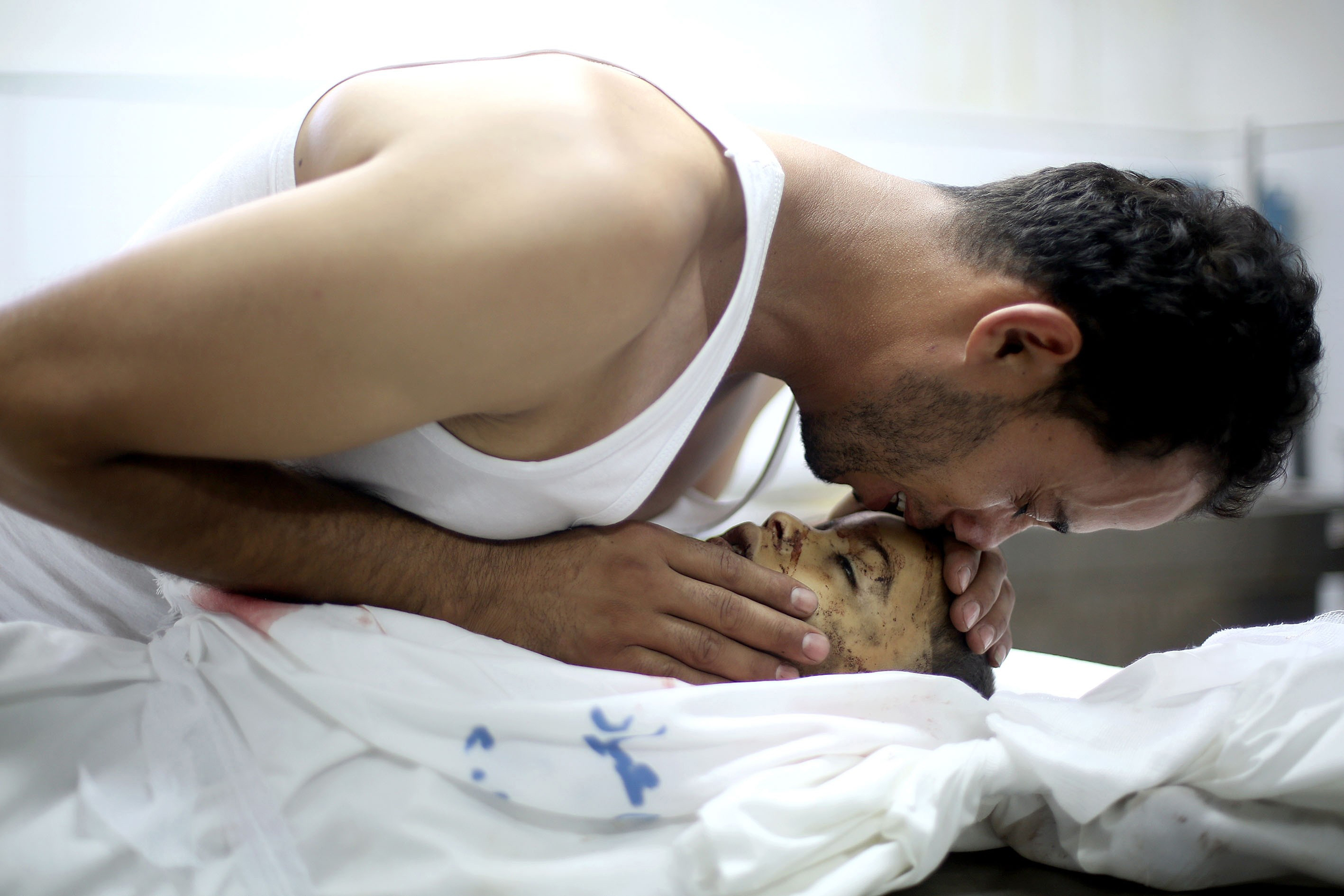
The dead body of Palestinians carried to Al-Shifa Hospital's morgue

Benjamin Wallace-Wells identifies why Israel is losing the PR battle in the American media:

“I’ve seen some truly shocking scenes this morning,” tweeted the Guardian’s man in Gaza, Peter Beaumont, on Saturday. “A man putting the remains of his two year old son into a garbage bag.” 3,000 people retweeted that. Earlier this month, the IDF’s twitter feed had been full of images of besieged Israelis. But by this weekend Israel was so clearly losing the public relations war that Prime Minister Benjamin Netanyahu complained to reporters, tersely, that Hamas uses “telegenically dead Palestinians for their cause.”

If Netanyahu is so bothered by how dead Palestinians look on television then he should stop killing so many of them. But his complaint is in itself a concession.

The story of the conflict between Israel and Palestine looks a little bit different this time around. Social media have helped allow us to see more deeply inside war zones–in this case, inside Gaza, and allowed viewers much fuller access to the terror that grips a population under military attack. America’s changing demographics (the country’s Muslim population has skyrocketed in the past decade and is now as much as 50 percent larger than the US Jewish population) have meant both a more receptive audience for sympathetic stories about Palestinians and more Americans like Abu Khdeir, with connections back to Palestine. The sheer imbalance in the human toll, in the numbers of dead, has been impossible to elide or ignore.

That’s despite the best efforts of media outfits like CNN, which reassigned the reporter who had dared to comment on how the Israeli spectators watching the war from the hilltops outside Sderot had threatened her and her crew:

CNN has removed correspondent Diana Magnay from covering the Israeli-Palestinian conflict after she tweeted that Israelis who were cheering the bombing of Gaza, and who had allegedly threatened her, were “scum.”

“After being threatened and harassed before and during a liveshot, Diana reacted angrily on Twitter,” a CNN spokeswoman said in a statement to The Huffington Post. “She deeply regrets the language used, which was aimed directly at those who had been targeting our crew,” the spokeswoman continued. “She certainly meant no offense to anyone beyond that group, and she and CNN apologize for any offense that may have been taken.” The spokeswoman said Magnay has been assigned to Moscow.

(Photo: A relative mourns over the dead body of a child killed due to Israeli attacks at Al-Shifa Hospital’s morgue in Gaza City, on July 20, 2014. At least 40 Palestinians were killed and 400 others injured in Israeli shelling of residential areas, including al-Shujaya, in eastern Gaza City. By Mustafa Hassona/Anadolu Agency/Getty Images.)
Putting Off The Iran Deal

Over the weekend, negotiations with Iran were given a four-month extension. The state of play:

The six powers want Iran to dramatically reduce its nuclear programme for a lengthy period of time and agree to more intrusive UN inspections. This would expand the time needed for Tehran to develop a nuclear weapon, while giving the world ample warning of any such “breakout” push.

The two sides are believed to have narrowed their positions in recent weeks on a few issues such as the Arak reactor, which could give Iran weapons-grade plutonium, and enhanced inspections. But they remain far apart on the key issue of Iran’s capacities to enrich uranium, a process which can produce fuel for reactors but also the core of a nuclear bomb.

The administration is trying to stay upbeat:

Obama administration officials insist that the talks have made major progress that justified giving negotiators until November to pursue a final deal. In a statement, Secretary of State John Kerry said“the very real prospect of reaching a good agreement that achieves our objectives necessitates that we seek more time.”

The Senate, however, remains a wild card – and AIPAC has been doing its usual work to buttress the case for war and for scuttling any agreement. The problem there, it seems to me, is that the necessarily private diplomacy has not allowed for a more robust and public discussion as to the costs and benefits. My own view is that the American public could be persuaded of the sanity of the least-worst option when it comes to preventing Iran getting a nuclear bomb; but the administration has been timid and defensive in its public outreach. Maybe that would change after a possible agreement. But it may be too late by then.

Majid Rafizadeh believes, for his part, that “the gaps between the six world powers and Iran would more likely require more than four months of extensions as well as a significant shift in Iran’s Supreme Leader, Ayatollah Ali Khamenei’s stance on his government’s nuclear program, or a remarkable change in the six world power’s stance”:

Considering the intricacies and examining Iran’s nuclear file and Tehran’s defiance, it becomes evident that the four month extension of diplomatic negotiations is barely enough to resolve these major hurdles.

The major barriers between the P5+1 (mainly the Western members: France, United Kingdom, Germany and the United States) and the Islamic Republic come down to the restriction of Iran’s production of plutonium, the dismantlement of crucial segments of the uranium enrichment program, the limiting of stockpiling and production, the question of Fordow, its underground nuclear facility center, the extent as to how the Islamic Republic should provide data with regards to its development, what type of nuclear research can be carried out, and how many centrifuges Iran can retain.

Tamara Wittes heard from Israelis that they are “worried that an extension would give the Iranians more time to exploit differences within the P5+1 and erode the sanctions regime.” But:

[I]t’s still important to evaluate this four-month extension in light of the alternatives. A collapse of the talks driven by U.S. dissatisfaction would have been even more likely to split the P5+1, and more likely to lead key states to soften their sanctions commitments. At the same time, the end of the interim deal would have left Iran’s enrichment and other nuclear activities unconstrained and largely unmonitored. It would have led, therefore, to a rapid collapse of the existing international pressure/containment strategy and a rapid escalation in the threat posed by Iran — and thus a push toward military force.

Meanwhile, Josh Rogin fears Russia will play spoiler:

[If] Putin decides that retaliating against the U.S. and ruining Obama’s foreign policy legacy is more important than sealing a pact with Iran, the whole thing could unravel. The shooting down of MH17 has escalated the diplomatic war between Washington and Moscow and made that scenario more likely because it could result in more sanctions and legal action against the Russian government.

It’s a Rubik’s cube. The odds are long.

Where Are They Supposed To Go?

gaza_2007_map_correct_PASSIA

Jesse Rosenfeld reports from Shejaiya, the Gaza City neighborhood that bore the brunt of yesterday’s shelling. Residents tried to evacuate but didn’t have many options:

Magdin Ayad, 26, standing with her seven children in front of a shuttered store on the edge of Al Shejaiya, doesn’t know where she can go. “We will just sit and wait,” she said amid the routine boom of exploding tank shells. With all her family also fleeing from the district, her only option is to join the hundreds seeking safety at Gaza City’s Al Shifa hospital.

Although strained and running out of supplies, the hospitals are the sole sign of any functioning civil institutions. There is a constant flow of ambulances bringing in wounded while doctors scurry to save them. Hamas spokesmen stand by the hospital gates and denounce the attack on Al Shejaiya as a massacre and vow to fight on. It’s the only place to get official government comment in Gaza and a handful of guards are the only security forces to be seen.

But there’s no seeking shelter at the Wafa hospital, which has been repeatedly bombed:

Since the beginning of the war, Israel had been calling the al-Wafa rehabilitation hospital in eastern Gaza telling them to evacuate ahead of a scheduled bombing, according to the hospital’s executive director Basman al-Ashi. The Israeli military says it was attacking military targets nearby. Many of the patients at al-Wafa are severely disabled or paralyzed, unable to move. The staff refuses to leave.

The fourth floor of the hospital was first shelled on Tuesday, and several times after that. Doctors moved the patients to the first floor to withstand the assault. Around 8:30 p.m. on Thursday, they received another call from an Israeli officer telling them to evacuate. Again, they refused. Minutes later, the attack began with artillery shells crashing into the fourth, third, and second floors.

“The electricity went out, all the windows shattered, the hospital was full of dust, we couldn’t see anything,” says Aya Abdan, a 16-year-old patient at the hospital who is paraplegic and has cancer in her spinal cord. She is one of the few who can speak. Many of the other patients are comatose.

Telling a hospital to evacuate or be bombed is what Israel has descended to. That the Israelis need to harden themselves in the face of such slaughter from the skies does not remove the stain. In some ways, it intensifies it. The rhetoric of Israel and its reliable supporters reflect this fact. They have to assign responsibility to Hamas for every child they kill. The alternative – the truth – is too painful for them to absorb. And so the dehumanization intensifies.

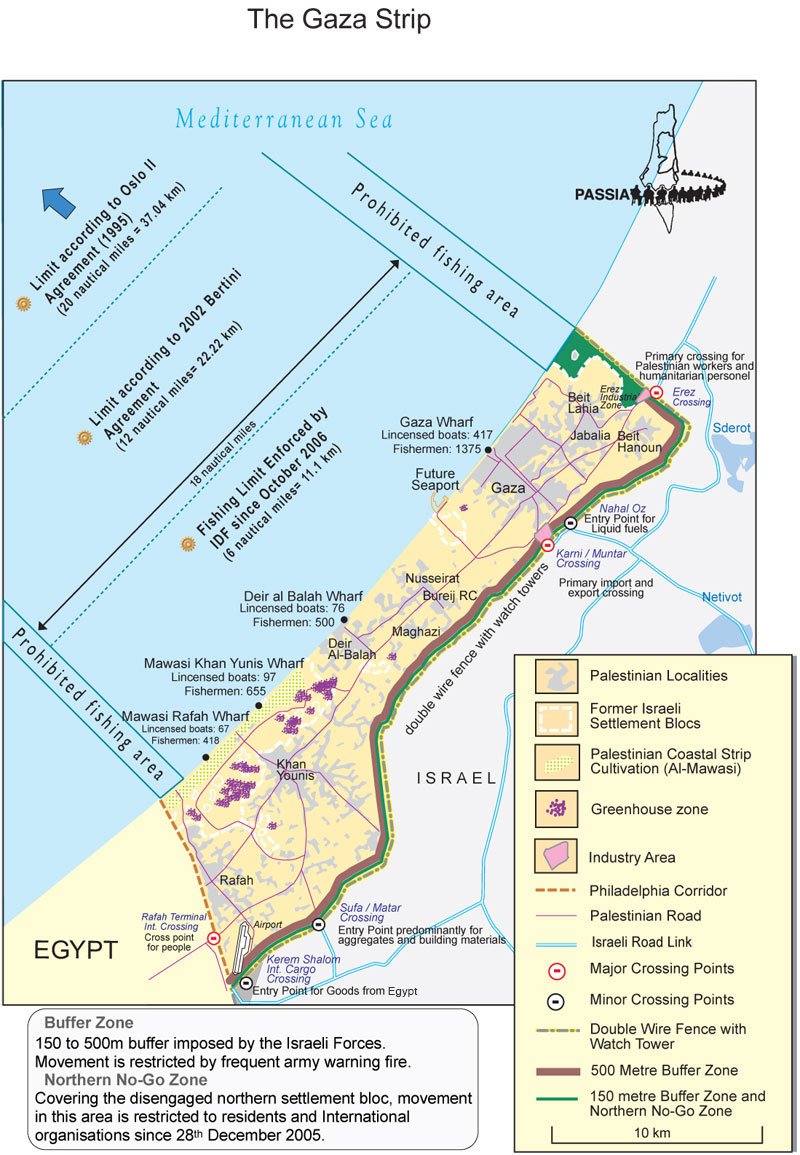
Zack Beauchamp captions the map above, which illustrates how trapped the Gazans are:

There’s a serious Israeli blockade of Gaza. You’ll notice Israeli fences, boundaries, and supervised crossings all around Gaza. Israel heavily controls the flow of goods through these channels, including food, medicine, construction materials, and the like. The [stated] reason it does that is to limit Hamas’ ability to resupply itself militarily; for instance, Hamas and other militant groups often home-build rockets that get fired into Israeli towns and cities. These restrictions also severely affect civilians. To deal with the military and civilian effects of the blockade, Hamas built well over a thousand tunnels out of Gaza — mostly into Egypt. Israel’s stated reason for the ground incursion into Gaza is shutting down tunnels into Israel built for attacks, but it also may want to shut down Hamas supply tunnels into Egypt.

Holding Corpses Hostage

UKRAINE-RUSSIA-POLITICAL-CRISIS-MALAYSIA-ACCIDENT-CRASH

I’ve not yet weighed in on Russia’s response to the downing of MH17, partly because it beggars belief. The staggering insouciance, the prickly denials of the bleeding obvious, the corrupt and foul attempt to shift the blame, and the shameful refusal to allow international flight inspectors into the area as swiftly as possible: which realm of barbarism do these goons of Putin’s invention come from? And now this:

Separatists controlling the area of the MH17 wreckage have declared that they can only ensure international investigators will have access to the crash site if Ukraine agrees to a truce: “We declare that we will guarantee the safety of international experts on the scene as soon as Kiev concludes a ceasefire agreement,” said Andre Purgin, a senior leader of the self-declared Donetsk People’s Republic. The declaration amounts to blackmail, as Nina Ivanovna put it. The separatists are holding the bodies of MH17 passengers hostage in exchange for territory.

I find myself agreeing with Roger Cohen:

This mass murder is an outrage that should not stand. Falling military budgets have reduced the Dutch special forces to a paltry remnant. Russia would veto any United Nations Security Council Resolution authorizing force for a limited mission to recover the bodies and the evidence. But Ukraine, on whose territory the debris and dead lie, would support it. The American, British, Dutch and Australian governments should set an ultimatum backed by the credible threat of force demanding unfettered access to the site. Putin’s Russia must not be permitted to host the 2018 World Cup. A Western priority must be to transform the Ukrainian army into a credible force.

The principle of non-intervention in distant civil wars is not harmed by this kind of resolve. What just happened over the skies of Eastern Ukraine was an attack on the far more important principle of free travel across the globe. If Russia’s thugs can down a civilian airliner  – can kill hundreds of European civilians – with impunity, then we have permitted a deeply damaging precedent for chaos and disorder to take root. Russia has crossed a Rubicon and should really now be deemed a rogue neo-fascist state that requires containment.

That cannot happen without European unity and resolve – without, that is, a far more stringent and focused response than we have seen so far. It means that Germany and Britain in particular must accept some sacrifice for the maintenance of a global order they rely on. If the Europeans do not enact sanctions at the level of America’s and more, their appeasement of this strutting, irresponsible tsar of disorder will come back to haunt them – and sooner than they might think. Russia is not a stable international actor, it is not a stable economy, it is rather an oligarchy kept together by ever-more inflammatory moral and xenophobic panics. There is no stable state to partner with.

The latest on the situation:

Four days after the tragic crash of Malaysia Airlines Flight 17, Dutch forensics experts are finally being allowed onto the scene. However, the site is still being guarded by armed rebels, who are making it very difficult for investigators to move in and out. The rebels also control much of the access to the bodies, most of which have been moved, decomposed, or otherwise tampered with. These Dutch experts have arrived to review remains of the victims, that is, if they can get to them.

The forensic experts are in the town of Torez, where many of the bodies have been put onto refrigerated rail cars. However, the train cannot leave, as Ukrainian prime minister Arseniy P. Yatsenyuk says the rebels controlling the area are preventing the train from moving. Thus far, the experts have only been able to inspect the bodies on the train.

(Photo: Bodies of victims wrapped in bags wait to be collected by rescuers at the site of the crash of a Malaysia Airlines plane carrying 298 people from Amsterdam to Kuala Lumpur in Grabove, in rebel-held east Ukraine, on July 19, 2014. By Dominique Faget/AFP/Getty Images.)

Peace Has A Good Chance

Flower_Power_demonstrator

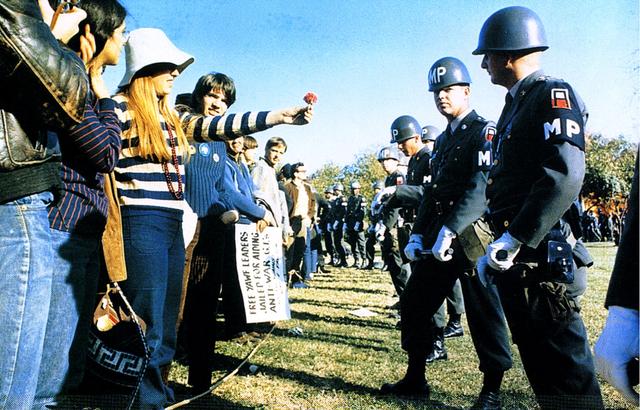
Noting how it “seems that at any given moment, thousands of people are mobilizing for change somewhere in the world,” Erica Chenoweth and Maria J. Stephan marshal evidence that non-violent civil resistance is more effective than taking up arms:

A longer view is required to see the real potential of nonviolent resistance, which is evident in a historical data set that we assembled of 323 campaigns that spanned the twentieth century — from Mahatma Gandhi’s Indian independence movement against British colonialism, which began in earnest in 1919, to the protests that removed Thai Prime Minister Thaksin Shinawatra from power in 2006. This global data set covers all known nonviolent and violent campaigns (each featuring at least 1,000 observed participants) for self-determination, the removal of an incumbent leader, or the expulsion of a foreign military occupation from 1900 to 2006. The data set was assembled using thousands of source materials on protest and civil disobedience, expert reports and surveys, and existing records on violent insurgencies.

Between 1900 and 2006, campaigns of nonviolent resistance against authoritarian regimes were twice as likely to succeed as violent movements. Nonviolent resistance also increased the chances that the overthrow of a dictatorship would lead to peace and democratic rule. This was true even in highly authoritarian and repressive countries, where one might expect nonviolent resistance to fail. Contrary to conventional wisdom, no social, economic, or political structures have systematically prevented nonviolent campaigns from emerging or succeeding. From strikes and protests to sit-ins and boycotts, civil resistance remains the best strategy for social and political change in the face of oppression. Movements that opt for violence often unleash terrible destruction and bloodshed, in both the short and the long term, usually without realizing the goals they set out to achieve.

(Photograph of a Vietnam War protestor offering a flower to a Military Police Officer, October 21, 1967, via Wikimedia Commons)

As If You Needed Another Reason To Feel Paranoid …

Governments in the Middle East and elsewhere are investing in spyware, sometimes to use against their own citizens:

On June 24th Citizen Lab, a Toronto-based cyberspace security outfit, said it had detected specialized spyware being used in Saudi Arabia – the first time it has seen such sophisticated software in that country. (The Saudi authorities have not responded to these allegations).

The software, known as a remote control device (RCS), can hack into mobile phones, giving the government access to all the user’s information – what he or she has looked at or written online and the call history, for example. Unlike basic surveillance software, the RCS can also transform the device into a monitoring tool by switching on and controlling the camera and microphone, without the user noticing. … Until recently such technology was only used by governments with a long history of expertise in spying, such as Russia, says Bill Marczak of Bahrain Watch, an NGO that monitors human-rights violations in Bahrain. “Now any government that is willing to spend several hundred thousand dollars can acquire these hacking tools and get the training they need,” says Cynthia Wong, who researches internet violations for Human Rights Watch. That leaves activists more exposed than ever.

The spyware was apparently bundled with “Qatif Today,” a legitimate news app. Some 60 countries are reportedly using what Citizen Lab describes as “malware sold to governments.”

The Elusiveness Of Hitler’s Evil

In an afterword for the new edition of his Explaining Hitler, Ron Rosenbaum reflects on one of the central puzzles driving examinations of Hitler’s life – “why that innocent infant evolved into a genocidal monster”:

[S]omething or some things made Hitler want to do what he did. It wasn’t a concatenation of Adolf Hitler, Kinderbildimpersonal, external forces, a kind of collective determinism. It required his impassioned personal desire for extermination, even at the potential cost of defeat for Germany. It required him to choose evil. It required free will.

It required Hitler to make a continuous series of choices, the ultimate source of which may always be shrouded in mystery. We will likely never know, for instance — barring some discovery in a “lost safe-deposit box” — what went on between Hitler and the alleged hypnotist, Dr. Forster, said to have treated him at the time of the World War I German surrender and instilled in him a will to avenge the (baseless) “stab-in-the-back” myth of German defeat. We have only Ernst Weiss’s fascinating novelistic speculation (The Eyewitness) to go on, and it can’t be counted as proof, although it may be the unsolved Hitler mystery I’d most like an answer to. In fact, we lack proof, and the most salient clues might be lost in the mists of history. We just may never know with certainty what made Hitler Hitler. And worse, we may never know why we don’t know: whether it’s because of a missing piece of biographical evidence, or an inability to evaluate the evidence we have. It’s beyond frustrating not knowing whether we might.

Update from a reader:

Long-time reader and subscriber.  Your post on “why that innocent infant evolved into a genocidal monster” I would highly recommend reading Robert G. L. Waite’s The Psychopathic God, which does a pretty good job of showing how documented accounts of his childhood history correlate to his compulsions later in life.

I read this at university as a student of central European history in the 19th and 20th century. Our professor warned us that psycho-history was scorned in academic historian circles but offered it as a perspective.

Interestingly, I later connected his work with that of the Swiss-German psychologist Alice Miller who wrote extensively about parental child abuse. In her work For Your Own Good she covers very similar ground as Waite, but as a trained psychoanalyst.

My belief is that sociopaths and psychopaths are largely made by their environment, but imagine there’s a bell curve with some individuals at one tail coming through trauma to lead relatively normal lives and others, at the other tail becoming “exceptional” monsters. Hitler arrived on the world stage in a time, place and context that would celebrate and willingly participate in his monstrosity.

So, I don’t find Hitler as monster so puzzling. Parents create them every day, but only rarely do they get to act out there pathologies in such a world-historical way.

(Image of Adolf Hitler as an infant, 1889–1890, via Wikimedia Commons)

Tracing Our Steps

The makers of an iPhone app that tracks exercise have transformed big data into beautiful GIF maps:

Using data collected from the Human smartphone app, major urban centres such as dish_humanappLondon, New York and Amsterdam have been drawn with pixels created by the movement of inhabitants that use the app. “We visualised 7.5 million miles of activity in major cities all across the globe to get an insight into Human activity,” said the team. “Walking, running, cycling, and motorised transportation data tell us different stories.”

The iPhone app was originally designed to encourage users to undertake at least 30 minutes of exercise each day. Using the phone’s location services and movement sensors while sat in a pocket or bag, it records the wearer’s type of movement and tots up the amount of activity completed. … As well as the city maps, the information was also used to rank the cities in percentage order of their residents’ most common means of transport. Amsterdam topped the list for cycling, Washington for walking, Berlin for running and Los Angeles for motorised transport.

Mark Byrnes recommends the video visualization seen below the jump:

The city-by-city results are perhaps most fascinating when viewed as a video. Displaying minute-by-minute data from each location, Human shows how the volume of movement around different parts of each place changes throughout the day:

Write Wingers, Ctd

Recently the Dish featured Adam Bellow’s manifesto urging conservatives to engage with popular culture, especially novels, as a way of spreading their message. Adam Kirsch, however, argues that “a conservative literary revival, along the lines Bellow desires, is not going to happen.” The reason? He sees too much anger and resentment driving the proposal:

[A]nger is a not a conservative emotion. Genuine conservatism is something much broader and deeper than a political orientation; it is a temperament, one that looks to the past with reverence and the future with trepidation, and which believes that human nature is not easily changed or improved. Defined in this way, conservatism is in fact a major strain in contemporary American literature. David Foster Wallace, the leading novelist of his generation, was a champion of earnestness, reverence, self-discipline, and work—never more so than in his last, unfinished novel, The Pale King, whose heroes are hard-working accountants. Dave Eggers made his name with a memoir about raising his younger brother after his parents died, a hip but deeply earnest hymn to family values. Zadie Smith excels at the conservatism of comedy, which resolves differences in laughter and exposes human follies with an indulgent understanding.

Kirsch goes on to pan Bellow’s new site for conservative fiction, Liberty Island, which describes itself as a place where “good still triumphs over evil, hope still overcomes despair, and America is still a noble experiment and a beacon to the rest of the world“:

The problem is not that these are conservative ideas, but that they are simpleminded ideological dogmas, and so by their very nature hostile to literature, which lives or dies by its sense of reality. If you are not allowed to say that life in America can be bad, that Americans can be guilty as well as innocent, that good sometimes (most of the time?) loses out to evil—in short, that life in America is like human life in any other time or place—then you cannot be a literary writer, because you have censored your impressions of reality in advance.

Micah Mattix adds:

Kirsch is right that conservatism is much more than patriotism or a defense of individual freedom, even if he also overestimates how many “conservative” works of fiction are published today (only two of the novelists he cites are actively writing; Wallace, Malamud, and Bellow are dead, of course), and even if has a rather rose-colored view of the commitment of liberal writers to art above politics. …

I’d like to see more conservatives write good fiction and poetry, not in order to win the culture war, but in order to have better fiction and poetry. There are number of conservative positions that are true and that are often ignored in fiction and poetry today. In Rod’s article last year on conservatives and storytelling, I noted one of these: The belief that evil is rooted in individuals and not in the structures of society (the church, schools, property ownership).

Bertrand Russell, Peacenik?

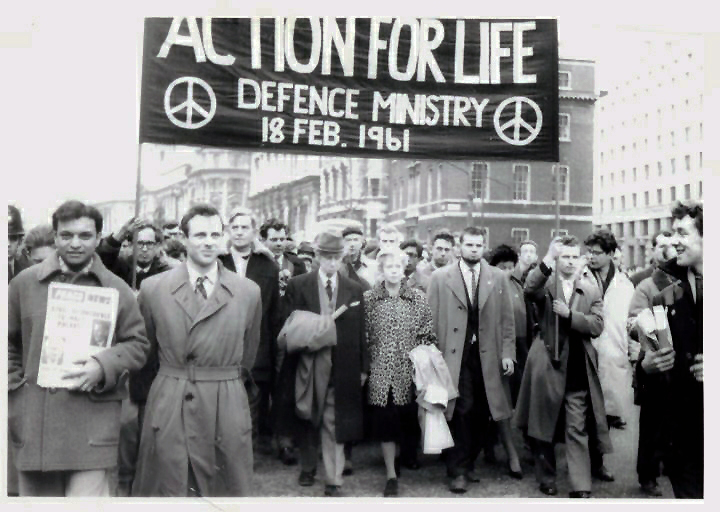
Bertrand_Russell_leads_anti-nuclear_march_in_London,_Feb_1961

Surveying the British philosopher’s pacifist writings and activism, Jonathan Rée isn’t quite persuaded by how he formulated the nature of war:

The peace agenda of Russell and his followers was always based on the assumption that war is simply a euphemism for the madness of state-sponsored mass murder, and that we could prevent it by standing up for moral and political sanity – by committing ourselves to global justice and the relief of poverty, for instance, or social and sexual equality, or common ownership, or world government…. But the paths to war are paved not with malice but with righteous self-certainty. People who choose to participate in military action are more likely to be altruists than egotists: they are prepared to sacrifice their own lives for the sake of something that transcends them, such as their country or their religion, or socialism, secularism or democracy, or a world where peace and tolerance will reign in perpetuity. Of course they are liable, like the rest of us, to be seriously mistaken in countless ways:

they probably have an inconsistent scale of values, a shaky grasp of facts and a faulty sense of proportion. They may, just possibly, be open to persuasion through tactful argumentation, subtle negotiation and ingenious rhetoric, but nothing will be gained by accusing them of selfishness, nihilism or moral idiocy, or delivering lectures about self-sacrifice, high principle and the future of humanity.

Different threats to peace, like different threats to health, require different precautions and different interventions, depending on the individual case, and success in averting war is going to depend on luck as much as judgement. If the prospect of nuclear extermination has receded since the time when Russell was prophesying it, the explanation lies less in campaigns for peace and freedom than in the unexpected consequences of developments that no one could have foreseen – the calculations and miscalculations of Mikhail Gorbachev, for instance, or the accidental canniness of Ronald Reagan. Irony is a force of history as well as a figure of speech, and in politics you need to be prepared for surprises, even if you are as clever as Bertrand Russell.

(Image: Bertrand Russell and his wife, Edith Russell, lead an anti-nuclear march by the Committee of 100 in London on February 18th, 1961, via Wikimedia Commons)