An Archbishop Heightens The Contradictions, Ctd

Yesterday, we got a glimpse of the actual affidavit filed by the former chancellor of the archdiocese of St Paul and Minneapolis that charges the Archbishop and others of continuing to ignore child sex abusers in their midst. Jennifer Haselberger appears to be a rare figure who actually cared about the safety and welfare of children in the archdiocese and tried to keep the entire place operating professionally and legally. And failed on both counts. What makes this case different is that the cover-up of child-abuse is occurring long after new rules were put in place to prevent it, and we have in Haselberger an unprecedented whistle-blower from the inside:

Most clergy abuse lawsuits rely on decades-old documents, testimony from a handful of experts on church law, and depositions from recalcitrant church officials and abusive priests. Top chancery officials rarely come forward to disclose the church’s secrets. [Attorney Jeff] Anderson called the affidavit “historically important” in the history of the clergy sexual abuse scandal in the U.S. Catholic Church.

Haselberger resigned in April 2013 in protest over the archdiocese’s handling of abuse cases. She contacted MPR News in July 2013 and disclosed how Nienstedt and other top officials gave special payments to abusive priests, failed to report alleged sex crimes to police and kept some abusers in ministry. Her account was especially stunning because it involved decisions made by church leaders as recently as April 2013.

To add to this toxic stew, Nienstedt is fighting back against “multiple allegations” of inappropriate sexual encounters with seminarians, priests and other men – including one accused of child abuse. He is also – surprise! – an almost fanatical opponent of marriage equality and a constant, obsessive voice against the evils of homosexuality. Dreher flips out at the prospect of another theocon revealed as a fucked-up fraud:

Haselberger says what drove her to quit in anger was realizing how little the archdiocese cared about protecting children, only protecting priests — even priests they knew were guilty — and how vulnerable children were. She says that Archbishop Nienstedt was such a micromanager that he would send stern notes (“nastygrams”) to chancery employees for such petty offenses as leaving the lights on, or not wearing a tie — but when it came to dealing with clerical sexual misconduct, he was seemingly indifferent … If Haselberger is telling the truth, it staggers the mind to think that Pope Francis — who has the right to remove Nienstedt — tolerates this man remaining in charge a single day longer.

It will and should be another acid test for this Pope on child abuse. This is about enforcing rules that have now long been implemented; it’s about retaining even a sliver of moral credibility; and it’s about protecting children from psychologically damaged products of the church’s incoherent and impossible teachings on sex. I wish I were more hopeful. But who can be, at this point?

Nah – The Young Are Still Leaning Left

Ideology By Generation

Using some new Gallup data, Leonhardt pushes back on the notion that today’s teenagers are more conservative than millennials:

For starters, the Gallup data indicates that today’s oldest teenagers do not identify themselves as any more conservative than people in their 20s. About 27 percent of 18- to 21-year-olds identify as liberal, compared with about 25 percent who call themselves conservative. Among 25- to 29-year-olds, the liberal lead is 28 percent to 27 percent. … Eighteen- and 19-year-olds look roughly as Democratic-leaning as people in their 20s. The Democrats have an advantage of about 14 or 15 percentage points.

Chait chimes in:

As Leonhardt notes, there may be a slight tilt away from the Democrats. But that still would count not so much as good news for Republicans as somewhat less terrible news.

As every election cycle, older, Republican-leaning voters die off and are replaced by newer, Democratic-leaning ones. If the youngest and newest cohort is somewhat less Democratic leaning than the previous one, it would slow the process. But it’s like having your house flood at a slightly less rapid pace. The fabled new teenage conservatism remains as yet illusory.

Yglesias feels that the GOP is simply out-of-touch with today’s youth:

There’s something very oldsterish about contemporary conservative politics. The constant bickering about Ronald Reagan is very odd to anyone too young to have any particular recollection of the Reagan years. Calling a group of people “Beyoncé Voters” as an insult is weird. Some of this oldsterism is just ticks, but some of it has policy implications. The sort of budgetary priorities that call for huge cuts in all domestic spending, except no cuts at all for anyone born before 1959 is kind of weird. The huge freakout over New York City starting a bicycle program last summer was bizarre. It’s easy to imagine a political party that’s broadly favorable to low taxes and light regulation without sharing this particular set of ticks. And then there was the time George Will wrote a column-length rant against blue jeans.

Bernstein bets this will change eventually:

Republicans will adapt to the biases and preferences of people who vote Republican in the 2020s, rather than only attracting people who are drawn to the current Republican mix of policies and rhetoric. And why will people be Republicans? Because they started out as Republicans (either by inheritance, or because they started voting in good Republican years). If the economy collapses when a Democratic president is in office, Republican “oldster” rhetoric isn’t going to matter much.

Or, to put it another way: The reason that Democratic positions and rhetoric, especially on second and third-tier issues, sound good to Yglesias and those younger than him is that he and so many of those folks are Democrats. Not the other way around. And when younger voters are mostly Republican (and, yes, that’s going to happen at some point), then Republican rhetoric and policy preferences will adapt to that cohort.

A Shoddy Infrastructure Bill

Arit John sums up yesterday’s news:

The House overwhelmingly passed an unpopular proposal to use revenues from underfunded pensions to pay for one year of funding for the Highway Trust Fund. According to NBC News, the House bill will pay for a 10-month funding extension for road and infrastructure projects “using pension tax changes, customs fees and a transfer from the Leaking Underground Storage Tank Trust Fund.” Despite threats from conservative groups Club for Growth and Heritage Action, only 45 Republicans voted against the bill.

Sargent explains why Republicans voted for the bill:

The battle over infrastructure in the context of the HTF is one area where GOP anti-government rhetoric collides with reality.

It’s easy for Republicans to strut around ranting about crony capitalism, and they know they can attack the Export-Import Bank’s efforts to help U.S. exporters as improper Big Gummint meddling in the economy because no one cares about it. But here was a case where infrastructure projects — and jobs — could have been put on ice in many GOP districts.

Plumer rattles off critics’ objections to the legislation:

For one, the House bill would only avert the crisis until next May — and doesn’t address the underlying structural problems with the Highway Trust Fund. Some Democrats would prefer to deal with the highway problem this December, in the lame-duck session right after the midterm elections. … Other tax experts have criticized the “pension smoothing” provision. As Len Burman points out, the move may not actually raise any money: Yes, companies can reduce their pension contributions now under the rules. But the amount those companies will eventually owe in pensions doesn’t change — which means they’ll have to increase their contributions later (and tax revenues will fall).

Bloomberg View’s editors pine for a long-term fix:

It’s a shame that Obama and members of Congress, including those who wanted to raise the gas tax, didn’t find another solution to the funding problem. The president reluctantly endorsed the House bill, explaining that he does not want to see the fund run dry in August, as the Department of Transportation says it will. That’s understandable, but it’s also shortsighted.

If the bill could be stopped, the economic impact would be limited. Work wouldn’t cease on projects already under way; funding for those is guaranteed. Some states might be forced to delay future projects, but this would help push unions and governors to increase the pressure on Congress to find a better answer. Without strong political pressure, Congress will keep the gimmicks coming — and that needs to stop.

Reform That’s Borderline Impossible

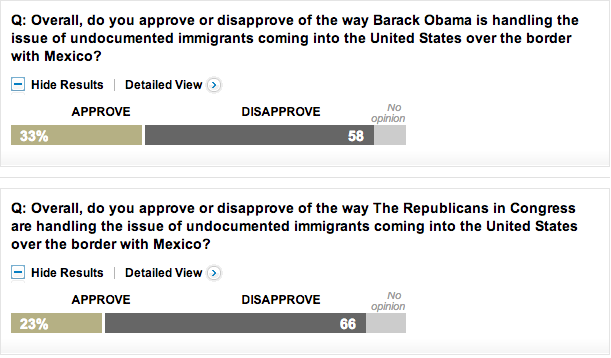
A new WaPo/ABC News poll dings both Obama and Republicans in Congress for their handling of the border crisis:

Screen Shot 2014-07-16 at 11.01.33 AM

The Republicans fare especially badly, but Noah Rothman attributes that to dissension in the ranks:

Republicans in Congress, who receive poor marks from nearly two-thirds of the public, can attribute some of that antipathy to their own voters. “Almost as many Republicans disapprove of their party’s handling of the issue as say they approve, with negative ratings rising to a majority among conservatives,” reads The Post’s write up of the poll. 48 percent approve of the GOP’s approach to the crisis while 45 percent disapprove. Only 22 percent of independents and 9 percent of Democrats approve of the GOP’s approach to the crisis.

The president, meanwhile, maintains the support of 57 percent of Democrats who approve of his approach to the border crisis. 12 percent of Republicans and 28 percent of independents agree. If the GOP maintained the intraparty unity that Obama benefits from, their numbers would look similar to the president’s.

The poll also asked respondents about the government’s $3.7 billion proposal to address the crisis. Sargent believes these results augur poorly for the plan’s fate in the House:

Crucially, only Republicans and conservatives oppose the plan. A majority of independents (51 percent) and moderates (58) support it, but only 35 percent of Republicans back it, versus 59 percent who are opposed, and only 36 percent of conservatives back it, versus 59 percent who are opposed. Among “conservative Republicans,” those numbers are a dismal 29-66.

This again raises the question: Can any plan to address the crisis pass the House? As I noted the other day, conservative groups such as Heritage Action are opposed, and may “score” the eventual vote on it, meaning more pressure on GOP lawmakers to vote No. Any funding plan first has to clear the Senate, which will be hard, but Democratic aides believe it will be doable. The House is another matter.

Drum agrees:

So Democrats are split and Republicans are opposed. This is not fertile ground for any kind of compromise. The only thing Obama has going for him is that what’s happening on the border really is a crisis, and at some point everyone might genuinely feel like they have to do something. But what? Even Obama’s fairly anodyne proposal has already drawn significant opposition from both sides, and any proposal that moves further to the left or the right will draw even more opposition. This could take a while unless, by some miracle, both parties decided they’re better off just getting this off the table before the midterm elections. But what are the odds of that?

Dissents Of The Day

Several readers take issue with my 23 -1 post on proportionality:

A “fair fight”?  When did that become an element in the definition of a Just War?  The most merciful of wars are probably the ones where one side overwhelmed the other as completely and quickly as possible. Whatever one may think of WWII, its finish (atom bombs and crushing superiority) was certainly not a “fair fight”.

Agreed that the conflation of “fair fight” with “just war” confuses much more than it clarifies. Just war requires never targeting civilians, period. I can merely see the desperate logic behind it, but that doesn’t excuse it for an instant. Another elaborates:

Are you really arguing that “proportionality” means an eye for an eye and that it would be proportional for Israel to shoot the same rockets back at Hamas as Hamas shoots at it but it is totally unfair for Israel to use its technological advantage? Or perhaps Israel is meant to send suicide bombs into civilian areas or something.  Maybe the US should have invaded Afghanistan with only the same tools the Taliban had.

Don’t be silly.  Proportionality doesn’t mean it has to be a “fair fight”.  Israel acts badly in this, but not because it’s better equipped and more powerful than Hamas.

I think Israel‘s best tactic IS to stop responding to Hamas, take purely protective action and say to the world “see, these people keep trying to kill us no matter what we do”.  Or maybe Hamas would actually stop attacking and there would be a peace to negotiate in.  Stranger things have happened.

Let’s all remember that the Arabs tried repeatedly to wipe out Israel from the moment it was declared to exist.  There WAS a two-state solution and they tried to drive it into the sea.  If they had lived and let live there would be a two-state solution today.  This is all historical fact.  The Arab side tried to obliterate Israel, still denies Israel‘s right to exist, and only fails because Israel (with the help of the USA) became too strong for it.  I feel sorry for the Palestinian people, but their leadership is what has created this situation.  They are not some innocents trodden on by an evil imperialist Israel.

I’m not defending Palestinian leadership over the last several decades because it’s not worth defending. But the West Bank has produced a generation of peaceful leaders in the last decade who have been rewarded for their moderation by ever more settlements and humiliations. And of course, Israel’s original establishment was a radical intervention in another people’s land to which those existing inhabitants never consented. To note Palestinian resistance without noting the Israeli incursion and violence and terror that is known by Palestinians as the nakba is to miss exactly half the story, and to misread everything thereafter. Another reader:

Until Hamas declined the ceasefire, I was largely aligned with your recent coverage of recent events. Even though Israel does not intend to kill those innocents it does, it knows that it will happen, and thus doing so is immoral if the back and forth can be stopped. And I figured if Israel stopped shelling, Hamas would stop wasting its ineffectual missiles. So I put the blame on Israel. I was wrong.

And, yes, the missiles are largely ineffective, but that doesn’t change the fact that Israelis simply shouldn’t ever have to accept that hundreds of missiles fired per day is normal, that no attempt to squelch them is justified. Some Israelis sitting on a hill is a small sample size and proves nothing. There are countless others who describe their fear. As long as Hamas rejects a cease fire, there is no moral ambiguity here.

Even apart from the recent conflict, you routinely neglect to reference a single key fact that really informs my view of the conflict, generally, when I feel torn about what’s “moral” and “right.” And the reader who wrote in on your most recent post “23-1” ignores it entirely.

Only ONE side in this conflict has the power to lay down their arms and renounce violence without the fear of instant death and/or destruction. Hamas, Fatah, and/or Palestinians generally, have the power to actually change the situation. Renounce violence, renounce the right of return, renounce any hold over part of Jerusalem (frankly, I’ve never understood why any country in control of its capital should ever be willing to give part of it up to an enemy that reviles its very existence). If a campaign of peace and acceptance of Israel’s existence swept through the Palestinian communities, then Israel would have no reason to fear opening the West Bank’s border with Jordan, would have no reason to keep Gazans penned, and would have no reason to exist in a state of fear.

And if Netanyahu and his right-wingers in government still kept the situation as is, there would be no ambiguity. It would be immoral with no possible justification. As it is, though, how can you sit here and expect a country with terrorists at its borders to relax and treat the Palestinian communities that support those very terrorists with any kind of respect or trust? How can you suggest that Israel is to blame for the current situation when Israelis (not “Greater Israelis,” who are no better than Hamas) would be happy to live in peace if their neighbors would let them do so? It is a somewhat fanciful notion, given history, but the fact is that Palestinians hold their own salvation in their hands, they just choose to hate instead. Israelis do not have a choice.

I’ll end this just by saying that while Gaza may be on open air prison, and there may be resulting psychological effects from that, Israel is an open air bunker, something that comes with its own attendant psychological effects. Israel is comprised of a bunch of Jews (and some Arabs) surrounded by a sea of millions more who hate them passionately. If you choose to give the Palestinians of Gaza the benefit of the doubt for being imprisoned, you have to do the same for the Israelis.

Is my reader saying that if Israel stopped its Gaza campaign, it would face “the fear of instant death and/or destruction”? Isn’t that exactly what has been disproved in the past decade, as the wall has severed the West Bank and Palestinians from most Israelis and reduced terrorist deaths in Israel proper to a fraction of the past? Hasn’t the Iron Dome also made the notion of instant destruction largely moot, given the pathetic home-made rockets Hamas is sending into the air? Yes, the Palestinians have a choice; but so too do the Israelis. They are the regional super-power. They have virtual impunity for anything they do. Within that context, their extra security on the Jordan border could easily be guaranteed by other countries, and the US has offered to do just that. Israel could easily acquiesce to a real, democratic Palestinian state on the West Bank, and use its success as a way to lure Gazans out of Hamas’ embrace. But Israel not only refuses to do this; it has intensified its colonization of the West Bank, while balking at any efforts to freeze or restrain it; and has fostered an atmosphere of hatred and intolerance that makes any future compromise increasingly hard to envisage at all.

I cannot and won’t justify Hamas’ desperate, criminal, cynical tactics. But there is nothing to negotiate with Bibi Netanyahu over, except the degree to which you are completely fucked. The goal – as plain as day – is to entrench Greater Israel as a permanent state, and, if the brutal logic holds, eventual ethnic cleansing to keep its tenuous Jewish majority. My view is that anyone who does not see that is doomed to misunderstand what’s going on. Which is a sliding, intensifying tragedy.

Reality Check

Democratic Senate

Sam Wang presents his “Senate polling snapshot for this year so far”:

The graph shows a history, over time, of the probability of Democrats/Independents getting 50 or more votes in an election based on today’s opinion polls. On Election Eve, opinion polls closely track final outcomes. Therefore, consider this a snapshot of Campaign 2014.

John Sides’ new forecast, which takes fundamentals into account, calculates an 86 percent chance of Republicans taking the Senate. Why this is higher than other models:

Our forecast in states like Arkansas, Georgia, Kentucky, and Louisiana gives the GOP a much better chance than many observers do. These races are toss-ups according to the Cook Political Report, for example. The reason is that our model is very confident of a GOP win in all three campaigns, and the polls do not give us enough reason to question this for now.  At the same time, the Democrats have strong candidates in these races, so it is possible that the prediction could shift in their favor. However, absent a clear trend toward the Democrats in the polls, our forecast will continue to favor the GOP in these races.

By contrast, the Upshot’s Senate model currently only gives the GOP a 51% chance of overtaking the chamber. But Harry Enten warns that a lot of seats are within the GOP’s grasp:

[I]f Republicans sweep those nine close races (plus South Dakota), the GOP would pick up 10 seats, controlling 55 in the new Senate. If Republicans lost all of them (including Georgia, Kentucky and Arkansas), they’d pick up only two seats — holding 47. In other words, the final outcome for the Senate could be anything from a minor Republican gain to a GOP romp. At the moment, the state of play seems manageable from a Democratic perspective, but the party’s position is perilous. A tiny shift could tip the canoe and spill a lot of Democrats overboard.

Cillizza examines the limits of these calculations:

Models are, by their nature, data driven.  (That’s why models tend to get better the closer the election gets. There’s just more raw material — poll numbers, fundraising numbers etc. — to mine.) Because of that reality, models tend to favor elements of races that can be easily quantified (presidential approval, GDP growth, fundraising) and diminish less easily quantifiable factors like candidate quality and the sort of campaigns being run on the ground.

Sides and his team use three data points aimed at ensuring the Election Lab model takes those candidate/campaign factors into account: 1) polling in the race 2) fundraising by the candidates 3)  experience in elected office.  Historically, all three have functioned as solid predictors of success or failure.

And yet, those three data points alone can miss other realities that do help to decide elections.

De Profundis

AIDS project

Many readers have responded to my essay yesterday on the plague and gay history. And I touched on some of its themes in this excerpt from my long conversation with Matthew Vines. Specifically the impact of AIDS on the first two gay weddings I attended:


A reader remembers as well:

Twenty years ago when I was diagnosed, I thought I had three years – at most – to live.  And here I am, healthy as a horse.  And it gets better … I am married to a man I love, and my über Catholic parents love him.  If anyone told me any of this was possible 20 years ago, I would not have believed them. Thanks for refreshing my memory and reminding me how far we’ve come.

Another writes:

Missing from your essay is the profound grief – in all its stages – that we plague survivors still feel today. I watched “The Normal Heart” with tears streaming down my cheeks because nearly all these young, vibrant men were struck down in the most hideous fashion and disappeared forever in less than 15 years. As few of us have children, they were OUR family and we grieve their passing as any family that has lost a son or a brother.

I appreciate that a blogger isn’t allowed to be a blubbering mess but for me the loss is intensely felt 20 years on, as retirement looms. These aggressive young men would be today’s activists for LGBT seniors fighting the institutional homophobia rampant in retirement homes, forcing greying gays to engage the world. Instead, our lost generation’s voice is silent and the already diminished survivors are even more alone and isolated.

Another:

You may not remember me. We met sitting at the Duplex Diner in 2000. You knew my now deceased partner Clay, who died in 1997. I was one of those who survived, fought back Meth addiction (am still going to meetings daily) emerging out of my personal abyss and climbing that mountain.

Clay was one of four men I dated who subsequently died. Another reader:

I have welled up with tears, pride, and love while reading this. I’m 49 and have been out for 25 years and I can say, here’s my story. I can send this article to my large Southern Baptist family in Texas and present to them a proud record, a context in which they can place this life of mine; the one they never quite understood. History does this.

Maybe this is overstating it, but I feel our history has begun only now. That is to say, the perspective from which we view this history is beginning to settle at a healthy distance.

Another HIV positive reader:

So your post has me somewhat weeping at work.  Thank you, but I should remember not to read essays like that in my office.  This is my first time writing you, but there is a minor personal perspective I want to add to your history.

Although I can map much of my life to the history you wrote, I did not actually feel a part of the gay community until recent years.  I was diagnosed as HIV positive in 1992, when I was 18 and still completely closeted.  I got it from sex with one of the other closeted guys I had met in cruisy parks and other places in those pre-Internet days.

Even once I started to gradually come out a year later, the majority of my friends remained straight men and women.  The one or two gay friends I had at any given time were like me.  Although we would “visit” the gay bars in the gayborhoods for a night every few weeks, most of the time we would hang out with our straight friends.  For many years, I was always the only one of my friends that was HIV positive.  And they loved me and supported me as my immune system gradually plummeted.  Thankfully, I have never had someone I know die of the disease.

So I cannot necessarily call it survivor’s guilt that led me to addiction and seeking oblivion once it became clear that I was going to live.  I relate to the depression and questioning “what now,” once simple survival was no longer the primary concern.  I relate to the experience of shame and pain when I would read “DDF” and “Clean” in dating profiles.  I had not expected to live to be 25, but at that age my immune system had rebounded, I had a job with health benefits that gave me access to those life-saving medications, and I was spiraling into the slow suicide of addiction.

Luckily, I found recovery.  My first time feeling a part of the gay community was in predominantly gay 12-step groups.  From there, I experienced the camaraderie and empowerment of playing for a predominantly gay sports team against “straight” teams.  I started a new career, and although it is not the focus of that career, I have donated significant time and money to LGBT rights, marriage equality, and to helping those with HIV gain access to health care and other services.   As the gay community has “healed” and strengthened itself, I have done the same, and come to feel a part of the community as a result..

Another:

Thank you, thank you, thank you from the bottom of my heart for this piece. I’ve been a committed Dishhead for over seven years but only came out this March at age 31. You and your work helped get me there by viscerally impressing on me all of pain and sacrifice by my predecessors that made my coming out a virtual non-event. (My boss at my corporate law firm gave me a tight, motherly hug and congratulated me. I teared up realizing that I could be out at work without fear of reprisal.)

I’m of that limbo generation that came of age after Stonewall, gay ghettos and the onset of the AIDS crisis, but before the mainstream equality movement. Even in liberal Seattle, to be an openly gay teenager in the late ’90s would have been a lonely, frightening thing indeed, and I didn’t have the courage. It took me ten years of adulthood to shed the vestigial fear of rejection and stigma that had been inculcated into me, and four months after coming out I still haven’t absorbed the liberating indifference with which the community around me greeted my outness.

This isn’t the same world in which I grew up – when Ellen’s homosexuality was splashed across the cover of People and men holding hands in public made us gawk and giggle. In 1996, I acutely remember my mother agreeing with the crackpot GOP candidate for Washington state governor that homosexuality was a mental disorder. Now, she keeps asking when I’ll bring a boy home to meet her.

Another:

I just retired from teaching at a Catholic High school in Ft Lauderdale, Florida. At my retirement party, I said one or two sentences about how much I appreciated the people in my high school for giving me their love through the years since 1984. Then one more sentence. I said that when I went out to Wilton Manors on occasion, and when I saw the rare man I had known or said hi to in the eighties, I often went up to hug him. Because most of those men are long since dead.

You know what, Andrew? I received comments the next day from some of my most intimate colleagues. They worried that I had said too much in front of my bosses, in front of my school’s chaplain.

Every word you wrote this afternoon, then, is true. It hurts me when I hear friends still living somewhere else in time than in the land of today. But your words here make it clear that I have millions of fellow travelers who have gone through much the same thing.

We’re not alone.

The Debtpocalypse Gets Delayed, Slightly

Federal Debt

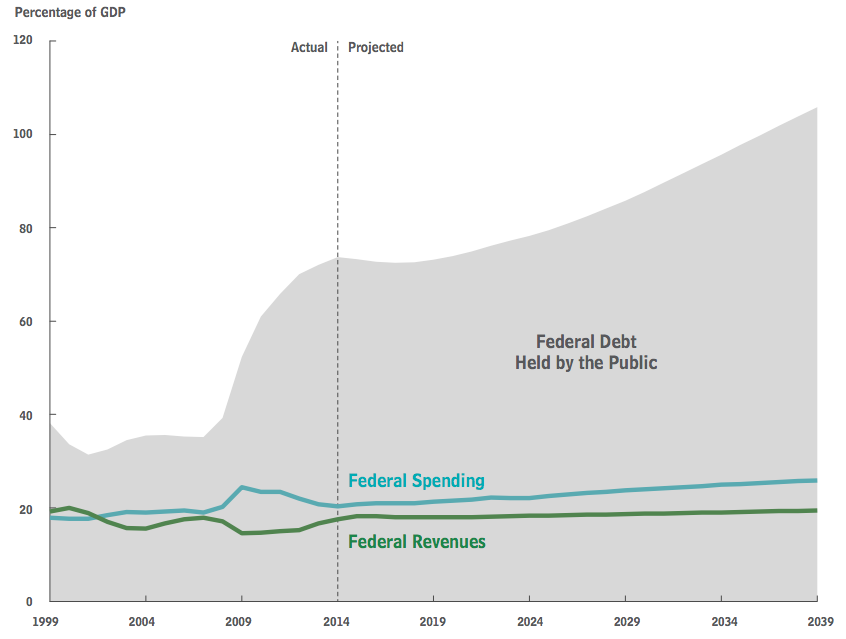
Yesterday, the CBO put out a new budget projection (pdf). Lori Montgomery summarizes:

For the 10-year period beginning in 2010, the estimated cost of Medicare and Medicaid — the government health programs for the elderly and the poor — has dropped by $1.23 trillion, according to revised CBO projections. In its latest look at the nation’s long-term finances, released Tuesday, CBO predicts that the savings will grow by 2039  to 1.5 percent of the economy — or, in today’s dollars, roughly $250 billion a year. That’s real money by any measure. But it’s not enough to brighten the CBO’s otherwise gloomy forecast for the next 25 years.

Besides the improved Medicare and Medicaid numbers, Andrew Smith finds “not much good news here”:

Under current law according to the CBO, debt will rise from 74 percent of GDP in 2014 to 80 percent of GDP by 2025, 108 percent by 2040, 147 percent by 2060, and 212 percent by 2085. These almost apocalyptic projections don’t even fully account for the scale of our predicament, as current law is held down by budgeting distortions, some benign and some gimmicky, like tax breaks that are projected to expire even though they’ll more than likely be extended and unrealistic cuts in Medicare reimbursement rates. As soon as 2039, the CBO anticipates a deficit of 6.4 percent of GDP.

Among William G. Gale’s take-aways:

The magnitude of the changes in policy needed to ensure that the debt-GDP ratio in 2039 returns to its historical average over the last 40 years – around 39 percent – depends on when corrective policies are initiated.

If policies were initiated next year, then it would take a cut in non-interest spending or an increase in taxes or a combination equal to 2.6 percent of GDP on an annual basis – about $465 billion in today’s economy. If we wait until 2020, it would require annual cuts of 3.5 percent of GDP. Twenty-five years may seem like a long time from now, but the longer we wait, the larger the changes will need to be.

Vinik sees the report as confirmation that taxes must go up:

We could make severe cuts to Medicare and Social Security. But that would undo decades of success in reducing the poverty rates for seniors. We could make severe cuts elsewhere. But all other federal spending outside of interest paymentsfrom the military to food stamps to agricultural subsidiesis projected to decline to a smaller share of GDP than at any point since the late 1930s. There is little room to cut there without causing serious damage.

That leaves one other option: higher revenues. Not just slightly higher revenues, but a lot higher.

But Pethokoukis argues the “the CBO report clearly states we cannot just tax our way out of this problem.”

[E]ven though revenue will rise 6 percentage points over historical levels, spending will rise by 16 points over historical levels. Record tax revenue, but also record spending. As I said, there’s your trouble.

Margot Sanger-Katz emphasizes the uncertainty of future Medicare costs:

C.B.O. points out that it can’t pinpoint the cause of the recent slowdown or its durability, which is why it’s not changing its fundamental view of where Medicare spending is heading over the very long term. “How long the slowdown might persist is highly uncertain,” the report says.

That’s probably smart. Even economists who are most enthusiastic about the recent numbers still aren’t sure whether the trend is here to stay.

also address the inherent uncertainty of these calculations:

A key question for economists and policymakers is how to think about this uncertainty: how should recognizing how little we know about the future affect our policy choices today? Some analysts believe that we should take action now to insulate us against the risk of larger-than-expected budget imbalances in the future. Others—particularly those who are very hopeful about future health cost growth—prefer “watchful waiting.”

Arabs Care About Gaza This Week

GazaTweets

“Has the Palestinian issue really lost its centrality to Arab identity or did it retain the latent power to galvanize Arab attention?” Marc Lynch asks. To try and answer that question, he took a look at Twitter trends:

Syria (in blue), which in 2012 and early 2013 consistently generated millions of tweets per month in Arabic, shows a relatively low level flat line. The shocking developments in Iraq (in green) galvanized attention in mid-June, and Iraq continues to attract more attention now than does Syria. But Gaza, after being virtually ignored for a long time, surges to dominate everything else once the conflict begins. Score one for the “latent relevance” hypothesis.

That doesn’t mean that nothing has changed, of course. Arab publics remain intensely divided and frustrated, while Arab regimes remain intensely repressive and more fearful than ever of popular mobilization. Sectarianism remains rampantly virulent, and the regional campaign against the Muslim Brotherhood can’t help but affect public sentiment toward Hamas (especially in Egypt). The Gulf states and their media seem to be replaying 2006, when they tried to buy Israel time to finish off Hezbollah.

But one of the lessons of 2006 was the limitations of such efforts: Hezbollah garnered widespread, intense Arab support for its struggle against Israel despite the Arab media’s coverage and the sectarianism generated by Iraq’s civil war. The solidarity generated by the killing of innocent fellow Arabs by Israel tends to overwhelm political divisions, even among those who blamed Hezbollah then or blame Hamas today for the war.

“Public Health Nativism”

Anti-Immigration Activists Protest Arrival Of Unaccompanied Central American Children To Housing Facility

The largely unsubstantiated concern that the Central American migrant children are carrying infectious diseases is fast becoming a trope among Republican lawmakers. It was given an airing on the O’Reilly show last night. “The fact that this rumor is circulating at all,” Jesse Singal comments, “can still tell us some interesting things about the way human beings are wired to view outsiders”:

Erin Buckels, a researcher at the University of Manitoba who has studied this issue, explained in in an email that both her work and a great deal of prior research has “demonstrated a strong and automatic tendency to dehumanize outgroup members, even when we have no prior experience with those groups.” Notions of pollution and infection loom large here: We often “view outsiders with disgust — partly due to the risks of infectious disease that outsiders carried in our evolutionary past — and this causes a conservative shift in our thoughts and attitudes.” So unfamiliar people “are seen as closer to animals than humans, and therefore pose a danger to our bodies (and even our souls).”

This is basically a universal human impulse — every time you read a horrific story about a young couple being murdered for a relationship that stretches across sectarian or class or caste lines, that’s part of what’s going on. In certain contexts, people just can’t stand the notion of being “infected” by outsiders — and infection can mean anything from “them” crossing “our” border to members of an undesirable class having sexual relationships with “our” daughters — to the point where they will kill people to prevent that infection from occurring.

But Samuel Kleiner is blunter, calling the claim another example of America’s long, ugly tradition of “public health nativism”:

Doctors have debunked claims of diseased-ridden children: The migrants tend to be middle class with updated vaccines. By engaging in this right-wing fear-mongering, the aforementioned elected officialsand many othersare earning their ignominious place in a long, ugly history in American nativism that demonizes immigrants under the guise of public-health concerns.

With each wave of immigration, nativists have made public-health excuses for keeping out migrants. In the 1830s, cholera was described as an “Irish disease,” and in the late 1800s Tuberculosis was portrayed as a “Jewish disease.” In 1891, Congress banned any immigrant “suffering from a loathsome or dangerous contagious disease.” Even at Ellis Island, a site we celebrate as America’s front door for the “tired and weary,” medical inspections were a weapon aimed at immigrants who traveled on second and third class and were commonly used to quarantine and turn back unwanted immigrants.

And then as recently as 1993, the HIV ban was instigated to prevent gays and Haitians from entering the country. It took almost twenty years to repeal and replace it.

(Photo: An anti-immigration activist stands next to a Pinar County Sheriff’s deputy during a protest along Mt. Lemmon Road in Oracle, Arizona in anticipation of buses carrying illegal immigrants on July 15, 2014.  About 300 protesters lined the road waiting for a busload of illegal immigrants who are to be housed at a facility in Oracle. By Sandy Huffaker/Getty Images.)