An Era Of Government Failure

We’re living through it:

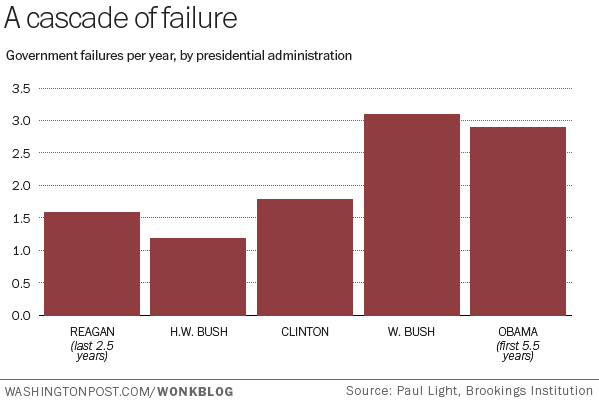
government failure

Ingraham and Hamburger unpack Paul Light’s study:

Two factors complicate the failure rate under Obama. The first is that many of the missteps under Obama had their roots in the Bush administration. That administration “could have fixed the information technology systems that led to the healthcare.gov and veterans breakdowns, but didn’t. They could have fixed the civil service system that led to the problems in the Secret Service and the General Services Administration, but didn’t. And of course they could have fixed some of the policy problems that led to the 2008 financial collapse and the West, Texas fertilizer plant explosion, but didn’t.”

The other factor is the level of fierce Congressional opposition Obama has faced in office.

Light writes that political polarization is “a grand contributor” to the rise in government failure. But he notes that Democratic contributions mostly take the form of neglect and omission – they ignored “the slow decimation of government capacity, and refused to embrace the need for bold thinking on how to improve its performance.”

Republican contributions to government failure, on the other hand, have been “very deliberate.”

On the same general topic, Leonhardt gleans insights from Peter Schuck’s Why Government Fails So Often: And How It Can Do Better. One part of the solution:

Rigorous evaluation, randomized trials and social impact bonds will never stir the political passion that calls for universal health insurance or lower taxes do. If anything, measurement and accountability are destined to provoke more opposition – from interest groups that have something to lose – than support. (This opposition often takes the form of, “Measurement is hard,” as if that were a reason to skip it.)

But in a divided country, where Congress only rarely passes far-reaching legislation, a more effective government may be the best way for both sides to get more of what they want: a government that is limited enough to protect individual freedom and ambitious enough to improve people’s lives.

Update from a reader:

Honestly, what the fuck is that study supposed to mean? The government failed “2-3” times per year under Bush and Obama? If there was ever a study that meant nothing, that was entirely dependent on starting assumptions, this is it. You could quite easily say the government failed zero times, because we maintain the constitutional form and have not fallen into Somalia-style anarchy; or you could say it failed hundreds of thousands of times a year, because, e.g,, the passport office fucked up my application.

A quick glance at his methodology shows the study is really looking at popular media characterizations of stories they claim represent government failure, but even then, it’s subjective to the point of meaninglessness.

Forced To Marry At 15

Naimeh Doostdar highlights a troubling trend in Iran:

According to research conducted by [the advocacy group Justice for Iran], which covers 2006-2007 and 2013-2014, the rate of marriage for girls below 15 years of age is on the rise. Statistics published by Iran’s National Organization for Civil Registration reveal that, between March and December 2013, more than five percent of married females were below the age of 15. The same figures reveal that, among the registered marriages in Iran, more than one third of women were below the age of 19.

But these are official figures only, provided for registered marriages. There are strong indicators that the actual numbers for underage marriage are higher, especially because the statistics released by the government do not include those marriages entered into by young women aged between 18 and 19.

Why is underage marriage on the rise in Iran? There are a number of reasons:

tradition and religious culture are two major factors. Some families believe an early marriage can protect them: their daughters will not have the opportunity to be led astray, bringing shame and dishonor to the family. In other cases, poverty plays a role: a daughter is simply sold off for money because her family cannot afford to feed her.

In parts of Iran, some believe that children must be sacrificed to forced marriages in order to maintain tribal bonds. Among some of these communities, there’s a traditional belief that a girl should not menstruate while still living in her father’s house. In bigger cities, these traditions manifest themselves differently. One family marries off a young girl because she has been reading a romantic novel, while another girl is forced into early marriage because she has been caught talking to her boyfriend on the phone.

Girls living in urban areas tend to reject the idea of underage marriage—but it seems that the official view is somewhat different. Some prominent public figures—among them former president Mahmoud Ahmadinejad—have tried to normalize or even promote underage marriage, viewing it as somehow beneficial to society. In 2009, when the average age of marriage rose to 24 for women and 26 for men, Ahmadinejad made his views known: “I believe that the right age of marriage for women is 16, 17 or 18, when girls have just blossomed.”

So Pew Me

Some readers follow my lead in taking the political typology quiz from the Pew Research Center:

That Pew test is pretty funny; apparently thinking that government isn’t evil, that environmental protection is important, that the government should help the poor, whether pewit is possible to be moral without God, that “homosexuality” (quite a different thing even from marriage equality!) is “acceptable,” and that immigrants “help American society” all make one a member of the “New Left.” I suspect that according to this test, Plato and Aristotle would be members of the “New Left” too!

I answered truthfully in all cases, refusing to “psychoanalyze” the quiz so as to make it make me show up as a conservative. I suspect that if the quiz had bothered to ask my opinions about what we should actually do about many of these problems, or about my opinions about abortion, I would no longer be a “New Leftie.” Yes, being anything but a frothing, racist, jingoistic, consumerist Rick Perry-style conservative stereotype apparently disqualifies one from being called a conservative.

One thing it has, however, made clear to me, is the enduringly exceptional character of the abortion question. I would be a pretty reliable liberal voter, if not for my profound moral reservations of the current liberal status quo on the abortion question. Oh, and I’m a “millennial.”

Another reader:

Whenever I take these kinds of quizzes I’m always thinking “yes, but …” – though the Political Typology Quiz you took has some questions that have me thinking WTF? Take this one for example:

Business corporations make too much profit or Most corporations make a fair and reasonable amount of profit

I’m like, my issue isn’t how much profit a company makes, I want them to make a lot of profit, my issue is how that profit is divided up between the employees, shareholders and the executives that manage the company.  So how the heck do I answer that question?

There were other questions I had issues with as well.  My issue isn’t that we shouldn’t be active in world affairs; it’s how we are active in world affairs and having an understanding of our limits in that regard.  On immigration, I think it makes us stronger, but I’d like to cut down on the uneducated low-skill immigrants and concentrate on ramping up our ability to brain-drain the rest of the world.

I scored a solid liberal, which isn’t surprising, though I think if the test was more nuanced I’d drift more towards the center.  They also didn’t ask about guns.  I’m sure that would have dragged me to the right.

Another:

I took it. Told me I was a “solid liberal” who probably voted mostly Democrat and loved Obama. Neither of which is true.

I never voted strictly Dem when I was living in the US. I was a reluctant Obama voter in 2008 and grew to loathe him and most of his policies, so much that I didn’t vote in 2012. His re-election (not that Americans had a choice really) was the push that decided me on giving up my US citizenship when I take Canadian citizenship (hopefully before the summer is over). Even here, where I am a card-carrying Liberal, I don’t support them provincially, and I’m a bit chagrined to say I even lean a bit Wildrose at times and occasionally think Mulcair would make a good PM.

It was a stupid quiz. Over half the questions should have had a “neither” choice or more accurately “it’s not that simple – unless you don’t use your brain for thinking much” option. But it was typical American, where everything is black/white.

Bah humbug.

Why Undertipping Makes You A Real Jackass, Ctd

Like Mr Pink:

Readers continue the thread:

I hope Dishheads aren’t overlooking the fact that institutionalized tipping constitutes a progressive – yes, progressive! – anti-jackass tax of sorts. Conspicuous consumption compels many of those who can best afford to subside service industry jobs to do so. Those who can’t, won’t, and let’s be honest: everyone goes into restaurants knowing what’s expected. Anyone who says they’re being lied to about bottom line prices is simply too proud to admit they’re being cheap.

Academics can argue until they’re blue in the face about the theoretical benefits of eliminating tipping, and perhaps higher-class restaurants where published academics like to dine wouldn’t be impacted as those staffs tend to be well-trained, experienced, and highly professional. But would you really eat at greasy spoons and dive bars where everyone was stuck working for the same wage regardless of performance? I sure as hell wouldn’t, and no one should underestimate the good vibes that come with knowing you’ve given a big tip to someone who truly deserved one, doubly so when you’re pinching your own pennies.

Another focuses on the issue of fudging income:

As one reader mentioned, many tipped workers under-report their tips, allowing them tax-free income. (I’ve always mildly resented how easy it is for the waiters I know to do this, but since none of them are getting rich waiting tables I don’t get too agitated about it.) However, there’s a real downside for the under-reporters that many of them (especially young people) rarely appreciate:

When they apply for a loan it is hard for them to prove adequate income, and when it comes time to collect Social Security retirement income they will show lower lifetime earnings and receive a smaller check as a result. In the big scheme of things I suspect most tip earners would be better off getting paid a regular minimum wage, perhaps with modest tips allowed as per the European approach.

Another refines an earlier point:

Your labor lawyer reader wrote, “The employer has to cover the difference to whatever the local minimum wage is, so any raises to minimum wage are also raises for tipped workers (e.g. once Seattle’s minimum wage reaches $15 per hour, employers will have to make sure their tipped employees leave with $15/per hour).” Point of fact: the state of Washington’s state minimum wage – higher than the national – does not include a tip credit. So a server makes regular minimum wage, plus tips.

Another has more on state laws:

There are a few states, including California, where tipped employees are subject to the same minimum wage laws as everyone else. When you go out to eat in these states, the social expectations in terms of tipping are exactly the same as everywhere else. I’m sure most people aren’t even aware that the law is different. So in this instance, yes, the restaurant is paying its servers more, but it does nothing to relieve customers of the additional 15- to 20-percent cost. (In fact, it may be more expensive to tip here in California because, as you pointed out, higher labor costs may lead to higher-priced menu items and we calculate tips as a percentage of those more expensive items.)

Another channels Mr White:

I will leave it to others to hash out the micro- and macro-economic pros and cons of tipping. I just want to give a little recognition to the waitresses – and it is almost always waitresses – slinging coffee, eggs, and pancakes on the breakfast shift in every town in the U.S. Working the breakfast shift is a hard, physically grueling job. But, because breakfast is cheap, breakfast servers are unlikely to make much in tips – even if people are tipping 15 percent. A good breakfast waitress can get the whole day started right. So, tip generously.

Criminally Bad Parenting

Lenore Skenazy defends Debra Harrell, a mother who was imprisoned for sending her nine-year-old daughter to a park alone:

Just because something happened on Law & Order doesn’t mean it’s happening all the time in real life. Make “what if?” thinking the basis for an arrest and the cops can collar anyone. “You let your son play in the front yard? What if a man drove up and kidnapped him?” “You let your daughter sleep in her own room? What if a man climbed through the window?” etc.

These fears pop into our brains so easily, they seem almost real. But they’re not. Our crime rate today is back to what it was when gas was 29 cents a gallon, according to The Christian Science Monitor. It may feel like kids are in constant danger, but they are as safe (if not safer) than we were when our parents let us enjoy the summer outside, on our own, without fear of being arrested.

Friedersdorf throws his hands up:

Statistically speaking, the South Carolina mother would almost certainly be putting her daughter in more danger if she strapped her into the car beside her for a hypothetical one-hour daily commute.

No one would arrest her for that. It wouldn’t surprise me if the child would more likely suffer harm sitting in a McDonald’s in front of a laptop, presumably eating fast food at least reasonably often, rather than spending summer days playing outdoors in a park with lots of parents. I can’t say with certainty that she’d be statistically safer. But neither have the South Carolina officials who arrested this woman.

Jessica Grose asked law professor Dorothy Roberts “if state laws give any specifics about how parents should behave.” Her response:

The short answer is that every state has its own child maltreatment laws and definitions of neglect—and they are all very vague with no specifics. Most include within neglect failure to provide adequate supervision. South Carolina’s child welfare law is actually more specific than most, but still doesn’t specify the age—”supervision appropriate to the child’s age and development.” But how does the judge/jury determine what’s appropriate? I don’t know of any law that specifies the age or the precise nature of failure to supervise.

Chait is disturbed how “reporters and onlookers alike are united in disgust at Harrell”:

America has decided to punish Harrell if she fails to acquire full-time employment; her employment does not provide her with adequate child care; and the community punishes her for failing to live up to unobtainable middle-class child-care standards. There are many perpetrators in this story. Debra Harrell was not one of them.

Balko connects Harrell’s arrest with recent stories about parents getting in trouble with the law for behavior such as leaving children in cars, as well as a recent case in which a mother was arrested for using narcotics while pregnant. Katie McDonough provides some context on the latter:

The Tennessee law is the first in the nation to charge a pregnant woman with criminal assault if she uses certain drugs, but remains part of a national trend that makes women vulnerable to detention and incarceration because of their pregnancies. An additional 17 states currently consider prenatal drug use a civil offense, South Carolina law handles drug use during pregnancy as child abuse, Alabama prosecutes pregnant women using a law intended to protect children from explosive meth labs and several statutes across the country have been used to the same ends.

The American Civil Liberties Union of Tennessee is currently seeking plaintiffs to challenge the law, and released a statement calling it “dangerous” and noting that the law “unconstitutionally singles out new mothers struggling with addiction for criminal assault charges.”

And Art Carden goes into more detail on the risks of leaving kids in cars:

According to this site, 623 kids have died from heatstroke from being left in cars since 1998. From the bar graph in the middle of the page, there doesn’t appear to be a clear upward or downward trend. The total from 1998-present is only about 3/4 of the number of kids who died from poisonings in 2010 alone. As tragic as these deaths are, it’s a mistake to say “if it saves one life, it’s worth it.” I wasn’t able to find data with a quick Google search, but my guess is that the risk of injury or death from a kid getting hit while walking in the parking lot–even while holding hands and looking both ways and all that–is as great or greater than the risk of a kid being injured while being left in the car.

“Kids dying in hot cars” looks to me like the 2014 version of the 2001 “Summer of the Shark” hysteria. It plays to some of our worst fears. It could happen to anyone. It ranks pretty low on the list of mortality risks, though.

A Failed Index

FSI

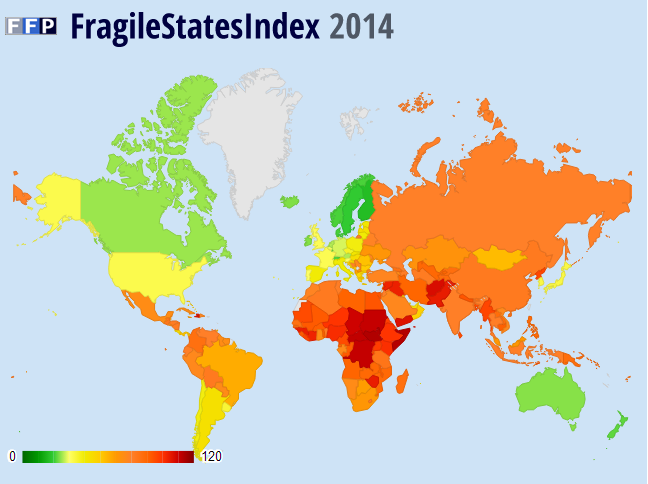
The Fund For Peace released the 2014 edition of its Failed States Index late last month, changing its name to the less pejorative “Fragile States Index.” Reviewing the extensive criticism the index attracts from academics and policymakers, Lionel Beehner and Joseph Young discuss some ways in which it could be improved:

For the tool to be useful, it should be predictive. Can we sort countries based on their susceptibility to certain undesirable outcomes? Yes, and probably better than just doing back-of-the-envelope guesses, which is what this arbitrary ranking essentially is. A look back at Ukraine’s 2013 score, for instance, gives no evidence that the country was about to be carved up. In 2010, states like Syria, Libya, Egypt and Tunisia fell into the same bracket as Brazil, Turkey, and Russia.

Another way perhaps to avoid its perennial failure at anticipating events is for the index to examine provinces, given the vast amount of sub-variation within countries. That might require a messier map of the world, but at least it would be more accurate (and account for what anthropologists call “alternatively governed” spaces).

A better a way forward might be to think about clustering countries.

The differences among countries may be ordered but any kind of exact ranking obscures the reality of the situation as the South Sudan/Somalia example demonstrates. Most reasonable people would say both states have serious internal (and external) threats, but ranking them reminds us of the obscure debates historians have over who was worse: Hitler or Stalin.  Those dictators might be in a category or cluster, which includes Pol Pot or Idi Amin, but ranking them is nonsensical.

Miles Evers argues that the FSI’s ahistorical, quantitative approach “misleads policymakers to believe that external intervention can be a proper reaction to rather than a cause of state fragility”:

The flaw with the FSI isn’t terminology. It is that its methodology masks the painful lessons of the past in a stale, numerical ranking of present circumstance. Claire Leigh rightly criticizes, “It gives us no clue why certain countries have the dubious distinction of topping the chart. It offers no policy prognoses or prescriptions.” With recent crises like the current ISIS incursion into Iraq putting the issue of unilateral intervention back on the table and giving think tanks greater currency in policy circles, this lacuna threatens to repeat history to the detriment of our own national interests, regardless of whether or not we call it a Failed or Fragile State. FSI’s name change serves as a reminder of how incomplete analyses can lead us to strategic blunders of the Vietnam and Iraq-type.

Psyched About CBT, Ctd

Judging by the in-tray, Dan was not the only one to notice the other meaning. On a more serious note, a reader writes:

I realize you’re trying to be balanced here, but Jenny Diski’s article makes it pretty clear she’s never actually tried cognitive behavioral therapy and is in fact just opposed to a political philosophy. I’ve been in and out of talk therapy for anxiety and depression all of my life, and my last therapist (not one specifically trained in CBT, as far as I know) pointed me toward The Feeling Good Handbook by David Burns, which is a do-it-yourself CBT manual. It helped to make me realize what I was thinking and which parts were really just in my head, and now at least some of the time I can short-circuit my own worst-case-scenario thinking. It has made me happier.

Diski dismissively says that “CBT aims to get the patient symptom-free, back to work and paying her taxes” – as though that weren’t the goal of other forms of therapy. Maybe I’m odd in that I’m happiest when I’m feeling productive, but that sounds like a pretty excellent goal to me.

Another also shares his story:

I’m a 30-year-old who just finished my 16th week of CBT after a suicide attempt in March.

I have found that working with my therapist on identifying thought patterns and behaviors surrounding my depression and anxiety to be of tremendous help. One of the best things to which I can compare my thought pattern when I begin to feel anxious or depressed is sliding down an icy hill in a car. Having the skills from CBT is like having just come out of a driving class and knowing that while you might not be able to stop the slide completely, you can control it and avoid the crash. The ability to pull back and distinguish what-I-know from what-my-mind-is-projecting is a skill that I lacked before therapy.

But as well as it does work for some of us, it’s not a silver bullet either. In addition to the CBT I am also taking a daily antidepressant and the occasional anti-anxiety pill when I can anticipate that certain situations are too much to handle on my own. My therapist is terrific, and we’ve adjusted the antidepressants when the first prescription wasn’t working as planned.

Another:

As the guy who wrote this reader email long ago, I thought I’d discuss my experience with cognitive behavioral therapy.

I have OCD, with an emphasis on the obsessive thoughts. To put it bluntly, CBT is the most effective treatment for obsessive thoughts that I have had. The counselor I had was a Buddhist and definitely not a “I’m going to make everything happy and great for you” kind of guy. In fact, one of the key elements of the CBT I had was acceptance of the obsessive thoughts. This is counterintuitive, because if you have OCD the number-one thing you want to do is get rid of the obsessive thought.

If I have a thought that I’m like Hitler, CBT teaches me to accept it like a leaf that passes over me as I lie in a stream. This is bitter medicine, because one’s instinct with a thought like that is to fight it over and over and try to rationalize it and thus rid yourself of it. But one of the key insights of CBT is that you cannot rationalize or “defeat” the obsessive thought. In fact, the only way I’ve found that you even move past the obsessive thought is if you allow it to exist within you. It will bother you immensely while it’s there. But when you mindfully acknowledge it rather than try to get rid of it, you do find that your mind moves on to more pleasant things.

My one criticism of CBT is the limited number of sessions. It’s admirable not to want to charge people money for endless counseling, but I have found it valuable to get a “tune up” once in awhile. Talking to a CBT counselor is helpful, and I don’t think should be cut off forever after just a couple of months.

My experience, of course, may not be universal for others with OCD. But I thought it was worth sharing.

Paying For The Chill

Iced coffee was already more expensive than hot coffee back in 2012, but prices keep climbing. Gabrielle Sierra explains why the cold brew can cost as much as a cocktail:

Iced coffee costs come from all sides, with the most obvious also being the easiest to overlook: the ice. “People think ice is free,” says Michael Pollack of Brooklyn Roasting Company, where a 24 oz iced coffee is currently $4.50. “Ice is a fortune. If you think we go through coffee fast, double that for ice. We actually store ten gallon refrigerator boxes of ice, because our needs are so tremendous.”

But the rising cost of beans – more of which are needed for cold coffee than hot – is also to blame:

In May, the New York Times went into detail about a coffee fungus that attacked fields in Central America, leaving less product to purchase. And fungus isn’t the only way mother nature is striking back at coffee lovers. According to Forbes.com, “The price of Arabica coffee beans has surged almost 100% from a level of 106 cents per pound to around 220 cents in mid April, due to tight supply as a result of prolonged drought in Brazil, followed by recent floods.”

And no doubt baristas are able to get away with charging more for iced coffee during the hot summer months. So if you need to save money on the surging price of coffee, you could always join the half of the world population that prefers the instant kind:

Americans have proved pretty exceptional in their utter disinterest in warming up to the most convenient method of coffee-making. “The U.S. is entirely unique in its aversion to instant coffee,” [industry analyist Dana] LaMendola said. “Even in Europe, where fresh coffee is preferred, instant coffee is still seen as acceptable for at home and on the go consumption. In the U.S. the view is just much more negative,” she said.

Instant coffee sales in the U.S. have barely budged since 2008, and even fell marginally last year to just over $960 million. While that might sound like a lot, it’s actually a paltry fraction of the $30-plus billion U.S. coffee market. Instant coffee accounts for a smaller percentage of all retail brewed coffee by volume in North America (barely 10 percent) than in any other region. By comparison, it accounts for over 60 percent in Asia Pacific, over 50 percent in Eastern Europe, over 40 percent in the Middle East and Africa, over 30 percent in Latin America, and over 25 percent in Western Europe. …

Americans might like their coffee fast, but that doesn’t mean they want it instant.

Update from a reader who has his own method for homemade iced coffee:

It’s a lot easier than you might think.  Here’s what I do:

1) Buy whole coffee beans and grind them yourself, in a fairly coarse ground.  I like to use the big grinder in the grocery store (usually in the bulk coffee area), and use the “French press” setting.

2) Get a big glass pitcher (I use a big, tall “margarita pitcher” that cost @ $8 at Walmart).  Put anywhere from 1.5 to 2 cups of ground coffee into the pitcher.  Fill it with cold water, give it a stir.  Cover the top with something like aluminum foil or plastic wrap.

How long to “brew?”  I find that if you let the coffee sit in the grounds for longer than, say, 18 hours, you start getting a lot more bitterness than you’d probably like.  I generally make my coffee in the morning, let it sit in the fridge all day, and then strain it in the evening.

3) I use a fine mesh metal strainer and a big plastic pitcher (“dollar store” of your choice).  Put the strainer over the plastic pitcher, and pour out the contents of the glass brew pitcher.  I use a big metal spoon to stir things around before I pour, and to scoop out the grounds into the strainer.

4) Once the brew has worked it’s way through the strainer, I then pour it, a little at a time, through a Melitta Ready Set Joe cone drip filter.  I set the filter on a couple of big, tall, wide-mouth glasses (about 16-20 oz. each).  I let the strained brew work its way through the paper filter, down into the glass.  When one glass is almost full, I move the drip filter onto the other glass.  The full glass is then emptied, via a cheap plastic funnel, into a heavy glass milk jug from the local dairy down the road.  I hold a couple of these back during the summer, rather than returning them to the grocery store for deposit.  Both the jugs and the little plastic caps hold up well through repeated trips in the dishwasher.

It should be noted that steps #3 and #4 take up most of an evening – but I don’t stand there watching the coffee, either.  I might start step #3 at 7:00, and start step #4 by 7:30 or 7:45.  That last step really goes slowly, but I just enjoy the evening with my family, and every 15-20 minutes, I go into the kitchen to pour more brew out of the plastic straining pitcher, into the cone filter.  By the time I top off the cone filter for the last time, it’s time for bed, and I just leave that last one sitting on the counter overnight, and add it to the jug in the morning.

I “brew” this coffee maybe 2-3 times a week, depending on how often my wife decides to help herself to a cup.  Every morning, I take my 24oz. Tervis tumbler … pour in a cup of lowfat milk … and top it with my iced coffee.  The milk is a good source of calcium, and I find that I only need a very small amount of sweetener, if any at all.

Honestly, I’ve never done any kind of “cost analysis” on this.  I can say that a big bag of bulk ground coffee will fill up three, maybe four pitchers.  Figure that bag of ground coffee costs $9, that’s $2.25.  And I make that three times a week … and each “jug” will last me three or four mornings.  Cost of a cup of milk?  Maybe 25 cents?  Not counting the cost of refrigeration, I’m still beating the hell out of Starbucks, don’t you think?

One last thing:  I don’t use ice; rather, I fill up a Tovolo King Cube mold with my brew, and float one huge cube in my tumbler each morning.  The supersized cube lasts two, three hours… and as the morning goes by, my coffee drink gets a little stronger, not weaker.  ;)

That’s what I do.  There are, of course, dozens of web pages, YouTube videos etc. that offer up their own methods for doing something like this.  Bottom line:  Make it yourself at home.  You’ll get a better product than any instant or canned option, and it’s really good.

Another:

That iced coffee method from a fellow reader was some serious Rube Goldberg shit. Here is a similar method in spirit, but ultimately much easier way to make good iced coffee at home.

1) Purchase a French Press – they’re reasonably priced and versatile since they obviously make excellent hot coffee (so you can use it in the winter).

2) Using coarse ground beans, put about 50% more than you’d use for making hot coffee in the press; the specific amount will depend in the size of the press and your preferences but indeed more coffee is necessary to prevent a weak final product. Then pour cold water over the grinds. Still thoroughly with a wooden spoon (the grinds will float in a thick, kind of gross slurry until heartily stirred). I do this not much later than 10:00pm. It takes about 2 minutes at most.

3) Cover the coffee and put the French Press in fridge without pressing the coffee, allowing it to cold brew overnight.

4) Take it out in the morning and press the coffee – done! Cold, very tasty iced coffee. I’ve found generally similar results with somewhat varied brewing times, but a minimum of 8 hours seems necessary.

While I appreciate the other reader’s resourcefulness, I think the purchase of French Press is more than justified by the savings in time and effort. Hope this is modestly helpful.

P.S. I’m a subscriber, just in case you’re curious.

The Astonishing Actual History Of The Gay Rights Movement

AIDS project

[Re-posted from earlier today]

I don’t care for the “right side of history” argument with respect to gay rights for a few reasons. It’s horribly condescending to people who have a sincere view against gay equality; it presupposes some sort of inevitability where there isn’t any; and it fails to understand the nature of history. History is never as dull as the concept of “progress” would have you believe. It is always, as Oscar Wilde once put it, crowded with incident.

In no case is this truer than for gay America. Our story, if presented as a Hollywood screenplay, would be dismissed as too outlandish, too melodramatic and implausible, to be taken seriously. And yet it happened, and remains with us – so close it is hard to see it, and with several sharp twists and turns.

ONE-1963.06From the extraordinary repression of the 1950s – the McCarthyite era when all gay people were threats to the republic – to the liberation of the 1960s and the frenzied libertinism of the 1970s, you had one powerful narrative. After centuries – no, millennia – of brutal sanctions against the love of one man for another, an unprecedented, ebullient flowering took place. In small enclaves, an openly gay culture began to thrive and express itself with all the understandable abandon of the suddenly free. It was still very much a subcurrent, among so many other social shifts in that era, and was surrounded by hostility and discrimination and stigma. But the sense of outsiderdom partly intensified the joy and the solidarity. The gay ghettoes of the 1970s and early 1980s did not much care about the world beyond them for a while. Freedom – even in one, small place – was exhilarating enough.

And then the plague. It is, quite simply, impossible to conceive of a more dramatic reversal. If gay men had finally struggled free from the internalized notion that they were sick, or enemies of God, or all but asking for divine retribution for their sins, that paradigm closed in with terrible, ironic ferocity. What else could explain a plague of that brutality and specificity but the wages of Satanic perversion? Jerry Falwell could not have dreamed of a more perfect scenario. Pat Buchanan, with his usual flair, intoned that the gays had declared war on nature and nature had therefore declared war on them. And in some dark way, many of us were tempted to believe it.

It would be absolutely understandable if gay men had simply collapsed under the weight of this paradigm. Some quietly did, their deaths hastened by shame and self-loathing and anger. “Tell my mother I hate her,” was one of my dying friend’s last wishes, as he languished alone in his hospital bed. My closest friend at the time both showed extraordinary courage in the face of his physical disintegration and yet also 400px-Aids_Quiltpainted on his naked back the words “Diseased Faggot.” The horror of the disease was compounded a million times by stigma. But the plague was also simply terrifying and terrorizing. No one knew what medieval bacteria would suddenly destroy his brain or liver or digestive system. No one knew who would be next.

I remember the intensified Provincetown summers of the early 1990s, where I had come to learn how to die. Each year, the band of infected brothers would come together and talk medications, buyers’ clubs, and drug trials, and care for the sick and mourn the dying and go to countless memorial services for the steadily mounting dead. (I suspect I will never go to as many memorial services in my seventies, if I last that long, as I did in my early thirties.) Some of us were intermittently crippled by the huge doses of experimental drugs we were then taking to keep the terror at bay. But we got past the nausea and the night sweats and the diarrhea to try and live before we died. We had a ramshackle night club in an abandoned house on Shank Painter Road, which we called the “Love Shack.” And every time you danced there with someone, you lost yourself in the eternal present, acutely aware that they might not come back next year, or you might not. It gave everything an intensity, a vividness, and an astonishingly fearful mindfulness.

Yes, medical progress was there, if tantalizingly distant for more than a decade. But in a perverse twist, as the medical gains fitfully continued, the deaths mounted. The worst year for deaths from AIDS was 1995 in a plague that had begun fifteen years before. And then, just as it seemed it couldn’t get worse, came the bewildering news of the breakthrough in treatments, the joy of those suddenly become Lazarus, and the deeper grief we had put off until the emergency was over. I sank into a deep depression that I subsequently came to understand as survivor guilt. Others – given a new lease on life but utterly bewildered about what to do with it – turned to drugs and sex and oblivion. Someone once observed that the members of ACT-UP after 1996 had three fates: they were either dead, crystal meth addicts or professional AIDS activists. What we had experienced during our most formative years simply made living hard, terribly hard, in the wake of survival.

Walter Armstrong has a wonderfully perceptive piece about this phenomenon that I recommend highly. The sexual oblivion of meth had its greatest appeal and took its greatest toll on the survivors:

Crystal methamphetamine took hold in urban gay communities in the late 1990s, soon after the first effective HIV drugs converted many death sentences and restored our generation to so-called normal life. Caring for the sick, burying friends and lovers, mourning the loss of entire sexual and social networks, and protesting in the streets had consumed much of our youth. Investment in the future, career building, saving money and all the other rigmarole of a middle-class US life had been jettisoned. The end of the crisis also meant an end to the intense sense of purpose and solidarity. Normal life could not compete.

As with other populations struggling with PTSD, a minority was collectively committing suicide, after surviving a war.

All of this was understandable, even predictable, given the powerful pressures crashing in on gay life. What was entirely not predictable is that the survivors also did something astonishing. Using the institutions and self-knowledge and smarts that had somehow defeated the plague, gay men charted a future when nothing like this would happen again, when gay men would never be parted from their spouses on their death beds, when gay men’s physical and psychological health would never be treated as insignificant, when gay men would never suffer the indignity that so many endured in front of our eyes. And so we built the case for marriage equality and for open military service as a recognition of the self-worth our survival had given some of us, and to pay some kind of tribute to those who had fallen.

We went, in other words, from about the deepest hole you can imagine to a determination not just to get out of it, but to see the mountaintop in our lifetimes. I do not know exactly where this act of will came from. It was not inevitable. It was, in fact, highly improbable. A few generations of licking of wounds would have been understandable. So would a collective in-turning in grief and pain and memory. But it didn’t happen. And today, we look out at that mountaintop … and may be forgiven for feeling vertigo.

Within the next few years, it is perfectly possible to conceive of an America in which marriage equality exists in every state and in which HIV is on a fast track to disappearance. If I had told my best friend before he died that this would happen in twenty years, his eyes would have widened into saucers. And we talk so much about how this has changed America, that we don’t often examine how it has impacted gay men themselves – how it is possible psychologically and emotionally to have come from such depths to such heights in so short a period of time, and stay sane and balanced and happy.

The younger gay generations know nothing of it, of course.

Because gay kids do not have gay parents, by and large, they have not been told stories of the dark days of courage and cowardice, and of unspeakable devastation and trauma. The average gay 22 votingyear-old today simply assumes that marriage is his civil right, and has only passing interest in how it came about. As for the AIDS years, he is about as informed as the average straight guy. And this is not a bad thing as such. The whole goal of all this ordeal was to create a world with only the trace of a robust equality, and not of lingering and persistent pain.

And yet the trauma of plague still reverberates in our heads – and that includes the young as well as the old. Sex for most of us has always been synonymous with fear – and that fear has had remarkable resilience over the decades, even as the reasons for it have waned. In another new must-read, Tim Murphy shows how this overhang is still with us, even for those who never went through the trauma of the worst years:

Over coffee and pie at the Blue Stove in Williamsburg not long ago, Adam, 33, a writer and filmmaker I know, mentions that he is exactly the same age as the pandemic. “The terror was at its height when I was coming of age, postpuberty,” he says. “The message from TV shows that was drummed into us as gay boys was that we could get this disease and die and make our parents very sad. I developed this intense fear when I was having sex with someone and not even doing anything risky. I’d still freak out the next day.”

And, of course this did not just make all sex fraught with anxiety on both sides, it also divided us into two camps, the positive and the negative. For a while, I vowed never to date someone negative, and sought sex partners online via HIV-positive sites. And within the HIV world, I often left condoms behind, as impediments to the full sexual intimacy I craved and to the HIV solidarity rubber-free sex generated. And then I was famously dragged out in public and shamed for this by HIV-negative activists who opposed my politics. It was a sign that the negative-positive divide was still deep and US-JUSTICE-GAY-MILITARYoccasionally vicious. It still is. On the hook-up and dating apps, you see the following phrases all the time: “Drug/Disease-Free For Same”; “Clean”; “Negative for Same”. Since no one has tangible instant proof of being HIV-negative, it’s not particularly effective in HIV prevention. But it instills the divide that has stalked gay men during the plague and after.

But that too is now collapsing. The revolution of the last couple of years is a Rubicon. We now know that any HIV-positive man on meds is no more infectious than someone who is HIV-negative. We also know that an HIV-negative man who is on Truvada cannot get infected. This means that there is no more HIV divide in the gay world – or rather that its empirical basis has just been completely erased. Which means, quite simply, that gay men for the first time since 1981 can live without fear of HIV if they so wish.

And this of course is just one more bewilderment. As we adjust to marriage equality and all that comes with it, we are suddenly offered the chance for an infinitely less anxious and less dangerous sex life as well. Men whose entire sexual identities have been wrapped, literally, in rubber, now have to navigate an entirely new world. Of course there is resistance:

Another HIV longtimer—a Chelsea store manager named Steve, 58, diagnosed in 1996—tells me frankly that, though he supports Truvada usage in theory, it mostly just pisses him off on a visceral level.

“I was at the Eagle a couple months ago,” he says, referring to the West Chelsea leather bar, “and this hot little muscly Latin guy told me that he was on PrEP and that I could fuck him raw. Boom, he just said it so easily.” Steve has lost many people he loved to AIDS. He finds even the effervescent celebrations of Gay Pride tough to witness. “I want people to understand why they’re able to take this right now,” he says. “It’s on the backs of people who have died and suffered. All that needs to be learned and honored.”

It does indeed. But I have no doubt that the beleaguered gay men of the early 1990s would be amazed and thrilled that we have come this far. They did not die hoping that their legacy would be sustaining fear in future generations for ever.

But bewilderment is not out of place. I think of the year I arrived here, and had to sign a box in my immigration form denying that I was a “communist”, “criminal” or a “homosexual”. In that year, 1984, the AIDS epidemic was just beginning to stalk the land, culling, by the time it US-JUSTICE-GAY-MARRIAGEwas finally stymied, five times as many young men as died in the Vietnam War in roughly the same amount of time. I remember the exhilaration of coming out in the 1980s and the terror of watching men my own age die horrible, humiliating deaths in front of me. I remember finding out that I was HIV-positive and immediately knowing that, for that reason, I could be deported instantly, and living in America in that limbo for twenty more years, with no guarantee of success. I remember the deaths of my friends and lovers; and the shift in 1996 as long-term survival seemed possible for the first time. And I remember the countless speeches I would give to gay audiences about marriage equality, and the glassy-eyed, incredulous stares that came back at me. I remember my military friends, in constant fear and trepidation, fired at will, struggling to square their often conservative dispositions with a sexual identity that labeled them “queer.”

I remember … and I forget. I forget because in many ways, forgetting is the only way I can actually live with some measure of freedom from a past that will never let go of me and a future that still blinds with the abundance and clarity of its light. I am not alone. We are on this mountaintop together, even as so many dead lie round.

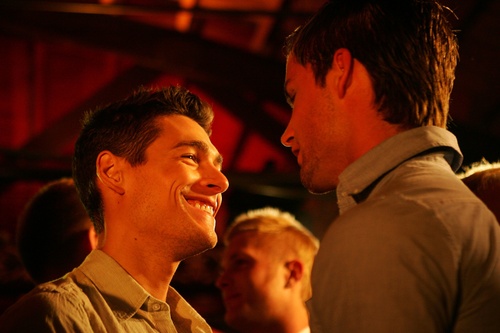
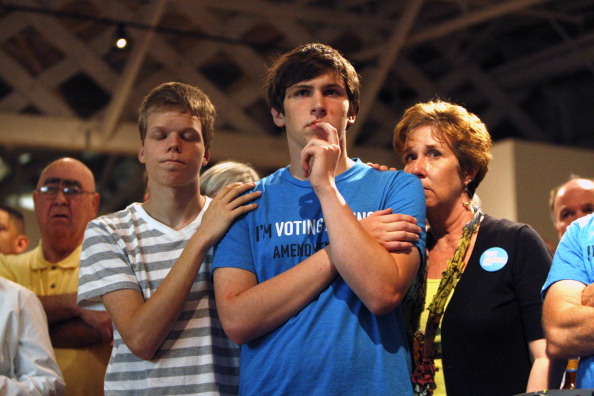
(Photos: The cover of One Magazine, June 1963; Dr. Richard DiGioia goes to George Washington Hospital to check on his patient, Tom Kane, on September 25, 1992. Kane is deaf. Dr. DiGioia hugs Kane before leaving. By James A. Parcell/The Washington Post via Getty Images; Thousands of people gather to view the AIDS Memorial Quilt on display on the Washington Monument grounds 10 October, 1992 in Washington, DC. By Renaud Giroux/AFP/Getty Images;  A couple participates in a symbolic group commitment ceremony for same-sex couples to kick off National Gay Pride Month at The Abbey bar and restaurant on June 4, 2008 in West Hollywood, California. By David McNew/Getty Images; Seth Keel, center, is consolded by his boyfriend Ian Chambers, left, and his mother Jill Hinton, during a concession speech during an Amendment One opposition party on Tuesday, May 8, 2012, at The Stockroom in downtown Raleigh, North Carolina. Amendment One, which would ban gay marriage in the state, was well ahead at the polls. By Travis Long/Raleigh News & Observer/MCT via Getty Images; Former US Army Lt. Dan Choi (L), a gay rights activist and opponent of “Don’t ask Don’t Tell”, arrives at the E. Barrett Prettyman Federal Courthouse March 28, 2013 in Washington, DC. By Brendan Smialowski/AFP/Getty Images; Michael Knaapen and his husband John Becker react outside the US Supreme Court in Washington DC on June 26, 2013. By Mladen Antonov/AFP/Getty Images.)

Vocal Cords With Character

Emily Mullin describes how developing a voice disorder altered her sense of self:

A few months after the onset of my strange symptoms, I was diagnosed with spasmodic dysphonia, a rare neurological disorder that causes muscle spasms in the vocal cords and affects one to four people in 100,000, according to the National Institutes of Health. The result is choppy, unstable speech quality. I was told there was no cure but treatment was available in the form of voice therapy and shots of botulinum toxin, or Botox, directly into the vocal cords. But even with treatment, my doctor told me that my voice would never be the same again. I had lost my voice.

Like other physical characteristics such as height, weight, and hair color, our voices help identify us.

The sound of our voice influences how other people perceive us—possibly even more than the words we actually say. “Our voice is our ambassador to the rest of the world,” says Dr. Norman Hogikyan, director of the University of Michigan Health System Vocal Health Center. “Often a first impression is based upon a person’s voice.” For people with voice disorders, a part of our identity is stripped away. Our weak voices can be unfairly associated with emotional sensitivity, a lack of confidence, lower intelligence, and sometimes, physical illness.

Meanwhile, Adam Clark Estes discusses how becoming partially deaf affected his relationships with others:

I got pretty good at reading lips. I got great at nodding and smiling. I found myself always retreating into music, because good ear buds would pump sound waves straight past my broken ear drums, past those tiny bones, and straight to my brain by way of the auditory nerve which, luckily, managed to remain intact despite the infections. Bass felt good, because I could feel it.

My reality was a quiet one, peaceful even. The busy streets of Brooklyn never bothered me at night because I simply couldn’t hear the car horns or the garbage trucks. It was easy to stay cool in tense conversations, because it simply didn’t register when people raised their voices. Maybe I did become a little brusque over time. But I was luckier than many people with hearing loss. My right ear was in better shape than my left, and I leaned on it like a crutch. When walking down the sidewalk, I made it a habit to keep people on my right side. I figured out how to get by, but I was constantly thinking about my hearing loss, as I tried to piece together conversations from muffled voices.