23 – 1

Tensions Remain High At Israeli Gaza Border

As we enter yet another phase in yet another bombardment of Gaza, I find myself nodding my head to much of Roger Cohen’s latest column (he’s been on a splendid roll lately). Part of me doesn’t want to look or write about it, because there is little point. There is even less of a point in actually trying to defend the Palestinians or to express grief that so many are being killed by Western armaments.

Hamas has indeed made itself again a pariah – for its refusal of any cease-fire, for its desperate aggression with its hundreds of largely useless but still traumatizing rockets, and for its cynical preparedness to allow civilians to die in the rubble made by the Israelis, as they “mow the lawn” yet again. On this subject, the world is full of passionate certainty, and it is a fool’s errand to care.

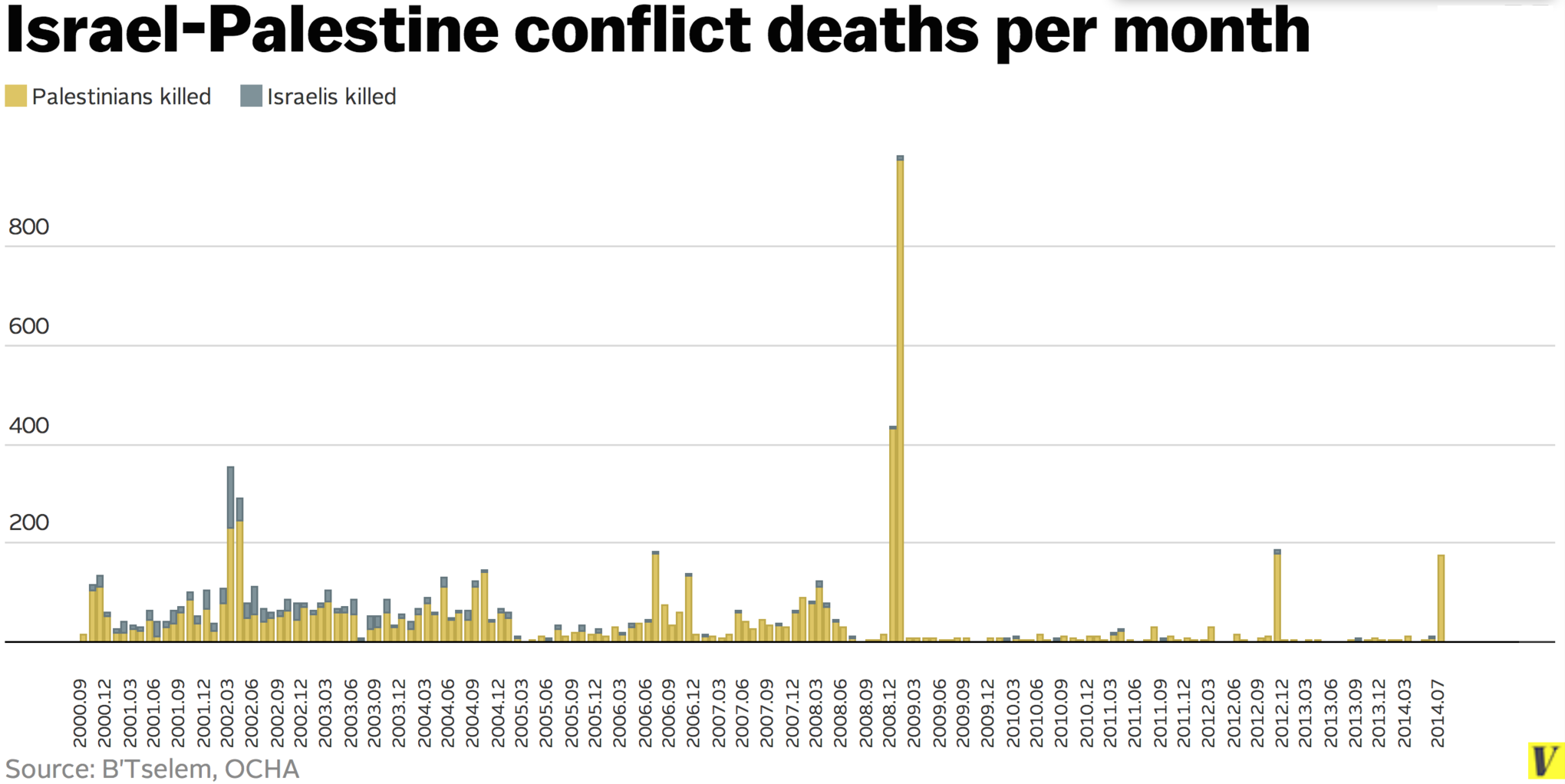
But I cannot help myself, because I do care. And, yes, I’m aware of the now-exhausted arguments about proportionality. We have gone over this once before in the 2009 Gaza war. But my view remains a relatively simple one: when one side has overwhelming military, economic and diplomatic superiority, it is not now and never has been a fair fight or a just war. And the fatalities on both sides prove that in staggering ways:

IP_conflict_deaths_total

Max Fisher notes that since January 2005,

when the conflict began to change dramatically, it has killed 4,006 people, of whom 168 have been Israeli and 3,838 Palestinian. That means that, since January 2005, only four percent of those killed have been Israeli, and 96 percent Palestinian. Since January 2005, in other words, the conflict has killed 23 Palestinians for every one Israeli it claims.

That is why when I hear Israeli outrage at the devastation of Israel’s security and peace by the latest Hamas offensive, it sounds to me like over-compensation. Yes, many are indeed traumatized by sirens and drills and rockets. I do not mean to minimize that or the Israeli deaths and injuries – but it is objectively infinitesimal compared with the living terror under which Gazans now live.

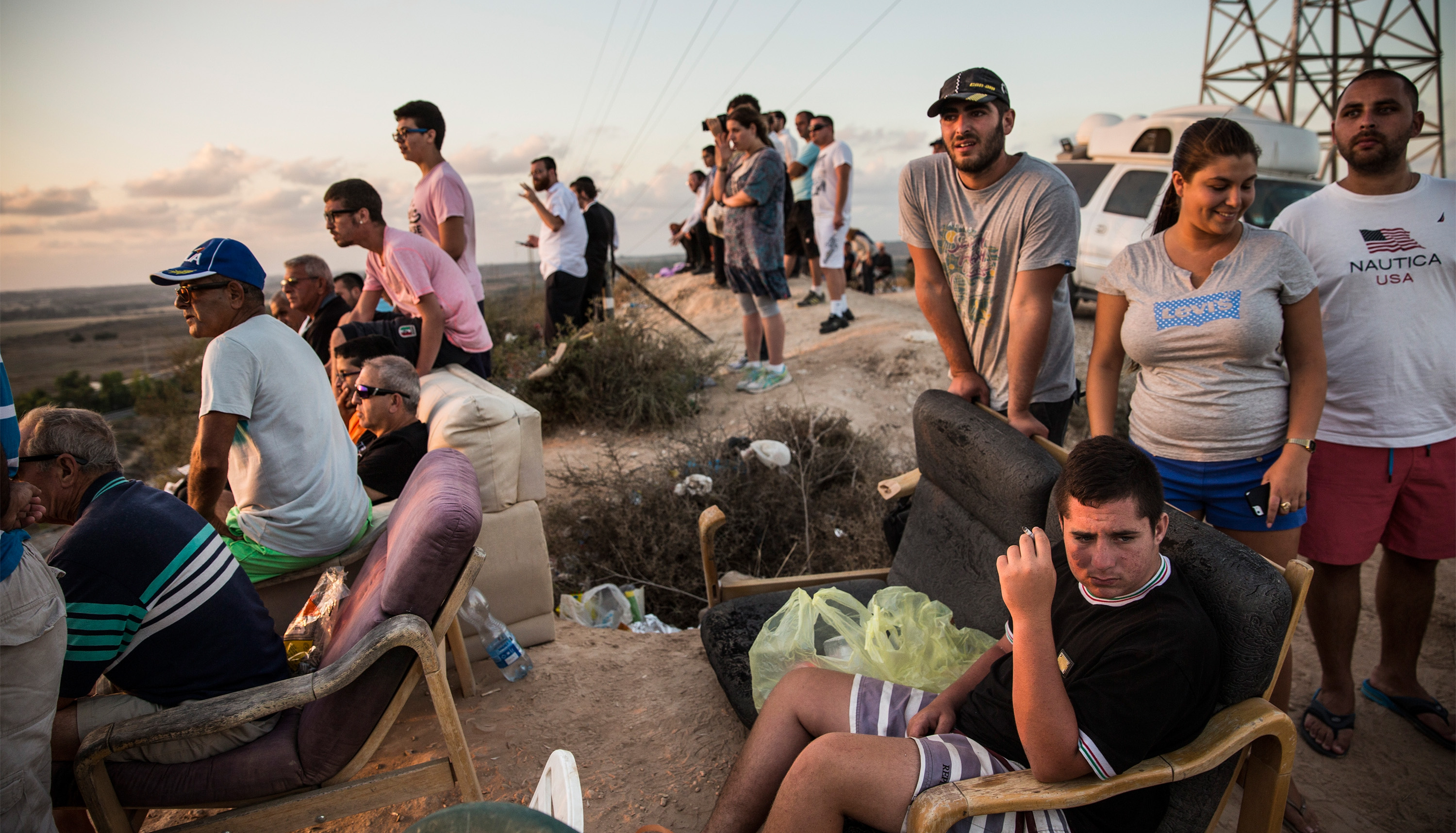
And look at the photograph above. Do these Israelis look terrified? They are watching Gaza get pounded into dust from a Sderot mountain. They’re within the rocket range, but they sure don’t look worried. They’ve brought chairs and beer and, yes, popcorn! Mackey has an excellent and devastating report on the atmosphere. When the sound of blasts occur, there is applause. And the same viewing parties happened in 2009, as children were being dragged out of rubble. Yes, Palestinians cheer Israeli deaths. But they have no power. To cheer even as you have overwhelming force and superiority tells you a lot about what has happened to the moral compass in Israel today.

There is also the question of rank ahistoricity in the coverage. Without an understanding of how Israel and Gaza got to this point, it is hard to put it in perspective. A reader puts it well:

Why is it that these seemingly now-routine flare ups of violence are treated as though they were unique situations? It’s always “they did this, so we responded” and an endless tit-for-tat follows until Hamas finally gives up. Rarely does there seem to be an appreciation of the consequences of having created an open-air prison on the West Bank with similar levels of control in Gaza.

I ask Goldblog and your dissenting readers, if not for these rocket attacks, are the Palestinians even relevant to the Israelis in any meaningful sense? The West Bank, in comparison to Gaza, has stayed relatively peaceful, but what does Fatah have to show for it? Ignorance of Palestinian suffering by the Israeli people, endless expansions of settlements, and lives utterly dictated by Israeli policy over which they have no influence. The Arab shopkeepers in Jerusalem staged a very visible protest and nobody cared. And now that Netanyahu has ruled out the possibility of a sovereign Palestine, they also have no future of their own. They are doomed to imprisonment forever, “state” or no “state.”

I keep returning to this article you posted by Max Fisher that early on remarks, “the occupation is wrong, it is the problem, and Israel is responsible.” I think this applies to Hamas’ futile rocket campaigns. I don’t believe that Hamas fires the rockets simply to raise the death toll, although that is probably part of the thinking there. Instead, I view this through the lens of street culture: they are firing these rockets for respect. The occupation is an endless line of indignities that Palestinians are subjected to every day, a fact that barely seems to register among Israelis, and Hamas is demanding they at least look them in the eye as they do it.

Returning to my earlier point, violence is the only case in which they are relevant to their captors, so they fire these rockets as a release, much as an ostracized kid will act out just to be noticed by someone else. They might be dominated in every sense by Israel, but they won’t be reduced to human livestock or a dehumanized “lawn” that must periodically be “mowed” to maintain an illusion of peace. Their lives may be completely dictated by Israel, but at least in this one case, they can defy that rule and be noticed for it – even getting the other side to admit their own powerlessness to truly stop it. Can Fatah claim to have ever gotten the Israeli government to admit defeat in any sense whatsoever? Hamas can.

And so the beat goes on …

Hey Baby

Straight guys often try to charm the ladies with a form of baby talk:

In an article soon to be published in the journal Evolution & Human Behavior, [psychologist Juan David] Leongómez and his colleagues discovered that when (heterosexual) men, for instance, are asked to flirt with a beautiful woman, two noticeable things begin to happen to their voices. First, their voices get deeper … or rather their voices achieve a deeper minimal octave than under comparison conditions. And second, men’s voices become more sing-songy or pitch-variable when speaking to a pretty woman, sort of like, well, how you’d speak to a baby.

It isn’t quite as pronounced as such prosodic “infant-directed speech” (and it’s probably unwise, I hasten to add, for a man to speak to any woman as if she were a puppy), but nonetheless, the investigators found these male voice adjustments during verbal courtship to be an empirically demonstrable effect. What this means is that not only do men’s voices get deeper when they’re chatting up some lovely woman, but they also get higher compared to when their speech is directed at another male or to an unattractive female listener. This effect appeared in both of the language samples tested – native male English and Czech speakers – and even after controlling for the unscripted content of the men’s speech.

What the researchers found about how straight women talk to men:

Interestingly, this so-called paralinguistic courtship modulation effect didn’t occur in women’s voices when they believed that they were speaking to a good-looking man, but it did occur when they were speaking to an attractive woman. That’s to say, when (heterosexual) women thought that they were communicating with an especially pretty member of the same sex, they began to stress their pitch modulation. The reason for this isn’t entirely clear, but it could be, as the authors suggest, that these female speakers’ intended audience is in fact desirable male mates, such that women are attempting to enhance their vocal appeal relative to these highly desirable female competitors. “Pfft. She’s not all that,” in other words. “Check out my natural speaking range.”

Update from a female reader:

I skimmed the post and got to the end and read the ridiculous conclusion of why heterosexual women’s modulation changes while speaking to other attractive heterosexual women, and I scrolled back-up and knew that the study was written by a man. So a heterosexual woman when speaking with an attractive man doesn’t find it necessary to change her voice modulation to attract him but she’s so competitive with other attractive women for a male’s attention that she changes her voice modulation for her? That makes no sense. When I go out with my friends, especially if I haven’t seen them in awhile, I always up the make-up. I wear eye-shadow for my girlfriends. I am not alone. I saw a dear friend this weekend, and after we hugged she said, “I curled my hair for you.” So maybe these women are more focused on what the women think of them, and not focused on knocking them off as competitors.

Also, your post on the plague and after is why I read you religiously, and why even when you piss me off I will continue to read you.

… she says in a baby voice.

Papers, Please

After visiting McAllen, Texas, to participate in a vigil, Jose Antonio Vargas realized that, “for an undocumented immigrant like me, getting out of a border town in Texas—by plane or by land—won’t be easy. It might, in fact, be impossible”:

[S]ince outing myself in the New York Times Magazine in June 2011, and writing a cover story for TIME a year later, I’ve been the most privileged undocumented immigrant in the country. The visibility, frankly, has protected me. While hundreds of thousands of immigrants have been detained and deported in the past three years, I produced and directed a documentary film, “Documented,” which was shown in theaters and aired on CNN less than two weeks ago. I founded a media and culture campaign, Define American, to elevate how we talk about immigration and citizenship in a changing America. And I’ve been traveling non-stop for three years, visiting more than 40 states.

Of course, I can only travel within the United States and, for identification, when I fly I use a valid passport that was issued by my native country, the Philippines. But each flight is a gamble. My passport lacks a visa. If TSA agents discover this, they can contact CBP, which, in turn, can detain me. But so far, I haven’t had any problems, either because I look the way I do (“You’re not brown and you don’t look like a Jose Antonio Vargas,” an immigration advocate once told me), or talk the way I do—or because, as a security agent at John F. Kennedy International Airport who recognized me said without a hint of irony, “You seem so American.”

I might not be so lucky here in the valley. I am not sure if my passport will be enough to let me fly out of McAllen-Miller International Airport, and I am not sure if my visibility will continue to protect me—not here, not at the border.

And today, just as he predicted, Vargas was detained:

A TSA agent checked Vargas’ Philippines passport and compared it to his ticket, according to a video of the exchange as well as sources familiar with the exchange. Satisfied, the agent initialed the ticket and cleared Vargas for travel. At that point, a Border Patrol agent took the passport from the TSA.

“Do you have your visa?” he asked.

“No, there’s no visa,” Vargas replied.

The agent asked Vargas a few more questions, then placed him in handcuffs and escorted him to the McAllen Border Patrol station for further questioning, according to the source. The station is not a detention center.

Dara Lind explains why the Pulitzer Prize winning journalist won’t necessarily be deported:

The government has “prosecutorial discretion” to determine what to do with unauthorized immigrants. That means it can decide whether or not to put Vargas into deportation proceedings in immigration court. The Obama administration has said, repeatedly, that its focus is on deporting unauthorized immigrants who fit its administration “priorities”: convicted criminals, “recent border crossers,” and people who have been deported and returned to the US. 98 percent of all people deported last year fit into one of those priorities. Vargas doesn’t meet any of those criteria.

Charles Cooke is sympathetic to Vargas but thinks the authorities had no alternative:

[T]his is a horribly sticky situation. Without question – and through no initial fault of his own – Vargas has found himself in a veritable nightmare. As he tells the story, he was brought here at a young age and told that he had legitimate papers, only later to discover that those papers had been forged. From that point on, his options were severely limited.

Conservatives who ask, “but why didn’t he just apply for legal status?” are rather missing the point. Under current law, he is unable to do so without leaving the country in which he has built his life. (Or marrying a U.S. citizen.) Because he did not have a petition filed before 2001, he didn’t qualify for relief under Section 245(i); because he is too old, he doesn’t qualify for the deferred action policy that President Obama illegally put into place in 2012. He’s genuinely stuck. Moreover, there really is no “home” for him to “go” to. This is it. If I had my way, he would be among those to whom some form of amnesty was extended. Those who have known nothing else should not be sent abroad.

Still, this is really not the point. The law that I would like doesn’t yet exist. And, knowing this better than anyone, Vargas willingly placed himself in this position. What were those charged with enforcing the rules supposed to do, exactly? Slip him under the desk?

Update:

A Theory Of Nail-Biting

Tom Stafford, a biter himself, advances one:

I propose that there is no special cause of nail biting – not breastfeeding, chronic anxiety or a lack of motherly love. The advantage of this move is that we don’t need to find a particular connection between me, GordonJackie and Britney. Rather, I suggest, nail biting is just the result of a number of factors which – due to random variation – combine in some people to create a bad habit.

First off, there is the fact that putting your fingers in your mouth is an easy thing to do.

It is one of the basic functions for feeding and grooming, and so it is controlled by some pretty fundamental brain circuitry, meaning it can quickly develop into an automatic reaction. Added to this, there is a ‘tidying up’ element to nail biting – keeping them short – which means in the short term at least it can be pleasurable, even if the bigger picture is that you end up tearing your fingers to shreds. This reward element, combined with the ease with which the behaviour can be carried out, means that it is easy for a habit to develop; apart from touching yourself in the genitals it is hard to think of a more immediate way to give yourself a small moment of pleasure, and biting your nails has the advantage of being OK at school. Once established, the habit can become routine – there are many situations in everyone’s daily life where you have both your hands and your mouth available to use. …

Nail-biting, in my view, isn’t some revealing personality characteristic, nor a maladaptive echo of some useful evolutionary behaviour. It is the product of the shape of our bodies, how hand-to-mouth behaviour is built into (and rewarded in) our brains and the psychology of habit.

Your Home Will Be Destroyed In One Minute

Adam Taylor passes along the above video of an Israeli “roof knock”:

“Knocking the roof” is the Israeli military practice of warning the residents of a building they are targeting that they should get out. Warnings can come via a phone call or a warning missile: In this case, the occupant of the house, Samir Nofal, received both, Watania reports. The practice has become one of the most controversial aspects of the current conflict. … When a specific building is due to be targeted, Israel may call an occupant, or fire a small missile at the building. That’s the final warning: Get out now, or you will die.

The Israel Defense Force (IDF) is open about this tactic. It recently released this video which includes a transcript of a phone call and a video of a “knock on the roof.” Despite the IDF’s apparent confidence in the tactic, critics see flaws. The phone calls show how much of Gaza’s communication networks are in Israeli control, for example, while others say that the “warnings” are not always followed up with an attack: A worrying tactic that might be considered psychological warfare.

Eyal Weizman calls the IDF’s warning shots an abuse of international law:

Israeli military lawyers argue that if residents are warned, and do not evacuate, then they can be considered legitimate collateral damage. Under this interpretation of the law, the civilian victims become human shields. This is a gross misuse of international law.  It is illegal to fire at civilians, even if the intention is to warn them. It is ridiculous to ask them to understand, in the commotion and chaos of war, that being shot at is a warning – and it is outrageous to claim that this is undertaken to save their lives.

International law should protect civilians. In Gaza, it is being abused in order to enable attacks where attacks should not be undertaken at all.

Update from a reader:

Quick note regarding the video about IDF “roof knocks” that you posted this afternoon; I am not invested in either side of the tragic conflict in any way, but it is worth mentioning that the video you posted has been edited. Watch the tree and the smoke at the 1:14 mark. I thought it worth pointing out.

Another is more skeptical:

That video is likely pure propaganda.  Watch the smoke start to billow out of the side window around the 1:11 mark.  Notice the bush gently swaying? Then a complete reset at the 1:16 mark.  Smoke is gone.  The lighting has even changed.  By the time the building goes, I’m not even sure any more that the entire thing wasn’t staged.

A “Family” Of Four

Ari Weisbard discusses living in a two-couple, one-mortgage household:

While most people take for granted that dual-parent households usually have more resources to deal with life’s challenges than single parents, why stop there? By forming a household with friends who share our values, we realized we could build an even stronger system of support than we would have in separate homes. The model is not even new; it’s an echo of raising children with the support of an extended family, but with less drama, I expect.

Many nights, when one of us stumbles home from work exhausted from a hard day, someone else has already done the shopping and cooked a great homemade dinner. When a pipe burst this February, we all took turns bailing out the basement. Once the baby arrives, we look forward to being crucial reinforcements for each other during those first several nearly sleepless months and trading off so each couple can have date nights.

Living together with another couple also has made it easier to identify and counteract some of the sexist patterns that emerge in many households. Because we discuss chores as a group and work consciously together to establish our household norms and individual responsibilities, there’s less opportunity for traditional gender roles to establish themselves surreptitiously. …

Living together seems to be a great financial move so far. With four adults splitting the mortgage and other costs, it is easier for each of us to save more of our income, which will give us the financial freedom to pay for childcare or reduce our work hours later, when we need more time and money for our families. We can also more easily afford investments in the house itself, like installing solar panels or weather proofing the attic, which will reduce our carbon footprint and save us more money in the long run.

Dissents Of The Day

Many readers are upset over this post and our Gaza coverage in general:

Over the last few days I noticed you keep saying Netanyahu called for revenge. I assume that is based on this NYT editorial. I refer you to this rebuttal in TNR. If you have any other sources for that claim, could you please post them? I would also like to note that you have repeatedly stated as fact that the Israeli authorities knew the teenagers were dead, but that’s pure speculation. All they could know for sure is that they were shot. You also state as fact that the kidnappers weren’t Hamas, which is again speculation (not to mention that Hamas both encouraged kidnapping beforehand and approved of this one, publicly).

I’ve been reading your blog for years and generally enjoy it, but I have to say you seem quite emotional when talking about Israel. Now I have to go take a shower because you made me defend Bibi.

No, I’m not. I’m referring to Netanyahu’s out-of-context quote from Israel’s national poet, Haim Nahman Bialik, in the wake of the discovery of the bodies of the three Israeli teens:

The passage he chose came from a poem that Bialik penned shortly after the 1903 Kishinev pogrom, in which dozens of Jews were murdered in what today is Moldova. The line Netanyahu quoted — “Such vengeance for blood of babe and maiden hath yet to be wrought by Satan…” — is often interpreted today as promoting or heralding a fierce revenge for murder.”

The full poem undermines that feeling – but Netanyahu quoted only the inflammatory phrase. Another reader:

I’m starting to worry about you when I read things like this:

But what alternative do they have exactly, if they [Hamas] wish to have any military capacity at all? Should they build clearly demarcated camps and barracks and munitions stores, where the IDF could just destroy them at will?

Seriously?  Let’s back up a step. Why should Hamas have a military capacity and for what purpose? If they were responsibly governing their territory, they would have a military set up for defense of their borders and their people.  Quiet would be met with quiet, and the IDF would have no cause to attack Gaza. That’s not what’s happening.  Hamas takes every opportunity to smuggle in explosives, weapons, and rockets with the sole intent of attacking Israeli soldiers and civilians.  I’m no lawyer, so I can’t say whether Hamas’ attacks from civilian areas and it’s situating of military facilities around and under civilian buildings is a war crime, but it shows a shocking indifference to the welfare of the people it claims to represent.

I’m just arguing that, given Israel’s designation of the whole area as a terror state, no military capacity, defensive or offensive, would be permitted by Israel and so concealment in urban areas makes a horrible kind of sense. I don’t defend it, with its awful consequences for civilians. But I can see why it’s there – and it’s  too crude to say it’s there solely to get civilian casualties to put international pressure on Israel. That may be part of a horrifyingly cynical calculus, but it isn’t all of it. Another reader:

I am not a fan of Bibi, and I know that you don’t much like his government, as your current coverage of the conflict with Hamas clearly indicates. But you fail to cover some news items from the area that you willfully ignore.

Since the war with Gaza began – and that’s what it is, a war – Israel has permitted humanitarian aid to cross the border from Israel to Gaza. This includes medical supplies (including blood products), food, and fuel. Israel WARNS Gazans to get out of harm’s way before they strike. They have called off air strikes because of the apparent presence of non-combatants. You don’t mention any of this that I can see. Who ever heard of such a thing?! Can you imagine any other nation doing this?! Does the US drop leaflets on Afghanistan or Pakistan before going after Taliban fighters with drones? I doubt they ever even considered it.

Is it tragic that civilians are dying in Gaza? Of course. I may be naive, but I truly believe that if Hamas stopped firing rockets, Israel would stop the bombing raids. Why is it that in your eyes only Israel is not permitted to defend itself?! When I was in Israel last month, before the boys were kidnapped, rockets were falling on Southern Israel and Israel did nothing. I met some folks from Nitzan, a community in Southern Israel, who said that the rockets were landing almost daily, just south of their town and that they were very ticked at the government for doing nothing about it.

These folks were not your “Greater Israel” types. They just want to live in peace. But having rockets rain down on your neighborhood is unacceptable. I wouldn’t accept it and neither would you.

Unfiltered feedback from readers on our Facebook page.

The View From Your Window Contest: Winner #213

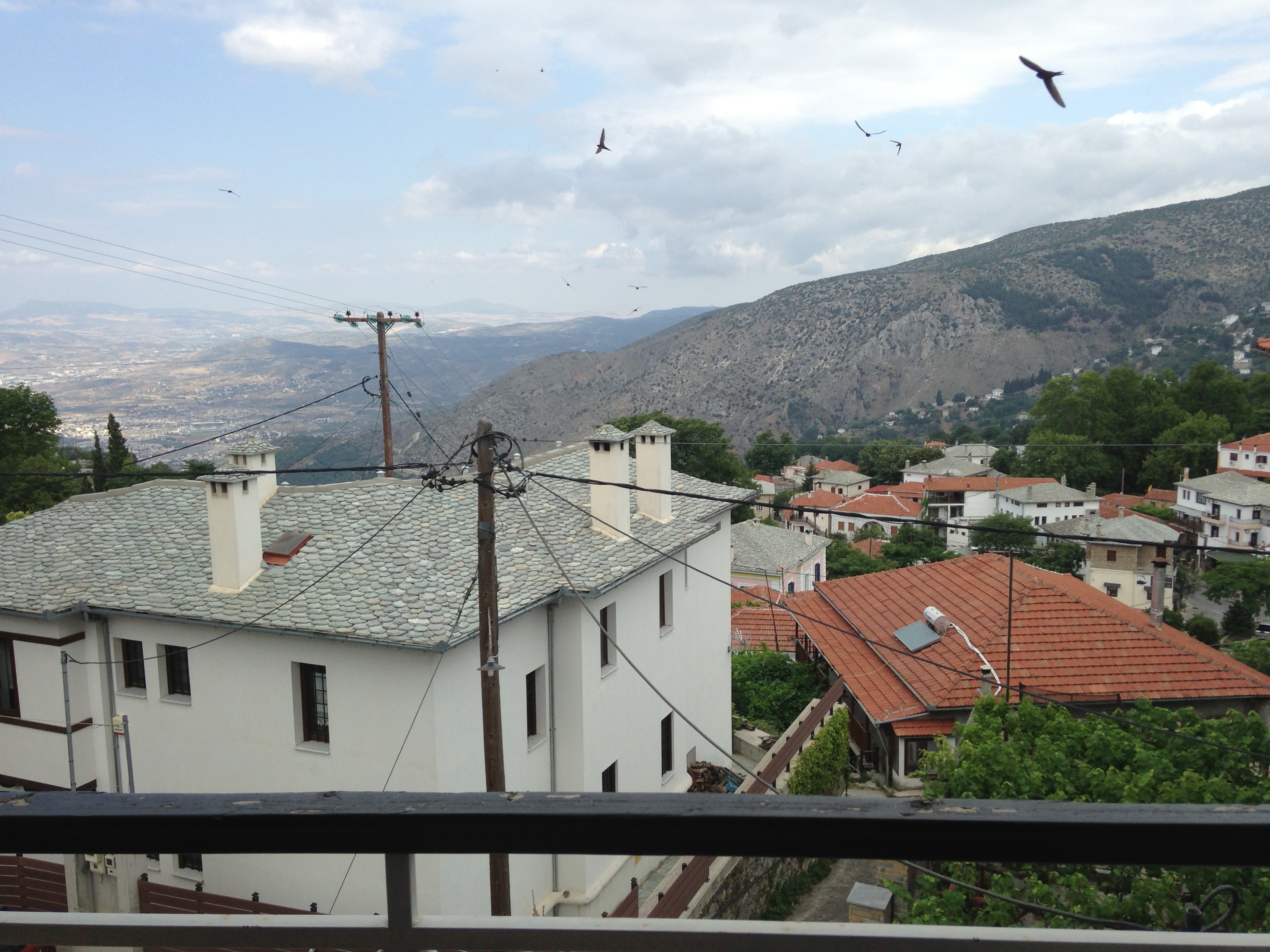
VFYWC-213

A reader writes:

You need wrong entries to start things off, right? So here’s one. But it does remind me of San Antonio de Escazu, Costa Rica, which probably means it’s time to go back.

Another thinks we’re timing the view again:

Totally stumped! But it’s GOTTA be either Rio or Buenos Aires because it’s the World Cup Finals weekend … no way it’s Germany! I gave up when I saw that Rio is too lush for the pic and Buenos Aries is too flat!

Another goes birding:

Seems to me those are Griffon vultures. And the topography looks like Spain, which is where most of the Griffon vultures live. After that, it’s time for darts and/or educated guesses. As this is the week that the St. Fermin Festival ends, I am going to say that the person who sent it in was in Pamplona and is now up in the Aragon hills (or could be farther up in the Pyrenees). So, let’s say a hill town outside of Huesca.

Here, by the way, is an Algerian bank note with Griffon vultures (some Spaniards getting eaten alive in the post-bubble housing market might think putting vultures on the money itself is overkill):

griffon vulture

Another pings Africa:

Cape Town, South Africa. Between Atlantic and Table Mountain. I’m guessing the Clifton/Camps Bay Area.

Another:

Milwaukee … because that is clearly a keg on the roof of that house in the foreground.

Back to that “keg” in a little bit. Another gets the right country:

This is a wild guess and probably not even close, but it seems like Greece to me. No way to prove that, however.

Another helps out with proof by nailing the correct town:

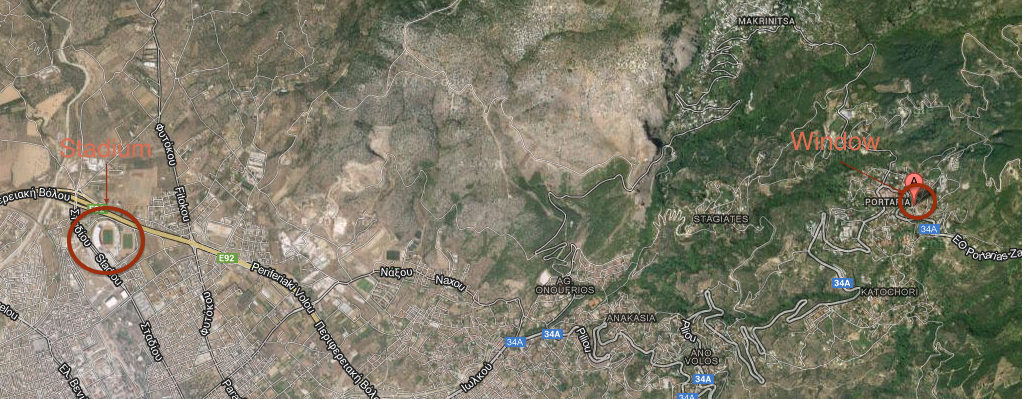
Based on the rooftops, vegetation and topography, this looks like Greece, and that looks like the Panthessaliko arena way off in the distance. That would imply that this picture was taken from somewhere near Portaria, Greece, although the limited time I had for a rooftop search to match the details of the picture came up blank. So close, alas …

Another correct guesser:

Looking across to Makrinitsa, and the distant plains of Thessaly. Land of the centaurs, by the way …

Chini notes:

The hardest part of these Mediterranean views is distinguishing between the architecture of the countries. This week, for example, I’m guessing the heat map is gonna have quite a few entries from Spain as well as Greece. And if you were one of the unfortunate readers who did get bogged down in Spain, well, it was probably a pretty long weekend.

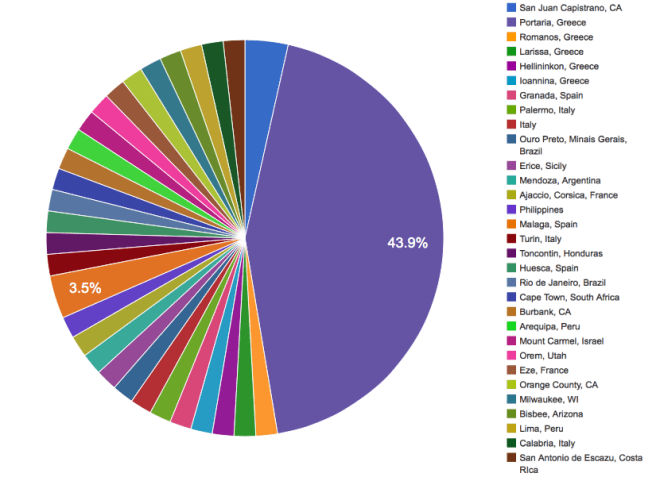
Yep, readers definitely put Spain (and Italy and California) on the map this week:

This embed is invalid

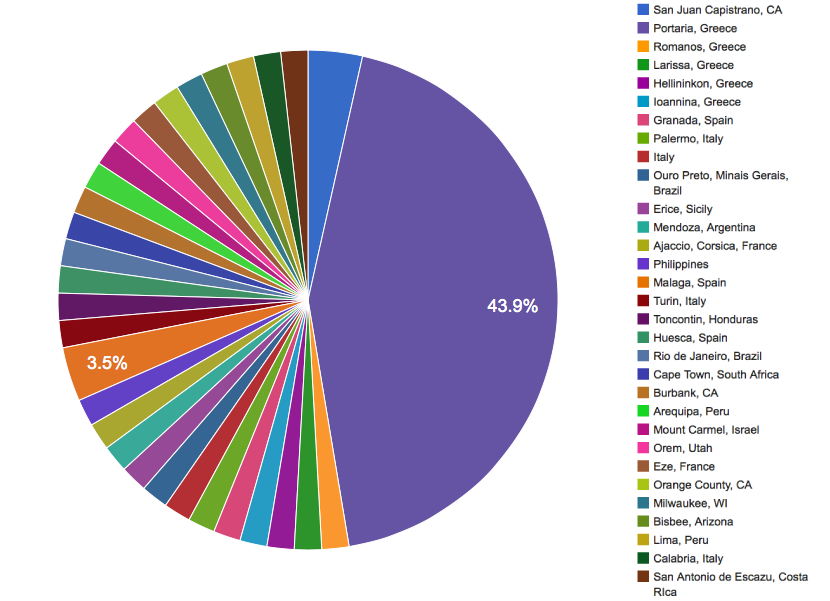
And here’s a delicious pie chart:
vfywc-213-pie-chart

Another reader nails the hotel and highlights what was, for most contestants, the essential clue to solving this week’s view:

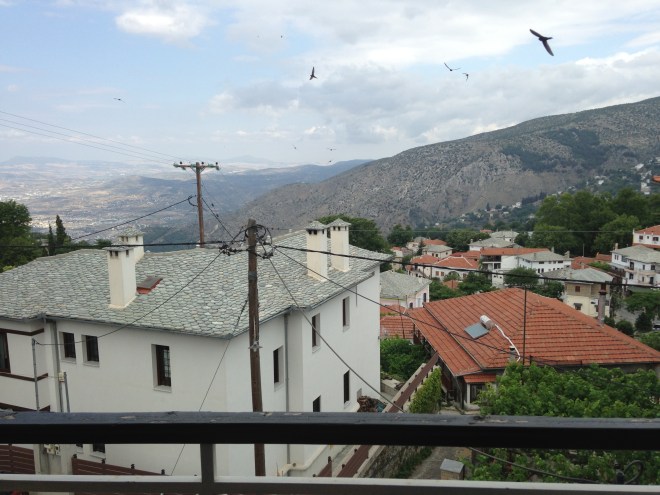
This sure seemed like a Mediterranean hill town, and the birds meant it sigmaprobably wasn’t too far from the sea. The rooftop solar installation has a “Sigma” logo on the side, and a little googling showed that belongs to a company that operates out of Volos, Greece. The last clue that cinched it was the grey slate that makes up many of the roof tiles and the chimneys in the photo. I had a hard time finding anything quite like it, but finally found some close matches in the area of Mt. Pelion, unsurprisingly very near Volos.

A little more sleuthing showed that this week’s view was taken from the Hotel Karavos, Hajakou 15, Portaria 37011, Greece. I’m pretty sure it was taken from the center window on the 1st floor of the West side of the hotel. And now I *really* want to go to Greece. The views of the sea from Portaria are just stunning.

Our favorite GIF-making player nails the correct window:
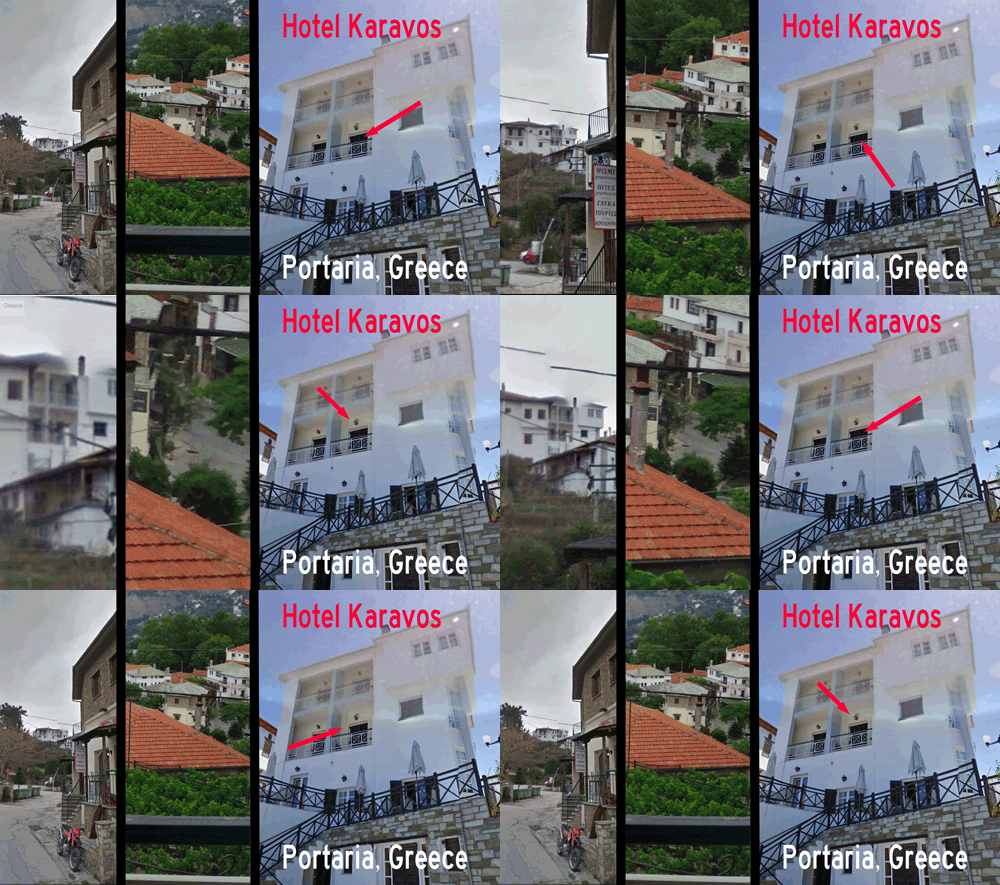
karavos-bitch

There’s a Sigma solar hot water heater on the building’s roof across the road. Sigma is headquartered in Volos. I then matched up the visible soccer stadium, rock quarry (?), and forest on the mountainside in Google satellite images, then pinpointed Portaria. The window was harder. (Fun fact: the room is named after a flower. Which one, however, I do not know … )

Check out how methodically this reader zeroed in:

An image search on Sigma Solar eventually got me too a rendering of a Sigma labeled cylinder above a solar panel, crucially with a red “a” in the name. This Sigma was located out of Greece, which seemed to fit the geography of the picture better, so there I went. This Sigma was headquartered out of Volos, but that area seemed to close to the coast, so I moved on, looking again at soccer stadiums. I was looking for a decent-sized stadium, perhaps ringed by arches. When I got to Panthessalakio Stadium, I didn’t find arches, but it was ringed by a concrete frame with many openings, and it was located in Volos, so I began to think maybe this was it. Zooming in on Google Maps, I saw mountainous terrain, and a stadium on the edge of town with a major road turning to the left just past the stadium, and a view that wouldn’t include the surrounding coast. I knew I had the background, but how to isolate to a specific building?

The view seemed almost exactly perpendicular to the long facade of the stadium, so I headed due east. Surprisingly, many of the neighborhoods were predominated by either red or white roofs, but very few had a good mix of the two colors. Once I got to what I now know is Portaria, I began to see the right mix. I couple swoops into street view made me think this was generally the right area, so I went back to the satellite view, looking for a white building with chimneys near a red roof with a solar panel. I was pleasantly surprised to find not just a solar panel, but one with a highly reflective object and thick white cabling running to the side, next to a white roof that looked the part.
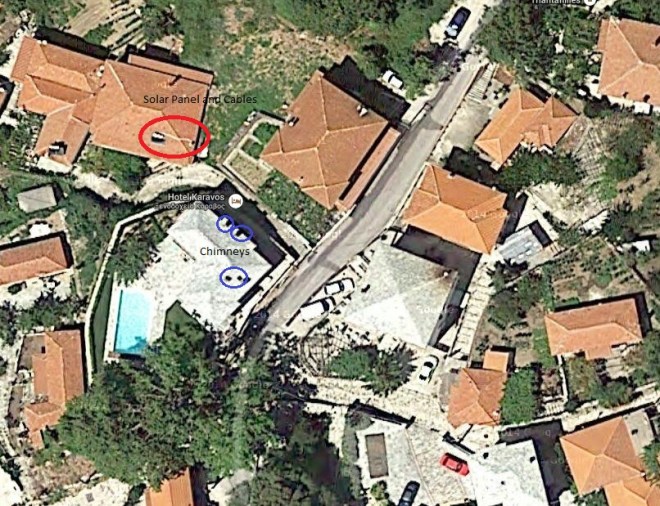
VFYW_213_The_Roofs

Street view quickly confirmed the white house was the foreground of my picture (Streetview voyeurism tells me that the solar panel was installed on the red roofed building sometime after July 2011).

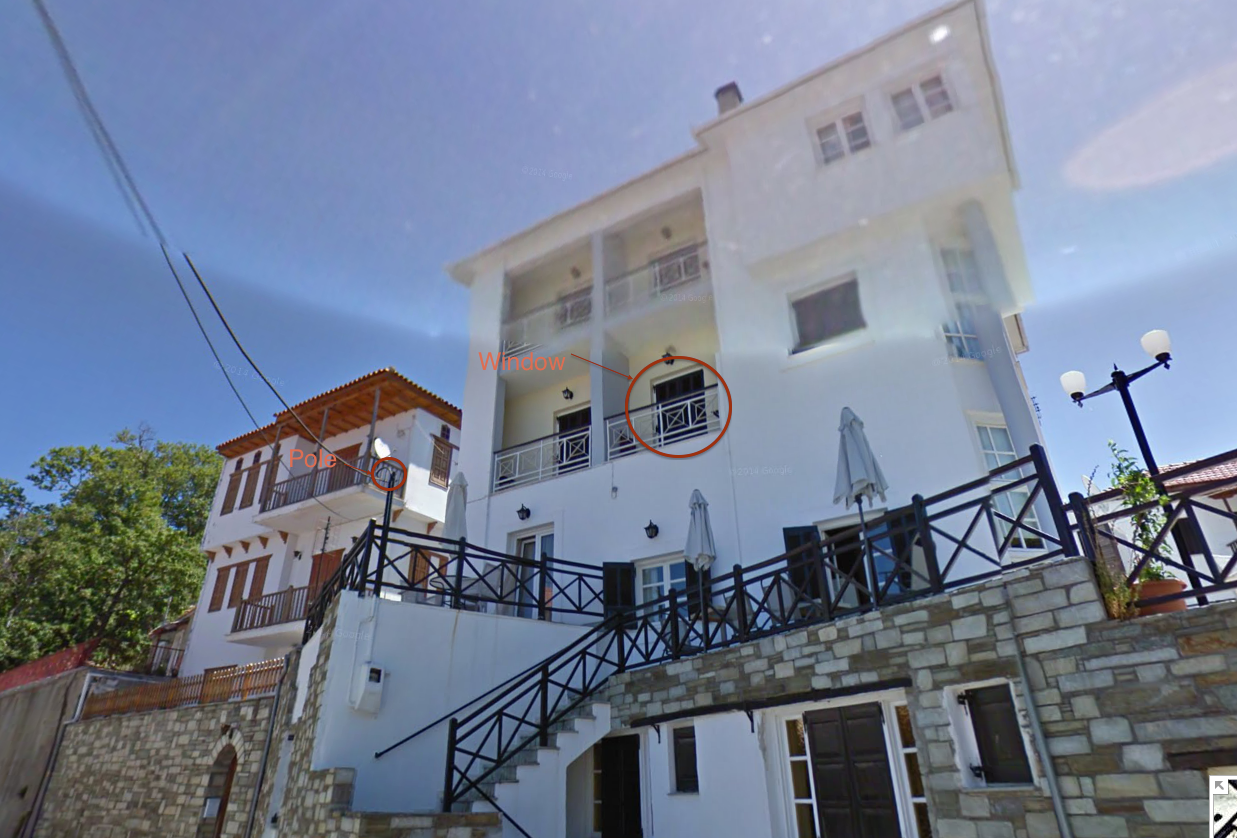
Continuing in street view, the building on the opposite side of the street had four rooms with balconies with brown railings, one of which clearly had to be the source of the shot. Based on angles, the street lamp, wires, and other signs in street view, I felt pretty confident that it was one of the lower two balconies on the third floor, but which one? Given the excellence of other contest-goers, I clearly needed to step up my game to get the correct window. Going further down the street, I could see a sign on the building for Hotel Karavos. I started to look at pictures on various hotel review sites, and eventually came across a picture that I think almost definitely came from the same balcony, albeit from farther back and on a slightly different angle:
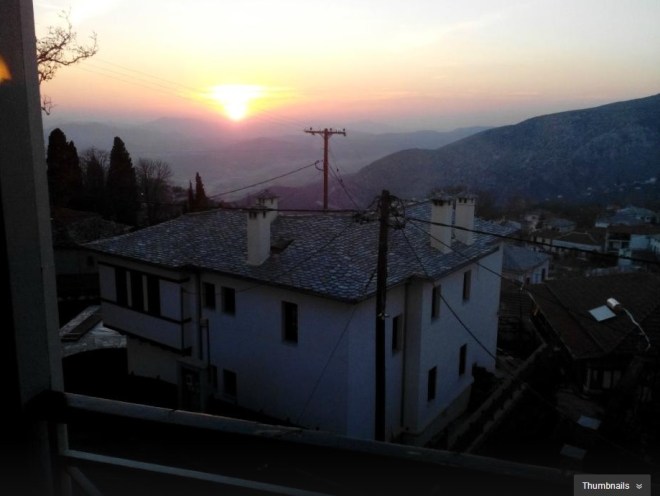
VFYW_213_Tripadvisor_View

The extra view of the balcony itself showed that balcony itself went slightly further to the left (looking out) than the railing itself. Street view shows that one balcony ended flush with a divider, so it had to be the balcony on the right (facing the hotel).

This was a really fun one, thanks.

Bravo. Meanwhile, a previous winner gets her collage on:
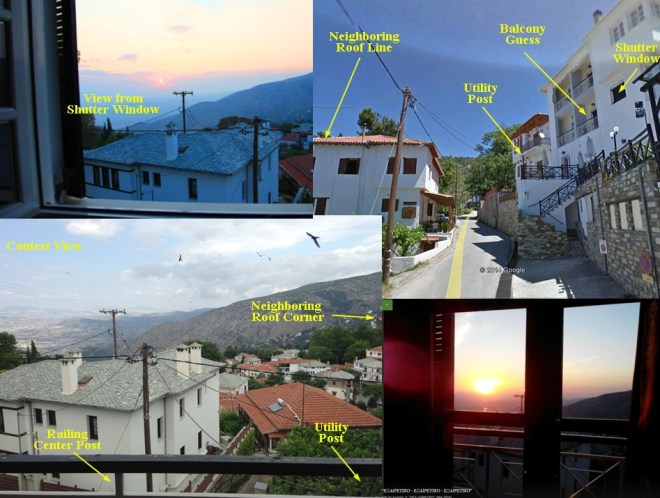
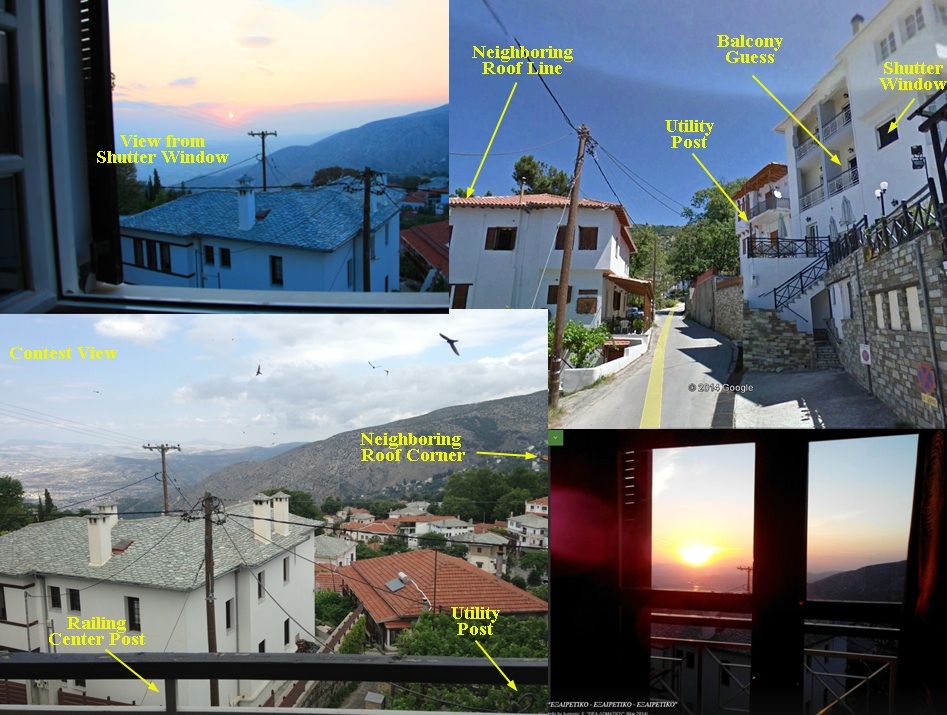
vfyw_7-12-14-collage2 copy

I began by trying to identify the soaring flock of birds, but they appear to be a common and widespread European swift. Next I focused on the stadium that is vaguely visible on the flats at the base of hills (soccer weekend). That was not productive. I then searched for worked-stone roof tiles like those in the view and quit quickly found similar examples in villages clustered on the steep ridges above Volos, Greece. The Volos Olympic Stadium on the flats helped confirm I was in the right place. Searches of hotels eventually located views similar to that of the contest and Hotel Karavos.

The photograph was taken from one of the four balconies on the west face of the hotel. My uncertain guess is the lower and southern-most one. The steep slopes made judging window heights even more difficult than usual. This balcony seemed the most likely to include a number of clues. The balcony view had to include the top of a utility post visible in the lower right of the contest view, the tip of a neighboring roof corner on the right of the photograph midway, and the center post of the balcony railing that is left of center in the view. The most convincing clue was comparing a similar view taken from the only upper window on the western face with shutters which is located south of the balconies. The view from the shutter window appears close to that of the contest view but slightly higher. This would be consistent with the shutter window’s location in relation to the lower balcony (or more so than an upper balcony).

Now I want to know how the stone roof tiles are made and perhaps reused.

Here’s the Dish own collage of your best entries:
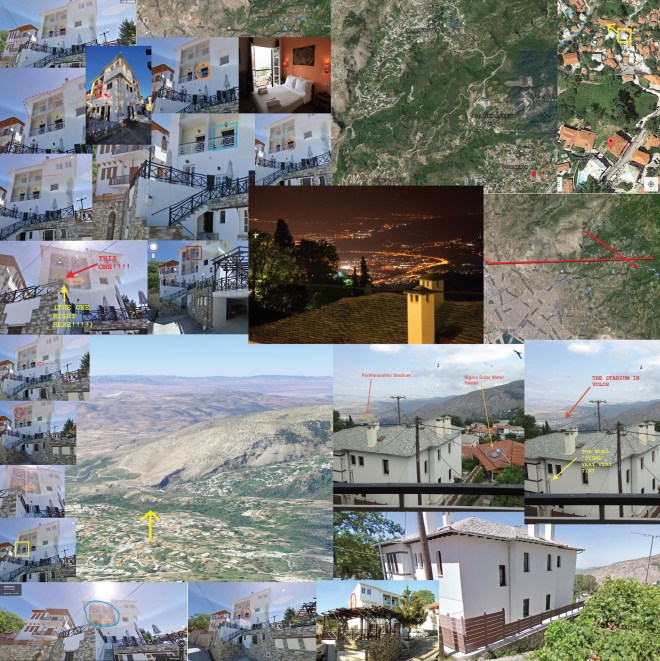
vfywc-213-guess-collage

One of those readers adds:

Of interest to me is that Volos is the home of the mythical hero Jason (of Argonauts and Golden Fleece fame) but also of real-life composer musician Vangelis whose work on film scores such as Chariots of Fire and Blade Runner is well known.

This week’s winner is an 11-contest veteran from our vaunted list of previous guessers of difficult contests:
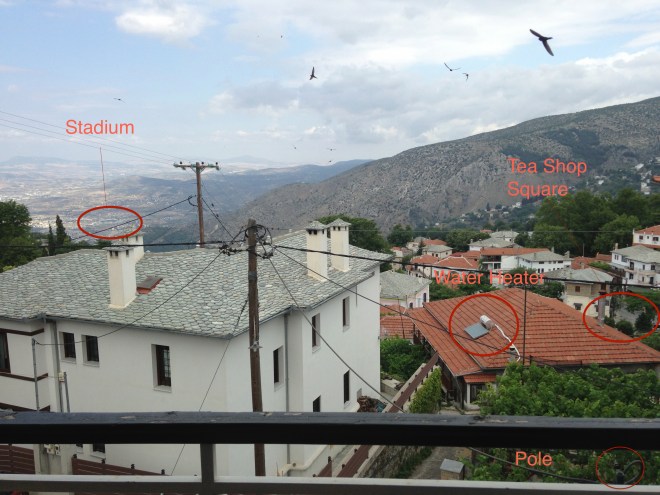
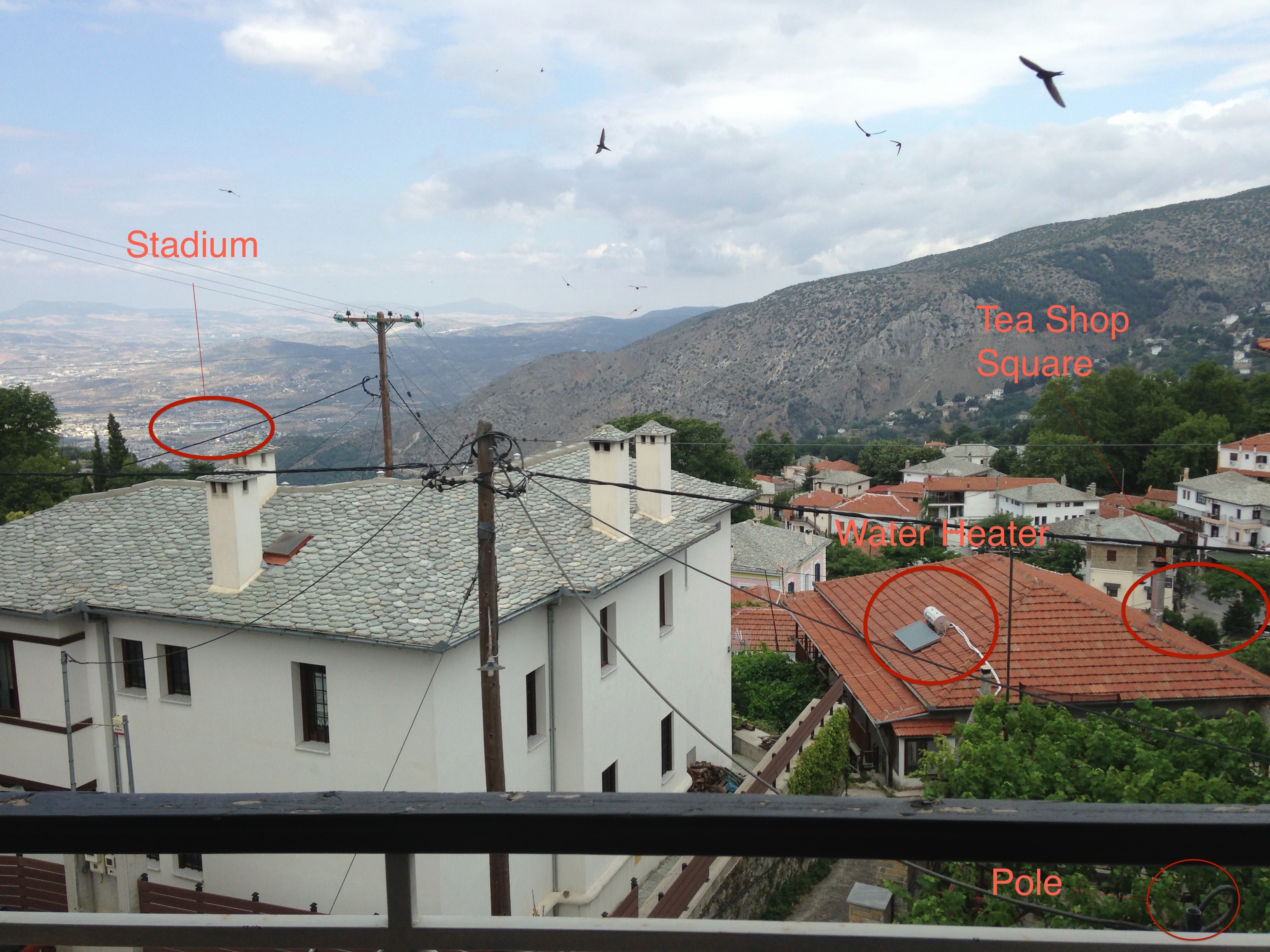
ContestImage

The most obvious landmark, the stadium way off in the background, wasn’t familiar, so searching for that right away wasn’t too helpful. Googling around for “sigma solar water heater” and doing some quick logo vetting narrowed it down to Greece rather than California or Spain. “Stadium Greece” was a fairly unhelpful Google Image search for the first few pages due to the prevalence of pictures of the Panathenaic Stadium, until I just happened upon the right one — in Volos, which is also the home of Sigma.
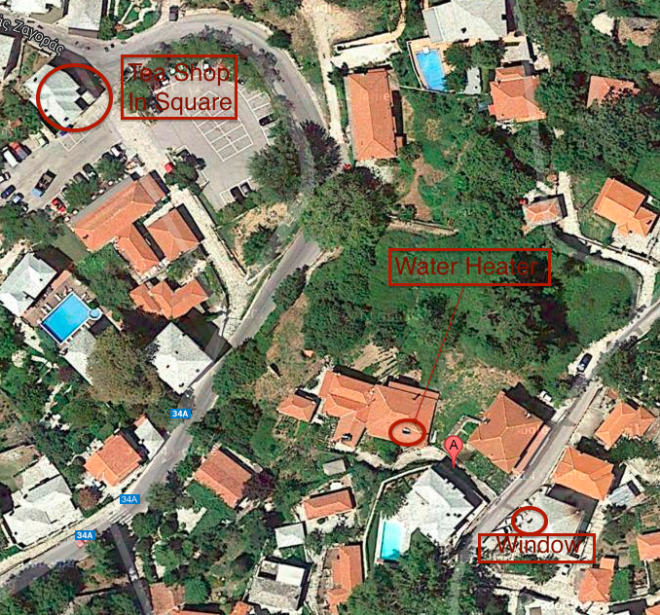
Environs

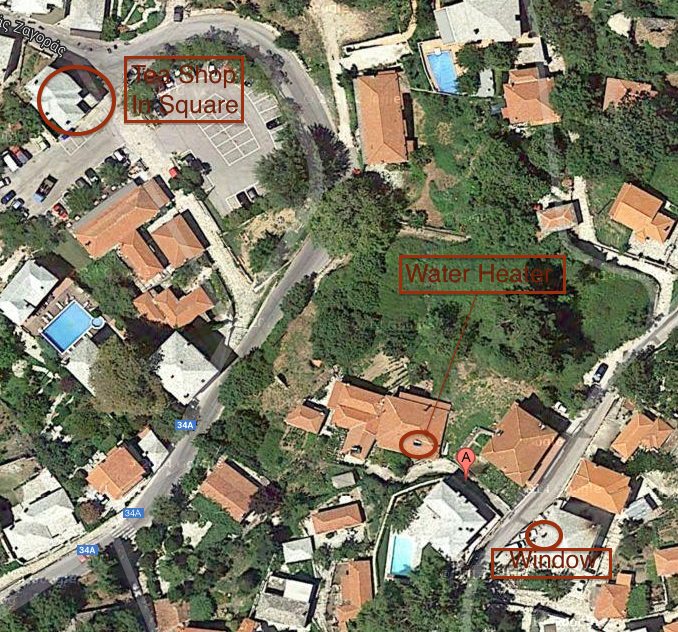
The mountains looked right, so I figured out roughly where it was on the map and zoomed in on anything looking like a square or large intersection (visible on the right edge of the image, 1/3 of the way up). On the second try, I found the building with the teapot sign (a tea shop), and from there it was a simple matter of turning around in Street View and looking up.
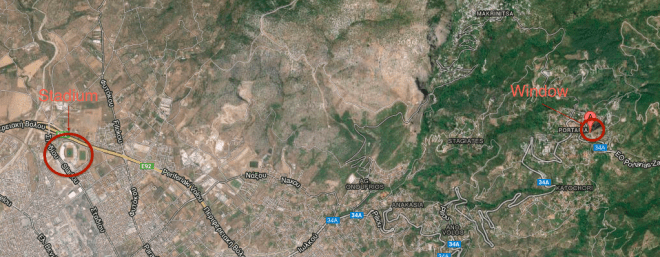
RelativeToVolos

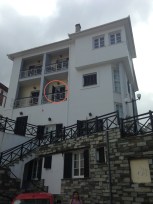
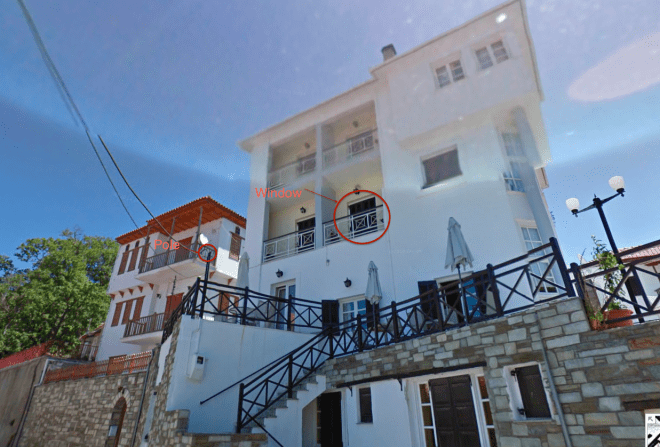
It’s Hotel Karavos, in Portaria, about 12km from Volos (39.389338,23.00066, for the picky). Due to the pole in the bottom right corner of the image, I’m guessing it’s… I don’t even know how you’d number the floors. Window is circled:
CircledWindow

From the view’s submitter:

Hotel window

The picture was taken from the window of Room 202 of Hotel Karavos, in the mountain village of Portaria, Greece. This is one of the little towns on the western side of Mt. Pelion, looking down to the city of Volos, part of which can be seen in the distance on the left of the contest picture.

The whole region is very beautiful, with quaint villages on the mountain slopes and beautiful beaches just a short drive away on either side of the peninsula. My wife and I spent there three days exploring the area together with two friends of ours, a couple who got married this Saturday – the same day the photo appeared in the contest!

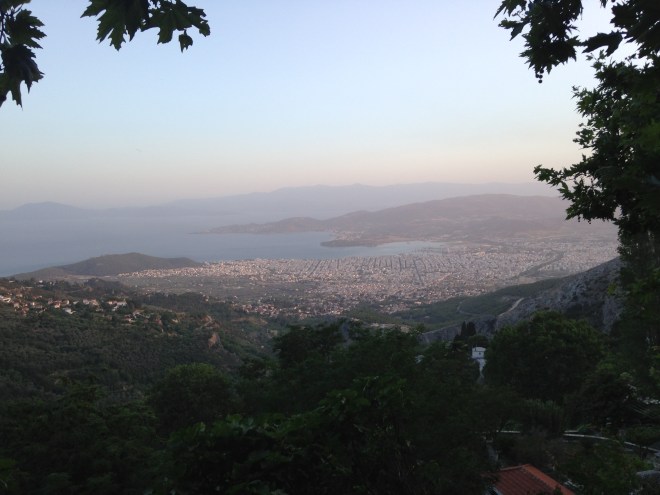
I’ve also attached another picture with a wider panorama of Volos, taken from the town of Makrinitsa, very close to Portaria:
view of Volos

(Archive: Text|Gallery)

The View From Your Obamacare, Ctd

A reader revives the thread with a new perspective:

For three days straight, a crew of two men has performed significant physical labor around our residence – drilling through brick and mortar, removing debris, and so much more. The President Obama Visits Boston To Talk About Health Caretoll on these guys’ bodies is beyond comprehension to a sedentary writer-type, who obsessively exercises to keep limber and burn calories and maintain a semblance of muscle tone.

For three days, one of the men complained regularly about his back pain. (Which certainly wouldn’t have been helped by carrying away our cast iron wood stove, lifting it onto the truck, off-loading it at the shop.) With a groan, he sat down to write up the final invoice. By now fully aware of his problem, I murmured sympathetically. He replied, “I had an MRI done a couple of years ago. It’s a disk. I need surgery.” I cranked up the sympathy. “I can’t afford it,” he continued matter-of-factly, “on my income. Not until I get my health insurance.”

I very nearly said something like, “Isn’t it great that it’s actually possible through the Affordable Care Act?” and was tempted to explain that next enrollment period comes up later this year.

I’m fairly well informed on the process; my husband’s workplace arranged for him to become a certified ACA advisor. All winter long he came home from the office with heart-warming news of how real, uninsured people were at least accessing what was previously unobtainable.

But, stifled solely by the crewman’s demographic characteristics, I said not a word. I could just tell this was not a fellow who would look favorably on Obamacare. And I didn’t want to introduce controversy or politics into what had been a pleasant temporary relationship.

Shortly before leaving, he spotted the framed photograph of me standing with President Obama, taken when he was a little-known candidate roaming through my First-in-the-Nation primary state. And his recognition prompted a rude comment that made me wish he’d had been as reticent about the president as I had been about the ACA.

When he and his cohort departed, I started to cry. Our entire exchange represented everything most depressing about perceptions of Obama and the intent of the law he – and the Congress, even if only a portion of it – brought into being. For the good of people like the man who needs back surgery to continue in his job, but can’t afford it. And who, until recently, wouldn’t have had a hope of getting insured.

Most of the time I do Know Hope. I’m hard-wired that way. But today there’s a terrible disconnect in my optimism.

Update from a reader:

Allow me to bring your reader’s experience with a temporary worker in her home a bit closer to home. As a small business owner with a long-standing (since age 17) preexisting condition who has had to buy my own insurance, the ACA has been a godsend. We went from our premium costing nearly $2,000 a month for our family of four to $1,100/month with much better coverage. And now I’m about to enter a job transition where I might not have an income for a few months. The ACA has made that much easier. A major health crisis would be horrible obviously, but one happening if I didn’t have insurance, it’d be financially devastating. I now can know we are covered and can afford to be even in job transitions.

But my sister doesn’t see this. She complains constantly about Obama and the ACA – complaints that more often than not have no basis in fact. She works several part-time jobs and her income, just above minimum wage, is volatile. She refuses to even look for an insurance plan on our state’s very good exchange. I am fairly certain she would find one, with subsidies, that would cost her under $100/month for silver plan coverage, barely $30 for bronze, coverage that could make her life healthier and more financially secure. She has several pre-existing conditions herself and current health issues she really should take care of now.

And it breaks my heart she refuses to do so out of some misplaced anger based on “Fox News” lies. The Fox News Republicans have done a great disservice to this nation in so many ways.

(Photo by Yoon S. Byun/The Boston Globe via Getty Images)

A Short-Lived Ceasefire

A ceasefire in the Gaza war, proposed by Egypt, failed to take hold this morning after Hamas rejected it:

Israel’s security cabinet agreed to the terms of the deal after meeting early on Tuesday. … Palestinian President Mahmoud Abbas also welcomed the terms Egypt had set forward. However, Hamas, which recently formed a temporary unity government with its rivals in Abbas’ more moderate Fatah political party, said that it wasn’t consulted in the drawing up of the terms of the ceasefire. In a statement on the website of its armed wing, the Qassam Brigades, Hamas said the Egyptian initiative was one of “bowing and submission” and “was not worth the ink it was written with.” With that statement lodged, rockets continued to fire from Gaza into Israel.

Hayes Brown interprets this development:

The rejection of the deal places a new burden on Hamas to maintain public support among Palestinians for its actions. Hamas’ approval ratings have jumped wildly since it first came to power in 2006, with an April poll from the Arab World for Research and Development showing that only 20 percent of Palestinians hold a positive view of the group’s governance efforts. In the face of international condemnation for rejecting a possible ceasefire, and the Israeli government sure to capitalize on its own willingness to hold fire, Hamas will have even further to go to reach what it sees as an acceptable outcome for an escalation it arguably didn’t want at this moment.

But Avi Issacharoff insinuates that the ceasefire was meant to be rejected:

Soon after the Egyptian proposal was published, one Hamas spokesman, Fawzi Barhoum, announced “there will be no truce unless the demands of the military wing, and of the Palestinian people, are met.” Did that represent Hamas’s rejection of the proposal? That’s not clear — and won’t be until the spokesmen of the military wing, who are leading this conflict with Israel, have stated their position. But sources in the Strip told this reporter late Monday that the military wing has decided not even to discuss the Egyptian proposal. These sources said that Hamas is fuming over the process by which the Egyptian terms were brought to its attention — via the media.

Indeed, the leaking of the proposal to the Egyptian media, the fact that it ignores Hamas’s demands, and the further fact that it includes a nod to Israel via its similarities to the 2012 terms, must seem suspicious indeed to Hamas. Could it be that Jerusalem and Cairo hatched this move together, in order to corner Hamas?

And Mya Guarnieri stresses that a ceasefire means something very different for Israelis and for Gazans:

Israel is willing to return to the status quo, a status quo that serves Israeli interests. Sure there is occasional rocket fire from Gaza but Israel has the Iron Dome and, in the sparsely populated south of the country, the rockets usually fall in open spaces. The occasional rocket from Gaza actually helps Israeli hawks strengthen their case for continuing the “occupation” of the West Bank (an “occupation” that, in the wake of Netanyahu’s recent remarks, should be understood as a de facto annexation). The Israeli right points to the rockets from Gaza and says, “Look, we withdrew from Gaza in 2005 and all we got is rocket fire!”

Returning to the status quo also means that Israel strikes Gaza from time to time and kills Palestinian civilians there and in the West Bank without garnering much scrutiny from the international media and, by extension, the international community. Returning to the status quo would also mean an end to the immediate damage to Israel’s image caused by the horrific photos and footage coming out of Gaza, and global protests against what Israel calls “Operation Protective Edge.”

An outraged Ali Abunimah argues that as long as Israel maintains its crippling siege on the strip, it is Israel, not Hamas, that is rejecting an end to the violence:

Already, Prime Minister Benjamin Netanyahu stated that “If Hamas rejects the ceasefire, we will have international legitimization to restore the needed quiet.” That is a euphemism to kill more people, on top of the almost 200 Israel has already killed, the vast majority of whom civilians, including dozens of children. This systematic targeting of civilians and civilian objects, in intense bombardments of Gaza has continued since 7 July. Media are likely to follow the Israeli spin instead of asking Israel why it is maintaining the collective punishment of 1.8 million Palestinians in Gaza and why it constantly violates ceasefire agreements. But the fact remains: it is Israel that has rejected reasonable ceasefire conditions that have always been on the table.

But whether or not the Israeli spin is justifiable, it will probably work. Mkhaimar Abusada expects Hamas to do a deal eventually, if only to save face:

“Hamas feels that that if it agrees to this, it hasn’t achieved anything more that it achieved in 2012. They feel they’ve done much better in this round of fighting…and so we should get a much better deal in order to end the fighting,” says Abusada, who studies the Islamic movement. At the same time, he notes, the price that Hamas will pay for continuing to refuse a cease-fire is high: It will annoy the Egyptians, lose points with war-weary Gazans, and could eat away at the international sympathy that has built up for Gaza amid the horrifying footage of a death and destruction. “Hamas has not made its final decision, and is engaging in its own internal dialogue now,” Abusada adds. “My hunch is that Hamas is going to accept the cease-fire, eventually, because to say no to the Egyptians will cost them too much.”