A Bullet With A Mind Of Its Own

It exists:

[I]magine if you could transform a dumb bullet into a guided missile? That’s what the Pentagon did earlier this year, successfully firing .50-caliber bullets that steered themselves in mid-flight. It has just released a video [above] trumpeting the tip-top targeting of its Extreme Accuracy Tasked Ordnance (EXACTO) program.

The technology could make our sharpshooters that much more deadly:

Current sniper rifles can regularly hit trucks at 2,000 meters, but not bad guys. (The record kill is 2,430 meters, just over 1.5 miles. It was charted by Canadian army corporal Rob Furlong against a Taliban fighter in Afghanistan’s Shah-i-kot valley during Operation Anaconda in March 2002—but his first two shots missed.) “There’s no limit as far as I can see so long as the bullet’s stable—I think 2,000 or 2,500 meters is very attainable,” [Keith Bell, former commander of the Army sniper school at Fort Benning, Ga] said. “Right now, anything past around 800 meters is an extremely tough shot.”

Duncan Geere adds a few more details:

The bullets are the size of a large pen and can be used in both sniper rifles and machine guns. The full EXACTO system comprises of both bullets and a real-time guidance system that tracks and delivers the projectile to the target. They’re still some way from the battlefield, however. This live fire test is likely just the first of many.

Kurdistan’s Moment? Ctd

Juan Cole’s list of recent “disturbing” news items from Iraq begins with some major developments regarding the Kurds:

1. Last Wednesday Prime Minister Nouri al-Maliki angrily lashed out at the Kurds, accusing them of harboring the terrorists of the so-called ‘Islamic State.’ Since the Kurds have in fact fought the IS radicals, al-Maliki’s charge is hard to take seriously. Rather, it appears to be a sign of how angry he is that Kurdistan president Massoud Barzani is pressuring him to step down. I don’t think al-Maliki can get a third term without Kurdish support.

2. Barzani responded that al-Maliki is “hysterical.” The Kurds then withdrew from al-Maliki’s cabinet, in which they had been his coalition partners. The ministries will likely go on running all right, but the move is symbolic of the break between al-Maliki and his erstwhile backers. Foreign Minister Hoshyar Zebari, one of those who suspended participation, says it will be hard for the Kurds to work with al-Maliki unless he apologizes.

3. On Friday, the Kurds seized two important oil fields in the Kirkuk region. Since their willingness to supply Turkey with petroleum seems to be one of the reasons Ankara has increasingly made its peace with Iraqi Kurdistan becoming independent, the Kurds are now in a position to remunerate Turkey even more generously for acquiescing in their national aspirations.

By seizing these oil fields, Keith Johnson fears, the Kurds risk antagonizing the Iraqi government and further escalating tensions between Baghdad and Erbil:

The big questions now are:

How much more will the move strain the unity of an Iraqi government still struggling to push back against a spring offensive by Islamist insurgents? And how will the Kurds actually sell the additional oil they now control? As a solely regional government, the KRG has hit major obstacles in finding international buyers for its crude since it began trying to sell abroad earlier this year — largely because of Baghdad’s threats and diplomatic pressure.

The Kurdish seizure will aggravate U.S. goals of getting Iraq’s Sunni, Shiite, and Kurdish populations to work together to fight the Islamic State, formerly known as ISIS. Coupled with strident talk of an independent Kurdish state, it further complicates efforts to broker a truce between Baghdad and Erbil, especially regarding international oil sales. “

Luke Harding provides a glimpse of what life is like in Kirkuk these days:

Iraq’s disintegration has affected the city in multifarious ways. It has, for example, touched on the fortunes of Kirkuk’s football club. Nowzad Qader, the head of Kirkuk’s FA, said Iraq wasn’t able to complete its league this year, with players unable to travel to Baghdad. It was too dangerous, he said, since Isis controlled the road. “Isis doesn’t like humanity much, let alone football,” he observed. “If Iraq still exists next season we’ll resume.” Nearby, youths kicked a ball around in the early evening heat.

Qadar said the local FA reflected Kirkuk’s tradition of coexistence, at odds with the sectarian mayhem in the rest of the country. He was a Kurd, his deputy a Turkman and the secretary an Arab. “It’s like a microcosm of Iraq. We work together in brotherhood,” he declared. Maureen Nikola, a volleyball coach, said girls who played on her team came from all of Kirkuk’s ethnic groups. Some of her Christian players had emigrated with their families after 2003, she said. Nikola, a Christian herself, added: “If the peshmerga weren’t here, we would have had to flee, like Mosul.”

Previous Dish on the prospect of an independent Kurdistan here.

A Sunni Revolution In Iraq

That’s how Osama al-Nujaifi, the most recent speaker of Iraq’s parliament and one of the country’s leading Sunni lawmakers, understands the insurgency from which ISIS emerged as the lead actor:

Yes, it is a revolution. But at the same time, the terrorists are taking advantage of it. It’s a revolution that started a year and a half ago, as peaceful demonstrations. [The government] didn’t deal with it according to the constitution. Instead, they faced it with force. So it turned into a military movement. But it wasn’t as broad as we see now. The Islamic State in Iraq and Syria (ISIS) [which now calls itself the Islamic State] took advantage of the gap between the government and the people, and they invaded and occupied Iraqi cities.

ISIS controls important military areas, but the wider geographical area is in the hands of tribes and armed groups who are rebelling against the government, and who before that were fighting the Americans. We need to differentiate between these groups and the terrorists. We need to face ISIS militarily. But these other groups should be dealt with politically.

For this reason, Owen Bennett-Jones suggests that the Islamic State will eventually fall apart, but he argues it’s likely to take Iraq, and maybe even Syria, along with it:

The disintegration of Iraq fits into larger trends challenging the established order in the Middle East and it isn’t only jihadis who are driving the changes. In a development that would have been unimaginable a few years ago, Western companies are now buying oil from the Kurds despite the opposition of the central government in Baghdad. In Syria, Isis controls some oilfields but the output still gets to market. As for borders, it is no longer outlandish to consider the possibility of an Alawite redoubt in western Syria and of Kurdish self-rule: a de facto independence that would change not only Iraq but also Turkey, Syria and Iran.

Meanwhile, Patrick Cockburn considers the prospects for an ISIS assault on Baghdad:

Iraq’s acting national security adviser, Safa Hussein, told me that ‘many people think’ Isis will ‘synchronise attacks from inside and outside Baghdad’. He believed such an assault was possible though he thought it would lead to defeat for Isis and the Sunni rebels who joined them. The Sunni are in a minority but it wouldn’t take much for an attacking force coming from the Sunni heartlands in Anbar province to link up with districts in the city such as Amariya, Khadra and Dora. Much depends on how far Isis is overextended, surprised by its own victories and lacking the resources to strike at the capital. …

A rational calculation of the balance of forces in any prospective battle for Baghdad shows that Isis has shot its bolt for the moment and can’t advance out of Sunni-dominated provinces. But Baghdadis are wary of assuming that they’re safe because they know they have to take into account the gross incompetence of the ruling elite around Maliki, which clings to power as if it had not just lost half the country. Even the generals who openly abandoned their troops in Mosul, Ali Ghaidan Majid and Abboud Qanbar, still hold their old jobs, two of the three most important in the army. ‘I still see them turning up to military meetings in Baghdad and they often sit in the front row as if nothing had happened,’ a senior official said despairingly. ‘It is beyond a joke.’

Who Killed The RomCom? Ctd

Readers join the thread:

I am a former studio film executive. A romantic comedy is one of the most, if not the most, difficult script to write. When a good one comes along, and it happens very rarely, the studios go into a feeding frenzy. A good romantic comedy is cheap to make and its return on investment ratio is much higher than most genres. If you are a young screenwriter with no connections writing on spec, throw away your action script and write a good, original romantic comedy. You probably will not succeed at it – the premise is that they are really hard to write well – but if you do, you will have suitors.

Another sighs:

Your post on the supposedly insidious effect the growth of the Chinese film market has had on the American romantic comedy would be a great piece of alarmist culture-bait if only it had a shred of truth to it. The simple fact is that the Chinese market embraced an enormous romcom hit, Finding Mr. Right [trailer above], only two years ago. It was atop the box office for four weeks in China and made well over $80 million – a hit by anyone’s standards.

The film is no masterpiece, but then many of the romantic comedies so lamented by the writers you quote weren’t such great shakes either.

Ironically, the movie explicitly references Sleepless in Seattle as it dealt with birth tourism – the trend of wealthy Chinese women to have their children in the U.S. to secure a coveted American passport. It also touched on issues of materialism and corruption in Chinese in a lighthearted but pretty direct fashion.

Part of the problem with the explosion of online film blogging is that many of the people writing about movies don’t have much knowledge of actual industry practices, especially foreign-market practices. That leads to writing that basically relies on cultural stereotypes (“Oh, the Chinese, they don’t laugh at the same things we do – they’re foreign.”) or what the writers pick up on a jaunt or two to an international film festival. Nor do they really wish for the return of such middlebrow, middle-class genres like the romantic comedy (or the straight drama – which has almost entirely migrated to cable television), they’re much more compelled by art house fare and the chance to denounce tentpole pictures like the latest Transformers movie).

No, what’s really killed the romantic comedy is the death of general audience film critic in the mode of Roger Ebert or Pauline Kael (who was never a fan of the romcom form, but certainly of many of the performers in the films themselves), which is tied to the crisis in print publishing. There are no more tastemakers for those audiences, so they’ve scattered. What’s left is a critical wasteland where virtually anyone can assert anything without fear of being read critically. Want to prompt some mouse clicks? Here’s a piece on how those Chinese don’t like romance – or laughter.

Update from a reader:

Your reader’s response to O’Brien’s article misses the point of the argument. It is not that Chinese dislike romance or comedy, rather that there is a translation problem. The more reliant on word play and cultural specific jokes don’t play well. If a New York RomCom was to make an Eliot Spitzer joke, Americans, more or less, would understand the joke and Chinese would probably have problems with it. This of course works both ways; Americans could not understand a joke that used Xi Jinping from a Chinese movie (if that was aloud). O’Brien isn’t arguing that foreign people don’t laugh, rather that the nuance of language, its subtle gibes, its turn of the phrases, its reference points are hard to translate, while big thing goes boom is an easy translation. No one has ever gone to see a Michael Bay film because of the dialogue … in fact language that is lost in translation probably makes them better films.

Why Undertipping Makes You A Real Jackass, Ctd

A reader writes:

I tip fairly generously and don’t really mind tipping when I go out. But why does the blame on low restaurant worker wages always fall to the jackass diner? Why not on the jackass restaurant owner? Is there any other industry where we put none of the blame for wages on the owner? If I had my choice, we would eliminate all tipping and just raise the prices to make up the difference. (If you get a chance, listen to the great Freakonomics podcast on tipping.)

Another also takes exception:

Excuse me? The jackasses in this situation are two:

one, the politicians who short-changed professions when writing minimum-wage laws. If they add waiters to the law, half (or more) of this problem goes away.

The other are the restaurants, who use the fact that tipping is required to falsely advertise prices. Force them to pay their waiters a proper wage and throw in requiring taxes to be included in the price, and then we’ll talk. But when a restaurant falsely claims I can eat there for, say, $20 per person, and it turns out that after taxes and, yes, tipping, it’s more like $35 … I think I’m entitled to feel cranky that I was lied to.

As to whether I’m an undertipper? Well, the target keeps moving, doesn’t it? I was used to 10%. Now it is 15% minimum. Soon, it sounds like it will be 20%, with various interest groups already calling for 25%.

Since the above jackasses won’t do their jobs, I’m the one left holding the invisible bill to pay these people? And I still get called a jackass for doing so? This is the primary reason why I have stopped going to places that have waiters, if I can help it.

Another:

Tipping is another cost-of-living expense that competes with the cost of living raise that regular workers are not getting. I tip pretty high even for bad service (which I get more often than good service, mostly because restaurants are understaffed to save even more money). So the headline should be: “restaurants are being jackasses for being like every other company and squeezing the low person on the totem pole.”

One thing to consider: if restaurants were forced to pay a higher wage, they would likely compensate by raising the price of their meals, especially since most restaurants operate on really tight margins. So the customer could be paying the same amount in the end – less tip, but a higher base price. Another reader changes tack:

Labor lawyer here. The tip credit is one of the most misunderstood areas of wage and hour law. The tip credit only covers what the employer has to pay the employee. The Fair Labor Standards Act (FLSA) still requires that the employee walk away with minimum wage for the week. So, for example, where the tip credit minimum wage is $2.13 this does not mean that employees at these joints earn just $2.13 per hour; they are required to be paid no less than full minimum wage. That means if their tips fall short of minimum wage, the employer has to make up the difference.

So an employee at a cheap diner may sometimes make more than minimum wage in tips, and sometimes less, forcing the employer to make up the difference. An employee at a high-end restaurant will often make more than minimum wage once tips are included, but the employer only has to pay them $2.13 per hour. The employer has to cover the difference to whatever the local minim wage is, so any raises to minimum wage are also raises for tipped workers (e.g. once Seattle’s minimum wage reaches $15 per hour, employers will have to make sure their tipped employees leave with $15/per hour).

As such, it really shouldn’t matter whether we ever raise the tipped minimum wage again, because the law already requires that tipped workers receive regular minimum wage at the end of the day. Instead we can focus on raising the minimum wage, or expanding the earned income tax credit, or both.

In practice, however, this is more complicated because there is a lot of labor law violations in the sectors where tipped workers work, both with employers underpaying employees and employees under-reporting tips. Raising the tipped minimum wage might ensure that tipped workers get paid a certain amount on the books. It often strikes me as a bit of a misguided to address issues of fraud and under-reporting with a new minimum wage, instead of better protections against fraud and wage theft themselves, though it seems that some of this misguided thinking comes from the fact that people believe that tipped workers are only entitled to $2.13 in minimum wage.

The Unavoidable Agony Of Defeat

2014 FIFA World Cup Brazil Final

A reader asks behavioral economist Dan Ariely, “If indeed, as suggested by loss aversion, people suffer from losing more than they enjoy winning – why would anyone become a fan of a team?” He responds:

Your description of the problem implies that people have a choice in the matter, and that they carefully consider the benefits vs the costs of becoming a fan of a particular team. Personally, I suspect that the choice of what team to root for is closer to religious convictions than to rational choice – which means that people don’t really make an active choice of what team to root for (at least not a deliberate informed one), and that they are “given” their team-affiliation by their surroundings, family and friends.

Another assumption that is implied in your question is that when people approach the choice of a team, that they consider the possible negative effects of losing relative to the emotional boost of winning. The problem with this part of your argument is that predicting our emotional reactions to losses is something we are not very good at, which means that we are not very likely to accurately take into account the full effect of loss aversion when we make choices.

Meanwhile, Argentina really could have used a World Cup win:

The national team, known here as La Selección (The Chosen), gave the country something to cheer for during a time of relentless bad news and sharp political division. Inflation in the country is running near 40 percent. Argentina’s vice president is facing corruption charges. A recent U.S. federal court judgment has ordered the government to pay back the creditors whom President Cristina Fernandez de Kirchner derides as “vultures.” Many worry their savings will be wiped out if Argentina defaults on its debts for the second time in 13 years. … The team’s World Cup run, said factory worker Diego Morales, “managed to unify the country, rich and poor,” at a time when the fraying dynasty of Fernández and her late husband, in power since 2003, has left Argentines too often feeling as though they’ve been playing on opposing teams.

(Photo: Argentinian fans in Rio de Janeiro watch as Germany defeats Argentina 1-0 in the final game of the 2014 World Cup. By Carlos Becerra/Anadolu Agency/Getty Images.)

A Breakthrough In Kabul

In a deal brokered by John Kerry, the two sides in Afghanistan’s seemingly intractable election crisis have tentatively agreed to radically transform the structure of the country’s government, moving toward a more parliamentary system with an empowered prime minister to check the authority of the presidency (NYT):

The candidate who is declared president after a complete vote audit in the coming weeks would then appoint either the loser, or that candidate’s nominee, to become a “chief executive” for the government, with powers to be agreed on later. Then, in the following two or three years, the Constitution would be amended to create a parliamentary democracy with a prime minister as head of government and a president as the head of state. That timeline puts important decisions off into a very indefinite future, and will revive a debate that deeply divided Afghan officials a decade ago, with some arguing then that a parliamentary system risked instability.

On balance, Mataconis decides this is the right call:

For the most part, Karzai fulfilled the role that he was supposed to play notwithstanding the well founded criticisms against him during his time in office. Now that he’s leaving, though, it seems clear that the government structure that was created a decade ago, seemingly with Karzai in mind as the person who would be the powerful President, is not going to work going forward.

Some of the reasons for this are obvious, of course. While Karzai may have been able to unite the nation’s various ethnic groups during his time in office, this election made clear that this isn’t going to be possible going forward. There are competing passions and interests, and a system that results in all of the power being vested in one side even if they only win by a narrow margin in a disputed election isn’t one that’s likely to last very long.

The parties have also agreed to a comprehensive audit of last month’s runoff election. This is all to the good, but Nishank Motwani warns that it’s too soon to breathe easy:

While the political crisis has been dampened momentarily, the increasing number of attacks by the Taliban on Afghan National Security Forces in recent weeks bodes ill for the country’s security transition. The Taliban, it appears, have been exploiting the political instability in the country and the drawdown of NATO’s International Security Assistance Force to instill fear and uncertainty in the population. Moreover, the Taliban stand to gain from an escalation of the political crisis because the ensuing instability would be far more destructive than what violence alone can deliver. Such a condition would play to their strengths as political opponents; tribal leaders and Afghans would look for an ally — even if the Taliban are undesirable — who could protect them from a crumbling, yet predatory, state. The intensification of Taliban attacks is also meant to demonstrate to the Afghan government and its security apparatus that they are far from a spent force.

In Praise Of The Millennials, Ctd

Living With Parents

An older reader snarks:

I’m sure my son appreciates your approval of the Millennial generation. Now, shall I have his things shipped directly to you, or would you like to stop by the house to pick them up?

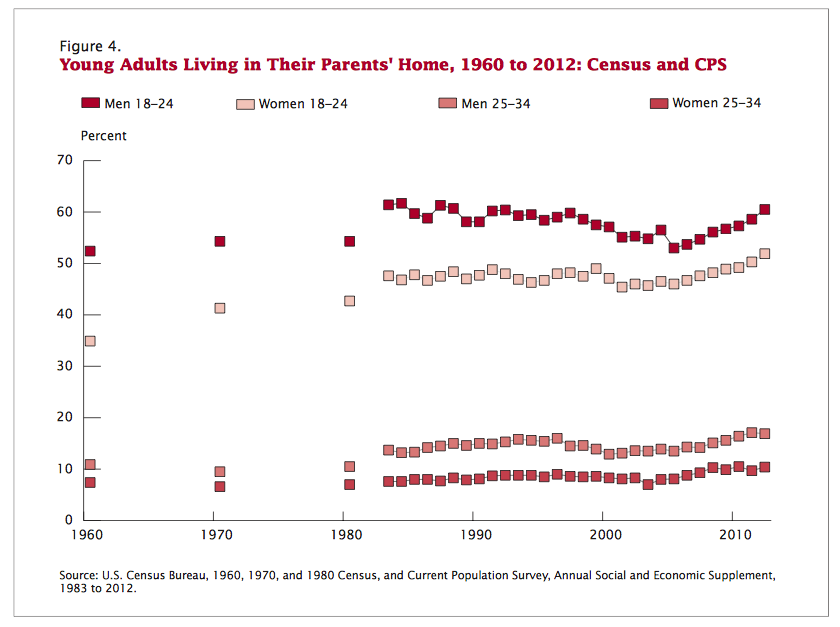
On that note, Derek Thompson recently argued that statistics about millennials living with their parents are “criminally misleading”:

Almost half of young people “living with their parents” are in college, where all campus housing counts as “living with their parents.” Scary Millennials Trends are fun and popular—young people read them to feel outraged; parents read them to gauge their own Millennial’s progress; others read them for schadenfreudeIf we’re going to freak out about young people, let’s do so for the right reasons. Unemployment is too high, entry-level jobs are depressingly salaried, and many have taken on student loans that will negatively shape their immediate future.

But David Dayen rebuts:

First of all, Thompson plays a bit with his age ranges. The statistics he pulls on the increase in college enrollment are for millennials aged 18-24. However, the trend of more young adults living at home, based on Current Population Survey statistics, extends from 18-34. You can see the upward trend for men and women aged 25-34 specifically. It’s hard to figure that this all comes from dorm living. Especially considering that college enrollment has actually fallen the past two years, yet young adults living at home continued to rise.

Put this all together, and you get the result that economist Jed Kolko of housing analysis site Trulia finds: even after you adjust for increased college enrollment, “millennials were more likely to live with parents in 2012 and 2013 than at any other time for which a consistent data series is available.” Even eliminating all full-time college students aged 18-24 from the data shows the trend.

Yglesias comes to the same conclusion. Back to the reader discussion:

While I agree that the Millennials have taken huge strides beyond our generation, it is well to remember one thing: they have the enormous advantage of being the second generation to grow up with massive change.

For example, why do they have fewer problems with gays and gay marriage? Well, consider that in my lifetime, anti-miscegenation laws were still the norm in the US. California, for example, only got rid of its laws in the middle of the last century (which means that, at the time I was born, my marriage would have been illegal). If you wonder why voters in our parents’ generation have so much trouble adapting to gay marriage, consider that they were raised in a culture where things didn’t change much – technology changed in some regards, but society much much less so.

Not to minimize how well the Millennials are doing at building a better society. But, as with all social constructions, the foundations were laid by those who went before. It’s all too easy to forget that.

Meanwhile, a pessimistic reader across the Pond writes:

I was born in 1995 and have become politically aware only during the
last couple of years, and here in England, what I see does not fill me with great confidence.

I see an electorate dominated by older generations who are terrified at the changes going on throughout the country. I would say that the political awakening that Millennials feel in this country is revulsion and cynicism. We don’t want anything to do with the obviously stitched-up system. Our only route is to get a good education and then get the hell out of this place before the older generations shut the doors to the continent and to the world through their palpable fears of everything. And our apathy and their fears have created a vicious circle, since if my generation wants nothing to do with the system and then abdicates the levers of the system to the older generations, then things will only get worse. I worry about my country.

I don’t know what can be done. I think Millennials will become more apathetic as our democracy becomes more corrupt, which will only worsen the corruption. It has become so bad that I now actually hope that Scotland will vote to leave the union in September. Maybe that can bring enough shock to the system that something can be rescued. I don’t know. I don’t hope much.

Another reader weaves in another thread:

Your reader is right that liberalising theology won’t get millennials rushing back to the pews. Partly this is because it will take time for churches to stop being associated with gay bashing, covering up child abuse and so on, it doesn’t get forgotten that instantly. And partly because it’s not enough for organised religious groups to remove some barriers to relevance; they also have to BE relevant. What does an organised church actually offer even to a millennial with faith in God that they can’t get from praying on their own or with friends or family, let alone to anyone wavering?

If nothing else, the millennial generation refuses to accept institutions and rules just because they are there or because they are venerable, and they’re getting old enough it can’t be written off as adolescent rebellion anymore. To me it is one of their most attractive features, but I imagine it aggravates people and institutions used to unquestioning obedience.

Andrew Asks Anything: Matthew Vines, Ctd

A reader connects the podcast to the ongoing thread on evangelicals and gay marriage:

A moment that jumped out at me during your podcast with Matthew Vines (partially because of my own interests and background as a former Presbyterian) was when you responded to Vines’ description of John Piper’s attempts to use the Greek to determine whether porneia was a valid excuse podcast-beaglefor divorce, and whether that divorce separated a married couple or a couple that was merely betrothed. You described this sort of hermeneutics as a sort of insanity. Matthew responded with the argument that if scripture is the word of God then we could and should take it seriously.

That exchange really intriguingly revealed the cultural distance between your Catholic upbringing and Matthew’s experience in a conservative reformed church. It was one of the few times when I thought you were both unable to achieve a mutual understanding of perspective and experience. Your faith traditions, I think, have materially different positions on what scripture is, what it’s for, how it’s interpreted, and what it should mean for our lives, going even beyond the simple Lutheran formula of sola scriputura.

In recent history, the reformed and evangelical churches responded to historical literary criticism of the texts by digging in their heels and doubling down on inerrancy and scriptural authority. But the whole exercise is a bit circular.

If you ask a good reformed Presbyterian how they know about God, they’ll say scripture. If you ask why scripture is any good, they’ll say because it’s inspired by God. If you ask them how they know that, they’ll probably cite 2 Timothy 3:16, “All scripture is God breathed and useful for rebuking correcting and training in righteousness.” See, scriptures says it’s God-breathed, so it must be true.

Which is why 1 Corinthians 7, cited by your evangelical reader as a source for Christian theology of singleness, is one of my favorite passages. Besides revealing Paul’s eschatological perspective and apparent belief that the end of the world was coming any minute, and all the juicy marital advice, Paul comes straight out and says on matters of singleness and marriage, his advice is NOT from the Lord, but only his own opinion. This passage is even used by Biblical inerrancy advocates to argue that Paul himself could tell that there were times he was writing under the inspiration of God.

But what do you do when God-Breathed scripture states explicitly that it’s not God-Breathed? Which part of that statement is inspired word of God? And what does it mean for Paul’s advice to single people? Is it a worth a hoot? Hard to tell.

My previous thoughts on the podcast are here and here.  And don’t forget to check out Matthew’s remarkable new book, God and the Gay Christian: The Biblical Case in Support of Same-Sex Relationships.

How Good A Case Does Boehner Have Against Obama?

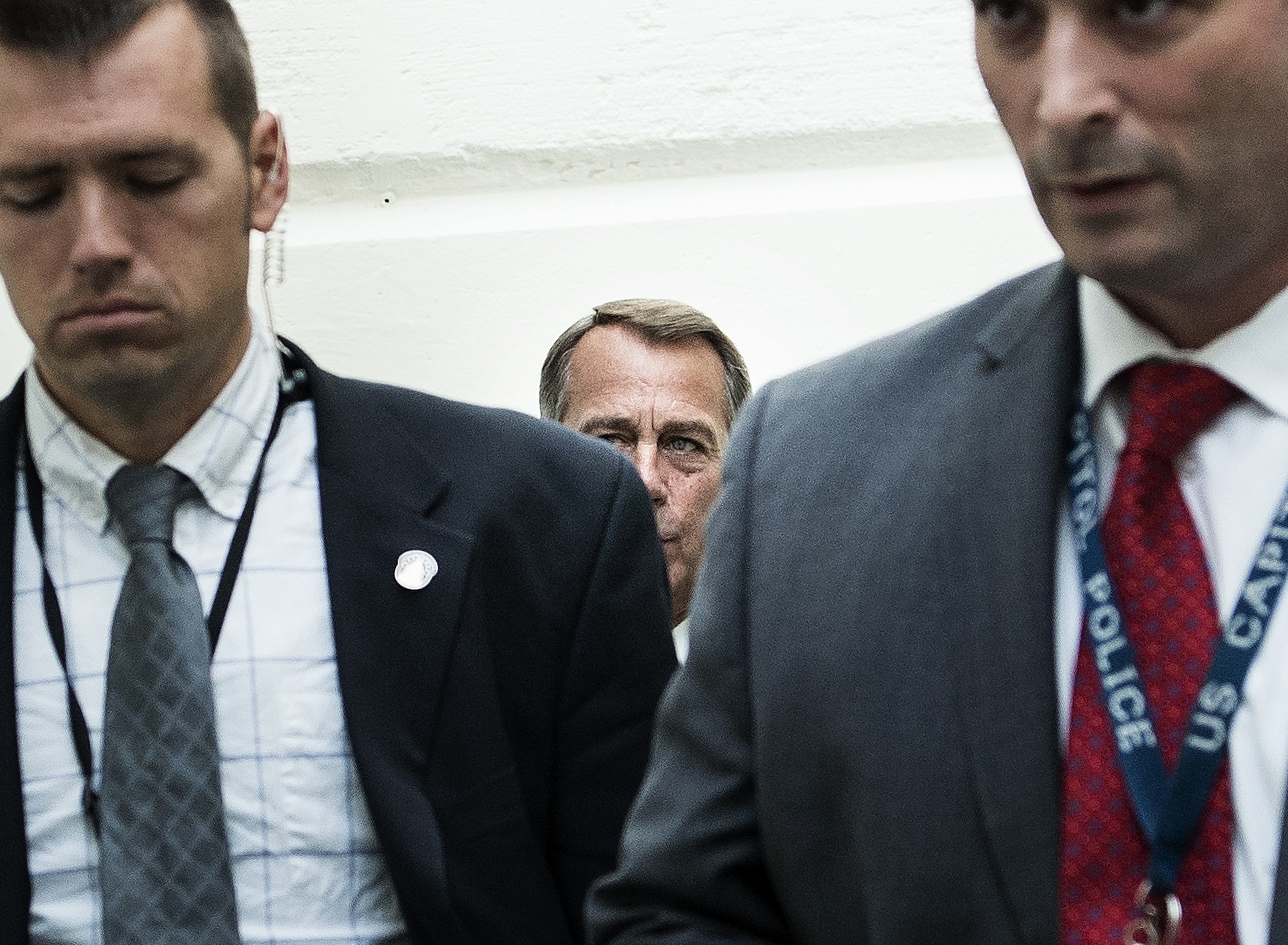
US-POLITICS-ECONOMY-BUDGET

Damon Root believes the lawsuit has legs:

That “failure to implement” refers to the White House’s controversial unilateral action delaying implementation of Obamacare’s employer mandate, the provision of the 2010 health care law requiring firms with 50 or more employees to provide qualifying coverage. As Peter Suderman noted in July 2013, the legality of that delay has always been in doubt. In fact, even Democratic supporters of the health care law have raised questions about the propriety of Obama’s actions on that front. Sen. Tom Harkin (D-Iowa), for example, declared, “This was the law. How can they change the law?” How indeed? Perhaps we’ll find out as the House’s lawsuit moves forward.

In a roundup of legal opinions relevant to the suit, Kliff finds that the precedent benefits the president:

Congress and the courts have repeatedly recognized that the White House needs some space for discretion to make laws work. Legislation is often a broader blueprint with a particular policy goal in mind — in the case of the Affordable Care Act, for example, expanding access to insurance. The agencies that turn that blueprint into actual regulation, courts have ruled before, need some space to make decisions about the best way to handle that process.

In 1984, for example, Supreme Court’s Heckler v. Chaney decision examined whether the Food and Drug Administration had acted unlawfully when it refused to stop prisons from using lethal injection drugs that it hadn’t approved for such a purpose. This is, after all, a hugely important job for the FDA: making sure Americans are using drugs safely. But in Heckler, the Supreme Court ruled that agencies exist in a world where there are budget constraints and scarce resources and competing priorities, and sometimes they need to use their discretion in figuring out how to make the trains best run on time.

In Eric Posner’s view, the lawsuit’s entire premise, that Obama “failed to execute” the ACA employer mandate, is off-base:

Forget what you learned in seventh grade: It’s simply not the case that Congress sets policy and the president executes it. The two branches battle over policy, using all means at their disposal. The laws themselves are frequently vague and loose. In the end, the president enforces most of the laws in an even-handed way because most laws are popular—that’s why they were enacted in the first place. If you don’t believe me, consider how rare it is for presidents to use the pardon power, which is without doubt discretionary, for partisan or ideological ends. President Obama has not gone beyond public opinion—for example, by releasing prisoners from Guantánamo Bay—because he fears a political backlash, not because it’s illegal.

This conflict is baked into our system. It’s a result of the founders’ decision to give the executive and the legislature different sources of political authority. This is how our government differs from a parliamentary system, in which the prime minister operates at the pleasure of the legislature. If you want to blame someone, don’t blame Obama. Blame the Constitution.

Boehner’s choice of subject for his lawsuit is inscrutable to Arit John:

Republicans would have to prove that the president’s lawless failure to enforce the employer mandate is an attempt to derail his signature policy initiative. (Conservative pundits and media outlets have been surprisingly silent on how this might work.) If the House had gone after the president’s gun control actions or, as many suspected, his immigration orders to defer the deportations of children brought to America illegally, then the lawsuit would have at least made sense. …

Boehner could have sued the president for enacting a number of policies his base doesn’t approve of: letting “Dreamers” stay in the country, any of his 23 different gun orders, or even ending LGBT discrimination among federal contractors. Instead he’s suing him for delaying a mandate Republicans would happily delay permanently.

Nicholas Bagley highly doubts the House has standing to sue on this issue:

The memo also asserts that there is no “legislative remedy” for the delays. That’s just false. Congress could, for example, enact a statute withdrawing the President’s claimed enforcement discretion. Congress retains the power of the purse, giving it enormous leverage in negotiations with the President. And don’t forget about the impeachment power. These options may not be politically viable, but that just means Congress isn’t willing to use its power, not that it lacks the power.

On the politics of it, Yglesias sees Boehner’s lawsuit against Obama as further evidence that the speaker is, as he puts it, in zugzwang – a chess term for when a player is forced to move when his best option is to pass:

The best thing for House Republicans to do this summer and fall is nothing — Obama’s approval rating is underwater, the GOP is poised to pick up seats in the midterms, and there’s no need to rock the boat. But conservative activists won’t tolerate a pass strategy. They hate Obama and want Boehner to do something that expresses that hatred. Lawsuits are a milder move than impeachment, so given the realities of the situation the litigation is arguably a savvy move by Boehner rather than a blunder. But the impatience of the activist right is still a gift to the White House. Rather than leaving Obama to struggle impotently from the White House, it allows him to underscore the basic reality of the situation — there’s stuff he would like to do that Republicans are furiously fighting to keep from happening.

Ezra considers it a safety valve of sorts for Republican rage:

Assuming House Republicans ultimately back Boehner’s lawsuit, it will begin a lengthy legal process as the case winds its way through the courts. House Republicans will be able to go back to their districts and tell their base that they’re doing something radical and even unprecedented to bring Obama to heel. Meanwhile, Boehner can argue that attempting impeachment before the case finishes would be counterproductive: if Republicans raise impeachment as a remedy there’s no way the courts will get involved. They’ll just let Congress work it out. Boehner is letting Republicans throw as many parties as they want in the House so he can make sure they don’t drink and drive home.

I’m struck also by the speed with which the GOP establishment tried to rule out the Palin impeachment idea. They saw immediately how damaging it would be politically, and dismissed it. But if the lawsuit fails?

Previous Dish on the lawsuit here, here, and here.

(Photo: Brendan Smialowski/Getty)