There Go Those Pesky Aligned Interests Again …

Iraq isn’t the only place where America and Iran are fast becoming best frenemies. “When it comes to Afghanistan,” Michael Kugelman argues, “Tehran and Washington tend to see eye to eye on many core issues, including the Taliban”:

There’s good reason to believe that Tehran wants a stable Afghanistan. Greater instability would intensify narcotics trafficking. Additionally, it would lead to further influxes of Afghan refugees (only Pakistan has more). In recent years, these immigrants have been increasingly unwelcome in Iran, and many have been deported. Tehran also likely worries that a deteriorating Afghan security environment would embolden anti-Shia forces, including the Pakistani organization Lashkar-e-Jhangvi, whose commanders vow to march into Afghanistan when international troops depart. Though Iran publicly opposes any U.S. troops in Afghanistan, in private it would probably happily accept the presence of a residual post-2014 force.

Tehran also shares the U.S. objective of an Afghanistan that is more integrated with South and Central Asia. Iran has pursued rail, pipeline, and trade projects meant to better link Central Asian states. It is also cooperating with India on the construction of a port that would facilitate more Indian trade with Afghanistan and Central Asia (the Chabahar port would enable India to bypass longer routes through Pakistan). These efforts dovetail with Washington’s “New Silk Road” initiative, which aims to develop regional energy markets in South and Central Asia and more broadly to boost cross-border trade and transit across these regions. However, U.S. sanctions on Iran have prevented Tehran from obtaining international financing for some of its projects. Phasing out these sanctions — a possible upshot of improved bilateral relations — could bring in more financing, and allow regional integration initiatives to truly take off.

The Challenge Of Reform Conservatism, Ctd

In response to me, Douthat expounds on the nature of and audience for reform conservatism. This is well said:

The reality is that, except in truly exceptional cases, our politics is better off in the long run when views held by large proportions of the public are represented in some form by one of our two parties. Right now (to run down a partial list of divisive cultural issues), a burke_1.jpgplurality of Americans want the immigration rate decreased; about half the country opposes affirmative action; more than half supports the death penalty; about half of Americans call themselves pro-life. Support for gay marriage and marijuana legalization has skyrocketed, but in both cases about 40 percent of the country is still opposed. Even independent of my own (yes, populist and socially conservative) views, I think these people, these opinions, deserve democratic representation: Representation that leads and channels and restrains, representation that recognizes trends and trajectories and political realities, but also representation that makes them feel well-served, spoken for, and (in the case of issues where they’re probably on the losing side) respected even in defeat.

Because without that representation, populism doesn’t go away; it festers. Just ask David Cameron, Sullivan’s example of a modernizing conservative, a politician whose agenda has had a number of admirable features … but whose style and approach also helped roll out the red carpet for UKIP and Nigel Farage. In the United States, a more populist and conservative and religious country than Britain, the Farage scenario would look wilder and stranger and much, much worse for conservatism and the country. And so Republican politicians interested in outreach and coalition-building and modernization have an obligation to make sure they don’t also create a pervasive sense of populist disenfranchisement along the way.

I take Ross’s other points as well – especially about social issues like marriage equality. The GOP will probably adjust soon enough to the radically new landscape, and I may even find them more sympathetic if they try simply to protect a dissenting religious minority, rather than over-reaching. I’m in favor of religious freedom over any attempt to ram a new gay orthodoxy on the entire country. I still don’t see a powerful theme or a leader who could turn this constructive caucus into an administration. But the future is wide open. Frum joins the conversation:

The reform conservatives seem more open to the new. This is progress. If the policy agenda that follows remains cautious, remember: These conservative reformers aren’t trying to change the world. They’re trying to change a political party.

You don’t change people’s minds by telling them they are wrong, even—or especially—if they are wrong. You change their minds first by establishing an emotional connection with them. Next you ratify their existing beliefs. When it comes time to introduce a new idea, you emphasize its consistency with things they already believe. This is what the reform conservatives are doing, or have begun to do. If they seem to be moving slowly, well, take it from me: It’s no good being even 10 minutes ahead of the times.

Kilgore criticizes Frum for setting the bar so low:

As I recall, it was Michael Gerson, not David Frum, who penned George W. Bush’s memorable line that accepting bad public schools for poor and minority students reflected “the soft bigotry of low expectations.” But it’s a not a bad description for Frum’s attitude towards the GOP, and thus towards the reformicons. He clearly thinks his party is so deep in ideological sin that it can tolerate only brief and veiled exposure to the light.

Well, yes. This won’t be easy, especially if the GOP doesn’t want to chip away at its base as it now exists. Bernstein adds:

Liberals shouldn’t expect to agree with the reformers, or to find their policies appealing. But they should expect the other party to have real policy preferences, and something resembling policy proposals, and for them to abide by the basic norms of the political system. By those standards, reform conservatives deserve an incomplete grade, but one that is more positive than negative.

Drum’s take:

Are [reform conservatives] trying to build credibility with conservatives so they can later nudge them in a new direction? Or are they mostly just trying to put a friendly veneer on an essentially tea partyish agenda? We don’t know yet, because so far they haven’t been willing to take many risks. And with good reason. As a friend emailed just a few minutes ago, “The reformers are one bad suggestion away from being fully Frumanized out of the party.” I wish the reformers luck. And I don’t really blame them for their timidity so far. Still, it’s far too early to tell how serious they are. We’ll just have to wait and see.

Frumanized? I think he means Frummed.

A Hail Mary Pass From The Iran Hawks

With the July 20 deadline for a final agreement looming, John Kerry returned to Vienna yesterday for another round of nuclear negotiations with his Iranian counterpart Mohammad Javad Zarif, saying “very significant gaps” still remain between Washington and Tehran’s positions. Opponents of a deal have already moved to preempt any possible success in Vienna, with House Foreign Relations Committee chair Ed Royce and ranking Democrat Eliot Engel circulating a letter

demanding that Obama consult Congress more closely on the ongoing negotiations and suggesting that Iran will have to satisfy Congressional demands on human rights, terrorism, ballistic missile development, and other issues unrelated to the ongoing nuclear negotiations before it will approve major sanctions relief. …

Of course, President Barack Obama himself can provide a certain degree of sanctions relief under executive order as he no doubt intends to if a deal is struck. And there is no doubt that Congress has a role to play in lifting sanctions. But the letter’s assertion that there is no exclusively defined “nuclear-related” sanction against Iran under US law and that any relief can only be extended by addressing a host of non-nuclear-related issues appears calculated to sow doubts about Obama’s ability to deliver among Iran’s leadership, thus strengthening hard-liners in Tehran who argue that Washington simply cannot be trusted.

The messaging continued on the Sunday talk show circuit. After Zarif went on “Meet the Press” to reiterate that Iran sees no benefit in developing a nuclear weapon, hawk-in-chief Benjamin Netanyahu, on “Fox News Sunday”, called that “a joke.” Speaking of the Iran hawks, James Traub urges Obama to “tell them — politely of course — to go to hell”:

After years of inaction and thunderous polemic, the negotiations of the past year have been remarkably professional. A report by the Arms Control Association lists 31 obligations that Iran undertook when it signed the so-called Joint Plan of Action; all but two are completed or in full compliance. Critically, Iran has agreed to stop enriching uranium at 20 percent, to dilute its existing stock of highly enriched uranium, and to allow regular inspections of its nuclear facilities by the International Atomic Energy Agency. The West, for its part, has made good on its promises of sanctions relief. …

Failure is still as likely as not. Very powerful forces in Iran are ideologically committed to an adversarial relationship with the West; others have earned a fortune in Iran’s isolated economy, and would lose out were the country to open up. Iranian negotiators continue to speak as if both sides must make equal compromises, when in fact the onus is on Tehran to comply with the NPT. Yet the Iranian people elected Rouhani to bring an end to their isolation and deprivation, and he knows — and presumably the supreme leader knows, too — that failure to reach a deal threatens Iran’s future, and perhaps the revolution as well.

Previous Dish on the latest round of Iran talks here and here.

Gaza Gets Worse

The conflict continues to escalate, with Israel launching a ground offensive and warning tens of thousands of northern Gazans to flee in advance of a major assault:

An estimated quarter of the 70,000 residents of the town of Beit Lahiya in northern Gaza fled their homes early Sunday after Israel dropped fliers and made phone calls warning residents of upcoming attacks. The United Nations reported 17,000 Palestinians have registered in shelters. The warnings came after Israeli special forces briefly raided Gaza to destroy a suspected long-range rocket launch site. Meanwhile, rockets were fired from Syria and Lebanon into northern Israel. The rocket attack from Lebanon was the third such incident since Friday. No one has claimed responsibility for the rocket fire Monday morning, and no injuries were reported.

The death toll in Gaza, according to Hamas officials, stands at 172, with over 1,100 injured. Gregg Carlstrom believes the Israelis when they say they are out to destroy Hamas for good:

The Palestinian militant group is, in the estimation of Israeli officials, weaker than it has been in memory, and Israel senses the best opportunity it has had in a long time to permanently degrade or even eliminate Hamas as a political factor.

It’s not just that the Israelis are pounding Hamas from the air and rounding up senior Hamas officials; with help from their de facto ally across the border—Egyptian general-cum-dictator-cum-president Abdel Fattah el-Sisi—they have managed to keep Hamas’ supply tunnels to Gaza virtually shut down. Analysts estimate that the roughly $20 million per month that Hamas collected in tax revenues from the tunnels has been reduced almost to zero.

Based on their public statements, it’s clear that at least some Israeli hawks would like to do to Hamas what Sisi has done to the Muslim Brotherhood group from which Hamas once sprung: batter it into submission. Officials in Israeli Prime Minister Benjamin Netanyahu’s cabinet have gone further, talking openly of a campaign to eradicate the group. Even Hamas officials admit they are worried. “I would say that, yes, the situation is not ideal,” Osama Hamdan, the head of Hamas’ foreign relations bureau, told me. “It’s certainly not as it was a few years ago.”

But as Juan Cole is quick to point out, it won’t work:

With leaders killed and rockets depleted, the Israeli hard liners probably believe, Hamas may be fatally weakened. At the very least, it will be less able to resist future episodes of lawn mowing in Gaza. The theory behind this campaign, however, is incorrect. Hamas is perfectly capable of building more rockets, even if they are smaller and have less range than the imported ones. And killed leaders can be replaced by their cousins.

Natan Sachs, however, doubts Israel actually wants to eradicate Hamas:

Even if Israel were to enter Gaza with ground forces, it’s unlikely to try and topple the Hamas regime, for fear of the immense cost of such an operation to the local population and to Israeli troops. Instead, Israel prefers a weakened, deterred, but effective Hamas. With the tunnels from Sinai now closed, a hit to the Hamas stockpile stands some chance of lasting longer than previous attempts, since it would be harder for Islamists to replace the lost weaponry.

But even if its weaponry were degraded, Hamas’s motivation to prove “resistance” to Israel will remain. Most acutely, this round of violence has the potential to reinforce the unrest — which had subsided — in the West Bank and in Jerusalem. A full blown Intifada, possibly coupled with attacks from Lebanon or elsewhere, could make this round of violence seem tame by comparison.

Previous Dish on the crisis in Israel and Palestine here, here, and here.

Why Undertipping Makes You A Real Jackass

Tipped-minimum-wage

The minimum wage for tipped workers has remained stagnant for 23 years:

Tipped workers have been getting short-changed for years. At least that’s what the gap between the federally mandated regular minimum wage and federally mandated tipped minimum wage would suggest.

When the tip credit, as that difference is often called, was created in 1966, it split hotel, restaurant and other service industry salaries up so part was paid by their employers and another part was paid by their customers. The legislation was intended to protect service industry workers who had previously been unprotected under the Fair Labor Standards Act (FLSA). And the split was originally 50-50 – meaning employers and customers shared the cost of each tipped worker’s minimum salary.

But the burden is increasingly falling on America’s restaurant goers and other service industry customers. “Today this two-tiered wage system continues to exist, yet the subsidy provided by customers in restaurants, salons, casinos and other businesses that employ tipped workers is larger than it has ever been,” a new report (pdf) by the Economic Policy Institute says. The tip credit has surged from fewer than $3 in the late 1980s to more than $5 today, largely because the tipped minimum wage hasn’t increased in 23 years.

When Your Heart Goes Out

Kirsten Weir looks at the very real phenomenon of deadly grief:

Studies from around the world have confirmed that people have an increased risk of dying in the weeks and months after their spouses pass away. In 2011, researchers from Harvard University and the University of Yamanashi, Tokyo pooled the results of 15 different studies, with data on more than 2.2 million people. They estimated a 41 percent increase in the risk of death in the first six months after losing a spouse.

The effect didn’t just apply to the elderly. People under 65 were as likely to die in the months following a spouse’s death as those over 65. The magnitude of the “widowhood effect” was much stronger for men than it was for women. … While women might be more resilient to losing a spouse, however, they aren’t immune to the deadly effects of grief. A 2013 study of more than 69,000 women in the United States found that a mother’s risk of dying increased 133 percent in the two years following the death of a child.

Weir goes on to describe “broken heart syndrome,” also known as stress-induced cardiomyopathy:

It appears to be brought on by a sudden surge in stress hormones including epinephrine (more commonly known as adrenaline) and its chemical cousin norepinephrine. That rush of hormones is a normal, healthy response to extreme stress. It fuels the body’s famed “fight or flight” response that prepares you for dealing with major threats. But in some cases the sudden flood of hormones essentially shocks the heart, preventing it from pumping normally. On an X-ray or ultrasound, the heart’s left ventricle appears enlarged and misshapen. The unusual shape is said to resemble a Japanese octopus trap called a tako-tsubo, hence the syndrome’s other alias: Takotsubo cardiomyopathy. The syndrome doesn’t permanently damage the heart’s muscle tissue, and patients often make a full recovery. …  Still, the condition can be deadly if the misshapen heart can’t pump enough blood to the rest of the body.

Earlier this year, a study identified over 20,000 cases of the syndrome across the US. The results found that they were most common in areas affected by natural disasters:

Missouri and Vermont possessed the highest number of reported cases, and the latter, with 380 cases per million residents, had more than double most other states. The data came from the same year Hurricane Irene wreaked the worst havoc Vermont had seen in decades. Similarly, the “cluster” in Missouri occurred near the site of 2011’s massive Joplin tornado. And while there might have been a number of other factors affecting these results, the general research takeaway suggests natural disasters can strongly contribute to cardiomyopathy.

A Deep Sea Delicacy

3797640892_217b339c03_z

Food trendsetters, Franz Lidz observes, are looking past sea urchins’ spiny exterior:

In the brave new world of fine dining, the roe of the humble urchin—a shellfish once cursed as a pest to lobstermen, mocked as “whore’s eggs” and routinely smashed with hammers or tossed overboard as unsalable “bycatch”—is a prized and slurpily lascivious delicacy. Unlike caviar, which is the eggs of fish, the roe of the urchin is its wobbly gonads. Every year more than 100,000 tons of them slide down discerning throats, mainly in France and Japan, where the chunks of salty, grainy custard are known as uni and believed to be an uplifting tonic, if not an aphrodisiac. The Japanese exchange urchins as gifts during New Year celebrations.

Lidz profiles Roderick Sloan, who harvests the creatures off the coast of Norway. According to one chef, Sloan’s plunder tastes “like you’re making out with the sea.” Updates from several readers:

My wife eats sea urchins every year when we go to Greece.  Her uncle collects them from the ocean in front of her father’s house there.  Just a little lemon and olive oil goes into the sea urchin and then you scoop it out with fresh bread.

But my sea urchin story has nothing to do with eating them.  My wife used to have warts on the bottom of her foot.

She didn’t deal with them quickly and picked at them (which you are not supposed to do) and when she finally did nothing worked to get rid of them.  She tried the acid pads, she greecewent to the doctor and got them frozen she even tried something where they infected her foot with yeast.  I wanted her to deal with it because I got them a couple of time on my foot from her.  (I dealt with them quickly using the acid pads from the drug store and got rid of them).  Her doctor told her that surgery would be the only way to get rid of them and that she would be on crutches for months they were in so deep.

Well, one day in Greece she stepped on a sea urchin.  Like I said, they live in the ocean right below the house in Greece where we swim in the afternoons.  It was painful and many a spike had to be tweezed out of her foot. Still, we couldn’t get all of them out (they break off when you try to pull them out with the tweezers). A month later she noticed that the warts were gone.  She told her doctor who was equally amazed. I don’t know how or why but stepping on a sea urchin killed off the warts on her foot!

The attached photo is of the cove were we swim in the afternoons where my wife stepped on the sea urchin.  Look for the house that is closest to where I took the photo – a white blob with a red door facing the camera – then look to the left and slightly up the hill: that’s my father-in-law’s house.  It’s our P-town.

A less happy story:

Years ago I spent six months in Cairo, Egypt, having been hired by an Egyptian family to help with the rehabilitation of their brain-injured son. We spent the hot month of August  at a villa on the Mediterranean coast just west of Alexandria. They knew my fondness for seafood (I’m from North Carolina), so one morning they brought me a tray of freshly caught sea urchins with some cut lemons. After they showed me which part of the strange interior to eat, I consumed the entire tray.

Almost exactly one month later, I came down with a raging case of hepatitis A and spent the next month in bed. My employer (my Egyptian patient’s father) told me that I must have eaten some bad street food in Cairo. I quickly thought back and remembered the sea urchins. I later learned that raw sewage was being released into the sea at Alexandria. I never told the family that in their effort to give me a treat, they had unwittingly fed me the contaminated urchins and nearly destroyed my liver!

Meanwhile, another recommends for stepping on urchins:

Have someone urinate on the wound. No really. It softens the spines and allows you to pull them out. I guess you can use vinegar if you’re not into golden showers, but on a beach far from civilization, it might be the only option.

(Top photo of sea urchin served at the Hungry Cat, a restaurant in Santa Barbara, via Roger Braunstein)

Watching The End Times In Primetime

Matthew Paul Turner unpacks the peculiar theology informing the new HBO show The Leftovers, which is premised on the sudden disappearance of 2% of the world’s population:

Believe it or not, the Rapture, as many evangelicals understand it today, is an idea that’s less than 200 years old, one part of an eschatology invented in the 1830s by John Nelson Darby, a British Bible teacher and devout member of the Plymouth Brethren. As a theologian, Darby constructed an entire Biblical interpretation known as Dispensationalism, an evangelical futurist expounding that, among other things, suggested that God’s relationship with humanity varied according to dispensations, or periods in history.

According to Darby, God’s epic timetable—from Adam and Eve to the apocalyptic endis split up into seven non-uniform eras. For instance, Darby’s first era—the dispensation of innocence—started with Adam and Eve and lasted only as long as the first biblical pair lived in the Garden of Eden. The second era—the dispensation of conscience—began right after God evicted Adam and Eve from the Garden and ended when  Cain murdered Abel. Darby said the sixth era—the dispensation of grace—started with the crucifixion of Jesus and would not end until Jesus rescued all Christians from earth, making the way clear for the Great Tribulation—seven years of torment and pestilence—to begin.

After watching the pilot episode, however, Brandon Ambrosino picks up on the nuances of the story being told:

[A]s [series creator Tom] Perrotta has insisted, his rapture isn’t the Christian one. Yes, he said, people will use the word “rapture” because it’s the one they’re familiar with when it comes to explaining mass disappearances. But he hopes Leftovers is able to “disconnect [the rapture] from its religious context,” which he thinks is too “purposeful and clear,” and lacking in “nuance and grief.”

After watching the pilot, I can see that Perrotta was true to his word: his series is not about the rapture that Christians have been obsessing over for a century or two. For that matter, The Leftovers isn’t even a show about a rapture — it’s a show about loss. Which is to say, it’s not a show about an event, but a show about the people left in the wake of that event. As Perrotta explained to the Times, that is a universal theme that should resonate with both religious and non-religious viewers: “We’re always being left behind, we’re always living in a world where there are these spaces where people we knew and loved used to be.”

Still, the religious — and, in my opinion, deeply biblical — influence of the narrative is still lurking throughout the show. In some moments, this influence is blatant, in other moments it’s merely winked at.

Sinking Noah’s Ark

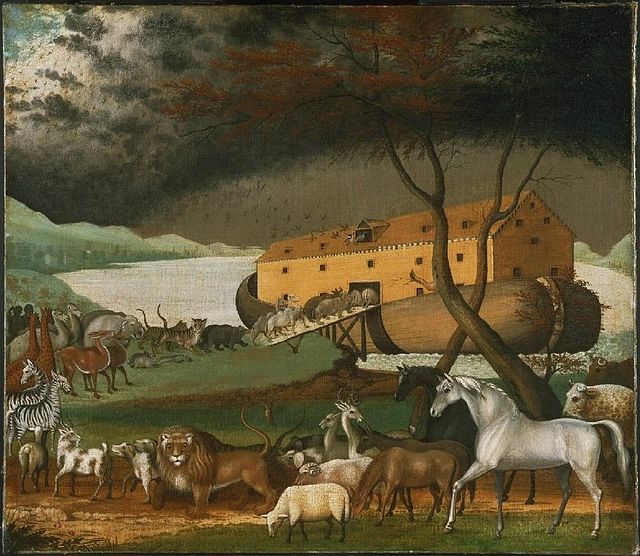
Noahs_Ark

Noting that it’s “the only biblical story, violent or otherwise, that has spawned Fisher Price toys and nursery decoration” and that “it holds the dubious honour of being the Bible text most often given as a present by religious relatives to the children of atheist parents,” Myra Zepf makes the case against Noah’s ark and its place in our culture:

It struck me recently why this story makes believers feel warm and fuzzy and leaves me cold. Fundamentally, they identify themselves with Noah in his self-righteous smug destiny, being saved by God for their purity and goodness, whereas I recognise myself among the rest of humanity in my watery grave, sitting as I do on the wrong side of divine judgement. Noah’s faith saved him, and I’m toast. This makes it all the less appropriate as a fluffy introduction for our children to the wonders of religion.

To be honest, it’s the disrespect inherent in this soft missionising that bothers me rather than the presence of religious books in my house per se. In fact, Noah’s Ark is a spectacularly rich text from which to springboard discussion about reality versus fiction with curious little people. There is endless fun to be had wondering together how Noah managed to build an ark half the length of the Titanic, a millennium before the Iron Age, without saws, hammers or nails. Then the minor detail of how he collected the estimated 1,877,920 species from around the globe, including penguins from Antarctica and kangaroos from Australia. What about the food supplies for a year of confinement, including fresh meat for the lions and bamboo for the giant panda? Where did the floods, which were higher than Everest, drain to? Kids will love looking up how much excrement a pair of elephants produces in a year.

(Image: Noah’s Ark by the American folk painter Edward Hicks, 1846, via Wikimedia Commons)

The Bible For Bibliophiles

Alan Jacobs flags an interesting venture:

Bibliotecha is a remarkably successful new Kickstarter project for designing and printing a Bible made to be read, in multiple volumes and with bespoke type design.

Designer Adam Lewis Green discusses the project with J. Mark Bertrand:

JMB: The factor that “solves” a lot of the traditional challenges with Bible publishing – the tiny text, the thin, translucent paper – is dividing the text into multiple volumes. The Nonesuch Bible, for example, contains three, and Bibliotheca will have four. Whenever I’ve floated the idea in the past, it’s been met with resistance: I’m told people don’t want the Bible in several parts. But the success of Bibliotheca contradicts that. Why do you think there’s a sudden openness to a multi-volume Bible? Is it a question of reaching a different kind of reader?

ALG: I am not sure whether this is a different kind of reader or not. Obviously, the economy and practicality of a single volume is appealing, but there is also an idea out there that the biblical library belongs together in one volume, because “that’s the way it has always been, and was always meant to be.” Understandably – and this included me until I became really nerdy about bible design – a lot of people who read and appreciate the biblical literature don’t know much about the history of its physical form. Why would they? The format of the Bible as it has been given to us for generations took shape in the post-enlightenment world of empiricism, often more concerned about demonstrable facts than the enjoyment of beauty. Now, I believe (or hope), we are coming out of that, to a more balanced place.

Green adds:

I think the response to this project signifies that the biblical anthology is much too large (and I don’t mean in a physical sense) to be contained in any one format or type of reading experience. This is a diverse literature, which transcends time, culture and style in a way that very few have done, and none to the same extent. It has always taken on different forms within various contexts – artistic and technical, story-driven and study-driven. These forms will continue to change and, at times, surprise us.