Air Travel Gets A Little Less Entertaining

skymall_product_montage

SkyMall, surely the most interesting thing to read in your seat-back pocket, looks like it’s folding. Roberto Ferdman sums up the news:

SkyMall made its business over the past 25 years by entertaining commercial airline passengers and, occasionally, persuading them to purchase whimsical, often expensive products, including a $1,000 serenity cat pod, a $2,250 garden yeti statue and a $16,000 personal sauna system. But the company has suffered at the hands of recent changes to airline policy, which have given passengers alternative means of entertainment and flooded them with different avenues for online purchasing. The permitted use of smartphones on commercial flights has usurped the magazine’s place as the de facto way to pass the time while cruising at 30-some-odd thousand feet in the air. And the growing number of airlines providing in-flight Internet service has not only further eaten into the catalogue’s bread and butter but also paved the way for more competition in the form of online retailers.

A nostalgic Emily Dreyfuss reflects on the end of an in-flight era:

SkyMall was a tradition. An absurd, capitalistic embodiment of everything that was shallow and wrong with our lives, and yet it also brought us comfort. No matter if the plane was delayed, or we were stuck alone on a layover, missing whichever parent we were leaving, missing the friends and the life we were leaving behind each time we went between homes, it was there to make us laugh. To let us roll our eyes. To surprise us with a new level of novelty and frivolity.

SkyMall, that stupid wonderful completely American wonder that, with its insistence that you take your own free copy, announced it was your right as a human in the ‘90s to never not be shopping. Never not be consuming.

Joe Pinsker thinks through the value SkyMall has provided for businesses:

It’s essentially a classified section, with pictures. Manufacturers, retailers, and lone-wolf inventors could pay for space in the catalog—with a full page reportedly costing $129,000 per issue—and then give a small cut of any sales to SkyMall. While it lasted, this was a pretty sweet deal: Sellers, some of them amateur inventors, saw big leaps in sales after their products were exposed to nearly 700 million flyers. And SkyMall got access to a well-off demographic: Their average customer was a college grad earning more than $75,000 a year.

Either way, the catalog’s demise makes sense to McArdle, who’d much rather browse her iPad than flip through eclectic junk:

Skymall was something that frequent flyers all over this great land had in common, like getting groped by the TSA. [But aficionados] of the catalog shouldn’t fret too much; you can still buy the Zombie of Montclaire Moors from Amazon.

But, paradoxically, Danielle Kurtzleben points out that other dead-tree catalogs are actually seeing a mini-renaissance:

In 2013, retailers sent out 11.9 billion catalogs in the US, the first uptick since 2007, but also down from nearly 20 billion sent out in 2007, according to the Wall Street Journal. And that’s in part because retailers have increasingly figured out how to use catalogs to their advantage.

For an example of this, look no further than one resurrected catalog: JC Penney. That retailer announced just this week that it’s bringing its catalog back from the dead. Yes, catalogs take money to print and distribute, but they also bring customers in. In a recent report, retail consulting firm Kurt Salmon found that eliminating catalogs in an effort to cut costs can backfire for a retailer, because it engages customers so much less. Meanwhile, customers engaging with a retailer on multiple platforms (online, with catalogs, in stores) also spent a lot more. This is part of what retailers call an “omnichannel” strategy — using several mediums simultaneously to attract customers. And it makes intuitive sense: encourage customers to find your goods in a variety of ways and places, and they’ll both remember you and keep coming back.

In the end, Barro feels a little guilty:

I’m sorry to report that even I have been a free rider. Like a Times reader who clears his cookies daily to avoid the paywall, I have enjoyed the SkyMall catalog hundreds of times without ordering so much as a single inflatable body pillow.

(Image: A collection of SkyMall products)

Egypt’s Revolution Isn’t Over, Ctd

https://twitter.com/erinmcunningham/status/559419081183334400

Ursula Lindsey is saddened by the present state of the country:

I appreciate the desire to offer some encouragement to Egyptian citizens who supported January 25, and I agree that it is important to keep thinking of how to be active, even under these terrible circumstances[.] I also agree that we are not just back to the old days — there was a huge rupture, and even if the hopes it raised were defeated, the repressive techniques employed to achieve this (media propaganda; Saudi subsidies; massive repression; a shameful politicization of the judiciary) are destabilizing and seemingly untenable in the long-term. But I take a much darker view of the kind of days we’re in. People used to say that the revolution had brought down the wall of fear and it could never be back up; I think the army and police have done a great reconstruction job. Virtually every institution in Egypt is worse off than it was four years ago; a big segment of society has been complicit — out of fear, ignorance, self-interest — with the falsification of its own history and with granting impunity for state injustice and violence.

But Eric Trager doubts that most Egyptians, content with the devil they know, will pursue another uprising:

Sisi appears to have staying power. This is party due to the fact that the state is performing better under his stewardship in certain critical respects. Bread shortages have diminished, a smart-card system for distributing subsidized bread is being implemented, and Sisi announced major gas-subsidy cuts during his first month in office—a vital cost-cutting measure. It is also partly due to his repression of the opposition, including a severe crackdown on the Brotherhood and the arrest of many prominent revolutionary activists under a 2013 law that significantly limits protest activity.

But perhaps the most important reason for Sisi’s staying power is the popular mood, which is a cocktail of weariness and relief. Egyptians are exhausted after four years of tumult, but at the same time satisfied that their country hasn’t suffered the devastating chaos of Syria, Iraq, Libya, and Yemen. So while many of the economic and demographic problems that caused the 2011 uprising haven’t been resolved, a critical mass of Egyptians now prefer their broken state to spinning the wheel again and risking further collapse.

A more hopeful H.A. Hellyer advises the veterans of Tahrir Square to be more organized, plan longer-term political strategies, and get back to the basics:

[The revolutionaries must] remain cognizant of what has distinguished it. The core of the January 25 revolutionary uprising was speaking truth to power. That is a tremendous stance of ideational power, if not political power. While the revolutionary camp may sometimes embrace certain fixed and regular political personalities or forces, it ought never to make the mistake of confusing its mission with that of simply acquiring a power position.

Why You Should Get Vaccinated

measles-cases

It prevents outbreaks like this:

A spokesman for the California state health department has told Reuters that he believes “unvaccinated individuals have been the principal factor” in a mid-December measles outbreak at Disneyland that has infected more than 70 people in six western states and Mexico, including five Disney employees.

Sarah Kliff spells out how more individuals getting vaccinated could have protected the six infants who got sick:

The measles vaccine is not licensed for use on babies younger than 12 months. That means that, for the first year of life, babies depend on the fact that everybody else around them gets vaccinated. This essentially creates a firewall: if other people are vaccinated, they won’t catch the disease — and won’t spread it to young children who cannot get protection.

This is what scientists call “herd immunity,” and its a huge reason we get vaccines in the first place. The shots aren’t just about protecting ourselves from measles, mumps, the flu, or other diseases. They’re about making it really hard for those who are medically frail (like the elderly) and those who can’t get the vaccine (often babies and pregnant women) to catch a disease that could be devastating to them.

Another reason herd immunity is important is because vaccines don’t always work. Katie Palmer explains:

The measles vaccine is actually one of the most effective vaccines in the world. According to Greg Wallace, lead of the measles, mumps, rubella and polio team at the CDC, two doses are 97 percent effective against infection. (Compare that to 88 percent for two doses of the mumps vaccine from the MMR shot.) It’s a live version of the virus, just weakened—or attenuated—so it doesn’t cause severe symptoms. The vaccine replicates just like the full-on measles virus, inciting your immune system to produce antibodies against it. Those antibodies then protect against actual measles as well.

But in some people, that response just doesn’t happen. No one knows why. Either your body doesn’t produce enough antibodies, or the ones it does produce aren’t specific enough to latch on to the virus and kill it.

After reviewing recent court cases, Eugene Volokh finds legal support for requiring vaccinations:

Phillips v. City of New York (2d Cir. Jan. 7, 2015) reaffirms that the government may mandate vaccinations. It may mandate vaccinations for everyone, and it can certainly mandate them for everyone who goes to public school. Seems quite right to me; there may indeed be a presumptive constitutional right to be free from unwanted medical treatment, but such a right can be trumped by the very strong public interest in preventing people from becoming unwitting carriers of deadly illness. … Such statutes often do allow religious exemptions, but that’s not a matter of constitutional obligation. In Phillips, the one of the plaintiffs did try to claim the exemption, but the trial court found that her “objections to vaccinations were not based on religious beliefs,” and the plaintiff didn’t appeal that finding.

Genna Buck looks at where our vaccination rates need to be:

In California’s Santa Monica-Malibu school district, 11.5 per cent of parents refuse to vaccinate their kids. In nearby Orange County, the figure is 8.6 per cent. In Beverly Hills it’s five per cent—almost, but not quite, a safe level of vaccine coverage. In a large study that observed measles infections in the Netherlands over decades, scientists calculated that 95.7 per cent of a population needs to be immune to measles to prevent regular outbreaks. And since no vaccine is perfectly effective, even more than that number need to be vaccinated to protect the whole community.

Tara C. Smith notes that MMR vaccination is “at or close to 90 percent by age 3 and about 95 percent by kindergarten”:

However, national statistics obscure local trends. Those 5 percent who are unvaccinated aren’t randomly distributed throughout the country. Instead, they tend to cluster in location, with many unvaccinated children living in close proximity to others, creating anti-vaccine communities with high susceptibility to measles and other vaccine-preventable diseases.

Why this is so dangerous:

What many forget is that we had a massive outbreak of measles in the United States from 1989–1991. While our 644 cases in 2014 seems high compared with recent years, 25 years ago measles incidence spiked to 18,000 cases per year, with a total of more than 55,000 infections before the outbreak began to dwindle. It was the largest measles outbreak in this country since the 1970s. … Despite our advances and our modernity and our status as a developed country, we still saw 123 measles deaths during this epidemic—here, in the United States, where we get plenty of Vitamin A. There were also 11,000 hospitalizations—fully one-fifth of people infected with measles became sick enough to be hospitalized.

(Chart from the CDC)

The GOP’s New Year

African_elephant_warning_raised_trunk

This was to be the winter of their deep content. Having won the mid-terms on a platform of pure fear and panic, they had Washington DC in their pocket. The agenda was going to be theirs – even if they hadn’t run on much of a platform. They would prove to be a capable governing party again, get the Congress in order, and finally put an asterisk next to Obama’s name for two years.

And what has happened since? We’ve had an attempt to ban all abortion past twenty weeks, with an implicit claim that some rapes are not legitimate (because they weren’t reported to the cops). Critical Republican congresswomen balked, and a largely symbolic vote on a day devoted to pro-life activism collapsed in disorder. Before that, the House voted on the most draconian legislation yet that would require, by some analyses, deporting up to 10 million undocumented immigrants. Moreover, the polling of the base shows, as Aaron Blake argued, that

Although [Republicans] supported citizenship over deportation 43 to 38 percent in November 2013, today they support deportation/involuntary departure over citizenship, 54 to 27 percent. That’s two to one — a stunning shift.

Meanwhile, Obama’s ratings among Latinos have sky-rocketed and Jorge Ramos is now unrelenting in his attacks on the GOP. On economic policy, the Republicans have focused on the Keystone Pipeline and free trade treaties. And that may be it. Dave Camp’s real tax reform proposals fizzled. Cutting Medicare or social security in today’s climate is a very heavy lift. Reform conservative policies have not found a compelling advocate. On foreign policy, the decision to invite Binyamin Netanyahu to address the US Congress (again!) over the head of the sitting president is a grotesque blunder. That’s particularly so as the speech will take place two weeks before the Israeli elections – a piece of meddling that really will hurt the US-Israel relationship.

But don’t take it from me, take it from Fox News:

And what is the argument the GOP wants to make on Iran? That it should be the US that derails the critical last stage of the talks? And that, after doing that, we should respond with a new war in the Middle East to prevent what would then be a rush to get the bomb in Iran? Makes. No. Sense. If the GOP wants to fight the next election on the basis of re-entering the Iraq War with ground troops or a huge bombing campaign against Iran, they’re welcome to try. But the American public is not as obsessed as Sheldon Adelson and AIPAC with the Middle East. And the Iraq war was not a Clint Eastwood fantasy. Even Americans haven’t forgotten that.

Then we had the spectacle of last weekend’s Steve King confab in Iowa. In Roger Simon’s words, the clown car became the clown van. The crowd egged on the far right to go further over the edge. The one candidate who might begin to appeal to more than the base – Bush – was a no-show. By all accounts, Scott Walker gave a bravura performance, which may be the only salient thing to last once the vapors have lifted (and he’s worth watching). But to have so many wackos deliver such red meat to a far right base – with Palin and The Donald delivering random strips of steak tartare – is not a basis for appealing to the broader middle any major party has to, if it wants to govern and not merely scream.

The Palin speech was truly a wonder – an Allen Ginsberg-style Republican “Howl”. I know that with respect to her, I’m an alcoholic who shouldn’t go near a bar – but I couldn’t help myself. Watching the stream of narcissistic, delusional consciousness was like downing three shots of Jäger at once. And there were times when it seemed as if she’d done the same thing (just pick any three minutes at random):

A party that nominated a deranged fantasist like this for vice-president – and still lets her rally its base – is, to put it mildly, a joke. Her one political strength – her ability to channel populism – is undermined by the fact that the GOP has a much less appealing set of proposals to address that, compared with the Democrats. This is an era when cultural populism may finally be weaker than economic populism. Obama’s SOTU was simply a reminder that in this moment, with growth returning but all of it going to the very top, the left-of-center party has the advantage. And a right of center party that refuses to raise any taxes on the extremely rich is at a steep disadvantage. There are some reform conservative ideas that are worth airing in that respect – but they are not stirring the base and do not have – as of yet – a plausible GOP proponent or candidate. The only one who might pull it off has the Bush name hanging like an albatross around his neck. And Romney? All he will do is generate energy against him from the base.

Of course, this could change. Events could intervene; the economy might falter again; Putin could do something very reckless. One candidate may surprise us. But right now, the GOP looks to me like a party unable to see any enemies to the right, with few policies to address soaring inequality, deeply alienated from Latinos and African-Americans, and with a foreign policy that looks increasingly like Cheney’s.

That’s not a party headed back to government. If it stays the course, it’s headed toward oblivion.

(Photo: Muhammad Mahdi Karim from Wiki)

The Greek Backlash Against Austerity

Results In The Greek General Election

Over the weekend, Greek anti-austerity party Syriza, lead by firebrand Alexis Tsipras, claimed a resounding victory. Matt Schiavenza contemplates the sizable implications:

Tsipras’ victory presents the troika—a consortium consisting of the European Central Bank, the European Commission, and the International Monetary Fund—with a series of unappetizing options. If the troika gives in and writes down Greek debt, then other, larger countries—such as Spain—will have an incentive to negotiate a similar deal, triggering a major financial headache in Brussels and Frankfurt. If the troika refuses, then Greece is likely to default on its debt obligations this year and be forced to exit the eurozone—a fate that neither Tsipras nor the European leadership say they want.

Either way, the events in Greece signal that Europe’s long, failed experiment with austerity is cracking. In addition to Syriza, anti-austerity parties have grown popular in Spain, where opinion polls show Pablo Iglesias’ Podemos with 20 percent support. And Euroskeptic parties gained heavily in last years’s European parliament elections, particularly Marine Le Pen’s National Front Party, which has campaigned against fiscal austerity in France.

James Forsyth fixates on Syriza’s forming “a coalition with a party that takes just a robust view as it on the need to renegotiate the terms of the Greek bailout, The Independent Greece party”:

Independent Greece and Syriza have little in common other than their view on the bailout, Independent Greece sits in the same group as the Tories in the European Parliament. That Alexis Tsipras has chosen to do a deal with them rather than the leftist Potami who favour a less confrontational approach to the troika is telling. It shows that he has no intention of blinking first in his negations with the IMF, the rest of the European Union, the European Central Bank and the European Commission. ​

George Magnus is unsure how this ends:

Negotiations will start very soon because there are outstanding loan tranches and repayments to be sorted out by 1 March, and larger repayments to the IMF in July and August. Most likely, technical agreements will be reached to extend or reschedule payments due. The crux, however, is that the troika creditors will come face-to-face with a Greek government that is quite different from its predecessors, which included factions and groups whose political interests were almost indistinguishable from those of creditors and of the policies they espoused.

Greece and its creditors could forge some kind of mutually face-saving compromise over the terms of the debt so as to manage debt servicing better, and offer Greece some relief. But it will be much harder to reach agreement regarding the policies of austerity and structural reform, and the more radical changes to living conditions that Syriza has campaigned on.

Daniel V. Speckhard foresees major hurdles:

The need to get agreement across the members of the European Union, and in some cases, parliamentary approval, makes it a tall order, particularly if one is under a tight time frame. And the populist rhetoric that the far-left government can be expected to adopt in its early months combined with no experience in managing international relations or public messaging for foreign audiences, is likely to complicate negotiations further.

Bloomberg View’s editors want the troika to give ground:

Europe’s leaders have to clearly understand the meaning of Sunday’s vote in Greece. Germany, Finland and the EU institutions that have lent Greece money must now negotiate with Tsipras in good faith — as they refused to do with more co-operative governments that preceded his — to soften the destructive economic policies they have imposed. Although this will encourage Syriza-like protest parties in Spain and elsewhere, such is the cost of ignoring the political dangers of Greek austerity for so long.

Yves Smith highly doubts Syriza will get what it wants:

[W]hat happens when Syriza comes to realize that the Troika is deadly serious, which I believe it is? Whether the Eurocrats are right or not, it seems that at least the Fins and the Germans see Greece as disposable. Their leaders believe that throwing it out of the Eurozone or simply taking radical punitive measures if Greece does not do a deal by the summer rollover date will be at most disruptive but not fatal to the Eurozone; indeed, they may believe any short-term [crisis] would be to the Eurozone’s long-term benefit, since making Greece a demonstration case of how costly it is to defy the Troika would serve to cow the rest of the periphery countries.

Hugo Dixon tries to imagine a way forward:

[T]here might be a way of cutting a deal. The snag is that doing so would involve a massive somersault – or what Greeks call a “kolotoumba”. Many of Tsipras’ backers would then accuse him of betraying their cause. It is still far from clear whether he is prepared to do that. But if the Syriza leader is not prepared to compromise, Greece will default and will have to impose capital controls to stop the banks collapsing. If the people then forced the government to backtrack, there would be one final chance to stay in the euro. Otherwise, the drachma would beckon.

Tom Rogan fears Syriza has lost touch with reality:

Syriza’s platform is, in fact, delusional. Alice in Wonderland comes to mind. “If I had a world of my own,” Alice says, “everything would be nonsense.” The Greek voters who brought Syriza to victory are asking for nothing less. After all, what are German taxpayers to make of Syriza’s proposals? Having already spent many billions to save Greece from a fiscal meltdown and preserve its euro-zone access, Germans are now being asked to give up on getting their money paid back. Syriza’s debt-forgiveness plan is fundamentally unserious.

But Dan Hough’s research suggests that Syriza will be more moderate in office:

In terms of Greece’s immediate future, a Syrzia-dominated government is unlikely to live up to the often radical pre-election rhetoric.  Syrzia is likely to take decisions that supporters find very difficult; but it will take them nonetheless.  Whether it gets any credit for them when Greece next goes to the polls is an altogether different matter.

However, Spyros Economides warns that “Greece is entering a period of deep uncertainty”:

Syriza’s victory may indeed turn out to be pyrrhic. It is confronted by the immense task of governing at a time when Greece may be ungovernable, while also facing a potentially divisive internal struggle. International partners have also made it clear that the new Greek government, whatever its makeup, will have to honour the country’s existing agreements and commitments.

If Greece’s international creditors don’t come through with quick concessions, or if radical opposition rears its head against Syriza’s more moderate approach, this could trigger an uncontrollable reaction based on fear of uncertainty. That could lead to an accidental default, which would have disastrous consequences for Greece.

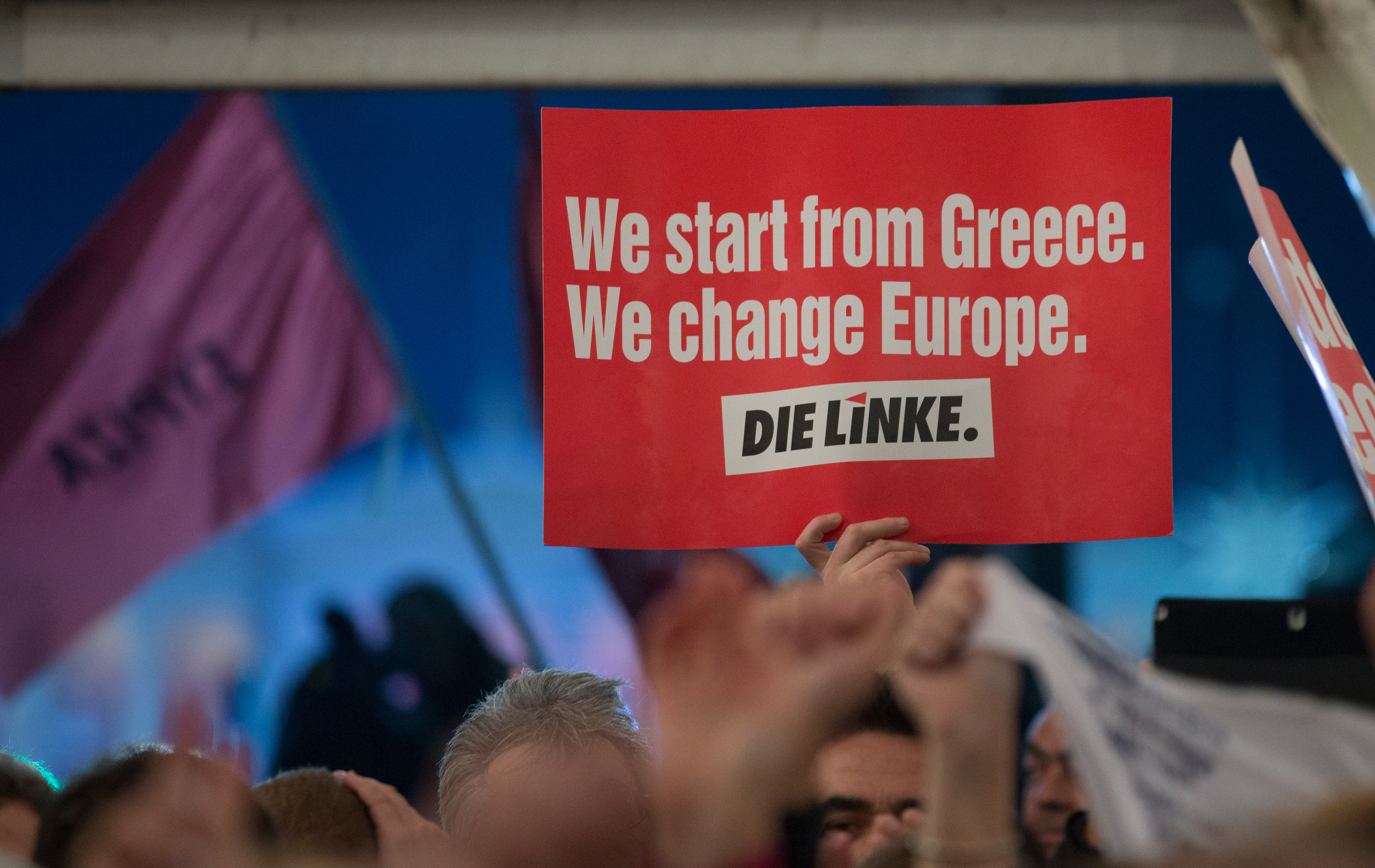
(Photo: A sign is held up stating ‘We start from Greece-We change Europe’ as supporters of Syriza react as exit polls showing their party is set to win the election on January 25, 2015 in Athens, Greece. By Matt Cardy/Getty Images)

Remains Of The Day

dish_gorgosaurus

Oliver Morton, pausing before a reconstructed gorgosaurus at the Manchester Museum, marvels that “absolutely all that remains of that creature’s life is this scarred skeleton”:

We often think of fossils as being in some way ancestral relatives, if not of humans, then of some other aspect of nature, parts of some great unfolding story. But for the gorgosaurs, the tyrannosaurs and indeed all the dinosaurs of the Cretaceous period, this simply isn’t true. The most fecund of their matriarchs has left no deeper imprint than a hatchling that died fresh out of its shell. No species alive today can be traced back to any of the dinosaur species except those few from which birds descended.

Fair enough; what everyone knows about dinosaurs is that they became extinct. What is not as well appreciated—but which, for some reason, the peculiar individuality of this one specimen brought home with some force—is this:

so did almost everything else. And almost all those extinct species lack descendants. What is more, even in the species which did contribute to life today—those ur-birds, for example—most individuals played no part in ensuring the continuation of their lineage. Most creatures make no contribution to the next generation, let alone to ultimate genetic posterity. From the point of view of the genes of creatures that are alive today, the overwhelming majority of all creatures that have ever lived are totally irrelevant. That dinosaur, dead in her 14th year, is a remarkable oddity in that her life and death can be known; but the rule of issueless irrelevance she represents is so nearly universal that its exceptions are all but miracles.

(Image of gorgosaurus at the University of Manitoba by Mike Beauregard)

“An American Orwell”

In a review of Irving Howe’s recently-published collected essays, A Voice Still Heard, Frank Foer appends that label to the critic and longtime editor of Dissent. Foer goes on to assert that Howe was “our most thrilling dissident, a socialist with conservative cultural sympathies, a scything polemicist capable of the most tender, patient literary explication”:

Irving_Howe_(1968)Howe had a heroic conception of the intellectual, and from an early age, he thrust himself into the growing world of little magazines. In his 20s, after his discharge from the Army, he worked as an intern, to use an anachronistic term, for Dwight Macdonald and Hannah Arendt. Both of these early patrons came to somewhat annoy him, but he paid close attention to their methods. Even as he became one of the greatest practicing critics in the country, he was also the sharpest, most observant student of his fellow intellectuals. They were truly his great subject. … Howe wrote about other writers with anthropological detachment, followed by blazing expressions of his disappointment with them. Namely, he flayed them for failing to do the most elemental part of their job, holding society to account.

David Marcus examines the way Howe “considered his literary and political inclinations to be one in the same, two sidesutopian and ironic, committed and criticalof the same intellectual vocation”:

[Lionel] Trilling remarked in this period that this choice between commitment and literary complexity was a “dark and bloody crossroads.” For Howe it was precisely by remaining between politics and literature that one became an intellectual.

Trilling insisted on the “moral obligation to be intelligent”; Howe insisted there was a moral obligation to apply such intelligence to politics. To rub social needs against utopian desires, the demand for political action against the supple ambiguities of the literary imaginationthis was the task of the intellectual; its friction generated sparks.

This was not a new position. Figures like Malcolm Cowley and Edmund Wilson also articulated such a vision in the 1930s and ’40s: that radicalism was a total stance, political and literary, engaged with discovering not only new images of the world but new social structures. As the French Surrealist, Andre Breton, put it in an address around this time: “‘Transform the world,’ said Marx. ‘Change life,’ said Rimbaud. These two are … one and the same.” But for many intellectuals in the early 1950s it was beginning to appear as if they should not be one and the same. Marx and Rimbaud, Trotsky and Proust, the rigors of politics and the spirited sense of possibility in literaturethese were increasingly seen as separate fields of intellectual activity.

To sample Howe’s writing, check out this famous 1969 essay of his, “The New York Intellectuals.”

(A photo of Howe at the University of Michigan in 1967, via Wikimedia Commons)

How To Flirt On The Internet

According to Emily Witt, who investigated the live webcam site Chaturbate, it helps if you’re a woman:

At first I avoided the most sexually explicit channels. I preferred to watch women, but not usually at their most pornographic. I watched when they were just doing things, chatting or cutting out paper hearts for Valentine’s Day or listening to the songs of Miley Cyrus. I watched the women because they were more interesting than the men, who invariably positioned themselves in a black computer chair at a desk in ghastly desk-lamp illumination, dick in hand, making the usual motions, unless they reclined in bed and did the same, with little in the way of creativity or gimmicks. It was amazing the diversity of what men wanted performed for them and how little they offered to others, except for a few of the gay guys, who seemed to understand that some form of flirtation might exhilarate the spirit and therefore did yoga routines in bike shorts or lip-synched to pop hits.

Witt goes on to consider whether “internet sexual” qualifies as a new orientation. She talks to Chaturbate performers Max and Harper – whose webcam performances have included a penis-in-ice-water endurance test as well as “puppet shows, and threesomes, and a food fight” – about how their ideas of sex have changed:

As Max and Harper have gone deeper into their online sexual exploration, they have learned that sex is no longer a thing either of them could define. “I know intercourse is definable as a thing but I don’t, like, believe in ‘sex’,” said Max. “I don’t think I could point to it, I couldn’t tell you what it is, because for some people, completely-clothed-just-pulling-at-your-nostrils-at-a-camera is sex, it’s a massive turn-on.”

Some people might look at Max and Harper, or anybody on Chaturbate, and disagree. They might think of clean sheets, a well-made bed, a clearly defined “partner,” and a closed door and think that they know exactly what sex is — loving, maybe; monogamous, probably; dignified by its secrecy; more authentic for not being shared; sacred because it’s not mediated through a cell phone. Spend enough time on Chaturbate and such a view starts to feel both rarified and unambitious. …

Right now I see being sexual on the internet as a bold and risky form of performance. I anticipate that in the future it will just be thought of as sex.

Hathos For Herzog

Werner Herzog narrates one of Klaus Kinski’s outbursts on the set of Fitzcarraldo (language is NSFW, especially for German speakers):

Kinski appears to have experienced the “compulsion of revulsion” for the director. Charlie McCann, who recently saw Herzog speak at the New York Public Library, elaborates:

At one point [event director Paul] Holdengräber read a particularly vivid passage from an autobiography by Klaus Kinski, the mercurial actor who starred in several of Herzog’s films:

“He should be thrown alive to the crocodiles! The sting of a deadly spider should paralyse him! His brain should burst from the bite of the most poisonous of all snakes! Panthers shouldn’t slit his throat open with their claws, that would be too good for him! No. Big red ants should piss in his eyes, eat his balls, penetrate his asshole, and eat his guts! He should get the plague! Syphilis! Malaria! Yellow fever! Leprosy! In vain. The more I wish the most horrible of deaths on him and treat him like the scum of the earth that he is, the less I can get rid of him!”

Herzog’s reply? “It’s good prose.”

He wasn’t just being game. When Kinski was writing this invective, he came to Herzog for assistance. Herzog pulled out his pocket OED and together they looked for choice metaphors and better epithets. It turns out even his sworn enemies come to Herzog for guidance.

Conflict Cuisine

Lionel Beehner considers a correlation:

In my past life as a freelance reporter based in post-conflict countries, I used to think there was a direct relationship between war-torn places and good cuisine. Maybe an inventive menu was a sign of ethnically diverse cultures, which may be synonymous with internecine conflict. Conflict zones, after all, tend to bestride former empires. Or perhaps the horror of war is what lends itself to good food – as a form of culinary escapism.

The tastiest kebabs I’ve tried are in Aleppo (in a former merchant guesthouse since leveled during the war). Which should come as no surprise: Syria sits at a cultural crossroads — its cuisine benefits from Ottoman, Armenian, Jewish, and French influences. That would also explain why the best falafel in Jordan, at least according to aid workers there, is in a Syrian refugee camp. I remember sampling the best cheese and wine I’d ever tried in Tbilisi shortly after Georgia’s 2008 war with Russia. That makes sense – Georgia has been invaded by the Mongols, the Persians, the Turks.

Blander food conversely seems to go hand in hand with peace and stability. Until Rene Redzepi’s Noma lit up the latest New Nordic foodie craze, peace in northern Europe corresponded with a dull and unpredictable diet of meat and potatoes. The Balkans may be a less stable place, but anybody who’s tried a cevapi in Sarajevo can say that Bosnian cuisine is anything but bland. I have fond memories of my trip last year to Tanzania – a country at relative peace since a border scuffle with Burundi in 1996 – but tasting its native cuisine was not one of them. Ethiopia, which has seen no shortage of war and conflict, boasts perhaps the continent’s best food.