A Plankton Of Action, Ctd

A few readers push back on this post:

As co-author of a marine science book who gives frequent public talks, I get asked about the iron sulfide engineering idea a lot. The downward flux issue is real, but there’s another major problem with the idea that’s even easier to articulate: what happens when those uber-blooms of plankton die off? Even assuming the carbon sequestration worked perfectly, you’ve now filled large swaths of the Southern Ocean with countless tons of dead plant matter. Bacteria will bloom to decompose it, creating enormous anoxic “dead zones” where pelagic fish and other organisms our species enjoys eating/admiring cannot live. Similar phenomena can be observed near major fertilizer runoff sites. The whole point of averting climate change is to prevent the ocean from turning into a sludgy toxic mess! This idea’s side effects are the very problems it means to combat.

Another is on the same page:

You ended your post about Victor Smetacek saying, “Further experiments, however, were halted due to protests from environmentalists.” But you did a disservice to them in not bothering to explain in part why they complained. As was noted in Scientific American:

A similar cruise and experiment in 2009 failed despite dumping even more iron fertilizer over an even larger area of the Southern Ocean. The eddy chosen for that experiment lacked enough silicon to prompt these particular diatoms to grow. Instead, the experiment yielded bloom of algae, which was readily and rapidly eaten by microscopic grazers. As a result, the CO2 in the algal bloom returned to the atmosphere.

In fact, these iron-seeding experiments could backfire by producing toxic algal blooms or oxygen-depleted “dead zones,” such as the one created in the over-fertilized waters at the mouth of the Mississippi River. At present, scientists have no way to ensure that the desired species of silica-shelled diatoms bloom. In short, Smetacek says, the type of bloom—and therefore the ability to sequester CO2—”cannot be controlled at this stage”.

This could be a great way to sink carbon, but we’ve gotten ourselves into problems before assuming a fix will be fine without paying attention to what might go wrong and I can’t blame people for urging caution in going forward here.

Update from a reader:

Not to pile on, but one more issue: Scaling. Thus far, we have data on ocean iron fertilization (OIF) only on a single-trial basis. We have to rely on models to extrapolate from the data at the global scale. However, here is a paper from Nature which makes several assumptions extremely favorable to OIF.

Briefly, I will highlight the favorable assumptions: It assumes a high (RCP 8.5) emissions scenario (thus relative impacts are maximized), continuous fertilization from 2020-2100, instantaneous deployment at full scale, and a full release of iron limitation from all phytoplankton south of 40° latitude.

The sum of this wildly optimistic model? A net loss of -.15°C (Table 2). Even under a low-emissions scenario (or low-sensitivity scenario favored by skeptics) OIF’s maximum potential is to buy us an extra decade at an unknown ecological price.

Dissent Of The Day, Ctd

A reader writes:

Your reader’s “Dissent of the Day” quoting Vaughan Roberts is maddening. It’s also horrible theology. Basically, the idea seems to be that “a seemingly intractable attraction to the same sex” is a natural disaster, to be ranked with “blindness, depression, alcoholism, [or] a difficult marriage,” but by “learning, no doubt through many difficult times, to look to Christ for the ultimate fulfillment of their relational longings,” they can turn their socially- and religiously-imposed emotional and existential suffering into spiritual bliss.

Very nice. Perhaps we should apply that same formula to heterosexuals. Who needs another human being when there’s God?

In fact, it’s pretty obvious that any relationship OTHER than one’s relationship with God is inferior, a distraction from our one and only necessary relationship. Right? This is nothing more than the same old homophobia dressed up in seemingly sweet words – but strip the “sweetness” away with a modicum of logic, and you again have a God who hates fags, and demands the sacrifice of personal integrity and emotional wholeness to earn His “love”: “God never asks us to give anything up, without giving us something better in return: himself.” So, God works through “deals”? You give up this, and I’ll go steady with you? This is “unconditional” love?

What a twisted theology. And then your reader tops it with the usual sauce of evangelical arrogance: “Of course, anybody who doesn’t experience life in this way doesn’t need moralizing, but rather a deep knowledge of the love of Christ.” In other words, if you disagree with my position, it merely shows you don’t have a “deep knowledge of the love of Christ.” Well, OK. I guess that settles that. End of discussion. Of course, there was never a “discussion” in the first place, was there? There never is: it’s all settled from the get-go.

I feel sorry for Vaughan Roberts. I feel sorry for your reader. But I don’t feel sorry for calling their theology ignorant and twisted, the root of social bias, inequality, self-hatred, and ultimately, always, violence.

How Crippled Is Afghanistan’s Democracy? Ctd

The preliminary results of the Afghan presidential election are out, but they promise only to deepen the country’s political crisis:

[W]hile the numbers show former World Bank official and finance minister Ashraf Ghani Ahmadzai a winner in a landslide, his opponent, Abdullah Abdullah, has been positioning himself for weeks to reject the outcome, complaining that he suspects electoral fraud and tampering by members of the independent election commission could have skewed the outcome. Election results were delayed to allow for more auditing – something Mr. Abdullah welcomed – but in an interview on July 2 he also said that if fraudulent votes were winnowed out, the result would be “very different from what is perceived at this stage.” At that time, Mr. Ghani was felt by many to be in the lead. The results released today give Ghani just under 4.5 million votes, 56.4 percent of the total, with Abdullah’s share 3.46 million, or about 43.6 percent. …

It’s hard to believe the results will not lead to increasing ethnic tensions, since Abdullah estimated that about 2 million fraudulent votes need to be thrown out. That could be enough to overturn Ghani’s 1 million-plus vote lead at the moment (though some fraudulent votes certainly went to Abdullah as well). But it’s hard to see Ghani and his supporters accepting a situation where a huge lead in the preliminary results ends up being overturned.

Aarthi Gunasekaran sketches out what happens now:

Thousands of supporters have called on Abdullah to form his own parallel government, with Abdullah responding that this “is a demand from the people of Afghanistan [and he] cannot ignore this call” and that he would consult with his advisers and make an announcement in a few days.

Though an adviser to Abdullah told the BBC on Tuesday “we don’t believe in setting up parallel government,” the candidate’s comments were still met with sharp concerns. Secretary of State John Kerry declared there was no justification for “extra-constitutional measures” and will be meeting with key parties on Friday, July 11th.

The U.S. government underscored this sentiment stating that any action that would alter constitutional legalities could result in Afghanistan losing the financial and security support of the United States and the international community. This would plunge Afghanistan into a deep economic and security crisis as foreign aid constitutes for over 95 percent of Afghanistan’s GDP and in 2013, government revenues accounted for less than $2.5 billion of that year’s $7 billion adopted budget.

Abdullah’s claims of shenanigans have some merit, though:

In the eyes of Abdullah supporters, it is easy to question how Ghani could have more than doubled the number of votes he received in the runoff (going from about 2.2 million votes to over 4.4 million) while Abdullah, who had been far ahead, only added about three hundred thousand votes (going from 3.2 million to 3.5 millon). Somehow, we are supposed to believe that Abdullah has the support of only 44-45% of the Afghan electorate, no matter how many show up and that Ghani was able to magically obtain the vote of every Afghan who voted for someone other than Ghani or Abdullah in the first round while also getting 56% of those new more than one million voters who turned up for the runoff.

How Our Political Identities Form

Generational Politics

When you were born has a huge impact on your politics:

new model of presidential voting suggests President Obama’s approval rating — currently in the low 40s — will inform not only the 2016 election, but also the election in 2076. The model, by researchers at Catalist, the Democratic data firm, and Columbia University, uses hundreds of thousands of survey responses and new statistical software to estimate how people’s preferences change at different stages of their lives.

The model assumes generations of voters choose their team, Democrats or Republicans, based on their cumulative life experience — a “running tally” of events. By using Gallup’s presidential approval rating as a proxy for those events, Yair Ghitza, chief scientist at Catalist, and Andrew Gelman, a political scientist and statistician at Columbia University, were able to estimate when political preferences are formed.

Leonhardt wonders whether today’s impressionable youngsters will skew conservative:

Some political analysts believe that teenagers are already showing less allegiance to the Democratic Party than Americans in their 20s, based on recent polling data. My own sense is that their argument rests on small, noisy sample sizes, and Mr. Taylor, of Pew, is also skeptical. The larger point, however, remains: The Democrats face challenges with today’s teenagers that they did not face with today’s 25- or 30-year-olds.

By any measure, Mr. Obama’s second term lacks the political drama of his first, when Democrats were passing sweeping legislation and the Tea Party sprang up in reaction. But the generational nature of politics means that the second Obama term still has enormous political import.

Dreher reflects on how his politics have shifted over time:

For me, the ages of 14 to 24 corresponded to the years 1981 to 1991 — the Reagan/Bush years. It was during that time that the feel-bad 1970s were dispelled (the first significant political memory I have was the Iran hostage crisis), and the Cold War concluded with the fall of the Berlin Wall. The liberalism of that era was thoroughly ossified and reactionary. John Paul II was at the height of his influence, and that did a lot to bring me into the Catholic Church.

What shattered my faith in my 1980s conservative worldview were three things that happened in the 2000s: the Catholic sex abuse scandal, the Iraq War, and the financial collapse. These things happened from 2002 – 2008, a period that takes in ages 35 to 41. The connecting thread of these three events is how they all destroyed my belief that the Roman Catholic Church and the Republican Party could be trusted to exercise sound judgment — on moral matters for the Church, and on social, economic, and foreign policy matters for the GOP — and strong leadership.

A High Price For Legal High

Washington state’s legal weed looks like it will fetch a premium, at least in the short-term:

[Hillary] Bricken [an attorney working with Washington marijuana businesses] expects the product that will be available — most likely on Wednesday at most locations, if not later — will be fairly expensive. From what she’s heard, recreational marijuana will likely sell for about $3,000 a pound. In comparison, marijuana on the medical side sells for at most $1,300 a pound.

“Those numbers haven’t been seen in Seattle for five years,” Bricken explains. “I think smart producer-processors are going to gouge away to meet that demand.”

Sullum fears the steep prices will drive people back into the black market:

Until the [Washington State Liquor Control Board (LCB)] develops rules for edibles this fall, Washington’s stores will be selling buds only, and they won’t have much to sell. The LCB started licensing growers in March. So far, according to a list it posted today, it has granted just 86 applications, with more than 2,500 others still pending. In addition to the shortage of legal growers, high taxes and and regulatory costs are pushing prices up.

Although customers lined up today for the novelty of buying legal pot, the new shops probably will have a hard time competing with dispensaries and black-market dealers. “My old supplier just texted me,” Deborah Greene, Cannabis City’s first buyer, told The Seattle Times. “[He] said, ‘I saw you on TV. Now I know why you’re not calling me.'” She may have been joking, but a lot will hinge on whether that sort of anecdote sounds plausible a year from now.

Why Dominic Holden is more than happy to fork over the extra cash:

I bought a bag of marijuana today at Cannabis City, Seattle’s first legal retail pot store, just after they opened at noon. (Surprisingly for a pot store, they opened on time.) It was a different experience from every other time I’ve bought pot—and I’ve bought a lot of pot before—not just because there were dozens of TV crews swarming outside. What legalization provides, prohibition never could: explicit certainty about what I purchased, what it contains, what it doesn’t contain, where it came from, where the money goes, and the promise that every time I purchase this product it will be essentially the same.

Moderate In The Extreme

Ezra wants us to stop referring to “moderate” voters, whom he calls a statistical mistake:

What happens, explains David Broockman, a political scientist at the University of California at Berkeley, is that surveys mistake people with diverse political opinions for people with moderate political opinions. The way it works is that a pollster will ask people for their position on a wide range of issues: marijuana legalization, the war in Iraq, universal health care, gay marriage, taxes, climate change, and so on. The answers will then be coded as to whether they’re left or right. People who have a mix of answers on the left and the right average out to the middle — and so they’re labeled as moderate.

But when you drill down into those individual answers you find a lot of opinions that are well out of the political mainstream.

“A lot of people say we should have a universal health-care system run by the state like the British,” says Broockman. “A lot of people say we should deport all undocumented immigrants immediately with no due process. You’ll often see really draconian measures towards gays and lesbians get 16 to 20 percent support. These people look like moderates but they’re actually quite extreme.”

The result is that voters who hold gentle opinions that are all on the left or the right end up looking a lot more extreme than voters who hold intense opinions that fall all over the political spectrum. … “When we say moderate what we really mean is what corporations want,” Broockman says. “Within both parties there is this tension between what the politicians who get more corporate money and tend to be part of the establishment want — that’s what we tend to call moderate — versus what the Tea Party and more liberal members want.”

Losing Our Taste For Cupcakes?

Crumbs

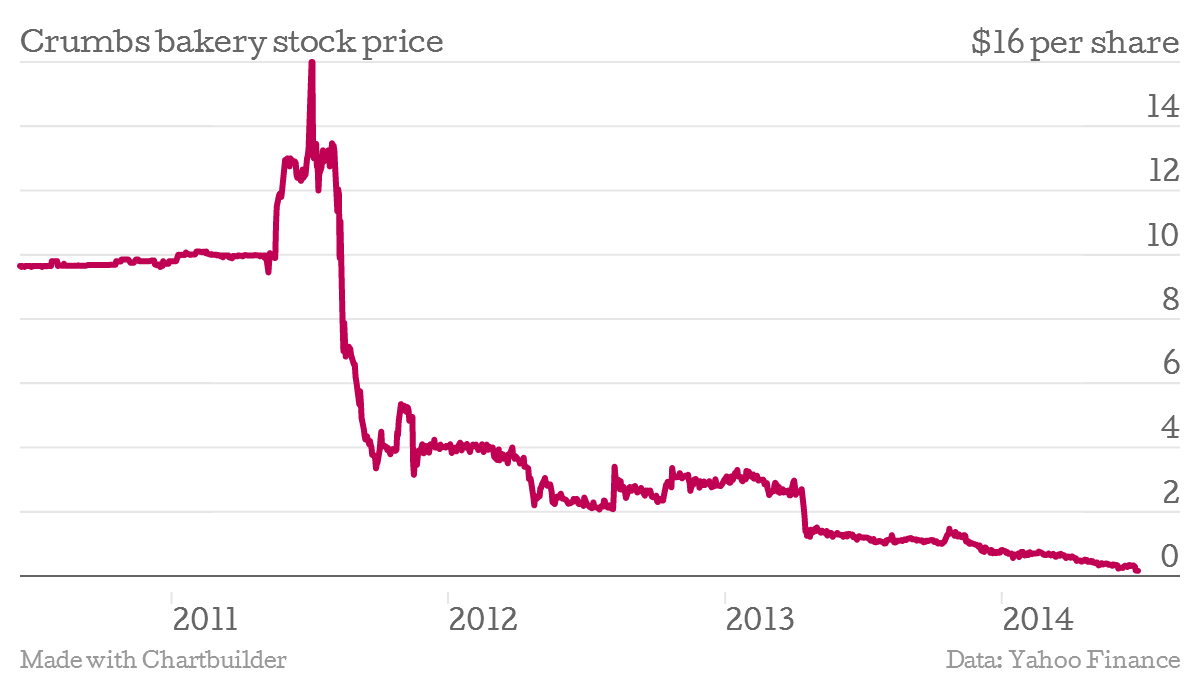
Roberto A. Ferdman is unsurprised that cupcake company Crumbs is closing up shop:

Cupcakes are a fad, not a food staple. The cupcake bubble, after all, was exactly that: a bubble. And bubbles—even cupcake bubbles (paywall)—burst. The market called this one back in 2011.

 has seen this all before:

Crumbs joins the long list of once hot food franchises that couldn’t resist the smell of growth and ultimately had difficulty managing it: David’s Cookies, Krispy Kreme, Einstein Bagels, World Coffee, just to name a few. They can survive, but generally after massive restructuring. Crumbs ran out of time and money. The pattern is similar: a good product or idea becomes increasingly popular, and investors get moon-eyed about the prospects. At the same time, other operators and investors will swear to you that there’s plenty of room for more than one brand—or that if there isn’t much room, their concept is superior.

Daniel Gross predicted this years ago:

Trends often inspire counter-trends. And the latest hot trend in dessert has proven to be something of a backlash to cupcakes. The cupcake bubble has been replaced, as I documented last year, by a fro-yo bubble. Tart instead of sweet, light instead of heavy, low-cal instead of fattening, fro-yo is in many ways the ying to the cupcake’s yang.

But John Aziz believes there “was never a cupcake bubble”:

[C]upcake sales have declined a little — falling 6 percent in 2012, flat in 2013, and falling 1 percent so far this year, according to NPD — but that is nothing like a bursting bubble. That’s a gentle, gradual decline that’s reflective of consumer tastes that have gradually changed, a marketplace that has become crowded, and snacks like the cronut and wonut that have begun to eclipse the cupcake. … Companies like Crumbs who botch their expansion plans, leaving themselves stuck with high levels of debt, tend to fail in whatever industry they are in. That’s not a bubble bursting — that’s business.

Jessica Grose finds all the cupcake hated a “little sexist”:

What’s going on seems to be about more than just the confection, which, like any other, some people enjoy eating and others do not. My theory: It’s about a dismissal and dislike of a certain kind of woman. (Hooooooold on, hear me out.) The kind of woman who watches Sex and the City (an important driver of the cupcake trend) and takes the bus tour to Magnolia Bakery. The kind of woman who gets excited about J. Crew catalogs and Instagrams her “glittery cupcake nail art.”

Mary Elizabeth Williams defends the humble cupcake:

Crumbs didn’t fail because people have stopped loving cupcakes. Put out a tray of cupcakes – Hostess, homemade, you name it – at a partytoday and see how long it lasts. Crumbs failed because the novelty has worn off — and because the product itself simply couldn’t sustain consumer loyalty after it had. But as long as there are mouths, people are going to love cupcakes. It’s cake you can carry around; figure it out. Victory will always belong to cake, even when all that’s left of Crumbs is, well, you know.

David Sax is of the same mind:

After nearly two decades as the reigning dessert trend in America, and increasingly the world, the cupcake will not go away. It will be there at birthdays, graduations and office parties. It will still elicit palpitations of excitement on sight, even from those who cursed its constant attention, because fundamentally the cupcake’s enduring strength is its very essence: a cake you can hold in your hand and eat without a fork. A cake you can eat in the car. America’s perfect cake.

(╯°□°)╯︵ ┻━┻

Alice Robb delves into the linguistics of emoticons and emojis:

At the forefront of the research into emoji use today is Stanford-trained linguist Tyler Schnoebelen. By analyzing emoticon use on Twitter, Schnoebelen has found that use of emoticons varies by geography, age, gender, and social classjust like dialects or regional accents.  Friend groups fall into the habit of using certain emoticons, just as they develop their own slang. “You start using new emoticons, just like you start using different words, when you move outside your usual social circles,” said Schnoebelen.

He discovered a divide, for instance, between people who include a hyphen to represent a nose in smiley faces :-)  and people who use the shorter version without the hyphen. “The nose is associated with conventionality,” said Schnoebelen. People using a nose also tend to “spell words out completely. They use fewer abbreviations.” Twitter notoriously obscures demographic data, but according to Schnoebelen, “People who use no noses tend to be tweeting more about Miley Cyrus, Justin Bieber. They have younger interests, younger concerns, whether or not they’re younger.”

In a primer on how to use emoticons more intelligently, Roni Jacobson stresses the gender stereotypes involved in smileys and frownies:

Multiple studies over the past 15 years have shown that women use emoticons more than men. Women also smile more in real life, perhaps because they are expected to be the more expressive gender, says Susan Herring, a linguist at Indiana University who studies online communication. In a 2009 analysis of messages featured on a texting-based Italian dating show, she and her colleagues argued that men and women used their texts to project different identities. The women who sent in their messages seemed to be “performing a kind of socially desirable femininity” characterized by “playfulness” and “fun,” while the men acted more serious.

“There’s this new norm that women are expected to show more happiness and excitement than men do,” said Herring. “If you’re a woman, you may have to realize that if you don’t use a smiley face sometimes, you may be misinterpreted as being in a bad mood or unhappy with the person you’re talking to. I don’t think that’s true for men.”

Ahmad Chalabi? Really?

Chulov and Ackerman report on the suddenly bright political prospects of the erstwhile Bush administration darling. His name has even been tossed in the hat as a potential successor to embattled Maliki:

“In all of Iraq, nobody knows how to punch above their weight or play the convoluted game of Iraqi politics better than Ahmad Chalabi,” said Ramzy Mardini, a Jordan-based political analyst for thinktank The Atlantic Council. “His enduring survival is beyond our comprehension. Unlike Ayad Allawi [another former exile], Ahmad Chalabi is close to Iran. This is the key relationship that makes Chalabi’s candidacy something of a realistic prospect should Maliki be ousted. If Iran has a redline against a candidate, [he doesn’t] have a shot in making it in the end.

“If Iraqi politics were Game of Thrones, Chalabi would play Lord Baelish, a consummate puppet master behind the scenes, constantly plotting his path to power. For him, chaos isn’t a pit, but a ladder and Chalabi knows the ways and means of exploiting a crisis to suit his interests and elevation in Iraq’s political circles. He apparently has good relations with everyone, except Maliki.” The next month will determine how willing Chalabi’s patrons are to throw in their lot with him. Maliki, apparently emboldened after a private talk with the office of Iraq Shia Islam’s highest authority, Ayatollah Ali al-Sistani, said on Friday that he was not going anywhere. Some of those touting Chalabi as leader are now saying he would be a better fit for finance minister.

A palpably amazed Adam Taylor spotlights how the neocons are reprising their old roles as Chalabi cheerleaders:

This week the National Journal’s Clara Ritger spoke to Richard Perle, the famously neoconservative adviser to Bush at the time of the Iraq war. Asked about who should next lead Iraq, Perle said 69-year-old Ahmed Chalabi was best suited for the job. “I think he’s got the best chance,” Perle said. “It would be foolish if we expressed a preference for somebody less competent, which we’ve done before.” …

So, Perle is championing a man who provided false information that led to a war now widely viewed as disastrous, is accused of stealing millions of dollars and is widely thought to have helped spy on the United States for Iran. And Perle isn’t alone. Paul Wolfowitz, another leading neoconservative who was key to Bush’s foreign policy, also has come out to say that for all his flaws, Chalabi is a viable candidate. “The man is a survivor,” Wolfowitz said in an interview on Bloomberg Television. “That’s impressive. I think he wants to succeed in what he does, he’s smart; maybe he’ll figure out a way to do it.”

Does Contraceptive Coverage Pay For Itself?

Austin Frakt considers the question from the insurer’s perspective:

In part because it is so cost-effective, most people are willing to pay for contraception with their own money, if they can afford to. (Many Medicaid-eligible individuals perhaps cannot, but most employed people probably can.) Insurers benefit from this, because every pregnancy avoided is one less they have to pay for. Therefore, when employer-sponsored insurers pick up the tab for contraception, not very many more pregnancies are avoided — most people were already using and paying for contraception.

According to the IMS Institute for Healthcare Informatics, though the proportion of Americans with no cost-sharing for contraceptives rose in 2013 to 50 percent from 20 percent, prescriptions written for contraceptive medications increased only 4.6 percent.

But when they begin to fully cover contraception, insurers take on its full cost, “crowding out” the willingness of individuals’ to self-insure for it. Therefore, the government’s accommodation of religious organizations’ objections to covering contraception (obliging insurance companies to pick up the cost of the coverage, with no offsetting premiums or cost-sharing from either employees or employers) may impose a cost on insurers, even though contraception is cost-effective for society as a whole.

Daniel Liebman’s two cents:

There is strong evidence that public contraceptive funding for underserved populations is cost-saving, and there is a chance that the cost-neutrality observed following the [Federal Employees Health Benefits (FEHB)] and Hawaii mandates will materialize for other insurers as well. There are undeniable economic benefits of contraception for society as a whole, as well as a multitude of social benefits that could fill many posts of their own. Focusing specifically on the economics of insurance, however, the literature on the subject is sparse. All told, we currently have little evidence to indicate the time frame needed for private insurers to realize cost offsets or savings, if there are indeed any to be had.