The Revenge Doctrine, Ctd

The graphic video seen above illustrates some of the devastation caused by Israel’s new bombing campaign in Gaza. At least 22 people have been killed and 90 injured. Meanwhile, militants in the strip are firing rockets with longer ranges than ever before, reaching Tel Aviv and beyond. Those that landed in and around the coastal city forced the evacuation of a peace conference organized by Ha’aretz. Max Fisher comments on the sad irony of that development:

Observers of the Israel-Palestine conflict often say that the violence committed by both sides is self-defeating, but rarely is this so demonstrably and immediately true as with today’s evacuation of the Ha’aretz peace conference. The conference itself is part of a larger effort by the Israeli political left to overcome Israeli apathy toward the conflict and build political momentum for peace; that movement is squeezed between Israel’s political right and militant Palestinian groups, both of which in action and rhetoric tend to polarize Israelis and Palestinians against one another and against even the idea of compromise. It’s often said that there is not enough “political space” for the Israeli pro-peace left, and while typically that is meant metaphorically today it was true physically as well.

While Hamas and other Palestinian groups have launched a number of rockets from the Gaza Strip into Israel over the past week, they almost never reach all the way to Tel Aviv, Israel’s largest city and a cosmopolitan haven rarely touched by the conflict. The rocket siren sounded over the city for the first time since 2012, when Gaza groups fired hundreds of rockets into Israel as Israeli forces bombarded the Palestinian territory. The rockets appear to have landed harmlessly and the conference attendees eventually returned to the hall. The incident ended bloodlessly, but it was a perfect symbol of the conflict’s tragic absurdity and endless cycle of self-perpetuation.

Meanwhile, Goldblog weighs in on the killing of Muhammad Abu Khdeir and the brutal beating of his cousin Tariq:

I think that while the murder of 16-year-old Muhammad Abu Khdeir is a terrible crime, the non-fatal beating of his cousin, the Palestinian-American teenager Tariq Khdeir, by Israel’s Border Police, is, in one way, more consequential. Obviously, murder is the ultimate crime, but this murder was committed, we believe, by thugs operating independent of state authority. The beating of Tariq Khdeir was conducted by agents of the state. We judge countries not on the behavior of their criminal elements, but on 1) how they police their criminal elements; and 2) how they police their police. Those of you who have seen images of the beating of Tariq Khdeir know that this assault represents a state failure.

Unfortunately, this is not a one-off failure. On too many occasions, Israeli police officers and soldiers have meted out excessive punishment to Palestinians in custody. I’ve witnessed some of these incidents myself, both as a reporter and as a soldier. More than two decades ago, I served in the Israeli military police at the Ketziot prison camp, by Israel’s border with Egypt. This was during the first Palestinian uprising (which is remembered now, of course, as the “good” uprising, of stone-throwing and Molotov cocktails, rather than suicide bombers) and the prison held roughly 6,000 Palestinians, many of them street fighters, but many from the leadership of the uprising as well. It was at the prison that I witnessed—and broke up—one of the more vicious beatings I have ever seen. I wrote about this incident, and others, in my book about my time in Ketziot, Prisoners: A Story of Friendship and Terror.

Fisher provides a depressing reminder that getting roughed up at the hands of Israeli police is an all too common experience for Palestinian boys:

According to a February 2013 report by UNICEF, the United Nation’s Children’s Fund, about 700 Palestinian minors are arrested, interrogated, and detained by Israeli security forces every year. That has been sustained for the last ten years, bringing the total to 7,000 under-age Palestinians detained by Israel, or about two per day, every day, for a decade. Almost all are boys, and according to the report many are released with substantial bruising and cuts.

According to the UNICEF report, “The common experience of many children is being aggressively awakened in the middle of the night by many armed soldiers and being forcibly brought to an interrogation centre tied and blindfolded, sleep deprived and in a state of extreme fear. Few children are informed of their right to legal counsel.” The most common charge is stone-throwing — as it was against Khdeir — and most detained children confess, almost always without a lawyer or parent present.
Dissent Of The Day

A reader writes:

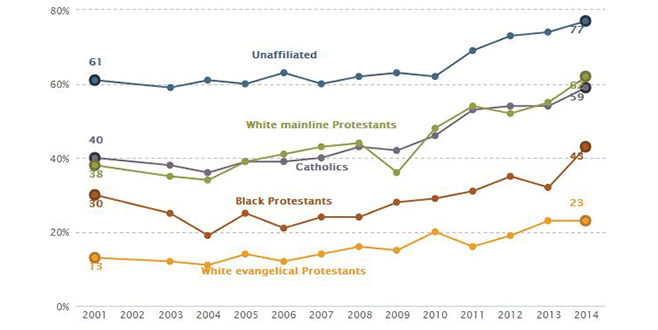
In your post yesterday on the American “evangelical” conversion regarding same-sex marriage, you said, “I’m not sure celibacy is a viable long-term argument for countless gay Christians who, by virtue of their very humanity, yearn for intimacy, companionship, love and sex.”

EvangelicalsThis position, I think, dissolves in the face of a God whose love and sustaining grace is sufficient to meet every emotional need; a God, moreover, whom one gets to know better through suffering (especially suffering for the sake of faithfulness to God). In Psalm 27, the Psalmist – although surrounded by enemies – describes his deepest wish like this: “One thing have I asked of the Lord, that will I seek after: that I may dwell in the house of the Lord all the days of my life, to gaze upon the beauty of the Lordand to enquire in his temple.”

The Christian is to be unapologetically obsessed with God. Psalm 73 expresses the same thought: “Whom have I in heaven but you? And there is nothing on earth that I desire besides you.” It’s not that the Christian shouldn’t care about other things, nor that the difficulty of aching longing and loneliness goes away. But the knowledge of God is both necessary and sufficient for Christian joy, even in the midst of deep pain and distress.

Vaughan Roberts is the Rector of St Ebbe’s church in Oxford, and is arguably the UK’s most-respected evangelical preacher. In 2012, he gave an interview in which he spoke at length about his celibacy and his exclusive attraction to people of the same sex:

We’re not called to a super-spiritual positivity which denies the frustration and pain; nor are we to embrace a passivity which spurns any opportunity to change our situation. But we are to recognise the loving hand of God in all we experience and see it as an opportunity for service, growth and fruitfulness… I have found that those I’ve learnt most from have invariably been believers who have grown in Christian maturity by persevering through significant difficulties. The experience of blindness, depression, alcoholism, a difficult marriage, or whatever the struggle may have been, is certainly not good in and of itself and yet God has worked good through it, both in the gold he has refined in their lives and the blessings he has ministered through them.

I have seen the same dynamic at work in some godly believers who have experienced a seemingly intractable attraction to the same sex. By learning, no doubt through many difficult times, to look to Christ for the ultimate fulfilment of their relational longings, they have grown into a deep and joyful relationship with him. Their own experience of suffering has also made them sensitive and equipped to help others who struggle in various ways.

Of course, anybody who doesn’t experience life in this way doesn’t need moralising, but rather a deep knowledge of the love of Christ. God never asks us to give anything up, without giving us something better in return: himself.

The World’s Third-Largest Democracy Votes

Indonesia Awaits Results Of 2014 Presidential Election

Kate Lamb previews today’s presidential elections in Indonesia, in which 190 million voters are participating:

There are many concerns voters could focus on in the election. While Indonesia’s economy has grown steadily in recent years, economic growth has slowed to 5.8 percent in 2013 and some 32 million people still live below the poverty line. Indonesia’s constitution largely protects religious freedom, yet in recent years attacks on Christians and minority Muslim sects have been on the rise. The country also faces significant environmental concerns, failing to properly regulate and police its logging, fishing, and extractive industries.

Yet the ballot, the third direct presidential election since the fall of longtime military ruler Suharto in 1998, has largely been framed in the context of a potential revival of Indonesia’s authoritarian past. Though the country is now a functioning democracy with a free press and strong civil society, its political institutions are still steeped in the personnel and politics that defined the old order.

Yenni Kwok profiles the candidates, who “stand in stark contrast to each other, and make this a showdown between political outsider and political patrician”:

The outsider is Joko Widodo, 53, a onetime furniture entrepreneur who has charmed the public with his down-to-earth demeanor.

Joko, popularly known as Jokowi, grew up poor, living in a riverside slum in Solo, Central Java. He cut his teeth in politics as mayor of Solo, where his blusukan (impromptu visits to constituents) and his push for clean governance set him apart from aloof officials in a country plagued with graft scandals. He even won recognition as one of the world’s best mayors. Riding on his immense popularity, Jokowi teamed up with a maverick Chinese-Christian politician to run in the Jakarta gubernatorial election in 2012 and won.

The outsider Jokowi has also drawn comparisons to a famous former resident of Indonesia:

A look at his rival:

The patrician is Prabowo Subianto, 62, a former military general dogged by allegations of past human-rights abuses. Prabowo comes from a privileged background: his father, the late economist Sumitro Djojohadikusumo, was a minister under Indonesia’s first two Presidents, Sukarno and Suharto. His brother-in-law is a former central banker, while his brother, Hashim Djojohadikusumo, who bankrolls his presidential campaign, is a billionaire with a global business reach.

Prabowo himself pursued a military career, and after marrying Suharto’s daughter (the two are now divorced), he quickly climbed up the ranks and took part in military operations battling rebels in East Timor and Irian Jaya. He went on to lead elite army units: the Special Forces and later the Army Strategic Reserve Command. His career ended abruptly after he was discharged from the military in 1998, months after Suharto’s fall, over his role in the abduction of pro-democracy activists.

If Subianto wins, Malcolm Cook notes, it will fit with the recent pattern of electoral victories by “realist conservatives” in democratic countries throughout Asia:

From Netanyahu and Modi in West Asia to Park, Abe and Ma (less so) in Northeast Asia, Aquino and Najib in Southeast Asia, and Abbott and Key in Oceania, the territory covered by this political trend is truly continental. Modi, Abe, Park and Najib are also stronger conservative nationalists than their party predecessors (Vajpayee, Fukuda, Lee and Abdullah respectively). The same trend is noticeable among East Asian non-democracies with Kim Jong-un and Xi Jinping seemingly more conservative and nationalist than their predecessors. The coup in Thailand is clearly inspired by conservative and nationalist goals and forces. Will the next generation of Vietnamese Communist Party leaders in 2016 follow suit?

The diversity of Asian societies and political systems and the fact that there are few if any exceptions (I cannot think of one) simply adds to the power of this political phenomenon and the need to try to understand it better beyond looking to the unique intricacies of each state. … Looking from India eastwards, I would hazard that the worsening external security environment is a contributing factor to the trend and one that is unlikely to change in the foreseeable future.

Lydia Tomkiw solicits some insight from Indonesia experts, who don’t all agree on how consequential the vote will be:

While the two candidates may be complete opposites on paper and in person, [Northwestern University professor Jeffrey] Winters argues that the media portrayal of a stark choice between a charismatic reformer and an old guard candidate isn’t accurate. “These two individuals are very different. But the constellations of social and political forces backing them are remarkably similar. Both have major business interests in their camp. Both have controversial military figures involved in their campaigns,” Winters said. “Whoever wins, this is not a revolutionary moment for Indonesia.”

Kevin O’Rourke, writer and editor of Reformasi Weekly, a newsletter about Indonesia’s political climate, sees it differently. “This is as stark as it can possibly be,” he says. “Indonesia has had a patronage-style government for centuries and now there is a chance for change. Widodo is a democratic figure. He’s the product of the new democratic system that just started taking place in the last decade.”

The latest on the voting:

Official results may take two to three weeks. Unofficial quick counts showed a slight edge for Widodo. One survey group, Lingkaran Survei Indonesia, showed 53.3% for Widodo and 46.7% for Prabowo with 99% of its data, and another group, Center for Strategic International Studies reported 52% for Widodo over 48% for Prabowo, with 95% of its data. Another independent survey group, Saiful Mujani Research and Consulting indicated 52-53% for Jokowi over Prabowo’s 46% with 99% of data.

Quick counts in Indonesia are usually accurate with a slim 1-2% margin of error, said Kevin Evans, a political analyst. Unlike previous Indonesian elections though, this race is a tight one.

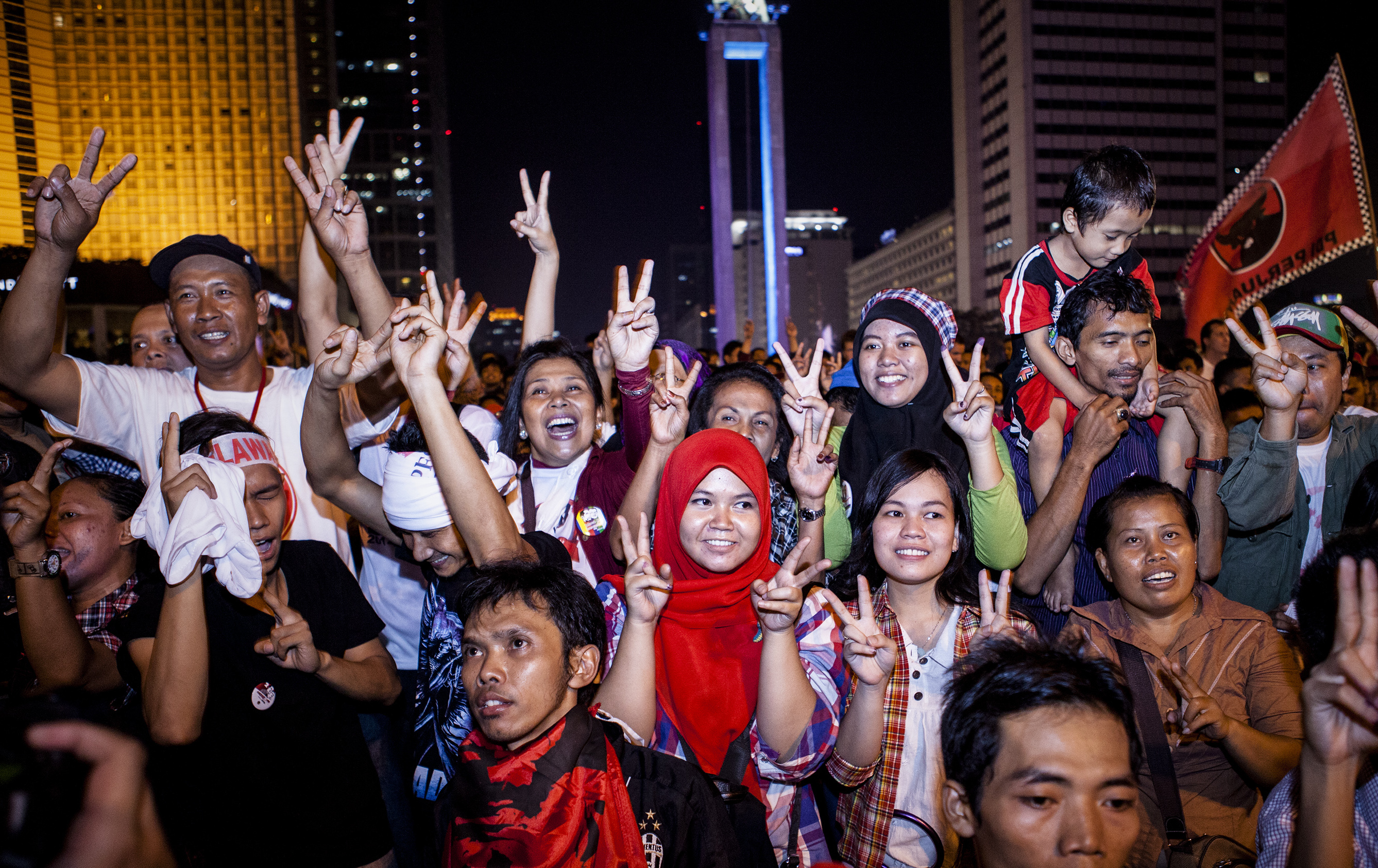
(Photo: Supporters of Indonesian presidential candidate Joko Widodo declare victory, although the vote counting is not complete, the race is very close, and the other candidate, Prabowo Subianto, has also claimed victory in the race on July 9, 2014 in Jakarta, Indonesia. By Oscar Siagian/Getty Images)

The Supreme Leader’s Red Lines

Khamenei has weighed in on nuclear negotiations:

Khamenei’s declaration that any nuclear deal preserve Tehran’s right to enrich uranium on an industrial scale to fuel its long-term energy needs echoes what Iranian negotiators have said throughout the talks, which began in earnest last year and are currently continuing in Vienna. Still, by drawing a red line in public, a rarity for Iran’s top cleric, Khamenei signaled that Tehran wasn’t prepared to accede to Western demands that it sharply curtail its enrichment activities. The United States and its allies have long accused Tehran of trying to produce weapons-grade uranium to build a weapon, a charge Khamenei has repeatedly denied.

The remarks come amid signs of disunity among big-power diplomats as talks near a self-imposed July 20 deadline for a deal between Iran and the permanent five members of the Security Council — Britain, China, France, Russia, and the United States — plus Germany, which are negotiating collectively as the P5+1.

Reza HaghighatNejad unpacks Khamenei’s comments:

In recent months Foreign Minister Mohammad Javad Zarif has sternly insisted on keeping the negotiating details confidential. He told MPs that he would not disclose such information even if he were to face impeachment. Now the Supreme Leader has pulled the rug from under him in a public speech.

It is clear Khamenei wants to leave no doubt about his regime’s red lines in the negotiations. The result is that now the Iranian negotiators have less room to maneuver vis-à-vis their Western counterparts.

Abbas Araghchi, spokesman for the Iranian team, tried to emphasize the supportive moments in  Khamenei’s speech. “The trust of the Leader is our greatest asset and encourages us,” he Tweeted. “We assure him and all Iranians that we would not retreat from any of our nuclear rights.”

Maybe it’s brinksmanship in the diplomatic end-game – or a sign that we will definitely have to enter an extended period for negotiations. But you can hardly take this as an encouraging sign, can you?

Palin vs Boehner: Round One

https://twitter.com/ArcticFox2016/status/486887550041460736

Beutler believes the reality show star has put the Speaker in a corner by demanding Obama’s impeachment:

Palin’s a self-caricature, but she speaks for a lot of people. They want impeachment, and they want the articles of impeachment to include a big section on Obama’s immigration policies. Boehner’s counteroffera lawsuitwon’t sell easily. But it’ll be even harder to sell if he omits immigration from the bill of particulars. Remember, the purpose of the lawsuit is to simultaneously mollify the impeachment-happy right, and then channel its enthusiasm into voting Republican this November. For that reason, Boehner has dressed it up as a comprehensive response to Obama’s equally comprehensive lawlessness. If at the end of the day, Boehner limits his challenges to a handful of trivial actionsthe employer mandate delay and No Child Left Behind waivers, sayeveryone will notice the incongruity. Including the people he’s trying to meet half way.

Boehner wriggled in said corner this morning:

That was pretty brusque, wasn’t it? I see a defund Obamacare moment coming, don’t you? And Palin is not alone:

 As The Post’s Aaron Blake has noted,  others favoring impeachment include Sens. James Inhofe (R-Okla.), Tom Coburn (R-Okla.) and Tim Scott (R-S.C.), Reps. Blake Farenthold (R-Tex.), Kerry Bentivolio (R-Mich.), Michael Burgess (R-Tex.) and Jason Chaffetz (R-Utah), former congressmen Tom Tancredo (R-Colo.) and  Allen West (R-Fla.), and the South Dakota Republican Party.

Even Mataconis observes that Palin’s read on the border crisis “has become something of an article of faith among the hard right”:

Rather than accepting the idea that the crisis is due in large part to deteriorating social conditions in Central America combined with a law signed into law by President Bush that bars the U.S. from automatically deporting children arriving from nations other than Canada or Mexico have created this crisis, they believe that the crisis was deliberately created by President Obama. The motives for this supposed conspiracy depend on who you’re talking to and include everything from forcing Congresses hand on immigration reform by creating a crisis on the border to overwhelming the resources of Republican states like Texas and Arizona. As with many things in politics, the fact that these conspiracy theories aren’t true isn’t nearly as important as the fact that it is widely believed among people on the right, and that it is motivating their actions.

Allahpundit makes similar points:

Needless to say, although the prime target here is Obama, the secondary target is Mitch McConnell and the looming Senate Republican majority.

I remember writing somewhere last year after the shutdown that impeachment could become the new “defund” effort — doomed to futility but sufficiently pure in intent and supported by a Republican with sufficiently high standing among grassroots conservatives that to oppose it for logistical reasons is to fail an ideological litmus test. Ted Cruz gave “defund” its political rocket fuel, Palin potentially could be providing the rocket fuel to impeachment. If McConnell decides that it’s pointless to try it because they’ll never get 10-15 Democrats to join them in convicting, it’ll be taken by righties as “proof” that squishy Republican majorities are no better than Democratic ones. That’s a useful grievance for a tea-party champion like Cruz to run on in the 2016 primaries, which makes me eager to hear what he thinks of this idea.

Jonathan Bernstein joins the conversation:

[E]ven if a lot of Republican politicians are calling for impeachment, it’s likely that when push comes to shove the House Republican leadership will shoot the whole thing down. After all, there’s probably nothing that’ll do a better job of pushing President Barack Obama’s approval ratings solidly above 50 percent than a bogus impeachment. House Speaker John Boehner knows that. Just as he and the rest of the leadership know that taking a stand against impeachment would provide further evidence that they are RINOs (apologies to the new House whip, Steve Scalise, and welcome to leadership).

I should also mention that a partisan impeachment with no hope of conviction was irresponsible enough when there was a bipartisan consensus that the president had actually done something wrong (as was the case with Bill Clinton). it’s far more irresponsible when whatever scandal this is supposedly about is only recognized as something significant by the most partisan faction of one party. It also would be unprecedented.

But so, according to the Palinites, is Obama’s dictatorship. Even Jonathan Tobin, who agrees with Palin about Obama’s “lawlessness,” writes that she is once again “demonstrating how profoundly unserious her brand of politics has become”:

Advocates of impeachment can say, as they do in every administration (leftists sang the same tune about George W. Bush), that impeachment is the recourse the founders gave Congress to restrain a president that had violated the law. But in the 225 years since the first president took the oath of office, it is a measure that has always rightly been considered not merely a last resort but a tactic that is associated with extremists who have abandoned the political process. Obama is, after all, not the first president to seek to expand the power of the executive at the expense of the Congress or even the Constitution. Even when a president has been caught violating the law in one manner or the other, the consensus has always been that the “high crimes and misdemeanors” standard set forth in the Constitution cannot be used to settle what are essentially political disputes about policy and turf.

But none of this matters to the Palinites and their talk-radio base. To my mind, this is a huge gift to the Democrats. It could make the fall’s elections a referendum on the impeachment of Obama. Which would, for the GOP, seize defeat from the slack, droopy jaws of a nihilist victory.

Cleveland Rocks The RNC

Ohio native David A. Graham seems a bit puzzled that Cleveland will host the 2016 Republican convention:

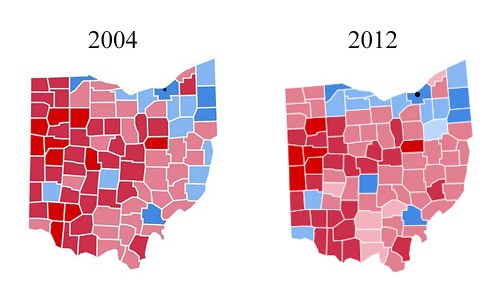
Cleveland is an interesting and counterintuitive pick for a variety of non-snarky political reasons. Most importantly, it’s the 1d4c41657anchor of the state’s liberal, union-friendly, northeastern corner, as you can see in the county-by-county map of the 2004 presidential election [to the right]. George W. Bush won the state, but Cuyahoga County, Cleveland’s home, and surrounding cities went strongly for John Kerry. (Cleveland is marked with a black dot.) Since 10 percent of the state’s population is in Cuyahoga County, Bush only won the state by about 2 percent, despite carrying so many counties. …

The last Republican to serve as mayor of Cleveland was George Voinovich, who left office in 1989 and went on to serve as governor and U.S. senator. In these respects, Cincinnati, which has a Democratic mayor but is in a more conservative part of the state and close to Speaker John Boehner’s home district, might have made more sense.

Weigel approves of the decision:

You do not want to see a tourist city at the height of convention season—imagine going to Venice or Brugge if entire sections were cordoned off by $50 million worth of public security forces. No, here’s what you need for a convention: an arena, a downtown, and an airport. Cleveland has all of those things. Unlike Tampa, host of a 2012 Republican convention that stranded delegates as far as 45 minutes away from the arena (seriously, and I was with the Iowa delegation), it spreads in a nice ameba pattern with no pesky bays or gulfs taking up real estate. In July, when this convention is likely to be held, average temperatures only rise to 80 or so – 10 degrees cooler than Tampa, with far fewer hurricanes. It’s an easy road trip through battleground states for us East Coast political hacks.

Morrissey also approves:

The candidates make more of a difference than the venue, and ground organization in the election more than in the convention. Still, this looks like a better choice in terms of what it says about assertiveness. Dallas would have been an easy choice, in deep-red Texas, perhaps giving an impression of either insularity or complacency. Choosing Cleveland shows that Republicans are serious about the Rust Belt and want to highlight that effort.

But Harry Enten notes that holding the convention in Ohio probably won’t make much of a difference for Republicans:

On average, candidates have done only 0.4 percentage points better [in convention states] than we’d expect given the swing in the national margin. That could be just noise; it could be a very small effect. Fourteen candidates did better in the state of the convention than we’d have expected, but nine candidates did worse.

If we look at just the Republican side, the candidates have done 0.7 percentage points worse compared to their national swing on average. Six candidates did better, and six candidates lost ground. This included Romney, who gained on McCain’s 2008 margin in Florida, but by fewer points than he gained nationally.

Meanwhile, Diana Lind examines what Cleveland is paying for the privilege:

One would think that the convention would pay for its venues and security, but actually, that comes at the local and national taxpayers’ cost. And what a cost it will be: The Republican National Committee has requested that the host committee put $68 million in escrow to cover the fees for hosting the convention.

Why are local politicians, including Democrat mayors, lobbying to host the convention then? Like other outsized gatherings, this one will fill tens of thousands of hotel rooms and bring economic activity to the city. Indeed, as a study from last election season’s host – Tampa Bay – showed, a convention can generate $214 million in direct and indirect spending.

Meanwhile, Cohn raises his eyebrows over how the venue relates to the Obamacare debate:

Whether or not they intend to make Obamacare a central focus of the 2016 presidential campaign, they’re going to talk about it at their convention. The conservative base would have it no other way. But if [Republican Ohio Governor John] Kasich wins reelection this year, then the host state governor, a well-regarded conservative and model Republican in almost every other respect, will also be the state’s most outspoken and eloquent spokesman for why the right’s absolutist opposition to the Medicaid expansion is so wrong.

It’s not the end of the world, obviously. People make way too much of convention geography and these sorts of rhetorical contradictions. But this was already a difficult issue for national Republicans to finesse, as writers like Steve BenenGreg Sargent, and my colleague Brian Beutler have discussed. Putting the 2016 convention in Ohio, where the Medicaid expansion has been such a prominent issue, probably won’t make that easier.

Update from a reader:

As a Cleveland journalist, I’ve been following Cleveland‘s bid to host the convention. Part of the pitch to the RNC is that Cleveland‘s basketball arena sits next to our ballpark, giving the RNC the ability to take the convention outside, 2008-Denver style, to anoint the 2016 nominee in front of 40,000 “fans” under a summer-night sky.

The only hiccup? Cleveland‘s ballpark is called Progressive Field.

Meet An American the NSA Snooped On

Faisal Gill is puzzled by the government’s interest in him:

Greenwald’s new NSA piece details the surveillance of Gill and four other innocent Americans:

The five Americans whose email accounts were monitored by the NSA and FBI have all led highly public, outwardly exemplary lives. All five vehemently deny any involvement in terrorism or espionage, and none advocates violent jihad or is known to have been implicated in any crime, despite years of intense scrutiny by the government and the press. Some have even climbed the ranks of the U.S. national security and foreign policy establishments.

Specifically:

The targets, all Muslim-Americans, include Faisal Gill, who was an advisor for the Bush administration’s Department of Homeland Security; Agha Saeed, a civil rights activist who was formerly a political science professor at California State University; Nihad Awad, executive director of the Council on American-Islamic relations; Asim Ghafoor, a lawyer who has represented clients in cases connected to terrorism; and Hooshang Amirahmadi, a professor at Rutgers University. …

The new document marks the first time individual US citizens have proof that they have been targeted by domestic surveillance, and could give them the legal standing to sue the government.

But as Scott Shackford points out:

It’s not just five American targets total.

The file Greenwald is drawing this information from, email surveillance targets from 2002 to 2008, contained more than 7,000 targets. At least 200 of them were of American citizens. The five men named and interviewed by Greenwald were the ones whose names they were able to figure out from their email addresses. More than 5,000 addresses don’t identify whether or not the targets are Americans (or they don’t know) so the number could actually be much higher. Some, indeed, were terrorism suspects, such as Anwar al-Alwaki, killed in a drone attack in Yemen in 2011.

Meanwhile, Friedersdorf is miffed by how Gill defends his patriotism in the above video:

[I]n explaining why he finds it absurd that he was surveilled, Gill can’t help but imply that it would be more understandable if he were inactive in his community, or a Reagan-hating liberal, or if he disliked football and sent his kids to a Muslim parochial school.

This is what happens in a surveillance state: to inoculate themselves against suspicion, people seem to legitimize the victimization of other less favored groups, even though they’re every bit as entitled to privacy and civil liberties protections. They do so without intending any prejudice–I assume, for example, that asked directly, Gill would say that of course spying on parents who send their kids to Muslim parochial schools is every bit as illegitimate. He only meant to suggest that it’s irrational to spy on him given America’s paranoid post-9/11 standards, and that people less mainstream than him must undeservedly have it even worse. His words would nevertheless feel like a blow to folks who fall into the groups that he implicitly characterized as more reasonable targets of surveillance.

Benjamin Wittes’ response:

I have little to say about all of this because there’s something big missing from Greenwald’s story: Any sense of what was actually in the relevant FISA applications. Assuming for a moment that Greenwald is correct that these five people were, in fact, the subjects of FISA surveillance, there would have been a substantial document submitted to the FISA court and approved by it. That document would have had to establish probable cause that the subject was an agent of a foreign power under the FISA’s complex definition of the term. Evaluating whether surveillance was appropriate without reference to what was in that document is a fruitless exercise and not an especially interesting one.

Meanwhile, Ambinder weighs in on the WaPo’s recent Snowden story. He isn’t too troubled by the revelation that the NSA collected communications from thousands of innocent Americans and failed to “minimize” or anonymize them. But, in a follow-up post, he outlines what he considers the most reasonable criticisms of the NSA, including one related to the question of data storage:

The NSA wants to store everything it collects for a long time just in case it needs to go back and re-analyze something it missed. That’s reasonable. But it’s not critical. And the balance should tilt in the direction of getting rid of irrelevant communication and SIGINT as quickly as possible, especially those transactions that might contain unminimized domestic selectors — because they are unminimized domestic selectors. Give the NSA a reasonable amount of time to keep the data, then force them to purge it. Six months is reasonable. Five years isn’t. And require the analyst who wants to go back into the data to recertify the foreign intelligence purpose and foreignness of the target before letting him or her do that. Subject the certifications to audits. Have Congress look at the audits.

Is Hobby Lobby The End Of ENDA?

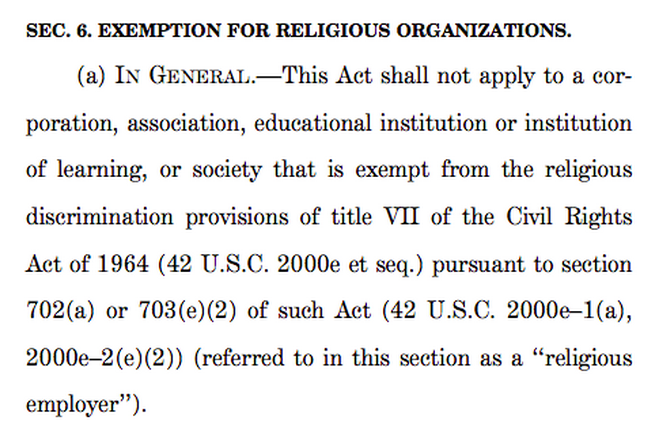
Screen Shot 2014-07-09 at 9.48.59 AM

Several major gay rights advocacy groups, including the ACLU, the National Gay & Lesbian Task Force, Lambda Legal, and GLAAD (but not HRC), have dropped their support for the current version of ENDA in the wake of the Hobby Lobby ruling, which they believe makes the exemption seen above much more powerful:

The groups said the federal Employment Non-Discrimination Act (ENDA) contains religious exemptions that are far too broad. Beyond typical exemptions for explicitly religious organizations like churches and ministries, ENDA includes provisions that would allow religious employers, such as a religiously affiliated hospital, to refuse to hire LGBT people. “ENDA’s discriminatory provision, unprecedented in federal laws prohibiting employment discrimination, could provide religiously affiliated organizations — including hospitals, nursing homes, and universities — a blank check to engage in workplace discrimination against LGBT people,” the groups argued. “The provision essentially says that anti-LGBT discrimination is different — more acceptable and legitimate — than discrimination against individuals based on their race or sex.”

But it is different in so far as a majority of major religions still sincerely hold that gay relationships are inherently sinful, indeed “objectively disordered” – and many base their views on literal readings of inerrant Scripture or centuries-old natural law. That includes the current, widely admired Pope. And even the gay left groups accept the legitimacy of some kind of religious exemption for ENDA. So the question is: how broad a religious exemption is needed in general and in the wake of Hobby Lobby?

Supreme Court Rules In Favor Of Hobby Lobby In ACA Contraception CaseOn the first question, I ask myself what it would feel like for a religious organization to employ, say, a married lesbian. Does it truly affect a hospital’s ability to care for patients or to uphold certain beliefs if the nurse or janitor or doctor is gay? Of course not. A college or high school with respect to an openly gay teacher? A closer call – but only if they violate professional duties by, say, advocating things in the classroom that a religious group would disagree with, and not by just “being gay while working”. A corporation making automobiles? Please.

So I would probably narrow the current ENDA religious exemption a little – remove the word “corporation”? – but not by that much. And one reason I differ from my fellow gay and straight allies on this is that I fear they are understandably reacting to the emotional toll of the rhetoric being used by some on the culture war right and thereby over-reacting to a relatively narrow holding in Hobby Lobby. They are, particularly, missing the key points of Kennedy’s concurrence and forgetting the business push-back within the Republican coalition we saw in Kansas against any broad anti-gay employment discrimination statutes. To put it simply: I don’t believe that there’s a threat of the kind posited by many who see the world in utterly Manichean culture war terms. I fear that both sides are whipping themselves up into a lather that is largely unjustified.

But on the religious exemption in federal contracting, Supreme Court Issues Rulings, Including Hobby Lobby ACA Contraception Mandate CaseI favor none whatsoever. I gave my full reasons here. But my view is that if the government mandates something, you have a right to opt out in some circumstances on the grounds of religious freedom. But if you are actively seeking federal money, you have no right to attach discriminatory conditions to it. The right to religious freedom does not extend to the right to government subsidy and the right to discriminate. Pick one, Rick.

Then there’s the bizarre situation in which gay groups are effectively saying that they’d rather have no employment non-discrimination bill at all, than one with a religious exemption. This would be like saying you’d rather there were no ACA because of the Hobby Lobby decision – i.e. that the first ever government mandate for contraceptive insurance coverage should be voided entirely because a few companies can get an exemption from it.

It’s an easy position to take right now, of course, as Geidner notes, because this bill is going nowhere anyway in this Congress and probably not the next either. And it may be best seen as a form of jockeying in order to put countervailing pressure on the administration given the major religious right lobbying recently. But if it really came down to it – and gay groups actually opposed ending employment discrimination for gays because of the religious exemption, what they’re really saying is that they’d rather engage in culture war against the religious right than vastly improve the lot of millions of gay people. I think that’s short-sighted and a sad reflection on how polarized we have become.

Of course I appear to be an outlier here (as usual). I believe the greater narrative is one of huge advances in gay rights, and that some accommodation to the fast-losing side is actually more likely to sustain our victory than ratcheting the culture war dynamic still further. But understandable emotions – fueled by right-wing trolling – see the world as always darkening for gay people. So here’s how Joe Jervis sees it:

Years and years of hard-fought battles resulted in the Senate passage of ENDA in November 2013 by a vote of 64-32. I exulted in that moment, truly. But no hope of the bill progressing in the GOP-dominated House coupled with the Hobby Lobby ruling means that the entire LGBT rights movement must now focus on having LGBT Americans included under the broad protections of the Civil Rights Act of 1964.

Some are loudly arguing that LGBT opposition to ENDA is yet another case of the perfect being the enemy of the good, a cry that was also made when many of us objected after transgender protections were stripped from the 2007 version of ENDA. But as some of you have pointed out, exempting the very people most likely to discriminate from an anti-discrimination bill just does not make sense in the post-Hobby Lobby world.

Why not – if the actual result is their cultural and social isolation and punishment in the marketplace? Ask yourself: has the firing of gay teachers made the Catholic church seem more Christian and likely to appeal to more people? Please. With every decision like that, they lose an entire generation. What too many miss is how the marketplace has a role here. The reason so many major corporations have non-discrimination policies when it comes to gay people is not because they hold a view on the question; it’s that they don’t want to lose good employees or good customers. And the power of gay money in changing the world is far too easily dismissed by people whose job it is to focus on government. I think the market and the culture are fast accelerating gay integration, and we can afford a little moderation in giving space to our beleaguered opponents.

Yes, this may mean tolerating some nasty anti-gay discrimination from a few companies or religious institutions for a while, but the anti-ENDA campaigners have already shown that’s something they can live with – by preventing passage of ENDA indefinitely as it now stands. I think the compromise I favor does far less damage, while allowing the country to move ever forward on the integration of gay people in society.

Morrissey adds some perspective:

In the case of employment discrimination … courts have routinely ruled that government has a compelling interest in ensuring equal treatment regardless of religious beliefs, even those sincerely held. In fact, they have ruled that way even on commerce discrimination, most recently in the case of the bakers and photographers who didn’t want to participate in same-sex weddings. Statutory enforcement such as that in ENDA has been commonly considered the least-burdensome method of addressing that compelling interest. Hobby Lobby didn’t change a single stroke of that precedent. Even if the exemption clause in ENDA is broader than that in RFRA, the overall thrust of the statute and intent of Congress in passing it would still move the LGBT lobby’s goal forward on the ground first, and probably in courts, too — which would still end up having to do the same kind of balancing test that RFRA requires, using existing precedent.

Exactly. But the culture war has too much emotional energy right now for such cooler heads to prevail.

(Photos from Getty)

Brazil Goes Bust

2014 FIFA World Cup Brazil

Nate Silver calls Brazil’s utter humiliation in yesterday’s 7-1 loss to Germany the “most shocking result in World Cup history.” Michael Goodman wonders if it will lead to unrest:

The immediate question is whether Brazil’s exit will serve as a flashpoint for an immediate revival of the previous protests, or in an even uglier scenario, like riots. The overwhelming police presence makes this unlikely, at least for now. It may not be pretty, it may not be humanitarian, it may not even be legal — but it has been brutally efficient. When the teams and the tourists and the cameras leave again, that’s a different story. There’s every reason to believe the lead-up to Rio 2016 will be similar to what Brazil experienced before the World Cup unless, of course, the government has a super-secret plan to boost the economy, increase employment, and more aggressively address persistent inequality.

Both Brazil the country and Brazil the team are likely in for a turbulent few years. Had the team won the World Cup, they might have avoided that fate with a confirmed soccer philosophy and break from social unrest. But the honeymoon wouldn’t have lasted very long. For Brazil, the problems run a good deal deeper than just losing a soccer match.

Keating eyes the country’s upcoming elections:

If Brazil had won the tournament, it could have changed the political significance of the entire event. If the country had made a dignified exit in the late rounds, it probably wouldn’t have had that much of an impact either way. But a defeat this humiliating is going to remind a lot of voters of why they were upset about the World Cup in the first place. Anti-Dilma chants were reportedly already being heard at the stadium today.

As Francisco Fonseca, a political scientist at Sao Paulo’s Getulio Vargas Foundation, told the L.A. Times on June 28, “if there were some kind of catastrophe, or chaos, that embarrassed Brazil in front of the world, that would clearly have negative consequences for the government in the election.”

Jesse Singal provides a psychoanalysis of the crushed Brazilian fan:

The problem is that soccer dominance is an important part of Brazil’s sports identity, and this loss cut to the core of it. As Eric Simons, author of The Secret Lives of Sports Fans, explained in an email, “If you’re Brazilian, your identity is based on self-concept that you’re always the best soccer team in the world, and you know that everyone else knows it, so you’re proud.” So the pain of losing isn’t, in this case, that of an underdog happy to be there, and for the Brazilians to lose in this manner is to collide violently against all sorts of national expectations and self-conceptions.

“What happens when your pride, self-concept, and identity are suddenly obliterated in front of the entire world?” said Simons. “I don’t know. I don’t know if anyone does; this is, in sports, something of an unprecedented self-esteem catastrophe. Has anyone that good, with that much expectation, [ever] lost that badly before, with so many people watching?” The answer to that question may be no, which would mean we’re in somewhat uncharted sports-trauma territory.

Update from a reader:

While there were some rumblings of riots yesterday, I think Brazilians deserve a little more credit. The idea of conflating a historically bad result in a crucial World Cup game with the protests about the country’s economic and management issues undermines the voters’ intelligence. Given the looming inflation, underwhelming GDP, exorbitant taxation, and horrible mismanagement of taxpayer money, Ms. Rousseff will have a hard reelection campaign regardless of how well Brazil performed in the World Cup. What we witnessed yesterday was the triumph of planning, discipline, and hard work over the notion that the home team was predestined to win. Germany gave Brazil a master class yesterday; it is up to Brazil now to learn from this lesson, both on and off the field.

Now if Argentina beats Brazil soundly on the consolation match on Saturday, all bets are off …

(Photo by Steffen Stubager/Anadolu Agency/Getty Images)

This Is A Refugee Crisis, Ctd

Protests Continue in Murrieta Against Processing of Undocumented Immigrants

Yesterday, Obama requested $3.7 billion from Congress to address the border crisis. The bulk of the funds ($1.8 billion) will go to HHS to better care for the tens of thousands of unaccompanied Central American children who have arrived in recent months, and another $1.1 billion to Immigration and Customs Enforcment to detain, prosecute, and deport undocumented families. But the plan is already catching heat from both sides:

By sending the request to Congress, Republicans, who are outraged over Obama’s immigration policies, will now have an opportunity to express their fury in must-sign legislation, possibly attaching policy riders or demanding budget cuts elsewhere. “The Appropriations Committee and other Members, including the working group on the border crisis led by Rep. Kay Granger, will review the White House proposal,” Michael Steel, a spokesman for House Speaker John Boehner, said in a statement. “The Speaker still supports deploying the National Guard to provide humanitarian support in the affected areas—which this proposal does not address.” And liberals are organizing to block the White House efforts to rewrite laws to make the deportation of child migrants from Central America less cumbersome.

And so you see that the GOP is so consumed with scoring political points against the president that they are prepared to allow what they have spent so long denouncing as outrageous. We have long known this. The animating spirit of the GOP these days is revenge – not advancing conservative policy options, not addressing an immigration crisis they have been hyperventilating about for weeks and months: just finding an occasion to stick it to the imposter president. Allahpundit therefore theorizes about what nefarious scheme Obamnesty is really up to:

The Orwellian irony there is that amnesty fans are pounding the table about due process for minors caught entering the U.S. illegally when, in many cases, those same minors won’t end up availing themselves of the process that’s due. The point isn’t to make sure they get a hearing before being deported, it’s to create a pretext that allows them to remain in the U.S. for the time being so that they can quietly disappear into the population while supposedly waiting for their hearing.

“Due process” is, in other words, being used as a tool to abet the breakdown in process, facilitating illegal immigration. And the chief executive is happy to let that go on, at least for now. Instead of pursuing summary deportation, he’s going to ask Congress for $3.8 billion in extra resources, nearly double his initial amount, to “process” all the new cases. Even though, as we all understand, many of them will end up going unprocessed, by design.

But from the left, the criticism is that Obama is being too tough on the children, many of whom likely qualify as refugees. Josh Voorhees, for instance, argues against Obama’s theory that expediting deportations will deter more kids from making the trip across the border:

Obama says that if parents knew for certain that their children would be sent home almost as soon as they arrived on U.S. soil, then they’d decide against sending their kids trekking across the Mexican desert in the first place. The president is betting that these families are choosing to have the children come—for reasons ranging from better jobs to reuniting with family—and not because they believe they have no other choice. And that’s where the president’s wrong, according to the plan’s critics.

“These parents and kids say that they understand how horrible the trips will be—that they might be robbed of their money or sexually abused, that they’ll be hungry and might die,” says Karen Tumlin, the managing attorney at the National Immigration Law Center. “And even after these kids get apprehended, they say they’d do it all again because of the violence and conditions in their home countries.” She and her fellow advocates argue that a parent who’s willing to pay to send her child with a “coyote” to the United States has already decided that doing anything—no matter how great the risk or low the odds—is better than doing nothing.

And William Finnegan fears that this approach will end up overlooking legitimate asylum claims:

The most disturbing part of the Administration’s response to the crisis at the border has been a suggestion by the President that, in order to fast-track deportations of young people from Central America, he might seek changes to a 2008 law meant to protect the rights and the welfare of trafficked children. Yes, there are a great many children, and the political optics are terrible for Obama. And yes, many of the newly arrived children will probably end up being deported. But others may have a valid claim to asylum—they come, after all, from some of the most violent societies in the world. All of them have a right to counsel and to a fair hearing. It’s called due process.

In any case, Waldman reminds us that this problem is largely outside of American control:

The trouble we’re having now is really two problems coming together: an increase in the number of children from Central America making this journey, and a system that doesn’t have the resources to handle them once they get here. A number of conditions are combining to create the former: desperate poverty and violence in the three countries most of these kids are coming from (Guatemala, El Salvador, and Honduras), false rumors that children who come today will get to stay under the administration’s Deferred Action For Childhood Arrivals policy (which actually only applies to people who came to the US before June 2007), and the more accurate belief that if you make it to the US you might get to stay anyway, at least for a while until your deportation hearing. … [I]n the long run, the chief driver of undocumented immigration is out of our control. The reason we aren’t faced with hundreds of thousands of Canadians sneaking over our northern border is that life in Canada is quite pleasant. People come from the south because the difficult and dangerous prospect of making it to America and then trying to build a life once you get here seems less frightening than staying where they are. And there’s only so much we can do about that

Offering an alternative solution, the Bloomberg editors argue that “to stem the flow of migrants, the U.S. must establish — and help to pay for — deterrence programs in Central American nations”:

One pilot program in Guatemala, for example, gives children repatriated from the U.S. a safe place to stay and provides education and job training. Beefed-up services at U.S. embassies and consulates could also help. Senators Charles Schumer and John McCain, a Democrat and a Republican, have suggested requiring claims for refugee status to be made at U.S. embassies in Central America rather than on U.S. soil. The White House has called for only $300 million for international programs. (The 2008 law under which the administration is operating specifically called for programs to assist in reintegrating and resettling victims of trafficking.) The more children can find services and hope in their own countries, the fewer will be tempted to make the dangerous trek north.

(Photo: Miguel Hernandez (R), an immigrant rights activist, stands among anti-immigration activists outside of the U.S. Border Patrol Murrieta Station on July 7, 2014 in Murrieta, California. Immigration protesters have staged rallies in front of the station for about a week in response to a wave of undocumented immigrant children caught along the U.S.-Mexico border in Texas and transported to the Murrieta facility while awaiting deportation proceedings. By Sandy Huffaker/Getty Images)