One Reason Why Buzzfeed Is An Embarrassment To Journalism

It runs articles by third parties attacking other newspapers’ integrity – yes integrity –  for money.  Update from a reader:

I think that BuzzFeed article is especially problematic because it’s actually just impossible to tell (likely purposefully impossible) exactly what a “Community Brand Publisher” is.

When you go to the site, the article disclaimer says: “This post was created by a Community Brand Publisher, which means it is not sponsored and has not been vetted or endorsed by BuzzFeed’s editorial staff.” While the “not sponsored” is likely meant to be read “not sponsored … by BuzzFeed’s editorial staff”, it could also be taken to mean that the article is not “sponsored content.” That reading would suggest that BuzzFeed had not been paid to run it, though it seems that they have. This is further confused by their use of the term “Community Brand Publisher”… the BuzzFeed “Community” is open to anyone and makes no mention of any payment, but I can’t determine what exactly a “Community Brand Publisher” is. Searching the term on Buzzfeed gives no results, and searching on Google seems to return a bunch of posts by these “Community Brand Publishers”, rather than any real definition of what that means.

It seems like Buzzfeed (through the use of the word “Community” and the lack of explanation of what that means) is trying to confuse their readers as much as possible while covering their asses (being able to say “well look, we clearly noted that it was a Community Brand Publisher, not someone from the Community”). An embarrassment to journalism indeed.

Write Wingers

Adam Bellow’s cover-story in National Review (paywalled) urges conservatives to re-engage with popular culture, especially by embracing the novel as a medium to fight the culture war and bring right-wing ideas into the mainstream. Dreher cheers:

[A]rt and culture should not be approached from an instrumental point of view. This is why, for example, so much contemporary Christian filmmaking is so bad: it’s designed to culminate in an altar call. It’s about sending a message, not telling a story. I’m personally aware of a conservative donor and investor who poured millions into an independent film because he thought it was wholesome, and would improve the character of its viewers. I watched the movie in a private screening, and it was terrible. A total waste of money. My sense was that the investor had no idea what he was paying for, and in fact he wouldn’t have paid for a film that was anything other than moralistic propaganda. That model is not what conservative artists and writers want or need.

Alyssa offers some advice to writers who want to heed Bellow’s call. “Popular fiction,” she notes, “has a long tradition of packaging conservative ideas about everything from sexual mores to foreign policy in page-turning plots,” but pop novelists like Tom Clancy, John Grisham, and Tom Wolfe haven’t always done a great job with it:

Neither Clancy nor Grisham are particularly adept at character development or psychological writing. Instead, they hook us with plot, which is the primary vehicle for their ideas. This is an approach that works well if the stakes for a story are external, whether Jack Ryan is foiling a terrorist plotor Mitch McDeere is bringing down a mob-controlled law firm. Something different is required when a novel is trying to get at more internal issues of morals and ethics.

In 2004, when Tom Wolfe published “I Am Charlotte Simmons,” his novel about an elite university and the contemporary students who fail to live up to its reputation, he obviously intended to pen a scathing look at what would come to be known as hookup culture. But the book is marred by Wolfe’s failure to create a fully compelling internal life for his titular fallen freshwoman. Charlotte reads like a 73-year-old’s fantasy of how an 18-year-old woman thinks, which is, of course, precisely what she is. “I Am Charlotte Simmons” should be a strong reminder of the value of empathy and nuance when writing characters who do not share your life experiences–particularly when you want to criticize their morals.

But Waldman is skeptical of Bellow’s vision, questioning whether the contemporary American right is even all that interested in influencing mainstream culture:

The problem is that conservatives love their politicized media bubble. It’s so nurturing and warm and supportive. Unfortunately, it also produces all kinds of pathological beliefs and behaviors, from the Benghazi obsession, to the insistence that climate change is a giant hoax, to the “unskewed” polls proving that Mitt Romney would trounce Barack Obama in 2012.

If Bellow can find a conservative writer who’s also the next great American novelist, more power to him. But he’ll start at a disadvantage, because artists are just more likely to be liberal. As a group, liberals tend to be more open to new experience and tolerant of ambiguity—traits that might lead one to be more creative—while conservatives tend to be more conscientious, but also more rigid. That’s why artists of all types have always been more likely to be liberals—challenging tradition, exploring new ways of seeing—and always will be. There are plenty of exceptions, of course, and maybe Bellow can help create a community of writers that produces work that would make both William Faulkner and Milton Friedman weep with gratitude. But it sure won’t be easy.

The Bias Against Black Dogs, Ctd

A reader writes:

It really is true that it is more work to appreciate the features of a black dog.  For instance, in this photo of my dog, you can barely see his eyes:

10176247_10152351667344189_1085738088_n

Or his body. Or his feet.

Another can relate:

I volunteered at a shelter and noticed this problem too. I adopted a black-haired, medium-sized, young adult, mixed-breed dog who turned out to be essentially perfect. I find that with a decent camera and some experience, experimentation, and digital editing, one can make great photos of black-haired dogs. Here’s one I took of my dog, which I think proves the point:

Kitchen Portrait-2

Another reader:

We recently adopted a rather large black dog. Sonny is beautiful, but there are problems.

First, Sonny is impossible to see at night. That means he sometimes gets stuck at the back door, begging to be allowed back in the house. And sometimes, in the middle of the night, I get tripped up on my way to the bathroom.

Second, having a black dog muddies my standing as a yellow dog Democrat. In years past, when asked about my politics, I just pointed to my pooch. Can’t do that now.

Another has a suggestion for photo-taking:

As you can see, black dogs can be photographed wonderfully, and tools like Instagram help:

unnamed-insta

Another has more tips:

First, there’s the Black Dog Project if you want to see some great photographs of black dogs. The photographer, Fred Levy, photographs them against dark backgrounds to highlight the difficulties they face in being adopted.

Secondly, there’s a few things that you can do when taking photographs of black dogs to make them turn out better. This is really good for shelter workers, but also just for regular dog owners who want better photos of their pooches. Black dogs can seem scary and ominous, but if you play with the dog for a few minutes and get it into a light pant, they start to look like they are smiling, and their eyes come alive. The dog goes from scary to friendly in an instant. Washing them and giving their coat a good brush will help them shine and create really nice highlights that also make them turn out less like a dark blob in a photo.

Finally, I’d be remiss to not include a photo of my own black pup:

puptraits

Another has a different recommendation:

The best barbecue joint I have ever been to in my life is in Urbana, Illinois, home of the University of Illinois, called Black Dog Smoke and Ale House. It proudly displays several signs about this exact issue of adoption, donates to the Humane Society of Champaign (a no-kill shelter), and the owners have their own adopted black dogs. And their food is out of this world. If you ever find yourself lost in the cornfields of Illinois, worth the time.

More readers share their pup pics:

I knew about the bias against black cats in shelters, but I didn’t realize it extended to dogs. He is hard to spot in the laundry basket, though:

IMG_0943 (1)

Another:

It breaks my heart to think that people might be biased against dogs based simply on the color of their coats.  Makes about as much sense as being biased against people based on the color of their skin.  Not saying that the effect isn’t real, just that it’s stupid.

My evidence?  Take a look at these two adorable mutts that rule over our house: Chloe on the left and Chip on the right:

chip

Never a better pair of “pound puppies” to be found!

Another:

I couldn’t help but write you after reading your post today on the bias against black dogs; it’s an issue I think about daily.  I have two dogs, both rescues; one is a beagle/border collie mix (mainly white with charcoal markings), and the other is a black lab/doberman/german shepherd mix.  Every evening, weather permitting, I take them on a long walk throughout the neighborhood, and whenever anyone stops to talk, or pet the dogs, the white beagle mix is “the little one,” and Moxie is “the black one.”  I find it fascinating.  The only exception to this is small children; teens, adults, and the elderly all toe the invisible “little/black” line.

Both of my dogs are extremely friendly, well-Moxiebehaved on walks, and love to meet new people. I absolutely understand why strangers would be apprehensive of my larger dog, as she is about 125 pounds, but no one, not ever, in four years of walks, has called her “the big one.” My neighborhood is fairly diverse, but regardless of the ethnicity of the person we meet, she is always the Black Dog.  It makes me a little sad, not just because it happens, but because it is apparently such a widespread bias.

Interestingly, the colors/sizes split along gender lines, too.  Both of my dogs are female, but strangers always assume the mostly white dog is a girl, and the black dog is a boy (even though she sports a hot pink collar and matching leash).

Like all proud dog owners, I can’t resist talking about my dog without forcing you to look at sending at least one picture along.  Look at that face!

I can’t close without telling you how much I enjoy The Dish, and how meaningful it is to me in my daily life.  I’m a founding member, and I can say without a doubt that my membership is one of the most rewarding purchases I’ve made, and I plan on renewing into perpetuity. Thanks again!

One more:

Our black dog is Chaucer, born in Oxfordshire, who has traveled with us through 10 countries on our (USAF) military career. We are now in S. Korea for another year on assignment. He has flown over the Atlantic and Pacific and is a love. Koreans are afraid of large dogs and people have been known to run screaming when they see us on our walks. The younger folks stop and ask if they can have their picture taken with him. As you can see, he is very photogenic; please, please, PLEASE add my gorgeous boy to your black dog thread. You will make him very happy!


20080413-DSC_2091

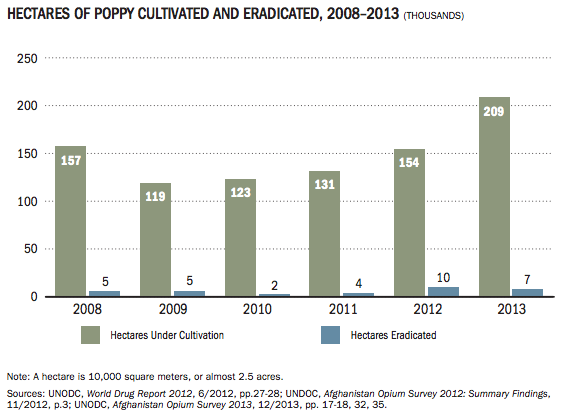
Drug War Fail: Afghanistan Edition

Screen_Shot_2014-07-07_at_11.06.01_AM

Beauchamp illustrates how little our opium eradication efforts have accomplished:

From 2008 to 2013, when the US anti-opium campaign hit its apex, the US only managed to eradicate 3.7 percent of the land devoted to poppy cultivation. The total amount of land devoted to poppy cultivation was a third higher in 2013 than in 2008 … Now, it’s true that the total amount of opium produced in Afghanistan has declined from its 2008 peak. But, according to the UN, that’s because of “plant diseases and bad weather” — not the war. There’s more land devoted to poppy cultivation, but it’s less productive because of natural conditions. Drug eradication doesn’t appear to have much to do with it.

Why has the campaign against opium failed so epically?

There are plenty of reasons, including widespread Afghan government corruption and the fact that 95 percent of poppy cultivation happens in the country’s insecure, Taliban-filled southwestern provinces. But the most important one is the most basic — Afghanistan runs on opium. Opium-related activities make up half of the country’s GDP; the legal economy depends on its proceeds to function. As Fabrice Pothier, the director of the Carnegie Endowment’s European branch and an expert of the Afghan drug trade, explains in an absolutely staggering passage, opium is more than 50 times as important to Afghanistan as cocaine is to Colombia[.]

Dan Murphy concurs with Zack’s takeaway:

To be fair, trying to wipe out opium production in Afghanistan would have been a Sisyphean task no matter what strategy was deployed. It’s a lucrative business, and poppies are easily cultivated, generating far more money for poor farmers and corrupt middlemen than any feasible substitution crop. During the height of the American counterinsurgency effort, winning over the general population to the side of the government and foreign forces was a big focus. The US found that tearing up crops and impoverishing farmers wasn’t very popular.

The early eradication strategy was largely abandoned in favor of going after big opium dealers and encouragng farmers to grow other crops. But that really hasn’t worked, either. The country’s opium and heroin trade is a top earner, and with the military effort winding down, the business opportunities associated with aid and foreign military spending are set to decline.

Who Profits From Prohibition?

Lee Fang contends that Big Pharma (and painkiller interests) are bankrolling anti-marijuana campaigns:

People in the United States, a country in which painkillers are routinely overprescribed, now consume more than 84 percent of the entire worldwide supply of oxycodone and almost 100 percent of hydrocodone opioids. In Kentucky, to take just one example, about one in fourteen people is misusing prescription painkillers, and nearly 1,000 Kentucky residents are dying every year.

So it’s more than a little odd that [the Community Anti-Drug Coalition of America (CADCA)] and the other groups leading the fight against relaxing marijuana laws, including the Partnership for Drug-Free Kids (formerly the Partnership for a Drug-Free America), derive a significant portion of their budget from opioid manufacturers and other pharmaceutical companies. According to critics, this funding has shaped the organization’s policy goals: CADCA takes a softer approach toward prescription-drug abuse, limiting its advocacy to a call for more educational programs, and has failed to join the efforts to change prescription guidelines in order to curb abuse. In contrast, CADCA and the Partnership for Drug-Free Kids have adopted a hard-line approach to marijuana, opposing even limited legalization and supporting increased police powers.

Jon Walker adds:

After reading this article it is worth drawing attention to the interesting correlation between medical marijuana states and prescriptions for opioid pain relievers. On average opioid prescription rates are noticeably lower in states that have medical marijuana laws. Of course correlation doesn’t necessarily mean causation. That said, it is also worth noting for-profit companies rarely give significant sums of money to politically active groups purely out of the goodness of their hearts.

We ran a map yesterday showing which states have the greatest dependency on prescription painkillers.

Israel’s Other Terror Problem

Keating suspects Israel is regretting its failure to do anything about the epidemic of of violence and vandalism committed by West Bank settlers against their Palestinian neighbors and their property:

While the attacks have been widely condemned in Israel, the response by authorities can charitably described as sluggish. According to one report,  between 2005 and 2013, 992 investigations of complaints of Israeli violence against Palestinians were launched but only 7.8 percent of them led to indictments.

As Daniel Byman and Natan Sachs have argued, a large part of the problem is the state of legal limbo created by the occupation of the West Bank. While Israeli police have authority over criminal disputes between Israeli citizens, “the military governs most aspects of public life, from security to construction permits,” and with the overall level of violence low until the last few weeks, the Israeli Defense Forces felt little public pressure to focus on protecting Palestinians from settler violence. Despite this, the IDF has on several occasions been the target of settler attacks.

Jonathan Schanzer profiles the settler gang known as “Price Tag”, which is responsible for many such attacks:

Price Tag is more a network than a group, because its cadres — religious, teenage Jews living in the settlements and in Israel alike — operate informally, leave no electronic trail of their activities, and seem to know how to elude detection from authorities. They are so elusive, in fact, that Israel’s vaunted internal security services has made only a handful of arrests since the acts of vandalism, usually marked by graffiti bearing the words “price tag” in Hebrew, began in 2008.

Some, including Israeli Defense Minister Moshe Yaalon, have called Price Tag a terrorist movement. This is debatable, because its activities have been limited to acts of vandalism and destruction of property. But Israeli officials I spoke to this week began to speculate that if the network was responsible for the murder of Abu Khdeir, it would have graduated into the realm of terrorism. Price Tag, at least so far, has not been linked to the murder. But amid the unrest that is now spreading across East Jerusalem, the Arab areas in Israel’s northern “triangle,” and parts of the West Bank, it is clear that the network poses dangers to Israeli security.

Who Killed The RomCom?

Andrew Romano suggests the small screen is to blame:

[N]ow that Hollywood has concluded that its only remaining competitive advantage is spectacle, it’s all but ceded the fairer sex to cable TV. The only demographic adrenalized enough to reliably show up for this weekend’s latest extravaganza is men aged 18-24, or so the thinking goes, and so the industry keeps churning out dude bait. Even romantic comedies themselves have become more male-centric over the last dozen years, with the Nora Ephrons and Nancy Meyerses of the world giving way to “bromance” auteurs such as Judd Apatow (The 40-Year Old Virgin) and Jason Segel (I Love You, Man).

Girls have something to do with this shift as well – again, on both sides of the camera. Take Mindy Kaling, who has made no secret of her love for romcoms. “What I’d really like to write is a romantic comedy,” Kaling revealed in The New Yorker in 2011. “This is my favorite kind of movie.” And yet Kaling hasn’t created a big-screen romantic comedy yet; she’s been too busy making a television show (The Mindy Project). Same goes for Tina Fey (30 Rock) and Lena Dunham (Girls), two other female writers who could potentially reinvigorate the genre (but who likely see more creative freedom in TV).

Matt O’Brien ties the rise of the Chinese film market to the decline of film comedy:

[T]he death of the comedy movie has come because the world is flat — and senses of humor aren’t. What’s funny to an American audience doesn’t always translate for a Chinese one. And now that China’s box office is the world’s largest outside of North America, that’s a major consideration.

Remember, Hollywood studios aren’t in the business of making movies. Like all financiers, they’re in the business of minimizing risk. That’s why, as Derek Thompson points out, they churn out so many sequels, prequels and reboots (and unnecessary splits of the last movie of a series into two). They do this because it works, and Hollywood knows it does. And now Hollywood knows that American comedies don’t work overseas, but American action movies do — especially if, like “Transformers 4,” they suck up to the Chinese government.

Indeed, Transformers 4 is now China’s top-grossing movie of all time:

Given that critical reaction to Transformers: Age of Extinction has been almost conspiratorially negative across the board — Richard Roeper called it “relentless,” and not as a compliment; Peter Travers at Rolling Stone refused to give it even one star — much of the coverage of its success in China has been, well, pretty darn condescending: “Chinese people are dazzled by anything Hollywood, etc.”

The reality is more complex. If the bar of cinematic quality is indeed set lower in China, the tastes of its 1.3 billion people aren’t necessarily to blame. The Chinese Communist Party is exceedingly picky about the films screened in the country, especially in the case of foreign cinema; so if a movie does well, one can ultimately thank the government.

The long and the short of it: Bay made a movie set and filmed in China, starring Chinese actors, using Chinese resources and pushing Chinese products, and in exchange, the movie gets a timely premiere across the country’s 18,000-plus movie screens.

Who Will Lead The Reformicons?

Not Paul Ryan:

The reformicons’ retreat from Ryan-style apocalypticism is not only a shrewd tonal shift, but also a welcome — albeit unacknowledged — recognition that the party’s doomsaying has not come to pass, and that the American way of life will indeed survive Obama’s reforms. Indeed, the success of Obama’s domestic agenda may create more space for a conservative counteroffensive, in the way that Reaganism opened political room for Bill Clinton. Whether or not the reformicons ever compose a workable domestic agenda, they have come to recognize that they cannot run a presidential campaign promising to rescue America from fire and rubble visible only to themselves.

Vinik takes a closer look at this split:

Term limits mean Ryan can’t keep his current chairmanship. And that’s where things get interesting. As a replacement, he’s expected to seek, and to get, chairmanship of the House Ways and Means Committee. That will give him direct jurisdiction over tax reform and, as the Washington Post’s Robert Costa confirmed in a tweet, Ryan hopes to keep pushing the same supply-side agenda. But that’s likely to put him in conflict with the nascent reform conservative movement. You’ve probably heard of this group. They’re the ones who were the subject of that New York Times Magazine article on Sunday – and who, prior to that, put together a new policy agenda in a compendium called “Room to Grow.” What you may not know is that the chapter on tax reform, written by Robert Stein, represents a substantial departure from agenda Ryan and other supply-siders have been pushing.

Kilgore celebrates this development:

[F]or the moment, it’s refreshing to see that Ryan looks more and more like a standard GOP business hack with an unhealthy addiction to Ayn Rand novels, and less and less like the Brains of the GOP.

ISIS’s “Mission Accomplished” Moment, Ctd

Keating notices that their declaration of a caliphate isn’t rallying many other jihadists around its flag:

So far, there hasn’t exactly been a rush of other jihadi groups pledging allegiance to [Abu Bakr al-] Baghdadi. A number of Islamist groups in Syria, including al-Qaida’s official branch there, al-Nusra, have denounced the announcement. The caliphate has gotten a few pledges of support from groups in Egypt and Libya as well as a factions of the Pakistani Taliban and al-Qaida in the Arabian Peninsula. But we’ve yet to hear from senior leaders like AQAP’s Nasir al-Wuhayshi or al-Qaida in the Islamic Maghreb under Abu Musab Abdel Wadoud. All in all, considering the power-play ISIS just mounted, it hasn’t gotten a particularly impressive show of support from the international movement it purports to now lead. As terrorism analyst J.M. Berger put it, “it’s starting to look like that time ISIS threw a caliphate party and nobody came.”

Richard Bulliet doesn’t expect the title of “caliph” to do much for Baghdadi either:

[T]he success or failure of an ISIL caliphate will have little to do with the history of either the title or the office. None of the OIC states will recognize Baghdadi’s grandiose proclamation, and without such recognition, it will remain meaningless.

ISIL may well continue to enjoy military success against the feeble and embattled Syrian and Iraqi regimes, and that success may well draw in recruits. But the benefit to ISIL of a claim to the medieval caliphate of Baghdad is nil. In fact, it already draws more ridicule than support. Yusef al-Qaradawi, a spiritual guide to the Muslim Brotherhood in Egypt, declared that ISIL’s declaration is void under sharia and has dangerous consequences for the Sunnis in Iraq and for the revolt in Syria.”

There is an outside chance that ISIL’s Islamic State could become a regional polity with some degree of staying power, like the Sokoto Caliphate. But if that does happen, it will be due almost entirely to the fortunes of war rather than the fallacious founding of a caliphate.

Meanwhile, Robert Ford sees potential to peel other Sunni groups away from the Islamic State’s coalition:

In a reversal of their thinking after 2003, many Sunni Arabs also now call for a Sunni Arab region modeled off the Kurdistan Regional Government that they so bitterly opposed 10 years ago, during the drafting of the present Iraqi constitution. The present constitution would allow a Sunni Arab regional government with its own security forces and a wide margin of self-rule. They are surely also thinking about the share of Iraq’s big oil revenues from southern and northeastern Iraq that would go to their region, which would be centered in western Iraq. This suggests that there is space to negotiate with at least some of the Sunni Arabs. These figures would likely be willing to stop the fight against Baghdad in return for a reformed central government and an agreed path to decide if and where to establish another regional government in Iraq.

Nevertheless, Paul Miller contends that “the Middle East is now a more favorable operating environment for jihadist groups than ever before”:

Today there is no serious ideological rival left to Islamist politics in most Middle Eastern countries. Nationalist and Marxist politicians discredited themselves with decades of corruption, mismanagement, and autocracy that left the region nearly worst in the world for human development. The groups gaining ground in the political ferment of the last few years tend to espouse variations of Islamism — of the peaceful sort, where possible, as in Tunisia (the Ennahda Party) and Egypt (the Muslim Brotherhood has publicly foresworn violence since the 1960s), but of the violent sort elsewhere.

[T]here is now a wide swath of territory across Iraq and Syria that is essentially safe haven for jihadist militants. This is probably the greatest strategic setback to the United States in its long war against jihadists since al Qaeda declared war on the United States in 1996. That a menagerie of like-minded jihadist militant groups are alive and well and capturing territory suggests the irrelevance of former Defense Secretary Leon Panetta’s claim in 2011 that al Qaeda was nearing “strategic defeat.” The fate of al Qaeda is simply one small piece of a much larger problem. The situation is all the worse today because jihadist groups can now exploit the international border between Iraq and Syria to their advantage. In a move familiar to anyone watching the Afghan and Pakistani Taliban, terrorists plan, train, and hide on one side of the border, unmolested by the local government because they only carry out operations on the other side.

The Big Picture On Immigration

Charles Kenny argues that immigration reform isn’t really dead, at least not in the long run. He’s talking not just in the US, but Europe as well:

Politically, there’s little question that immigration is currently seen as a losing issue. … The average citizen in both the U.S. and Europe, however, appears to be far calmer about immigration than the heat and light of recent events would suggest. Though there has been an uptick in popular concern about levels of migration in Europe and (to a lesser extent) the U.S., that rise should be seen in the context of a longer-term trend away from nativism. According to World Values Survey data, the proportion of Germans who think that “when jobs are scarce, employers should give priority to people of this country over immigrants” has fallen from 56 percent in the late 1990s to 41 percent more recently. Over the same period in Spain, the proportion fell from 70 percent to 53 percent, and in the U.S., 59 percent to 50 percent.

The U.K. is the only country out of eight European countries and the U.S. surveyed by the German Marshall Fund where the majority of respondents thought there were too many immigrants in the country in 2013. Compare that with 41 percent in the U.S. and only 24 percent in Germany. In the U.S., more than two-thirds view immigration as a good thing for the country.

But Reihan feels that Kenny’s column “obscures more than it reveals”:

What Kenny does not mention is that when asked if there were “a lot but not too many” immigrants in the country, 39 percent of Americans, 55 percent of Germans, and 28 percent of Britons answered in the affirmative. One obvious possibility that Kenny neglects is that Germans might be reluctant to tell a pollster that there are “too many” immigrants residing in their country while Americans and Britons, who presumably don’t have the same anxieties about national chauvinism, are somewhat more inclined to do so. While Kenny cites the fact that only 24 percent of Germans will forthrightly say that there are too many immigrants in the country, he neglects to mention that 43 percent of Italians and 43 percent of the French say the same. The Swedes, like the Germans, are outliers in that only 23 percent report that there are too many immigrants in the country, yet Sweden is home to large numbers of migrants from neighboring countries like Finland (12.5 percent of all foreigners residing in Sweden), Denmark (6.8), and Norway (6) as well as countries like Iraq (9.3). A finer-grained question might ask respondents if there were “too many” immigrants from affluent market democracies or from the developing world. …

Instead of admonishing politicians on both sides of the Atlantic to consider the math, Kenny should keep in mind that the math favors immigration policies that raise the average skill level over those that lower it. Lo and behold, it turns out that societies that select immigrants on the basis of skill are also less hostile to immigration.