An Online Right To Be Forgotten? Ctd

May’s ruling in the EU Court of Justice upholding the “right to be forgotten” online is beginning to have predictably strange effects, such as causing Google to scrub from its European search results a seven-year-old blog post from the BBC:

The post was removed because someone who was discussed in it asked Google to “forget” them. In the original article, [BBC economics editor Robert] Peston only named one particular individual, Stan O’Neal, a former executive at Merrill Lynch. That narrows down who put in the request to Google with great ease.

Peston describes his post as a discussion of “how O’Neal was forced out of Merrill after the investment bank suffered colossal losses on reckless investments it had made.” The post did not outwardly attack O’Neal, nor was it “inadequate, irrelevant or no longer relevant,” which are the requirements set for being “forgotten.” This plays directly into fears that Google would allow illegitimate requests to slip through the cracks, “forgetting” search results that remain relevant, and undermining the freedom of journalism.

But Mario Aguilar thinks it was brilliant of Google to notify the BBC of this removal, effectively ensuring that it became news:

Oopsies Stan!

Looks like your dirty laundry is flapping in the wind all over again. And all because you tried to cover it up. Google’s response is a wonderful reaction to censorship and a triumph for transparency. It’d be better if nothing was getting de-indexed at all, but this is at least a delicious reminder that you can’t run away from your past on the internet. Nothing really goes away, and if you’re an idiot, you’ll pay the price forever.

Sooner or late, Drum figures, someone will come up with a way to effectively nullify the ruling:

I wonder if there’s a way to make this backfire? How hard would it be to create an automated process that figures out which articles Google is being forced to stuff down the memory hole? Probably not too hard, I imagine. And how hard would it then be to repost those articles in enough different places that they all zoomed back toward the top of Google’s search algorithm? Again, probably not too hard for a group of people motivated to do some mischief.

Update from a reader:

Update to the story here. Turns out the request came from a commenter to the article, not O’Neal himself.

Adopt American? Ctd

A reader protests:

I hope you like the taste of worms, because you’ve opened a big ol’ can of them with excerpt of Rebecca Buckwalter-Poza’s piece on the adoption of African-American children overseas. There are several things in that article that I can see Dish readers vociferously debating – like the citation to an unnamed legal scholar who thinks Western Europe is a less racist place to raise a black child – but I want to focus on her implication that domestic adoptions in the United States ought to be colorblind.

While there is no doubt that the overwhelming number of African-American children in the foster care system is an urgent matter that needs to be addressed, I disagree with Buckwalter-Poza’s suggestion that we can help solve this problem by dismissing cultural competency concerns in transracial adoption applications.

Firstly, as a historical note, she doesn’t mention that a major reason for the mid-20th century backlash against transracial adoptions was because of programs like the Indian Adoption Project, where Native American children were taken from their communities and deliberately placed with white adoptive parents in order to mainstream them (and give them ostensibly “better” lives). This was widely perceived by Native American tribes as an effort to stamp out their language and culture, and when transracial adoption proponents turned to African American children in need of families, there was wariness that this was going to happen to the black community next.

Secondly, whether we like it or not, raising a minority child in a white-centered, prejudiced society today is still a complicated task – one that is made even more fraught if parents are ignorant of or unwilling to address the effects that a child’s race will have on how he or she is treated by society. Parenting a minority child is always going to be different in some regards from parenting a white child, so why shouldn’t the ability of prospective families (regardless of their race) to navigate those issues be considered as part of the adoption vetting process? Whether it’s having the skills to properly care for black hair, knowing where to find resources for your Chinese child who asks about his/her heritage, or knowing when and how to engage in “The Talk” with your African-American kid (something that I as an Asian person was completely ignorant about until Trayvon Martin), having cultural awareness is hugely important.

To be clear, I definitely do not think that any parents should be out of the running for adopting a child simply because they are of a different race, nor do I assume that cultural competency is automatically present so long as a prospective parent is the same race as the child. I am saying, however, that getting rid of that consideration entirely (as opposed to, say, beefing up cultural competency training and support for transracial adoptive parents) is a mistake.

An A-OK For The NSA

An independent oversight panel appointed by the White House has found that the NSA’s online data collection program is both legal and effective:

As the NSA’s troves of ostensibly foreign emails and Americans’ international communications come under heavy scrutiny, the Privacy and Civil Liberties Oversight Board dealt the NSA a victory on Tuesday night by calling the information reaped “valuable”. It pointedly rejected similar claims for the bulk collection of US call data in a January report. Under the so-called “702 program” – named after section 702 of the Fisa Amendments Act of 2008 – the NSA can harvest large amounts of ostensibly foreign digital information, including Americans’ international communications.

But the board did question the NSA’s intrusion into Americans’ data and recommended limits to the government’s ability to access large amounts of American communications data that the NSA inevitably collects and searches through without a warrant.

The Electronic Frontier Foundation is less than thrilled with the report:

The board skips over the essential privacy problem with the 702 “upstream” program: that the government has access to or is acquiring nearly all communications that travel over the Internet. The board focuses only on the government’s methods for searching and filtering out unwanted information. This ignores the fact that the government is collecting and searching through the content of millions of emails, social networking posts, and other Internet communications, steps that occur before the PCLOB analysis starts.

The foundation also slams the panel for not taking a firmer stand on whether government agencies need warrants to search Americans’ communications:

The Fourth Amendment requires a warrant for searching the content of communication. Under Section 702, the government searches through content without a warrant. Nevertheless, PCLOB’s analysis incorrectly assumes that no warrant is required. The report simply says that it “takes no position” on an exception to the warrant requirement when the government seeks foreign intelligence. The Supreme Court has never found this exception.

Although they have few qualms about the data collection itself, the Bloomberg editors favor a warrant requirement:

A lot of regulations cover the use of these data. But the NSA asserts that, once collected, it can be lawfully searched by its agents and others. The Central Intelligence Agency conducted about 1,900 queries of such information in 2013. The Federal Bureau of Investigation, alarmingly, says it doesn’t track how often it accesses the communications of Americans gathered under this program but “believes the number of queries is substantial.” In fact, the report says that the government has no idea how much data it collects on Americans, and it notes that the rules “potentially allow a great deal of private information about U.S. persons to be acquired.”

The board was split on exactly how to treat that information, an issue that gets pretty complicated. But the bottom line is this: If intelligence agencies are intentionally sifting through these data for the content of specific Americans’ communications, they should get a warrant — except in emergencies — just as the Constitution requires in all other cases.

This was the standard recommended by the president’s NSA review panel in December. And it’s the standard the House of Representatives voted to affirm last month. The Senate should do the same.

And Susan Crawford pivots from the report to make the case for stronger judicial oversight:

What’s needed now is better oversight by the FISA court. That means Congress needs to expand the court’s authority. The PCLOB report makes clear that the FISA court is being informed about the procedures that the surveillance authorities are following with respect to broad categories of foreign intelligence information. But that’s it. The court does not otherwise exercise any judicial review over the substance of these programs.

Surveillance will inevitably continue. An overly timid NSA would not serve domestic or foreign interests. But the court needs to double-check that federal agencies don’t overstep their legal limits on targeted surveillance. In this murky context, the FISA court remains at a distinct disadvantage when attempting to balance national security and privacy interests.

The Highway Trust Fund Is Running Low, Ctd

As the Highway Trust Fund approaches its fiscal cliff, the DOT is preparing to take drastic measures to ration funds for state infrastructure projects before the money runs out by the end of August. That is, unless Congress does something quick (ha!):

Any solution will need to pass the House of Representatives, whose own plan for funding DOT involves shuttering Saturday deliveries by the U.S. Postal Service—a plan that critics described as “unworkable” and “bad transportation policy.” The Congressional Budget Office estimates that DOT would require $8.1 billion to meet its obligations through Dec. 31. A spending solution that moved the deadline to the end of the year would push it past the November midterm elections, after which solutions like gas-tax increases might stand a chance. Senate Finance Committee Chairman Ron Wyden (D-Ore.) supports a $9 billion bill that would do exactly that: kick the ball down the road.

But the damage may be done already: Even if construction projects aren’t suspended in the middle of the summer construction season, states may be reluctant to launch big transportation infrastructure projects—especially since states depend overwhelmingly on federal funds for transportation spending. If the funding stream is shaky, the infrastructure planning will be, too.

Vinik looks over the options:

Congress is contemplating three proposals – none of them with broad support and all of them seriously flawed, for reasons I discussed last week. The White House proposal is not much better:

It’d use revenues from corporate tax reform as a short-term patch, which would mean we’ll be back in the same position four years from now. The optimal solution remains what it’s always been: Raising the gas tax by six cents in each of the next two years, then indexing it to inflation. By recouping the value lost to inflation and ensuring such erosion doesn’t happen in the future, this would make the Highway Trust Fund whole over the long-term.

It’s easy to see why the White House isn’t endorsing such a policy: It’s a political nightmare. Doing so would break the president’s promise not to increase middle class taxes. Beyond that, Republicans would never agree to it. Obama has spent enough of his presidency searching for a compromise by proposing politically risky policies. He’s not about to do it again with the gas tax. But that means it’s up to Congress to craft a sensible solution to this problem. So far, it’s not looking very good.

But Chris Edwards argues that excess spending is to blame for the shortfall, rather than a lack of tax revenue:

Tax-hike advocates say the gap is caused by insufficient gas tax revenues. It is true that the value of the federal gas tax rate has been eroded by inflation since it was last raised two decades ago. But the gas tax rate was more than quadrupled between 1982 and 1994 from 4 cents per gallon to 18.4 cents. So if you look at the whole period since 1982, gas tax revenues have risen at a robust annual average rate of 6.1 percent (see data here). In recent years, gas tax revenues have flat-lined. But the source of the HTF gap was highway and transit spending getting ahead of revenues, and then staying at elevated levels.

Previous Dish on the HTF here.

When Movies Go Meta

In a clip-laden essay, Oliver Farry surveys a history of cinema that turns the spotlight on itself:

Picture houses became a handy (some might say lazy) plot device for screenwriters, a place for characters to disappear into when pursued by police or the baddies. This was lampooned by Mel Brooks in Blazing Saddles where the villainous Hedley Lamarr ducks into an anachronistic cinema in the Old West and tries to get a student rate at the box office. …

Nostalgia for one’s youth forms much of the nostalgia for picture houses, which, in the movies is often elegiac.

This stands to reason – the cinema is a place for the young, for people with time and just enough money on their hands, for young lovers, student loners and groups of teenage friends. Peter Bogdanovich’s The Last Picture Show uses the closure of the local cinema in a small Texas town as a totem for the passing of an era, and of burnished youth. …

The ultimate cinema-nostalgia film is Giuseppe Tornatore’s Cinema Paradiso, in which a successful film director reminisces about his childhood helping projectionist Alfredo (Philippe Noiret) in the cinema in a Sicilian village. The film doesn’t stint on sentimentalism but it does have a pragmatic heart underneath it all. Alfredo encourages the boy, Toto, to leave the village to do something with his life, even obstructing a blossoming relationship with a local girl to do so. The cinema, palatial as it is for such a small town, exists only thanks to good fortune – after the initial one is burned down, costing Alfredo his eyesight, it is rebuilt thanks to the lottery winnings of a local, not exactly the wisest investment, it must be said. Toto’s future career is made possible by a film industry that stays alive, while the cinema, like many others in small towns, falls by the wayside.

This Is A Refugee Crisis, Ctd

A reader testifies to the truth of that statement:

I am a leader in my Catholic parish’s decades-old sister parish relationship with a church in San Salvador. I have been visiting regularly since 2009. In these five years, the level of violence and insecurity has increased dramatically. Our parish supports their parish school and our families sponsor about 45 kids there. We measure this crisis in the impact on these kids, not on partisan hyperbole. Here are some of the concrete situations we’ve encountered:

• A teenager’s mom is killed in front of her, because the mom can’t pay extortion money to the gang. The teenager has dropped out of school because she needs to support the rest of her family.

• Half of the older boys in the program can no longer attend the weekend enrichment programs because they have to cross a newly shifting gang boundary due to a split in the local Calle 18 “chapter”. Before, they knew how to navigate between MS-13 and Calle 18. Now, who knows? They stay in their one-room shacks in sweltering heat as adolescence passes them by.

• Kids from Calle 18  are sent to a neighborhood  controlled by MS-13 on a mission to beat up someone (doesn’t matter who really). They choose a beloved social worker who is one of the few responsible father figures in the neighborhood.

• A young nun gives presentations on human trafficking and the reality of immigration. She tells adolescents that there is a really high risk of rape. They tell her, “I’ve already been raped by (my father; the police; the gangs). What do I have to lose?” She tells them about dying of thirst in the desert. They tell her about death in their neighborhood because of lack of clean water.

The boys and girls on the border are children fleeing for their lives. They are not economic migrants.

Good Luck Finding A Lesbian Bar In Portland

Alexis Clements ponders the decline of America’s “lesbian spaces”:

Two of the most stark examples are bars and feminist bookstores.

In the 1990s, there were literally 100 feminist bookstores in the U.S. Today there are 14. So in 20 years, they’ve almost disappeared. Then if you start to do any kind of research about lesbian bars, you see that they are also disappearing. Philly lost two of them. Chicago lost one. Portland doesn’t have one anymore. West Hollywood – one of the places many people consider to be one of the gayest areas in the United States – doesn’t have a lesbian bar anymore, and it had one of the oldest, the Palms. That’s gone now. …

A lot of people say, “Oh, well, there’s gay marriage now, so essentially queer people can assimilate into the larger culture; we don’t need places to go.” But for both political and romantic reasons, we still need to be able to spend time with people who we want to partner with or who we want to engage in political activities with. Those two things are in many ways core to a lot of lesbian and queer communities. Not every lesbian is a political activist, and not every political activist is queer, but the collision of politics and lesbian identity is longstanding and a very rich and important history.

Update from a reader:

I think that there are fewer lesbian bars because lesbians are much less at war, or at least high tension with straight men.

I’ve lived in Berkeley/Oakland since 1963, which has long been the lesbian’s lower profile mirror to San Francisco’s gay male community. In the ’70s through ’90s, the tough-ass-dyke-man-hater was a local fixture. At some point there was a shift, and the poster person for the lesbian community became much younger and less confrontive. Still tough, but not defined by anger towards males. This new model is also happy to show off her beauty, and less likely to buy into butch/femme sterotypes. I think that this generation doesn’t want to be beholden to a way that they are “supposed” to act.

Perhaps lesbian bars represent the “old” angry worldview. How does the saying go? “Living well is the best revenge”? From my bi-male standpoint, it looks like this generation’s largely having a great time of it, and in that sense is exacting their revenge quite well.

But I’d really like to hear from your lesbian readership. It’s a good question.

Where’s All The Plastic Going?

Bottlenose dolphin (Tursiops truncatus) swimming in oil slick, black plastic bag is along belly Curacao, Netherlands Antilles

The ocean should be a lot more plasticky than it actually is:

For a decade or more, scientists have assumed our seas carry millions of tons of plastic, much of which should be floating in open water, forming vast midocean “gyres” – islands of man-made mess such as the Great Pacific Garbage Patch. But according to a new study, something more worrying is happening to 99 percent of the ocean’s plastic: it’s disappearing.

The study outlines the findings of scientists who trawled the waters around five large ocean gyres in 2010 and 2011. The data they obtained put them far short of the expected amount of plastic in the ocean — rather than millions of tons, the global load of ocean plastic was calculated at 40,000 tons at most.

So what happened?

Though it’s possible that sunlight is eroding it into nothingness, or that tiny pieces are washing back ashore, researchers are skeptical. What’s probably happening, scientists theorize, is that tiny fish are eating it. The most likely plastic-snackers are lanternfish and other small “mesopelagic” species, meaning those that live in the middle swath of the ocean, swimming to the surface at night to feed. These are far and away the most populous fishes in the sea. …

We don’t have a good sense of what swallowing plastic does to these fish, or even whether they’re able to excrete or throw up their plastic meals. That’s worrisome, since the toxic chemicals in plastic might permeate their tissue – bad for mesopelagic fish, but also potentially bad for humans. Pellets in the 0.5-5-millimeter range are also commonly found in the bellies of the predators who eat these smaller fish, according to the study. Those include tunamackerel and other sushi-menu faves.

For the larger chunks of plastic, drones could help:

[G]etting to the scale needed to map the world’s ocean garbage will require a gigantic remote-controlled swarm of nautical drones. Ultimately the idea is to deploy thousands of swarming, meter-long sailboats equipped with sensors and dragging nets behind them to scoop up the garbage.

Protei’s shape-shifting robotic hull is the project’s breakthrough technology, and the design is open source for anyone to use. The hull bends and curves like a snake in order to control the boat’s trajectory through the water. Touted as unsinkable, self-righting, and hurricane-ready, the drone uses wind power, and the latest prototype can tow a payload of under five pounds, the group claims. The vessel would use a custom plastic sensor to locate the trash; the sensor is able to measure “slices” of pollution at various depths.

Recent Dish on plasticky sedimentary rocks here.

(Photo: A bottlenose dolphin (Tursiops truncatus) swims in oil slick alongside a black plastic bag off the shore of Curacao, Netherlands Antilles. By Wild Horizons/UIG via Getty Images)

We The Profligate People

Libby Nelson considers the failings of personal finance education:

Just 17 states require personal finance courses for students, and only six test students on what they’ve learned. But those classes don’t seem to make much difference anyway: students who took a semester-long class in personal finance fared below average on the Jump$tart survey. There is no evidence that the classes actually made students worse at managing money, the group wrote in its report. But it certainly didn’t make them any better.

Academic research backs up that conclusion. A 2008 study from two Harvard Business School professors studied the relationship between education and saving and investing behavior. They found state-required financial literacy education had no effect on graduates’ saving behavior later in life. The money spent on financial literacy education, they concluded, produced little in return.

McArdle chides Americans for spending so much and saving so little:

[W]hat we have is people spending more than they have to on the big basics. The average car loan, for example, is more than $25,000, and for people with the worst credit ratings, it’s actually higher: almost $30,000. This is not because you have to spend $27,000 to get yourself from Point A to Point B. It’s because people are pouring a big fraction of their income into driving something “nice.”

By the same token, raising your kids in a modestly sized home is not physically impossible. But we’ve come to regard as deep deprivation anything less than one bathroom and one bedroom per person. Cash-strapped people mention giving up vacations as if doing so were as great a sacrifice as giving up food or heat.

Why Clinton Needs Female Challengers

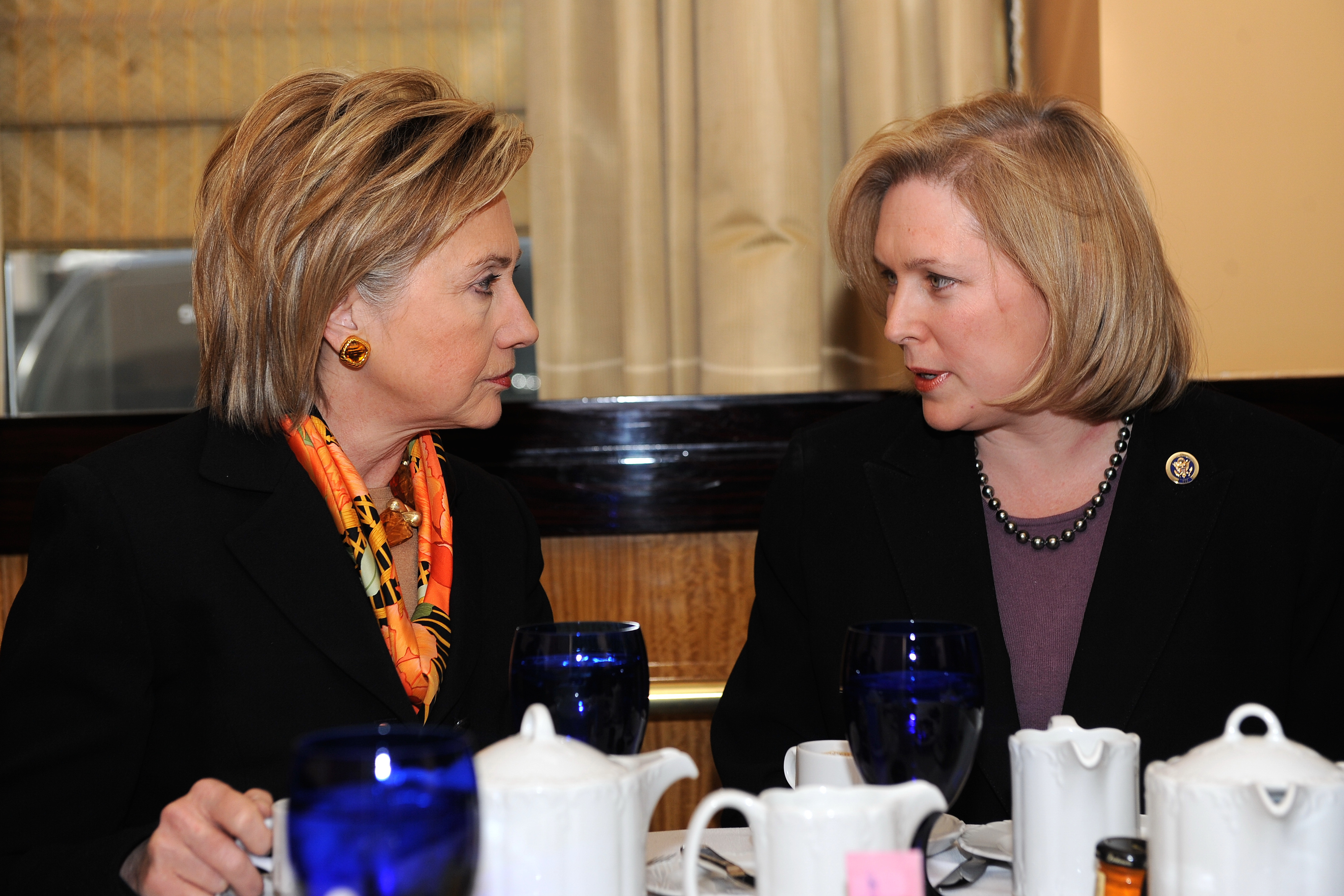
Secretary of State Hillary Clinton has lunch wtih her replac

Rebecca Traister makes a compelling case:

The last thing any woman in politics needs is the appearance of having won only because her would-be opponents gave her a pass. This perhaps goes double for Clinton, whose years in the spotlight have demonstrated again and again that she is at her most appealing when she is fighting and scrappy, and at her most loathed when she is self-assuredly coasting. Clinton and her party require arresting, attention-drawing competition. She needs to be duking it out, and not just with a bunch of white guys. How many people are salivating at the thought of a Martin O’Malley candidacy? 19? 20?

A predictable primary is a boring primary, and a boring primary leads to a disinterested Democratic Party—a major hindrance going into a general election.

Part of what hooked voters in the mesmerizing 2008 race was the thrum of newness, the frisson of history-making every time a woman and a black man stood on a debate stage together. And while we could reproduce that thrill in a variety of ways—there is, after all, a shameful abundance of racial, ethnic, religious, and gendered history to be made before presidential politics become remotely inclusive—one of the most realistic, ready-to-roll scenarios of 2016 is the one in which multiple women show up to debate each other.

But there’s more at stake here than the health of the party in one presidential election. Viewing women as adversaries—ideologically and also within their own parties—is an urgent next step in helping the nation adjust to the idea that female politicians are just like, you know, regular politicians. That means we have to swiftly abandon the processional model, in which one diligent woman takes her hard-earned turn, while the next waits patiently in the wings. …

When a single avatar stands in for womankind, womankind projects onto that avatar its own varied ideas and priorities and standards. Clinton suffered from this last time, metaphysically unable to satisfy a million divergent hopes. She couldn’t be progressive enough, authentic enough, strong enough, stoic enough, or well-dressed enough for everyone. That’s part of why it’s dangerous for one woman to mean so much to so many.

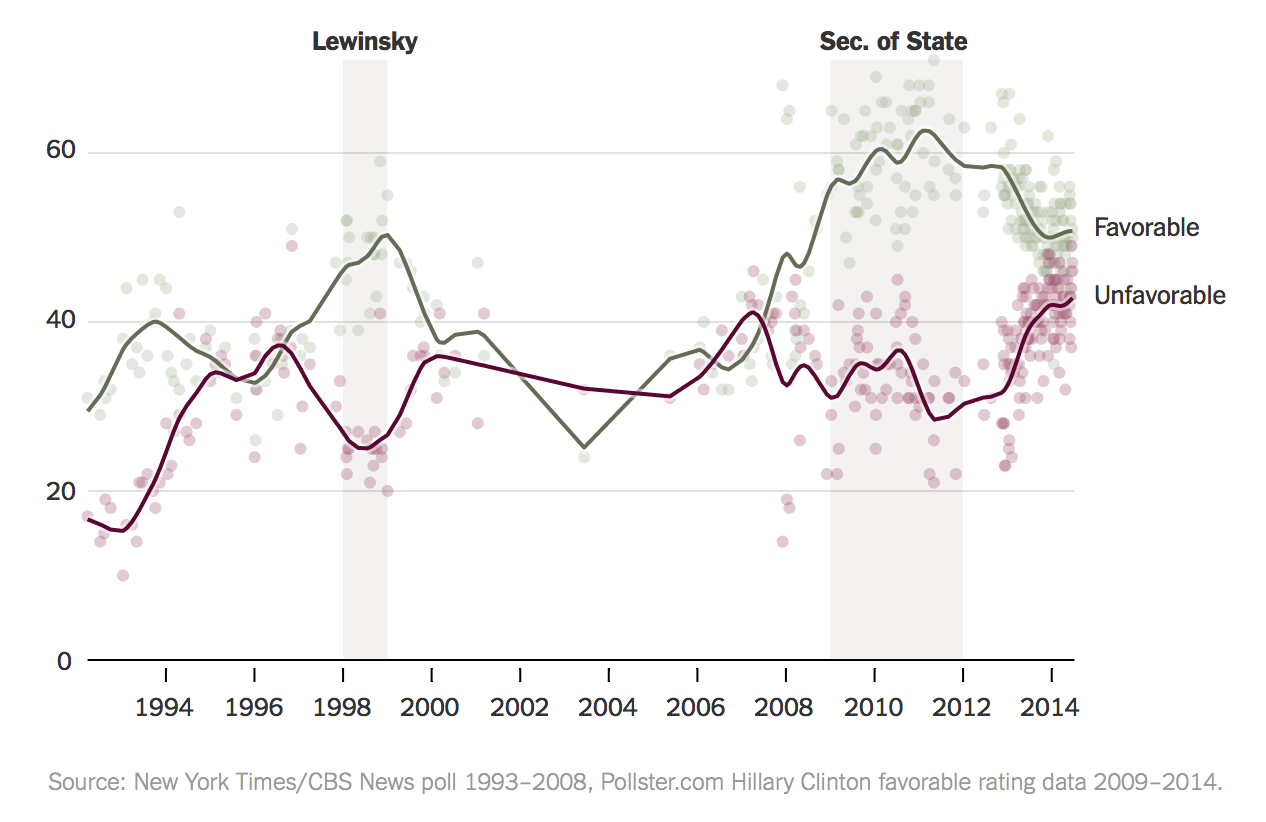
Meanwhile, Nyhan checks in on Clinton’s approval numbers:

[Her] artificially inflated poll numbers have made her seem like an especially strong presidential candidate, but the Clinton bubble is quickly coming to an end. …

Screen Shot 2014-07-03 at 5.21.23 AM

[W]e tend to overrate the importance of candidate image, which is largely a function of the flow of partisan messages. When opposition elites withhold criticism during, say, a presidential honeymoon or a foreign policy crisis, politicians can seem unstoppable, but when normal politics resume, their images — and their poll numbers — quickly return to earth. The same will be true for Ms. Clinton.

(Photo: Secretary of State Hillary Clinton has lunch with her replacement in the Senate, Kirsten Gillibrand, at Oscars Restaurant in New York City on January 25, 2009. By Enid Alvarez/NY Daily News Archive via Getty Images)