Why Am I Not So Alarmed By Hobby Lobby? Ctd

Iud

Some second day thoughts. (You can read a variety of new overnight bloggy reactions to the case here.)

First off, it still seems to me that the fury over banned contraception is de trop. Of the twenty forms of contraception mandated as covered in the ACA, Hobby Lobby agreed to fund all but four of them, the ones that could, in their view, be seen as abortifacients. I think they’re pretty obviously wrong about that as a scientific matter. In which case, the best counter-argument is to make is exactly that: their religious consciences are simply empirically misinformed. But that is not the argument being proffered.

Secondly, this case is effectively an affirmation of our new, libertarian order. Ross has a great blog post on this today. For the first time, evangelical Christians are pretty much a minority on a major social question (a few forms of contraception), and they are therefore, like many minorities before them, looking to the Court to protect them. Money quote from Ross:

On other culture-war fronts — same-sex marriage, most notably — the old dynamic still sort of shows up, with judges repeatedly overturning democratically-enacted (though, in many cases, no longer majority-supported) laws that religious conservatives tended to support. But on religious liberty, the old order is increasingly reversed, with conservative believers looking to the courts rather than the vox populi for protection against moves made by the elected branches, and especially the current national executive.

Why is this not overall a good development? I remain of the view that if this precedent leads to discrimination in employment against purported sinners, then it will be a death-knell for Christianity in America. If Christianity becomes about marginalizing groups of people, it will be a betrayal of the Gospels and a sure-fire path to extinction. And the Christianists will not win with that argument, as the marriage equality experience demonstrates. But if evangelical or orthodox Catholic Christians seek merely to protect themselves from being coerced by government in overly aggressive fashion – remember that the Obama administration lost this fight because they chose the maximalist position with respect to employer-provided health insurance and did not choose another, less invasive path of providing contraception – then I think that’s a paradigm worth encouraging.

Religion is best when it does not seek to impose itself on other people.

This, indeed, is the core heresy of Christianism – a desire to impose religious rules on others who do not share the faith. But when it seeks merely to carve out a space in a secular culture where it can operate as autonomously as possible, it is imposing nothing on anyone. It is merely seeking an exemption for itself. Yes, Hobby Lobby prevents its own employees, who may not be evangelical Christians, from getting four types of contraception. But nothing in the ruling prevents other ways of providing those options that do not violate anyone’s consciences. A single-payer provision, for example, would not incur any religious freedom issues. Which means that this decision is, in essence, a libertarian one. And the more the evangelical right seeks merely to protect its own rights, rather than imposing on anyone else’s, the better.

There is, in other words, a kernel here that could unwind Christianism as a domineering force in our multi-faith and multi-cultural polity. Perhaps liberals and old-school conservatives should cheer that, instead of hyperventilating quite as much as they did yesterday.

(Photo: An Iud by BSIP/UIG Via Getty Images)

Laying Down Landmines

The US announced on Friday that it would stop producing anti-personnel mines, in a possible move toward finally joining the 15-year-old Ottawa ban treaty:

This new announcement builds on previous commitments, the White House said in a fact sheet accompanying the announcement, “to end the use of all non-detectable mines and all persistent mines, which can remain active for years after the end of a conflict.” In layman’s terms, in the past administrations have chosen to draw the line between so-called “dumb mines,” which last indefinitely, and “smart mines” that deactivate on their own. While the Clinton administration refused to sign onto the Ottawa Convention, it did decide to ban its use of “dumb mines” everywhere but on the border between North and South Korea, already destroying 3.3 million AP mines back in 1999. At present, the U.S. is estimated to have approximately 9 million self-destructing anti-personnel mines in its stockpile.

Beauchamp looks back at how our military commitment in Korea has kept us from signing the treaty thus far:

Why is Korea such a big sticking point for the US?

In very simple terms, North Korea vastly outnumbers its southern neighbor in troops. The North Korean military is almost double the size of its South Korean counterpart (roughly 1.2 million to 700,000). The massive quantity of landmines planted in the DMZ, in the US’s view, would considerably slow down any attempt by the North Korean military to rapidly overwhelm the South by dint of sheer numbers.

In the 1990s, many of those landmines were American-owned mines, not Korean. So if the US had accepted a treaty commitment to dismantle its mine stock, it would have had to dismantle weapons it believed were deterring a North Korean invasion. Today, though, South Korea technically controls all of the mines — not the US. However, joining the Ottawa Convention would prohibit any US-led forces from military cooperation with nations that use landmines during wartime. Considering that there are 30,000 US troops in South Korea, signing the treaty would severely constrain the US’s ability to work with South Korea.

The political point-scoring has, of course, already begun:

On Friday, Rep. Buck McKeon, R-Calif., chairman of the House Armed Services Committee, issued a statement calling the effort to replace landmines with new technology “an expensive solution in search of a nonexistent problem.”

“Once again, the President makes an end-run around Congress and demonstrates his willingness to place politics above the advice of our military leaders,” McKeon said. “His announcement today is perfect for a feel-good press release but bad for the security of our men and women in uniform. … McKeon said President Obama “owes our military an explanation for ignoring their advice and putting them at risk — all for a Friday morning press release.”

To Be A Christian In The “Islamic State”

Well, you may be able to imagine. Andrew Doran and Drew Bowling report on the plight of Mosul’s terrified Christians:

On June 23, the Assyrian International News Agency reported that ISIS terrorists entered the Iraqi Refugees in Erbilhome of a Christian family in Mosul and demanded that they pay the jizya (a tax on non-Muslims). According to AINA, “When the Assyrian family said they did not have the money, three ISIS members raped the mother and daughter in front of the husband and father. The husband and father was so traumatized that he committed suicide.”

Although few reports from ISIS-occupied Iraq can be corroborated, the group’s record of torture chambers, public executions, and crucifixions lends credibility to nightmarish accounts from the ground. Since the fall of Mosul, a litany of evils has replaced the liturgies of the Christians there: a young boy ripped from the arms of his parents as they ran from the ISIS advance and shot before their eyes, girls killed for not wearing the hijab.

Small wonder that since the fall of Mosul, tens of thousands of defenseless civilians have fled the ISIS onslaught, including the region’s Christians, whose presence on the Nineveh plains dates back to the earliest centuries of Christianity. Most have left their homes with nothing but the clothes on their backs.

Meanwhile, some Iraqi Christians are turning to Putin as a possible savior:

“Russia proved through history that it’s the only defender of Christians,” said Ashur Giwargis, who heads the Assyrian Patriotic Movement (APM), which for two years has energetically lobbied the Kremlin to support an independent Assyrian Christian state in northern Iraq. Until recently, the Beirut-based exile and his colleagues, who are scattered among the global Iraqi diaspora, had little to show for their efforts, but in January, as Western-Russian tensions escalated over Ukraine, Giwargis was summoned to Moscow to meet government officials. …

There are few assurances that Russia—which is already held in low regard by much of the Arab World for its stance on Syria—will further jeopardize its relations across the region by throwing its weight behind Iraq’s Christians. Nor, for that matter, does APM’s courting of Putin necessarily command serious support among many Iraqi Christians, of whom only 10-15 percent favor its pro-active approach, according to several church officials.

But the APM’s fishing for alternative patrons is illustrative of the tremendous anger many Eastern Christians feel towards the West for its perceived indifference to their plight.

(Photo: A Iraqi girl fleeing from the city of Mosul arrives at a Kuridish checkpoint. ISIS has captured major roads and town in central Iraq. June 12, 2014. By Sebastiano Tomada/Getty Images.)

Hobby Lobby Wins: Reax II

Our early roundup of blog commentary is here. My initial take on the ruling is here. Your thoughts are here and here – and we’re compiling many more. From the next wave of blog commentary, Amy Davidson seizes on several quotes from Ginsburg’s dissent and anguishes over the majority decision:

Alito sees all the substance in how put-upon the owners of corporations feel. In oral arguments, Kennedy openly worried that companies would somehow be mixed up with abortion, and one suspects that his sense that abortion is a distinctly volatile, morally charged subject was part of why he acquiesced here, and why seems to believe, against all reason, that this decision is narrow. Women’s health is treated as something troublesome—less like other kinds of health care, which a company should be asked to pay for, than as a burden for those who have to contemplate it.

Soraya Chemaly is on the same page:

Ninety-nine percent of sexually active women will use birth control at some point in their lives. The Court’s decision displays the profound depth of patriarchal norms that deny women autonomy and the right to control our own reproduction—norms that privilege people’s “religious consciences” over women’s choices about our own bodies, the welfare of our families, our financial security and our equal right to freedom from the imposition of our employers’ religious beliefs. … This religious qualifier was narrowly construed to address just this belief and not others, such as prohibitions on vaccines or transfusions. It is not a coincidence that all three female members of the Court and only one man of six dissented from this opinion.

Drum is also bummed:

This is not a ruling that upholds religious liberty. It is a ruling that specifically enshrines opposition to abortion as the most important religious liberty in America.

But McArdle doesn’t buy such sweeping statements:

Here’s a representative tweet from my feed this morning: “So let’s all deny women birth control & get closer to harass them when they’re going in for repro health services. BECAUSE FREEDOM.” Logically, this is incoherent, unless you actually believe that it is impossible to buy birth control without a side payment from your employer. (If you are under this tragic misimpression, then be of good cheer! Generic birth control pills are available from the drugstore for about $25 a month.) Otherwise, according to the reasoning of that tweet, I am being denied something every time my employer refuses to buy it for me: cars, homes, Hummel collectible figurines. …

Now, there are women out there for whom a few dollars a month is a crippling expense, but I venture to say that few of them are salaried workers getting health insurance from closely held corporations with deeply religious owners; most of them will be hourly workers on Medicaid.

Suderman counters critics of the court’s view that “corporations are people”:

The key to Alito’s ruling arguably comes down to just two words: “a person’s.” The big question isn’t whether the contraception mandate violates the religious freedoms of some faceless corporate entity entirely separate from the individuals who own that company—it’s whether the requirement would violate the free exercise of religious for the particular people who founded and now run the company. As Alito writes in his opinion, “A corporation is simply a form of organization used by human beings to achieve desired ends….When rights, whether constitutional or statutory, are extended to corporations, the purpose is to protect the rights of these people.”

Ilya Somin adds on that score:

Even the dissent by Justice Ruth Bader Ginsburg partially recognizes this, since she accepts that [the Religious Freedom Restoration Act] does apply to nonprofit religious corporations, such as those established by churches. The latter, of course, are no more natural “persons” than for-profit corporations are. In modern society, people routinely use corporations for a wide range of activities. Numerous employers, churches, schools, newspapers, charities, and other organizations use the corporate form. When they do so, their owners and employees should not have to automatically check their constitutional and statutory rights at the door.

Meanwhile, Aaron Blake notes something I mentioned last night: the court’s metric of “closely held” – defined by the IRS as companies in which five or fewer individuals own more than half the stock – affects about 90 percent of all businesses and about 50 percent of all employees. Blake then asks:

But does that mean the employers of half of all Americans will suddenly nix contraception coverage?

Of course not. According to a Kaiser Family Foundation poll, 85 percent of large employers had already offered contraception coverage before Obamacare mandated it. And while Hobby Lobby fought that mandate, so far few other large companies have joined them. … [T]here is little reason to believe that tens of millions of American women will suddenly see their contraception coverage come to an end.

And for those who do lose their coverage, Danny Vinik reminds us that “employees of closely held corporations may receive contraceptive coverage anyway”:

That coverage would likely mimic the workaround developed in 2012 by the Department of Health and Humans Services. That regulation exempted nonprofit religious institutions like hospitals and charities (churches were already exempt) from adhering to the contraceptive mandate. However, it required insurance companies to offer contraceptive coverage free of charge to those employees. This workaround, the Obama administration argued, ensured that religious institutions were not directly participating in offering contraception to their employees.

In fact, Alito essentially recommends that workaround in his ruling. Cohn takes that one step further to argue that “the obvious solution to this dilemma is to take health insurance away from employers altogether” and give it to “the government or tightly regulated insurers”:

But the people and groups who oppose government’s providing insurance directly tend to be the same people who object to the contraception mandate. That’s not a coincidence. While I don’t doubt the religious objections to birth control are sincere, I do think they are masking another belief conservatives bring to this debate: As a general rule, conservatives don’t think government should be compelling them to pay for other people’s medical expenses.

As Beutler puts it, “Ironically, and appropriately, the ruling probably prefigures a call for a greater, not smaller, government role in the health care system.” Still, any such workarounds probably won’t satisfy companies like Hobby Lobby:

To take advantage of the exemption, a closely held company owned by religiously devout individuals must file a form, specified by the government, in order to trigger the legal duty of the “middle man” to provide the coverage as a stand-in for the company or its owners. Federal government lawyers have made it clear in court, over and over again, that the “middle man” will not have any authority to step in unless the company or its owners file that government form claiming an exemption for the mandate. Some whose religions tell them to have nothing to do with some forms of birth control (often on the premise that they amount to a form of abortion) believe that even the filing of that formal declaration is itself an act of participation in the provision of those very services for people on their payroll.

And that argument is winding its way through the courts:

At least 51 nonprofit lawsuits have been filed against the administration’s policy by groups that say the accommodation still forces them to violate their religious beliefs since they have to arrange for the contraception coverage. Some of those challenges have reached the appellate court level, and just this past New Year’s Eve, Justice Sonia Sotomayor temporarily blocked the administration from enforcing the requirement against the Little Sisters of the Poor, a group of Colorado nuns.

As SCOTUSblog pointed out over the weekend, two more religious-affiliated groups on Friday asked for a similar protection from the contraception rule. “It is now nearly a certainty” that the Supreme Court will take up the nonprofit challenges to the contraception requirement next term, according to SCOTUSblog.

Hobby Lobby: Your Thoughts, Ctd

The in-tray remains full of your insights. One reader writes:

Your first reader’s reaction – that it’s troubling the Court made a point to protect only an evangelical Christian belief – is really interesting. This whole case hinges on construing the Religious Freedom Restoration Act, and RFRA was a direct legislative response to very similar reasoning in Smith v. Oregon.

In that majority opinion, Justice Scalia said Smith had no constitutional right to exercise the religious practice in question (use of 1024px-Peyote_Cactuspeyote in a Native American ritual). Or rather, he said the state of Oregon’s interest in preventing abuse of peyote outweighed Smith’s religious freedom. He made a point of saying part of the balancing act was the fact that the religion Smith adhered to was not widely practiced, and therefore very few people’s religious rights were trammeled by Oregon’s law.

The dissent put the question to Scalia: what happens if a state outlaws use of sacramental wine in the interest of preventing alcohol abuse? Scalia’s explicit reply was: oh please, that will never happen because Catholicism, and other denominations, have so many adherents. Such a law could never be supported democratically, so the issue would never arise. He stood the Religion Clauses on their head; they weren’t there to protect religious minorities from the democratic will of “overweening majorities”; they were there to do just the opposite. Many, many people found that outrageous, and Congress (very much including Democrats) passed RFRA as a direct rebuke to Scalia’s opinion.

So, Hobby Lobby is now the second modern case I know of that singles out a widespread religious practice for protection, while denying it to similar practices of smaller faiths. And this case did it while being decided on the basis of legislation passed as an explicit disavowal of that first case. That’s a nifty bit of bendy logic to pull off, and a bit of a “fuck you” to the legislative branch.

Another reader reiterates the fair and important point that this was not about contraception as such, but contraception believed to be a form of abortion:

You stated: “The notion that the executive branch has the right in wartime to seize an American citizen and torture him into incoherence strikes me as a more important question than whether someone can have access to free contraception if her employers disapprove.”

What this ignores, and what most of the responses to the SCOTUS ruling on the Hobby Lobby case ignores, is that the thing that makes this more important to the religious right is that these people think the morning-after pill kills babies (and they believe this even of intrauterine devices); whereas the enemy who is tortured into incoherence is (1) still alive, in most cases, and (2) the corporate entity may be paying for it at a remove, but their taxes are not labeled as “for torturing prisoners.” I’m not defending their crazy views, mind you; but unless we realize that they really, really think this, and that’s what they’re upset about, I don’t see any way of effectively putting this to rest, the way we pretty much have done with blood transfusion refusers and snake handlers.

I hope at least some liberals grasp that being required to finance something you believe to be murder is a legitimate area of conscientious objection.

We’re All Libertarians Now (Except David Brooks)

GERMANY-HISTORY-WALL

[Re-posted from earlier today]

In a characteristically astute and bracing essay, Mark Lilla recently remembered – with mixed feelings – “the grand drama of political and intellectual life from 1789 to 1989.” It strikes me as an important piece, because it comes at a propitious time to regroup and rethink recent history a bit more seriously. The world really did change in 1989, finally ending a period of two centuries of ideological struggle – a struggle that gave meaning and structure to billions of people on both sides. By the 1990s, the organized, intellectual armies of right and left effectively and slowly peeled away from a battlefield in which democratic capitalism (with varying levels of social welfare) had triumphed by default.

And I think Mark is specifically emphasizing: by default. Yes, the right, in many ways, won the philosophical argument. But the right’s victory left us domestically with a profoundly unreflective libertarianism:

Whatever ideas or beliefs or feelings muted the demand for individual autonomy in the past have atrophied. There were no public debates on this and no votes were taken. Since the cold war ended we have simply found ourselves in a world in which every advance of the principle of freedom in one sphere advances it in the others, whether we wish it to or not.

The core idea of this post-ideological new age was simply expanding the freedom of the individual – and it was embraced economically by the right, socially by the left, and completely by the next generation of pragmatic liberaltarians. Here’s what Mark posits as the core of the libertarian ethos:

This outlook treats as axiomatic the primacy of individual self-determination over traditional social ties, indifference in matters of religion and sex, and the a priori obligation to tolerate others. Of course there have also been powerful reactions against this outlook, even in the West. But outside the Islamic world, where theological principles still have authority, there are fewer and fewer objections that persuade people who have no such principles. The recent, and astonishingly rapid, acceptance of homosexuality and even gay marriage in so many Western countriesa historically unprecedented transformation of traditional morality and customssays more about our time than anything else.

Think also of the astonishing speed with which marijuana seems on its way to legalization.

One thing I’d emphasize: this outlook also deeply informs our view of the world and America’s place in it, in ways we are less familiar with. Just as government or some governmental authority Berlin During The Cold War: Then And Nowaxiomatically shouldn’t curtail an individual’s right to do what she wants and be who she wants, so a super-power, even a benevolent one, has no right to dictate the choices and fate of any other individual country, however despotic and evil its regime might be. This libertarian foreign policy is observed even in the breach. There is, for example, nothing to stop Putin from annexing Crimea – but he loses international standing and is increasingly isolated as a consequence. Ditto Israel’s constant excesses in the occupied West Bank; it goes on ad infinitum, but so too will Israel’s pariah status as a result. And, of course, the cause célèbre of this entire movement is the Iraq War, a catastrophe now regarded as utterly illegitimate by everybody on the planet, apart from a few Cheney dead-enders and Tony Blair.
In fact, the only addendum I would add to Mark’s argument is that libertarianism has had a much bigger impact in foreign policy than we care to admit.

To wit: if your axiomatic worldview is live and let live, and it permeates all your non-thinking prejudices, then interventionism abroad has a much higher bar to meet than in the past when it was justified by a dangerous and global state enemy or by a firm belief in a world-historical mission. In the wake of the triumph of the West in the 1990s, this was not obvious. So we over-played a somewhat triumphalist hand, expecting Western values, having vanquished Soviet and Nazi ideology, to spread spontaneously around the globe. So we pressed NATO to the Russian border, expanded the EU to 28 states, charted maps of democracy’s invincible rise across Asia and then, in a fit of hubris, actually decided to force it upon Iraq and Afghanistan of all places as a panacea to all the Islamic world’s ills as it struggles fitfully to come to terms with modernity.

We know better now – but that lesson means that the bar for intervention is future is likely to be extremely high. Legitimacy matters – and in the last ten years or so, America has lost most of its international legitimacy, whether the neocons and liberal interventionists recognize it or not. The question is: how do we respond to this? And there are, it seems to me, a liberal and a conservative option.

The liberal one is to fight back in defense of universal values, American droit de seigneur (also known as American exceptionalism), and democratization as a sacred duty. Which is why, when push comes to shove, David Brooks is a liberal. His column in response to Lilla’s essay uses a peculiar word – “spiritual” – to define his crusade:

Such is life in a spiritual recession. Americans have lost faith in their own gospel. This loss of faith is ruinous from any practical standpoint. The faith bound diverse Americans, reducing polarization. The faith gave elites a sense of historic responsibility and helped them resist the money and corruption that always licked at the political system. Without the vibrant faith, there is no spiritual counterweight to rampant materialism. Without the faith, the left has grown strangely callous and withdrawing in the face of genocide around the world. The right adopts a zero-sum mentality about immigration and a pinched attitude about foreign affairs. Without the faith, leaders grow small; they have no sacred purpose to align themselves with.

So in response to the end of ideology, Brooks wants a new-old one, a national commitment to “universal democracy” (undefined) that is sacred. If we don’t have that faith, we are somehow reduced. I guess I’m just being an atomized individual, but my own “counter-weight to rampant materialism”, for example, is Christianity. But this faith is, for David, insufficient. It doesn’t strengthen the nation! I must join some Berlin During The Cold War: Then And Nowcollective, secular spiritual mission to complete my life and one, moreover, that goes out into the wider world to find monsters to destroy or countries to civilize. The fact that this ideological mission is deeply out of step with this moment in world history and has just been discredited on a massive, comprehensive scale sails past the need for it to exist in Brooks’ mind. Which is my best read on the cognitive dissonance in the column.

But there is another, saner response to this, and Lilla points the way. It is to re-exercize the intellectual muscles that created and then defended the idea of democratic capitalism – and to use them, first of all, to address the democratic deficits in our own too-often bought-and-paid-for republic, to build and defend intermediate institutions that check individualism’s acidic power – families, churches, neighborhoods, school-boards, sports leagues, AA meetings. And so we match gay freedom with gay marriage and military service, embracing libertarianism but hitching it to institutions that also connect it to the community as a whole. Abroad, the sane response to our political and intellectual moment is to abandon the crude idea that democracy – purple fingers and all – is all that matters, and direct our attention at the specific things that make a difference in very different societies, and away from the grand principles and systems that cannot be imposed by force or even constant suasion.

Lilla puts it this way:

The big surprise in world politics since the cold war’s end is not the advance of liberal democracy but the reappearance of classic forms of non-democratic political rule in modern guises. The break-up of the Soviet empire and the “shock therapy” that followed it produced new oligarchies and kleptocracies that have at their disposal innovative tools of finance and communication; the advance of political Islam has placed millions of Muslims, who make up a quarter of the world’s population, under more restrictive theocratic rule; tribes, clans, and sectarian groups have become the most important actors in the post-colonial states of Africa and the Middle East; China has brought back despotic mercantilism. Each of these political formations has a distinctive nature that needs to be understood in its own terms, not as a lesser or greater form of democracy in potentia. The world of nations remains what it has always been: an aviary.

For which you need an aviarist, not an ideologue.

Even though it seems foolish to deny that most countries still seem headed over time toward Western norms (Fukuyama remains basically correct), in the here and now, all sorts of hybrids are forming and will form, as they always have. Our goal in foreign policy is to understand them better by using the vast apparatus of political philosophy bequeathed to us by our Western canon, and tapping into our collective reserves of diplomatic and military experience, and adjust accordingly. That means bracketing the simple democracy-spectrum and looking for how to deal with various forms of oligarchy, kleptocracy, or emerging democratic society. Now and again, a little nudge might help (see the Balkans in the 1990s). But for the most part, the changes we want will happen without us (Tunisia, anyone?), and the places where we simply act as if the world were a blank page ready to be filled by democracies (Israel, Libya, anyone?) will turn out to be a case study in the frequent destiny of good intentions.

What Mark is saying, it seems to me, is that only conservatism, properly understood, can rise to the challenge of governance in this post-ideological age. And conservatism in America is, alas, as widely misunderstood as it is routinely ignored.

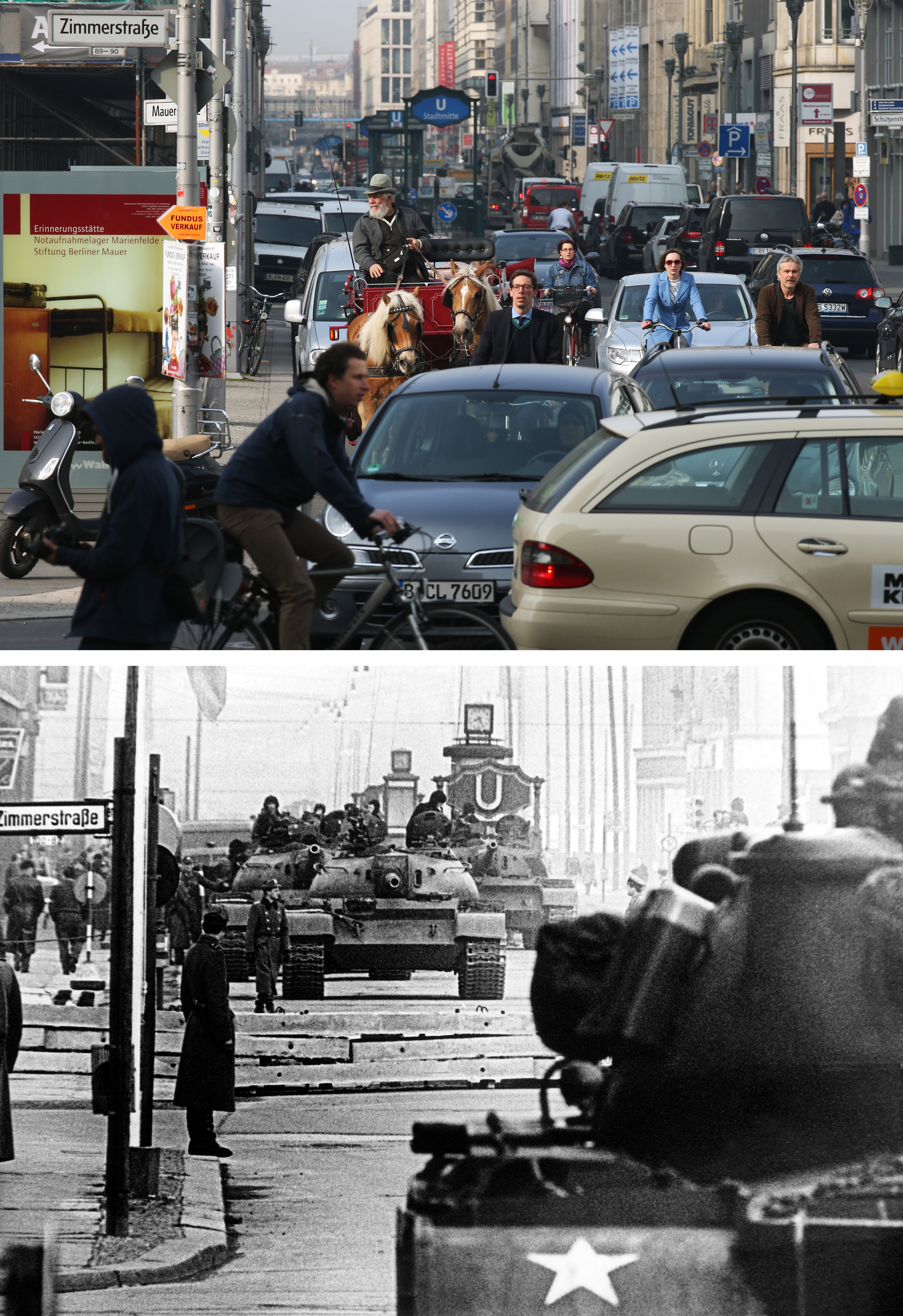
(Photos: 1) Roses stuck in a gap of the memorial of the Berlin Wall on November 9, 2013 on occasion of the 24th anniversary of the fall of the Wall. By Stephanie Pilick/AFP/Getty Images. 2)In the first composite image, a comparison has been made between Berlin in the 1960s and Berlin now in 2014. In the color photo above traffic, cyclists and a horse-drawn carriage carrying tourists make their way across the intersection of Friedrichstrasse and Zimmerstrasse at former Checkpoint Charlie on April 1, 2014 in Berlin, Germany. In the black and white photo Soviet tanks (behind) and U.S. tanks confront one another at the same location on October 26, 1961. By Keystone-France/Gamma-Keystone via Getty Images. 3) In the second composite image, the color photo shows a man walking a dog past the memorial to the Church of Reconciliation, which was demolished by East Berlin authorities to make way for a widening of the Berlin Wall, in Bernauer Strasse on February 25, 2014 in Berlin, Germany. In the black and white photo people in West Berlin look at an early version of the Berlin Wall in front of the church at the same location sometime in 1961 or 1962. By Imagno/Hulton Archive via Getty Images.)

Was 1994 The Greatest Year In Hip-Hop?

And Pater Tosiello highlights a handful of retrospectives rolled out for the 20th anniversary:

Chief among the honorees has been Nas’s Illmatic, a debut whose 20th birthday has been celebrated with a two-disc reissue, accompanying tour, three-part Fuse special, and feature-length documentary. The two-decade anniversary of Outkast’s debut Southernplayalisticadillacmuzik brought about the long-awaited onstage reunion of members Big Boi and Andre 3000. Elsewhere, Bone Thugs-N-Harmony has embarked upon a tour commemorating the 20th anniversary of their debut EP Creepin on ah Come Up, and Warren G announced plans for a follow up to his multi-platinum selling 1994 debut Regulate…G Funk Era. Mobb Deep’s new release The Infamous Mobb Deep confusingly shares a title with their breakthrough album and includes a second disc of outtakes from 1994 studio sessions. A few months late to the party, Onyx released their first album in a decade, Wakedafucup, with a title inspired by their debut Bacdafucup, and The Wu-Tang Clan has reported internal strife around their already-delayed album planned for the 20th anniversary of Enter the Wu-Tang (36 Chambers).

But Tosiello finds the anniversary “insanely awkward”:

For each tour and retrospective, middle-aged musicians must assume the personae of their teens and early 20s, overlooking two decades worth of artistic output.

Nas has been beckoned to recite Illmatic’s 10 tracks dozens of times this year at venues ranging from the Kennedy Center with the National Symphony Orchestra to the Preakness Stakes’ InfieldFest. If these performances have highlighted Illmatic’s timelessness, they’ve also reasserted the consensus that Nas has yet to surpass his debut.  In selecting Coachella for their reunion, Outkast joined a bill mostly composed of electronica artists and a young audience in part predated by Southernplayalisticadillacmuzik. Of the new Mobb Deep record, Pitchfork’s Jayson Greene wrote, “the album is exactly the sort of hastily tossed-off, forgettable project that legacy acts will sometimes tack onto can’t-miss releases.”

The focus on 1994 also highlights rap’s precarious position today. Hip-hop sales swelled corresponding with the pre-Napster boom at the turn of the century, but in the intervening years rap lost a significant market share. Forty-three of Billboard’s year-end Top 200 Albums were rap records in 2004, but in 2013 only 25 cracked the Top 200. Last fall the 10th annual Rock the Bells Tour, a hip-hop specific concert series that saw the reunions of ’90s icons the Fugees and A Tribe Called Quest, was cancelled due to slow ticket sales. Upon the cancellation, planned performer Kid Cudi tweeted, “Hip hop shows aren’t exciting… People wanna smile and dance.”

“It’s like remaking the same classic movies over and over,” J-Zone says of the recent nostalgia wave. “People are running out of ideas and instead revisiting stuff for interesting content.”

Ain’t No Party Like A Military Party

VENEZUELA-ELECTION-CAMPAIGN-MADURO

Venezuela’s supreme court decided last week that military participation in pro-government rallies was not only permissible, but actually a good thing. Juan Nagel decries the ruling for “dramatically eroding what is left of democracy, bringing Venezuela back to its nineteenth-century roots when warlords ruled the land”:

The Venezuelan Constitution clearly establishes the military as a non-partisan entity. According to Articles 328 and 330, active service members “have a right to vote,” but they cannot participate in “acts of propaganda or political partisanship, and they cannot proselytize.” This, apparently, is not clear enough for Venezuela’s highest court. In complete opposition to the text, the court ruled that active military participation in partisan acts “is a high water-mark for democratic participation.” The ruling goes on to hail the use of the military in partisan activities as “a progressive act geared toward the consolidation of civilian-military union.” … The ruling basically sets into law what has been a fact in chavista Venezuela: that the military is the armed faction of the governing party.

He contextualizes the court’s WAR IS PEACE ploy to show how dangerous it really is:

Keeping the military impartial was an important part of Venezuela’s democracy. The military guards all elections in Venezuela, doing everything from manning voting centers to handling voting material. They are also charged with ensuring safety in and around voting centers. Now that they are part of the governing party, how can anyone in the opposition be sure that results will be respected? Asking the military to take care of elections is like asking your dog to guard a stash of freshly cooked bacon.

That may be the only way president Nicolás Maduro can win an election at this point, considering how the country is falling apart:

[R]ampant scarcities of food and basic goods, sky-high inflation, and staggering crime rates have chipped away at Maduro’s popularity, reducing them to record lows. In early February, a rash of street protests and barricades paralyzed the nation, and were violently suppressed by state authorities in a series of crackdowns that saw several notable opposition leaders incarcerated. The resulting negative publicity led even previously supportive international media outlets, such as the The Guardian to become more critical, and when Hollywood stars began chiming in against his government, the 2014 Academy Awards were pulled from the Venezuelan television lineup for the first time in 39 years.

And now this: in the middle of a triumphalist speech for “national journalists day,” broadcast by law on every Venezuelan television and radio station, the lights suddenly went out on Maduro—and on much of the country. Much of Caracas, and areas in nearly all of Venezuela’s other 22 states was affected the country’s aging and poorly maintained power grid struggled to get back online.

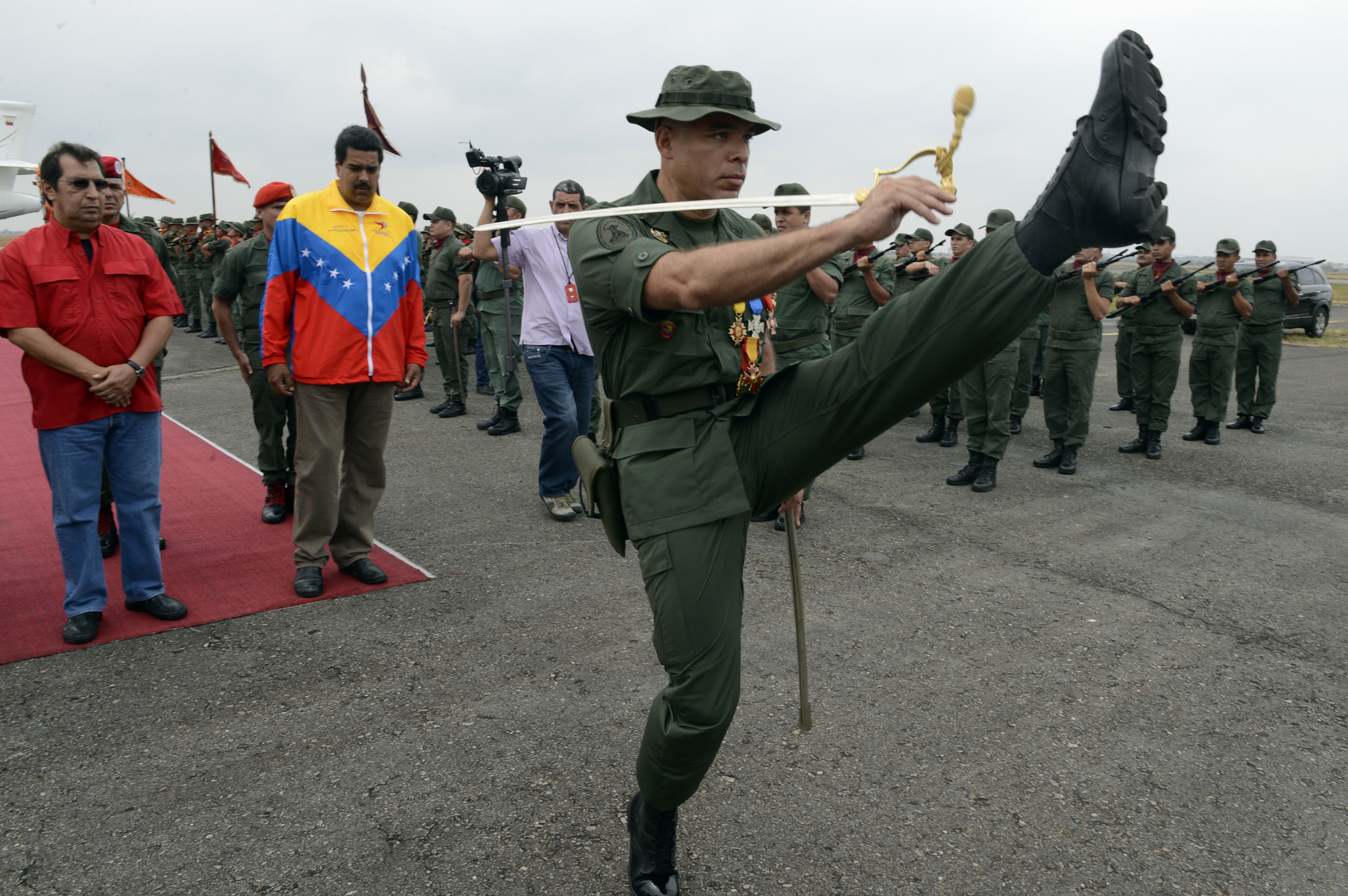
(Photo: Venezuelan acting president Nicolas Maduro (2nd-L) and state governor Adam Chavez (L) receive military honors before heading for a campaign rally in the state of Barinas, Venezuela on March 30, 2013, ahead of the presidential election on April 14. By Juan Barreto/AFP/Getty Images)

Kurdistan’s Moment? Ctd

The president of Iraqi Kurdistan, Massoud Barzani, has indicated that the Kurds intend to remain in control of Kirkuk, which peshmerga forces occupied earlier this month to defend it from the jihadist scourge:

Speaking at a press conference on June 27 with British Foreign Secretary William Hague in the Kurdish region’s capital, Irbil, Barzani said Kirkuk’s status “now is achieved.” Hague was visiting Irbil as part of a trip to Iraq aimed at convincing Iraq’s Shi’ite, Sunni, and Kurdish political leaders to bridge their differences. Britain and the United States are both urging the creation of a national-unity government that is “inclusive” and can quell sectarian tensions threatening to pull the country apart.

Barzani’s remarks, meanwhile, have fueled concerns that it may already be too late to patch up the divisions within Iraq. Kirkuk — an ethnically diverse city in northern Iraq — is part of disputed territory in northern Iraq that the Iraqi Kurds have wanted to incorporate into their autonomous region for decades. Successive governments in Baghdad have refused to put the oil-rich territory under the exclusive control of authorities in the Kurdish autonomous region. Such a move is also opposed by the city’s Arab, Assyrian, and Turkoman populations.

Meanwhile, the cause of Kurdish independence has found a supporter in Bibi Netanyahu:

In a speech to a Tel Aviv thinktank, Netanyahu said that the rise of both al-Qaida-backed Sunni extremists, as well as Iranian-backed Shia forces, had created the opportunity for “enhanced regional cooperation”. He said Jordan, which is facing a growing threat of spillover from conflict in neighboring Iraq and Syria, and the Kurds, who control an oil-rich autonomous region of northern Iraq, should be bolstered. “We should … support the Kurdish aspiration for independence,” Netanyahu told the thinktank, going on to call the Kurds “a nation of fighters [who] have proved political commitment and are worthy of independence”.

Israel has maintained discreet military, intelligence and business ties with the Kurds since the 1960s, seeing in the minority ethnic group a buffer against shared Arab adversaries.

Recent Dish on Kurdistan here, here, here, and here.

How Crippled Is Afghanistan’s Democracy?

In Daniel Berman’s view, the rift created by Afghan presidential candidate Abdullah Abdullah’s allegations of widespread irregularities favoring his rival Ashraf Ghani casts the country’s entire future into doubt:

While it seems almost certain now that Ghani has/will win, with recent rumors putting his AFGHANISTAN-ELECTION-UNRESTtotal as high as 59%, the United States and NATO, perhaps distracted by Ukraine, have done little or nothing to respond to Abdullah’s blackmail. This is worrying because behind it lies a more serious threat. With the impending withdrawal of American forces and fears of a Taliban resurgence among Tajiks, Afghans affiliated with the former Northern Alliance have begun rearming, placing their future in their own hands rather than with Kabul’s. In many ways Abdullah’s candidacy is being sold as their last overture to national unity; the victory of a Pashtun candidate, even one as  liberal as Ghani may well be treated as a signal to withdraw from the national government in Kabul.

The result would be devastating, the current events in Iraq enacted on a smaller scale. Without the need to conciliate non-Pashtuns, the national government would become increasingly infiltrated by pseudo-Taliban elements, likely backed by the Pakistani ISI. This in turn would reinforce the Tajiks in their determination not to have anything to do with it. This political death spiral can still be prevented by American pressure. But the opening to do so is vanishing rapidly. And if America’s focus remains dead set on Iraq, it may well find itself implicated in a second Civil War.

Last week, Leela Jacinto plumbed the depths of the controversy:

[T]he figures the Abdullah campaign has been citing are initial, regional IEC tallies. Preliminary runoff results are only due on July 2, and final results on July 22. The sheer ferocity of Abdullah’s premature response has sparked questions over whether the former mujahideen-era leader is simply trying to cover up his loss. Reports of the ongoing vote count suggest that Ghani has made a surprise comeback after finishing behind Abdullah in the April 5 first round.

Ghani contends that a successful voter mobilization campaign ahead of the latest vote is responsible for the last-minute surge in ballot casting. That could be true. Or it could just be a cover-up for dubiously magnified figures. With suspicions feeding the Kabul rumor mills, there have even been mumblings that the Taliban did not stage attacks on election day because the Pashtun militant group favors a Ghani victory. There’s no proof of this, of course. And even if it were true that the Taliban has an insidious, unacknowledged stake in favoring one candidate over another, it may not necessarily be disastrous for Afghanistan.

Ashley Jackson just hopes the election authorities can sort out the mess:

In my conversations with Afghan friends and colleagues in Kabul over the past few days, no one disputes that there has been widespread fraud and many are disillusioned with the way the process has played out. Few think the accusations should be brushed under the rug. But they also think it is up to the election bodies, with the international community’s support, to investigate and address discrepancies — however long it takes.

So far, the international community is sounding the right notes with the deputy head of the U.N., Nicholas Haysom, affirming the protestors’ rights but urging calm. Karzai has also voiced support for the U.N. in mediating the crisis, but this is ultimately a dispute that must be settled by Afghans.

(Photo: Supporters of Afghan presidential candidate Abdullah Abdullah shout slogans during a demonstration in Kabul on June 27, 2014. Abdullah led thousands of demonstrators at a noisy rally through Kabul, upping the stakes in his protest against alleged election fraud that has triggered a political crisis. Abdullah has vowed to reject the election result, saying he was the victim of massive ballot-box stuffing in the June 14 election with vote counting reportedly putting him far behind his poll rival Ashraf Ghani. By Shah Marai/AFP/Getty Images)