Hobby Lobby: Your Thoughts

Readers are far less sanguine about the ruling than I was. One writes:

You should be appalled, not reassured, by the Supreme Court’s ruling on Hobby Lobby precisely because it’s such a narrow ruling. The Court has ruled that only the religious views of abortion opponents count. The views of other religions do not count – Jehovah’s Witnesses (no blood transfusions), Orthodox Jews (no vaccinations on the Sabbath), Christian Scientists (no doctors, period). The narrowness of this ruling not only exposes it as the most blatantly political since Bush v. Gore, it is also the most blatantly Catholic – the result of having five Catholic conservatives in the majority.

Another reader thinks the narrowness of the decision is misleading:

I’m surprised that language in the majority opinion is read so credulously. The underlying reasoning in an opinion is more important than bald statements like “this opinion doesn’t mean that our reasoning can be taken to its logical conclusion.” Yes it does. That’s why we keep winning handily every time Lawrence v. Texas and its progeny (Windsor) comes up. Lawrence explicitly said “this case is not about gay marriage.” Scalia’s dissent howled that it in fact does – and he was right. Lawrence led directly to Windsor and every court that has considered the issue has cited Windsor (and its predecessor, Lawrence) for the proposition that marriage equality is a constitutional mandate. Pretending that Alito’s one throwaway sentence in this opinion somehow immunizes the reasoning from being applied to other areas looks to me like a refusal to grapple with the actual reasoning of the opinion.

About those other areas:

All the “reassuring language from Alito” you quoted specifically says that his opinion only addresses the contraceptive mandate because mandatory coverage of blood transfusions and vaccines weren’t a part of the case. He didn’t actually shut the door on another closely held company making a RFRA claim that mandatory coverage of blood transfusions or vaccines abridges religious freedom. If anything, he’s swung the door wide open for these kinds of cases. I could easily see a company make the argument that a person getting HIV is being punished by God for sinful behavior and treatments like Truvada abrogate punishment for that.

And the ramifications could continue:

I’m no lawyer, but I don’t understand why the objection to the compulsion of a small-business owner who is also a Jehovah’s Witness to provide transfusion coverage (or the compulsion of a Scientologist to provide his employees mental health coverage) would be any less legitimate.

Another reader:

What happens to women who take birth control for noncontraceptive reasons? Should Hobby Lobby be required to comply with the law for these women since they are not violating any religious beliefs? If so, would a woman have to promise Hobby Lobby she won’t use birth control for contraception to get covered? How would that work exactly? And by that same logic, is Hobby Lobby then exempt from having to provide other medications that have contraception as a side effect? Like chemo, for example?

But Hobby Lobby never opposed most kinds of contraception, including the pill. As we noted earlier:

The company objects to paying for morning-after pills and inter-uterine devices, but freely provides insurance that covers tubal ligation, birth control pills, condoms, diaphragms and contraception delivered via a patch or ring inserted into the cervix. More than 80% of all contraception users in the U.S. rely on these methods.

Update from a reader, who catches a typo in that excerpt from Kate Pickert:

Vaginated Americans – even the worst spellers among us – would note the inherent comic hopelessness of any such things as “inter-uterine devices” before letting that misprint meet the pixels of day (it should be “intrauterine” of course). Powerful as sisterhood gets, there is no device to link us up at the uteri.

Heh. Another reader:

I see others have already tread this ground, but I fail to see how Alito’s “caution” that

this decision concerns only the contraceptive mandate and should not be understood to hold that all insurance-coverage mandates, e.g., for vaccinations or blood transfusions, must necessarily fall if they conflict with an employer’s religious beliefs.

… is in any way reassuring, because of the underlying principle that this decision, and Citizens United represents. It has granted limited liability corporate entities individual rights. The fact that a company is closely held or publicly traded should be immaterial; a corporation is not an individual, and therefore shouldn’t be granted rights ascribed to individuals by our constitution.

In fact, the only way the Religious Restoration of Freedom act applies to Hobby Lobby or any other corporation is if you explicitly decide that when Congress wrote a law protecting individuals, they implicitly meant corporations, too. But Congress doesn’t write laws that way; they know the difference between these two.

But if that’s the way that so-called conservative jurisprudence wants to go, they also need to consider this: If there’s no separation between the individual religious beliefs of business owners/controllers and their operations, why should there be any separation of liability. I’d like to see the legal logic that says you can have one without forfeiting the other.

Another:

I share your view of the opinion.  Although I haven’t read the whole thing yet, the holding is much narrower than it might have been.  It may also be a Trojan horse for the shareholders of corporations like Hobby Lobby.  As things stood before the opinion, shareholders enjoyed nearly absolute immunity from liability provided by the shield of the corporate entity.  The fundamental exception has been in cases where a corporation, usually as a result of commingling of funds, can be deemed the “alter ego” of its shareholders, or a group of shareholders.

What happens now when a corporation, through its policies and actions, becomes liable as a result of its execution of the religious biases of its shareholders?  Does the corporation become the alter ego for that limited purpose?  The full opinion probably carves out an exception to the exception to provide ongoing confidence in the integrity of the corporate entity theory. However, I think a creative plaintiff might argue that the justification underlying the holding (in certain closely-held corporations religious belief of the owners may be attributed to the corporation for purpose of compliance with certain statutory mandates) opens the door to liability.  In availing itself of a special, statutory immunity by virtue of assuming the religious beliefs of its owners, the corporation AND the owners become liable for torts arising from actions taken in the name of those religious beliefs.

Who knows?  Stranger things have happened in the wake of “narrow” opinions.

Dr Zuckerberg Will Treat Your Moods Now

F1.large

Above are the results of a controversial study in which Facebook altered the News Feeds of its users in order to determine if “emotional states [could] be transferred to others via emotional contagion, leading people to experience the same emotions without their awareness.” Robinson Meyer explains:

For one week in January 2012, data scientists skewed what almost 700,000 Facebook users saw when they logged into its service. Some people were shown content with a preponderance of happy and positive words; some were shown content analyzed as sadder than average. And when the week was over, these manipulated users were more likely to post either especially positive or negative words themselves. …

Many previous studies have used Facebook data to examine “emotional contagion,” as this one did. This study is different because, while other studies have observed Facebook user data, this one set out to manipulate it.

Meyer notes that the experiment was “almost certainly legal”. But Katy Waldman doubts anyone could argue that users really consented:

Here is the only mention of “informed consent” in the paper: The research “was consistent with Facebook’s Data Use Policy, to which all users agree prior to creating an account on Facebook, constituting informed consent for this research.” That is not how most social scientists define informed consent. … So there is a vague mention of “research” in the fine print that one agrees to by signing up for Facebook. As bioethicist Arthur Caplan told me, however, it is worth asking whether this lawyerly disclosure is really sufficient to warn people that “their Facebook accounts may be fair game for every social scientist on the planet.”

Katie Collins notes:

In the Code of Ethics and Conduct published by the British Psychological Society, it is stated that psychologists should: “Ensure that clients, particularly children and vulnerable adults, are given ample opportunity to understand the nature, purpose, and anticipated consequences of any professional services or research participation, so that they may give informed consent to the extent that their capabilities allow.”

Adrienne LeFrance reports that the study did go through an institutional review board – a tool used by the scientific community to assess the conduct of researchers when their experiments involve humans. The approval was “on the grounds that Facebook apparently manipulates people’s News Feeds all the time”. Ha! Laurie Penny rings the alarm:

Nobody has ever had this sort of power before. No dictator in their wildest dreams has been able to subtly manipulate the daily emotions of more than a billion humans so effectively.

There are no precedents for what Facebook is doing here. Facebook itself is the precedent. What the company does now will influence how the corporate powers of the future understand and monetise human emotion. Dr Adam Kramer, the man behind the study and a longtime member of the company’s research team, commented in an excited Q & A that “Facebook data constitutes the largest field study in the history of the world.” …

Emotional engineering is, and always has been, Facebook’s business model. It is the practice of making itself socially indispensable that has ensured that, for many millions of people, Facebook has become the default front page of the internet. Their newsfeed is literally that – it’s the first place many of us go to find out what’s been happening in the world, and in the worlds of those we love, those we like, and those we once met at a party and got an awkward friend request from two weeks later.

Bershidsky reminds us that Facebook’s ongoing daily behavior isn’t exactly beyond reproach either:

An algorithm called EdgeRank scores each post on a number of criteria; such as how frequently a News Feed owner interacts with its author and the quality of that interaction (a comment is more valuable than a “like”). The higher-ranked posts go to the top of the feed. That’s why a typical user doesn’t see everything her friends are posting — just what Facebook decides she’d be interested in seeing, plus paid advertising (which is also supposed to be targeted). You can tweak the settings to make posts appear in their “natural” order, but few people bother to do it, just as hardly anyone ever reads Facebook’s data use policy: buried among these 9000 words, there is a sentence that says research is a legitimate use. … Facebook manipulates what its users see as a matter of policy.

Kashmir Hill raises an eyebrow at the site’s response to the backlash:

Mid-day on Sunday, Facebook data scientist Adam Kramer who helped run the study also commented on it through a post on his Facebook page. … Kramer says, essentially, that the reason he and his co-researchers did this study was to make Facebook better. “[W]e care about the emotional impact of Facebook and the people that use our product,” he writes. “We felt that it was important to investigate the common worry that seeing friends post positive content leads to people feeling negative or left out. At the same time, we were concerned that exposure to friends’ negativity might lead people to avoid visiting Facebook.”

Kramer sounded a wee bit apologetic: “In hindsight, the research benefits of the paper may not have justified all of this anxiety.” He said that Facebook is working on improving its internal review practices for approving experiments like this and that it will “incorporate what we’ve learned from the reaction to this paper.”

Meanwhile, Charlie Warzel flags some pointed criticism on whether the study was even effective:

Dr. John Grohol, founder of the psychology site, Psych Central said he sees there two major flaws in the study, starting with the use of its sentiment analysis tool, Linguistic Inquiry and Word Count application (LIWC 2007). It’s a software program linguists and others psychologist commonly use in their research and it’s a well-understood tool that’s been pretty widely use but it was never designed to be used for small bits of text. …

Furthermore, Grohol said, the study, while focused on exploring emotional contagion, doesn’t actually measure the moods it’s trying to capture. “They never went to Facebook users and had them fill out a mood questionnaire. Instead the authors were making strange judgement calls based on content of status updates to predict a user mood,” he says, noting that the authors would likely need some other tool or survey to accurately gauge something as complex as emotional state.

And Cowen wonders if we should even care:

Clearly plenty of ads try to manipulative us with positive emotions, and without telling us.  There are also plenty of sad songs, or for that matter sad movies and sad advertisements, again running an agenda for their own manipulative purposes.  Is the problem with Facebook its market power?  Or is the the sheer and unavoidable transparency of the notion that Facebook is inducing us to pass along similar emotions to our network of contacts, thus making us manipulators too, and in a way which is hard to us to avoid thinking about?

Obama’s Budding Syrian Warriors

Syrian Civil War

Those above are our guys, apparently. Pity their machine gun just blew up. But Michael Crowley still manages to argue that the president is “finally getting serious” about Syria in his decision to seek $500 million from Congress to train “moderate” rebel groups there:

Obama … still wants Assad gone. He just doesn’t want him toppled by ISIS. It’s not exactly a simple plan. And it will unfold slowly. If Congress approves Obama’s plan, it will be months longer before a Pentagon training program gets underway—and more time still before it forges enough skilled fighters to shape the Syrian conflict.

What’s clear is that Obama understands the status quo in Syria is a disaster, one that is creating what the recently-departed United Nations special envoy, Lakhdar Brahimi,called a “failed state” prone to “blow up” the wider region. And so Obama may be admitting he’s wrong. After months of arguing that taking serious action in Syria is too risky, Obama is signaling that the consequences of inaction — now unfolding across northern and western Iraq — are too dangerous to tolerate.

Or perhaps too dangerous to avoid appearing to do nothing, while not exactly doing much – for the exact reasons we have not done much before. No one has ever shown how aid could be sent to some rebels and not get purloined by the crazier ones – no one. The premise of Mike’s argument is that somehow this wasn’t and isn’t the case – but it is, as Juan Cole explains:

Training given by the US to “moderates” will be shared with ISIS and other radicals.

It is obvious that the training the US Central Intelligence Agency gave Afghan Mujahidin in northern Pakistan in the 1980s, in how to form covert cells and how to plan and execute tactical operations flowed to the Arab volunteers who were allied with the Mujahidin. In other words, US training helped to produce al-Qaeda when the training was shared by trainees with allied radicals.

There is little doubt that any special training given Syrian Sunnis by the US will be acquired by members of al-Qaeda affiliates for use against the US. It will be acquired because out on the battlefield US-trained moderates will be de facto allies of ISIS, and so will need the latter and will fight alongside them, sharing techniques. It will also be acquired when the moderates defect to the al-Qaeda affiliates.

Keating also questions the logic behind the intervention:

Given the atrocities he has committed, it is an unpalatable notion, but we may be fast approaching—if we haven’t already passed—the point at which the humanitarian and regional stability consequences of continuing to support the fight against Assad outweigh those of accepting that he will remain in power.

I would also hope that before authorizing these funds, Congress presses the administration to explain why the $500 million given to the rebels to fight ISIS will be more effective than the billions spent on training and equipping the Iraqi army that crumbled before them this month. The question becomes even more pressing given the nearly $5 billion that the president wants to fund counterterrorism training in several countries. (Remember when we were pivoting away from the Middle East?)

My faint hope is that all this activity is a ruse for doing very little. But my hope is fading, as the hegemonist impulse remains.

(Photo: Two Free Syrian Army (FSA) members injured after a machine gun exploded while shooting outside the Aleppo prison on May 26, 2014. By Salih Mahmud Leyla/Anadolu Agency/Getty Images.)

A Century Of Screwing Up Iraq

800px-Maude_in_Baghdad

Scott Anderson traces the origins of the present crisis in Iraq back to World War I:

For nearly 400 years prior to World War I, the lands of Iraq existed as three distinct semi-autonomous provinces, or vilayets, within the Ottoman Empire. In each of these vilayets, one of the three religious or ethnic groups that predominated in the region – Shiite, Sunni and Kurd – held sway, with the veneer of Ottoman rule resting atop a complex network of local clan and tribal alliances. This delicate system was undone by the West, and for an all-too-predictable reason: oil.

In order to raise an Arab revolt against the Ottomans, who had joined with Germany and Austria-Hungary in World War I, Great Britain forged a wartime alliance with Emir Hussein of the Hejaz region of Arabia, now the western edge of Saudi Arabia bordered by the Red Sea. The 1915 pact was a mutually advantageous one.  Since Hussein was an extremely prominent Islamic religious figure, the guardian of the holy cities of Mecca and Medina, the alliance inoculated the British against the Ottoman accusation that they were coming into the Middle East as Christian Crusaders. In return, Britain’s promises to Hussein were extravagant: independence for virtually the entire Arab world.

But oil was discovered in all three of these vilayets, and so “the ‘nation’ of Iraq was created by fusing the three Ottoman provinces into one and put under direct British control.” Unrest predictably ensued, setting in motion the dynamics we’re still grappling with today:

In a belated effort to defuse the crises in Iraq and elsewhere in the Middle East – throughout the region, Arabs seethed at having traded their Ottoman overseers for European ones – the British government hastily appointed Winston Churchill as Colonial Secretary in early 1921.  One of the first people Churchill turned to for help was Lawrence the war hero and champion of the Arab independence cause. As a result of the Cairo Conference that March, one of Emir Hussein’s sons, Faisal, was made king of Iraq, while another son, Abdullah, was placed on the throne of the newly-created kingdom of Jordan.

But whereas the ‘artificial nation’ of Jordan would eventually achieve some degree of political stability and cohesion, the same could never truly be said of its Iraq counterpart.  Instead, its history would be marked by a series of violent coups and rebellions, with its political domination by the Sunni minority simply deepening its sectarian fault lines. After repeatedly intervening to defend their fragile creation, the British were finally cast out of Iraq in the late 1950s, their local allies murdered by vengeful mobs.

If all this sounds vaguely familiar, it’s for very good reason: the disastrous British playbook of 1920 was almost precisely replicated by the United States in 2003.

Recent Dish on the First World War’s impact on Middle Eastern politics here.

(Image: British troops entering Baghdad in 1917, via Wikimedia Commons)

The Supreme Court vs President Obama?

US-POLITICS-INAUGURATION-SWEARING IN-OBAMA

Ilya Somin believes the number of times SCOTUS has ruled unanimously against the Obama administration on an issue of executive power says something about the president’s view of the constitution:

The administration’s unanimous defeats in significant constitutional cases cover a wide range of issues, including freedom of religion, property rights, executive power, and the Fourth Amendment. What these otherwise disparate cases have in common is a strong reluctance to accept even modest limits on federal authority.

Ramesh is on the same page:

Some of the complaints reflect the normal back-and-forth of party politics. Democrats charged that the George W. Bush administration seized too much power as well. Almost all of those complaints, however, centered on longstanding differences of opinion over the scope of a president’s Article II powers as commander-in-chief. The Obama administration has advanced broad readings of its power over a wider range of issues, without much in the way of Article II arguments.

The fact that even liberal Supreme Court justices appointed by Democratic presidents — two appointed by Obama himself — have repeatedly ruled that the administration’s positions ran afoul of the Constitution suggests that more than just party politics is at work.

But the questions involving Article II have much more profound implications. The notion that the executive branch has the right in wartime to seize an American citizen and torture him into incoherence strikes me as a more important question than whether someone can have access to free contraception if her employers disapprove. Orin Kerr finds this criticism unfair for another reason:

Ilya has some fun suggesting that Obama was the uniter, in that he personally brought the Justices together with his positions. But at least in the cell phone cases, the arguments likely were crafted mostly by career lawyers who have been in the government for a long time.

The Bush Administration DOJ took the same position back when it existed, at least to the extent that the arguments of DOJ lawyers can be imputed to “the Administration.” And state prosecutors took the same position in their respective state courts and in Riley. It’s the standard position you would expect any prosecutor to take, not something BHO cooked up one afternoon after reading his daily chapter of Saul Alinsky.

More broadly, I think the internal dynamics of the Justices are too contingent to draw easy conclusions from vote counts. Maybe my experience is quirky. But when I was a law clerk, I was struck by how a case that seemed very easy ex ante could somehow emerge 5-4 ex post. And the opposite was true, too: a very hard and close case ex ante could somehow emerge 9-0. The public would assume that the 5-4 cases were close and the 9-0 cases were simple and easy. But at least in my experience, the reality was sometimes far different.

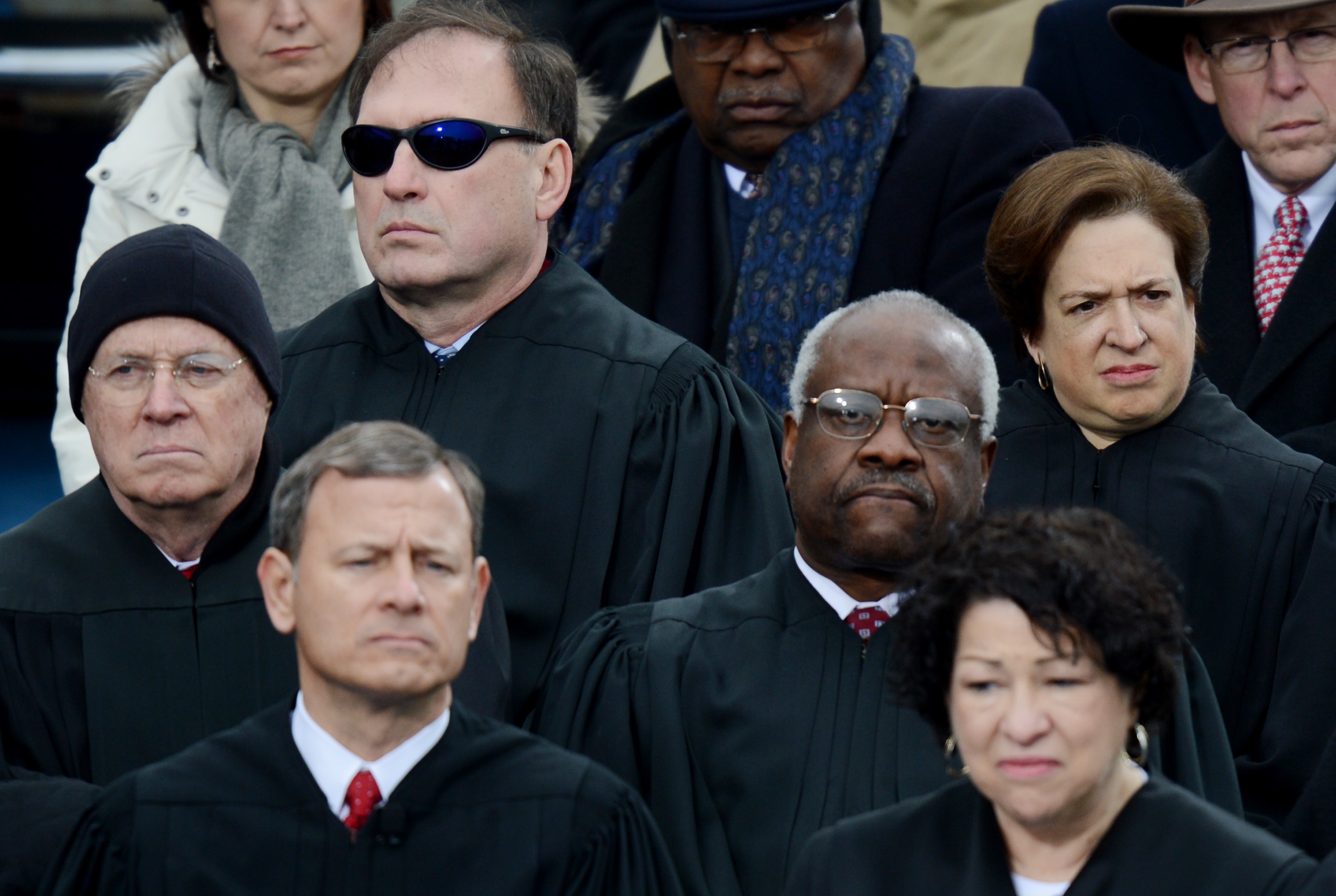
(Photo: Members of the US Supreme Court after US President Barack Obama was sworn-in during the 57th Presidential Inauguration ceremonial swearing-in at the US Capitol on January 21, 2013 in Washington, DC. By Saul Loeb/AFP/Getty Images.)

Hobby Lobby Wins: Reax

SCOTUS ends its current term with a dramatic decision:

The Supreme Court ruled Monday that some corporations can hold religious objections that allow them to opt out of the new health law requirement that they cover contraceptives for women. The justices’ 5-4 decision is the first time that the high court has ruled that profit-seeking businesses can hold religious views under federal law. And it means the Obama administration must search for a different way of providing free contraception to women who are covered under objecting companies’ health insurance plans.

Alito penned the majority opinion:

[Alito] held that this provision of the health care law, as applied to Hobby Lobby, ran afoul of the terms of the Religious Freedom Restoration Act (RFRA), a 1993 law signed by President Bill Clinton which says the government may not “substantially burden a person’s exercise of religion,” unless it has a “compelling” justification and has used “the least restrictive means” available.

“Under RFRA, a Government action that imposes a substantial burden on religious exercise must serve a compelling government interest, and we assume that the HHS regulations satisfy this requirement. But in order for the HHS mandate to be sustained,” Alito continued, “it must also constitute the least restrictive means of serving that interest, and the mandate plainly fails that test.”

Read the full text here. Noah Feldman frames it thus:

The core of the court’s opinion held that the Obama administration had failed to satisfy its burden under the law to show that it had adopted the least-restrictive means to respect religious liberty rights. To get there, the court first had to decide that closely held corporations are entitled to protection under the law. The court broke this into two questions.

The first was whether corporations are persons under RFRA. The court answered this with a resounding yes that extended to all corporations … This analogy between nonprofit and for-profit, however, had already been adopted by the Supreme Court in the Citizens United decision with respect to free-speech, so it’s not terribly surprising that it was adopted in the context of religious liberty.

The second question, however, was whether corporations could be said to hold religious beliefs. Here the court restricted itself to holding that closely held corporations can be said to possess the religious beliefs of their owners. This is not the same thing as holding that all corporations — and certainly not publicly traded corporations — would necessarily have the capacity to possess religious beliefs under federal law or under the U.S. Constitution.

Emma Green has more on that “closely held” distinction, emphasizing that “the most important question here isn’t actually about contraception—it’s about businesses”:

The Court has held that these businesses qualify as “persons,” meaning that they can have religious beliefs.

It’s worth noting that this ruling only applies to closely held private companies, or businesses that are owned by a small number of people who are mostly involved in the day-to-day operations of that business. Roughly 90 percent of American companies qualify as closely held, so this ruling will apply to a pretty sizable portion of the American business community. But it won’t affect coverage requirements for publicly held companies, which include large companies traded on the stock market—as Kevin Russell over at SCOTUSblog writes, the Court is “leaving for another day whether larger, publicly traded corporations have religious beliefs.”

Mataconis is comfortable with that distinction:

In the end, a closely held corporation is really nothing more than a partnership with tax advantages. What ever you might call it, it is still a business that is owned by a small amount of people. If Hobby Lobby were a partnership or sole proprietorship, there would be no question that the Greens [the Hobby Lobby owners] would be within their rights to assert a religious objection under the RFRA. Given that, it doesn’t strike me as being all that radical to say that they retain those rights when they enter into a different kind of business form that, ultimately, was chosen so that they could expand the company to the national operation employing thousands of people that it is today. We are still talking ultimately about the individuals who own the company and their rights, which is why this decision would not make any sense if you applied it to a publicly traded corporation owned by tens of thousands of individuals and institutions like Apple, or Exxon Mobil.

Meanwhile, Jason Millman clears up a common misconception:

The administration and supporters of the contraception mandate had warned that a broader recognition of corporations’ individual rights could enable more business owners to claim religious exclusions for other health-care services, such as blood transfusions or vaccinations, and civil-rights protections. The court today said its ruling narrowly applies to just the contraception requirement.

Ramesh clears up another:

Hobby Lobby doesn’t object to providing contraception; it objects to contraceptives that may act as abortifacients. (Donna Harrison provided some background information on this issue for NRO.) And the mandate isn’t in Obamacare. Even the very liberal Congress of 2009-10 never explicitly decided, or even really debated whether, to force companies to provide contraceptive coverage. HHS used the authority the law gave it to impose the mandate. Several pro-life Democrats who provided the law’s narrow margin of victory in the House have said they would have voted against the law had it included the mandate.

Kate Pickert specifies that line over contraception drawn by Hobby Lobby, whose “individual position is less extreme than many believe”:

The company objects to paying for morning-after pills and inter-uterine devices, but freely provides insurance that covers tubal ligation, birth control pills, condoms, diaphragms and contraception delivered via a patch or ring inserted into the cervix. More than 80% of all contraception users in the U.S. rely on these methods.

In another post, Ramesh tries to calm the coming backlash over today’s ruling:

There will be a lot of liberal fulmination today about an activist right-wing Supreme Court and impending theocracy. Just remember: 1) If Congress wants to require all employers to cover birth control, it can pass a new law that explicitly exempts itself from the Religious Freedom Restoration Act. This ruling wouldn’t be an obstacle to such a law.

But Sally Kohn is still freaking out:

In her dissent, Justice Ginsburg bristles at the majority’s “decision of startling breadth.” Justice Kennedy tries to argue otherwise in his concurring opinion, arguing that the majority opinion “does not have the breadth and sweep ascribed to it by the respectful and powerful dissent.” And yet majority opinion held that corporations are “persons” under the Religious Freedom Restoration Act! That’s huge! While the court limits part of its ruling around the contraception mandate to closely held corporations (defined by the IRS here), the essence of the decision is a profound and radical shift in corporate rights.

Further, the ruling in part eroded the distinction between religious non-profits (which were already exempted from parts of Obamacare) and private corporations. If you think going to the mall is like going to church, that makes sense. To everyone else, it’s nuts.

More on Ginsburg’s “dramatic dissent“:

[She] called the majority opinion “a decision of startling breadth.” Ginsburg read a portion of her decision from the bench on Monday. Addressing the majority of her colleagues — including all but one of the six men sitting on the Supreme Court — Ginsburg wrote:

In the Court’s view, RFRA demands accommodation of a for-profit corporation’s religious beliefs no matter the impact that accommodation may have on third parties who do not share the corporation owners’ religious faith—in these cases, thousands of women employed by Hobby Lobby and Conestoga or dependents of persons those corporations employ. Persuaded that Congress enacted RFRA to serve a far less radical purpose, and mindful of the havoc the Court’s judgment can introduce, I dissent.

The justice goes on to criticize the opinion’s interpretation of the religious freedom law, writing that “until today, religious exemptions had never been extended to any entity operating in ‘the commercial, profit-making world.'”

The reason why is hardly obscure. Religious organizations exist to foster the interests of persons subscribing to the same religious faith. Not so of for-profit corporations. Workers who sustain the operations of those corporations commonly are not drawn from one religious community. Indeed, by law, no religion-based criterion can restrict the work force of for-profit corporations…The distinction between a community made up of believers in the same religion and one embracing persons of diverse beliefs, clear as it is, constantly escapes the Court’s attention. One can only wonder why the Court shuts this key difference from sight.

“In sum,” Ginsburg adds about the free exercise claims at the heart of this case,“‘[y]our right to swing your arms ends just where the other man’s nose begins.’”

What will this mean for women in the immediate future? Probably not much:

It is extremely likely that the Obama administration will by regulation provide for the government to pay for the [contraception] coverage. So it is unlikely that there will be a substantial gap in coverage.

Ukraine And Europe Seal The Deal

Remember the EU trade agreement that set off the Maidan protests in Ukraine when former president Viktor Yanukovych turned it down six months ago? Well, his successor Petro Poroshenko signed it on Friday, effectively snookering Putin and raising anxieties about how Moscow might respond. Bershidsky considers what effect the deal will have on Russia:

In a document meant to dispel myths about the association agreement, the European Commission stressed that “there is nothing in the Agreement which will affect trade with any other trade partner of Ukraine, including Russia. Therefore no negative economic effects regarding trade with other trade partners of Ukraine can be expected as a result of the Agreement itself. Threats by Russia to raise its tariffs if Ukraine signs the Agreement are not based on economic reasoning”.

That isn’t strictly true. Russia and Ukraine already have a free trade agreement, signed under the auspices of the post-Soviet Commonwealth of Independent States. What scares Russia about Ukraine’s EU deal is the possibility that duty-free EU goods, passed off as Ukrainian ones, will flood the Russian market.

Steven Pifer worries that Putin may react more aggressively than he’s letting on:

Can Moscow now reconcile itself to the association agreement? A Russian deputy foreign minister warned of “serious consequences” but conceded that signing such a document was “a sovereign right of any state.” Mr. Putin’s spokesman said Moscow would take steps to avoid any negative impact on the Russian economy.

To be sure, Russia has legitimate interests at stake. Kyiv appears ready for a dialogue on minimizing the impact of the association agreement on Ukrainian-Russian trade. But will that satisfy Moscow? That is a key question. Russia has significant influence over the armed separatists in Donetsk and Luhansk, many of whom are Russian citizens, and has other leverage over Ukraine. Russia can use that influence and leverage to promote a ceasefire and a settlement, if it wants to. If Moscow instead chooses to continue its efforts to destabilize Ukraine, that will immensely complicate implementation of the Ukraine-EU association agreement.

And on the same day that Poroshenko signed the deal, Russia’s gas conglomerate threatened to reduce natural gas supplies to any European countries that try to re-export it to Ukraine:

In remarks to reporters, Alexei Miller, the CEO of Gazprom, spoke out against European contemplation of a maneuver called “reverse-flow supply”—taking Russian gas exported to Europe and re-delivering it to Ukraine. If successful, the stratagem would reduce Moscow’s ability to pressure Ukraine to pay a disputed $4.5-billion gas debt. “A reverse flow is a semi-fraudulent mechanism whereby gas runs in circles,” Miller said. “This is Russian gas.”

Ukraine already receives gas this way from Germany, which delivers it via Poland. And Slovakia has agreed to reverse-flow a small volume to Ukraine as well, starting in October. On June 25, Gunther Oettinger, the European Union’s energy commissioner, explored the idea of significantly enlarging the plan to effectively take care of all of Ukraine’s gas imports.

Putin is not as smart as he’d like us to think. I like to think of him as Cheney-smart.

The Definition Of IS Is …

Apparently it’s just “the Islamic State” now, not “ISIS”:

IS announced Sunday it was establishing a “caliphate” — an Islamic form of government last seen under the Ottoman Empire — extending now from Aleppo in northern Syria to Diyala province in eastern Iraq, the regions where it has fought against the regimes in power. In an audio recording distributed online, the group declared its chief Abu Bakr al-Baghdadi “the caliph” and “leader for Muslims everywhere”. Henceforth, the group said, he is to be known as “Caliph Ibrahim” — a reference to his real name.

Though the move may not have immediate significant impact on the ground, it is an indicator of the group’s confidence and marks a move against Al-Qaeda — from which it broke away — in particular, analysts say. The caliphate is “the biggest development in international jihad since September 11”, said Charles Lister of the Brookings Institution in Doha, referring to the Al-Qaeda attacks on the United States in 2001.

J.M. Berger reads into this lofty declaration:

The pronouncement of the caliphate is sure to be wildly controversial on religious grounds, but ultimately it could cut either way.

The backlash may harden the pro-AQ segment of the global jihadist movement against ISIS, especially with the announcement’s flat-out demand that all other jihadist groups are religiously obligated to pledge loyalty to ISIS. But it will also generate some enthusiasm from foot soldiers and different segments of the global movement that see ISIS as a rising star. …

On the other hand, Muslims worldwide are likely, on the whole, to react negatively to the pronouncement. The question here is how many currently nonviolent radicals will jump toward ISIS and how many will jump away from it. Again, this is a high-risk, high-reward scenario for ISIS. It could reap considerable benefits, but the backlash could be severe.

Juan Cole ridicules the announcement, pointing out that the abolition of the caliphate 90 years ago has meant precisely nothing to the vast majority of the world’s Muslims, who aren’t likely to care any more for “Caliph Ibrahim” than for Abu Bakr al-Baghdadi:

The Egyptian Muslim Brotherhood developed the institution of the Supreme Guide, which under President Muhammad Morsi in 2012-2013 developed theocratic aspirations. The Supreme Guide, Muhammad Badie, proved conspiratorial and controlling, and Morsi proved compliant. The vast majority of Egyptians were annoyed by this grandiosity, and they overthrew the Muslim Brotherhood government. Badie is in danger of being executed. I think that the Egyptian elite has gone too far in persecuting Muslim Brothers and branding them terrorists, mind you, and the death sentence on Badie is a human rights violation. But I’m just pointing out that calling yourself Supreme Guide and getting the loyalty of a sectarian group is no guarantee of worldly success. And the Brotherhood is way more important the the ‘Islamic State.’

This Baghdadi ‘caliphate’ thing is doomed, as well.

Morrissey is also dismissive, but he sees a strategic purpose:

At any rate, the declaration of the caliphate has less to do with statehood or global leadership than it does with local competitors. Zawahiri may get annoyed, but he’s not really the main target of this declaration. It’s meant to warn competing militias in the areas ISIS already controls that either they’re with Baghdadi, or they’re against him. ISIS wants no competition in arms inside of their existing footprint or adjacent to it, and will target any other networks that don’t fall in line. That’s where the infighting will occur.

Charles Lister, on the other hand, thinks it’s a pretty big deal:

The impact of this announcement will be global as al-Qaida affiliates and independent jihadist groups must now definitively choose to support and join the Islamic State or to oppose it. The Islamic State’s announcement made it clear that it would perceive any group that failed to pledge allegiance an enemy of Islam. Already, this new Islamic State has received statements of support and opposition from jihadist factions in Syria – this period of judgment is extremely important and will likely continue for some time to come. …

Geographically, ISIS is already fully operational in Iraq and Syria; it has a covert presence in southern Turkey, appears to be establishing a small presence in Lebanon; and has supporters in Jordan, Gaza, the Sinai, Indonesia, Saudi Arabia and elsewhere. This could well be the birth of a totally new era of transnational jihadism.

From The Annals Of Chutzpah

Matt Wilstein almost missed that recent tweet from the former half-term governor:

Perhaps Palin forgot what it was like to be the subject of a similar investigation exactly three years earlier after her office released her emails to the press.

On June 13, 2011, the Anchorage Daily News reported that “Nearly a month of former Gov. Sarah Palin’s emails are missing from the documents released to media organizations last week, a gap that raises questions about what other emails might also be missing from what’s being nationally reported as her record as Alaska governor.”

According to the documents Palin’s office provided, she sent no official emails from between December 8, 2006 and December 29, 2006, in other words her first full month in office. As the paper put it, “That means zero emails during a period during which, among other things, Palin put out her proposed state budget, appointed an attorney general, killed the contract for a road out of Juneau and vetoed a bill that sought to block state public employee benefits to same-sex couples.”

The Anchorage Daily News argued that the gap was due to Palin’s preponderance to use a personal Yahoo email account instead of the official state account, thereby allowing her to hide certain communication from public view. The first email Palin was on record as sending came on January 2, 2007, one month after she took office.

1,700 Slaughtered? Ctd

140627_hrw1crop

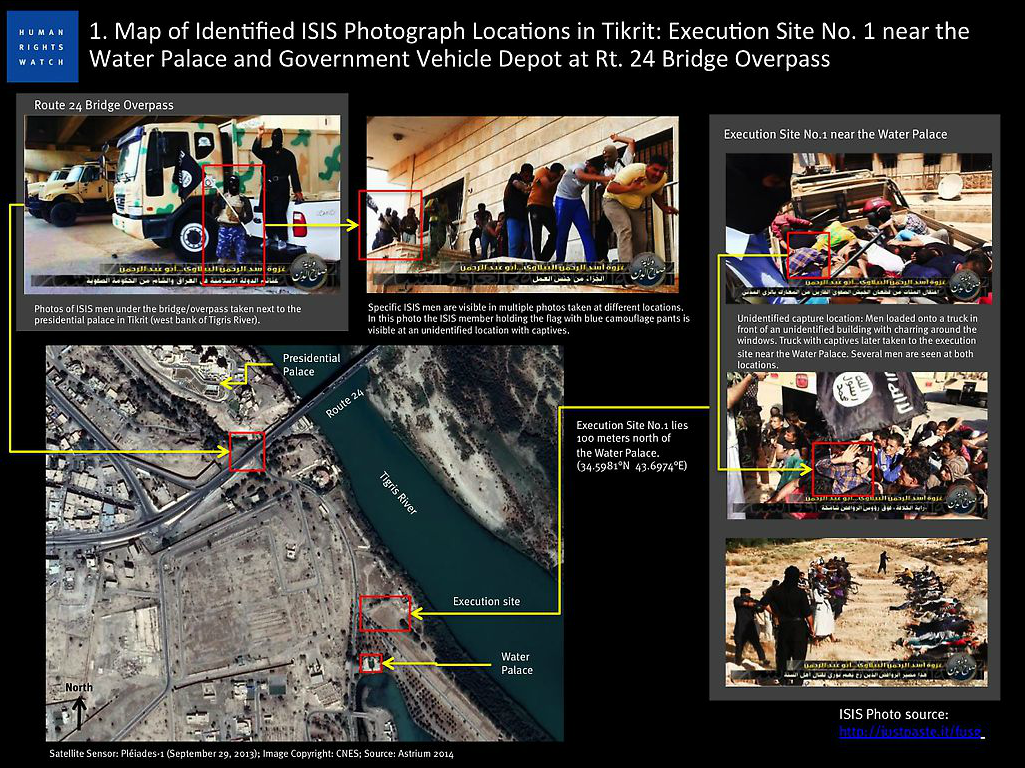
In what Elias Groll calls “an incredible piece of detective work”, Human Rights Watch has partly verified ISIS’s grisly claim from earlier this month that it had killed over 1,700 people during its campaign through northern and western Iraq:

In a report released Friday, Human Rights Watch pinpointed the exact location in which the images were taken. Corresponding satellite images show ground disturbance that apparently matches what the area would look like if mass graves had been dug and heavy vehicles — as seen in images posted by ISIS — had been driven there there.

Human Rights Watch determined that the photographs were taken a stone’s throw from the Tigris River and a former Hussein palace. The group’s analysis picks out individual captives and militants who appear across the photographs, seemingly bolstering the photos’ authenticity. The analysis suggests that between 160 and 190 men were killed between June 11 and June 14, though the actual death toll from ISIS executions in Tikrit could be significantly higher. The slides documenting the analysis are reproduced at the bottom of this post.

Meanwhile, Mona Mahmood and Mark Tran report, ISIS isn’t the only militia that has Iraqis scared for their lives:

[A]trocities are also being carried out by Shia militias, who have been summoned by the highest Shia authority in the land, Ayatollah Ali al-Sistani, to defend Shia holy shrines. The old Mahdi army, rebranded as Peace Brigades, can be counted on to stand and fight the insurgents, unlike the military. But their zeal is feared by those they target.

Hani Sa’aeed, 24, disappeared three days ago when he went to a shopping centre with a friend in Mahmoudiya, a town south of Baghdad. “After a few hours, his friend contacted us to say that Hani was taken by the Righteous League militia who are in control of the town,” said Ibrahim Abdul Majid, Hani’s cousin. “The militia were so furious after four explosions rocked the centre of the city during the day and killed many people. They were busy picking up young men based on their IDs. Hani’s friend advised us to act quickly to save him but we did not know what to do.”

Adbul Majid eventually rang the police, who said they had found the body of a young man in a compound near the shopping centre.