Bad Omens For Obamacare

Many small ones have popped up recently. First up, Adrianna McIntyre explains why ACA enrollees might have to switch plans next year:

The federal subsidies used to offset the cost of insurance are based on income, but they’re also pegged to the second-cheapest silver plan on each state exchange, which is called the “benchmark plan.” When people choose something cheaper than the benchmark plan (the cheapest silver plan, or one of the bronze plans), they will spend less money out of their own pocket on the insurance premium. If a person chooses a plan that’s more expensive than the benchmark plan, he’s responsible for the extra cost.

But annual changes to insurance premiums aren’t uniform across plans. That means the “benchmark plan” can change from year to year — with financial consequences for those with subsidies. These consequences will be most acutely felt by low-income enrollees.

Speaking of subsidies, Sarah Kliff wonders how states will pay for the upkeep of their exchanges when the federal money runs out next year:

The Affordable Care Act provided federal grant funding for states to get their new web portals up and running.  The Obama administration doled out $4.6 billion in grants to states launching their own marketplaces. But Obamacare also requires state exchanges to become self-sustaining by the start of 2015. That means every state exchange that will operate next year now needs to figure out how to pay their bills. …

“There won’t be any big pot of federal money,” says Elizabeth Carpenter, a director at health research firm Avalere. “When you think about being able to run an exchange without the federal backstop, it will take awhile to forecast and figure out what money is needed.”

Next, Adrianna McIntyre warns that the next ACA open enrollment period is at the worst time of year:

Open enrollment for 2015 will last from November through February. The Obama administration probably picked late fall for open enrollment because that is when Medicare and most employers permit insurance enrollment changes. But between Thanksgiving and Christmas, late fall is also incredibly stressful, both financially and emotionally.

According to a new study in Health Affairs, people’s capacity for decision-making is stretched especially thin during the lead up to the holiday season. And when people are stressed, behavioral economists have found that decision-making is done with a sort of tunnel vision: people focus only on their most pressing short-term problems, sidelining long-term issues.

Suderman digs into another new study, from Kaiser, that “suggest[s] the potential limitations of Obamacare’s coverage scheme”:

It’s not a precise instrument: More than 40 percent of exchange enrollees were already insured, suggesting that while Obamacare is expanding coverage to the uninsured, it’s also resulting in a fair amount of subsidized coverage going to people who already had coverage (the vast majority of exchange beneficiaries got subsidies). Digging a bit deeper into the survey also hints at the difficulty in measuring who, exactly, counts as previously uninsured. If someone had health insurance up until a month prior to getting new coverage under the law, should that person count as uninsured? Probably not. What about six months before? Or a year before? These questions are legitimately difficult to answer.

Kaiser’s survey finds that the majority of previously uninsured lacked coverage for two years, and that 45 percent reported not having coverage for five years. Which means that more than half of the previously uninsured were covered at some relatively recent point.

Jason Millman looks at other surveys that don’t bode well for Obamacare:

Just how much will people buying their own coverage shop around for a better deal on health insurance year-to-year? By creating a marketplace where plans have to compete for business under the same rules, Obamacare is supposed to facilitate the shopping experience. Some recent studies throw cold water on that idea, though.

Just 13 percent of seniors enrolled in Medicare’s prescription drug program changed plans during the annual enrollment period, according to an October 2013 Kaiser Family Foundation survey that reviewed the first five years of program enrollment. Those facing the highest premium increases were the most likely to switch plans — anywhere between two and four times of the average rate of all enrollees who switched plans. Still more than two-thirds of enrollees who faced the highest premium increases stuck with their plans.

And last but not least, Lanhee Chen argues that “data published in the Wall Street Journal suggest that [the possibility of an ACA death spiral] may not be so far-fetched after all”:

At its base, the data show that people insured through the law’s exchanges have higher rates of serious medical conditions. Of the enrollees who have seen a doctor or other health-care provider in the first quarter of this year, 27 percent have significant medical problems, including diabetes, cancer, heart trouble and psychiatric conditions. That rate is substantially higher than that for patients in nonexchange market plans over the same period. And it’s more than double the rate of those who were able to hold onto their existing individual market insurance plans after President Barack Obama was forced to allow them to keep them.

This outcome should not surprise anyone. The law’s one-size-fits-all regulatory regime, which requires insurers to offer coverage to all comers and prohibits pricing of coverage based on an applicant’s health status, was bound to increase the number of relatively sicker people purchasing insurance through the exchanges. Moreover, Obama’s executive action, which effectively allowed many people who had individual market plans to remain in them through at least 2016, bifurcated the insurance markets such that healthier people remained in the plans they already had, while relatively sicker patients were left to acquire coverage through the Affordable Care Act’s exchanges.

Some of the bad risk in the exchanges has been offset by the enrollment of relatively healthy people who acquired coverage because of the law’s generous subsidies. Yet the numbers make clear that the exchanges remain a haven for those who may consume more medical services than others.

Update from a reader:

I found a few of the “bad omens” really rather business as usual and left me scratching my head thinking but this is how free markets, even ones that have some controls in place work.

For example, the lead off that the benchmark plan could change from year to year. So frigging what, I say. Most of my adult life, I’ve had my insurance provided by my employer, the state. We are fortunate in having many insurance options (including several managed care options and a more traditional [and more expensive] health insurance option) … um, sort of like the ACA market place. Employee premium costs for these have ALWAYS been tied to a benchmark plan, with the state usually paying some percentage of the lowest cost plan (all plans have to meet a uniform set of benefits, by the way, again sort of like ACA). It has been the case for all the years I’ve gotten my insurance through my state employer that the cheapest plans change from year to year.

When I was young, and not a big consumer of healthcare, I changed plans almost every year to take the cheapest plan. Now that I have a family, I’m older and use more healthcare, and have developed relationships with my various doctors, I am willing to suck up some price increases (although competition among the various insurers who provide plans to the state really has appeared to minimize very much price fluctuation) to maintain the status quo. I probably would change insurance plans if, for me and my family, the costs of not switching started to outweigh the benefits. And, it seems to me, the marketplace will make it relatively easy to shop for a better price the next year. Whether people take advantage of this will be up to them.

Not sure, but is the Medicare demographic mentioned in Millman’s piece really going to be the same as people enrolled in ACA? I don’t know. It might depend too on how this is marketed to enrollees. Can we “force” people to shop for cheaper insurance plans. Oh, the threat to our liberty!

Oh, and really? People might be too stressed to buy insurance during November through February? Sorry, this seems sort of lame to me!
Book Club: A Conversation With Alexandra And Maria, Ctd

In our latest audio sample, the two women discuss the email from the reader on the autism spectrum who senses too much of the world around her:


You can listen to the entire conversation from Alexandra and Maria below. Follow the whole book club discussion here, and email your thoughts and observations to bookclub@andrewsullivan.com. One reader writes:

I just finished the wonderful read of Alexandra Horowitz’s On Looking. Thanks for such a great selection and I’ve already bought many copies for family and friends.

So I paged through the chapter Sources and on the last page of Acknowledgements, Ms. Horowitz mentions her editor, Colin Harrison. She states that he has many theories about the gummed up spots on the sidewalk. Unless she plans to write the sequel of the Gummed Up Spots on the Sidewalks – will Mr. Harrison share his gummed up theories with The Dish Book Club? I’m dying to know. Living downtown Chicago, I look for Wrigley’s gum falling out of pedestrian mouths every hour and never see it happening. I look for pedestrians with sticky gum strands sticking to shoes while walking and never see it happening.  What are these gummy blobs all over our city sidewalks? I love a good conspiracy theory …

Another:

As a photographer –  someone who “looks” professionally – I’d actually downloaded the book before it became a book club choice, but I couldn’t get through it.

It’s mostly just a collection of different people observing different objects, people, sounds and smells (do sounds and smells even count in a book about “looking”?) – yes, there are a lots of objects, people, sounds and smells in the world, and no, they’re not always interesting. It seemed to me that most of the experts in the book were looking at stuff in a similar way; they just happen to be looking at different stuff.

Why wasn’t a photographer included? You can’t get more of a “professional observer” than that. As I’ve learned my craft, I realise that learning photography has very little to do with mastering all the knobs and dials on your DSLR and everything to do with learning to look, really look, and get beyond the endless collections of different objects and people. My love of photography is in direct proportion to how much I am learning to look, really look, by practising it.

To observe how the light falls on the side of someone’s face or on the pews of a church; to see interesting textural juxtapositions or beautiful colour palettes; to notice the fleeting stories conveyed in a look or a gesture or an old piece of furniture; to see the pleasing bend in the road, the interesting compositions created by unrelated shapes and colours, or the interplay of light and shadow through the trees. It’s a totally other way of looking, so very different from being yet another observational collector of stuff and facts, and it seemed a pity that this perspective wasn’t included at all.

A Shocking Number Of Refugees

140620_refugeegraphicrevised

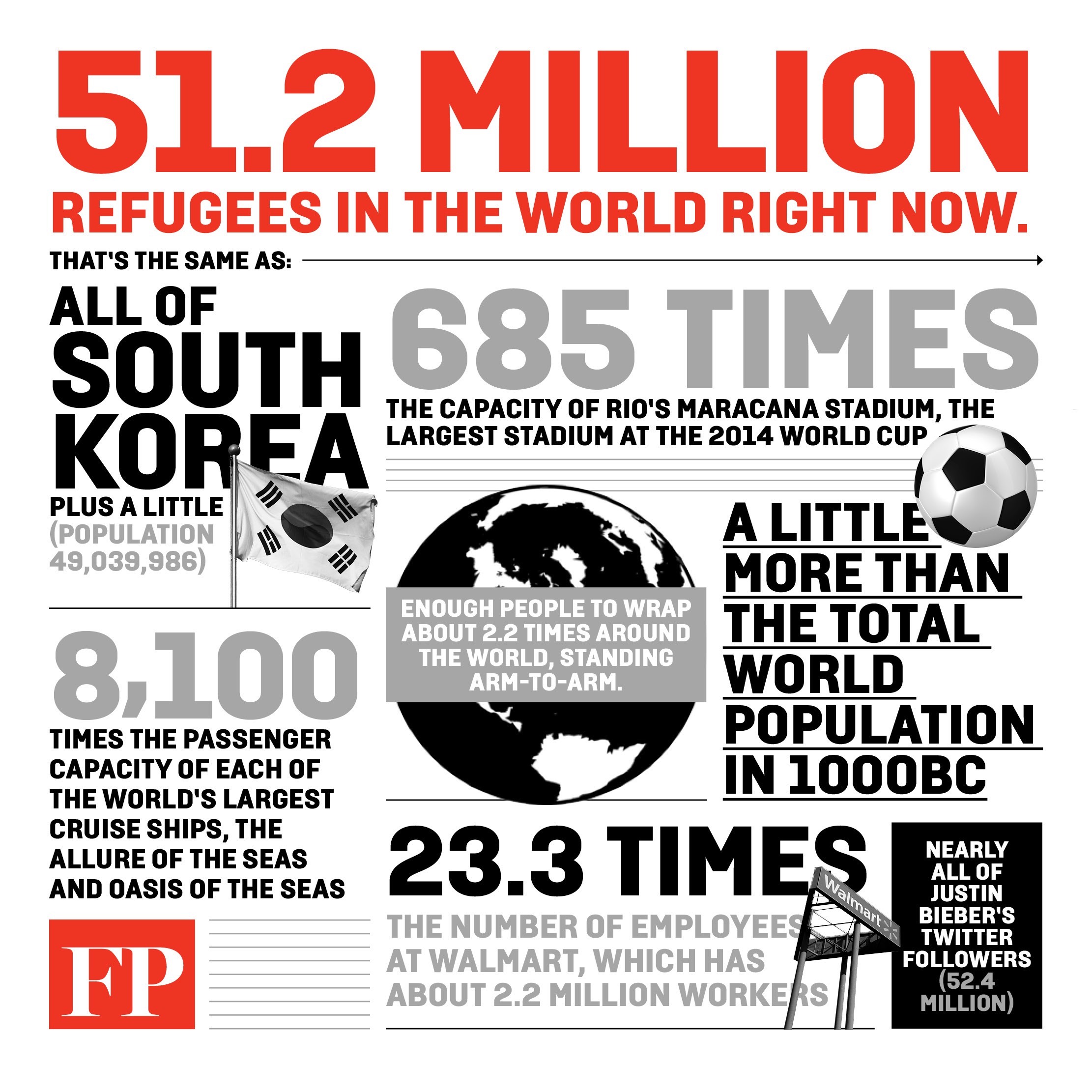
According to a recent report from the UN Refugee Agency, December was the first time since World War II that the number of displaced people climbed over 50 million:

The sharp increase in the total number of refugees was in large part the result of the ongoing Syrian civil war, which has forced 2.5 million to flee the country and resulted in 6.5 million internally displaced people. In total, there were some 51.2 million refugees in the world at the end of 2013, an increase of more than six million on the previous year. On its own, the figure 51.2 million can be somewhat difficult to conceptualize, a figure so large that it’s difficult to imagine the human toll of conflict.

Will Freeman delves into the report, which shows how Iraq is driving the number up even further:

In just over a week, refugees fleeing insurgents battling to create an Islamic state in Iraq have tripled from 500,000 to 1.5 million. The swift takeover of towns such as Mosul and Tikrit by the Iraq Islamic State in Iraq and Greater Syria (ISIS), also known as the Islamic State in Iraq and the Levant (ISIL), has displaced nearly 1 in 30 Iraqis. UNICEF, the United Nation’s children’s agency, recently upgraded the crisis to a level 3 humanitarian disaster— its most severe ranking. … The future is grim for Iraq’s latest wave of displaced people, as only 31 percent of the United Nation’s funding requests have been met. With terrorists continuing to fight their way towards Baghdad, the number of refugees will likely continue to rise.

To make matters worse, the record number of refugees are experiencing brutal temperatures:

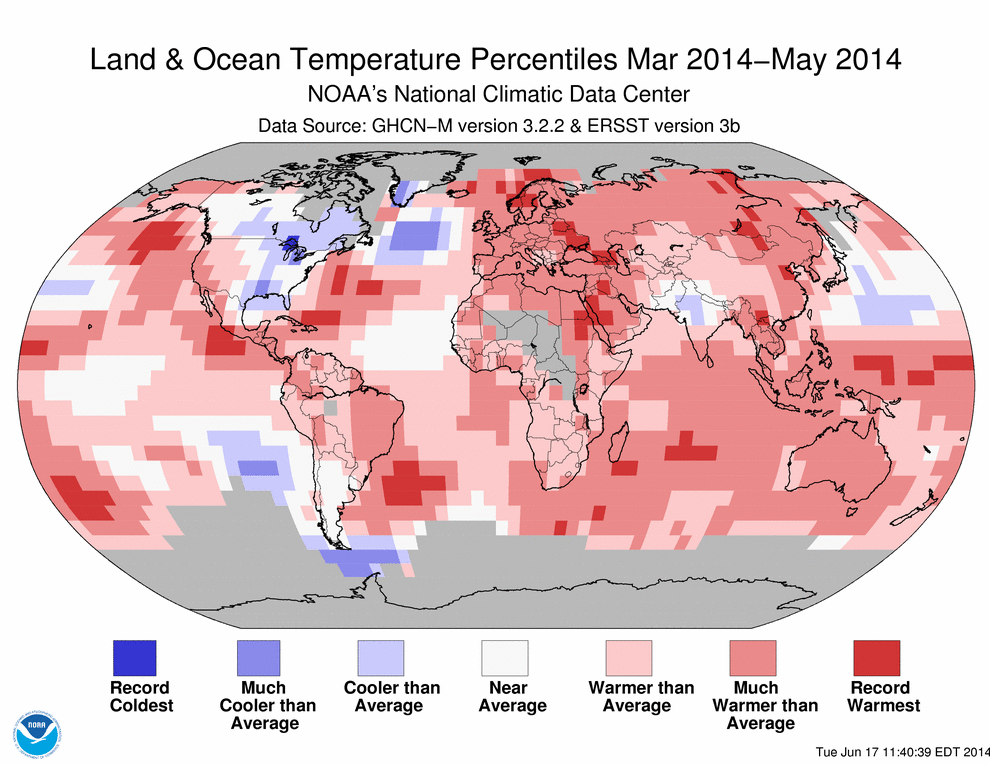
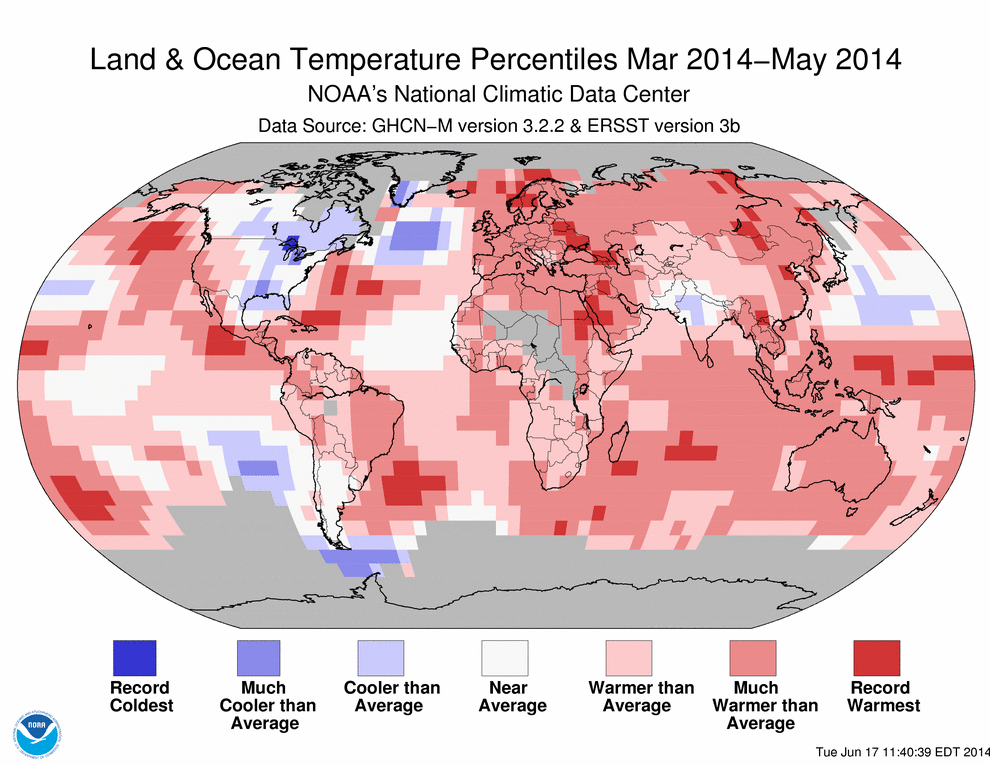
Temperatures have indeed been much hotter than average in the Middle East this year. According to the US National Oceanic and Atmospheric Administration, just about the entire region was classified as “Much Warmer Than Average” for the March-May period, while much of Iraq and bits of Syria saw record-high temperatures.

1403897449674704

Image: NOAA

In line with global warming’s habit of punishing the most vulnerable populations, other refugee-laden regions saw record heat too, such as the conflict-stressed area near the Golden Triangle, an opium-producing hotbed. Thailand’s border is riddled with refugee camps, where Burmese have sought shelter for decades, after fleeing the violently oppressive ruling junta.

I’ve been to one of those camps, and it was an abject, malarial place. Tens of thousands of people were cramped together in mud-pocked makeshift housing, with limited access to medical treatment, and totally exposed to the elements. Like the heat.

There are 16.7 million refugees in such situations, and 35 million more are displaced. And both trends, displaced people and rising temperatures, are only on track to worsen.

Previous Dish on the Iraqi refugee crisis here and here.

Update: Jay Ulfelder disputes a key talking point of the UN Refugee Agency report:

A lot of the news stories on this report’s release used phrases like “displaced persons highest since World War II,” so I assumed that the U.N. report included the data on which that statement would be based. It turns out, though, that the report only makes a vague (and arguably misleading) reference to “the post-World War II era.” In fact, the U.N. does not have data to make comparisons on numbers of displaced persons prior to 1989. With the data it does have, the most the UNHCR can say is this, from p. 5: “The 2013 levels of forcible displacement were the highest since at least 1989, the first year that comprehensive statistics on global forced displacement existed.” The picture also looks a little different from the press release if we adjust for increases in global population.

A Papered-Over Problem

Umbra Fisk looks into the limits of recycling:

Paper can indeed be recycled only a finite number of times before its fibers get too short and frayed to be recovered. And according to the EPA, that magic number is about five to seven trips through the paper mill. That means we must always turn to some amount of brand-new pulp – called virgin pulp in the biz – to fulfill our needs. According to estimates from a nonprofit and a paper industry group, if we tried to make all paper from 100-percent recycled content starting now, we’d run out of materials in just a few months.

And the process is far more preferable than this abomination, however kickass it looks:

(Top video: Inside a paper recycling plant.)

Are There Really Universal Rights?

The philosopher John Searle says yes – but with a caveat:

I’m not skeptical about the idea of universal human rights. I’m skeptical about what I call positive rights. You see, if you look at the logical structure of rights, every right implies an obligation on someone else’s part. A right is always a right against somebody. If I have a right to park my car in your driveway, then you have an obligation not to interfere with my parking my car in your driveway. Now the idea of universal human rights is a remarkable idea because if there are such things, then all human beings are under an obligation to do—what? Well, I want to say that with things like the right to free speech it just means not to interfere. It’s a negative right. My right to free speech means I have a right to exercise my free speech without being interfered with. And that means that other people are under an obligation not to interfere with me.

Now, when I look at the literature, I discover that there is a tradition going back to the UN Universal Declaration of Human Rights, where not all of the rights listed are negative rights like the right to free speech, or the right to freedom of religion, or the right to freedom of association, I think all those negative rights are perfectly legitimate. But there are supposed to be such rights as “every human being has a right to adequate housing.” Now I don’t think that can be made into a meaningful claim.

The claim that “every human being has a right to seek adequate housing,” or that there are particular jurisdictions where the British government, or the government of the State of California, can decide “we’re going to guarantee or give that right to all of our citizens”—that seems to me OK. But the idea that every human being, just in virtue of being a human being, has a right to adequate housing in a way that would impose an obligation on every other human being to provide that housing, that seems to me nonsense. So I say that you can make a good case for universal human rights of a negative kind, but that you cannot make the comparable case for universal human rights of a positive kind.

Will Wilkinson comments:

I think it’s easy to confuse the constitution of rights with the recognition of rights precisely because the constitution–the construction of the social fact of rights–has depended historically on a rhetoric of recognition. The first step toward rights with a real social and institutional existence has often been the propagation of the belief that the aspirational right has a freestanding, natural, preinstitutional existence we are obliged to recognize and honor. The defense of universal human rights is a good strategy making rights more universal. Fake it ‘til you make it.

My sense is that as a piece of political rhetoric, the UN Declaration’s notion of universal positive rights has done a lot of good, so I see no particular reason to abandon the strategy of trying to bring rights into existence by pretending they already exist.

Reading Between The Laughs

Reviewing Mary Beard’s Laughter in Ancient Rome, Gregory Hays points to the deeper meaning she finds in their mirth:

On Beard’s telling, ancient laughter is generally associated with unease, especially the unease generated by differences of status and power. In the Life of Aesop, jokes articulate the power relationship of master and slave. Roman comedies feature a recurrent character, the parasite, whose “job” is to laugh at his patron’s jokes—and, when the patron’s back is turned, at the patron. Laughter shapes the relationship between ruler and subject. The murderous pranks of Caligula, Commodus, or Heliogabalus contrast with the “good” emperor’s tolerance of quips, or his willingness to make fun of himself. (“Oh dear,” the dying Vespasian is supposed to have said, “I think I’m about to become a god.”)

Laughter for Beard is also a sign of cracks or fissures in the smooth surface of human identity. The ancients thought of “man” as a category bounded by animals at one end and gods at the other. For Aristotle, man is the only animal that laughs (if lions could understand our jokes they would not find them funny). Laughter links us with the divine, but not always in pleasant ways; in Ovid’s Metamorphoses the gods laugh last, best, and usually at the human characters’ expense. For men, in turn, Beard observes, the most perfectly laughable animal was the monkey: a creature striving to be human but not quite succeeding, like our cheezburger-craving cats or poker-playing dogs. Almost as hilarious was the donkey, particularly when eating; Apuleius’ novel [The Golden Ass] invokes this apparently familiar joke. Yet the donkey’s bray (Latin rudere) is uncomfortably close to the human laugh (ridere). Do they have more in common than we like to think?

Harry Mount compares the humor of ancient Rome to our own:

[I]f you’re expecting to laugh at the things that made Romans laugh, prepared to be disappointed by Mary Beard’s latest book. But, then, Beard isn’t trying to be funny — or even saying that the Romans were particularly funny, either. What she tries to do is nail what made the Romans laugh.

And what she pretty conclusively proves is that, even if we don’t find their jokes funny, the Romans gave us the furniture for our own comedy today. The language of modern humour is rooted in Latin. Iocus is Latin for ‘joke’; facetus, as in facetious, is Latin for ‘witty’; ridiculus, as in ridiculous, meant ‘laughable’.

Roman comic situations were similar to ours, too. Sex figures prominently. Cicero’s list of the different kinds of Roman jokes — based on ambiguity, the unexpected, wordplay, understatement, irony, ridicule, silliness and pratfalls — is pretty close to any comparable modern list.

A Letter For The Day

“Well, the big news here is Gay Power. It’s the most extraordinary thing. It all began two weeks ago on a Friday night. The cops raided the [Stonewall Inn], that mighty Bastille which you know has remained impregnable for three years, so brazen and so conspicuous that one could only surmise that the Mafia was paying off the pigs handsomely. Apparently, however, a new public official, Sergeant Smith, has taken over the Village, and he’s a peculiarly diligent lawman. In any event, a mammoth paddy wagon, as big as a school bus, pulled up to the Wall and about ten cops raided the joint. The kids were all shooed into the street; soon other gay kids and straight spectators swelled the ranks to, I’d say, about a thousand people. Christopher Street was completely blocked off and the crowds swarmed from the Voice office down to the Civil War hospital.

As the Mafia owners were dragged out one by one and shoved into the wagon, the crowd would let out Bronx cheers and jeers and clapping. Someone shouted ‘Gay Power,’ others took up the cry–and then it dissolved into giggles. A few more gay prisoners–bartenders, hatcheck boys–a few more cheers, someone starts singing ‘We Shall Overcome’–and then they started camping on it. A drag queen is shoved into the wagon; she hits the cop over the head with her purse. The cop clubs her. Angry stirring in the crow. The cops, used to the cringing and disorganization of the gay crowds, snort off. But the crowd doesn’t disperse. Everyone is restless, angry and high-spirited. No one has a slogan, no one even has an attitude, but something’s brewing.

Some adorable butch hustler boy pulls up a parking meter, mind you, out of the pavement, and uses it as a battering ram (a few cops are still inside the Wall, locked in). The boys begin to pound at the heavy wooden double doors and windows; glass shatters all over the street. Cries of ‘Liberate the Bar.’ Bottles (from hostile straights?) rain down from the apartment windows. Cries of ‘We’re the Pink Panthers.’ A mad Negro queen whirls like a dervish with a twisted piece of metal in her hand and breaks the remaining windows. The door begins to give. The cop turns a hose on the crowd (they’re still within the Wall). But they can’t aim it properly, and the crowd sticks. Finally the door is broken down and the kids, as though working to a prior plan, systematically dump refuse from the waste cans into the Wall, squirting it with lighter fluid, and ignite it. Huge flashes of flame and billows of smoke.

Now the cops in the paddy wagon return, and two fire engines pull up. Clubs fly. The crowd retreats.

Saturday night, the pink panthers are back full force. The cops form a flying wedge at the Greenwich Avenue end of Christopher and drive the kids down towards Sheridan Square. The panthers, however, run down Waverly, up Gay Street, and come out behind the cops, kicking in a chorus line, taunting, screaming. Dreary middle-class East Side queens stand around disapproving but fascinated, unable to go home, as though torn between their class loyalties, their desire to be respectable, and their longing for freedom,” – Edmund White, in a letter to the poet Alfred Corn and his wife Ann, just days after the Stonewall riots in June 1969.

For more on the Stonewall riots, check out this excellent radio documentary produced by Dave Isay – the first documentary in any format about the uprising:

This embed is invalid

Faces Of The Day

lede_art_women2

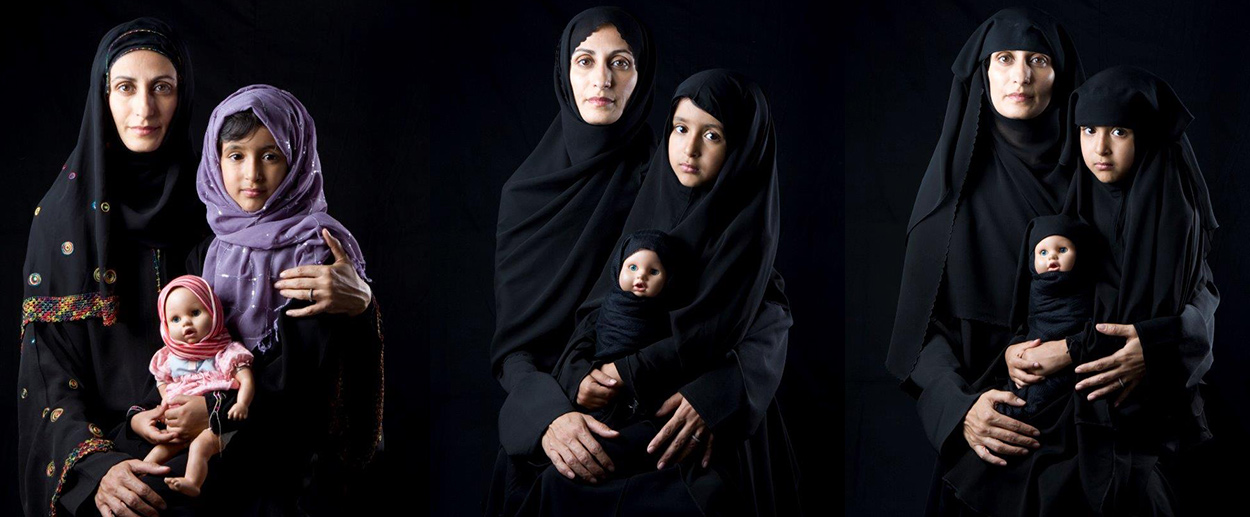
Yemeni photographer Boushra Almutawakel photographs mothers and their daughters:

[I]n her “Mother, Daughter, Doll” series, taken from a new exhibit at the Howard Greenberg Gallery, The Middle East Revealed: A Female Perspective, Almutawakel portrays a simple progressionfrom Western clothing to full hijabthat has far-reaching implications for how we read and register the human form.

Almutawakel explains her thinking:

As an Arab Muslim woman living in Yemen who has first-hand experience with the hijab, I have mixed feelings regarding this topic.

There are certain aspects of the hijab I like and others I don’t particularly care for. I don’t believe it is black or white. I found the veil to be an intriguing, complex, multilayered topic.

In this ongoing project on the hijab/veil I want to explore the many faces and facets of the veil based on my own personal experiences and observations: the convenience, freedom, strength, power, liberation, limitations, danger, humor, irony, variety, cultural, social, and religious aspects, as well as the beauty, mystery, and protection. The hijab/veil as a form of self-expression;  the veil as not solely an Arab Middle Eastern phenomenon, the trends, the history and politics of the hijab/veil, as well as differing interpretations, and the fear in regards to the hijab/veil.

I also want to be careful not to fuel the stereotypical widespread negative images most commonly portrayed about the hijab/veil in the Western media, especially the notion that most, or all women who wear the hijab/veil, are weak, oppressed, ignorant, and backwards. Furthermore, I hope to challenge and look at both Western and Middle Eastern stereotypes, fears, and ideas regarding the veil.

See the Howard Greenberg Gallery here.

A Physicist Defends Philosophy

Sean Carroll responds to the common criticism of his fellow physicists that philosophers “care too much about deep-sounding meta-questions, instead of sticking to what can be observed and calculated”:

Here we see the unfortunate consequence of a lifetime spent in an academic/educational system that is focused on taking ambitious dreams and crushing them into easily-quantified units of productive work. The idea is apparently that developing a new technique for calculating a certain wave function is an honorable enterprise worthy of support, while trying to understand what wave functions actually are and how they capture reality is a boring waste of time. I suspect that a substantial majority of physicists who use quantum mechanics in their everyday work are uninterested in or downright hostile to attempts to understand the quantum measurement problem.

This makes me sad. I don’t know about all those other folks, but personally I did not fall in love with science as a kid because I was swept up in the romance of finding slightly more efficient calculational techniques.

Don’t get me wrong — finding more efficient calculational techniques is crucially important, and I cheerfully do it myself when I think I might have something to contribute. But it’s not the point — it’s a step along the way to the point.

The point, I take it, is to understand how nature works. Part of that is knowing how to do calculations, but another part is asking deep questions about what it all means. That’s what got me interested in science, anyway. And part of that task is understanding the foundational aspects of our physical picture of the world, digging deeply into issues that go well beyond merely being able to calculate things. It’s a shame that so many physicists don’t see how good philosophy of science can contribute to this quest. The universe is much bigger than we are and stranger than we tend to imagine, and I for one welcome all the help we can get in trying to figure it out.

How To Lose A Generation (Or Two)

Responding to efforts to permit bakers, caterers, photographers, and others to refuse to do business with gay people for reasons of religious liberty, Jonathan Rauch begs believers to reconsider – for their own good. He argues that “when religion isolates itself from secular society, both sides lose, but religion loses more”:

[T]he desire to be left alone takes on a pretty aggressive cast when it involves slamming the door of a commercial enterprise on people you don’t approve of. The idea that serving as a vendor for, say, a gay commitment ceremony is tantamount to “endorsing” homosexuality, as the new religious-liberty advocates now assert, is a far-reaching proposition, one with few apparent outer boundaries in a densely interwoven mercantile society. It suggests a hair-trigger defensiveness about religious identity that would have seemed odd just a few years ago. As far as I know, during the divorce revolution it never occurred to, say, Catholic bakers to tell remarrying customers, “Your so-called second marriage is a lie, so take your business elsewhere.” That would have seemed not so much principled as bizarre.

His take on where all this will lead, and what an alternative might be:

I wonder whether religious advocates of these opt-outs have thought through the implications. Associating Christianity with a desire—no, a determination—to discriminate puts the faithful in open conflict with the value that young Americans hold most sacred. They might as well write off the next two or three or 10 generations, among whom nondiscrimination is the 11th commandment.

There is, of course, a very different Christian tradition:

a missionary tradition of engagement and education, of resolutely and even cheerfully going out into an often uncomprehending world, rather than staying home with the shutters closed. In this alternative tradition, a Christian photographer might see a same-sex wedding as an opportunity to engage and interact: a chance, perhaps, to explain why the service will be provided, but with a moral caveat or a prayer. Not every gay customer would welcome such a conversation, but it sure beats having the door slammed in your face.

This much I can guarantee: the First Church of Discrimination will find few adherents in 21st-century America. Polls find that, year by year, Americans are growing more secular. The trend is particularly pronounced among the young, many of whom have come to equate religion with intolerance. Social secession will only exacerbate that trend … For religious traditionalists, it is a step toward isolation and opprobrium—a step bad for society, but even worse for religion.