Working Less Pays More

You don’t have time to watch this right now:

… because you’re working too much:

The 40-hour workweek is mostly a thing of the past. Ninety-four percent of professional workers put in 50 or more hours, and nearly half work 65 or above. All workers have managed to cut down on our time on the job by 112 hours over the last 40 years, but we’re far behind other countries: The French cut down by 491 hours, the Dutch by 425, and Canadians by 215 in the same time period. Workers in Ireland and the Netherlands are also working less. We’re also increasing our productivity, getting more done in the time we spend at work. It went up by nearly 25 percent between 2000 and 2012. …

Taking some time off actually improves a worker’s productivity at work. A study from Ernst & Young found that every ten hours of vacation time taken by an employee boosted her year-end performance rating by 8 percent and lowered turnover. Former NASA scientists found that people who take vacations experience an 82 percent increase in job performance upon their return, with longer vacations making more of an impact than short ones.

Relatedly, Cohn wants the US to have better work-family policies. Here he addresses the main pushback:

Conservatives in particular complain that requiring paid leave would hurt businesses, because employers must scramble to fill vacant posts—and do so temporarily. But if you talk to actual business leaders, you hear a different, much more nuanced story.

The trend among Fortune 500 companies has been towards offering longer leaves, with more compensation. Google, for instance, recently announced that it was extending paid leave for its employees by several weeks. One study found that the market even rewards such behavior; when companies announce they are extending parental leave, share prices rise.

The reason is that offering workers more leave tends to improve retention. Although the evidence is far from definitive, many studies have shown that, overall, new parents (and, in particular, new mothers) are more likely to return to work if they have the opportunity to take an extended leave for newborns. If companies don’t offer such long breaks—if they insist employees come back too soon—the new parents are more likely to abandon the job altogether and never come back. When workers who would rather work leave their jobs anyway, to take care of children, the companies aren’t the only ones who suffer. The economy does, too.

Zachary Goldfarb asks:

Why hasn’t the president been more aggressive on family leave? He’s enacted other major family-related benefits, such as the expansion of health care insurance under the Affordable Care Act, and proposed other child-focused policies, including a plan to offer pre-K to 4-year-olds from low- and moderate-income families. The idea of paid leave, however, hasn’t seriously come up in White House policy discussions, according to a person who has been deeply involved in those talks.

The reason has to do with the substantial cost of such a program, and the difficulty of funding it without raising taxes on the middle class — which would violate a major 2008 campaign promise. Recall that during his first presidential campaign, one of Obama’s big promises was that he would not raise taxes on any household earning less than $250,000 a year. He has tried to hold firm to that pledge, rejecting pressure from liberals who argue that it creates an unnecessary limit on what he can accomplish.
An Orthodontic Hat Trick, Ctd

On the subject of Luis Suárez, a reader writes, “The one thing you might want to mention is that human bites are very, very nasty”:

I’m a clinical pharmacist working in a big-city emergency department, and by far, the worst bite wounds and consequences we get in the emergency room are human bite wounds. The potential for infection with seriously awful bacteria is quite high. Eikenella Corrodens is the worst, and it causes infections almost exclusively from human bite wounds. When it gets into a joint (you see this in “clenched-fist injuries,” virtually always the result of someone hitting someone else in the mouth and lacerating their knuckles), it can especially cause lots of issues, including moving to the heart valves and causing endocarditis.  The infections from those bites are really tough to treat.

If it were me, I’d much rather be bitten by a dog or cat or any type of (non-rabid) animal than a human.

Physician Matt McCarthy elaborates on the many disgusting organisms living in your maw:

The pathogens that live in the mouth include common Staph and Streptococcus species, as well more obscure, yet potentially lethal bacteria like Eikenella, Fusobacterium, Peptostreptococcus, and Prevotella. You might not have heard of Eikenella, but at our hospital we see it quite frequently, typically as the causative agent of endocarditis, a potentially life-threatening infection of the heart. The bacteria can live harmlessly in the mouth, but if enough of it gets into the bloodstream, it can wreak havoc. There’s a good chance Luis Suárez has Eikenella living in his mouth—most of us do.

But wait, there’s more: Syphilis can also be transmitted via biting. The one case I know of occurred when a prostitute bit a 47-year-old man in the right nipple during sex. The nipple bled profusely, eventually became ulcerated, and failed to respond to several rounds of antibiotics. It was more than a month before doctors figured out it was syphilis. Not that anyone involved is known to be carrying around an STI—but would you want to explain how you caught syphilis from Luis Suárez?

Adopt American?

Kathryn Joyce registers a decline in domestic adoption rates:

[F]fewer women are willing to relinquish children for adoption if they find themselves pregnant at a young age, or while unmarried. A 2010 report from the Center for American Progress noted that annual domestic infant adoption rates have fallen so significantly that they are hard to track accurately. There is the simple fact that teenage pregnancies are down across the country. And for young women who do experience unplanned pregnancies, there are more choices available today. Although adoption is often presented as the pro-life alternative to abortion, the Center for American Progress report found that the greater acceptance of single parenthood is a stronger factor in fewer women choosing adoption than the availability of abortion, since both adoption and abortion rates have fallen, while rates of unmarried parenthood have dramatically increased.

Paradoxically, Rebecca Buckwalter-Poza notes that hundreds of American-born children are being raised by Canadian and European adoptive parents:

Over the past 10 years, Canadian parents have adopted more than 1,000 American-born children; another 300 are growing up in the Netherlands; and at least another 100 will be raised in the United Kingdom. … The best estimate, from Joan Heifetz Hollinger, a professor at the University of California-Berkeley School of Law, is that as many as 500 infants, most of whom are blackleave this country through outgoing adoption every year. When it comes to the adoption of black infants, the European market is all demand and America all supply. Social acceptance of single parenthood, the accessibility of contraception, and the legalization of abortion have drastically reduced the number of children available for adoption domestically in much of Western Europe, and U.S. agencies have emerged to meet the demand.

Buckwalter-Poza adds, “the perseverance of race-based preferences is troubling for a number of reasons, not least of which is that black children are less likely to be adopted than white”:

Any policy – official or not – that slows the adoption of non-white children is a worrying one. More than 100,000 thousand children become eligible for adoption in the US in a given year; on average, about 50,000 of these children will be adopted annually. Rough math finds a troubling truth: Approximately 46 percent of black children awaiting adoption were placed in 2012, compared to 58 percent of eligible white children over the same time period.

It can be argued that outgoing adoption is an indirect consequence of the commoditization of adoptees in the American market: White children are, in these terms, more “valuable,” and there is, as now-judge on the Seventh Circuit Court of Appeals Richard Posner once put it, “a glut of black babies.” Foreign prospective parents, it seems, appear less concerned with a child’s race than American parents; in some countries, international, transracial adoption has become “the norm.” One legal scholar explicitly champions outgoing adoption as a “win-win” for black adoptees, arguing that they benefit when we allow less racist countries to adopt children of color.

How Big A Problem Is Student Debt?

Screen Shot 2014-06-26 at 6.48.49 PM

Leonhardt believes the problem is overblown:

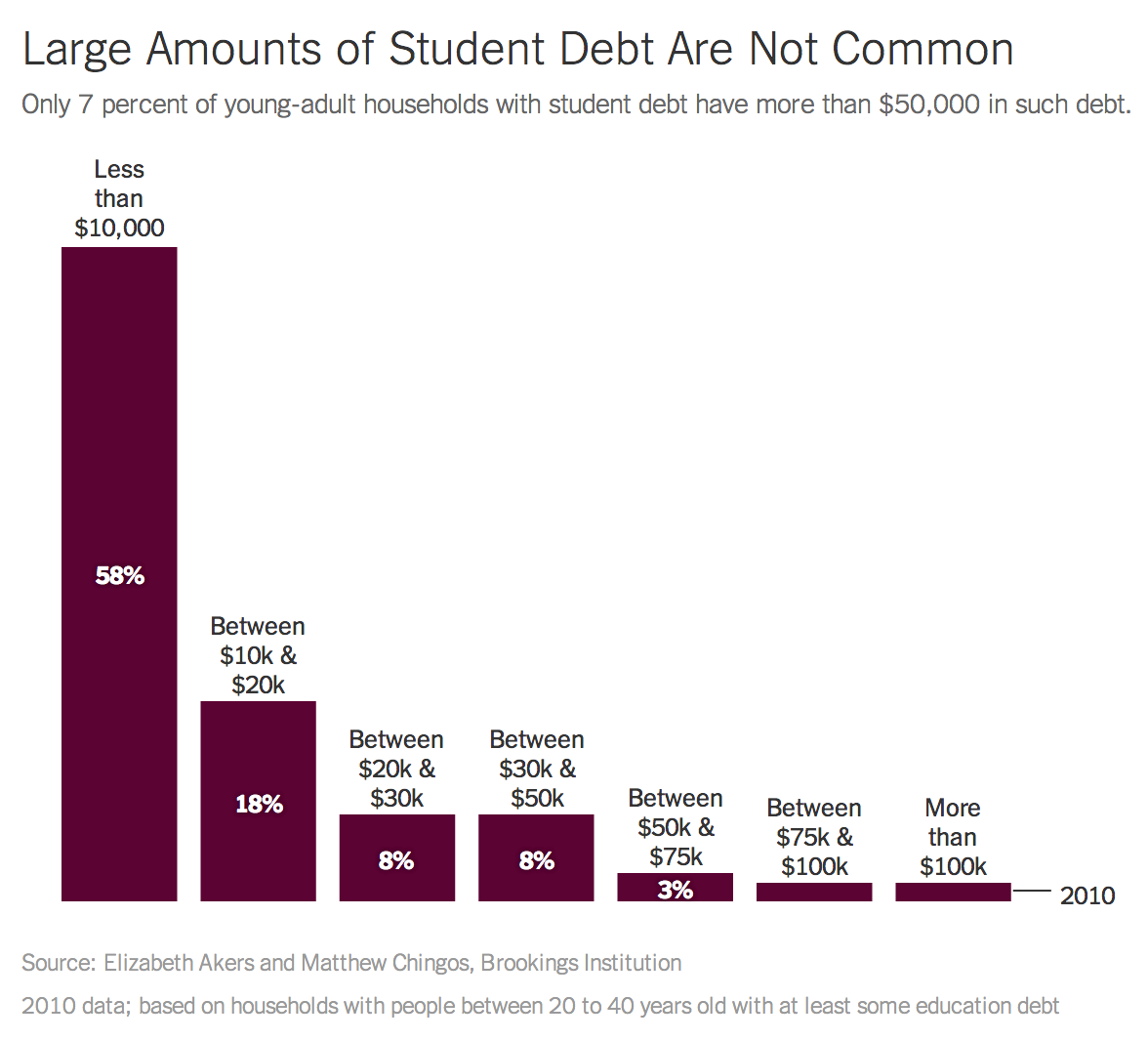
In fact, the share of income that young adults are devoting to loan repayment has remained fairly steady over the last two decades, according to data the Brookings Institutions is releasing on Tuesday. Only 7 percent of young-adult households with education debt have $50,000 or more of it. By contrast, 58 percent of such households have less than $10,000 in debt, and an additional 18 percent have between $10,000 and $20,000. “We are certainly not arguing that the state of the American economy and the higher education system is just great,” Matthew Chingos, a Brookings fellow and one of the authors of the new analysis, told me. “But we do think that the data undermine the prevailing sky-is-falling-type narrative around student debt.”

Choire Sicha tears into Leonhardt:

All this data comes from the Survey of Consumer Finances, which is conducted by the Federal Reserve Board of Governors and the Department of Treasury. … Of all the households in that study, only about 1711 have “household heads” that are younger than 40. That’s what they’re extrapolating from. (And, intriguingly, a small number of those have a head of household younger than 18.) This is not a big sample!

What, obviously, does this data completely omit? Well, one obvious thing is…

households who are headed by someone who is not under 40. One thing we know is that, in 2012, 36 percent of Americans aged 18 to 31 were not their head of household, because they were living with their families. This survey also clearly combines family and non-family households. (Also, there’s some unknown amount of statistical imbalance from same-sex households; 31 percent of same-sex households are likely to have two college-degreed people, compared to 24 percent of opposite-sex married households and just 12 percent of opposite-sex cohabiting households.)

But Freddie questions Choire’s statistical know-how:

This is something I’ve written about before – people dramatically overestimate the sample size needed to make responsible statistical conclusions. A sample size of almost 2,000 isn’t just big, it’s enormous. The standard error of a sample of this size will be very low. Absent systematic sampling bias (as opposed to error), the odds of the underlying population being significantly different from a sample of this size is tiny. Saying that it’s not a big sample just displays ignorance about the standards applied in statistical research.

His take on the topic:

[T]he student loan crisis is indeed a crisis, a moral and practical problem of considerable size. But it’s not the size that most people think it is. And more, it doesn’t change this fact: that despite the endless concern trolling of almost our entire media, the constant tendency for the (college educated) professional writers in our culture to say that “college isn’t worth it,” a college education remains a very good investment for the large majority of graduates. American college graduates are, by essentially any international standards and in comparison to Americans with only a high school degree, in a very economically secure class.

At the same time, Derek Thompson makes the case that college isn’t actually getting that much more expensive:

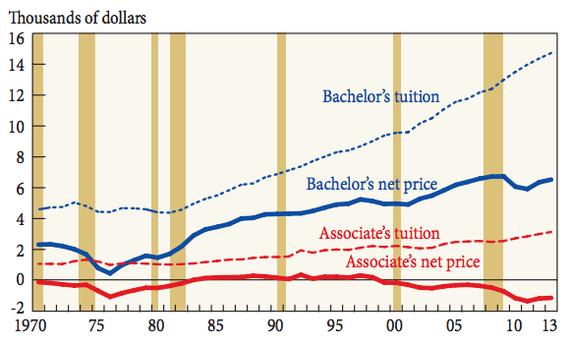
One of the confusing things about college is that it’s hard to keep straight its price, cost, and value. The sticker price of college  that is, the published tuition  isn’t paid by most middle-class students, who receive grants, tuition breaks, and tax benefits. The average net price of a bachelor’s degree is still 55 percent lower than the sticker price today. For many students, tax benefits eliminate the full cost of an associate’s degree. College is much cheaper than advertised.

7a2c3da3e

Meanwhile, Matt Phillips argues that “if you managed to rack up giant student debt loads, that’s likely because you’ve undertaken – and finished – the kind of extensive education that enables you to earn a good salary over time.” He adds:

The real student debt problem comes in the relatively modest amounts of borrowing done by low-income, first-generation college goers, who are four times more likely to leave school after the first year than students without those risk factors. Incidentally, this is also why increased funding of state schools is probably the answer. And, of course, most elites didn’t go to state schools. (Go SUNY Binghamton!)

Jordan Weissman concurs:

If you talk to people who study education policy for a living, they’ll tell you that the real victims of student debt aren’t English grads who took out a bit too much money to attend the University of Michigan or Oberlin. Those kinds of borrowers usually end up just fine.

However, there is a huge contingent of working-class and minority students – some of whom are among the first of their families to attend college – who are getting chewed up by student debt. These are young people, and increasingly older adults, who might not have gone to college 20 or 30 years ago, but do now because the economy is brutal for job-seekers without a degree. They borrow for school, often to pay the inflated tuition at an unscrupulous for-profit institution or little-known vocational school, then frequently drop out. Suddenly, they find themselves in debt, with no degree and no guidance on how to manage their loans.

Christopher Ingraham adds, sensibly:

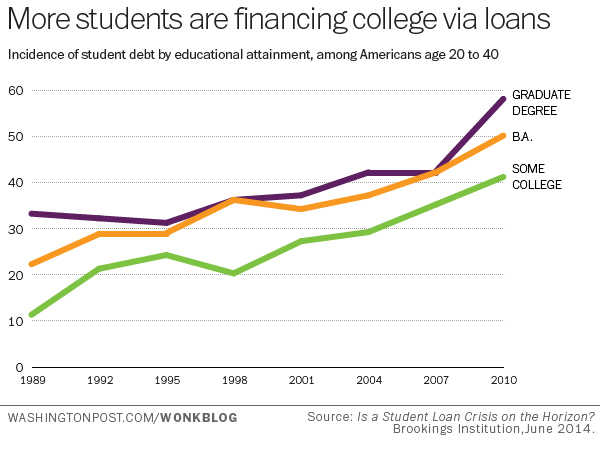
The big story in student debt over the past 20 years is not  and never should have been  the few people taking on huge debt burdens, but rather that the share of all students graduating with any student debt has risen sharply:

debt

In 1989, 22 percent of households headed by twenty-to-forty-somethings with a degree were saddled with student loan debt. That figure more than doubled by 2010, standing at 50 percent. It’s likely climbed even more since then. That number is probably an underestimate, too. … Another important consideration is that the data above only go back to 1989. If we could extend it further, to the 1960s and 1970s, when Boomers were graduating, we’d likely see even lower rates of student debt back then. This is the reason why it feels like student debt is everywhere these days compared to the ’60s and ’70s, it is everywhere.

Lastly, Mike Konczal notes that today’s student debtors spend 13.4 years paying off their loans, in contrast to the class of 1992’s 7.4 years.

Did SCOTUS Tip Its Hand On The NSA?

Allahpundit wonders if there might be some clues in yesterday’s Riley ruling, given the surprisingly intense support Roberts expressed for digital privacy:

Maybe not: Gabe Malor’s right that there’s a difference legally between the cops searching data stored on your own hard drive and searching data (or metadata) you’ve shared willingly with a telecom company. There’s a privacy interest in the former but not, under current precedent, in the latter. Then again, Roberts’s language today really is broad. If the Court’s worried about letting the state tap a bottomless reservoir of information about individuals, they may not care much where the tap is placed. You could, in theory, dispatch with current precedent in one flourish: Since, in our interconnected world, virtually all digital information is disclosed to some entity at some point, the act of disclosure to a telecom company can’t be understood as destroying the individual’s privacy interest in the information.

“After Riley,” Tim Edgar remarks, “the intelligence community has some reason to be nervous”:

In defending its activities, the Obama Administration has pointed—entirely appropriately—at privacy protections, including detailed targeting and minimization procedures, and substantial internal and external oversight.  Despite real challenges, these protections are meaningful and far exceed anything that other nations provide to protect privacy in their intelligence activities. The Chief Justice made short shrift of a similar argument in Riley, when the government said it would develop “protocols” to deal with the privacy problems its cell phone searches would create in an age of cloud computing. “Proba­bly a good idea, but the Founders did not fight a revolution to gain the right to government agency protocols,” he said.

As someone who wrote and reviewed many such guidelines for intelligence agencies, I couldn’t agree more!  I expect to see this quote in brief after brief, whenever the government says internal safeguards are good enough. There is undoubtedly some heartburn at the NSA on this point.  Safeguards and oversight matter.  The Supreme Court reminds us that they are no substitute for the Constitution.

But Garrett Epps isn’t ready to make any predictions:

There is already speculation about what, if any, implications this case will have for challenges to the National Security Agency’s amassing and storage of data from Americans’ cell-phone and computer use. It would, I think, be a mistake to read too much into it—nothing in this case implicated national security or terrorism, two government interests to which this Court seems relatively eager to defer—as in Clapper. But it does suggest that the Court that hears that case, when it does, will be more technically savvy than it has been. The John Roberts who wrote Riley will understand why privacy advocates worry about the collection of “metadata” as well as of the contents of calls.

The Strange Resilience Of David Cameron

BRITAIN-IRAQ-POLITICS-UNREST-SECURITY

Tally up the disasters: the loss to UKIP and Labour in the European elections; the embarrassment of having hired criminal phone-hacker Andy Coulson for Number 10; a doomed campaign to stop the incoming president of the European Commission; a looming end to the UK with Scotland’s impending referendum on independence; and a favorability rating of 35 percent (behind UKIP’s Nigel Farage at 36 percent).

And yet … he has a little spring in his step, thanks to:

the very public implosion of [Opposition leader] Ed Miliband. Yesterday, at Prime Ministers Questions, Miliband had the opportunity to humiliate David Cameron over the Coulson conviction. Instead, he ended up humiliating himself. “As the Tory benches cheered and their Labour counterparts grimaced, the wind left Miliband’s sails. After this right hook, Miliband’s technical queries on the civil service could not help sounding flat. Against expectations, Cameron ended the session on top,” reported that fanatical right-wing scandal sheet the New Statesman. Although the Statesman actually got it wrong. The problem for Miliband is that when Cameron came out on top it surprised precisely no one.

Then there’s a shift in mood since the Tories were able to avoid catastrophe in the recent local and European elections, and Labour looked much more wobbly than expected. And a Tory prime minister’s usual foes – his own backbenchers – are quiescent, if only because they see both a potential victory next year but more important a referendum on Britain (sans Scotland, perhaps) leaving the EU. In that Cameron’s failure to stop Carl Juncker winning the European Commission actually helps him in the long run – because it is likely to make the EU even less popular in Britain than it now is. Clive Crook is (rightly) worried:

Cameron’s difficulties over Europe are rapidly compounding. His position requires him to argue that Europe is reformable; Europe is telling the world it isn’t. How many of these rebuffs can Cameron absorb before he has to acknowledge that the U.K.’s choice is not between a new, less centralized union and divorce, but between divorce and the union as it is (only more so)? In effect, he’s already cast aside the argument that Britain has a compelling interest in remaining an EU member on almost any terms. If he believed that, he wouldn’t have promised a referendum in the first place.

Not so long ago, it was unimaginable that Scotland would leave the UK and that the UK would leave the EU. I still think the odds are slightly against both, but no one should bet on it. In which case, perhaps Cameron could survive … but the very structure of the country he governs fundamentally come apart.

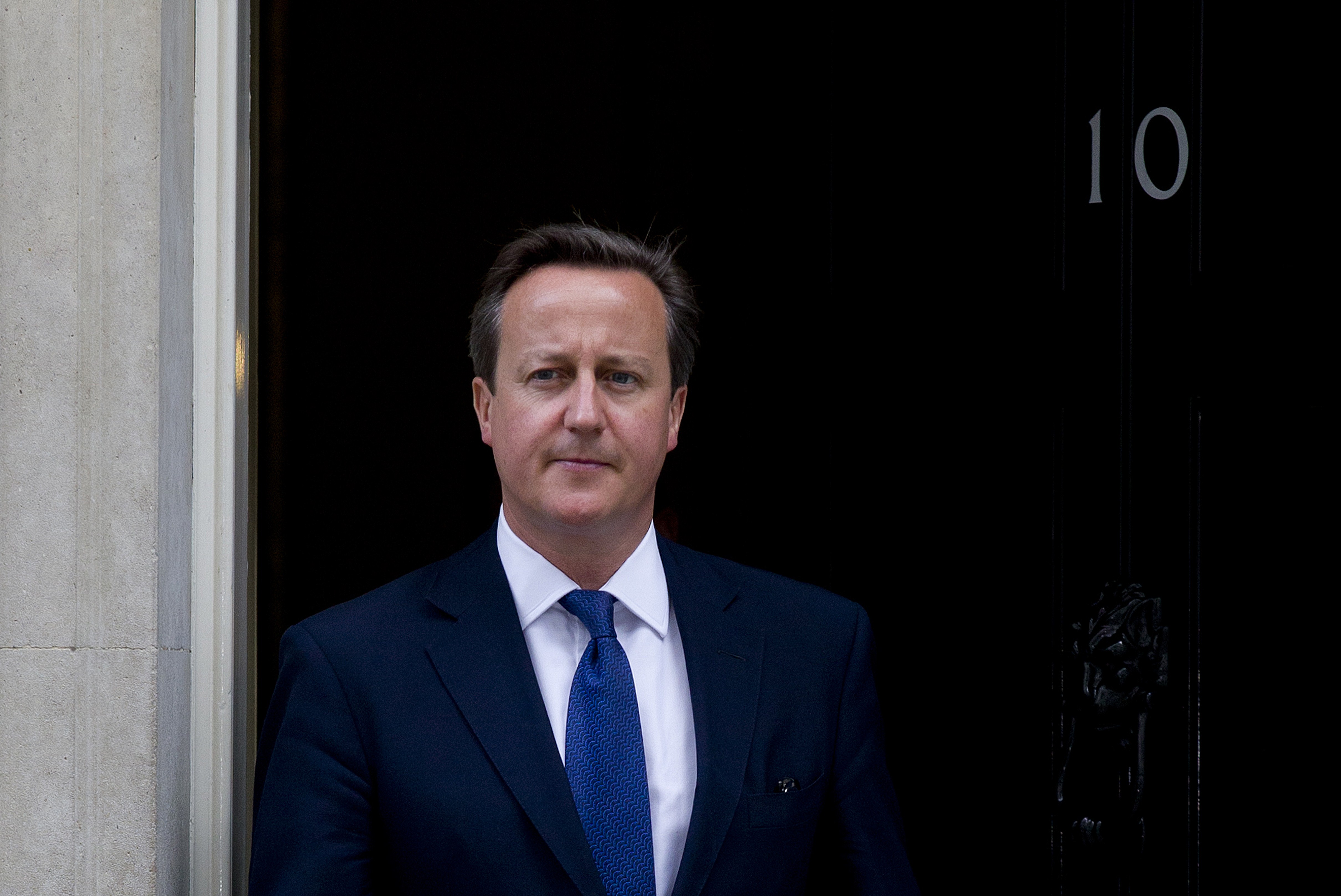
(Photo: British Prime Minister David Cameron leaves 10 Downing Street in London on 18 June, 2014. By Justin Tallis/AFP/Getty Images.)

So You Think You Can Make A Show About Assad

FX’s new series Tyrant is about the Americanized son of a brutal Arab dictator who returns home for a family wedding and ends up having to stay to run the country. With a premise like that, how could they go wrong? Let’s start with the bad casting:

The problems begin with Adam Rayner, who plays the show’s protagonist, Bassam “Barry” Al Fayeed. After fleeing Abbudinthe fictional country standing in for pre-civil war Syria or Saddam-era Iraqas a teenager, Bassam has made a life as a pediatrician in Pasadena, trying to forget that his father once used chemical weapons against his own people. After years of estrangement, he reluctantly brings his wife Molly (Jennifer Finnigan) and two children to Abbudin for the first time to attend his nephew’s wedding. (For some reason, Bassam’s wife doesn’t understand why her husband might have a complicated relationship with his war criminal father, and is hoping the two might reconnect.) Bassam is horrified by his family’s corruption and secretly afraid he is no better than them. The role requires an actor who can show the potential for brutality beneath his righteous outrage. Rayner mostly just glowers.

This is particularly disappointing because Rayner is a white, English actor cast in an Arab role. The producers’ claims that they couldn’t find an Arab actor with the skills to carry a show would be easier to forgive if Adam Rayner was giving a Bryan Cranston–level performance. Instead, he’s just a pretty white guy in a suit, easily overshadowed by the (actually Middle-Eastern) actors around him.

Poniewozik gets to the heart of the problem:

There’s not a fleshed-out character in the show, beginning with Barry’s stock-villainous brother Jamal (Ashraf Barhom), who we immediately meet raping a subject with her own husband and children still in her house. To a person, the characters are types: the shallow American kids, the dissolute playboys, the noble protesters and journalists, the cynical advisers, sneering elites and sad-eyed children. The problem isn’t that Tyrant portrays a troubled region as troubled; it’s that it doesn’t use its time to begin to make this world as real as ours.

Eric Deggans also faults the show for trading in stereotypes:

This is a show about the Middle East as seen through Americanized eyes, with little of the nuances in Arab or Muslim culture on display. The unfortunate effect is a constant, not-so-subtle message: If these people would just act like Americans, everything would be so much better. Piled on top of this simplistic dynamic is a series of decisions made by the characters that seem utterly baffling. …

In fact, even though the country is teetering on edge of rebellion during many episodes, no one in Bassam’s immediate family acts as if he is worried about his own safety. And when they arrive in Abbudin, they seem to know almost nothing about the country — as if at least one of them wouldn’t have hopped on Google to read up a little on this dictatorship ruled by their relatives.

Alyssa pans the show as well:

“Tyrant” feels less like an act of powerful imagination and more like the recreation of a Generic Middle East (it was shot in Tel Aviv), where everyone is oppressed, except the tacky gluttons who are blowing their money in nightclubs. Everyone speaks in cliches, whether they are defending their right to Dom Perignon or talking about winning over survivors of the regime’s gas attacks or overseas audiences.

And the show, in keeping with the long-running television vogue for explaining repulsive people, veers towards moral relativism. Having established Jamal as a serial rapist, it is genuinely bizarre that “Tyrant” spends subsequent episodes worrying about his sexual health. It is nice that a prep-school aged Barry was horrified by his father’s use of chemical weapons, but against tens of thousands dead, are we really supposed to be this concerned with his feelings?

But Can ISIS Harm Us?

Arguing against intervention in Iraq, Aaron David Miller downplays the threat posed to Americans:

[I]t is unlikely that it will come to rule Syria or Iraq in full, let alone fulfill its fantasy of creating an Islamic caliphate. … Instead, it is likely that ISIS will become a major counterterrorism problem for the region, and perhaps for Europe. As for striking America, that’s a more complicated issue. It didn’t work out so well for al Qaeda’s central operations, as recent history shows. And as my Foreign Policy colleague Micah Zenko reminds us, in 2013 there were 17,800 global fatalities due to terrorism, but only 16 of those were Americans. Although preventing attacks is the most important foreign policy priority, bar none, terrorism — including from ISIS – just isn’t a strategic threat to the homeland right now.

Ambinder thinks Obama is responding to the threat, such as it is, pretty astutely:

ISIS’ anti-American bluster is worth noting, as are its direct ties to lethal insurgents elsewhere. But surely the way to expedite the fermentation of the next wave of Sunni terrorism is for the U.S. to start fighting Sunnis.

Interestingly enough, the central tenet of President Obama’s counter-terrorism policy is NOT to deny terrorists safe havens. Our counter-terrorism policy is mocked by critics as little more than a game of whack-a-mole. And they’re right. A terrorist pops up here; so here is where you send the drone. Mole whacked. …

If all the terrorists in the world found themselves attracted to a caliphate between Syria, Kurdistan and Iraq, they would make the country a ripe target for later, purposeful intervention by the United States. Right now, the threats to the U.S. are bluster. Keeping a response to an intelligence and special operations force surge to Iraq is a good way to make sure that, whatever happens — and really, there is no way of knowing what ISIS will look like in a month, or two — the U.S. will have its eyes and ears on a potential threat.

But Aki Peritz is worried about “bleedout”, especially in Europe, as Western jihadis come home from the fight:

There are troubling signs that bleedout from the Syria conflict might already be occurring. Just this year, an attack on a Jewish center in Brussels that left four people dead was reportedly the handiwork of a Syrian returnee. In Kosovo last November, local authorities arrested several individuals, including two Syria vets, who were plotting an unspecified terrorist attack. More ominously, French authorities busted another Syrian returnee in Cannes for building a one-kilogram bomb filled with the high explosive TATPright out of the al Qaeda playbook.

Multiple investigations remain ongoing to determine whether Syrian extremist groups specifically greenlighted any of these operations. But for a jihadist organization to spare 100 or 200 foreign fighters to return to their home countries to carry out operations, however, doesn’t require a stretch of the imagination.

28 Strangers vs 600,000 DCers

That’s the measure of this country’s commitment to democratic self-government. The duly elected officials of Washington DC have been moving ahead with plans to decriminalize possession of marijuana, reducing the current penalties from $1,000 and a one-year jail-sentence to a $25 civil fine and a 60-day jail sentence for public smoking. The latest public opinion polls put support for outright legalization in the District at 63 percent:

Washingtonians of every age, race and ethnicity — teenagers and seniors, blacks and whites — registered double-digit increases in support of legalization. Even among those who oppose legalization, nearly half support relaxing punishment for marijuana possession to a fine of $100 or less.

So you have close to unanimity of the city’s residents and voters behind the current proposal. But in America – unlike any other democratic country on the planet – the voters in Washington DC can simply be over-ruled by a handful of congressmen from other parts of the country on the House Appropriations Committee. And so this condescending douchebag from Maryland gets to preach to Washingtonians as if we were incapable of running our own lives:

“Congress has the authority to stop irresponsible actions by local officials, and I am glad we did for the health and safety of children throughout the District,” Representative Andy Harris, the Maryland Republican who proposed the provision, said in a statement.

It’s all for the children! But wait! The House Committee can only remove funding for implementing any such change in the law; it cannot actually change the law. And the only parts of the new law that require funding for enforcement are – yep! -the penalties:

Eliminating the previous criminal penalties … costs nothing. So by preventing funding for DC’s decriminalization law, House Republicans could end enforcement for the few penalties that remain. That would leave DC with decriminalization but no ability to enforce civil fines or jail time — something that looks very similar to outright legalization.

Somehow I doubt that an act of brazen contempt for democracy will lead to a triumph of democracy. The full House will have to vote on this at some point. But, in the last days of Prohibition, you never know.

Update from a reader on Twitter:

Maliki Won’t Budge

As the Iraqi president refuses to step down and instead vows to move ahead with forming his own government, Juan Cole sees the crisis deepening:

Al-Maliki rather outrageously accused those who called for him to step down in favor of a government of national unity of de facto allying with ISIS, a would-be al-Qaeda affiliate, and the remnants of the Baath Party that used to rule Iraq in former dictator Saddam Hussein’s day.

Shiite leader Muqtada al-Sadr put forward a 6-point plan for ending the crisis. He urges that the ‘moderate Sunnis’ be separated from ISIS terrorists and called for a government of national unity (exactly what al-Maliki just rejected). He also called on Iraqis to act against any foreign incursions into Iraq.

At the same time, Ali al-Hatim, leader of the Council of Sunni Tribes, rejected the notion of al-Maliki gaining a third term: “He has to go, like it or not.” He characterized al-Maliki’s rule as “rule by Iran.” He also denounced the present constitution as an “occupation constitution.”

But even if Maliki were willing to step down, replacing him wouldn’t be easy:

“There is no chance of the elites coming together to confront the serious threat to the state that ISIS presents with Maliki at the helm,” said Emma Sky, who served as the political advisor to Gen. Ray Odierno during his tenure as the top U.S. general in Iraq. “The best hope is that the elites agree on an alternative — they have the votes to do so.”

Still, finding a replacement acceptable to all of Iraq’s sects and political parties will be an extraordinarily difficult task because of the number of boxes the potential leader must check. He has to be a Shiite, but not one as harshly anti-Sunni as Maliki. He needs the military know-how to repair Iraq’s battered armed forces and oversee a counterattack against ISIS. To top it off, he needs the diplomatic skills to work with both Washington and Tehran, despite the lingering tensions between the United States and Iran.

Reading between the lines of US strategy, Mark Thompson suspects that Obama is trying to save Maliki but force him to compromise:

It’s simple: the U.S. military generally “sends messages” by attacking. Now it is sending messages by not attacking. And its target this time around isn’t the enemy, but its purported ally running the country.

While the Pentagon officially denies it, the U.S, government is dragging its feet when it comes to defending Prime Minister Nouri al-Malaki’s government in Iraq. … Washington is trying to hit the sweet spot: promise to deliver enough help in the form of air strikes and on-the-ground advisers to preserve Maliki’s government, but make sure it arrives slowly enough that he feels compelled to compromise with the Sunnis and Kurds who are now tearing the country apart.