Chart Of The Day

gayampercent

Philip Bump put it together:

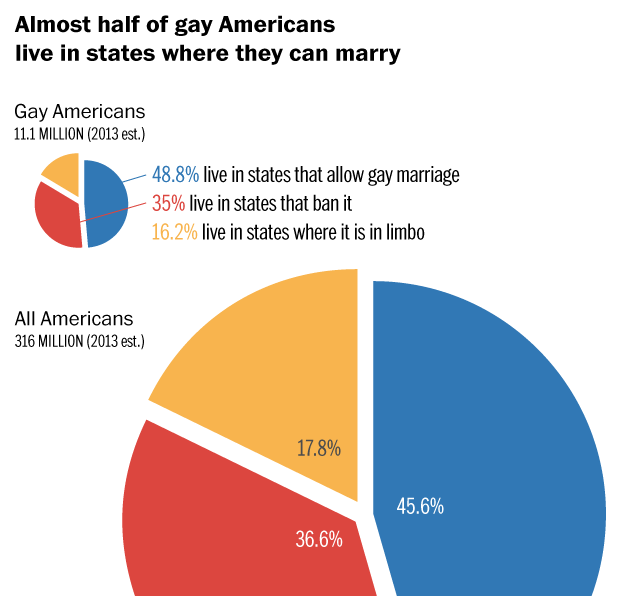
Nearly half of the 11-plus million gay Americans (how we arrived at that figure is explained in more depth below) now live in states that allow gay marriage, and are more likely to live in such states than Americans on the whole. 48.8 percent of gay Americans live in states where they can legally marry, according to our estimates. The percentage of Americans in those states overall is at 45.6 percent. And, of course, a large portion of the country live in states where the legal status is in limbo.

Speaking of that limbo, Bazelon looks at yesterday’s court ruling out of Utah:

The 10th Circuit stayed its ruling to give the opponents of gay marriage a chance to appeal to the Supreme Court. Rick Hasen and plenty of other people think this means gay marriage is headed back to the justices as early as next term. So far, though, there’s no split over gay marriage in the lower courts since the DOMA ruling. Anyone want to subscribe to my (minority) theory that gay marriage could become the law of the land without another word from the high court? Gay marriage has so much righteous momentum behind it—maybe it doesn’t need another push from Kennedy. Though surely, with a record of 20–0 this year in the lower courts, he will be ready to give it.

I’m prepared to make that bet with Emily – although you never know. Ilya Somin sounds off:

For reasons I explained in this post, I am skeptical about the validity of the argument embraced by the Tenth Circuit majority. But I do believe they reached the right result, because laws restricting marriage to opposite-sex couples are an example of unconstitutional sex discrimination. This reasoning was endorsed by the district court opinion affirmed by the Tenth Circuit (though it also endorsed other constitutional arguments against laws restricting marriage to opposite-sex couples).

Be that as it may, [yesterday’s] decision is an important victory for advocates of same-sex marriage. But Judge Kelly’s dissent suggests that the legal battle over the issue is far from over. The question is likely to return to the Supreme Court, quite possibly sooner than many of us at first anticipated.

My reaction to the Utah ruling – and the more exciting one in Indiana – here.

When The Phone Goes Dead

Alice Robb takes note of a remote village in Papua New Guinea where locals call the deceased on their cellphones:

[The villagers] have long been confident in their ability to talk to the dead, believing they can communicate with the world of spirits in dreams, visions, and trances induced by special rituals. The introduction of mobile phones has opened up new possibilities: The Ambonwari believe they can use them to contact their dead relatives, whose numbers they obtain from healers. And once they reach them, they can ask for anything. “It is a general conviction,” write [anthropologists Borut] Telban and [Daniela] Vavrova, “that once people know the phone numbers of their deceased relatives they can ring and ask the spirits to put money in their bank accounts.”

I asked Telban if the villagers are discouraged that they never get through to the spirit world; he assured me that they’re not. They might assume the spirits aren’t available. And they ring random numbers so often that occasionally they do reach someone, whose voice they attribute to a spirit.

Meanwhile, in the US, hardly anyone seems to use their cellphones to call the living:

In fact, the use of voice calls – which has been dropping since 2007, the year Apple introduced the original iPhone – has fallen off a cliff lately. As of last year, cell providers in the U.S. are now making more money per user from data use than voice calling. (The U.S. is only the seventh nation to reach the data-voice tipping point — it happened in countries like Japan as early as 2011.) A recent survey of 7,000 U.S. high-school seniors found that only 34 percent made phone calls every day — far fewer than the number who texted or used apps like Snapchat, Facebook, and Instagram. And companies like AT&T and Verizon, which saw the data boom coming years ago, have been spending more and more on new, bigger LTE data networks, while essentially giving away their voice plans for free.

A Thad Unorthodox Strategy, Ctd

Screen Shot 2014-06-26 at 1.30.29 AM

Matt Lewis sums up “perhaps the biggest thing we can all learn” from Thad Cochran’s victory:

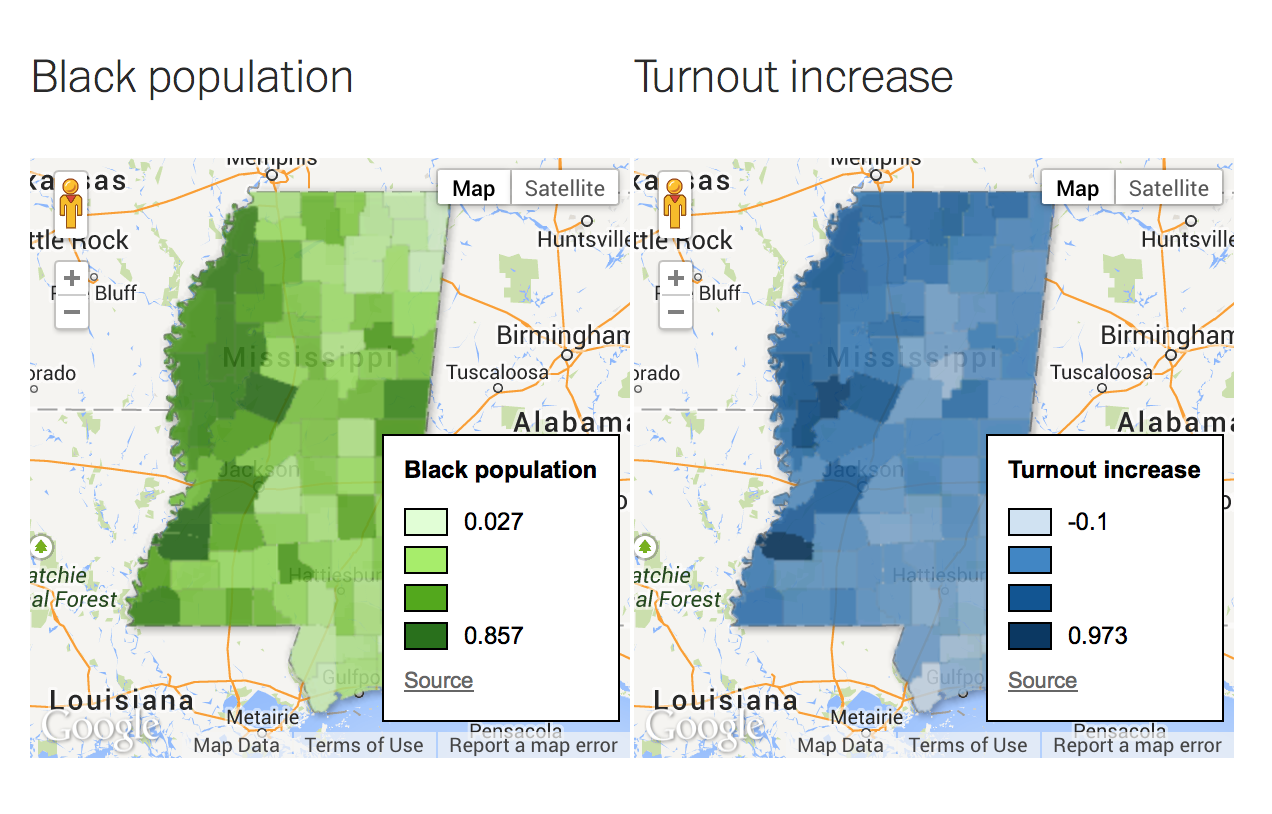
Adapt, and you will overcome. … Essentially, [GOP strategists] conceded that if the election were about who can be the most conservative, Cochran couldn’t beat McDaniel. So rather than playing a losing hand, they changed the game. Cochran appealed to African Americans and other Democratic base voters — who can vote in GOP races in Mississippi’s open primary system, and who would prefer to be represented by the relatively pro-government Cochran than by the anti-government McDaniel. Basically, Cochran’s plan B was to woo Democrats. And it worked. (I realize this was a unique case, but what if Republicans always hustled this hard to win over African American voters…)

Serwer addresses the backlash from the base:

Conservatives may cry foul over McDaniel’s loss, whether or not it’s proven that Democrats made the difference. But there’s nothing wrong with crossing over to vote for the lesser of two evils in a primary in a place like Mississippi, where the result of the Republican primary for statewide office usually determines the outcome of the general election. It’s not even unique to Mississippi or this election – those of us who live in Washington, D.C. are quite familiar with the concept. The Democratic Primary almost always determines who will win the general election of citywide office in D.C., people who would be Republicans anywhere else register as Democrats so as to have a voice in the process. McDaniel himself voted Democratic a decade ago.

Alec MacGillis adds, “It is hard to overstate the significance and historical ironies of black Mississippians crossing party lines to rescue a senior member of the state’s Republican establishment.” Amy Davidson challenges McDaniel for crying “irregularities” in the face of those ironies:

What does he consider “regular” at a polling place in Mississippi? Whom would he like to see there?

Perhaps it might have occurred to him to appeal to black voters, who do make up more than a third of the state. Strategic voting, of the winking kind, is when you vote for the other party’s weaker or more marginal candidate, hoping that it will help your side further along. If Mississippi’s black voters were really the pawns of national machine-politics operatives, they might have been directed to get McDaniel in. His nomination would maybe give the Democratic candidate a chance that he wouldn’t usually have in Mississippi, or maybe McDaniel would have just embarrassed the G.O.P. nationally, as he had shown every indication he might do. (In addition to the break-ins, there was “Mamacita”-gate.)

But, in the past few weeks, Cochran, a deep conservative himself, made a real, targeted pitch to black Mississippians that, given the choice, he would be a better senator, and enough black voters and community leaders bought it. That’s how elections work, though not how they worked for generations in Mississippi, where people were killed in living memory just for the right to register to vote.

Jaime Fuller also responds to McDaniel contesting the results:

There is one section of Mississippi election law that the McDaniel team seems to think could work to their advantage. That section reads: “No person shall be eligible to participate in any primary election unless he intends to support the nominations made in which he participates.” In other words, if the Democratic voters who helped Cochran win plan to vote for his opponent, former Rep. Travis Childers, in the fall, that would, theoretically, be against Mississippi law.

“I wouldn’t be too optimistic if I were [McDaniel]” says John M. Bruce, head of the University of Mississippi political science department. “This issue has already been adjudicated.” A 2008 decision by the 5th Circuit Court of Appeals said that in order for a ballot to be thrown out, poll workers would need to ascertain that the voters already were planning on supporting a different candidate a few months down the road. As Bruce says, “that’s not enforceable”. Bruce — who has lived in Mississippi for over 20 years, says that he can’t remember anyone ever discussing this section of the state’s election law at such length. The 2008 case was mostly unnoticed. “No one even thought about this law,” he noted.

Sabato et al. look beyond those sour grapes:

The national Republican Party is the big winner. … Nowhere was the jubilation greater, once Cochran had won, than in the D.C. halls of GOP power. Now they don’t have to spend a dime this fall in Mississippi, and they don’t have to waste a breath defending McDaniel elsewhere.

Zeke Miller questions the conventional wisdom of the runoff coverage:

Conservative political consultant Keith Appell cautioned against interpreting Tuesday’s results as a knockout punch against the Tea Party, blaming McDaniel’s failure to win the required 50% of the vote in the initial primary on a blogger who incited outrage—and sympathy for the incumbent—by strangely filming inside the nursing home housing Cochran’s ailing wife. “Interpreting this as some kind of ‘Empire Strikes Back’ moment is an overreach,” Appell told TIME. … Conservatives and Tea Party activists have to take the long view, the big picture is that they’re really winning,” Appell added.

(Map by Philip Bump)
What’s This “Ex-Im Bank” People Are Talking About?

Yglesias voxsplains:

There is an influential current of thought in right-of-center America flying under the banner of libertarian populism, which holds that a free market agenda can be framed as a fight for the interests of the little guy. The Export-Import Bank is a great example of the kind of thing a libertarian populist might oppose. That’s because the bank is a pretty textbook example of the government stepping in to arbitrarily help certain business owners.

The way it works is that the Ex-Im Bank guarantees loans extended by private financial firms to foreign companies that want to buy certain US-made products. The main beneficiaries of this scheme are a handful of large American manufacturing companies — Boeing, GE, and Caterpillar prominent among them — who are in effect receiving a subsidy. Secondary beneficiaries include the private financial firms whose loans are guaranteed and the foreign customers who get access to discount loans via the Ex-Im Bank.

If you want an example of big government stepping in to help out some favored businesses, you’re not going to find a much better example.

Alex Rogers adds:

The bank [is] supported by the White House, the Democratic-controlled Senate, the business community and at least 41 House Republicans… . Its supporters credit it with supporting about 205,000 American jobs, while opponents say it could easily be replaced by the private sector. Congress must renew the Ex-Im bank’s charter by Sept. 30 or it will be unable to back new loans.

How Rebecca Robins distills the dilemma for both parties:

The Ex-Im Bank debate has splintered the Republican Party between those concerned about corporate welfare and those committed to upholding traditional allegiances to big business. Meanwhile, Democrats have found themselves allied with large corporations in the fight to keep the Ex-Im Bank alive.

Danny Vinik wants it dead:

Already liberals are unsure about whether to support the bank or not. In the New York Times, Joe Nocera professed his support for the bank. But Jared Bernstein, the former chief economist for Vice President Joe Biden, was less sure. At his blog, he noted the benefits of the bank, but also explained that “the Brat’s of the world [sic] have a point in that for politicians to pretend otherwise, invoking red-meat slogans like ‘free trade,’ ‘the government doesn’t create jobs,’ ‘the government doesn’t pick winners,’ and then support institutions like the XMB is nonsensical.” Ultimately, the Ex-Im bank does pick winners and losers.

That’s where the investigations reported by the Wall Street Journal become so damaging: If they prove true, then officials are choosing winners and losers based on kickbacks. And that should make the decision easy for liberals: Join with conservatives and oppose the reauthorization of the Export-Import bank.

Drum disagrees:

Killing Ex-Im is basically a conservative hobbyhorse, but plenty of lefties have weighed in too. Dean Baker points out that an interest rate subsidy is basically the same as a tariff, so if you’re in favor of free trade you should be opposed to Ex-Im. Paul Krugman admits that Ex-Im is mercantilist and therefore a bad idea—except when the economy is weak and monetary policy is up against the zero lower bound. Which it is, so Ex-Im acts as an economic stimulus, more or less, and we should probably keep it around for now.

Edward Alden is aligned with Drum:

The Export-Import Bank’s role is a small one, helping less than two percent of all U.S. exports. For a certain class of exports to developing countries–mostly aircraft and large infrastructure projects such as mining, telecommunications and oil and gas development–the bank offers various kinds of loans, insurance and loan guarantees to ensure that U.S. companies get paid. These are transactions that private sector banks are reluctant to finance completely because of the risks involved. Yet the Export-Import Bank, because it is backed by the full credit of the U.S. government, is able to do so. And its track record is impeccable–in the past five years it has actually earned $2 billion for the U.S. Treasury.

If the bank is shuttered, it’s not like those projects will disappear. Instead the contracts will go to European or Canadian or Chinese companies that are getting the same sort of export credit support from their governments (indeed, often more generous) that the Export-Import Bank currently offers. If American companies want to compete they will likely move production to other countries to become eligible for that financial support. Jobs will move with them.

Can Pakistan Tackle The Taliban?

Last week, the Pakistani military launched a major operation to clear Taliban extremists from the lawless region of North Waziristan, after five years of prodding from the United States. Shuja Nawaz expects it to fail:

Pakistan still lacks any national strategy in which the government and armed forces together fight Islamist militancy and terrorism. In North Waziristan, the army is re-using the blunt force approach it has used before: clear out the local population, then use air strikes, artillery, and ground forces to clean out any insurgents that remain. This tactical, rather than strategic, approach means that the North Waziristan battle will not be definitive, but rather just another fight in Pakistan’s inconclusive long war.

To build a national strategy, Prime Minister Nawaz Sharif’s government needs to bring the military out of what has been a long silence to share with the Pakistani public its vision of what will work. The government must then include the military’s view in a way it has not so far. In February, for example, Sharif’s administration released an embryonic National Internal Security Policy that had been prepared with no visible participation by the military and that has already hit snags in its implementation.

Hassan Abbas fears that Pakistan is underestimating the sophistication of its enemies:

Only recently, Pakistan’s security ‘wizards’ have started realizing that Tehrik-i-Taliban Pakistan (TTP) (the really ‘bad Taliban’) benefits in many ways from logistics, infrastructure and even funding sources of ‘good Taliban.’ What Pakistan still avoids to fully acknowledge is that TTP today is a far more dangerous group than it was when it emerged in late 2007.  Now, its tentacles are reaching deep into Pakistan and it has close links with the remnants of al Qaeda as well as organized crime. …

Pakistan will not be able to defeat, dismantle, and discredit the TTP through military means alone in [the Federally Administered Tribal Areas]. It should be ready to deal with them through civilian law enforcement methods inside the mainstream Pakistan, especially Punjab and Khyber Pukhtunkhwa province. Pakistan’s recent security policy brief shows little indication that it has any plans to invest in reform and modernization of its police and broader criminal justice system. Change in this arena will be the most potent sign of real shift in Pakistan’s counterterrorism policy.

And Muqtedar Khan argues that securing Waziristan should be a regional initiative, not a solo project by Karachi:

The Waziristan region in Pakistan has become a watering hole for extremists who threaten many countries. Besides Pakistan, India, Iran, and Afghanistan have strong interests in eliminating threats that emanate from this area. The problem is that most countries in the region feel that Pakistan is hunting with the hound and running with the hare at the same time. Pakistan’s intelligence is suspected of nurturing many of the same groups for geopolitical reasons even as they threaten its own stability. This perception prevents Pakistan from developing closer relations with its neighbors who have the resources, the will, and the interest to help Pakistan become terror free.

A regional coalition will make the struggle against extremism more potent, more durable and less expensive, but it will take more than deft diplomacy to achieve. Pakistan must convince its neighbors that the alleged ties between the Pakistani state and the Taliban have been severed irreparably.

Don’t Drive Stoned And Drunk, Ctd

Sullum says Washington’s blood-THC limit effectively prohibits medical marijuana users from driving at all:

Washington’s five-nanogram rule, modeled after the per se standard for alcohol, was meant to reassure voters worried about the threat posed by stoned drivers. But like all per se standards, it treats some people as unsafe to drive even when they’re not.

Last year experiments by KIRO, the CBS station in Seattle, and KDVR, the Fox affiliate in Denver, showed that regular cannabis consumers can perform competently on driving courses and simulators at THC levels far above five nanograms. The lack of correspondence between the new standard and impairment is especially unfair to medical marijuana users, some of whom may be above the five-nanogram limit all the time, meaning they are never legally allowed to drive in Washington. …

“The five-nanogram rule doesn’t make sense,” says Mark Kleiman, a University of California at Los Angeles drug policy expert who was hired to advise Washington’s cannabis regulators. “It doesn’t correspond to impairment, and for regular users, they’re always going to be over the limit. It would be absurd to say you can smoke pot but then you can never drive.”

Along with Kleiman, Amy Weiss-Meyer reviews research on driving under the influence:

In 2000, researchers at Maastricht University in the Netherlands gave driving tests to subjects who had consumed various amounts of alcohol and/or marijuana. While all subjects both drank and smoked in each round of the study, some were given placebos, so that the researchers were able to test the effects of each substance on its own as well as their combined effect. They measured drivers’ “standard deviation of lateral position” (SDLP), or the distance they drifted out of their lane, and also the time out of lane (TOL).

The study found that alcohol on its own increased SDLP by 2.2 centimeters (as compared to double-placebo conditions). Marijuana, depending on the dosage of THC (100 or 200 micrograms per kilogram of body weight), increased SDLP from placebo conditions by 2.7 and 3.5 centimeters respectively. In other words, drivers who had smoked pot were less able to drive in a straight line than drivers with an elevated BAC. (Most drivers’ BACs fluctuated around 0.04 grams per deciliter, below the legal limit of 0.08.)

The researchers concluded that the percentage of TOL was not significantly affected by either alcohol or marijuana alone, but that it was much higher when both substances were used together.

Abby Haglage joins the conversation:

The truth is, after decades of analysis, we still don’t have a firm grasp on how THC impairs driving. Laboratory studies have confirmed that THC (officially, Delta-9-tetrahydrocannabinol) impairs many motor skills necessary for driving. But actual driving simulation studies have not mimicked these results. One sound example is a 2004 study in which three researchers found THC to inhibit attention, reaction time, hand-eye coordination, short-term memory, time and distance perception, and concentration.

But when tested in actual driving simulation, the authors found the results did not “replicate” their laboratory evidence. In other words, researchers were able to prove that THC should, technically, impair driving, but not that it does. Their explanation for the discrepancy: Drivers with THC are likely cognizant of their impairment and are thus able to “compensate…by driving more slowly and avoiding risky driving maneuvers.”

Pain As Privilege

Historian Joanna Bourke, the author of The Story of Pain, recalls that physical discomfort was once thought to be an affliction of the elite:

In many white middle-class and upper-class circles, slaves and “savages,” for instance, were routinely depicted as possessing a limited capacity to experience pain, a biological “fact” that conveniently diminished any culpability among their so-called superiors for acts of abuse inflicted on them. Although the author of Practical Rules for the Management and Medical Treatment of Negro Slaves, in the Sugar Colonies (1811) conceded that “the knife of the anatomist … has never been able to detect” anatomical differences between slaves and their white masters, he nevertheless contended that slaves were better “able to endure, with few expressions of pain, the accidents of nature.” This was providential indeed, given that they were subjected to so many “accidents of nature” while laboring on sugar-cane plantations. …

But what was it about the non-European body that allegedly rendered it less susceptible to painful stimuli?

Racial sciences placed great emphasis on the development and complexity of the brain and nerves. As the author of Pain and Sympathy (1907) concluded, attempting to explain why the “savage” could “bear physical torture without shrinking”: the “higher the life, the keener is the sense of pain.” There was also speculation that the civilizing process itself had rendered European peoples more sensitive to pain. The cele­brated American neurologist Silas Weir Mitchell stated in 1892 that in the ‘process of being civilized we have won … intensified capacity to suffer.” After all, “the savage does not feel pain as we do: nor as we examine the descending scale of life do animals seem to have the acuteness of pain-sense at which we have arrived.”

Naturally Nonsense

Brad Plumer considers the absurdity of labeling food as “all-natural”:

In a recent essay in PLOS Biology, [Cambridge geneticist Ottoline] Leyser argues that it’s time to kill this mistaken idea once and for all. Basically everything in modern agriculture is unnatural. “The cereal crops we eat bear little resemblance to their naturally selected ancestors, and the environments in which we grow them are equally highly manipulated and engineered by us,” she writes. “We have, over the last 10,000 years, bred out of our main food plants all kinds of survival strategies that natural selection put in.”

There’s more along these lines. “Agriculture is the invention of humans,” she adds. “It is the deliberate manipulation of plants (and animals) and the environment in which they grow to provide food for us. The imperative is not that we should stop interfering with nature, but that we should interfere in the best way possible to provide a reliable, sustainable, equitable supply of nutritious food.”

Roberto Ferdman provides a chart on the subject:

The list of lucrative food labels is long, and, at times, upsetting.

Food-labels

Many of these labels are pasted onto food packages for good reason. It’s imperative, after all, that consumers with celiac disease be able to tell which food items are gluten free, or that those with milk allergies be able to tell which are made without lactose.

But some are utterly meaningless. Take food labeled with the word “natural,” for instance. Actually, remember it, because it’s probably the most egregious example on supermarket shelves today. The food industry now sells almost $41 billion worth of food each year labeled with the word “natural,” according to data from Nielsen. And the “natural” means, well, nothing. The US Food and Drug Administration (FDA) doesn’t even have an official definition or delineation of what “natural” actually means.

Update from a reader, who passes along a classic Carlin skit on the subject:

Another reader takes issue with Ferdman’s reference to people with “milk allergies”:

Please, please don’t continue to spread the misconception that lactose intolerance has any relationship whatsoever to genuine allergy. It contributes to widespread misunderstanding of what allergies are, and, in particular, how serious genuine allergic reactions can be.

Lactose intolerance is a digestive disturbance. It is very unpleasant and uncomfortable – and definitely something to be avoided. I am afflicted myself and I know what I’m talking about here. But, accidental ingestion of lactose is not a life-threatening situation.

Genuine allergic reactions, on the other hand, can definitely be life-threatening. Every year there are reports of deaths due to genuine allergic reactions to accidental ingestion of peanuts or shellfish. Applying the term “allergy” to conditions that are nowhere near life-threatening trivializes the word and makes education of the public much more difficult.

ISIS’s Frenemies

In a lengthy and penetrating look into the Syrian roots of the current conflict in Iraq, Rania Abouzeid discusses ISIS’s fraught relations with other militant groups:

ISIL couldn’t work with others in Syria, so how long before it turns on, or aggravates, its new Iraqi allies? ISIL’s code of conduct for Mosul’s Nineveh province, posted just two days after insurgents seized the area, provides one indication. Its repressive rules are the SYRIA-CONFLICT-NUSRAsame as those it has enforced in Raqqa: obligatory prayers five times a day in mosques; women must dress modestly (i.e., in a balloon-like black cloak and face-covering veil) and should only leave their homes in emergencies; and all shrines should be destroyed, among other edicts. Unlike Nusra, it hasn’t learned to prioritize the importance of gaining popular support.

But the fate of ISIL is far from the only question. Will Nusra and other Syrian rebel groups try to make some sort of large-scale move against ISIL positions in Syria now that the group is preoccupied in Iraq? Will Nusra lose members to a group whose Islamic state is increasingly taking shape? How will Zawahiri react? He is unlikely to capitulate to ISIL, but nor can he much criticize a group that is implementing the ultimate goals of his own organization. Could al Qaeda try to prove its relevance through new attacks? Does it still have the capability?

Will Saletan breaks down how ISIS violates all of Osama Bin Laden’s rules for Jihad:

Bin Laden was a theocratic fundamentalist, but he cautioned his allies to avoid the “alienation from harshness” that was “taking over the public opinion.” The worst offender was Somalia’s al-Shabab. In a 2011 letter, Bin Laden urged Atiyah to “send advice to the brothers in Somalia about the benefit of doubt when it comes to dealing with crimes and applying Shari’a, similar to what the prophet (PBUH) said, to use doubts to fend off the punishments.”

When ISIS captures a city, it follows this rule at first. But soon, the nice-guy act disappears. The group seizes property and humanitarian aid. It executes Christian and Muslim “apostates.” Two days after taking Mosul, Iraq’s second largest city, ISIS banned booze and cigarettes, instructed women to stay home, and announced that government employees who failed to repent would be put to death. This behavior antagonizes Sunni fighters who have collaborated with ISIS. “In some areas that ISIS has taken they are killing our people, they are imposing their Islamic laws on us,” one tribal leader told the New York Times. “We do not want that.”

(Photo: A Turkish fighter of the jihadist group Al-Nusra Front, bearing the flag of Al-Qaeda on his jacket (C-back), holds position with fellow comrades on April 4, 2013 in the Syrian village of Aziza, on the southern outskirts of Aleppo. By Guillaume Briquet/AFP/Getty Images.)

The Whoring Just Keeps Getting Worse

If you think I’m a crank on the surge of sponsored content replacing journalism, take a look at one big media company’s bet on the future:

The new [Yahoo] publications combine original articles and material licensed from other sites, as well as big photos and videos into an endless page of tiles aimed at enticing people to linger. Mixed into that stream is a different kind of advertising — so-called native ads or sponsored posts — which look almost exactly like all the other articles and videos on the page except that they are sponsored by brands like Knorr, Best Buy and Ford Motor. These ads, Yahoo hopes, will attract the attention of more readers and make more money for the company. In some cases, Yahoo editors even help to write that advertising — a blurring of the traditional lines between journalists and the moneymaking side of the business.

If Yahoo wanted to become an advertising or public relations company, I’d have no problem with that. But what they’re doing is deliberately deceiving readers on what is advertising and what is journalism, and using journalism as a cover for a lucrative public relations business. Here’s the industry consensus in a quote from the editor of Yahoo Food:

I think our involvement elevates the advertising. Our ability to bring editorial knowledge and finesse to advertising content makes it better and gives it a point of view.

And in so doing makes it more and more indistinguishable from editorial. That’s also the paradox of one of the recent native ads that got a lot of positive press:

the native ad at the New York Times on female incarceration by Netflix’s “Orange Is the New Black”. Check it out here. It’s gorgeously produced, vividly presented  – in ways more innovative and arresting in design than the NYT’s own editorial product! Yes, unlike Yahoo or Buzzfeed and the other whoring sites, there are markers that this is not produced by the editors of the paper. But then it gets a bit confusing because it was created by the NYT – by a

newly formed Brand Studio unit, which was built to create native ads for advertisers. The article was written by Melanie Deziel, an editor at the studio who worked in the past at The Huffington Post and BuzzFeed. The illustrations are by Otto Steininger, whose work has appeared on the cover of The New Yorker.

So you have a journalist writing ad copy and a New Yorker artist creating visuals for an article that is created by the NYT, but is actually an advertisement. The cumulative effect, if the ads keep improving in quality, have more journalistic input and better graphics, is to make fake journalism less and less distinguishable from, you know, real journalism – journalism informed by an independent writer’s views, rather than paid for by a client.

This decision to merge advertising and editorial was driven by one thing and one thing only: money. As ad rates have dropped, websites have gone back to their sponsors to ask them how high they should jump to get some more love:

Last year, Ms. Mayer met repeatedly with Unilever executives and asked how Yahoo could improve. When she shared her thinking about sponsored content for some new digital lifestyle magazines, Mr. Master said, “We put our hand up and said, ‘We will do that.’ ” Unilever has since expanded its commitment to advertising on Tumblr and Yahoo sites.

Use your magazine to inject corporate propaganda into what appears to be independent journalism and “we will do that.” Quite why any self-respecting editor of journalist would do that is another matter. But self-respect went out a long time ago in this business, didn’t it?