First Chapters, Then Verse

We’ve featured reviews of James Booth’s new biography, Philip Larkin: Life, Art, Love, over the last few months. Now, Dana Gioia notices an interesting wrinkle in the poet’s story – it was only after Larkin wrote two early novels, Jill and A Girl in Winter, that he devoted himself to verse:

As his dreams of being a great novelist expired, Larkin poured his full talent into poetry. He discarded his lofty, early models, Yeats and Auden, and studied instead the homely genius of Thomas Hardy (another novelist-turned-poet). Larkin then brought a novelistic sensibility into his verse. Emphasizing the prosaic virtues of plot, setting, character, and narrative voice—the building blocks of fiction—he crafted a new sort of lyric poem, one firmly placed in the everyday world and yet charged with evocative power. His new poems also had personality; they were simultaneously savage and yet compassionate, very depressing and very funny. His language grew commonplace without losing its musicality, and he displayed a gift for using complicated verse forms in ways that sounded utterly conversational, as in the opening lines of “Annus Mirabilis”:

Sexual intercourse began
In nineteen sixty-three
(Which was rather late for me)—
Between the end of the Chatterly ban
And the Beatles’ first LP.

The change happened during his years in Belfast (1950–1955).

Always a good poet, Larkin suddenly became a great one, producing a series of works in quick succession that were destined for the anthologies—“Lines on a Young Lady’s Photograph Album,” “I Remember, I Remember,” “For Sidney Bechet,” “Poetry of Departures,” “Toads,” and “Church Going.” Although these poems would become signature pieces of contemporary British literature, Larkin initially couldn’t find a publisher for them. After repeated rejections, the despairing poet sent his breakthrough volume, The Less Deceived, to George Hartley, a friend in Hull, who wanted to start a press. Larkin would regret the decision, but the small, unpublicized collection proved an immediate success with great reviews and steady sales. Larkin soon found himself named the central figure of “The Movement,” a celebrated group of young writers. To his own astonishment, he was famous.


Quote For The Day

“Shall we say that Montaigne has spoken wisely, and given the right and permanent expression of the human mind, on the conduct of life?

We are natural believers. Truth, or the connection between cause and effect, alone interests us. We are persuaded that a thread runs through all things: all worlds are strung on it, as beads; and men, and events, and life, come to us only because of that thread: they pass and repass only that we may know the direction and continuity of that line. A book or statement which goes to show that there is no line, but random and chaos, a calamity out of nothing, a prosperity and no account of it, a hero born from a fool, a fool from a hero,- dispirits us. Seen or unseen, we believe the tie exists. Talent makes counterfeit ties; genius finds the real ones.

We hearken to the man of science, because we anticipate the sequence in natural phenomena which he uncovers. We love whatever affirms, connects, preserves; and dislike what scatters or pulls down. One man appears whose nature is to all men’s eyes conserving and constructive; his presence supposes a well-ordered society, agriculture, trade, large institutions and empire. If these did not exist, they would begin to exist through his endeavors. Therefore he cheers and comforts men, who feel all this in him very readily. The nonconformist and the rebel say all manner of unanswerable things against the existing republic, but discover to our sense no plan of house or state of their own. Therefore, though the town and state and way of living, which our counsellor contemplated, might be a very modest or musty prosperity, yet men rightly go for him, and reject the reformer so long as he comes only with axe and crowbar.

But though we are natural conservers and causationists, and reject a sour, dumpish unbelief, the skeptical class, which Montaigne represents, have reason, and every man, at some time, belongs to it. Every superior mind will pass through this domain of equilibration – I should rather say, will know how to avail himself of the checks and balances in nature, as a natural weapon against the exaggeration and formalism of bigots and blockheads.

Skepticism is the attitude assumed by the student in relation to the particulars which society adores, but which he sees to be reverend only in their tendency and spirit. The ground occupied by the skeptic is the vestibule of the temple. Society does not like to have any breath of question blown on the existing order. But the interrogation of custom at all points is an inevitable stage in the growth of every superior mind, and is the evidence of its perception of the flowing power which remains itself in all changes,” – Ralph Waldo Emerson, “Montaigne; or, the Skeptic,” in Representative Men.

Convincing Creationists Of Climate Change, Ctd

In an interview with Guernica, Katharine Hayhoe, a climate scientist and Evangelical, discusses why attempts to reconcile faith and science can’t always take the long view:

Here’s the thing: if you can frame climate change as an alternate religion, or as one more of those issues where the pointy-headed liberal atheist scientists are trying to discredit the Bible, then you’ve already got a ton of people on your side who are concerned about heresy, other religions, or teaching evolution in schools. Some people—very well-meaning people in the [scientific] community whom I genuinely respect—have said to me, “Well, let’s just focus on getting people on board with the science. We have to reach out to churches and schools and help people understand science, and we have to build rapport between scientists and people of faith. Then once we get that understanding and rapport built, then everyone will be on board with climate change.”

I’m involved in some of these efforts myself, and I believe they are important. But I’ll tell you, we don’t have a hundred years to fix climate change. We don’t have a hundred years to wait until we’ve built all these bridges and rapport and scientific understanding and so on and so forth. We have to fix climate change with the people we have right now, and to a large extent with the perspectives we have right now as well.

She adds:

My faith is an enormous motivator for me to engage … because climate change is not just an issue that affects the entire planet, it is one that disproportionately affects those who do not have the resources to cope with this change—those whom we are explicitly told as Christians to care for. We are called to help, to make people healthy, to love. When I look around, the biggest way in which we are failing to care for those in need is through ignoring climate change and acting like it doesn’t exist. As a Christian, I believe that is something the church needs to know.

On a related note, William Saletan profiles Jeff Hardin, chairman of the University of Wisconsin’s zoology department and an Evangelical who claims that “God authored the emergence of life and humankind but that evolution explains how this process unfolded.” When he tries to convince his co-religionists to be less skeptical of science, one thing he emphasizes is humility:

“Truth and absolute certitude are not the same,” says Hardin. The proper Christian attitude is that truth resides in Jesus. The believer’s job is to follow Jesus, not to assume that the believer knows the route. Hardin cites the Apostle Paul’s counsel that God “works in you to will and to act in order to fulfill his good purpose.” One way God works in people is through science. They learn that their initial conclusions from scripture—computing the age of humanity, for example, from the number of generations recounted since Adam—are clumsy and naive. To allow God to work in them, Christians must remain, in Hardin’s words, “epistemically open.”

Christians who believe that the world was created in six days, or that the Earth is only a few thousand years old, think they’re reading the Bible literally. But in reality, they’re projecting modern notions of time and narration onto their ancestors. Hardin shares their aspiration to be faithful to the Bible, but he argues that to achieve this, one must approach the text the way one approaches science: with empirical rigor. Scripture is a real thing. It was written and preached for a lay audience in a historical context. Those people weren’t scientists or journalists. So it makes no sense to treat the text as a tight chronology, nailing down timelines or the process of speciation. Instead, evolutionary creationists advocate what Hardin calls “literary-cultural analysis”—asking, in layman’s terms, what each passage was meant to convey to an ancient Hebrew.

Previous Dish on climate change and faith here.

Woven Wonders

dish_martyrdompaul

In a review of the Met’s exhibition Grand Design, Anthony Grafton extols the virtues of Pieter Coecke van Aelst, the tapesty artist whom “everyone who was anyone in the sixteenth-century art world liked.” He particularly praises Coecke’s depictions of the Apostle Paul:

When Coecke depicted the martyrdom of Saint Paul, he made the setting modern—starting with the castle that bulks large in the background. The artist wanted above all to show the violence that confronted the first Christians and the combination of sorrow, fear, and understanding with which they met. To achieve such effects, he subjected his work to endless revision. For The Martyrdom of Saint Paul, we have both his petit [patron, a small pattern] and his grand patron [the image, or cartoon, that tapestry weavers followed]. Comparing them, we see that his great fluency and facility were accompanied by an equally distinctive and powerful drive for revision and improvement. A young, innocent-looking Roman soldier appears in the sketch, pulling a woman by the wrist. In the cartoon he has turned into an older, battered man who has experienced and inflicted much—and he keeps that character in the final tapestry.

Grafton continues:

Coecke was an artisan—a painter without, so far as we know, an extensive formal education. He collaborated, as artisans did, and played second chair when a monarch placed someone else in the first. And he had what Albrecht Dürer thought the artist’s and artisan’s principal gift, the docta manus (learned hand), with its tacit skills at which words could only hint. But he also looked and read as widely as any scholar. Coecke wrote a neat, scholar-like cursive hand. He read Latin more accurately than the otherwise exemplary authors of the exhibition catalog, who make a hash out of too many of his brief, clear Latin captions, and other languages as well. In fact, he produced his own partial translations of the ancient architectural work of Vitruvius and the modern one of Serlio. … Men like Coecke contained multitudes—Italian as well as northern ones—and it will take an equally capacious mind to do them justice.

The exhibition is open through January 11th.

(Image: The Martrydom of Paul by Pieter Coecke van Aelst, circa 1535, via Wikimedia Commons)

A Short Film For Saturday

This embed is invalid


Bernardo Britto’s film Yearbook imagines the end of the world:

As is usually best when depicting world-shattering events, Britto’s film is insular, the script a narrated monologue (by Britto himself) detailing a single character’s evolving process of cataloguing the history of humanity. It’s a remarkable premise, and Britto thoughtfully explores it within the film’s short 5 minute runtime. The real twist? When the hard drive runs out of space. …

Britto’s dry delivery of the narration, and the character’s placid demeanor combine to undersell the strong emotional effect of the film however. When dealing with such a weighty topic there isn’t a need to cue the violins, the thoughtful carrying out of inquiry will arrive at a pretty devastating place. When our lonely cataloguer reaches his epiphany, we recognize where he’s ended up. We feel for him, we feel for ourselves, we feel for everyone we’ve ever loved.

In an interview back in August, Britto spoke about what inspired the work:

The film poses the question, what if you were tasked with condensing the whole of human history into a single hard drive. What inspired this idea?

The idea came from the obvious realization that everything will be forgotten eventually. And, with that in the front of my mind, it became really hard for me to create something new. The only thing that made sense was for me to make a movie about that feeling and confront it head on. I think the hard drive thing specifically was something left over in brain from the bit in Keanu Reeve’s really great documentary Side By Side where they talk about film preservation. I pretty much just ripped off Keanu for that one.

As part of the narrative concept, you were forced to select your own take on the most important people in history. How did you decide who would be spoken about and who would actively be written off?

It’s actually not my own take; I tried to make it so it was the character’s own take. So it’s very male-centric and also from a pretty American point of view. Initially there were a few more film people and Walt Disney and stuff and I had to sort of step back and think, “Who would this guy think is important?” So the only black people he writes about are the two most obvious Civil Rights leaders. And the only women are Jane Fonda–whom he seems to remember more forBarbarella than for her political activism–and Joan of Arc and Marie Curie–but only because of how they died. And then I snuck a few people in that I just personally think are interesting historical figures like Eugene Debs, Ninoy Aquino, and Tiradentes.

Sexting Just Got Easier

dish_flirtmoji


Flirtmoji is a new “visual language designed to empower people of all sexualities to communicate their desires, concerns, and of course, flirtations”:

The often NSFW icons include anatomically accurate genitalia, whips, chains, fuzzy handcuffs, and even some sexually-suggestive fruit. There are also special, specific collections like BDSMS, Snow Bunny (holiday appropriate), and Safe Sext.

Katy McCarthy, one of the creators of Flirtmoji, discussed the project in an interview in November:

Some of these, like the vulva in particular, are really detailed and surprisingly anatomically correct. Did you have to think about ways to also make them sexy?

Well that’s the meat of the project. That’s where some of the most heated debate came out. To pass our test, the drawings have to be sex-positive. Anyone has to be able to look at them and not feel offended. There’s definitely a ton that didn’t make the cut.

But some people will probably find these offensive anyway.

Well sex-positive and offensive… there’s definitely a judgment call on that. There are people who will be very deeply offended — people who are offended by certain sexualities — but we’re not worried about those people. I mean, get your shit together. People are having sex, and it looks like this. And yes, part of being inclusive is that it’s all sexy. Even if it’s not my thing, necessarily, I wanted the Flirtmoji to be sexy because it’s someone else’s thing and it’s sexy to them.

A Socialist In The White House?

In his profile of Bernie Sanders, Mark Jacobson asks the senator from Vermont what his administration might look like:

“This is how it is going to be,” Bernie says, as if he were still in his $200 car, back in the Liberty Union days [in the 1970s]. “Suppose you want to raise the minimum wage to a fair level and know that change is not going to come from inside Washington. Not in this climate. So, as president, I’d invite millions of low-income workers to come to the capitol. Like a bonus march. I’d do the same thing about making college affordable. Put out the call, invite a million students. Make sure they’re all registered to vote. Then when these congressmen come by the White House and they’re beholden to the Koch brothers, the super-PACs, or the oil companies, I will say, ‘Do what you want, but first do one thing for me: Look out the window.’

“Look out the window,” Bernie repeats, liking the sound of it, the call to arms, just the sort of phrase that might get the attention of a downtrodden, detached electorate and prompt them to raise a fist in the air. “Look out the window. Because all those people are out there. They’re demanding their fair share and they’re not leaving until they get it.”

Back in October, Andrew Prokop also considered how a hypothetical Sanders presidential campaign might affect 2016:

Essentially, Sanders is calling for the Democratic Party to wage a rhetorical war on the billionaire class, to better mobilize the general public against them, and break their power. He believes the power of the rich is the defining issue of our politics, and wants to elevate it accordingly.

The specifics of how this mobilization happens, and what the public does once it’s mobilized (beyond voting out Republicans), are less clear. Sanders’ generic suggestion tends to be for a march on Washington. “You wanna lower the cost of college? Then you’re gonna have to show up in Washington with a few million of your friends!” he told an audience member in Waterloo. …

But Hillary Clinton is extremely unlikely to take up the banner of class warfare in her presidential campaign. According to a report by Amy Chozick of the New York Times, she is currently exploring, through discussions with donors and friends in business, how her campaign can address inequality “without alienating businesses or castigating the wealthy.” Beyond Clinton’s desire to raise campaign cash, there’s a long-held belief among many Democratic political consultants that messaging critical of the rich simply isn’t effective in US politics. Instead, they argue, much of the American public actually rather admires successful businessmen, and aspires to be like them. And lack of trust in government is a real and consistent force in American politics and public opinion.

A Portrait Of The Artist As A Young Networker

William Deresiewicz, tracing a history of the creative process, notes that for today’s artist, “10,000 hours is less important now than 10,000 contacts.” So what kind of art should we expect from new generations of highly networked, creatively diversified makers?

What we see in the new paradigm—in both the artist’s external relationships and her internal creative capacity—is what we see throughout the culture: the displacement of depth by breadth. Is that a good thing or a bad thing? No doubt some of both, in a ratio that’s yet to be revealed. What seems more clear is that the new paradigm is going to reshape the way that artists are trained. One recently established M.F.A. program in Portland, Oregon, is conducted under the rubric of “applied craft and design.” Students, drawn from a range of disciplines, study entrepreneurship as well as creative practice. Making, the program recognizes, is now intertwined with selling, and artists need to train in both—a fact reflected in the proliferation of dual M.B.A./M.F.A. programs.

The new paradigm is also likely to alter the shape of the ensuing career. Just as everyone, we’re told, will have five or six jobs, in five or six fields, during the course of their working life, so will the career of the multiplatform, entrepreneurial artist be more vagrant and less cumulative than under the previous models. No climactic masterwork of deep maturity, no King Lear or Faust, but rather many shifting interests and directions as the winds of market forces blow you here or there.

But Robinson Meyer doubts that Deresiewicz is sizing up a real sea change in how art gets made:

The value of any discipline, whether craft or art, is not extracted solely by experts. In his essay, Deresiewicz approves of how Gertrude Stein once scolded Picasso for writing poetry. I have also heard Picasso was a terrible poet, but I really don’t know, and I can’t hazard whether some iambic innovation would have spurred him to paint differently.

I am not Picasso, though, and neither are you. And in the world I’d like to live in, everyone—whether they’re a famous painter or a CPA—would feel as though they can explore the breadth of human expression, whether through writing poetry or learning about Chinese pottery or even researching historical pickling methods. If cultural democracy comes, my guess is it will not look like 100 million specialists. It will appear as a society of curious minds, captivated by human traditions and inspired to improve upon them, interested in the many places in the world where humans have spent their attention—and hungry to invest more.

Publishing The Torture Report

The small independent publisher Melville House has done it, turning “a five-hundred-and-twenty-eight-page PDF with the slanted margins and blurred resolution of a Xerox made by a myopic high-school Latin teacher” into a more readable text. Alexandra Schwartz, who stopped by the publisher’s offices, offers a glimpse into the process:

“There’s a lot of reasons why this is insane,” [Melville House co-founder Dennis] Johnson said. “We’ve basically shut down the company to do this reportontorture-320x487 at the busiest time of the year.” The cost of printing alone, he estimated, would run to six figures, a lot of money for such a small, if scrappy, operation to risk. There’s also the possibility that Americans may feel that a book detailing the chronic and grotesque abuses of its government is not in keeping with the Joy to the World spirit. As Johnson put it, “Torture isn’t something you want to carry over the holiday season.”

Still, Johnson has faith in the power of the book as a physical object—“You can still read the first book ever printed, the Gutenberg Bible. I’ve seen it. It still works! The binding has held up!”—and in the power of the written word to move the masses to action. “They really were reading that at Valley Forge,” he said, of Thomas Paine’s “Common Sense.” “They really did sell a hundred thousand copies of that in what was then a tiny little country. That’s probably the equivalent of—” he paused to do a mental calculation. “Tens of millions of copies today. It really did inspire people to go into revolution!”

The manuscript of the torture report was due to the printer at nine the next morning, a start-to-finish turnaround of less than seventy-two hours. A dozen full-time employees, plus a smattering of freelance proofreaders, copy-editors, interns, and volunteers sat at computers, retyping the government PDF’s tangle of text into Microsoft Word files. Melville House’s office was once a warehouse, and a nose-to-the-grindstone atmosphere—part college library, part North Pole workshop—pervaded the space.

Adam Chandler paid them a visit as well, noting the employees there couldn’t resist giving the report a literary spin:

Place the material before a group of literary minds, and a discourse begins. The report’s reference to Grayson Swigert and Hammond Dunbar, the pseudonyms of the CIA’s contract psychologists who were paid $81 million to help create the interrogation program, recalled “Thomas Pynchon names,” according to some of those gathered.

Other passages in the text were reminiscent of “a John le Carré novel,” “an Oscar Wilde story,” and “a really boring porno.” (The delirious team of about 15 employees and volunteers, which had been working on the project more or less without rest since Tuesday, found this last remark hilarious.)

The report’s linguistic flourishes were noted. “He sang like a tweetie bird. He opened up right away and was cooperative from the outset,” one quote read. One official repeatedly referred to the detainees as “yahoos.”

The first printing of 50,000 sold out in one day, and the publisher is preparing a reprint.

Taking A Stand On The Can, Ctd

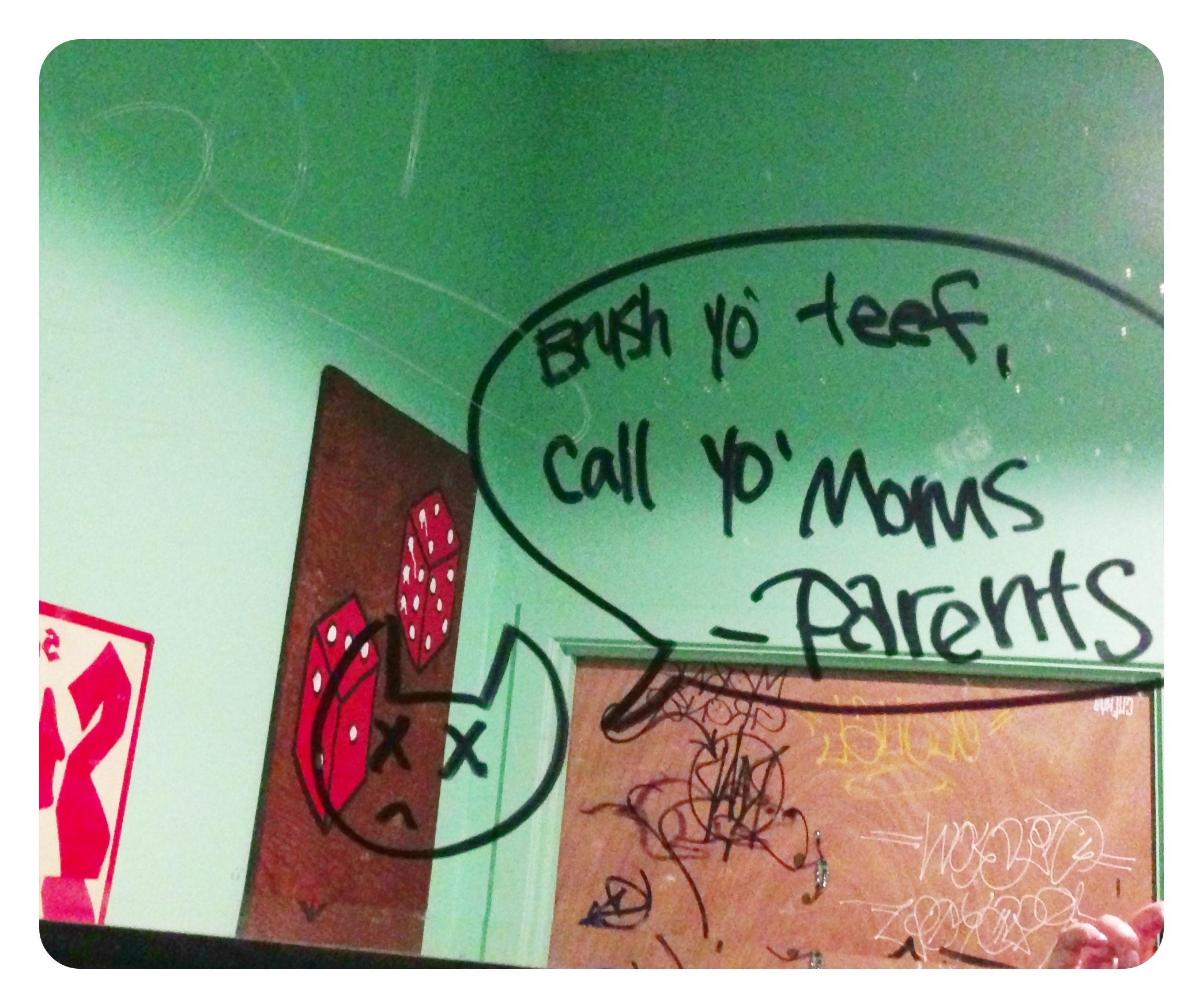
IMG_0662

A reader responds to our recent post on bathroom graffiti:

Oh, I think you’ve started a whole new thread here. My personal favorite, from an old-style English public convenience: “Here I sit broken-hearted; paid a penny and only farted.”

Another sends the above photo: “Here is my favorite from a mirror at Telegraph Beer Garden in Oakland, from ‘parents'”. Another reader:

Do I have what it takes to turn this one into a thread? Let’s find out.  I want to add another dimension to why people scrawl bathroom graffiti, which is group identity.

When I’m in the bathroom at a trendy or well-known bar or club, I often notice a big difference in tone and quality of the wall scrawling, compared to the average truck stop or gas station. Jokes that are actually funny, bits of poetry, or even running conversations are much easier to find. It seems like patrons want to demonstrate the value of their establishment in the kinds of things they write. Sometimes the jokes are so good that I wonder if some of the paid staff were instructed to write them to contribute to ambience.

Spontaneous case in point: at my small, very bookish liberal arts college, someone penned, in the grout between the tiles above a urinal, a pun playing off of the word “grout.” Other students found this so delightful that they started contributing additional grout puns along other parts of the grout. “Grout Expectations,” “The Grout Books,” etc. After a few years of many people adding more puns, it got to the point where you had to be very lucky, or have a very full bladder, to successfully think of a new one before your purpose at the urinal was spent.

Eventually, the grout puns spread to other men’s rooms on campus. I never discussed these puns aloud with anyone at school, but it was clear that all of the male students knew about them and that many of us contributed at one point or another. (I never found out if they spread to the women’s rooms.) How can one explain this popular, leaderless explosion of puns on the unlikely word “grout”? How else but that it nicely conformed with our self-conception as a student body of being clever, non-conforming nerds who read too many books?