The Creation Museum Of Movies

It’s easy to dismiss God’s Not Dead, the cringe-inducing film about an evangelical undergraduate who takes on his atheist professor, but Robert Geroux sees it as an emblem of what’s wrong with too much of conservatism, and conservative Christianity, in America these days:

I have a theory about contemporary conservatism generally, and the religious right more specifically. They’ve studied the post-68 playbook of the center-left. They’ve appropriated the language of civil rights, the student movement and identity politics and turned it in a new direction: targeting “religious discrimination,” cultural indifference and even aggression (the “War on Christmas”), and so on. Both then and now, many of these battles took place on college campuses. Kevin Sorbo’s arrogant professor is surely a distortion, but the persona is meant to resonate with conservative viewers, especially young people who have been told repeatedly that the secular classroom is the place where faith commitments are deconstructed and stripped-away, often painfully. In God’s Not Dead this myth becomes hyperbole: no philosophy professor requires – on the first day no less! – the disavowal of God. What the distortion discloses however is the cynical belief that the role of authority in the pursuit of knowledge and even wisdom is nothing more than a sham, a mere power trip, intellectual combat for its own sake. According to these terms, the young man in question doesn’t really belong in a Philosophy class, since he already has all the wisdom he needs.

We have to strip away the image here to get at the reality.

What parades as a liberating experience of “speaking truth to power” is in fact profoundly disingenuous. The position and situation of the young man in the film is merely one of nothing more than a mobilized series of stale tropes, tableaux that support a worldview in which evangelical Christians are an oppressed minority. That we know this isn’t true is beside the point. Films like God’s Not Dead are the ideological expression of this stance, of a piece with the Creation Museum and Fox News histrionics around the holiday season. What we see in films like this is the elaboration of a closed circuit, a symbolic gated community in which to live. No thanks. And it has to be said as well: the ideological edifice just isn’t a very good one. So far, every overtly evangelical work of pop culture I’ve experienced is a transparent piece of unconscious self-parody and abysmal kitsch.

Are You A Heretic?

In an interview about his recent book, Know the Heretics, professor and priest Justin Holcomb lays out a definition for the term:

A heretic is someone who has compromised an essential doctrine and lost sight of who God really is, usually by oversimplification. Literally, heresy means “choice”—that is, a choice to deviate from traditional teaching in favor of one’s own insights.

For Christianity, the Nicene Creed is a historic, globally accepted creed that encapsulates the Christian faith in a short and rich summary. If someone holds to the Nicene Creed, we should not call them a heretic. Not even if we believe they are in error on the details or on other doctrines. I think a good shorthand for heresy, is to ask, “Can they say the Nicene Creed and mean it without their fingers crossed?”

His take on the heresies most prevalent today:

I think many of the old heresies are repackaged today. For example, there is plenty Sabellian Modalism—the belief that God is one actor wearing three hats—floating around today. Also, I think a repackaged version of Pelagianism is most “live” today. (My summary of Pelagius’ heresy is “God has already given us the tools we need.”)

Pelagius correctly saw human nature as something good created by God, and there is no such thing as original sin. Adam’s sin in no way makes humans guilty or corrupt. Humans by nature have a clean slate — a state of neutrality — according to Pelagius. Potentially, then, one could live a sinless life and merit heaven, for there is nothing intrinsically sinful about humans. To me, this sounds like lots of the gobbledygook that is passed around today in popular Christian TV, radio, and publishing.

Behind The Screens

When the new Transformers movie, Age of Extinction, began filming in Chicago last year, Kevin B. Lee decided to make a behind-the-scenes documentary about how the filming affected the city. But he wasn’t the only one; he noticed “dozens of people standing across the street, most of them holding phones and cameras, doing the same thing I was doing.” So his project, Transformers: The Premake, took a twist:

The original idea for the Transformers documentary grew out of my dissatisfactions as a freelance film critic who spent most of his waking hours in front of screens. … Part of the reason I backed away from work as a critic and went to graduate school was so that I could spend more of my time interacting with people face to face. Similarly, I chose a film project that would allow me to connect with the physical realities behind the media that gets served up on our various screens.

But my encounters with so many other people filming their own videos made me rethink my whole approach. Frankly, it humbled me as a filmmaker, because it drove home the realization that everyone is a filmmaker now. I also realized that everyone in their own way was making their own version of Transformers, based on the small privileged glimpses they had of this massive production. I started to notice these videos popping up on YouTube, and not just from Chicago, but from Utah, Texas, Detroit, Hong Kong. After a weekend of keyword-spelunking through the caves of YouTube, I emerged with 355 videos that documented the production. In a sense, the documentary of the making of Transformers had already been made, in 355 pieces. Now it was a matter of figuring out how the pieces fit together.

Noel Murray appreciates the end result:

[W]hile Transformers: The Premake’s insights into modern life and modern moviemaking are depressing, the movie itself is anything but. Lee’s not really scolding the fans here; The Premake seems to acknowledge that big blockbuster explosions are fun to watch, and that it’s genuinely thrilling to catch a glimpse of Mark Wahlberg on the other side of a barricade. …

Transformers: The Premake is about the increasingly long cycle of build-up to the release of a major motion picture, and how studios defray the staggering costs by getting communities to provide tax breaks, and convincing local governments and businesses to work for them for nothing. Lee explores the myriad aspects of the complex ecosystem that’s developed, up to and including the way that studios allow some fans to hype their films for them, but shut others down. Lee puts it all together cleverly, contrasting the state censorship of China with the relatively benign (but still irritating) copyright claims of Paramount, and conveying the surreal experience of sitting inside of a Starbucks and watching a city pretend-crumble outside. In the end, Lee takes his cues from a piece of Age Of Extinction set dressing: a giant poster from the Chicago location that reads, “Report Alien Activity.” Transformers: The Premake does just that, thoroughly and entertainingly.

The full 25-minute documentary can be seen above. The Dish previously featured a browser-based short film here.

The Picture Of Controversy

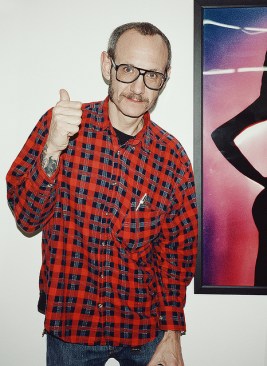
Early into his long profile of Terry Richardson, Benjamin Wallace sums up why the fashion photographer holds “a singular, controversial position” in his field:

He has cultivated a reputation of being a professional debauchee, a proud pervert dish_richardson who has, outside his commercial work, produced a series of extremely explicit images—often including himself naked and erect—that many find pornographic and misogynistic, and which can make viewers distinctly uncomfortable. In recent years, a number of the models in those images have indicated that they, too, weren’t altogether comfortable, filing lawsuits and, increasingly, speaking up in essays and interviews. Richardson has been called “the world’s most fucked up fashion photographer” by the website Jezebel, “fashion’s shameful secret” by the Guardian, and “America’s Next Top Scumbag” by Wonkette. Baron von Luxxury, a Los Angeles DJ, wrote a song called “Terry Richardson” with the lyrics “She’ll have a few more sedatives / I’ll have whatever comes next / And then I’ll burn the negatives.”
Callie Beusman rips Wallace to shreds for “consistently gloss[ing] over Richardson’s sketchy behavior.” Robyn Pennacchia shakes her head in disgust, and Mary Elizabeth Williams is also unsympathetic:

There are, to be fair, references to lawsuits “quietly settled” and some of the more vivid and troubling stories about the photographer, including Charlotte Waters’ account from earlier this year of a session in which “He also straddled me and started jerking off on my face. He told me to keep my eyes open super wide.” But the overwhelming image is of a man who grew up listening to his father banging Anjelica Huston in the next room and struggled with addiction, who now “meditates and attends AA meetings and exercises daily” but still “obviously misses the old Terry.” …

I find it more damning than anything else out there written about him, because it shows a man of deeply arrested maturity, a man who lives in “always the same clothing, always the same pose in front of the camera, always the same sandwich.” I don’t find understanding some of the reasons someone might be selfish and unfeeling toward vulnerable women any excuse at all; I just find it, if anything, more compelling evidence of the credibility of his accusers.

One of those accusers is Anna del Gaizo, who says she is bothered by “the fact that this man, who has announced with his actions that his desires, fantasies, and yes, his raging boner are more important than another human being’s state of mind or consequential distress, continues to be revered, hired, and supported by celebrities, professionals, and publications alike. And that’s really the problem here.” Tom Hawking, who finds Wallace’s profile “startlingly sympathetic,” doesn’t disagree:

The quality of Richardson’s art is beside the point. Throughout history, societies have been notably willing to indulge the whims of those it deems to be worthy artists, from the catankerous to the thoroughly unpleasant to the downright criminal. To an extent, this comes back to the good old question of art/artist separation. But … Richardson’s life and his art are so intertwined that it’s impossible to separate them. …

[W]e return [to] the fact that we’re talking about consent and exploitation, about a man coercing young women into situations they find threatening, and/or to do things they might be reluctant to do, or simply just don’t want to do. Richardson is a grown man in a position of power, and the accusation is that he has exploited this power to, in his own words, become “a powerful guy with his boner, dominating all these girls.” Sure, it’s perversely fascinating to know why this might be. But ultimately, the only really important question is how to stop it.

Related Dish on the conundrum of great art and its perverted purveyors here. Update from a reader:

Everybody acts like the Richardson situation is complicated, like it’s about whether or not its OK to explore sex in a passionate way, or if its OK to make art with strong sexual content. But I don’t think that’s what’s at issue here. It’s a pretty simple question of consent.

Richardson takes work situations and makes them sexual without explaining what’s going to happen upfront. He starts to shift things while the work is in progress, when the models are expected, by the conventions of their industry, to do what Richardson tells them to do. I assume it’s true that at least some women are glad to have an exciting experience, and to get really good photos from him. But it’s indisputably true that many, many other women feel pressured and uncomfortable, and in extreme cases, deeply violated by what he does.

If Richardson would fully disclose to the modeling agencies and models what he’s going to do, it would be ok. If Richardson said to a modeling agency, “Please send over an 18-year-old woman for a shoot, who is ok with my being naked during the shoot, and putting my penis in her mouth,” it would be better. If before the whole thing started, someone sat down with the young woman and said, “OK, this is what’s about to happen, we want to make sure you know about it ahead of time, and we want to be sure you’re ok with it,” then it would be a lot easier to defend.

But that’s not what he does. He takes young women who are desperate to break into the industry, starts doing a traditional shoot, and then transforms the whole thing into a porn shoot without any prior negotiation.

It’s not the sex that’s the problem. It’s ok to make porn movies, because the people who make porn movies all know what they’re doing, and go into the shoots. If someone goes to kink.com to shoot a movie, they know what they’re doing. But if, on the other hand, someone took a job as a lab technician at a pharma company, and found everything getting super freaky on their first day of work, with no prior warning or prior consent, that would be really wrong.

I’m uptight about sex, and I’m not exactly a sex positive person. But the sex life I have had has revolved mostly around BDSM, and consent is what makes BDSM possible. It’s not prudish to insist upon consent; it’s quite the opposite, because when you have clear communication and consent, the universe of what you can do expands enormously. Sexual freedom is predicated on the idea that adults can talk to one another about what they want, and ought to be free to participate or not, depending on how they feel about it. That’s what a sexually free world looks like.

Richardson acts like it’s his raw sensuality that causes all his problems. But there are lots of people making erotic images who manage to handle consent properly. It’s not like he wouldn’t be able to find collaborators in his projects who would be excited to work with him.

(Photo of Terry Richardson by Dave Tada)
The Trophy Wife Myth

A new study undercuts it:

To get to the bottom of the trophy wife myth, relationship inequality researcher Elizabeth McClintock analyzed attractiveness ratings, professions and socioeconomic backgrounds of couples from a nationally representative survey. McClintock combed the data for statistical correlations, looking for hints that successful men pair with attractive women.

She found, however, that attractive women weren’t necessarily pairing with rich guys – they were pairing with attractive guys. Like tends to attract like. The biggest statistical predictors of whether two people would get together were how similar they were in their educational background, race, attractiveness and religious views.

As Claire Hannum notes, a lot of previous research on the subject was flawed in a way that seems pretty obvious in retrospect:

In examining couples, [previous] researchers only looked at the women’s appearance and the men’s status and disregarded data on women’s status or men’s attractiveness. They were so certain they’d find a specific result (in this case, proof of exchange relationships) that the studies were skewed. More problematic to the skewed data is the fact that rich people are more likely to be good-looking, and vice-versa. …

Young women who marry these rich old dudes could easily have just as much status as their husbands, like the correlation between wealth and looks hints toward. By overlooking a full half of the equation and not even studying these ladies’ status level, researchers could have missed the fact that plenty of the supposed “trophy wife” marriages were actually matches rather than exchanges.

Jesse Singal observes, “McClintock’s study touches on some extremely important, fundamental questions about how we deal with gender in the social sciences”:

No one study can conclusively disprove the idea of beauty-status exchange, but this one certainly puts a sizable dent in it, and it offers a rather compelling-seeming reason as to how so many researchers could have come to believe this idea in the first place. …

Eli Finkel, a psychologist at Northwestern who studies relationships but who wasn’t involved in this study, expanded on this point in an email. “Scientists are humans, too, and we can be inadvertently blinded by their beliefs about how the world works,” he said. “The studies that only looked at men’s (but not women’s) income and only looked at women’s (but not men’s) attractiveness were problematic in that way, as was the peer review process that allowed flawed papers like that to be published. Fortunately, cases like that are the exception rather than the rule, and science tends to do a good job of ferretting them out. That’s what McClintock has done here.”

Update from a reader:

Too bad the episode of Tales From The Crypt that you featured didn’t include Danny Elfman’s great funny/scary intro. (It’s no wonder Tim Burton tapped him to do the songs for The Nightmare Before Christmas.) At 40 seconds into it, we get to hear the greatest squeaking door sound effect ever. I always wondered who created it, when, and in what other movies it’s been used. It never fails to make me giggle.

Listen for yourself:

Prose For The Road

Reviewing Patrick Leigh Fermor’s posthumously published The Broken Road: From the Iron Gates to Mount Athos, Daniel Mendelsohn samples the charms of the man “considered by some to be the greatest travel writer of the twentieth century”:

The author’s chattiness, his inexhaustible willingness to be distracted, his susceptibility to detours geographical, intellectual, aesthetic, and occasionally amorous constitute, if anything, an essential and self-conscious component of the style that has won him such an avid following. It has more than a little in common with the “centrifugal lambency and recoil” he found in Central European design, the “swashbuckling, exuberant and preposterous” aesthetic that he so extravagantly admired in a picture of Maximilian I’s knights, which he came across one night while leafing through a book on German history in the luxurious apartment of a charming girl he met and ended up staying with in Stuttgart. (The strange new city, the chance meeting, the aesthetic reverie, the hints of money and eros: this would prove to be the pattern of the young man’s progress across the continent.)

It is indeed odd that, among the many classical authors to whom Leigh Fermor refers in his writing—none more famously than Horace, verses of whose Soracte Ode the author found himself swapping, in Latin, with a German general he had kidnapped on Crete during World War II, a famous incident that was later turned into a film starring Dirk Bogarde—Herodotus does not figure more prominently. There is no writer whose technique Leigh Fermor’s more closely resembles. Expansive, meandering, circular, it allows him to weave what is, after all, a relatively straightforward tale of a youthful backpacking hike into a vast and highly colored tapestry, embroidered with observations, insights, and lessons about the whole panorama of European history, society, architecture, religion, and art.

When Leigh Fermor died in 2011, David Bentley Hart paid enthusiastic tribute to his writing:

He was…a man of boundless erudition: a classicist, a linguist, an historian, deeply and broadly read, widely and wisely traveled, with impeccable taste in literature and the arts. As it happens, his formal education was of the most irregular and intermittent kind. He was sent as a boy to a “progressive school” (which was something of a nudist colony), had a good private tutor for a while, got himself expelled from Canterbury’s King’s School, was drummed out of Sandhurst before beginning studies, and never attended university. And yet few men of his time could match him for breadth of learning.

Early on in life, he acquired a passion for Greece and all things Byzantine (in part, under the influence of Robert Byron). He even celebrated his twentieth birthday by staying at the Russian monastery of St. Panteleimon on Mt. Athos, and his book Roumeli includes some of the most illuminating writing on Orthodox monasticism in English. (Even Leigh Fermor’s close friends seem uncertain whether he had any particular religious convictions, but he definitely had a fascination with the monastic life.) And for a great deal of his life, he kept his home in southern Greece.

In the end, Leigh Fermor will chiefly be remembered for his prose , which has few credible rivals in modern English letters. He was an exacting and excruciatingly slow writer, by all accounts. He could polish a single sentence obsessively, draft upon draft, for months on end. Nothing went to print before it met his highest standards, which were already far higher than most of his contemporaries could hope to achieve. He also spent a great deal of his life living rather than writing. The result is that, when one adds up the sum of his published works, one sometimes cannot help but feel he was a little parsimonious towards his readers.

Dreher recently discovered Leigh Fermor as well, and offers similar praise, especially for his A Time of Gifts. Check out his excerpt-heavy posts on the man here, here, and here.

A Death Knell For “Disruption”?

Jill Lepore has had enough of it:

Ever since The Innovator’s Dilemma, everyone is either disrupting or being disrupted. There are disruption consultants, disruption conferences, and disruption seminars. This fall, the University of Southern California is opening a new program: “The degree is in disruption,” the university announced. “Disrupt or be disrupted,” the venture capitalist Josh Linkner warns in a new book, The Road to Reinvention, in which he argues that “fickle consumer trends, friction-free markets, and political unrest,” along with “dizzying speed, exponential complexity, and mind-numbing technology advances,” mean that the time has come to panic as you’ve never panicked before. …

Most big ideas have loud critics. Not disruption. Disruptive innovation as the explanation for how change happens has been subject to little serious criticism, partly because it’s headlong, while critical inquiry is unhurried; partly because disrupters ridicule doubters by charging them with fogyism, as if to criticize a theory of change were identical to decrying change; and partly because, in its modern usage, innovation is the idea of progress jammed into a criticism-proof jack-in-the-box.

It’s not just an overused buzzword, she argues. In fact, the influential concept of “disruptive innovation” is probably bunk:

Disruptive innovation as a theory of change is meant to serve both as a chronicle of the past (this has happened) and as a model for the future (it will keep happening). The strength of a prediction made from a model depends on the quality of the historical evidence and on the reliability of the methods used to gather and interpret it. Historical analysis proceeds from certain conditions regarding proof. None of these conditions have been met. … The handpicked case study, which is [Innovator’s Dilemma author Clayton] Christensen’s method, is a notoriously weak foundation on which to build a theory.

Timothy B. Lee will hear nothing of the sort:

[T]he term “disruption” has often come hand in hand with a certain amount of hucksterism. People who have no connection to Christensen, many of whom don’t seem to even understand his theory, have declared everyone and everything to be disruptive. The problem has become so bad that that many intelligent people have begun writing it off as a meaningless buzzword. Yet Lepore’s nitpicking aside, Christensen’s theory has a lot of explanatory power. It’s impossible to talk about what’s happening to companies as diverse as Kodak, Microsoft, and the New York Times without the vocabulary and concepts Christensen developed. And while understanding the theory won’t solve all the problems these companies face, it will certainly allow them to make more thoughtful decisions than if they follow Lepore’s advice and write it off altogether.

Will Oremus has a measured approach:

Lepore’s piece largely succeeds in skewering the zaniest of the “disruptive innovation” zealots and highlighting the fallibility of their prophet and holy text. And her revisionist reading of Christensen’s book adds some important caveats to his model. Importantly, the “disruptors” don’t always win in the end, and in some cases established businesses might harm themselves more by overreacting than underreacting. It would also be a great service if Lepore’s story had the effect of making people stop and think before they throw around “disrupt” as a buzzword. That said, Lepore’s cherry-picked counterexamples don’t definitively overthrow Christensen’s theory any more than his own cherry-picked examples definitively prove it.

Drake Bennett wonders, “If the evidence is, in fact, more ambiguous, why have Christensen’s ideas proven so broadly popular?”

Some part of it is clearly the rise of the Internet. In the age of Uber and Craigslist, the idea certainly feels true (particularly to those, like journalists, whose business is feeling disrupted at the moment).  … Part of it, too, I’d argue, is that Christensen’s description of how the world works matches how Silicon Valley sees itself, and Silicon Valley has gotten a lot more culturally important. The disruption narrative is one in which the upstarts are the heroes. Their eventual victory over the established order is foreordained, and they are the force that moves society – or at least technology – forward, disruption by disruption. Starting a company holds the potential to be not only lucrative, but also revolutionary.

At the same time, Kevin Roose resents the way some use the term as an “all-purpose rhetorical bludgeon [to] distract us from the real issues with emergent products and companies”:

Frequently, when start-ups working in heavily regulated industries encounter resistance from lawmakers or industry overseers, the concept of disruption is invoked almost instinctively. “But we’re disruptive!” the start-up pleads. “How can you be against disruption?” The problem with this reaction is that it lumps all opposition to new technology into the same category – anti-progress Luddites protecting the status quo at the expense of innovation. In reality, motives differ widely. Maybe a flashy new biotech start-up is being opposed becuse regulators are in the pocket of Big Pharma. Or maybe the FDA is holding it up because the founder is a charlatan selling fake stem-cell treatments to children. When every new innovation is cast as disruptive, there’s no way to distinguish between legitimate opposition and mere protectionism.

Does Drinking Seawater Make Sense?

Yoram Cohen argues for more desalination:

Critics contend that reverse osmosis desalination requires large amounts of energy. But so do our home refrigerators, air conditioners, and washing machines. The real issue is the cost of water desalination relative to other available sources. For example, bottled water costs range from $1 to $3 per liter in the U.S., depending on the brand and location of purchase. In comparison, seawater desalination costs can be as high as about $0.45 per 100 liters and about $1.50-$2.00 per 1,000 liters for large-scale production. Of course, the above cost does not include conveyance of the water to the customer.

Over the years, intensive research and development efforts have been devoted to lowering the energy cost of reverse osmosis seawater desalination with tremendous success. Since about 1990, energy costs have decreased by nearly 75 percent for large-capacity plants.

But Eric Holthaus instead recommends recycled water:

While it’s not quite correct that every glass of water contains dinosaur pee, it is true that every source of fresh water on Earth (rainfall, lakes, rivers, and aquifers) is part of a planetary-scale water cycle that passes through every living thing at one point or another. In a very real way, each and every day we are already drinking one another’s urine. …

Barring a miracle, desalination is among the least desirable options. There are significant economic, environmentalenergy, and political barriers. Desalination is the Alberta tar sands of water resources. When you look closely at the choices, it’s clear the future of Western water supplies is toilet water.

Can Female Candidates Save The GOP?

Maybe not:

Since 1980, presidential campaigns have on average produced a 15-point gender gap. That is, the difference between Democrats’ advantage among women and Republicans’ advantage among men is generally 15 points. So, for example, Democrats win women by 8 points and Republicans win men by 7 points: 8+7=15. …

Now, using 15-17 points as the baseline gender gap, we looked at eight marquee Senate races between 2006 and 2012 in which Republican nominated a female candidate. According to exit polls and the last available pre-election polls (where exit polls were not available), the average gender gap for women in these eight races was … wait for it … about 15 points (14.5, to be exact).

John Sides isn’t so sure:

At least one piece of academic research offers a somewhat different conclusion. In a 2005 article entitled “Women for Women?,” political scientist Craig Brians examined voter behavior across 300 different House races from 1990-2002 in which female and male candidates squared off.

Brians found a modest tendency for female voters to support female candidates more than male candidates: 55 percent of women voted for the female candidate while 45 percent vote for the male candidate. Men’s votes were split 50-50.

Meanwhile, Marcotte notes the considerable challenges that female candidates of all parties candidates face:

After performing 45 interviews with experienced candidates and officeholders and holding multiple focus groups with other politicians and staff members, the [Institute for Women’s Policy Research] found that women had smaller networks than men to access for funding, faced sexist nonsense while campaigning, and had far less support on the homefront than male candidates, who can often depend on a wife who devotes herself to his career full time.

One thing the researchers did not find is that women lack ambition. “Ambition is not an issue or a deficit with these women,” Denise L. Baer and Heidi Hartmann, the study’s authors, write. “Most women self-recruited for their first office or campaign, and only one in four say others recruited them for their first office.”

Previous Dish on Project GROW, the GOP’s attempt to recruit more female candidates, here.

Why Does Academic Theology Skew Liberal?

Michael Peppard grapples with the question, offering this answer – “under the current conditions, few conservatives want to become professors”:

[A]cademic theology shares a similar model for research as the rest of the university: one must consistently produce new knowledge about the world; the process of double-blind peer review is the gold standard; notions of scientific repeatability in analysis are also applied to the “data” of theology and religion. Theology as done in the university is usually investigative, exploratory, and boundary-pushing. …

Which conservatives, then, are likely to find a calling to the academy, as it is currently organized? I would say those who are substantively conservative (e.g., have conservative topics of inquiry, scholarly conclusions, or policy prescriptions for society) can in most cases find a successful and happy spot in the academy, as Matthew Woessner’s research has found. But that substantive conservatism will probably need to be combined with a liberal temperament that continually seeks newness and a research procedure that challenges at least some authoritative traditions in ways that secular peers recognize.

Dreher nods, wondering if this explains the ideological tilt of his own profession, journalism:

I think that succeeding in journalism requires a high degree of questioning authorities and institutions, and that liberals are in general more predisposed to do that. The problem with this is that newsroom liberals are in general highly disinclined to question their own assumptions.