Trying To Stand It

After becoming convinced that his sedentary lifestyle posed a major health threat, Dan Kois decided to spend a month on his feet. (He made exceptions for driving, using the bathroom, and, once, attending a play). His thoughts toward the end of the experiment:

Hit wall. Completely fucking dead. Wife rubbed my feet tonight. If Sitting Dan got a foot massage from his wife, he’d thank her. Standing Dan is a whiny asshole. Email to friend: “If a nun gave me a $100 bill I would be like, screw you, my legs hurt.”

What he learned:

[T]his enforced standing has made me realize how much of my time bonding with my family is spent seated. Now we play Crazy Eights with me hulking over the table like a grudgingly accepted giant. I’ve begged off story time because my kids don’t like craning their necks to see the pages, and I find it maddening not to be able to snuggle with them in bed. At the beach house we shared with my in-laws for Easter weekend, I was completely unable to relax or join anyone else in relaxing. … It all came to a head at Easter dinner, during which I stood straight up as if in a Last Supper parody, loved ones assembled to each side, my roast lamb perched on that stupid aluminum work tray. All I wanted to do was just be for a little while! Instead, I could never stop thinking about my dumb, clumsy, painful body, not for a second. …

My month has been an ordeal, but it’s clearly succeeded. I’ve lost almost five pounds and gained muscle in my legs, especially my calves. I’ve cut my time-wasting drastically, editing and writing more than in any month I can remember. I’ve walked 92.5 miles, basically without trying.

An Anthology Of Other People’s Mail, Ctd

Recently we featured the blog-turned-book, Letters of Note, an eclectic archive of correspondence from both the famous and unknown. Andrea Denhoed recently talked to Shaun Usher, the project’s mastermind, offering a glimpse of how it all works:

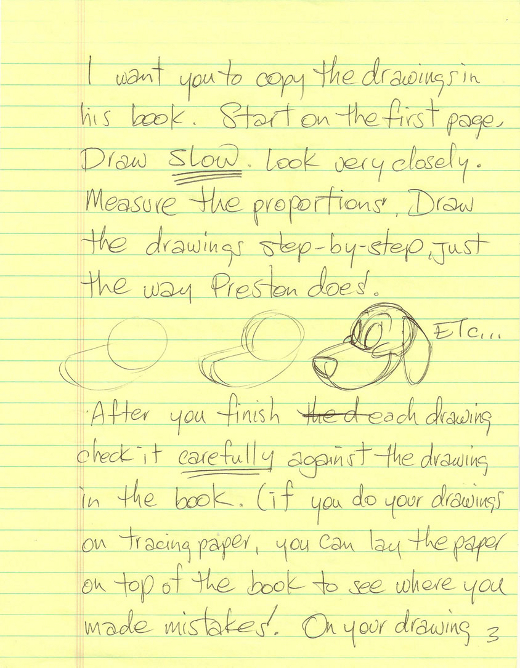
The success of “Letters of Note” is certainly a tribute to the charm of written correspondence, dish_renstimpyletter but it’s also evidence of the value of a supportive spouse—Usher’s wife, who was working as a manager for a cosmetics company, supported the family alone for most of two years before his work became profitable—and the indispensability of tireless trench work. These days, Usher receives a steady flow of submissions and has connections with a number of archivists. Starting out, however, there was much more digging involved. He says, “In those days … I’d get a list of famous people and I’d type into Google, I don’t know, ‘Stan Laurel letter’ and I’d literally just search about Google to see what I could find. And it worked to an extent.” His first letter to go viral was found this way, several pages into the search results. It’s an unusually kind and lengthy letter to a young fan from John Kricfalusi, the creator of the cartoon “Ren and Stimpy.” It included sketches, encouragement (“Alright Bastard, let’s get to work. Draw!”) and practical cartooning advice (“Learn how to draw hands.”)

The project’s popularity, however, has brought its own frustrations:

Usher estimates that he reads at least twenty unusable letters for each one that he ends up including. He says, “I’ve bought hundreds of books purely to find one letter I just had a hunch might be in there.” With his success, a new problem has cropped up: he also receives a huge number of unusable submissions. He’s been sent a few, he says, that are too scandalous to post. “It’s so frustrating,” he says. But “I’d get sued pretty quickly.” Far more often, he gets “very personal letters—from their grandma, or their grandpa … and it’s this very lovely letter. But I receive so many of them, and I’ve seen them so many times that they’re not …” He trails off, like he can’t quite bring himself to say that these precious family heirlooms can be boring. “I have to write some very tactful rejection letters.”

The idea behind the Letters of Note project—that correspondence holds a rare communicative and aesthetic power—also happens to be well calibrated for the Internet. It hits on a juncture of Pinterest-style object nostalgia, an appetite for emotive but bite-size reading, and a mild voyeurism. Usher points out the irony that “the very service that’s going to kill off letter writing” is responsible for bringing these missives before so many eyes.

(Image: Page from John Kricfalusi’s letter via Letters of Note)

Reading Above The Din

Although Tim Parks grants that today’s readers are willing to put in time for lengthy novels like Karl Ove Knausgaard’s multi-volume My Struggle or the Lord of the Rings trilogy, he finds that “the texture of these books seems radically different from the serious fiction of the nineteenth and early-twentieth centuries. There is a battering ram quality to the contemporary novel, an insistence and repetition that perhaps permits the reader to hang in despite the frequent interruptions to which most ordinary readers leave themselves open.” So what does this mean for fiction?

“In a good novel—it hardly needs to be said—every word matters.” Thus Jay Caspian Kang giving us the lit-crit, text-is-sacred orthodoxy in a recent New Yorker blog post. Honestly, I wonder whether this was ever really true; authors have often published then republished their work with all kinds of alterations but arguably without greatly changing a reader’s experience (one thinks of Thomas Hardy, Lawrence, Faulkner), while many readers (myself included), in the long process of reading a substantial novel, will simply not register this or that word, or again will reread certain sections when they’ve lost their thread after a forced break, altering the balance of one part to another, so that we all come away from a book with rather different ideas of what exactly it was we experienced during perhaps a hundred hours of reading.

But today Kang’s claim seems less and less likely to be true. I will go out on a limb with a prediction: the novel of elegant, highly distinct prose, of conceptual delicacy and syntactical complexity, will tend to divide itself up into shorter and shorter sections, offering more frequent pauses where we can take time out. The larger popular novel, or the novel of extensive narrative architecture, will be ever more laden with repetitive formulas, and coercive, declamatory rhetoric to make it easier and easier, after breaks, to pick up, not a thread, but a sturdy cable. No doubt there will be precious exceptions. Look out for them.

In response to Parks, Corey Robin confesses to taking long subway rides to no place in particular in order to find time to read:

I take nothing with me but my book and a pen. I take notes on the front and back pages of the book. If I run out of pages, I carry a little notebook with me. I never get off the train (except, occasionally, to meet my wife for lunch in Manhattan.) I have an ancient phone, so there’s no internet or desire to text, and I’m mostly underground, so there are no phone calls.

When I get back, I sometimes post about my little rides and what I’m reading on Facebook: Schumpeter in Queens, The Theory of Moral Sentiments in the Bronx, Hayek in Brooklyn. The more incongruous, the better, though sometimes I find some funny or interesting parallels between what I’m reading and where I’m riding and what I’m seeing.

But the joking on Facebook covers up my dirty little secret: I ride the rails to read because if I’m at home, and not writing, I’m on the internet. “It is not simply that one is interrupted,” as Park writes; “it is that one is actually inclined to interruption.”

Freddie recommends turning off “the part of your mind that cares about getting finished quickly”:

A project book is one that you want to take a long time with, often one that necessitates taking a long time with. And though so many of your instincts are going to militate against it, you should stretch out into that time. Get comfortable. Think of your project book as a long-term sublease, a place that you know you won’t live in forever but one that you also know has to come to feel like home. You want to take months, reading little chunks at a time. It might offend your bookworm nature, but I find it’s useful to make a regular appointment– for this hour, twice a week, I will read this book and ancillary materials about it. Think of it like appointment television, if that suits you. Learn to enjoy the feeling of not being in complete control over what you mentally consume all the time, a feeling that has become rarer and rarer.

The Battle Over Iraq’s Oil

Iraq’s largest refinery has come under attack:

The refinery accounts for more than a quarter of the country’s entire refining capacity, all of which goes toward domestic consumption – petrol, cooking oil and fuel for power stations. At the height of the insurgency from 2004 to late 2007, the Baiji refinery was under the control of Sunni militants who used to siphon off crude and petroleum products to finance their operations. Isis has used its control of oilfields in Syria to boost its coffers.

Any lengthy disruption at Baiji risks long lines at the petrol pump and electricity shortages, putting further pressure on the Shia-led government of the prime minister, Nouri al-Maliki.

Ari Phillips checks in on the Iraqi oil intended for export:

“Most of the oil fields in the region are around Basra between Iran and Kuwait, so they aren’t really under threat right now and I doubt they will be,” Peter Juul, a policy analyst specializing in the Middle East at American Progress, told ThinkProgress. “Unless somehow ISIS runs the table and takes over the entire country, which would lead to general chaos — but I don’t think that will happen.”

Rob Wile explains what a disruption of the southern oil fields would mean:

If the conflict migrates to the South, we could be looking at $160 a barrel, [Bank of America Merrill Lynch] says.

Our commodity research team believes that in the unlikely event ISIS invades the South and the entire 2.6 million b/d of southern oil production is lost, oil prices could face $40-50/bbl upside. Further immediate risks to production seem limited under the base case scenario where oil prices remain around $110/bbl. The bulk of Iraq’s oil fields are located in the Shia South, far from the conflict zones.

The Guardian assesses the situation:

Output from Iraq reached an all-time high of 3.5 barrels a day earlier this year and remains at a high level but output is hampered by a lack of export capacity made worse since a northern pipeline was blown up.

The key oilfields in Iraq have largely escaped the real impact of the fighting because they are located in the south of the country. But threats to oil workers of kidnapping, coupled with corruption and equipment shortages, have already hampered their development.

China is already considering its other energy options:

While Iraq has been growing in importance as a source for China’s energy needs, that’s likely to change if the crisis continues much longer. China may instead focus more on tapping oil in Russia, Iran, and Oman, according to Li Li, research and strategy director at ICIS C1 Energy, a Shanghai-based energy information consultancy, English-language China Daily reported.

Engaging The T, Ctd

photo (3)

A reader revives a recent thread with a fascinating personal story:

If you choose to use any of this, please scrub my name from it.  I am a transgendered woman who has, in fact, committed the unpardonable sin of transitioning and then, largely, being done with the whole thing.  The vast majority of people in my personal life have no idea, and almost no one in my professional life does. Now that’s because I pass very well, which is both a matter of luck and a matter of will. It was luck because I didn’t shoot up to an inconvenient height, nor were my hands or feet inconveniently large, but it was will because I tried to just be an ordinary woman of my generation (born in the late 1960s).

In the last decade or so, I have seen transgender activism take on the idea that gender is “constructed” and that the “medicalization” of being trans is a horrible thing.  It seems short-sighted in the extreme – at least for those of us who have a difference of opinion between our self-image and our secondary sexual characteristics.  I say that because just as Medicare and other providers are finally starting to cover SRS (sex reassignment surgery) and hormone treatments, the activists are trying to make the case that none of that is necessary.   It has taken activists two decades and more to get us to this place, and just as we are starting to see the light at the end of the tunnel, they are trying to not just pull the rope up, but burn it.

Why? Because some transgender people are not able to pass and/or some transgender people have a hard time finding work (whether because of passing issues or unwillingness to conform, even the least bit, with the kinds of behavior necessary to secure a well-paying job).

I agree, mostly, with your assessment that those of us who are minorities may be in the uncomfortable position of having to educate people and answer questions because we may be the first person someone outside our little social category may have had significant interaction with. It isn’t really fair, but better to learn it from someone within the group than to persist in ignorance or, worse yet, to learn it from someone hostile to the group.  I do part company with you on the issue of genitalia, however.  That is a really intrusive question and one that I think is reasonable for me to divulge to anyone I am dating, any medical professional, any mental health professional and to select friends. It isn’t for public consumption, however.

You wrote this:

The transgender desire not to be trans-gender but to be one gender physically and mentally is actually quite an affront to queer theorists for whom all gender and sex are social constructions. Many of these people want testosterone and estrogen and surgery to end their divided selves. And it doesn’t get more crudely biological and not-social than that. Which means that there are also divisions within the trans world between those who might be able to pass completely as another gender, after reassignment surgery, and those whose visual ambiguity or androgyny will remain.

Here is where I really have parted company with what has become of the trans-movement in the last decade or so.  When I transitioned in the early 1990s, the idea was to move through being transgendered and into just being a woman (or a man, for my FTM brothers). Now, it seems the point is to be neither a man nor a woman.  What’s more, well-adjusted and socially successful transgendered people like myself are a profound threat to the activist and academic portions of the movement because we violate the narrative.

As a black transgendered woman, the narrative is that I have found it difficult if not impossible to find work that pays me more than a pittance. What’s more, I am supposed to have spent some time as a prostitute. As a transgendered woman, the narrative is that I am socially shunned and ostracized and only other transgendered people or “allies” will have anything to do with me.

None of that has applied to me, and it has not applied to me in a very visible fashion.  I have not worked with someone who knew I was trans since the mid-nineties, when I told a boss that I was trans because I knew that I was going to need surgery and thus need to take some extended time off. Since my boss at the time was a lesbian, I thought it was a good risk.  To give you an idea of how well I pass, when I told her she was fine, but the next day a couple of my coworkers, who were also gay and whom I had told first to see how our boss would react, said I needed to clarify some things for her.  She actually had thought I was moving in the opposite direction (FTM instead of MTF) and was worried because, as she put it, “I just can’t see a femme like her as a boy”.  We all had a really good laugh about that.

This was while I was working at a large software company in the San Francisco Bay Area. Does that sound like rejection and ostracism? It doesn’t to me, and I didn’t experience it that way. It remains, to this day, one of my favorite memories from the time in my life where transitioning was still something I was doing and not something I had done.

One other thing you get right is that, in fact, from the point of view of the queer theorists and the activists who follow them, wanting hormones and surgery is a profoundly conservative impulse as defined by the theorists and activists.  Like marriage equality it does cede some realities that in a certain (politically) correct light be seen as conservative. In the latter case of marriage equality, it absolute cedes the conservative idea that marriage is a stabilizing force in the lives of individuals and communities. In the former case it concedes the “gender binary,” at least in as much as it doesn’t try to construe being transgendered as a third, fourth or twelfth gender and instead cedes that for the vast majority of people male and female more or less accurately.

One of the results of this has been that transwomen like myself have largely stepped back from the community and do not mentor people newly in transition.  It is not that I don’t want to; it’s that I don’t think I have anything to offer. Rather, it is that what I have to offer puts me at odds with a lot of the trans community – at least that portion of it involved in conceiving “theory”. I am very pragmatic in my approach to transition. Questions I think a trans person needs to ask and find answers to are:

1) Am I going to stay in a field that I started as my birth gender or am I going to find a new career?  (For me, I started young enough that I didn’t have a career, so I got into one because of the need for regular money in sums above and beyond sustenance levels and regular, reliable health insurance coverage)

1a) If the former, what do I do with my work history?

1b) If the latter, what kind of jobs can I find where I will make enough to actually be able to do this?

2) How am I going to broach this subject with my friends and family?

3) How do I do this?

These are no longer questions to ask, according to queer theorists.

I applaud your courage in taking on this topic.  You are going to be flamed for it as sure as there will be men in Speedos at Gay Pride parades in a couple of weekends.

Another reader circles back to the beginning of the thread:

Kevin Williamson’s essay may be over the top in its callousness, but I have to say, I read a lot of lefty sites/news outlets, and the focus on “the T question” sort of takes me aback. Why so much focus for what may be, as you note, as little as 0.1 of the population? Why is this the premier civil rights question of our lifetime, as trans folks might have it?

Worse than this is the impulse, which you address, among trans activists to essentially burn down the existing societal framework due to its inherent oppressiveness and replace it with something new – something that people like myself, a married suburban father who bears no ill will toward the transgendered community – will be required to accept.

For example, the use of the term “cisgendered.” We’re now supposed to use this at all times, you realize; I’m supposed to refer to myself as “cisgendered,” as a rhetorical means of leveling the playing field. The 99 percent or 99.9 percent must now adopt the rhetorical demands of the trans activists lest we reveal ourselves to be utterly hateful.

But you know what? I don’t use the term “cisgendered” and I will not use the term “cisgendered.” I think the term itself and the supposed logic behind it are ridiculous. Do your own thing; live your own life, and I will insist that however you choose to do so, you are accorded the same legal rights and privileges that every other American possesses. But when that’s not good enough – when my refusal to think of myself as “cisgendered” or use the term marks me as a bigot – I’m off the bus.

Update from a reader:

Your reader is claiming that an unknown group of straw trans-men and women are forcing him to use the term “cisgendered” to describe himself. To which I say, what planet do you live on??  “Cisgender” is an academic term adopted by some in the trans community to describe those who do, in fact, associate with the gender of their birth. Why your reader is so incensed that trans folks call him “cisgender” is beyond me. Why he thinks he’s now required to call himself that is a question for the ages. I have seen no movement, even among the most nutjob of activists, to force the term “cisgender” on the American citizenry.

Your reader, in short, is no bigot, but sounds like my parents did in 2006: “We support you, but why do you have to call it marriage?” (I’m thankful to report they were fully on the marriage bandwagon within five years after that.)

(Photo: The bedroom door of a Dish reader’s 15-year-old daughter)
No Gas For U!

As promised, Russia’s energy giant Gazprom cut off gas exports to Ukraine on Monday due to the country’s unpaid bills. But the company says gas will still flow to Western Europe through trans-Ukrainian pipelines. This is obviously not just about payments:

The previous disputes in 2006 and 2009 were largely about payments and price levels – and agreements were eventually reached in a more-or-less business-like fashion. The current situation, which has flared in the wake of Russia’s annexation of Crimea and the on-going conflict in Eastern Ukraine makes it clearer than ever the way in which the Kremlin uses energy exports as a geopolitical lever.

In this context, it is difficult to see how a lasting agreement on gas prices can be brokered without a wider agreement between Ukraine, the EU and Russia on Ukraine’s future and its territorial integrity. The gas dispute is a litmus test of the wider geopolitical crisis and, with no resolution in sight, it promises to be a worrying winter for gas consumers in Europe.

Walter Russell Mead sees the gas war as yet another clever coup for Putin:

All of this is being done with plausible deniability in mind. Moscow is carefully flying below the radar here, not escalating the provocations to the point of formal aggression, but nevertheless having the same effects on Ukrainian stability and viability. Putin is counting on the irresolution of a divided West: as long as the waters are muddy, it’s easier for European countries sitting on the fence to hesitate about taking tougher measures.

With natural gas prices rebounding from a steady decline this spring, Putin is getting more spending money just when he wants it. Put that together with instability in the Middle East—a reminder to Europe that it isn’t easy to free itself from dependence on Russian energy—and it seems that Putin is holding all the good cards these days.

But markets, somewhat surprisingly, aren’t freaking out. Jason Karaian offers several reasons why:

Despite the pipeline explosion, a parallel line was able to carry gas to Europe without too much disruption, Ukraine’s gas company said (link in Ukrainian). The current dispute is also taking place in the warmer months, whereas previous cutoffs came during the dead of winter. The 2011 opening of the Nord Stream pipeline, which pumps gas from Russia to Germany, has reduced the EU’s reliance on gas piped via Ukraine. And, across Europe, gas reserves are unusually high following recent mild weather, and unlike in 2006 and 2009, the pipelines that normally ship gas from Ukraine to the west are now able to reverse their flows, if need be. For these and other reasons, the markets see the dispute as more of a skirmish than a full-blown war.

The Dish previously touched on the natural gas dimension of the Ukraine crisis here.

“The Occupation Is Indefensible”

In a lengthy and powerful reflection inspired by Israel’s outsized response to the kidnapping of three yeshiva students in the West Bank on Friday, Max Fisher announces that he is finished blaming the Israeli-Palestinian conflict on “both sides”:

There has always been, and there remains, plenty of culpability to go around in this conflict, plenty of individuals and groups that squandered peace and perpetuated suffering many times over. Everyone is complicit and no one is pure. The crisis over the kidnapped students shows all this. But it is also highlights what has become perhaps the most essential truth of the Israel-Palestine conflict: for all the complexity of how it came to be and why it’s continued, for all the shared responsibility for this week’s crisis and everything that led up to it, the conflict predominantly matters for the human suffering it causes. And today the vast majority of that suffering comes from Israel’s occupation of the Palestinian territories.

Today, the suffering has become so disproportionately administered by the occupation and so disproportionately felt by Palestinians that, in a conflict famous for its complexity and its gray areas, this is an issue that looks less gray all the time: the occupation is wrong, it is the problem, and Israel is responsible. …

Ha’aretz columnist Gideon Levy generated anticipatable controversy when he wrote that “if, in the West Bank, yeshiva students aren’t abducted, then the West Bank disappears from Israel’s consciousness.” To many, this sounded as if the column were encouraging Palestinians to abduct school-age Israelis; to others, presumably including the columnist himself, it may have rung true as a description of many Israelis’ apathy to the suffering of West Bank Palestinians.

Here’s what has happened in Hebron as a result of the kidnappings:

In the three days since, the Israeli military has descended on the southern part of the West Bank where the yeshiva students disappeared, and especially on the major Palestinian city of Hebron. I happened to visit Hebron the day before the kidnapping and found it already suffocated by occupation. Dozens of Palestinians have been arrested; some estimates say 120, some nearer to 80, but all agree that it includes the entire population of middle-aged and older men who work for Hamas’s political branch (remember that they are also a political party). The military has severely restricted Palestinian movement in Hebron, forbidden residents under age 50 from leaving the country, and completely shut down all movement in or out of Gaza and the southern West Bank save for “humanitarian and medical assistance.”

I don’t know how you live in a place where a foreign army can do this to you at will at any time. And I do not begin to know how you live with it for decades and decades, as the occupation continues to advance by colonizing and settling. Until the United States is capable of ending aid to Israel unless it ceases its illegal and immoral attempt to control and repress a whole nation under its thumb, this will go on. In so many ways, this is America’s colonization as well. Until we have the foresight and sanity to cease our enabling of it.

The Enemy Of My Enemy Is My Frenemy? Ctd

Daniel Berman doubts the US can cooperate with Iran on Iraq. Not only does Rouhani lack the clout to do a deal with the Great Satan, he says, our interests there are not really aligned – a fact Iran hasn’t forgotten, even if we have:

Iran, is not … unduly concerned about the breakdown of the Iraqi state. While Tehran does not desire a Sunni Islamist Iraq, it doesn’t particularly want a multicultural or even strong Shia led Iraq either. Such a state, especially if it remains democratic, would IRAN-IRAQ-US-UNREST-ROUHANIpose a serious threat to the legitimacy of the Iranian regime, especially given the relatively “liberal” outlook of Iraq’s Shia clergy compared to Iran’s. Many senior Iraqi clerics showed sympathy for the Green Movement in 2009 and Iran is not interested in a repeat.

The best shot Iran has at preventing one is for Iraq to be dominated by a weak Shia regime in the south and center dependent on Iranian military support. Such a government would be unable to seriously oppose Iranian policies, or to allow its senior leaders to criticize Iran’s internal arrangements. It would also allow Iran to effectively exclude the United States from the country, something that would be harder in a state with substantial Kurdish and Sunni influence. Iran therefore has an interest in supporting Maliki to the extent that the fall of Baghdad is prevented, but has no real reason to want to win his war for him. This is also why the United States should not raise its expectations too high regarding cooperation with Iran. The goals of the Iranian and American governments in Iraq are still far too great.

A cautious Frum asks why we should protect Maliki when he’s really Tehran’s guy, not ours:

Now, the most extreme and brutal of the anti-regime forces inside Syria has turned against Maliki. He is seeking American help, and Maliki’s patrons in Tehran appear content to see the United States rescue their client. According to some reports, the Iranians view U.S. aid to Maliki as a strategic partnership that could smooth the way to a nuclear deal more favorable to them. Is this situation not utterly upside down? It’s Iran that has a vital interest in the survival of Maliki, not the United States. It’s Iran that should be entreating the U.S. for assistance to Maliki—and Iran that should be expected to pay the strategic price for whatever support Maliki gets.

Abbas Milani sees cooperation between Iran and the US as a heavy lift:

Both in Iran and the U.S., as well as the Middle East region, there are powerful forces and countries that feel threatened by any Iran-American rapprochement. Iran wants to keep Iraq together, keep Shiites if not Maliki in power, and keep the IRGC’s extensive network of militia and economic presence in Iraq intact. The U.S. clearly has no love lost for Maliki and his sectarian politics, is gingerly moving toward favoring a loosely federated Iraq, and certainly does not want to encourage, or enable, Iran’s increased power in Iraq. Moreover, the two countries find themselves on opposing sides of the war in Syria. While Rouhani took four daysonly after much cudgeling by conservativesto congratulate Assad on his “election” victory, radical conservatives keep insisting that keeping Assad in power is a key strategic goal of the Islamic regime. In spite of these tensions, the specter of ISIS haunting the Levant is strong enough to bring the old foes together, if only briefly, to try to put the genie of Salafi extremism back in the bottle.

In Tom Ricks’ view, Iran is playing a long game here, and winning:

I don’t think that Iran has a failed state on its hands. What it had for several years after 2001 was the threat of American-dominated states on both its western and eastern borders. Now it faces no such threat, and is consolidating its hold on the Shiite rump in Iraq, from Baghdad to Basra. That’s a big piece of important territory that represents extension of Persian control to the Euphrates, and because that area includes Basra, tighter control of much of the Persian Gulf. And after Iran finishes there, I think eventually it will turn its attention to the Kurds and get some of the oil up there. But no hurry.

But the Bloomberg editors argue that we need to hold our noses and work with Iran in order to prevent complete chaos in Iraq:

The bigger question isn’t whether the U.S. should try to work with Iran, but whether it can. Events are moving so quickly that the chance for a political settlement may soon pass. ISIL is boasting of executing 1,700 Shiite soldiers in a transparent attempt to provoke the Shiite retaliation that would inflame moderate Sunnis and ignite a Syria-style civil war. Hard-liners in Tehran may also prefer to replicate their success in propping up Assad in Syria, pouring gasoline on the fire rather than work with the Great Satan in Iraq.

McCain’s usual partner in foreign-policy adventurism, Senator Lindsey Graham of South Carolina, has it right. Working with Iran to stabilize Iraq, he said, is akin to the Allies working with Stalin to defeat Hitler in World War II. Then, as now, the U.S. had to prioritize threats and try to work with any willing partner to counter them — even when that partner was an enemy.

I remain ambivalent, but inclined to live with Iran’s attempts to prevent any ISIS inroads in Baghdad. As for any US military intervention, I think Tom Friedman has been on a roll lately:

It feels both too late and too early to stop the disintegration — too late because whatever trust there was between communities is gone, and Maliki is not trying to rebuild it, and too early because it looks as if Iraqis are going to have to live apart, and see how crazy and impoverishing that is, before the different sects can coexist peacefully.

It is a delusion to believe the US can play any meaningful role in that sad process of learning. In fact, the more we intervene, the more we postpone Iraqis reckoning with their own actual options. Previous Dish on the potential for US-Iranian cooperation here and here.

Is It Time To Abolish Iraq?

IRAQ-UNREST-VOLUNTEERS

Steven Cook glumly predicts that the country as we know it is finished:

Had Maliki been inclusive—something that was impossible given the constraints and incentives of Iraqi politics—he likely would have still confronted resistance from areas of the country that chafe at the centralizing propensities of those in the capital.  And herein lies the fundamental problem of Iraq:  The country’s political physics create pressure to pull it apart.  To the extent that people in Anbar and neighboring areas, no less the Kurds and many in the south, do not want to be ruled from Baghdad, it only gives impetus for rulers there to accumulate power in an effort to ensure that the country remains intact.  Yet this only fuels yet more resistance to the capital. It seems that only Saddam-like brutality could keep the country together. Once American forces smashed that system of fear, the process of dissolution was set in motion.

Rosie Gray collects told-you-sos from Bush-era advocates of partitioning Iraq into Sunni Arab, Shiite Arab, and Kurdish states:

“Clearly it would have been better 10 years ago to accept the reality because then Sunnistan would not be an ISIS state, it would be something that was more tolerable,” [Peter] Galbraith said. Still, he said, “It’s really a matter of time and not very much time before they go to full independence.” As for Biden, the highest-profile supporter of such a plan at the time, [Les] Gelb said the vice president still supports a potential federal system in Iraq. “He still agrees with it, still wants to try,” Gelb said. “He’s realistic and understands that it’s a long shot.” Gelb said that other than Biden, he doubted there was much support inside the administration for such a plan.

Clive Irving looks back at British spy Gertrude Bell’s role in the invention of Iraq:

In reality, the Iraqi borders had been arbitrarily drawn and disregarded 2,000 years of tribal, sectarian, and nomadic occupation. The Persian frontier was the only firmly delineated border, asserted by mountains. Beyond Baghdad the line drawn between Syria, now the property of France, and Iraq was more cartography than anthropology. Nothing had cooled the innate hostilities of the Shia, in the south, who (in a reversal of the current travesty in Baghdad) were virtually unrepresented in Bell’s new assembly, and the Sunnis to the north, as well as the Kurds, the Armenians and the Turks, each with their own turf. [T.E.] Lawrence, in fact, had protested that the inclusion of the Kurds was a mistake. And the desert border in the south was, in Bell’s own words, “as yet undefined.”

The reason for this was Ibn Saud. Bell wrote in a letter to her father, “I’ve been laying out on the map what I think should be our desert boundaries.” Eventually that line was settled by the Saudis, whose Wahhabi warriors were the most formidable force in the desert and who foresaw what many other Arabs at the time did: Iraq was a Western construct that defied thousands of years of history, with an alien, puppet king who would not long survive and internal forces that were centrifugal rather than coherent.

But Debora MacKenzie argues that Iraq’s borders are not the problem, and warns that partition could actually make things worse:

Commentators have been quick to blame Sykes-Picot for the current unrest, but experts disagree. “The violence in Syria is not some messy centrifugal separation of an artificial state into its primordial ethnic or sectarian ingredients,” says Elias Muhanna of Brown University in Providence, Rhode Island. The idea that humans are naturally divided into clear “nations”, each with its own political territory, has failed to stand up to anthropological investigation. John Breuilly of the London School of Economics, says former colonial empires were carved into multi-ethnic states partly because people were intermixed and ethnic groups ill-defined, and partly to avoid conflict by privileging particular groups.

With prosperity and even-handed government, multi-ethnic states from Belgium to Malaysia are viable. … Countries with diverse populations can be stable if their governments are capable of guaranteeing security to everyone, in some cases perhaps by creating large, semi-autonomous enclaves like the Kurds in Iraq. The alternative is reshuffling the region’s population into ethnically or religiously defined states, such as the one ISIS wants. However, the migration and “ethnic cleansing” that follow is likely to be considerable – and violent.

And Robin Wright focuses on political reconciliation:

Any plan for stability—whether Iraq remains a single state or breaks into three—has to begin with the underlying political problem. Last week, President Obama called for a multiethnic governing council in Baghdad but, with insurgents less than fifty miles from the capital, that option is now too little, too late.

Iraqis must become invested in their own political order and risk putting their lives on the line to secure it. Unfortunately, Maliki may not be willing to either cede the powers required for a just resolution or to step aside. His intransigence has sabotaged Iraqi nationalism—though others share in the blame—and simply propping him up could eventually be costly. On Tuesday, Maliki defied international appeals for political outreach. Instead, he declared a boycott of a Sunni political bloc and put the blame for Iraq’s disintegration on Saudi Arabia. “We hold them responsible for supporting these groups financially and morally, and for the outcome of that—which includes crimes that may qualify as genocide: the spilling of Iraqi blood, the destruction of Iraqi state institutions and historic and religious sites,” his government said in a statement. So Washington will have to be bold and blunt with him—and even consider withdrawing support. Leaving the political work undone a third time around only risks yet another failure—and who knows how many more.

(Photo: Iraqi Shiite tribesmen brandish their weapons as they gather to show their willingness to join Iraqi security forces in the fight against Jihadist militants who have taken over several northern Iraqi cities, on June 17 2014, in the southern Shiite Muslim shrine city of Najaf. By Haidar Hamdani/AFP/Getty Images)

Meanwhile, Back In Ukraine

The country’s recently elected president, Petro Poroshenko, is trying to cobble together a deal to end the conflict with separatist rebels in the restive east:

In a meeting with the Ukraine’s National Security and Defense Council on Monday, the newly elected president said that he will offer a ceasefire to separatists in the east “as early as this week,” but only on the condition that Ukrainian forces are first able to fully secure the Ukraine-Russia border. The thinking is that once the border is secured, separatists will be cut off from Russian resources and more likely to negotiate on the government’s terms. It will also afford Ukrainian troops some much-needed relief from the aggressive anti-terrorist operation, which killed 49 troops over the weekend when separatists shot down a Ukrainian plane near Luhansk.

Linda Kinstler goes on to give her assessment:

It’s not a bad plan, and it’s certainly a shrewd political move for Poroshenko, who is hoping that the peace plan’s emphasis on decentralization will drum up support for his government among eastern Ukrainians. But there are also a few serious problems that could compromise the entire effort, the first of which is that it is nearly impossible for Ukraine to secure the border at current capacity. …

Even if the border is adequately secured in the near future, it’s unlikely that the separatists will agree to a ceasefire. “That too is an aspirational goal, frankly, because there appear to be many factions, many actors who don’t seem to be reporting to one single controlling authority,” says [the Carnegie Endowment’s Eugene] Rumer. “A ceasefire accepted by one faction doesn’t mean that other factions will accept it.” The separatists already refused to cooperate with the creation of civilian corridors for the evacuation of civilians, despite the fact that both Russia and Ukraine endorsed the effort. There’s no reason to think they’ll agree this time aroundunless, as the Ukrainian government hopes, they are forced to.

Peace can’t come soon enough, as the rebels are getting more and more deeply entrenched. Alec Luhn profiles the “emerging warlords” of eastern Ukraine, whose ultimate loyalties remain unclear:

When pro-Russian protesters first occupied the Donetsk regional administration building in April, different rebel groups and units staked out each of the 11 floors. Since then, these motley bands have been eclipsed by three powerful, armed factions: the Russian Orthodox Army, the Vostok Battalion, and Oplot. Each is built around an influential commander who spends his time not only waging the ongoing guerrilla war against Kiev’s forces, but also dispensing harsh justice and detaining civilians, sometimes for prisoner exchanges. Each group has several hundred men, including Russian volunteers, and heavy armaments. (During a recent visit to Vostok’s base, I saw four fighting vehicles, two anti-aircraft guns, numerous rocket-propelled grenades, and surface-to-air missiles.)

Are these commanders the backbone of an emerging independent East Ukraine, or are they burgeoning warlords staking out their turf for whatever comes next?