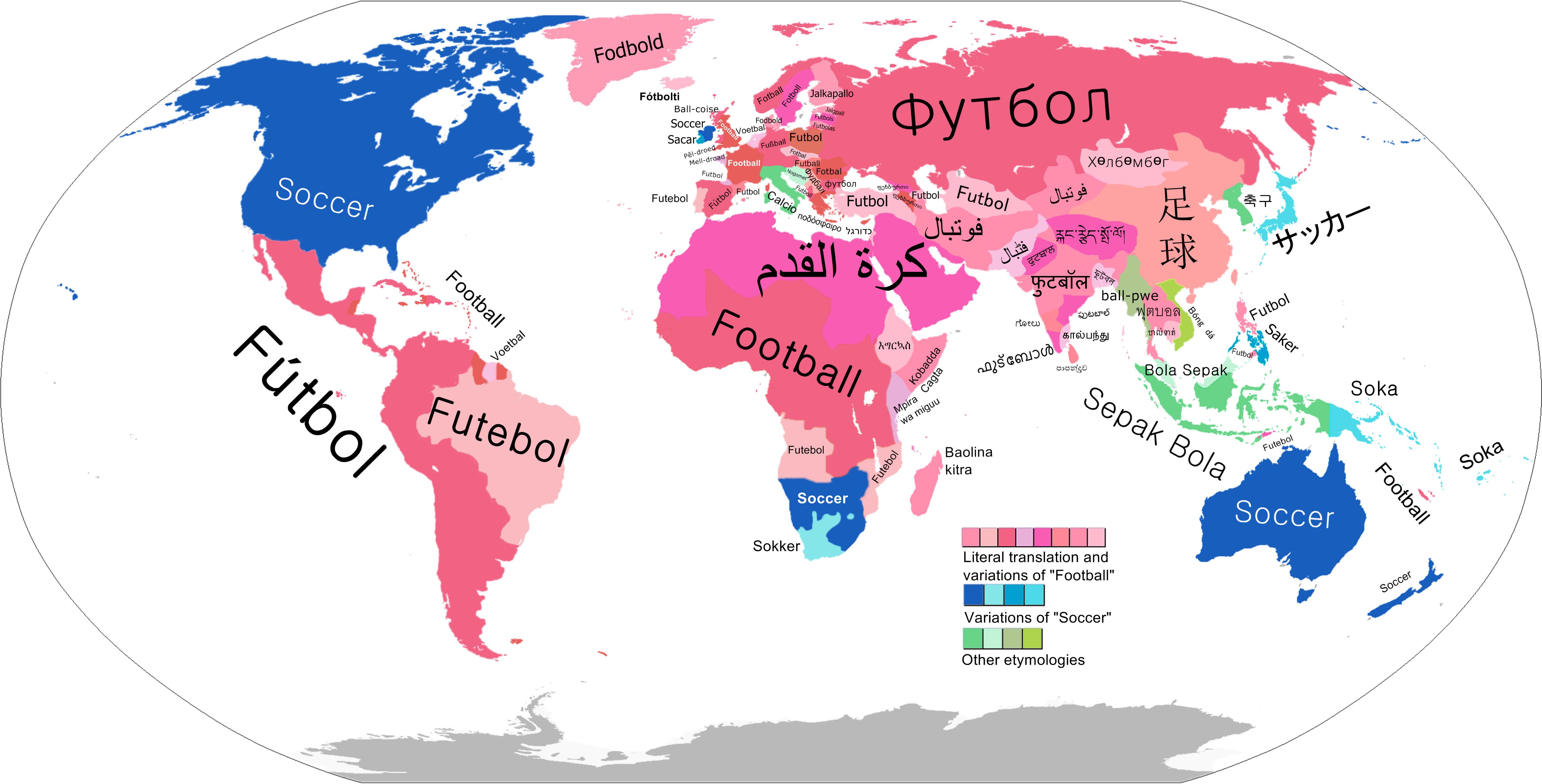
American Fútbol, Ctd

2GHdRDg

Pascal-Emmanuel Gobry sticks up for the American preference for calling it “soccer” rather than “football”:

I’m writing this post as a public service to point out the actual fact, which is that the word “soccer” is basically as old as the sport itself, and has impeccable English bona fides. Here’s the real story, as Wikipedia notes: soccer came into existence at around the same time as other forms of football, in particular rugby football. The sport therefore became referred to as “association football”, to differentiate it from rugby football. With their talent for abbreviation and metonymy, “association football” quickly became “soccer”, from the word “association”.

Call soccer whatever you like. But now you know that the word soccer has impeccable historical and European bona fides, and is not some navel-gazing American invention. It is absolutely proper to call soccer soccer. If anything, calling it “football” is the navel-gazing form, since it ignores other forms of football, whether NFL football or rugby football.

Uri Friedman digs deeper into the history of the term:

If the word “soccer” originated in England, why did it fall into disuse there and become dominant in the States?

To answer that question, [sports economist Stefan] Szymanski counted the frequency with which the words “football” and soccer” appeared in American and British news outlets as far back as 1900. What he found is fascinating: “Soccer” was a recognized term in Britain in the first half of the twentieth century, but it wasn’t widely used until after World War II, when it was in vogue (and interchangeable with “football” and other phrases like “soccer football”) for a couple decades, perhaps because of the influence of American troops stationed in Britain during the war and the allure of American culture in its aftermath. In the 1980s, however, Brits began rejecting the term, as soccer became a more popular sport in the United States.

In recent decades, “The penetration of the game into American culture, measured by the use of the name ‘soccer,’ has led to backlash against the use of the word in Britain, where it was once considered an innocuous alternative to the word ‘football,'” Szymanski explains.

Trolling Or Threatening?

That’s roughly the question at the heart of a new First Amendment case the Supreme Court is taking up in its October term:

The case, Elonis v. United States, which we’ve previously covered in some detail, has reached the nation’s high court on appeal, after the Third Circuit Court of Appeals found that defendant Anthony Elonis’ 2010 Facebook rants mentioning attacks on an elementary school, his estranged wife, and even law enforcement, constituted a “true threat” under First Amendment precedent. As such, the court upheld Elonis’ sentence and conviction. In his petition to the Supreme Court, Elonis’ counsel said the issue boils down to “whether a person can be convicted of the felony ‘speech crime’ of making a threat only if he subjectively intended to threaten another person or whether instead he can be convicted if he negligently misjudges how his words will be construed and a ‘reasonable person’ would deem them a threat.”

For example, in one such Facebook posting, about which Elonis has since argued that he lacked criminal intent, he wrote: “Do you know that it’s illegal for me to say I want to kill my wife? It’s illegal. It’s indirect criminal contempt. It’s one of the only sentences that I’m not allowed to say.”

Lithwick’s take:

This case is not only crucially important in that it will force the court to clarify its own “true threats” doctrine and finally apply it to social media to determine whether—as Justice Stephen Breyer has suggested—the whole world is a crowded theater.

But perhaps it’s even more important in pushing the conversation about law enforcement, prosecution, and threats to include a much more sophisticated understanding of the ways in which the Internet is not just a rally or a letter. As Amanda Hess has explained so powerfully, women experience threats on social media in ways that can have crippling economic and psychological effects. At the margins, this is a case about the line between first amendment performance art, fantasy violence, real threats—and real fear. In a world in which men and women find it nearly impossible to agree on what’s an idle threat and what’s a legitimate one, it’s also a case about where that line lies, or whether there can be one.

Alex Goldman ponders how the Internet has changed the way we interpret threatening speech:

The internet has, in a strange way, diluted the power of the death threat. In more heated, less moderated corners of the internet, death threats are as natural as breathing. While threats against the President tend to be investigated seriously, and depending on the venue, they can land people in disproportionate trouble, death threats have sort of become part of internet parlance. Don’t like the my political views? I’ll kill you. Don’t like my favorite sports team? I’ll kill you. Don’t like the latest DLC for Fallout 3? I’ll kill you. For better or worse, the context of a death threat is often used to gauge how seriously it should be taken.

How Obamacare Is Splitting Republicans

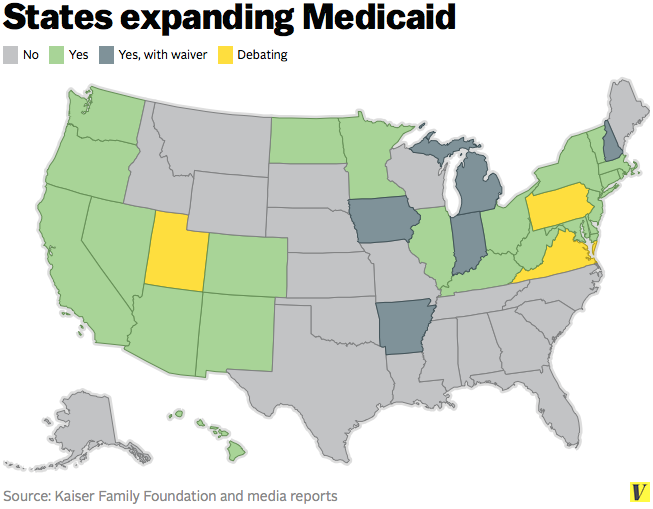
medicaid_map

Senator David Vitter, who is running for governor in Louisiana, is flirting with Obamacare’s Medicaid expansion:

Republicans have found they have a good deal of leverage in using the Medicaid expansion to request state-based reforms, which require a federal waiver, from the expansion-supporting Obama administration. Arkansas pioneered the unique approach with a private option that uses Medicaid dollars to enroll people into private insurance plans through HealthCare.gov. Since then, MichiganIowaIndiana, and New Hampshire have adopted their own reform-pegged expansions.

Whether Vitter actually becomes governor and manages to expand Medicaid is, of course, an open question. But at the very least his current support for a reform-based expansion shows the growing schism among Republicans about whether they should approve the Medicaid expansion

It’s worth noting that Vitter’s support of expansion is conditional:

In an email to The Wire a Vitter spokesperson wrote that any support of the expansion would depend on fixing the program: “The only way Senator Vitter would ever consider any expansion is if it fundamentally reformed the program, did not continue to drain state dollars way from higher ed, and did not provide additional disincentives for able-bodied folks to work, all factors he laid out clearly.”

Still, Igor Volsky sees Vitter’s maneuvering as part of a trend:

Vitter’s comments come as a growing number of Republicans are re-evaluating their opposition to Medicaid expansion. In May, Senate Minority Leader Mitch McConnnell (R-KY) expressed support for growing Medicaid by arguing that the process could be controlled by the state. Indiana Gov. Mike Pence (R), a possible 2016 presidential candidate, has also announced that he would apply for a waiver that would allow Indiana to provide private coverage to its residents using funding secured by the Affordable Care Act. In total, nine Republican governors have backed Medicaid expansion, and the provision is also being embraced by vulnerable Democrats up for re-election, including Louisiana’s Mary Landrieu (D) and North Carolina’s Kay Hagan (D).

Beutler makes similar points:

[Vitter is] no stranger to the scatter-rightward impulse. But he’s also seen Louisiana’s unpopular current governor Bobby Jindal struggle with the absolutist position on Obamacare, and wants to replace Jindal who’s up against a term limit in 2015. So Vitter’s is actually triangulating against the current governorbanking against the possibility that some other hardliner will outmaneuver him. Vitter still boasts of his efforts to repeal Obamacare on his Senate website. But running anti-Medicaid expansion isn’t good politics. Even in Louisiana.

This kind of doublespeak isn’t new. But as Affordable Care Act enrollment inches toward 9 million, skeptical carriers announce that they’ll enter the marketplaces next year, and others announce nominal premium hikes, it’s becoming common in more and more conservative states.

Our Little Lie Detectors

Ryan Jacobs reviews research that suggests kids know how to spot a liar:

Studies have already shown that kids work as incredibly precise detectors of straight-up lies. Outside the realm of bold-faced falsehoods, though, children perform quite brilliantly, too. Subtler and more elegant deceit—the kind where the truth is told but other important elements are shaded or concealed—doesn’t go unnoticed by six-year-olds either, according to a new study published in Cognition. Unbeknownst to their teachers and parents, young kids are apparently equipped with the perceptive powers of seasoned Cold War spies. The new paper suggests that they don’t appreciate when they’re being misled with lies of omission and even adjust their behavior based on a previous record of deceit.

Eliana Dockterman explains how the experiments worked:

Researchers at MIT studied how 42 six and seven-year-olds evaluated information. … [T]he children were separated into two groups: one group got a toy that had four buttons, each of which performed a different function—lights, a windup mechanism, etc.; the other group got a toy that looked the same but only had one button, which activated the windup mechanism.

After the two groups of children had played with their respective toys, the researchers put on a show: a teacher puppet taught a student puppet how to use the toy, but only showed the student puppet the windup function. For the kids playing with the one-button toy, this was all the information; but for the kids playing with the four-button toy, the teacher puppet had left out crucial information. The researchers then asked all the children to rate the teacher puppet in terms of how helpful it was on a scale from 1 to 20. The kids with the multi-functional toy noticed that the puppet hadn’t told them the whole story and gave it a lower score than the children with the single-function toys did.

Privatize The VA?

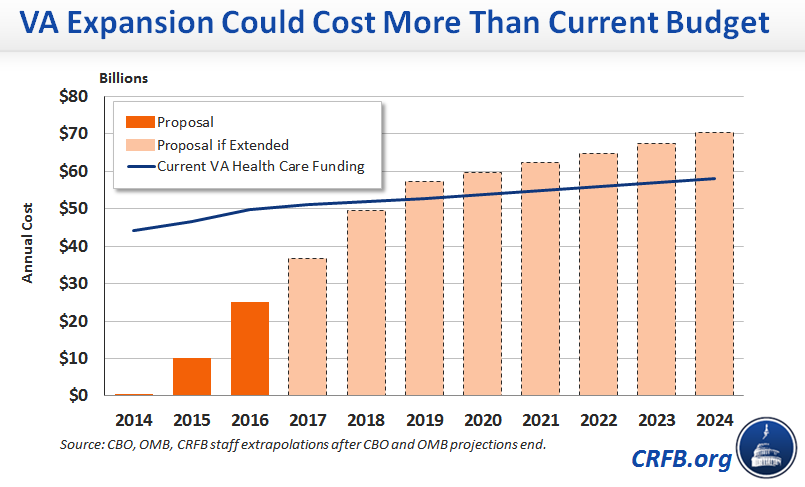
va_expansion_could_cost_more_than_current_budget

A bill to reform the department, which passed the Senate in a nearly unanimous vote last week, would allow veterans facing long wait times at VA facilities to seek out care from private local doctors instead. However, it would also more than double the VA’s annual healthcare spending:

The analysis from the Committee for a Responsible Federal Budget suggests that providing VA-reimbursed private care to veterans, without setting budgetary caps and oversight, could explode the VA’s health-care budget with an additional $500 billion in spending over the next 10 years. … That’s more expensive than the entirety of Medicare Part D, which funds prescription drugs for seniors.

Patrick Brennan pans the reform as expensive and unnecessary:

The VA scandals demand an immediate response, of course, but the Senate bill isn’t necessary to execute it: President Obama has already ordered that the VA expand the coverage it offers outside the system for vets waiting for care. No program like this should be passed as an emergency measure.

Fixing the VA’s problems, such as they are, may require lots and lots of money — and maybe the Senate wasn’t voting to spend quite as much money as the CBO just said. But any congressman with any respect whatsoever for the concept of fiscal responsibility — not deficit hawks, just anyone concerned with how much we spend and on what — should want Congress to take time to study this issue (as, indeed, the House is planning to).

Danny Vinik calls it a “Trojan horse” for privatization:

The reason that clinics and hospitalsat both VA and non-VA facilitieshave such long wait-times is a shortage of primary care doctors. This shortage has happened for a number of reasons: Medical students face financial incentives to choose a specialty field instead of becoming a primary care doctor. State occupational licensing laws prevent nurse practitioners from performing many straightforward medical tasks. Medical schools receive billions in federal funding with little oversight for how may primary care doctors they produce. The bills’ partial privatization scheme does nothing to ease these problems.

But Kevin Drum sees it as an opportunity to finally resolve the question of whether privatization actually works or not:

Maybe this is a good thing. Better access to health care means more people will sign up for health care, and they’ll do it via private providers. That’s the basic idea behind Obamacare, after all.

Of course, it’s also possible that this might be a bad thing. As Phil Longman points out, outsourced care lacks the very thing that makes VA care so effective: “an integrated, evidence-based, health care delivery system platform that is aligned with the interests of its patients.” …

So which is it? Beats me. That’s why I sure hope someone is authorizing some money to study this from the start. It’s a great opportunity to compare public and private health care on metrics of both quality and cost. It’s not a perfect RCT, but it’s fairly close, since the people who qualify for private care are a fairly random subsegment of the entire VA population. If we study their outcomes over the next few years, we could learn a lot.

Michael Cannon and Christopher Preble would prefer to do away with the separate VA health system entirely:

We propose a system of veterans’ benefits that would be funded by Congress in advance. It would allow veterans to purchase life, disability and health insurance from private insurers. Those policies would cover losses related to their term of service, and would pay benefits when they left active duty through the remainder of their lives. To cover the cost, military personnel would receive additional pay sufficient to purchase a statutorily defined package of benefits at actuarially fair rates. The precise amount would be determined with reference to premiums quoted by competing insurers, and would vary with the risks posed by particular military jobs.

Insurers and providers would be more responsive because veterans could fire them — something they cannot do to the Department of Veterans Affairs. Veterans’ insurance premiums would also reveal, and enable recruits and active-duty personnel to compare, the risks posed by various military jobs and career paths. Most important, under this system, when a military conflict increases the risk to life and limb, insurers would adjust veterans’ insurance premiums upward, and Congress would have to increase military pay immediately to enable military personnel to cover those added costs.

Gold Stars For Teachers

Adam Ozimek argues that educators get more love than many realize:

The truth is that teaching is still a highly respected career, and we still lionize teachers in this country. One piece of evidence for this comes from a Harris Interactive poll that has asked the following question sporadically from 1977 to 2009:

I am going to read off a number of different occupations. For each, would you tell me if you feel it is an occupation of very great prestige, considerable prestige, some prestige or hardly any prestige at all?

So how do you think teachers have faired on this survey? It turns out the do quite well. As of 2009, 51 percent of respondents thought teachers had “very great prestige” and another 22 percent thought they had considerable prestige. This is compared to 17 percent and 22 percent for journalists, and 44 percent and 24 percent for police. Judging by the “very great prestige” percentage, teachers rank 6th under firefighters, scientists, doctors, nurse, and military officer. Only 10 percent of individuals thought teachers had hardly any prestige at all.

Freddie counters that while the American public may hold teachers high in esteem, the country’s elites do not:

Ozimek has repeatedly denied to me that the Ivy League striver types that are at the pinnacle of American aspirational culture have a low view of teaching as a profession. But we can let the people within those institutions speak for themselves. Harvard Graduate School of Education Dean James Ryan — who, I presume, Ozimek would recognize as knowledgeable on this topic – says that only a minuscule percentage of Harvard students study education, despite the fact that almost 20 percent of Harvard students apply for Teach for America. And Walter Isaacson, who as president of the Aspen Institute has plenty of exposure to both educational research and elite culture, is quoted as saying there’s a perception that “it’s beneath the dignity of an Ivy League school to train teachers.” That’s reflected in institutional behavior: Cornell has stopped providing undergraduate teacher training. That actual institutional behavior tells us far more about what elites think of teaching than polling could.

Don’t Blow A Fuse Over That Soccer Game

Electricity-consumption-Todd-Moss

The US beat Ghana 2-1 in their first round World Cup match yesterday. Hard luck for Ghana, which had rationed electricity to make sure everyone could watch the match on TV:

Ghana has been suffering from a power shortage this year due to low water levels at hydroelectric dams on the Volta River. The nation’s utilities regulator is already rationing electricity by mandating sporadic shutdowns. To ensure World Cup viewing won’t be interrupted, Ghana is purchasing 50 megawatts of electricity from its neighbor, Ivory Coast. Power plants will also be running at maximum capacity, and Volta Aluminum, the nation’s largest smelter and a large drain on electricity, will slow production during the match.

Plumer takes the opportunity to point out that “access to electricity is a hugely pressing concern throughout Africa”:

Ghana is actually one of the luckier countries on this score — roughly 72 percent of its population has access to electricity, however unreliable. In neighboring Ivory Coast, by contrast, it’s 59 percent. In Tanzania, only 15 percent of people have reliable access to electricity. Add it all up, and some 590 million people across sub-Saharan Africa don’t have any power at all. Among other things, that’s a major public-health issue: Without electricity, many households turn to wood stoves, whose indoor pollution now kills 4.3 million people per year (worldwide), more than AIDS and malaria combined.

(Chart from Todd Moss)

Recession Ripples

Spring-boarding off a recent paper (pdf), Ryan Avent sizes up the Great Recession:

[T]he rich world is setting itself up to suffer through future events like the crisis of the last few years. Because there has been no urgency about moving back to full economic capacity, both interest rates and inflation rates remain at rock-bottom levels across much of the rich world. That means that there is very little cushion in the system against future shocks.

If big trouble strikes central banks will once again struggle to find the will to boost activity, and economies will once again move sideways for long periods of time. Fiscal policy is unlikely to come to the rescue, since the economic morass of the past six years seems to have made the public less tolerant of bold fiscal stimulus and certainly hasn’t done anything for sovereign debt loads.

The most pernicious aspect of this dynamic is its pace. If we woke up tomorrow to find the German economy brought to a screeching halt, we would rush to action, to restore activity there and prevent damage elsewhere. But because this disaster is playing out a bit at a time, such that our expectations slowly adjust, we tolerate it.

Weissmann chimes in:

Typically, we expect economies to fully heal after a recession. But if a downturn is powerful enough, and its effects are allowed to linger long enough, the thinking goes, a country can end up permanently scarred. The unemployed drift from the workforce for good. Companies cut back on investing in new tools or research, which makes them less productive and innovative in the future. Ultimately, the economy’s potential—its size if everything were functioning normally, judged by fundamentals like labor availability and capital stock—simply shrinks. Hysteresis sets in.

And Americans aren’t the only ones supposedly suffering. Most of the developed world appears to be infected, too.

The War Beyond Iraq, Ctd

Nicholas Blanford sees ISIS’s Iraq campaign changing the Syrian regime’s war strategy, which in turn has implications for Lebanon:

Although sworn enemies on paper, ISIS has largely refrained from fighting the Syrian regime to focus on building an Islamic state in northern Syria and ousting more moderate rebel rivals. In return, the regime has left ISIS alone, allowing the Syrian military to concentrate on fighting the moderate rebel groups. At the same timeAssad also points to the brutal exploits of ISIS and other jihadist groups in the conflict to justify its argument to the international community that it is fighting Islamic “terrorists.” The Iraq upheaval appears to have changed that calculation. It has also injected uncertainty into Assad’s reliance on Iraqi Shiite fighters to seize the upper hand in Syria’s war. In recent weeks, “thousands” of Iraqi Shiite fighters who were in Syria to defend the Assad regime have left, according to a diplomatic report from a European embassy in Beirut. …

A drawdown of Iraqi Shiites could make Syria’s regime even more dependent on Hezbollah fighters, further straining the Lebanese group’s support base. Lebanese Shiites generally have supported Hezbollah’s intervention in Syria, especially when Shiite areas of Lebanon suffered suicide bombings last year by extremist Sunni groups. But the last car bombing occurred at the end of March, and since then Lebanon has enjoyed a period of relative calm. Now, there is a sense of unhappiness building among the families of Hezbollah fighters. They are increasingly asking how much longer their fathers, husbands, brothers, and sons will be sent to fight and die on the Syrian front.

Jean Aziz notes the anxiety of the Lebanese that this war will spread to their country in new and more dangerous ways:

With the progress made by ISIS in Iraq, there are once again Lebanese fears of the possibility of ISIS sleeper cells in Lebanon or at least the possibility that its progress in Iraq will revive hopes and illusions among other fundamentalists on Lebanese territory to join their “brothers” in jihad, even if they do not have an organizational link to ISIS. With more than 1 million displaced Syrians now on Lebanese territory, one cannot be certain that there are no fundamentalists among them.

Lebanese politicians opposed to the Damascus regime refer to a second source of concern. Recognizing the danger of these Sunni fundamentalists, they raise the possibility that Syrian troops might deliberately take advantage of the “erasing” of the international border between Iraq and Syriaby ISIS and resort to doing the same along the Syrian-Lebanese border. They believe that the Syrian army might initially carry out limited incursions, but then expand or legitimize them under the pretext of pursuing ISIS militants on both sides of the border between Lebanon and Syria. They fear that Damascus would dare take such steps in eastern and northern Lebanon because of possible international, in particular Western, indifference in blessing any step that targets Sunni fundamentalist terrorism.

Looking across the Gulf to the Arab petro-states, Keating imagines some anxious fidgeting:

Qatar has officially stopped giving aid to more radical groups under U.S. pressure, and Saudi Arabia has also backed off its support of the rebels, a process the culminated in the removal of spy chief and Syria point man Prince Bandar bin Sultan earlier this year, but private donations from Saudi Arabia and the Gulf states—notably Kuwait—have likely continued. For the last few months, the Saudi government in particular has been attempting, somewhat awkwardly, to both continue to fund non-extremist groups fighting Assad while combating the growth of al-Qaida and its affiliates and offshoots. The kingdom has good reason to fear the revival of an al-Qaida-like group with wide territorial ambitions. The government claims to have broken up a terrorist cell in May that had links to both ISIS and al-Qaida in the Arabian Peninsula. ISIS has also reportedly launched a recruitment drive in Riyadh. …

None of the likely outcomes in Iraq—a prolonged period of violent chaos in Iraq giving extremists a new base of operations, unilateral Iranian intervention, U.S.-Iranian cooperative intervention—is going to be viewed very favorably across the Gulf.

Mama Said Always Tell The Truth When Purchasing Firearms

The Supreme Court narrowly ruled that buying a gun for someone else – and lying about it on official documentation – is illegal. Adam Winkler shares the story behind the case:

Bruce Abramski must have known he was going to get into trouble when he bought a Glock 19 for his uncle. A retired police officer, Abramski was familiar with gun regulation. Yet he accepted $400 from his uncle, went to a local gun store, and – as required to purchase the Glock – filled out federal Form 4473. Question 11.a of that form required Abramski to confirm that he was “the actual transferee/buyer of the firearm(s)?” Question 11.a includes, in stark bold lettering “You are not the actual buyer if you are acquiring the firearm(s) on behalf of another person. If you are not the actual buyer, the dealer cannot transfer the firearm(s) to you.” Nonetheless, Abramski signed the form, knowingly lying about his intentions in purchasing the gun for his uncle.

When he was finally caught, Abramski answered with the audacity increasingly typical among a certain class of gun owners: He insisted the law itself was illegal. His lying, he claimed, was perfectly lawful. Surprisingly, he almost convinced the Supreme Court to let him off. Instead, a narrow majority of the Court declined Abramski’s invitation to gut one of the nation’s most important laws designed to reduce easy access to guns by felons and the mentally ill. The ruling is a relief to law enforcement – and a setback for the National Rifle Association.

Tim Murphy elaborates:

In the case, Abramski v. United States, the NRA and other gun groups argued that lying about who would end up with the gun shouldn’t matter if the intended owner could legally own one – and more broadly, that the entire prohibition on straw purchasing was itself a “legal fiction” with no real basis in the law itself. Twenty-six states signed on in support, arguing that the law infringed on their rights to regulate gun sales.

In the majority opinion, Justice Elena Kagan, who was joined by the three other liberal-leaning justices and the swing vote, Anthony Kennedy, emphatically disagreed: ‘No piece of information is more important under federal firearms law than the identity of a gun’s purchaser—the person who acquires a gun as a result of a transaction with a licensed dealer.”

Jeff Shesol examines the rulings:

In his dissent, Scalia—joined by Roberts, Alito, and Thomas—heaps contempt on the majority’s view that the “true buyer” of the handgun in question was not Bruce Abramski, who went to the counter, (falsely) filled out the forms representing himself as the purchaser, and bought the gun, but Abramski’s uncle, who had given him the money and, as arranged, took possession of the gun just after the sale. This, to Scalia, is sophistry. “Abramski’s uncle,” he writes, “was not the ‘person’ to whom the gun was ‘s[old].'” The “plain language of the Act” makes that obvious; so does “ordinary English usage.” Scalia offers a homespun example: “If I give my son $10 and tell him to pick up milk and eggs at the store, no English speaker would say that the store ‘sells’ the milk and eggs to me.”

But Justice Elena Kagan is an English speaker, and here is what she replies in a footnote to her majority opinion in Abramski: “The dissent claims the answer is easy. … But try a question more similar to the one the gun law’s text raises: If I send my brother to the Apple Store with money and instructions to purchase an iPhone, and then take immediate and sole possession of that device, am I the ‘person’ … who has bought the phone or is he? Nothing in ordinary English usage compels us an answer either way.” Scalia, in a retort to Kagan’s reply (this could go on all day!), professes to find it “puzzling” that the majority thought “the answer would be different if the sale involved consumer electronics instead of groceries.”

Paul M. Barrett marvels at the close decision:

What’s amazing about this decision is that four dissenting members of the court – led by Justice Antonin Scalia – were prepared to rule against the federal government in a fashion that would have undermined countless prosecutions of alleged gun traffickers. To put this more starkly: The Supreme Court is one vote away from judicially nullifying one of the most common tools U.S. law enforcers use to deter and punish criminals who send other people into gun stores to purchase firearms and circumvent the federal background-check system.

Nicole Flatow considers the stakes:

One goal of federal gun law is to “keep guns out of the hands of criminals and others who should not have them.” Abramski argued that so long as [his uncle, Angel] Alvarez is a legal purchaser, that goal is not threatened by their transfer. But the dynamic between third-party purchasers and the ultimate user of a gun is more complex than the picture painted here. In gun trafficking schemes, there may be two, three, or more go-betweens who hold the gun before it gets to the ultimate end user, who may be banned from purchasing a gun. Alvarez, for example, could have later sold the gun to another person, who sold it to another. Punishing the person who lies about their purchase in the first place prevents gun traffickers from skirting the law by arguing the legality of the immediate third party.

There is also a second goal of federal gun law, which is to “assist law enforcement authorities in investigating serious crimes.” This pursuit is severely thwarted by Abramski’s purchase of a gun. If Alvarez were to later commit a crime using the gun purchased by Abramski, that gun might be traced to Abramski – the first purchaser on the background check form – rather than Alvarez, shielding Alvarez from the gun used in the crime. Making it a crime to lie about the actual buyer allows prosecutors to enforce the federal law’s fundamental purpose of identifying and vetting gun purchasers, in a climate in which straw purchases are a key component of illicit gun trafficking.