Mosul Under The Fanatics

Andrew Slater tries to get a sense of what daily life is like there now:

Residents in Mosul seemed very worried about the city being bombed by the Iraqi Air Force and the return of the Iraqi Army from the south, but most did not see this prospect as imminent. But many sounded untroubled by the fearsome reputation of life under ISIS after observing them for a few days as even the foreign fighters appeared to be leaving the people of Mosul alone. New announcements are being broadcast throughout the city from the speakers of mosques, but these primarily concerned people returning to work.

Most said they had not observed or heard of the new ISIS authorities enforcing their announced bans on smoking cigarettes or water pipes, immoderate dress, and public gatherings, but most residents said they have been very careful to comply with the new rules.  A few women had returned to work wearing the hijab, but most are staying home, uncertain of how they would be treated by the ISIS fighters in public. Even low-level government employees who were forced to swear oaths against the government in Baghdad were reportedly allowed to return to work unmolested.

Just wait a while … and the beheadings will surely begin. Meanwhile, Fehim Taştekin talks to Mosul’s governor Atheel Nujaifi, now taking refuge in Kurdistan, about his plans to try and retake the city:

It appears almost impossible for Iraqi actors to develop a joint plan for action against the chaos generated by ISIS. The governor said he is now relying on his own resources and the KRG administration. He is coordinating with Erbil and believes some groups controlling parts of Mosul are ready to fight ISIS. Even if ISIS is ousted from Mosul, however, it will not bring about resolutions to the grievances of the Sunni majority there. It is not enough to treat the matter solely as an issue of terror. Nujaifi had earlier proposed a federalism model for the region, but it was not accepted.

So what is the the real solution to ISIS? Nujaifi offered, “Another course of action is needed to combat ISIS. This issue has to be resolved not by Maliki, but as a Sunni project. We have to struggle against ISIS with our Sunni way. It is not a fight for Shiites or Maliki’s supporters. Maliki cannot fight ISIS. Sunnis can do it because that will prevent ISIS from exploiting sectarian arguments.”

Who Are These ISIS Chappies, Anyway? Ctd

Keating pens a thorough explainer on ISIS leader Abu Bakr al-Baghdadi, tracking his rise from low-level militant to head of his own rogue proto-state:

Baghdadi fought in some capacity with Sunni militant groups after the U.S. invasion of Iraq but was arrested in 2005 and interred by U.S. forces at Camp Bucca, the main U.S. detention facility after the closing of Abu Ghraib. He wasn’t considered much of a threat and was released in 2009. The former commanding officer of Camp Bucca recently told the Daily Beast that when Baghdadi was released, he told his captors, “I’ll see you guys in New York.” (The guards at the prison were from a Long Island-based military police unit.) The commander, Col. Kenneth King, says Baghdadi “was a bad dude, but he wasn’t the worst of the worst” and is surprised he rose to such prominence.

It seems as if Baghdadi became far more hqdefaultinvolved with al-Qaida in Iraq while imprisoned than he had been before, to the point that he took over the group after the deaths of [Abu Ayyub] Masri and the other [Abu Omar] Baghdadi a year later. In 2011 he was designated as a global terrorist by the U.S. State Department with a $10 million bounty. Things really picked up in 2012, when, sensing an opportunity, Baghdadi dispatched some foot soldiers to join the fighting against Bashar al-Assad’s government in Syria. In 2013 he announced that the group was merging with Jabhat al-Nusra, the other al-Qaida affiliate in Syria, to form a new group called the Islamic State in Iraq and al-Sham.

That new group has turned out to be more formidable than anyone expected, in no small part due to its impeccable organization. Martin Chulov passes along what CIA and Iraqi analysts have learned from a massive trove of ISIS intelligence acquired on the eve of the group’s blitzkrieg on Mosul:

Laid bare were a series of staggering numbers that would be the pride of any major enterprise, let alone an organisation that was a startup three years ago.

The group’s leaders had been meticulously chosen. Many of those who reported to the top tier – all battle-hardened veterans of the insurgency against US forces nearly a decade ago – did not know the names of their colleagues. The strategic acumen of ISIS was impressive – so too its attention to detail. “They had itemised everything,” the source said. “Down to the smallest detail.”

Over the past year, foreign intelligence officials had learned that ISIS secured massive cashflows from the oilfields of eastern Syria, which it had commandeered in late 2012, and some of which it had sold back to the Syrian regime. It was also known to have reaped windfalls from smuggling all manner of raw materials pillaged from the crumbling state, as well as priceless antiquities from archaeological digs. But here before them in extraordinary detail were accounts that would have breezed past forensic accountants, giving a full reckoning of a war effort. It soon became clear that in less than three years, Isis had grown from a ragtag band of extremists to perhaps the most cash-rich and capable terror group in the world.

Yochi Dreazen outlines the “mafia tactics” ISIS is using to become financially independent of its benefactors in the Gulf:

The exact amount of money in ISIS’s possession is the subject of intense debate among Western intelligence officials. At the high end, some analysts estimate that the group may have access to at least $500 million in cash drawn from bank robberies, oil smuggling, and old-fashioned extortion and protection rackets. Other analysts believe the number is far lower, with one official putting it at between $100 million and $200 million. Those numbers are moving higher as the group conquers more cities on its seemingly inexorable drive toward Baghdad and is able to loot the local private and government banks. On Monday, ISIS fighters took the strategically important town of Tal Afar, adding to the territory under its direct control. …

ISIS’s success at funding its own operations is indicative of a broader trend. Extremist groups throughout much of the world, particularly Africa, are beginning to reduce their dependence on outside donors.

More background on ISIS here and here.

Soccer: An Immigrant’s Game

Charles Kenny adds soccer to the list of reasons to support a more open immigration policy, pointing to the aftereffects of a 1995 European Court of Justice ruling that made it easier for players from outside the EU to play for European clubs:

Unsurprisingly, leagues that saw a higher influx of talented players improved: Clubs in the South Africa Child Football Teamsleague won more Europewide competitions. Meanwhile, talented players migrated to teams in strong leagues based in countries that were richer, closer to their home country, and shared colonial ties. That meant the better leagues, like the English Premier League or Spain’s Primera Division, extended their lead over other European leagues in countries such as Denmark and Romania. In this case, talented migration into Europe created greater productivity but also increased inequality. Everyone was better off, but it is true the best leagues benefited the most.

There was unvarnished good news for the countries that the talented migrants left behind. First, national teams in origin countries did better in international matchups the more their emigrants played in the top leagues in Europe. [Researcher Chrysovalantis] Vasiliakis estimates that the impact of greater global mobility of players lifted Uruguay, Paraguay, and Chile 25 places or more in the 2010 FIFA rankings of national teams.

But those effects only seem to extend so far. Mallé Fofana asks why West African countries don’t field World Cup-winning teams even though they produce lots of great players for European clubs:

Talent alone cannot win games. Talent must be molded and refined in a system that can nurture and sustain it.  European and South American football teams have perfected this system — a well-oiled and well-financed system of coaches, trainers, nutritionists, and sports psychologists that not only have helped to develop the system but also sustain it today.  This system offers part of the access that a country like Cameroon lacks, in soccer as in the rest of its economy.

The other part comes from the lucrative financial incentives for performance. When the potential for income is taken away, so is the incentive to perform.  This in turn impacts morale, motivation, and results, and once again the matter circles back to the issue of access.

Brandon Valeriano notices that the US national team is short on Latino players:

Club soccer dominates in the U.S., and this is an expensive and almost impossible barrier for Latinos due to the costs and suburban nature of the programs.  Moving up a level, participation in high school or college teams assumes the participant has the freedom to actually play sports after school, an option not many of us had as working became a priority once we were of legal age.  College soccer is an even tougher prospect, since the costs or barrier of an inadequate school system make this path a huge obstacle for the Latino population.  The pipeline of talent to the World Cup team is broken for Latinos, but it’s also broken in the higher education system and in the political system.  The lack of development of Latino players is a symptom of the deeper problems in American society.

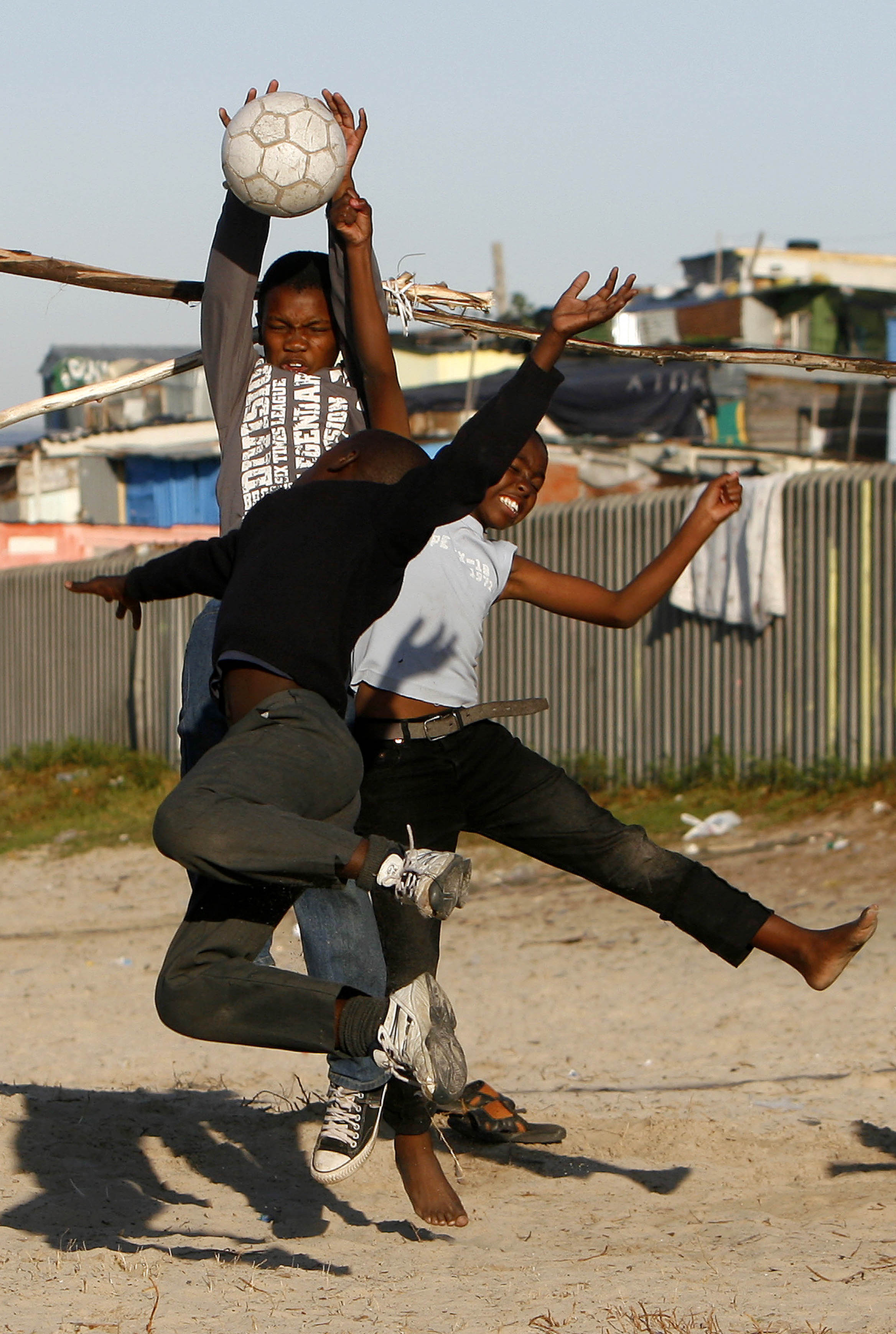
(Photo: Local children from the ‘Seven Stars’ Football Team practice and play football on their field next to the N2 Highway that runs past Gugulethu Township near Cape Town, Western Cape, South Africa on May 20, 2010. By Mark Wessels / Barcroft Media / Getty Images)

Don’t Get Too Excited, Neocons …

Obama is deploying troops to Iraq, but only 275 of them, to reinforce security at the embassy. Beauchamp breaks down the move:

[T]his doesn’t mean the US is going to war in Iraq again, or even helping the Iraqis fight theirs. It does, however, say that the US wants some of its embassy personnel out of Baghdad. The reasons why could be safety, or they could be something more subtle (say, to liaise more effectively with the Kurdish authorities). According to the Press Secretary statement, “the US embassy in Baghdad remains open, and a substantial majority of the US Embassy presence in Iraq will remain in place if the embassy will be fully equipped to carry out its national security mission.”

Per this useful Q&A from the AP, the 100 troops currently guarding the embassy are the only US service members in the country. We might also send in Special Forces to help train Iraqi soldiers to fight ISIS. Allahpundit doesn’t see how we’d advance our objectives any other way:

If you want trustworthy intelligence inside Iraq, your only option is American troops. The Special Forces team is probably there mainly for surveillance, to pick up tips on ISIS movements and relay them to American air assets. And of course there’s a third possibility in honor of the McCain/Graham spat, that U.S. troops are on the ground to coordinate with Iranian military elements that are already inside the country and, maybe, to provide a U.S. counterweight to Iran in influencing Maliki’s maneuvering. And if worse comes to worst and ISIS ends up overrunning Baghdad anyway, hey — you’ll have 100 of the best troops in the world right there to help get everyone out of the embassy before the barbarians run wild and start chopping off heads.

A Healthy Sign For Obamacare

Insurers

Last week, Dan Diamond spotlighted one:

Insurers sat out of the exchanges for different reasons in year one. Some were wary of the start-up risks. Others were openly taking a wait-and-see approach. Still more, it seems, didn’t want any part in the first year’s batch of customers, who were expected to be older and sicker.

And while the technical problems associated with the exchanges have been legion, plans that participated have reported predictably higher revenue, if unclear profits. One million more consumers signed up than expected…and while they weren’t as young and healthy as the insurance companies had hoped for, they were more customers.

Now, more plans want their chance to chase those dollars.

Kliff comments:

It’s not just new entrants into the exchanges that’s increasing competition.

In Washington, for example, there are two plans that only sold in small parts of the state that now want to sell everywhere. Both United Health Care and Moda, a local plan, are increasing the geographic area of where they plan to sell coverage.

The only state that hasn’t reported an increase in carriers for 2015 is Oregon. There, all 12 carriers who sold in 2014 plan to sell again in 2015, but no new insurers have proposed rates. It’s possible that this has to do with Oregon’s incredibly challenged Obamacare rollout — or it could reflect the fact that Oregon had one of the most competitive Obamacare markets to begin with.

More nationally though, the trend seems to be clear: More insurers are getting into the Obamacare game in year two.

Jason Millman adds:

The development is important for a few reasons. For one, recent research suggests that more competition in the exchanges could help temper premium increases. Other new analysis shows that exchange plans, on average, are cheaper than individual plans offered outside the insurance marketplaces. And given the narrow networks in exchange plans, more insurers could mean better access to providers.

In New Hampshire, the exchange’s only insurer last year had excluded 10 of 26 hospitals in the state from its network, meaning the exchange’s customers were limited in their choice of care providers. In 2015, though, New Hampshire will have five insurers selling individual and family health plans on the exchange, state officials announced [last] week. That also includes the expansion of two non-profit, co-op plans that received start-up funding from the Affordable Care Act.

India’s Rape Infrastructure?

crime-and-sanitation-of-homes-with-toilets-rate-of-rape-per-100-000-_chartbuilder

Neil Padukone connects the high incidence of rape in India to its urban design choices:

Most of New Delhi is built according to what urban planners sometimes call “single-use” design: sections of the city are devoted almost exclusively to one use (industrial, institutional, retail, or residential) and separated from each other by open space, roads or other barriers. … This is in contrast to “mixed-use” planning, which carefully integrates residential, retail, institutional, and cultural spaces into the same area—areas that are easily accessible by walking, bicycle, or mass transit.

There are many reasons planners favor mixed-use design, including smaller carbon footprints and increased access to economic opportunity. Easy and efficient access to work, leisure, home, and childcare makes juggling responsibilities much easier, particularly for women. But one of the most important benefits of mixed-use planning is what the urbanist Jane Jacobs famously called “eyes on the street.” If an area is used for multiple purposes, there will always be somebody—a homemaker, shopkeeper, pedestrian, peddler, or office worker—keeping a passive watch, inadvertently but effectively policing it 24 hours a day. Street vendors, for example, may be the most perennial pairs of eyes that monitor any streets, and even police have tapped this human resource.

Two girls who were gang-raped and murdered in Uttar Pradesh last week were attacked while going to relieve themselves in a field at night. Hayes Brown discusses how the absence of private toilets poses a serious safety problem for women in the poorest parts of the world:

Some critics have said that the focus on sanitation as an issue ignores the larger issue of rape and deterring men from assaulting women in the first place. As an article from First Point India explains, however, nobody is arguing that “the sole reason for sexual violence is the lack of a loo. It is an undeniable fact, however, that the absence of a safe toilet adds to the vulnerability of women. And there are numbers to show it.” The First Point article cites a BBC report in which “a senior police official in Bihar said some 400 women would have ‘escaped’ rape last year if they had toilets in their homes.”

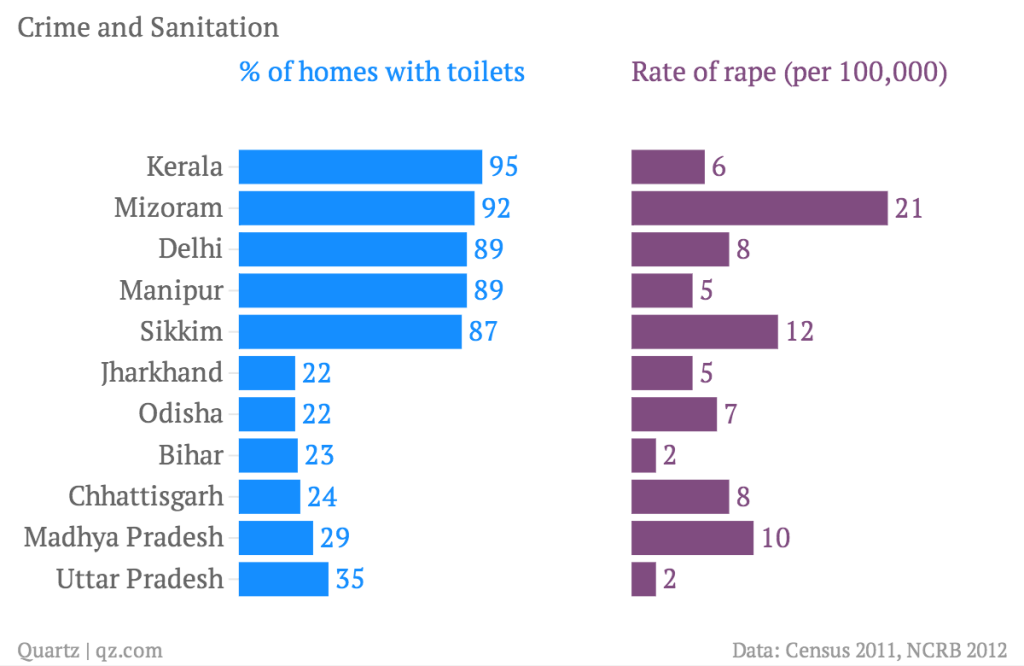
Diksha Madhok pushes back on that alleged link with the above chart:

[I]f a toilet shortage is fueling rape in India, then their presence should lead to lesser crimes against women. But data analyzed from the National Crime Records Bureau (NCRB) show that there is no inverse relation between rape and toilets. Quartz India compared the states with the highest and lowest toilet density against their rates of rape, defined as those reported per 100,000 women.

The state of Mizoram has one of the lowest number of households without toilets. Yet, the rape rate against women remains a stubborn 21, much higher than the national average of 4.26. Meanwhile, only 20% of households in Jharkhand have a toilet, but its rape rate is one-fourth of Mizoram’s.

Update from a reader:

As an Indian living in India, I strongly favour mixed-use urban spaces. That said, if this was the reason for rape, it would be a reason for all sorts of other crimes. But violent crime against men is relatively rare in India. As a man, I feel perfectly safe walking in quite seedy-looking neighbourhoods – far more than I would in New York or Paris. With women, two sorts of crime occur: (1) molestation (rape is merely the extreme end of a spectrum) and (2) “chain-snatching”, ie grabbing their gold chains and running. The solution to (2) is presumably not to wear gold chains, but social customs die hard. As for (1), I remain convinced that this is a societal problem exacerbated by inadequate policing by poorly-trained and often prejudiced personnel.

Back to mixed-use spaces: in 2006, the Chief Justice of the Indian Supreme Court, Y K Sabharwal, ordered the sealing of commercial establishments in many residential areas. Thousands of such establishments were sealed, many of which had been functioning for decades. It turned out that Sabharwal’s sons, both of whom were in the real estate business, stood to benefit immensely from this order. Journalists from the Mid-Day newspaper who reported this were held in contempt of court and jailed. A good overview of all this is here.

The bottom line is, India’s separate-use urban practices encourage not only criminal activity, but corruption. And when it’s the Supreme Court, there is little recourse for citizens.

A World Cup Of Waste

It’s likely to follow in the soccer tournament’s wake:

The host country has been producing 30% more TV sets than last year, according to the Asociação Nacional de Fabricantes de Produtos Eletrônicos (National Association of Electronics Producers)—which means that, by the end of this year, Brazil will have between 18-20 million more TVs than when it started. By May, over half of them had been sold to giddy Brazilians in anticipation of seeing their team, the big favorites, win the sixth World Cup of its history in high definition.

The paixão pelo futebol, as they say in Brazil of their passion for soccer, might have unexpected effects. For every new TV set that comes into a Brazilian home, an old one usually goes out. A study by the World Bank pointed out that Brazil currently produces 14 lbs. of electronic waste per person every year, which makes it the leader in this type of garbage in Latin America. And it is rising: the government expects the amount will go up to 17.5 lbs per person by 2015. Television sets account for the largest type of e-waste in Brazil.

Meanwhile, the strain on Brazil’s power grid is requiring it to burn more fossil fuels:

According to Ildo Luís Sauer, director of the Institute for Energy and the Environment at the University of São Paulo, there’s “a chance” a blackout could occur in the country during the World Cup due to a “critical situation of excess demand” on the national electricity grid. “Usually, in Brazil, during World Cup hours — especially during evening games — you have a composition of huge demand because everyone is at home watching them,” he said.

But it is a risk that the sprawling country seems unwilling to take. Javier Diaz, a senior energy analyst at Bentek, said Brazil is attempting to preserve hydro inventory levels by importing and burning more liquefied natural gas, “especially with the [arrival of the] World Cup.” “Brazil’s monthly LNG imports broke new records in February and March, importing 95 percent and 76 percent more than in 2013,” he said in an email. In fact, the country is currently firing all of its thermal power plants — LNG, coal, diesel and fuel oil — said Sauer, who added that it’s “quite unusual.”

Finally, Thomas Brewster reports that Anonymous hackers are launching an all-out assault on FIFA, World Cup sponsors, and the Brazilian government:

Anonymous is irate at the Brazilian government for spending hundreds of millions on stadiums and infrastructure for the World Cup, rather than funnelling funds into the poorest parts of the country. It’s launching digital attacks to coincide with the street protests that erupted across the South American country this week, which have highlighted the abject poverty and governmental abuse of citizens in Brazilian cities and favelas.

A representative of the collective told Reuters they planned to launch attacks on other big-name sponsors, including Adidas, Budweiser, Coca-Cola and Sony, yet they seem to have had limited success with those large organisations so far. That’s likely because they’re used to DDoS attacks and have the resources to fend them off. DDoS threats can be dealt with by various techniques. One method is to use “scrubbing,” where massive influxes of data are split between data centres to ease the pain. Another is to use DDoS detection technology, which picks up on huge surges of traffic and allows the user to quickly block connections from offending IP addresses.

Previous Dish on Brazil’s World Cup woes here.

Justice In A Bind

Dahlia Lithwick worries that retention elections for state supreme court justices are becoming more and more politicized, particularly with the help of outside money:

Knocking off a state supreme court justice is one of the cheapest political endeavors going. It costs a few measly million bucks to buy a judge’s robe, which is vastly cheaper than a Senate campaign. But when politicians target elected judges and justices with political claims using political tactics (big money and inaccurate accusations), judges are forced to either respond like politicians or judges. Opting to do the former destroys the notion of impartial justice. Opting for the latter ends judicial careers.

And now here we go again.

Three justices on the Tennessee Supreme Court are facing an election-year attack, not for any particular decision they have authored or even for any unpopular opinion they have espoused. No, in an ugly campaign in Tennessee that appears to be getting ever uglier, Senate Speaker Ron Ramsey, who is also the state’s lieutenant governor, is attempting to oust three state Supreme Court justices in their Aug. 7 retention elections, chiefly for the judicial outrage of having been appointed to the high court by a Democrat. Under Tennessee law, the governor appoints Supreme Court justices, and then they come up for retention elections every eight years thereafter. This is a pretty common set-up in states that elect their justices.

Kristol Meth

 
What do you do with near-clinical fanatics who, in their own minds, never make mistakes and whose worldview remains intact even after it has been empirically dismantled in front of their eyes? In real life, you try and get them to get professional help.

In the case of those who only recently sent thousands of American servicemembers to their deaths in a utopian scheme to foment a democracy in a sectarian dictatorship, we have to merely endure their gall in even appearing in front of the cameras. But the extent of their pathology is deeper than one might expect. And so there is actually a seminar this fall, sponsored by the Hertog Foundation, which explores the origins of the terrible decision-making that led us into the worst foreign policy mistake since Vietnam. And the fair and balanced teaching team?

It will be led by Paul D. Wolfowitz, who served during the Persian Gulf War as the Under Secretary of Defense for Policy and as Deputy Secretary of Defense during the first years of the Iraq War, and by Lewis Libby, who served during the first war as Deputy Under Secretary of Defense for Policy and during the Iraq War as Chief of Staff and National Security Adviser to Vice President Dick Cheney.

Next spring: how the Iraq War spread human rights … by Donald Rumsfeld.

Most people are aware that relatively few of the architects of a war have fully acknowledged the extent of their error – let alone express remorse or even shame at the more than a hundred thousands civilian deaths their adventure incurred for a phony reason. No, all this time, they have been giving each other awards, lecturing congressmen and Senators, writing pieces in the Weekly Standard and the New Republic, being fellated by David Gregory, and sucking at the teet of the neocon welfare state, as if they had nothing to answer for, and nothing to explain.

Which, I suppose makes the following paragraph in Bill Kristol’s latest case for war less shocking than it should be:

Now is not the time to re-litigate either the decision to invade Iraq in 2003 or the decision to withdraw from it in 2011. The crisis is urgent, and it would be useful to focus on a path ahead rather than indulge in recriminations. All paths are now fraught with difficulties, including the path we recommend. But the alternatives of permitting a victory for al Qaeda and/or strengthening Iran would be disastrous.

But it is shocking; it is, in fact, an outrage, a shameless, disgusting abdication of all responsibility for the past combined with a sickening argument to do exactly the same fricking thing all over again. And yes, I’m not imagining. This is what these true know-nothing/learn-nothing fanatics want the US to do:

It would mean not merely conducting U.S. air strikes, but also accompanying those strikes with special operators, and perhaps regular U.S. military units, on the ground. This is the only chance we have to persuade Iraq’s Sunni Arabs that they have an alternative to joining up with al Qaeda or being at the mercy of government-backed and Iranian-backed death squads, and that we have not thrown in with the Iranians. It is also the only way to regain influence with the Iraqi government and to stabilize the Iraqi Security Forces on terms that would allow us to demand the demobilization of Shi’a militias and to move to limit Iranian influence and to create bargaining chips with Iran to insist on the withdrawal of their forces if and when the situation stabilizes.

What’s staggering is the maximalism of their goals and the lies they are insinuating into the discourse now, just as they did before.

Last time, you could ascribe it to fathomless ignorance. This time, they have no excuse. ISIS is not al Qaeda; it’s far worse in ways that even al Qaeda has noted undermine its cause rather than strengthen it. It may be strategically way over its head already. And the idea that the US has to fight both ISIS and Iran simultaneously is so unhinged and so self-evidently impossible to contain or control that only these feckless fools would even begin to suggest it. Having empowered Iran by dismantling Iraq, Kristol actually wants the US now to enter a live war against ISIS and the Quds forces. You begin to see how every military catastrophe can be used to justify the next catastrophe. It’s a perfect circle for the neocons’ goal of the unending war.

I don’t know what to say about it really. It shocks in its solipsism; stuns in its surrealism; chills in its callousness and recklessness. So perhaps the only response is to republish what this charlatan was saying in 2003 in a tone utterly unchanged from his tone today, with a certainty which was just as faked then as it is now. Read carefully and remember he has recanted not a word of it:

February 2003 (from his book, “The War Over Iraq“):  According to one estimate, initially as many as 75,000 troops may be required to police the war’s aftermath, at a cost of $16 billion a year. As other countries’ forces arrive, and as Iraq rebuilds its economy and political system, that force could probably be drawn down to several thousand soldiers after a year or two.

February 24, 2003:  “Having defeated and then occupied Iraq, democratizing the country should not be too tall an order for the world’s sole superpower.”

March 5, 2003: “We’ll be vindicated when we discover the weapons of mass destruction.”

April 1 2003: “On this issue of the Shia in Iraq, I think there’s been a certain amount of, frankly, Terry, a kind of pop sociology in America that, you know, somehow the Shia can’t get along with the Sunni and the Shia in Iraq just want to establish some kind of Islamic fundamentalist regime. There’s almost no evidence of that at all. Iraq’s always been very secular.”

Yes, “always been very secular”. Always. Would you buy a used pamphlet from this man – let alone another full scale war in Iraq?

(Thumbnail Photo: Gage Skidmore)

Drug War And Peace In Colombia

A new approach to combating the cocaine trade, embedded in peace talks between the Colombian government and FARC rebels, raises the hopes of Oliver Kaplan that “the drug war may soon be coming to an end”:

In early May, negotiators from the Colombian government and the rebel group Fuerzas Armadas Revolucionarias de Colombia (FARC) reached an agreement on drug trafficking as part of their effort to end the country’s 50-year old conflict. Shifting away from old, controversial methods like crop fumigation, the new deal focuses on substituting crops, taking on organized crime and cartels, and treating drugs as a public health issue to treat addicts and reduce demand. It’s a historic move — and good news for President Juan Manuel Santos, who faces an increasingly popular opposition candidate in second-round elections on June 15.

Santos’ re-election yesterday bodes well for the peace process, which his opponent had threatened to halt:

Santos got 53 percent of the votes for candidates, against 47 percent for right-wing challenger Oscar Ivan Zuluaga, the hand-picked candidate of former two-term President Alvaro Uribe, who many considered the true challenger. More than 600,000 voters cast “blank” ballots, a protest vote for neither candidate. Zuluaga and Uribe accused Santos of selling Colombia out in slow-slogging Cuba-based negotiations, and said Zuluaga would halt the talks unless [FARC] ceased all hostilities and some of its leaders accepted jail time. Santos said the win affirmed his claim to be ably steering Colombia through a historic moment — out of a crippling conflict that has claimed more than 200,000 lives, mostly civilians.

But if coca cultivation in Colombia declines, Reid Standish suspects that Peruvians will increase theirs:

Drug researchers call this the “balloon effect” — where pressure from the authorities in one country or region pushes drug production elsewhere. Squeezing the balloon at one end causes drug producers to compensate and expand into another. Since the U.S.-led war on drugs began in the 1980s, the balloon effect has shaped the cocaine trade.

In 2013, fumigation and forced eradication of coca crops in Colombia finally hit a turning point and the South American nation bequeathed its crown as the world’s top coca producer to its neighbor, Peru. Both the United States and the U.N. declared it a milestone. Unsaid was that the Colombian government’s efforts to crack down on production — in part under the banner of Plan Colombia, the U.S.-backed effort to combat left-wing guerrillas and drug traffickers — simply shifted production to Peru.

Colombia and Peru have swapped the coca-producer champion crown for decades. In the mid-90s Peru launched an intense eradication campaign and Colombia was back on top. In 1990, Colombia was only responsible for 19 percent of the global coca market, behind top producers Bolivia and Peru. By 1997, it was the world’s top producer. See the pattern here?