Send In The Kurds?

That’s what Michael Knights proposes to fend off the ISIS menace:

The geometry of the battlefield makes the Kurds particularly vital: ISIS pursued Iraq’s retreating forces south of Mosul for over 200 miles, with most units ordered to rally on Taji in Baghdad’s northern suburbs. This has given ISIS significant depth on the north-south axis, meaning that the government may need to painstakingly retake a sequence of key insurgent-held cities in turn. But due to the Kurds’ advanced positions all along ISIS’ eastern flank, the jihadist movement has very little west-east strategic depth if key centres like Mosul were counterattacked from the Kurdish-held areas. Kurdistan has offered the use of its airbases to U.S. forces many times, and they would be an ideal place from which to conduct limited U.S. airstrikes. This was precisely the formula – U.S. special forces advisers and pesh mergas – that crumbled Saddam’s hold on Mosul and northern Iraq in a matter of days in 2003.

The Iraqi Kurds are generous and brave: they hate the extremism of radical jihadist groups and will not tolerate a major jihadist center in Mosul, located just an hour’s drive east of the shining new skyscrapers of Erbil, the Kurdish capital. Indeed social media reporting of Kurdish martyrs in the fight against ISIS are proliferating. The Kurdish pesh merga are already fighting ISIS at half a dozen points from the Syrian border to Iran, with Baghdad’s air forces in support in some areas.

Jay Newton-Small takes a closer look at what the Kurds stand to gain from this conflict:

The fact that an estimated 5,000 ISIS fighters now stand between Erbil and Baghdad only serves as a physical barricade of a partition that has been in effect for at least six months, if not years. As Iraq falls apart, the Kurds are discretely moving towards their long-sought-after goal of an independent state. “We’ve said all along that we won’t break away from Iraq but Iraq may break away from us, and it seems that it is,” Qubad Talabani, deputy prime minister of the Kurdish Regional Government, tells TIME. “There’s been many times that we felt it could happen, that it was only a matter of time that it would happen, and it has.”

Talabani also argues that his government would be a better ally for the US than Maliki’s. In an interview with Eli Lake, he claims that the Kurds aren’t gunning for a land grab:

Talabani told The Daily Beast that the Peshmerga deployment to Kirkuk was actually approved by Prime Minister Nouri al-Maliki. “No one has asked us to abandon those posts in Kirkuk,” Talabani said. “On the contrary, the Iraqi prime minister’s office gave us the green light to do what we can to protect as much territory as we can in the north.” The fact that Peshmerga secured positions in Kirkuk with the blessing of Maliki’s Shi’ite-dominated government is in itself a sign of how desperate things have become. …

Talabani said the presence of Peshmerga troops at Kirkuk—which has significant oil resources itself—does not change its status. “It doesn’t change anything on the ground, ultimately we have said Kirkuk belongs to the Kirkukis,” he said. “It’s something we always felt rests with the people of Kirkuk. The fact that there are no longer Iraqi units outside the city, it does not change Kirkuk’s status in the country.”

Keating, however, doubts the Kurds will hand their gains back to Baghdad without extracting some major concessions:

If ISIS is eventually beaten back, it’s likely going to require the help of what seems to be the country’s most organized fighting force, and the conflict will likely end with Kirkuk and several other cities under the control of Kurdish forces. The Kurds may cede these gains back to Baghdad, but I’d expect their price to be high.

Finally, in an interview we highlighted earlier today, Kirk Sowell pushes back on the notion that the Kurds have been operating some kind of autonomous paradise, noting that after an oil dispute the Maliki government had stopped making the monthly payments on which the Kurds were deeply dependent:

[C]oming in to this crisis, the Kurds were on the verge of insolvency. Like, complete insolvency. The only thing that kept them alive was that the Barzanis and the Talabanis [leading Kurdish families] have massive amounts of money stored back that they’d been stealing all of these years. They used it to keep the Kurdish region afloat, or at least pay the peshmerga [independent Kurdish militias].

He calls the new conflict with ISIS a “lifeline” for the Kurds:

Maybe they can get Baghdad to restore their payments, maybe they can’t. If Baghdad doesn’t restore their payments, they might as well declare independence right now. Now that they control Kirkuk, they can export the oil they control to Turkey. They don’t yet have the infrastructure to replace what they were getting from Baghdad, so it would be rough for a year or two. But eventually they’d do OK. So they’re really the big winners here.

America Is Armed To The Teeth

gun_ownership_map

Zack Beauchamp maps American exceptionalism when it comes to gun ownership:

Here’s a map of firearm ownership around the world, using 2012 data compiled by The Guardian. The United States has nearly twice as many guns per 100 people as the next closest, Yemen — 88.8 guns per 100 as opposed to 54.8 in Yemen. … How does this relate to homicide rates? Not simply. For instance, the United States has over 12 times as many guns per person as Honduras, but the 2012 US gun homicide rate per 100,000 people (2.97) is 1/22 of Honduras’ (68.43). That’s because, while guns make murder easier, wealthy industrialized countries generally have significantly lower rates of violent crime than comparatively impoverished ones. But when you compare the United States to nations like Britain and Japan, it becomes clear that firearm ownership contributes to America’s murder problem. The American homicide rate is about 20 times the average among Organization for Economic Cooperation and Development countries (excluding Mexico).

Also, although mass shootings are getting more media coverage, they actually aren’t on the rise:

12-massshootingsnew.w1120.h1472It’s clear that there is no major upward trend. And slicing the data differently doesn’t make a difference — [James Alan Fox, a criminologist at Northeastern University] said that since homicides are on the downswing in general, the overall shape of the graph wouldn’t change much if you changed the definition of a mass shooting to, say, three victims or more. There isn’t even any upswing in the number of school shooting victims, at least based on the Department of Education’s own official statistics (PDF).

Why, then, is there such a powerful feeling that things are getting worse? Media coverage plays a big role. It’s almost hard to believe today, but there was a time in the not too distant past when people in New York might not even hear about a school shooting that happened across the country.

Drum puts Fox’s statistics in context:

Since 1993, the rate of violent crime in America has plummeted by half. That’s the background to measure this against. In general, America has become a much safer, much less lethal place, and yet mass shootings have remained steady. Compared to the background rate of violent crime, mass shootings have doubled. Why?

And here’s an equally interesting question: between 1976 and 1993, violent crime increased by a significant amount, but mass shootings remained steady. Again, why? Raw numbers are a starting point, but they don’t tell the whole story

Between A Rock And A Sectarian Bloodbath

IRAQ-UNREST

Harith Hasan examines how Iraq’s Sunni population views ISIS:

Most Sunnis maintain their suspicious view of the Shiite-dominated government in Baghdad, but they do not see ISIS as a good alternative. It is true that ISIS has largely invested in the sectarian tension in Iraq and the region, but its objectives go beyond the Iraqi borders or the major concerns of Iraq’s Sunni community. Through its simultaneous involvement in Syria and Iraq, ISIS established its distinct entity and identity with an agenda that is largely indifferent to Iraqi politics.

However, fighting ISIS has yet to become a Sunni priority. One reason is the growing strength of the organization and its proven ability to carry out revenge against “traitors,” as was the case with the assassination of Khamis Abu Risha, a leader in the anti al-Qaeda awakening groups (Sahwa) which previously were a key voice in the anti-government rallies in Anbar. Second, the Sunni elite is divided and increasingly incapable of determining its communal priorities, and some of its members think that the main problem lies in the policies of Prime Minister Nouri al-Maliki’s government.

Joshua Landis offers an ominous prediction about the coming Shiite backlash:

I would not be shocked to see significant ethnic cleansing of Sunni neighborhoods in Baghdad should ISIS attack and give the Iraqi Army a run for its money.

After all, the Iraqi army is large, has helicopters, sophisticated intelligence capabilities, tanks, artillery and all the rest. They were caught napping and without esprit de corps, much as the Syrian army was. But capable officers will emerge who will strip down the “power-sharing” fat that the US built and rebuild it based on loyalty to Maliki and Shiism, if most of that has not been done already. This is what happened in Syria, when we saw the Syrian Army unravel at the base during the first year of the Sunni uprising. The Syrian military was quickly rebuilt along sectarian and regional lines to make it much stronger and more loyal, with locally recruited Iranian style National Defense Forces modeled on the Islamic Guard. If Sunnis choose to form such local militias and ally with the Shiite regime, so much the better. If they do not and choose to lay low until they figure out whether ISIS can win in their regions, the Shiites will go it alone and assume all Sunnis are a fifth column.

In an fascinating interview with Zack Beauchamp, Iraqi politics expert Kirk Sowell highlights the near-complete unviability of ISIS-controlled Iraq:

[T]here’s no money [in northwest Sunni Iraq]. All these provinces are dependent on Baghdad for their budgets. This is what held Iraq together all these years — it would have fallen apart years ago had it not been for this financial dependence. Anbar [an insurgent-controlled Sunni province] is totally dependent; over 95 percent of their money comes from Baghdad. They got a little bit of money from customs when they controlled the [Syrian] border, but they don’t even get that now. Ninevah [the insurgent-controlled province containing Mosul] is going to suffer a complete economic collapse. …

[E]ven if the insurgents had some oil, [which they don’t,] they couldn’t develop it. They’re able to make use of the Syrian oil infrastructure because it’s already developed; but to the extent that there are oil reserves in the insurgent-controlled territory they’re not developed. So there’s nothing to sell.

So in principle they could make their own state, but only if they’d be willing to starve. It’d be a permanent downward economic spiral — like Gaza, basically.

Meanwhile, Shireen T. Hunter argues that the most significant factor in Iraq’s political instability is “the inability of Iraq’s Sunni Arabs and its Sunni neighbors to come to terms with a government in which the Shias, by virtue of their considerable majority in Iraq’s population, hold the leading role.” She even claims that the Maliki government’s closeness to Iran was not so much a choice as a necessity after being isolated by the country’s Sunni neighbors:

In short, by exaggerating the sectarian factor, Iraq’s Sunni neighbors have exacerbated Shia fears and made it more difficult for them to pursue a more inclusive policy vis-à-vis the Sunnis. Further, most killings in Iraq have been in Shia areas, undertaken by Sunni extremists of various kinds who are funded by Sunni governments in the region. The plight of the Shias has also not been limited to Iraq. Similar mistreatment in Bahrain, Saudi Arabia, and Pakistan has gone unnoticed by the West, while the exclusion of Iraq’s Sunnis from leadership posts in Baghdad has been blown out of proportion. Western and especially US dislike of Iran has been a major cause for the disregarding of mass killings and assassination of Shias.

But Nussaibah Younis insists that most Sunni grievances are legitimate and must be treated seriously, especially now:

Iraqi Sunnis don’t want to be governed by Isis, they don’t support the massacre of Shia civilians and they don’t want another civil war. But they also don’t believe there is a place for them in Maliki’s Iraq. Iraq’s politicians must persuade them that a future does exist in which Sunnis can participate as equal citizens in an Iraqi state, and that this is something worth fighting for.

I glean from much of this that Obama’s caution is easily the smartest posture. ISIS may well have begun a process by which they are destroyed. And allowing your foes to self-destruct is a talent of the president’s over the years.

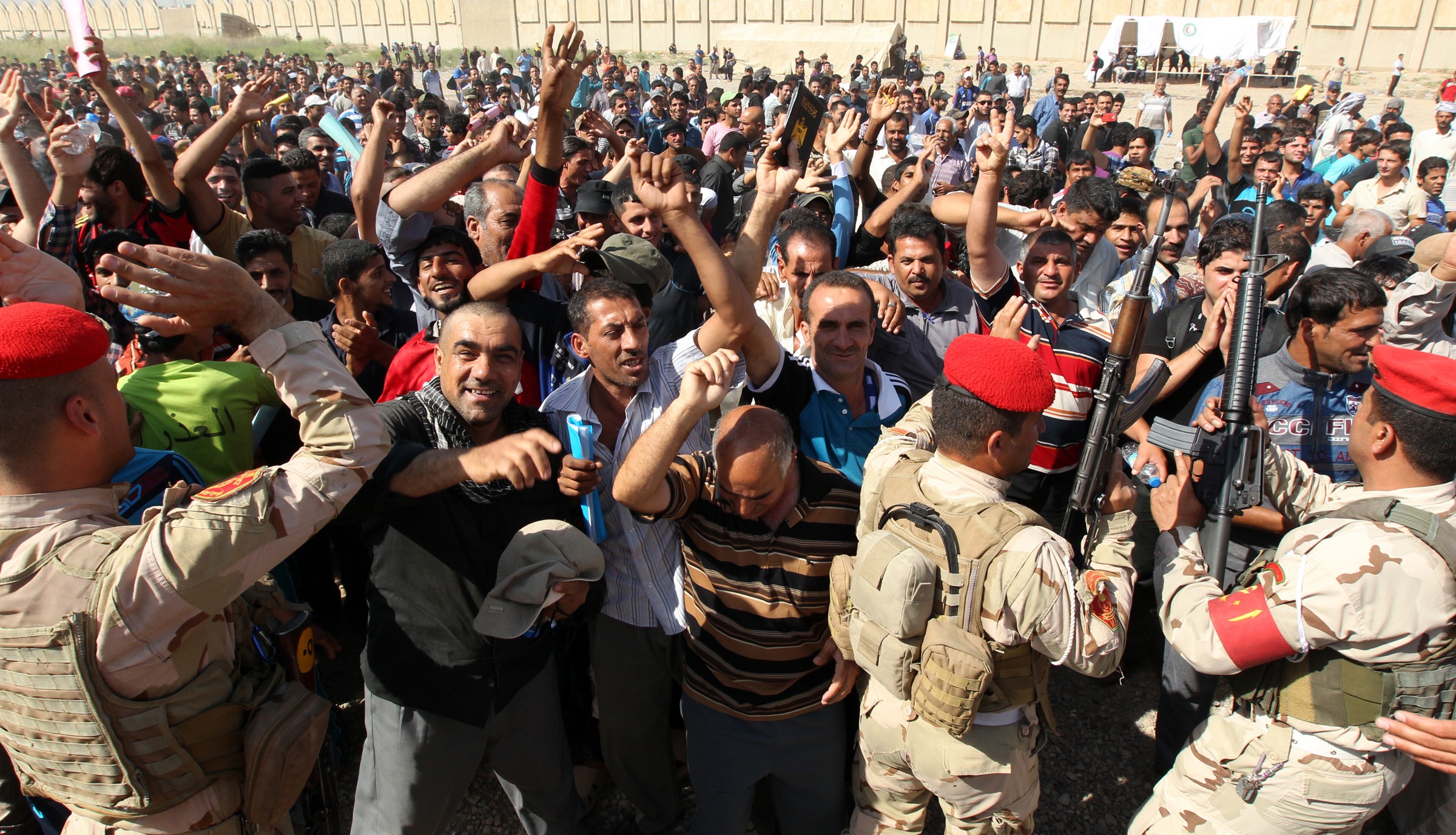
(Photo: Iraqi men, who volunteered to fight against the Jihadist militants, gather around buses in Baghdad, ahead of being transported for training at Taji infantry camp on the outskirts of Baghdad, on June 16, 2014, as security forces are bolstering defenses in the capital. By Sabah Arar/AFP/Getty Images.)

Diplomacy Instead Of Drones?

When it comes to confronting ISIS, Matt Steinglass encourages the US to embrace a supporting, rather than primary, role:

It is much easier and less risky for America to aid the Iraqi government as part of an anti-ISIS coalition with Turkey and Iran than to do so in the guise of Iraq’s leading patron or ISIS’s archenemy. And a limited programme of military aid might be enough to ward off Republican attacks that the administration is doing nothing about ISIS; critics will be hard pressed to explain to a war-weary public why America should be doing even more to reinsert itself into Sunni-Shiite bloodshed in Iraq. This, in fact, appears to be the policy the Obama administration has selected.

I don’t see why the president should do anything to satiate the desires of the neocons – even a “limited program” of military aid. We’ve already given Maliki a huge amount of aid and he has proven unable to use it wisely. Without some serious concession to the Sunni minority – something I cannot see happening for real – it would merely increase the likelihood of ISIS getting its hands on our aid, rather than having it actually making the slightest bit of difference. But if this scenario rings a bell for you, you’re not hallucinating:

Iran, Turkey, and other regional players will have to take the lead in backing the Iraqi government and combating ISIS, because America lacks the expertise, the political will, and ultimately the capacity to do that job. We’ve tried it; it didn’t work. Perhaps the endgame will end up looking something like what happened in South-East Asia 40 years ago. After America’s departure and the collapse of its hapless proxies, regional powers moved in to assert their interests and create a new geopolitical order.

It’s not an accident that the latest Kagan war-manifesto also argues that we should never have left Vietnam either. Janine Davidson, who rejects the viability of airstrikes, thinks pre-conditioned aid is probably America’s only rational play:

[W]e can help Iraq get its security forces back in order.  The uncomfortable truth is that it will take time. Iraq is in for a long, hard fight; any assistance the United States provides cannot be a quick, one-off effort.

More importantly, a successful strategy will require pressure on Maliki, whose horrifying treatment of the Sunni minority is largely attributable to Iraq’s current woes. As Dr. Walter Ladwig observed in his review of the United States’ new counterinsurgency doctrine, outside intervention in such conflicts can only succeed if the host nation is willing to change its ways—this, in turn, requires a motivating event and outside pressure[.]

Meanwhile, Gordan Chang is waiting for China to finally throw its weight around:

[The Chinese] would have a much harder time [than the US]  if Iraq’s 3.7% of global production suddenly went offline.  China, which is increasingly dependent on energy imports, is now that country’s largest foreign customer, taking an average 1.5 million barrels a day, almost half of Iraq’s production. China National Petroleum Corp., a state enterprise, swooped up Iraqi oil after last decade’s war—Beijing, by the way, sold arms that ended up in the hands of insurgents fighting Americans—by accepting Baghdad’s razor-thin margins and onerous conditions.

Then, many said it was China that won the Iraq War because it signed the major oil deals afterwards. As a result, Beijing now has a lot riding on the outcome in Iraq as ISIS takes on the Shiite-dominated ruling group in Baghdad.

But Russia, according to Fyodor Lukyanov, is likely to butt out:

Despite the serious Russian-US standoff over Ukraine, Moscow will definitely not try to play the role of spoiler and exacerbate the problems the United States faces in the region. There is too high a risk of collapse of the entire regional system, so close to the Russian borders. This is even more so because Russia-friendly Iran in this situation is as interested as the United States in maintaining the status quo in Iraq.

Moscow, however, is unlikely to undertake active efforts to assist Washington. For the Russian leadership, as well as for Russian public opinion, what is happening in Iraq is a verdict on the entire US policy after the Cold War, and the symbol of the resounding failure of those who only recently displayed the utmost arrogance toward everyone who disagreed with their policies. Putin sees in Iraq yet further proof of how right he was.

Ask Me Anything: Ready For Hillary?

You asked, I answered:

My “Ask Anything” answers from previous years are here.

On the latest proof that a Clinton doesn’t really change, Hillary’s inability to own her own anti-gay past, apologize, explain and move forward is still dogging her proto-campaign. As Nate Silver notes, Clinton’s support “on moral and religious grounds” for banning marriage equality for gay couples might have been politically expedient, but it was out of sync with the demographic Clinton is in:

silver-datalab-clintonssm-11

So when women in Clinton’s demographic were roughly between 60 percent and 80 percent likely to back marriage equality (1996), Clinton was backing the Defense of Marriage Act. Or to put it another way, Clinton fits into the ten-to-fifteen percent in her demographic most hostile to marriage equality over time. She can’t really win, of course. But the idea that she has ever risked an iota of her own power to back the equality of gays and lesbians is preposterous. That some gays still regard her as a savior says a lot more about their own delusions and diva-fantasies than anything approaching reality.

Update from a reader:

Not EVERYONE is waiting for you to have an epiphany about Hillary Clinton. As far as I’m concerned, you can wait as long as you like. The really upsetting thing to me is how her presence appears to be depressing any other Democrat from considering a presidential run. Are we not to be presented with any other options? Is it only to be Hillary or nothing? Can it really be that the fractious Democratic Party, which often yields eight or more candidates in a primary, will simple roll over and die for another Clinton? It makes me want to lie down …

Iran’s Quagmire Now?

IRAN-IRAQ-US-UNREST-ROUHANI

Aki Peritz insists that Iran is biting off more than it can chew in Iraq:

Iran can only go so far to pacify Iraq with its own forces. The IRGC and its Shia proxies are reviled in Sunni-majority areas, and an effort to hold territory by these groups would eventually cause a major backlash among the population. So Iran would have to eventually withdraw, leaving a power vacuum, again, in those areas.

More broadly, many of the socio-economic and sectarian drivers that brought Iraq to this horrific juncture would remain in place after the shooting stopped. A semi-failed state containing thousands of virulently anti-Shia veteran fighters on its western border will remain a long-term national-security nightmare for Tehran.

The economic impact of a war-torn Iraq must also be considered, as Iran sends some $5 billion in non-oil exports to their neighbor every year. But, as for the rest of the region, Bruce Riedel believes it will be Iran’s enemies who suffer if the intervention is successful:

Saudi Arabia long ago lost the battle for influence in Iraq, but it will see its role further diminished with both a hostile ISIS and a hostile Iran splitting the pie on its northern border. If Iran emerges as the savior of Iraqi Shiites, the Shiites of Bahrain, Kuwait and the kingdom’s eastern province will be further inclined to see Iran as their savior, too.

Since Israel defines Iran as its greatest regional rival, it is also a loser. Certainly, moderates in the Arab world will be increasingly squeezed between extreme Sunni groups and Shiite Iran. They will be less inclined to take conciliatory steps toward Israel that will be unpopular and dangerous. Jordan is the most vulnerable moderate state.

If Iran helps stop ISIS outside Baghdad, the impact will be felt in Syria. The Iranians and their Hezbollah allies will gain further credibility as the only force that is actually on the ground resisting al-Qaedaism. Tehran will have emerged as the leader of a block of Shiite-dominated states, each looking to Iran for critical security support.

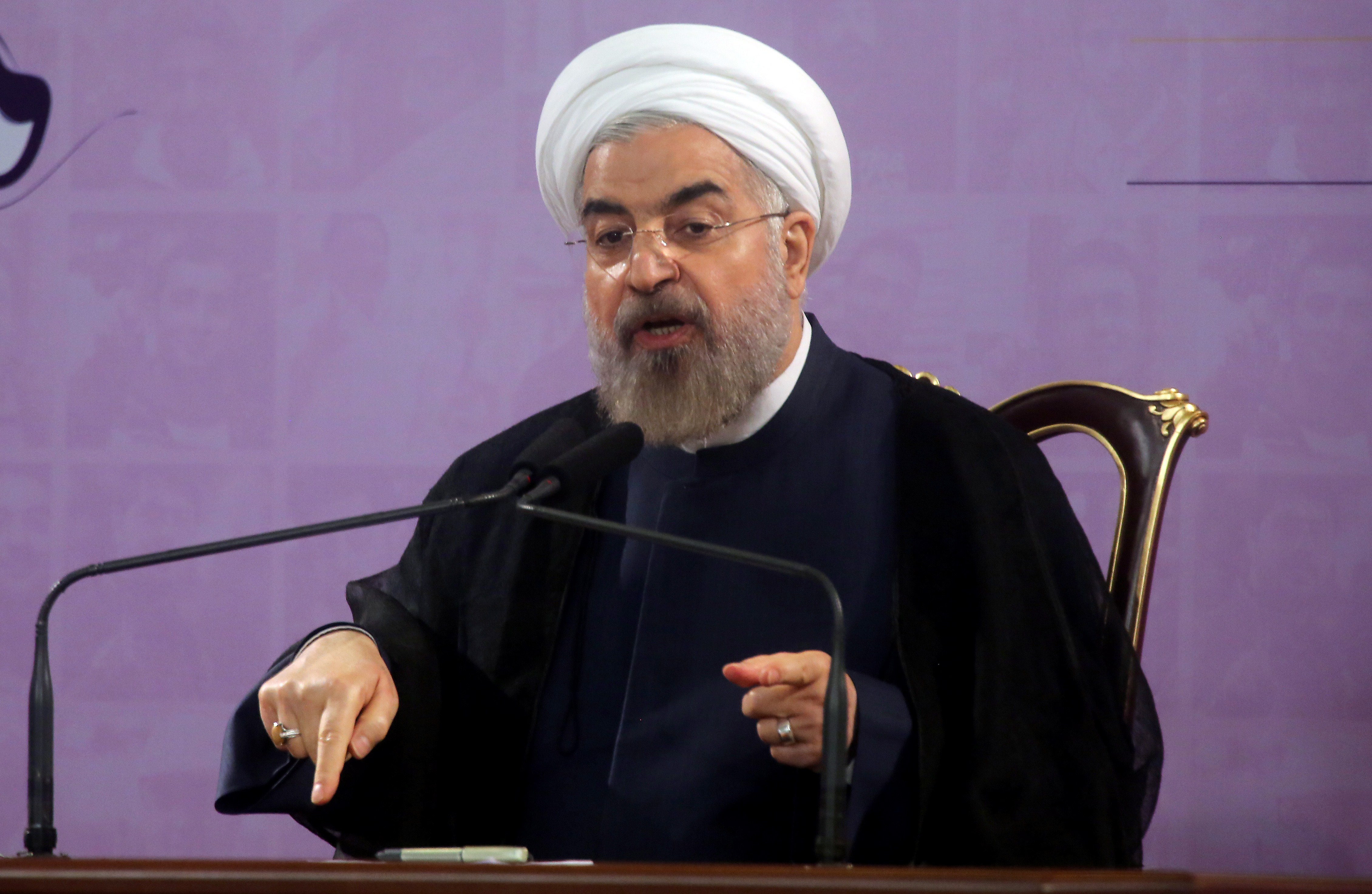
(Photo: Iranian President Hassan Rouhani speaks during a press conference in the capital Tehran on June 14, 2014. Iran may consider cooperating with the United States in fighting Sunni extremist fighters in Iraq if Washington acts against them, Rouhani told journalists. By Atta Kenare/AFP/Getty Images.)

The Battle For Baghdad


Analyzing ISIS’s strategic position, Bill Roggio sees the militants’ moves so far as part of an effort to encircle the capital, very similar to the strategy Abu Musab al-Zarqawi’s Islamic State of Iraq employed in 2006:

The ISIS advance toward Baghdad may be temporarily held off as the government rallies its remaining security forces and Shia militias organize for the upcoming battle. But at the least, ISIS should be able to take control of some Sunni neighborhoods in Baghdad and wreak havoc on the city with IEDs, ambushes, single suicide attacks, and suicide assaults that target civilians, the government, security forces, and foreign installations. Additionally, the brutal sectarian slaughter of Sunni and Shia alike that punctuated the violence in Baghdad from 2005 to 2007 is likely to return as Shia militias and ISIS fighters roam the streets.

Meanwhile, many Western embassy personnel are being evacuated and bombings are already happening in and around the city:

In Baghdad on Sunday, a suicide attacker detonated explosives in a vest he was wearing, killing at least nine people and wounding 20 in a crowded street in the centre of the capital, police and medical sources said. At least six people were killed, including three soldiers and three volunteers, when four mortars landed at a recruiting centre in Khlais, 50 km (30 miles) north of Baghdad. Volunteers were gathered by army to join fighting to regain control of the northern town of Udhaim from ISIL militants.

Nader Uskowi adds that the militants’ capture of the Turkmen-majority city of Tal Afar yesterday strengthens their position in Iraq’s northwest:

With the capture of Tal Afar, the ISIL now controls the entire Nineveh province, solidifying their grip on the Tigris valley north of Baghdad. The insurgents want to establish an Islamic caliphate in the area. …

Meanwhile, there were reports of heavy fighting on Sunday between Iraqi security forces and ISIL in the city of Baquba, 37 miles northeast of Baghdad, and the provincial capital of Diyala. If the city were to fall, the insurgents will have three-pronged access to Baghdad: from Anbar to the west, Nineveh and Salahuddin to the north, and from Diyala to the northeast.

And Maliki is calling up his Iranian-trained Shiite militias to defend it:

Before the fall of Mosul this week, the activities of both Asaib [Ahl Haq] and Kataeb Hezbollah had been kept out of the open. Politicians and group members acknowledged the militias’ activities in private, but government spokesmen and Asaib and Kataeb Hezbollah publicly denied their involvement in fighting. Now, with Sunni armed groups pushing to break through Baghdad’s western, northern, southern and eastern edges, Asaib and Kataeb Hezbollah are at the tip of the vanguard of informal volunteers. No one bothers to pretend any more that the fighters are not patrolling and battling in Baghdad’s hinterlands.

Amid rumors and allegations of Iranian advisers or units working in Iraq to defend Shiite territories, the likelihood is that any Iranian presence is tied to these groups, which have been nurtured and trained by Iraq’s neighbor for years.

If ISIS fails to capture Baghdad, James Barnes expects the group to fail spectacularly:

ISIS took over Mosul, parts of Kirkuk and then moved south to Tikrit and have been on the march since. Since then, the Kurds in the north have retaken Kirkuk (they did it in a day) and have sworn to defend Iraqi Kurdistan from any incursion. Mosul is within spitting distance of Kurdish forces and they could, frankly, invade and begin retaking it at any time if they chose to. Western Iraq is a desert and if ISIS is routed on its way to Baghdad and tries to retreat back into Syria it will have an enormous problem doing so. They’d have to either go back north whence they came and possibly face Kurdish forces or they’d have to head straight west across the desert where they’d be sitting ducks for Iraqi (or even Iranian) air strikes. This is a classic case of bad strategy on the part of ISIS. They can get in but unless they take the capital of Baghdad then they have no way of getting out and despite what the news is saying, Iraqi Sunnis don’t have the stomach to engage in a protracted civil war. They’re too few in number, no one would support them, and they’re ultimately Iraqis, not heart eating al-Qa’ida affiliates.

(Map by the Long War Journal)

The Enemy Of My Enemy Is My Frenemy?

As more evidence surfaces of Iranian forces joining the conflict in Iraq, the WSJ reports that the US and Iran will now engage in direct talks toward resolving the crisis:

The U.S.-Iran dialogue, which is expected to begin this week, will mark the latest in a rapid move toward rapprochement between Washington and Tehran over the past year. It also comes as the U.S. and other world powers try to reach an agreement with Iran by late July to curb its nuclear program. …

The U.S. officials said it wasn’t certain yet which diplomatic channel the Obama administration would use to discuss the Iraq situation. One avenue could be through Vienna, where senior American and Iranian diplomats will convene starting Monday as part of international negotiations aimed at reaching a comprehensive agreement to curb Tehran’s nuclear capabilities.

Over the weekend, Rouhani himself expressed an openness to working with the US to confront ISIS:

“If we see that the United States takes action against terrorist groups in Iraq, then one can think about it,” he said, despite the lack of diplomatic relations between Tehran and Washington for more than three decades. “We have said that all countries must unite in combating terrorism. But right now regarding Iraq… we have not seen the Americans taking a decision,” Rouhani added.

But a Foreign Ministry spokesman also mixed that signal by suggesting Western intervention would only complicate a situation Iran believes it can handle all by itself. Ian Black surveys the debate:

Commentators in Tehran and Washington have argued that these old enemies share significant interests in defending the status quo in Baghdad: for example, both had urged Maliki to act more inclusively to stop alienating Sunnis for fear of empowering Isis. “Iraq is one of those places that contradicts the popular notion that Iranian and American interests constitute a zero-sum game,” the analyst Kenneth Pollack, a CIA veteran, commented on the eve of the April elections. “There, what is bad for Iran is often just as bad for the United States and what they want to see is often what we want to see as well.”

Whether those common interests will extend to actual, as opposed to de facto, military coordination – US air strikes or drone intelligence in support of Iranian revolutionary guards, or Iranian-advised Iraqi units – remains to be seen. It is fascinating too to speculate whether any cooperation could impact on the ongoing talks on Iran’s nuclear programme, a month before the deadline for a deal.

Meir Javedanfar thinks through the ramifications for Rouhani:

In the short run, President Rouhani also has much to gain. The ISIS victories will make Iran look like an attractive partner to the United States in the fight against ISIS. Should the West decide to cooperate with Iran, this would boost Rouhani’s position domestically, as he could say his moderate approach toward the United States made the country dependent on Iran for help. Rouhani could then use such help as a bargaining chip in the P5+1 talks to extract further concessions.

However:

There could also be domestic repercussions against Rouhani’s interests.

The head of the Basij organization, Gen. Mohammad Reza Naghdi, has already accused the United States of being behind the ISIS attacks. The spokesman for parliament’s National Security Commission, Mohammad Hossein Naghavi Hosseini, has publicly accused the Saudis (as well as Israel and the United States) of being behind the ISIS attacks.

The longer the ISIS crisis continues, the more difficult it will be for Rouhani to create a diplomatic rapprochement with the United States, as this crisis could strengthen the hand of Iran’s conservatives, who are against such a scenario. The same applies to Rouhani’s aspirations to improve relations with the Saudis.

Stepping back, Keating tries to sum up the bizarre intersection:

Relations between Iran and the U.S. have improved since Hassan Rouhani became president last year, but this hasn’t been a great couple of weeks. Nuclear talks have hit an impasse over the number of centrifuges Iran will be allowed to maintain for nuclear enrichment. It now seems unlikely that a deal by the July 20 deadline set by negotiators. It seems like it should be possible to compartmentalize the nuclear issue while the two sides work together on another pressing priority.

But the bigger obstacle may be Syria, where Iran has been one of the primary international backers of Bashar al-Assad’s government. Iran views ISIS as the inevitable consequence of American, Arab, and Turkish support for anti-Assad rebel groups. The U.S. view is that Assad’s brutal response to the moderate Syrian opposition led to the growth of radical opposition groups. It’s hard to wrap one’s head around a situation where the U.S. and Iran are fighting as allies on one side of the porous Syrian-Iraq border and essentially fighting a proxy war on the other side, but all bets are off when it comes to Middle Eastern geopolitics at the moment.

Robin Wright has some important reminders:

In 2010, James Jeffrey, the U.S. Ambassador [in Iraq], estimated that Iran was linked, through its surrogates, to the deaths of more than a thousand American troops. “My own estimate, based just upon a gut feeling, is that up to a quarter of the American casualties and some of the more horrific incidents in which Americans were kidnapped … can be traced without doubt to these Iranian groups,” he said.

Even after Washington announced its intent to leave Iraq, Defense Secretary Robert Gates charged that Iran’s support for Shiite militias was intent on “killing as many as possible in order to demonstrate to the Iraqi people that, in effect, they drove us out of Iraq at the end of the year.” When the United States ended its combat mission, in 2011, it did not leave even a residual force behind, because Iraq—under Iran’s strong influence—refused to sign a Status of Forces Agreement granting immunity to U.S. troops for acts deemed criminal under Iraqi law.

Marc Pyruz adds that Iran’s current strategy against ISIS will need to change from how it tried to fight the US:

[Quds Force] direction of battle in Iraq is set to differ in key respects from the period of American military occupation. During that period, the American military relied on combat aviation, overwhelming firepower and a heavy logistical presence. The current situation in Iraq is very similar to what is taking place in neighboring Syria, where IRGC-QF tactics have been developed against determined, hardy Jihadist fighters dug often in built-up or urban environments, with IRGC-organized militias often times proving more motivated and reliable in combat.

One of the weak links for Iraq is the lack of a capable air force. The Iranian air forces’ fixed wing combat aircraft– IRIAF and IRGC-AF –are not in a state of fit and lack the numbers of operable aircraft for sustained operations, and any potential losses can not be replaced with additional acquisitions. To some extent, this might explain certain Iranian officials’ public statements of floating the idea of a shared role [with the US] in stabilizing the military situation in Iraq.

That idea seems to have piqued the interest of even Butters, who yesterday, while calling Iran the Stalin to ISIS’s Hitler, nevertheless endorsed some kind of collaboration:

“The Iranians can provide some assets to make sure that Baghdad doesn’t fall. We need to co-ordinate with the Iranians and the Turks need to get into the game.”

“We should have discussions with Iran to make sure they don’t use this as an opportunity to seize control of parts of Iraq. They’re in this, we need to put a red line with Iran.” Graham said the US should “sit down and talk” with Iran. “To ignore Iran and not tell them ‘Don’t take advantaged of this situation’ would be a mistake,” he said.

Jessica Schulberg sees no other choice:

While there are political barriers to an outward alliance with Iran, the U.S. needs to recognize the influence that Iran has in the Middle East, and harness the cooperative gains made in the nuclear negotiations to wider cooperation in dealing with Syria and Iraq. … While it is not clear what form their intervention will take, collaborative effort with the Iranians, whether overt or covert, is necessary in stabilizing Iraq.

Responding To Student Groans, Ctd

A reader writes:

This writer’s complaint shows no connection to the contemporary job market or college reality.  Anyone who writes about “Why don’t kids nowadays do what we did back in our day!” is probably full of shit.  Not to put too fine a point on it.

I too worked my way through college: security guard, office clerk, janitor, movie theatre tickets/concessions, laborer on construction sites – then, once 21, waiter/bartender.  I worked summers to save cash for the school year and during the school year as well.  No frats, no 5d4parties – just full-time work and classes (and years or semesters off when broke).  I ended up with a PhD and in academe, where I now work advising and teaching and deal every day with the economic reality contemporary college students face.

So, kids nowadays, why don’t they just work instead of taking out student loans?  The sort of jobs I got when I was their age are no longer available to your average college student in a four-year university.  They have to spend their summers doing unpaid or lowly-paid or pay-tuition-to-get-course-credit-and-work-for-free internships to prep for their long-term career goals.  What paying jobs are available for the kids who choose the JuCo/State School route are minimum-wage fast food/retail jobs that actually will not help you pay your tuition now, much less save money for tuition later.

“Summer jobs” don’t exist anymore.  The average age of the minimum wage worker is now 35, not 18. This reality is just one more symptom of the end of the striving lower-middle class.  Kids whose parents can pay the rent while their children work unpaid summer internship help their kids get – or stay-ahead.  Kids who don’t have such resources are screwed, though some universities (including, thank God, the one I work at) do their best to help these kids with stipends or grants.

The good old days are done. Anyone who thinks otherwise isn’t paying attention.

Several more readers support that view with data:

In my work as a graduate teaching assistant and adjunct instructor over the past seven years, I can also attest to the fact that many undergraduate students are working while going to school – it just isn’t enough. The reader blithely concedes that “tuition has increased,” but that’s such an understatement. It’s a fitting coincidence that he said he started college in 1985 because this Labor Department study shows that college costs have not just “increased” but have skyrocketed over 500% since 1985. And this is while the cost of living has also increased but wages have stagnated.

Another adds, “Even the state institutions have more than doubled in cost since the ’80s.” Another continues along those lines:

Even state schools have gotten expensive. Emma Green at The Atlantic did a great piece back in April on Randal Olson’s graduate work at Missouri State University, where he determined that it now takes a little under 1000 hours of work at minimum wage just to cover the average cost of tuition only, and he was using in-state tuition data from state schools.  With additional fees (including room and board and meal plans), the idea of working your way through college is just unrealistic now.

Another crunches some numbers:

$8000 a year for tuition, in the scenario your reader presented, means that working at just above minimum wage ($8), you’d have to work 1000 hours, or 20 hours/week to make that money. This is ignoring whatever deductions occur for federal/state/local income taxes and FICA taxes.

But wait! This is for a non-residential program, which means that you also have to cover housing and food. Let’s assume $300 a month in rent and $200 in food a month (~$2 a meal). That’s another $6000, or another 15 hours/week. And this doesn’t begin to include other costs such as transportation, books and supplies, clothing, etc.

So basically, even in the scenario your reader describes, you’re essentially working at least a full-time job on top of a full slate of classes and homework to make this work. Of course these costs are mitigated if you’re able to live at home, or your parents can help defray some costs, but students take out loans specifically because parents are not able/willing to defray these costs, and many students live in areas that aren’t close enough to any kind of college to commute.

Furthermore, this all supposes that these students are even able to get jobs. Given that the unemployment rate for 16-24 year olds is much higher than other age groups (13-15% vs. <7%), the unemployment rate for high school graduates is also way higher (7% vs. <5%), AND that these numbers are all down from their peaks in 2009-2010, I’m not certain how reasonable that is.

And even if they could make this situation work, it’s not apparent that it would be worth it. Employment rates for young college graduates aren’t very good, and if you drill down in the numbers deeper, those who come from less prestigious schools are more likely to be unemployed or underemployed. Should you scrimp and sacrifice to go to a local school, get a degree, and possibly be not much better off coming out of that, or should you take on debt to go to a better school without distractions? I’m not certain which of these is the better choice, but i don’t think it’s as clear cut as your reader does, especially when the benefits are four years off from when these students make their decision.

Finally, your reader was able to do what he did because a) he spread out his degree over 10 years, and b) his tuition costs were MUCH lower, even after you control for inflation. It’s a stark fact that tuition has outpaced both inflation and real wage growth over the last 30 years.

As a Millennial (and one of the lucky ones with no debt and a good job), it kills me when I hear people talking about how they managed to do this or that 20+ years ago. Things just aren’t that simple any more.

(Image of “Old Economy Steven” from Know Your Meme)

Why Fish Never Run Late For School

In Ferris Jabr’s telling, sea creatures evolved to perceive time very differently than we do:

Five hundred million years ago, every animal in existence made its permanent home in the ocean. We can safely assume that many such animals experienced time as one moment following the next and, if they were like many modern finned and tentacled denizens of the deep, formed memories. Indeed, the octopus, one of the ocean’s greatest geniuses, seems to have evolved the means to use tools, solve problems, and possess foresight completely independently of land animals. But mental time travel—the ability to consciously relive past experiences and imagine the future—may have really taken off at the water’s edge.

This notion forms part of the buena vista hypothesis, which Malcolm MacIver, of Northwestern University, conceived to explain the origins of consciousness:

In deep or murky water, animals can see only a few meters ahead of themselves at any moment. There is not much opportunity to make long-term plans if you cannot even glimpse where you will be in a few minutes. Around three hundred and fifty million years ago, however, when pseudo-limbed fish first crawled ashore and brought their eyes into the open air, they could suddenly see much farther into the distance than ever before. With such grand views, they could learn much more about the world from a single glance and construct more intricate mental maps of the surrounding landscape, which in turn permitted more sophisticated thought and behavior. …

In other words, our evolutionary ancestors may have been limited in their ability to mentally travel through time until they got to the right place.

Previous Dish on the experiences of animals here and here. Update from a reader, who ties in yesterday’s post on Dawkins’ dismissive attitude toward fairy tells:

Yesterday, my teenage daughter (a self-defining atheist) described a book she liked: “It’s historically accurate, except for the magic.” Then she laughed, and joked that she would use that as a title for her autobiography. Your post discusses the development of time-consciousness and “the ability to consciously relive past experiences and imagine the future.” One should not assume that Dawkins speaks for all atheists, or for anyone other than himself. Memory and imagination – including the ability to imagine those things not empirically provable, and to invent memory – has nothing whatsoever to do with supernaturalism, and neither do memory and imagination inherently enact enchantment and mystery, visions and miracles, as Olmstead suggests. My ability to imagine frogs and princes (or sub-atomic particles and global commodity flows), and to use such narrative constructs to make sense of experience, has nothing to do with the discourse of belief.