The Impact Of The Nuclear Option

Judges

Relaxing the Senate’s confirmation rules has paid off for Democrats:

Contrary to some predictions, the GOP hasn’t reacted to the rules change by slowing the confirmation process to a crawl. The above chart seems to indicate that fewer nominees have been confirmed overall — but the Senate was in session for fewer days in the latter 6 months. When one accounts for that, the confirmation pace seems unchanged — the Senate has confirmed about 2 nominees for each session day.

The big change, though, is how many of those confirmed nominees are now federal judges with lifetime appointments. Compared to most executive branch nominees, who will serve only two and a half more years, judges seem more consequential to Obama’s legacy. And in a post-nuclear Senate, far more are getting through. Here are the numbers broken down by district courts and appellate courts

David Fontana remarks that more “than 99 percent of federal cases are never decided by the Supreme Court and are resolved at the final stage by these other federal courts”:

Over the course of his entire presidency, Obama has succeeded in having more federal judges confirmed than did President George W. Bush, who put a lot of work into transforming the federal courts. When President Bush left office, ten of the 13 federal appellate courts had a majority of judges nominated by Republican presidents, two had an equal ratio of Republican and Democratic nominees, and one had a majority of judges nominated by Democratic presidents. Now, nine have a majority of judges nominated by Democratic presidents, while four have a majority of judges nominated by Republican presidents.
America’s Saddest Workers

dish_depressingjobs

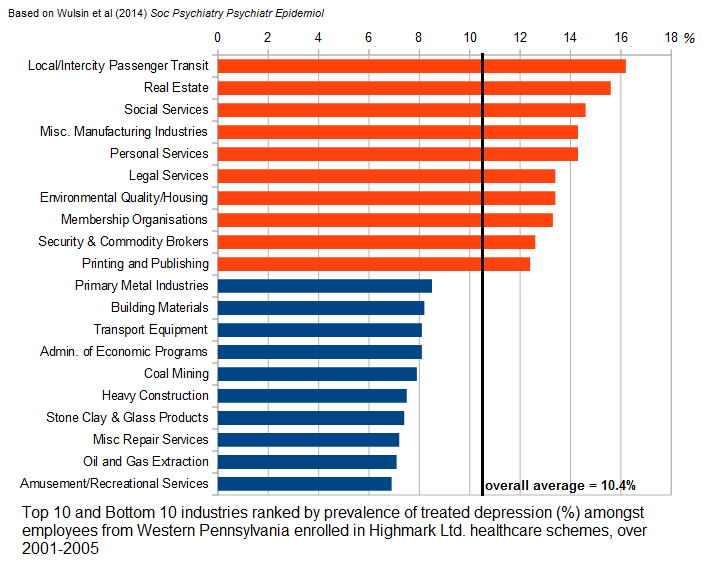
A recent study measured mental health on the job, drawing from insurance care records in Western Pennsylvania:

Looking at the chart above, the items in blue represent those industries in which depression is reported the least, while the ones in red report the most. So, people working in passenger transit, real estate, and social services are among the most affected by clinical depression, while those working in amusement/recreational services, oil and gas extraction (who knew?), and miscellaneous repair services are among the least affected.

According to the researchers, “Rates for clinical depression in 55 industries ranged from 6.9 to 16.2%, (population rate = 10.45%). Industries with the highest rates tended to be those which, on the national level, require frequent or difficult interactions with the public or clients, and have high levels of stress and low levels of physical activity.”

Neuroskeptic nods:

Which makes intuitive sense if you go with the idea that those are actually more depressing jobs, i.e. that they cause depression, rather than (a weaker claim) just being correlated with it or (weaker still) being correlated with people reporting it to their doctors.

However, is that true the world over or is it just a Westsylvania thing? It’s interesting to contrast this paper to one I blogged about in 2012. That study showed that, in the UK, blue collar occupations were amongst those with the highest rates of suicide, over the period of 2001-2005. Coal mining occupied the #1 spot in the British suicide rankings but in Western Pennsylvania, remember, coal miners had amongst the lowest rates of treated depression.

Happy Father’s Day! Now Get Back To Work.

James Poniewozik stresses the need for paid paternity leave:

A new study from the Boston College Center for Work and Family has found that new dads take paternity leave only to the extent that they’re paid to – i.e., not a lot. As the Washington Post reports, the majority of men who get two weeks’ paid leave take two weeks, those with three weeks take three, and so on. And per the Families and Work Institute, those lucky guys are few; only 14 percent of employers offer any pay for “spouse or partner” leave, compared with 58 percent for maternity leave (mostly through temporary disability insurance and very rarely at full salary).

Bryce Covert digs into the new research:

The report notes that in a study of 34 developed countries, the United States is one of just two that doesn’t ensure all fathers can access paid family leave. Here, both parents are only guaranteed 12 weeks of unpaid leave for the arrival of a new child, but even that only covers about half of all workers thanks to restrictions. Only 12 percent of workers get paid leave through their employers, although three states — California, New Jersey, and Rhode Island –  have instituted paid family leave programs for everyone. This past December, Sen. Kirsten Gillibrand (D-NY) and Rep. Rosa DeLauro (D-CT) introduced a bill that would give all workers access to paid family leave.

A past study from the Center for Work & Family found that 85 percent of fathers still take time off when their child arrives, but three-quarters take a week or less. California’s experience, meanwhile, backs up the most recent survey’s finding that paid leave increases leave taking. Just 35 percent of fathers took leave before the program began, but now three-quarters do, taking an average of three weeks.

Jena McGregor adds:

The vast majority of respondents – 86 percent – said they wouldn’t use paternity leave or parental leave unless they were paid at least 70 percent of their normal salaries. Roughly 45 percent said they wouldn’t use it unless they received all of their regular pay. Much of the explanation for those numbers is likely an economic one, as many of these fathers may be the primary breadwinner in their families.

Meanwhile, Aaron Gouveia praises his employers for letting him take paid leave as a new father:

By the time my second child was born last year, I had switched companies and had access to two weeks of fully paid paternity leave in addition to vacation time — all of which I was encouraged to take if I needed it. That extra time (and positive company attitude) was invaluable to me; it gave me peace of mind.

I was able to take care of my wife. I was able to supervise my oldest’s transition from only child to big brother. But most importantly, I was free to bond with my baby. I held him, changed him, got up at night to support my wife during feedings, learned his sounds, and developed a routine. Whether it’s moms striving for perfection or dads being hesitant (or already back at work) during those first few weeks, uninvolved dads lose out on so much of that initial experience that serves as a foundation for fatherhood. But paternity leave allowed me to be an active participant in parenting, as opposed to a bystander.

The Sons And Daughters Of Abraham

Pulitzer Prize-winning playwright Ayad Akhtar, whose The Who And The What recently opened in New York, considers the similarities between Jewish and Muslim identity, particularly in America:

My relationship to Jewish artists and writers began when I was very young. It started with Chaim Potok, and in college I discovered Saul Bellow, Philip Roth, Woody Allen, Seinfeld. All of that stuff was hugely influential in helping me think about my experience. There seemed to be so many commonalities; I found myself and my community in those works, oddly.

I think there is a lot of continuity between the Jewish and the Islamic traditions. We know this historically, though people don’t want to talk about that – especially Muslims. There is a common source for both Judaism and Islam, or let’s say that Islam finds its source in Judaism. The commonalities of practice and sensibility, ethos and mythos, create a lot of overlap.

Post-9/11, the notion of “Muslims” taking on a potential truculence [corresponds to] – although it’s different – ways in which Jews were seen pejoratively within dominant Western cultures. Something about the orientation of faith being your identity marker as opposed to nationality or ethnicity. Post-9/11, that is an issue: folks get labeled “Muslim” no matter where they’re from. If you are Muslim, then that is part of it, but here’s the complicating factor for me: growing up, the only part of my identity that mattered was being Muslim, and I knew that. Being Pakistani was not as important as being Muslim. So the black guy whom I met who’s a Muslim, I’m much closer to him than the Christian Pakistani guy who is my dad’s friend. We have a closer bond. This was innate to me as a kid.

I don’t know what it’s like to be Jewish, but I suspect there is some aspect of that: being Jewish is the thing that bonds you as opposed to being Jewish from Poland, or Jewish from Hungary.

Pop Rocks

Jillian Mapes reflects on the musical taste she inherited from her father:

These days, there’s a phrase for the classic rock my Baby Boomer father raised me on: Dad Rock. Some say Dad Rockers are forever stuck in 1976 or 1985 or even 1994, when the music was real, man. Prominent in Urban Dictionary’s most up-voted definition of Dad Rock is this phrase: “Dad Rockers have no desire to listen to recent music and are stuck in the past.” But I can assure you it is possible to teach an old dad new tricks when it comes to matters of rock ‘n’ roll.

I prefer this definition from Wilco’s Jeff Tweedy, the leader of a band often dubbed New Dad Rock: “When people say Dad Rock, they actually just mean rock. There are a lot of things today that don’t have anything to do with rock music, so when people hear something that makes them think, ‘This is derived from some sort of continuation of the rock ethos,’ it gets labeled Dad Rock. And, to me, those people are misguided. I don’t find anything undignified about being a dad or being rocking, you know?”

Mapes’ advice for teaching an old dad new tunes:

The key is to mix familiar sounds and structures (perhaps a current band who makes room for guitar solos) with something new or slightly experimental (could be as simple as electro-pop synths). Still, if your Dad Rock dad was as obsessive over music as my pops was in his day, trust that his tastes are not as narrow as they may seem now that he’s past his prime music discovery years. (My dad said that for the typical music fan, keeping up with new music slides off the priority list when you have kids and you settle in hard with your all-time favorites.) Present a wide array of new music and see what sticks. It may be a chart-topping rap song about money-grubbing groupies, or it may be the new War on Drugs album (which I will be sending dad).

More suggestions here.

(Video: Bruce Springsteen, Dad Rocker extraordinaire, performs “The River” in 1980)

Fairy Tales Can’t Come True

So Richard Dawkins would rather do without them:

Speaking at the Cheltenham Science Festival, Dawkins, a prominent atheist, said that it was ‘pernicious’ to teach children about facts that were ‘statistically improbable’ such as a frog turning into a prince. … Speaking about his early childhood he said: “Is it a good thing to go along with the fantasies of childhood, magical as they are? Or should we be fostering a spirit of skepticism?” “I think it’s rather pernicious to inculcate into a child a view of the world which includes supernaturalism – we get enough of that anyway,” the 73-year-old said. “Even fairy tales, the ones we all love, with wizards or princesses turning into frogs or whatever it was. There’s a very interesting reason why a prince could not turn into a frog – it’s statistically too improbable.”

Nothing but Zola for the kiddies, then? Gracy Olmstead ripostes:

[T]his is the argument for fairy tales that I don’t think you’ll like – because the more you appreciate the pattern and beauty, the magic and charm of the empirical world, the less likely you are to chalk such things up to statistical probabilities. When you see the wonder of nature and people, the potency of words, the luminosity of our world, it’s very hard to return to a merely statistical, empirical vision. Things do become enchanted and mysterious. We begin to consider visions and miracles. These things are very dangerous, so I can understand why you’re alarmed by them.

Perhaps you’re right – perhaps it’s better for us to just abandon the tales and fantasies. After all, the more we dabble in “creating worlds,” the more likely we are to consider whether our own world had a Creator. The more we construct and tell stories, the more likely we are to ponder the possibility of our own Storyteller.

Update from a reader:

On one hand, I’m amenable to what Dawkins is saying. But the death of the fairy tale is the death of science. The actual practice of being a scientist who advances knowledge demands a kind of imagination, creativity, and questing that can’t be contained in a regression equation. The tools we use to prove hypotheses are profound in their own right, but inculcating a sense of magical possibility and hidden reality in children is the first necessary condition in preparing them to make the next generation of rigorously tested leaps forward.

The Good Book, Without God

Valerie Tarico asked a number of prominent atheists and secularists what their favorite verses in the Bible were, reasoning that “if clear-eyed Christians can take the risk of exposing the Bible’s nasty bits, the converse should also be true—atheists should be able to acknowledge the parts that are timeless and wise.” Greta Christina, author of Coming Out Atheist, was one of a number of respondents who pointed to Ecclesiastes:

I actually have an entire favorite book: Ecclesiastes. There’s lots of beautiful stuff in it about nature, human nature, and good ways to live life. It has plenty of stuff I have serious problems with, too — the God stuff, obviously, and some other stuff as well — but much of the philosophy and poetry is quite lovely and moving. And much of it is oddly humanist, with an awareness of how small humans really are in the scheme of things, and how fragile our lives are, and the absurdity of how important we think we are (“all is vanity”), and how much our lives are shaped by chance, and the repeated reminders of our mortality.

I deeply love 4:9-12: “Two are better than one; because they have a good reward for their labour. For if they fall, the one will lift up his fellow: but woe to him that is alone when he falleth; for he hath not another to help him up. Again, if two lie together, then they have heat: but how can one be warm alone? And if one prevail against him, two shall withstand him; and a threefold cord is not quickly broken.”

Passages about social justice also appeared with some frequency. Here’s Kim Veal’s selection:

I sometimes read Gospel passages in the tradition of Zen koans. I like John 14:2, where Jesus says, “In my Father’s house there are many mansions.” Holding the paradox of many mansions inside a house gives me a sense of spaciousness, of welcome, of saying, “Everyone can find a home in my heart.” I have no idea if that’s what Jesus meant—it doesn’t seem to be what Christians mean sometimes—but it reminds me that we’re all one grand, human family and that we need to care for each other.

Reading The Bible With Fresh Eyes

The Anglican theologian and priest N.T. Wright explains why he understands scripture’s place in the Christian life in dynamic, rather than static, terms:

One of the wonderful things about the Bible is the way no generation can complete the task of studying and understanding it. We never get to a point where we can say, “Well, the theologians have sorted it all out, so we just put the results in our pockets or on the shelves, and the next generation won’t have to worry — they can just pull it out and look it up.” No, the Bible seems designed to challenge and provoke each generation to do its own fresh business, to struggle and wrestle with the text. I think that is the true meaning of the literal sense, in Augustine’s sense of “what the writers really meant”: we have to acquire those old eyes, the historian’s quest to understand Genesis and Matthew and Romans in their historical context. I know that is strongly resisted today by many conservatives, but this is ridiculous: without historical inquiry, parallels, lexicography, and so on, we wouldn’t even be able to translate the text.

And, yes, I know that there are many secularizing biblical scholars, and indeed many left-brain dominated conservative ones, who produce a kind of biblical scholarship that the church either shouldn’t use or couldn’t use. But just because the garden grows weeds, that doesn’t mean we shouldn’t plant fresh flowers, instead paving the whole thing over with concrete. No, each generation must do its own fresh historically grounded reading, because each generation needs to grow up, not simply to look up the right answers and remain in an infantile condition.

Recent Dish on Wright’s work here and here.

There’s No Wrong Way To Pray

That’s one of the conclusions Pascal-Emmanuel Gobry came to after diving into the work of Ruth Burrows, a Carmelite nun known in her order as Sister Rachel, who’s written a number of classic books about prayer:

Whenever we think about prayer, or our prayer life, we think of prayer as a performance–as something we do for God. And we wonder whether we do it “right.” And we fuss and wonder about technique. This is quasi-Pelagianism. We Christians are under the order of grace. Our relationship with God is–must be–totally marked by grace. We are saved by God by sheer grace through Jesus Christ. God does not want performance from us. God only wants us to agree to receive his grace, which is in many ways a lot harder, because it means surrendering control, and surrendering our idolatry of ourselves. But it is also liberating, because it means there is no “wrong” way to pray. We don’t have to worry about praying “wrongly”, because whatever we do, what matters is what God does to us, not the other way around. … [Burrows] stresses that even the great “mystics” and saints of this highly-mystical Tradition mostly had basically the same prayer experience as most of us every day: dryness, distraction, frustration, and so on.

In an interview in 2012, after the release of her book Love Unknown, Burrow expanded on this point:

Prayer can never be a failure. If I used that expression it would refer to how people express themselves: “I can’t pray”; “my prayer is a failure”; “I pray and nothing happens; I’m praying to myself.” This is to have a completely false idea of prayer. To believe in the God of Jesus Christ is to know that, through what God in his love has done for us, there is absolutely no barrier between God and ourselves. We have free access. God is always available, always there, always with us—with you, with me. …

Prayer is essentially God’s work. Our part is to give time, do our best to keep attention, surrender ourselves as best we can. Then we can be sure that God works. Faith does not ask for signs, for tokens. When we really grasp that prayer is essentially God’s business, not ours, we will never talk of failure, no matter how unsatisfactory prayer seems to us.

Beyond The Neck Tie

Ian Crouch traces the history of Father’s Day, noting that its early iterations downplayed the commercial aspects of the holiday, given that men’s “comparative economic autonomy created a kind of anxiety about gift-giving” – an anxiety ad men would seize upon:

Father’s Day got a significant boost, and a final push toward general recognition, in the early thirties, when the Associated Men’s Wear Retailers, a New York trade group, formed a Father’s Day Committee and débuted a new slogan, “Give Dad Something to Wear.” In 1938, the trade group redoubled its efforts, forming the National Council for the Formation of Father’s Day and hiring a retired adman, Alvin Austin, to marshall its promotion. This is the holiday’s other origin story, and it is a plainly commercial one: Father’s Day would become what Schmidt identifies as a “second Christmas” for men’s retailers. In 1972, Father’s Day was made official, signed into law by Richard Nixon, who wrote, grandly, “In fatherhood we know the elemental magic and joy of humanity.”

The custom of buying Dad a necktie (or another manly present, such as tobacco, cologne, or, later, power tools and gadgets), aided by yearly ad blitzes, became the midcentury’s middle-class standard, with mothers taking their kids to the department store to pick out a tie, a razor, or a bottle of Old Spice. They were rather gloomy offerings, and symbols of the white-collar dad’s professional life: his routine, his absence, and his almost generic unknowability.

Commenting on the Dove commercial seen above, Crouch points to the changing images of fathers it’s responding to:

The Dove commercial, however, is a celebration of the value of the soccer dad—and of the dad who changes diapers and kisses his children. From a brand perspective, it makes sense: buying your father moisturizer anticipates closeness; skin-care products are, in large part, about the value of softness and intimacy. It may not be revolutionary, but its sincerity stands out compared to another high-profile Father’s Day campaign from this year, which continues to emphasize fatherhood as a fraught and unsettled emotional enterprise. The American Greetings card company has produced a response ad to its own Mother’s Day commercial, called “World’s Toughest Job,” which showed women taking part in mock job interviews that emphasized the daunting nature of motherhood. In “World’s Toughest Job-Dad Casting,” actors bumble through scenes of domestic conflict, flubbing their lines, revealing themselves to be clueless, emotionally stunted, and largely bewildered by the customs of middle-class American parenthood. At the end, the moment of sincerity is simply that they are there to listen—“I’m here for you”—like dumb sounding boards, holding down the fort until Mom gets home from work to sort things out. These dads are goofballs, and probably, at best, deserve another necktie.