Sex And The Single Soldier

by Katie Zavadski

In What Soldiers Do: Sex and the American GI in World War II France, Mary Louise Roberts recounts the unsavory activities of the good boys of the Greatest Generation. Jennifer Schuessler reviews the book (NYT):

The book cites military propaganda and press accounts depicting France as “a tremendous brothel inhabited by 40 million hedonists,” as Life magazine put it. (Sample sentences from a French phrase guide in the newspaper Stars and Stripes: “You are very pretty” and “Are your parents at home?”)

On the ground, however, the grateful kisses captured by photojournalists gave way to something less picturesque. In the National Archives in College Park, Md., Ms. Roberts found evidence — including one blurry, curling snapshot — supporting long-circulating colorful anecdotes about the Blue and Gray Corral, a brothel set up near the village of St. Renan in September 1944 by Maj. Gen. Charles H. Gerhardt, commander of the infantry division that landed at Omaha Beach, partly to counter a wave of rape accusations against G.I.’s. (It was shut down after a mere five hours.)

In France, Ms. Roberts also found a desperate letter from the mayor of Le Havre in August 1945 urging American commanders to set up brothels outside the city, to halt the “scenes contrary to decency” that overran the streets, day and night. They refused, partly, Ms. Roberts argues, out of concern that condoning prostitution would look bad to “American mothers and sweethearts,” as one soldier put it. Keeping G.I. sex hidden from the home front, she writes, ensured that it would be on full public view in France: a “two-sided attitude,” she said, that is reflected in the current military sexual abuse crisis.

Fiona Reid also reviews the book:

GIs arrived on French soil with preconceived sexual fantasies and an ingrained belief in the decadence of French women. This prejudice was reinforced in the early days of liberation as women suspected of sexual liaisons with Nazi soldiers were paraded, shaven-headed, through the streets while other (equally available) young French women eagerly greeted their American liberators with public kisses. Clearly there was romance but there was also abuse. Sex may have been given freely in the initial heady days of liberation, but it quickly became a commodity and US soldiers were soon associated with prostitution and soaring rates of sexually transmitted disease. Those who argue that prostitution does not necessarily degrade should pay close attention to the language of Panther Tracks, a GI newspaper, on this topic: “An especially vivacious and well-rounded harlot might demand a price of 600 francs. However the price scales downwards for fair merchandise and mediocre stock. Some fairly delicious cold cuts can be had for 150 and 200 francs.” By conceptualising French women as “cold cuts”, GIs grew used to accepting subservience from all women and from the entire highly “feminised” French nation.

In a review last month, Robert Zaretsky considered the racial implications:

A veritable army of infected women, overwhelming France’s shattered medical facilities, was one tragic legacy of this cultural collision. An even more tragic and disturbing legacy, though, was that of rape by American soldiers. The crime was almost always, due to the institutionalized racism of the American Army and racial prejudices of French civilians, associated with blacks: of the 152 soldiers tried for rape in France, 139 were black. Segregated and relegated to service duties like food and laundry services, black soldiers had more contact with French civilians. This presence of black soldiers in the rear lines fused with racial stereotypes, widespread among both Americans and French, that blacks were “hypersexualized.” When one adds stark linguistic and cultural divides to these stereotypes, as well as the traumatic experience of war and liberation, blacks were frequently accused of crimes they never committed.

Inevitably, a segregated army that numbered thousands of officers from the American South rarely questioned these accusations. Roberts’s meticulous review of the rape trials reveals a fatal pattern of racial prejudice with accusers and the military courts. Along with chocolate and cigarettes, Jim Crow turned out to be another welcome American import.

David Ellwood finds parts lacking:

It is a devastating tale, written with rare fluency and style and meant to pull down for ever the sacred images of the ‘good war’ and America’s armies as being full of unsullied heroes, risking their lives to bring liberation, relief, hope and democracy. Unfortunately it also presents a blinkered view, restricted in effect to what happened in two regions in northern France in parts of 1944 and 1945. … Depravity was not the whole story. In most places Americans were also seen as carriers of a model of modernity. The medium of their technology alone carried a message: the soft power of hard metal.

It is David Reynolds who explained best just why the GI’s behaved so often in their uncontrolled way, a question Roberts never gets to the root of, even as she insists that the US army was unique in its attitudes to sex. Freedom to spend, eat, drink, smoke and to buy women anywhere, anytime was not the casual thoughtlessness of a power new to total war. Instead it was the key technique chosen by the general staff and Congress to hold together armed forces which were not fighting to defend home and hearth; a huge, raw mass of young individuals in uniform from a land with scarce military traditions and a strong commitment to citizen democracy. The American under arms was an extraordinarily privileged being compared to those all around wherever he (or she) went to war. Probably it is still so, but over time the Pentagon has found other ways to motivate its personnel beyond the promise of unlimited money, food and sex. The unhappy Normans (and plenty of others) paid the price for the start of this learning process.

When Your Next Step Could Be Your Last

by Matthew Sitman

Byliner has unlocked Brian Mockenhaupt’s The Living and the Dead: War, Friendship, and the Battles That Never End for Memorial Day, which follows three soldiers in Afghanistan – Tom, Ian, and Jimmy – and the way battle shapes their lives. Here’s a glimpse of the gripping story Mockenhaupt tells:

With the mine detector, his rifle, ammunition, grenades, body armor and helmet, two radios, the bomb jammer, water, and medical supplies, Ian carried close to 90 pounds, more than any other Marine in the patrol.

He could handle the load: at five foot seven, he had weighed 150 pounds when he entered the Marines in 2007, but he had since bulked up to 205. He figured carrying extra weight would increase the patrol’s overall effectiveness—a weaker and overloaded Marine falling behind put everyone at risk. Besides, that way other Marines couldn’t complain about their lighter loads, or not being able jump across canals with the awkward weight.

Ian turned south, onto a tree-lined road that split two muddy fields. In a month the fields would be thick with waist-high poppy plants.

Tick tock.

Fifty yards up, the road crossed a canal just in front of a large, high-walled compound to the left.

“Muller,” Tom said, “slow it up a bit.” The patrol had stretched out after the Afghan soldiers, farther back, stopped to question a farmer. Tom and Matt picked up their pace and closed the distance with Ian, who worked the mine detector back and forth.

Tick tock.

Holly sniffed the air, five feet behind Ian, as he stepped onto the dirt bridge that spanned the canal.

Tick tock.

Tick.

Matt still can’t figure out how Holly wasn’t killed.

For the rest of the holiday weekend, you can read the rest here. Purchase The Living and the Dead as a Kindle Single here.

When It’s Not PTSD

by Jessie Roberts

Lynne Jones questions the spread of the diagnosis, which entered the DSM-III in 1980. She recalls that, while working as a psychatrist in Sarejevo during the Bosnian War, “what immediately struck all of us living under siege at that time was the irrelevance of describing anything as ‘post-traumatic’”:

One researcher found that almost 94 per cent of displaced Bosnian children living in collective centres met the criteria for PTSD. But he wondered if some of those symptoms might be adaptive in the midst of continuing conflict. The children had been repeatedly shelled during the two-month research period. The hyper-vigilance that made a child startle at a sudden sound might actually keep them alert enough to take cover.

Jones went on to run a mental health clinic in Gorazde, Bosnia in 1996. She remembers that “most of the problems people brought to the clinic simply did not fit [the PTSD] pattern of symptoms”:

The most common problem among the ex-soldiers was chest pain. Bojan arrived at the clinic short of breath and trembling with anxiety. A short chubby man, slightly balding, he sat down and talked without stopping. The problem had begun during the war. After the funeral of a close friend, who had died in fighting, Bojan had collapsed with chest pain. Everyone thought he was having a heart attack. He had been sent to Sarajevo and put in intensive care with chest monitors and blood tests. After a few days, they told him it was his ‘nerves’ and sent him back to his unit in Gorazde. He was angry at doctors who had mishandled his problem and terrified of dying of a heart attack like his father. But he did not have nightmares or tend to relive painful memories from the war. He enjoyed his six-year-old child, his wife, his work; and whatever he had, it was not PTSD.

Some of my colleagues at home argued that the PTSD construct should be adjusted to include all post-conflict reactions, in both adults and children. But the point of a diagnosis is to distinguish problems that require different approaches. What is gained by extending the frame to include different symptom patterns, when all they have in common is exposure to the same supposed triggering event? A patient who has a persistent cough and is diagnosed with pulmonary tuberculosis requires a quite different treatment from a chronic smoker with a cough. If no distinction is made, one may end up giving the psychological equivalent of cough mixture: the ubiquitous, undefined ‘counselling’.

He Certainly Did More Than Paint

by Matthew Sitman

In a long review of three recent books about John Quincy Adams and his wife, Louisa Catherine, Susan Dunn considers the accomplishments of his post-presidential career, which saw Adams return to public life as a member of the House of Representative and take up the abolitionist cause:

Though launched anew upon what he called “the faithless wave of politics,” Adams had a John_Quincy_Adams_1843guiding star, a clear path forward: the battle against American slavery. In 1831 and again in 1832, he dined with an impressive young Frenchman who queried him about the culture of democracy in America. “Do you look on slavery as a great plague for the United States?” asked Alexis de Tocqueville. “Yes, certainly,” Adams replied. “That is the root of almost all the troubles of the present and fears for the future.”

Ending slavery became Adams’s great mission. But because he understood that slavery was the one issue that could tear apart the union, he decided that, instead of taking it on frontally, he would attack it on the flanks. He aggressively defended the right of abolitionists to petition Congress and denounced the “gag resolution” that mandated the tabling of all petitions and propositions relating in any way to slavery, and he opposed Texas’s admission to the union as a slave territory. Invoking the immortal values of the Declaration of Independence, taunting his foes, barely surviving a censure resolution, he became known to sympathizers, as Robert Remini noted in his excellent short biography of Adams, as “Old Man Eloquent” and to southerners as “the Madman from Massachusetts.”

In 1847, Abraham Lincoln, a freshman congressman from Illinois, took his seat alongside Adams in the House of Representatives. John Quincy, whose mother had taken him more than seventy years before to watch the Battle of Bunker Hill from atop Penn’s Hill in Quincy, was a living link between the revolutionary generation that created a republic tragically flawed by its compromise with slavery and Abraham Lincoln, who would end slavery and rescue the republic from its own undoing.

Focusing on Fred Kaplan’s biography, John Quincy Adams: American Visionary, Carol Berkin emphasizes that “John Quincy did not find his independent voice until he was in his 70s,” when his anti-slavery activism reached its peak:

As Kaplan lays out the events that heightened Adams’ commitment to abolition, the narrative’s tempo increases and the story unfolds more powerfully. It culminates with the Amistad trials, which revolved around 53 Africans seized by Portuguese slave traders. Sold to Spanish planters, they were loaded onto the Amistad to be sent to Caribbean plantations. They rebelled, killed the captain and attempted to sail to Africa, but the ship was seized by an American brig off the U.S. coast. The Africans were imprisoned in New Haven, Connecticut. As the planters, the Spanish government and the brig captain argued over who owned this human property, abolitionists insisted the Amistad passengers were free individuals, kidnapped illegally.

When the case came to the Supreme Court, it was Adams who argued — and won — the defendants’ case. This, at last, was Adams’ moment — not a tribute to his father’s memory but a declaration of his own commitment to human equality and justice.

(Image: John Quincy Adams in 1843, via Wikimedia Commons)

Government Is Not The Problem

by Matthew Sitman

Arguing that “American conservatives are in danger of appearing as though they had no positive idea of government at all,” Roger Scruton makes the case for the necessity and goodness of government:

The truth is that government, of one kind or another, is manifest in all our attempts to live in peace with our fellows. We have rights that shield us from those who are appointed to rule us—many of them ancient common-law rights, like that defined by habeas corpus. But those rights are real personal possessions only because government is there to enforce them—and if necessary to enforce them against itself. Government is not what so many conservatives believe it to be, and what people on the left always believe it to be when it is in hands other than their own—namely a system of power and domination. Government is a search for order, and for power only insofar as power is required by order. It is present in the family, in the village, in the free associations of neighbors, and in the “little platoons” extolled by Burke and Tocqueville. It is there in the first movement of affection and good will, from which the bonds of society grow. For it is simply the other side of freedom, and the thing that makes freedom possible.

Rousseau told us that we are “born free,” arguing that we have only to remove the chains imposed by the social order in order to enjoy our full natural potential. Although American conservatives have been skeptical of that idea, and indeed stood against its destructive influence during the time of the ’60s radicals, they nevertheless also have a sneaking tendency to adhere to it. They are heirs to the pioneer culture. They idolize the solitary entrepreneur, who takes the burden of his projects on his own shoulders and makes space for the rest of us as we timidly advance in his wake. This figure, blown up to mythic proportions in the novels of Ayn Rand, has, in less fraught varieties, a rightful place in the American story. But the story misleads people into imagining that the free individual exists in the state of nature, and that we become free by removing the shackles of government. That is the opposite of the truth.

Punnin’ Games

by Jessie Roberts

“In mixed company, puns are, along with politics and religion, best left alone,” states Ted Trautman, who traveled to Austin, Texas, to compete in the O. Henry Pun-Off World Championships:

Contestants in the “Punslingers” bracket, facing off in pairs onstage, are given a theme—Disney, weather, et cetera—and forced to make thematically relevant puns every ten seconds or so until one contestant runs out of ideas. … Just as a slam-dunk in basketball earns the same number of points as a layup, this portion of the Pun-Off rewards a contestant for the quantity of her puns rather than their quality. As the moderators explained several times, in a refrain later echoed by desperate contestants defending their ripostes, “It doesn’t have to be good. It just has to be a pun.” The Punslingers event may be the only sport on Earth in which the highest level of play is the most painful to watch. …

[M]y favorite moment of the day occurred during a round in which players had to pun on the theme of “Groups (human and animal)”—e.g., flock, herd, choir, and the like.

The two men on stage had exhausted most of the obvious words in the category, and were beginning to butt heads with the moderators…. After a healthy volley one of the contestants offered an invalid answer, and then another, courting disqualification. And then he rebounded with the perfect pun—not the most clever, not the most original, but one that managed to both keep the round going and poke fun at the increasingly strict moderators: “Next year,” he said, “this topic ought to be band.” Despite the limits on both time and topic, this contestant delivered a pun in the heat of the moment that, against all odds, actually made sense. The crowd went wild, perhaps forgetting for a moment that on Monday they would have to return to a world where words mean just one thing at a time.

A Debate Over A Troublesome Book, Ctd

by Patrick Appel

us-census-races

A biology professor writes:

While the scientific reviews of Nicholas Wade’s new book have been almost uniformly negative, your treatment of the matter seems to have missed the major point of both Wade’s book and the damning criticisms. What Wade gets wrong is not that there are genetic differences among human populations, and that you can tell where a person (or his ancestors) are from by looking at these differences (on this point he is simply correct: the geographic division of humanity into genetically diagnosable groups is not a “social construction,” but a fact of nature). Rather, Wade’s major and unsupported claim is that differences between contemporary human societies are genetic and have evolved extraordinarily quickly.

Here, for example is Jerry Coyne on the book. Allen Orr, in the New York Review of Books, has a very similar view of Wade’s book. Both Coyne and Orr are geneticists, experts in the study of species and their origins (they coauthored a book on the subject 10 years ago). While the fact of geographically-based genetic subdivision (which is what biologists mean by “race”) may drive some to apoplexy, its not news to a geneticist. It’s Wade’s “second part” that doesn’t hold up to critical analysis, and this is what knowledgeable scientific reviews have pointed out.

Wade’s application of genetics to the differences between societies is indeed the most troubling and evidence-starved part of his book. I didn’t miss it; I highlighted Coyne’s and Orr’s reviews last week. And I fully accept “the geographic division of humanity into genetically diagnosable groups.” But what’s the utility of calling those genetic divisions “race”? Having two definitions for race, one biological and one societal, is liable to make individuals think the socially constructed racial categories are exactly the same as the biological ones and lead individuals to incorrectly justify social hierarchies using biology.

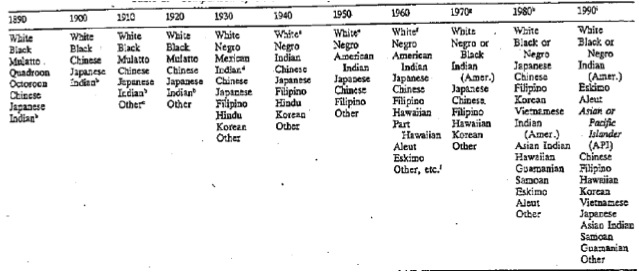
The graphic at the top of this post, from Jennifer Raff’s review of Wade’s book, shows the “United States census classifications of race or color, 1890-1990.” A highlight from Raff’s takedown of A Troublesome Inheritance:

Human biological variation is real and important. I’ve studied it my entire professional career. We can see this variation most easily in physical traits and allele frequency differences between populations at extreme ends of a geographic continuum. Nobody is denying that. Let me repeat this: no one is denying that humans vary physically and genetically. All anthropologists and geneticists recognize that human differences exist. But Wade, and others who agree with him, have decided that certain patterns of variation—those which happen to support their predefined notions of what “races” must be—are more important than others.

Wade’s perspective fits with a larger pattern seen throughout history and around the world. Folk notions of what constitutes a race and how many races exist are extremely variable and culturally specific. For example, the Bible claims that all peoples of the world are descended from Noah’s three sons, mirroring the popular concept of three racial divisions (Caucasians, Africans, and Asians). On the other hand, the five-part division of races seems most “logical” to Wade. Anticipating confusion on this point he claims: “Those who assert that human races don’t exist like to point to the many, mutually inconsistent classification schemes that have recognized anywhere from 3 to 60 races. But the lack of agreement doesn’t mean that races don’t exist, only that it is a matter of judgment as to how to define them” (p. 92).

A matter of judgment. So, rather than being defined by empirical criteria, as Wade had asserted so confidently earlier in the book, it really is just a subjective judgment call. The differences between groups are so subtle and gradual that no objective lines can be drawn, so Wade draws his own on the basis of his own preconceptions.

A reader adds:

It should be mentioned that there are some reputable scientists who defend something like Wade’s conception of broad races, while being much more careful than he is to point out that these are not really discrete groups, that the number of them and boundaries between them are somewhat arbitrary.

You may have seen the recent comments by Jerry Coyne, Steven Pinker and Alan Orr—none of whom is much bothered by Wade’s assertions of race-as-reality, though they’ve all rubbished his grand, gene-based account of human history. Personally, I have yet to see any of these guys fully justify the notion of fixed, coarse racial categories vs. the much more fluid and contextual idea of populations, which exist at various levels of scale and whose definition depends entirely on what you’re interested in learning.

There is a big cultural and, some would say, ideological split between this subset of evolutionary biologists who’ve denounced the “race as social construct” idea as a “myth,” and the majority of anthropologists, who continue to hold that position.

Another reader takes issue with Charles Mills’ speech on the social construction of race:

My gripe with this clip is that it attempts to illustrate the social construction of race by still preserving fairly recent forms of “racial” categorization as its model: i.e. “whiteness” and “blackness.” Mills then goes on to take these categories, which emerged slowly between four hundred and two-hundred and fifty years ago, and transpose them onto the medieval period.

Neither Medieval Europe nor any portion of Sub-Saharan Africa during Medieval days utilized these markers “white” and “black” as social divisions. A more useful alternative universe might imagine a social order in which completely different categorization schemes emerged. For instance, we know that through the early 1700s Europeans were more likely to classify Africans by their “tribal” origins (I’ll leave aside the problematic ways in which the encounter with Europeans actually served to construct these tribal boundaries as they came to be known). As such, where slave traders captured their labor force was a more prominent marker than that labor force’s “blackness.” “Blackness” emerges as a primary marker only after several generations of intermarriage in the Americas among slaves.

So we’re better served, I would argue, imagining a system that eschewed Blackness and Whiteness as the primary dividing line altogether, and imagine a world where, say, the Iberian Moors, with the help of darker skinned Africans from both East and Sub-Saharan Africa succeeded in displacing the authority of Europeans. In such a system, there may have been a hierarchy that placed Iberian Moors at the top of the social order (perhaps because of language skills that enabled them to serve in clerical positions in dominance of fellow Europeans). And then a “racial” scheme that divided the world according to gradations of skin (or hair, or a combination of features) that privileged something akin to a mocha over various gradations of lighter and darker skin (i.e., the darker or the lighter you were, the lower your status). Or perhaps one in which blonder and redder hair became the marker for subjugation.

The point (which I don’t think Mills did a great job of emphasizing), is that there was nothing inevitable about skin color even being a social marker. For much of human history, it doesn’t appear to have been so.

Another reader adds some context on epigenetics:

Jonathan Marks is quoted as writing:

“the ways in which DNA can be modified in direct response to the environment, and those DNA modifications can be stably transmitted…”

He should clarify what he means by “stably transmitted.” In fact, epigenetic modifications are very rarely felt beyond perhaps third generation. Jerry Coyne wrote, about 3 years ago, a great commentary on how epigenetics is being hyped.

And final reader theorizes about why Wade largely ignores culture:

Apparently Wade has it in his head that culture = easy to change through an implicit logic that if it’s not hard-coded it must be infinitely and immediately mutable. Which is sheer nonsense, of course, but betrays the unscientific bias in his thinking. There’s actually no reason at all to presume that it should be easy to transfer an institution from one society to another given actual institutional behaviors usually depend on a whole accumulation of wider behaviors.

The idea that cultural institutions, which have changed radically over the centuries in those regions, are hard-coded in genes is just kooky. And it’s dangerously self-excusing and deceptive to ascribe inability to easily, in a facile fashion, transfer institutions to genetics. All this is a pity as there is a lot of learning to come from the real – but subtle – influence of genetics in framing human action. That learning is deeply distorted by primitive and fuzzy-minded thinking.

Most of all, though it’s really disappointing to see a science writer for the Times betray the fact he really has a poor grasp of science.

Previous Dish coverage of Wade’s book here.

Was Dietrich Bonhoeffer Gay?

by Matthew Sitman

Charles Marsh’s Strange Glory: A Life of Dietrich Bonhoeffer, a new biography of the German theologian and pastor killed by the Nazis and a hero to many conservative evangelicals in America, has reviewers asking the question. I can’t say if he meant for this to be a wink and a nod or not, but Timothy Larsen begins by noting Bonhoeffer’s rather fastidious attention to what he wore:

You could illustrate almost every momentous turning point in his life with sartorial commentary. When he takes a pastoral internship in Spain, he bombards the senior minister with written inquiries regarding the proper formal wear for dinner parties. The poor, overworked man eventually remarked sarcastically that the new intern should bring his preaching robe.

Bonhoeffer was thrilled by the writings of Barth, but his confidence in the brilliant theologian was shaken when he first met him and observed that he lacked dress sense. When Eberhard Bethge, Bonhoeffer’s student and close friend, arrived at his underground seminary, Bonhoeffer was identified as “the sporty dresser.” He even arranged to get his favorite brown suit delivered to him in prison.

About that “close friend”:

Marsh makes a convincing case that Bonhoeffer harbored feelings for Bethge that extended beyond friendship. Those feelings were unrequited, and Bonhoeffer probably did not consciously acknowledge them. Still, Marsh notes, he was possessive and smothering in his attention. He created a joint bank account and sent Christmas cards signed, “Dietrich and Eberhard.”
This turns into a major, recurring theme in Strange Glory. It fascinated me at first, but I grew tired of Marsh directing the camera angle of every scene so as to rather heavy-handedly keep it in view. Particularly regrettable is his decision to describe this relationship using words from Emily Dickinson—”The heart wants what the heart wants”—given the association between the quotation and Woody Allen’s use of it to justify unsavory behavior.

Bonhoeffer, by contrast, was so sexually innocent that I would not assume Athanasius himself surpassed him in this regard. Any such possible desires for Bethge appear sublimated and regulated. Even Bonhoeffer’s physical relationship with his fiancée, Maria—whom Marsh says Bonhoeffer was “smitten” by—comprised only a solitary occasion when, as a prisoner, he kissed her on the cheek in the presence of the public prosecutor. In a late prison letter, Bonhoeffer observed that he had lived a full life even though he would die a virgin.

In a review of the book we flagged last month, John Stackhouse Jr. picked up on the theme as well, remarking, “Marsh defends the chastity of the two men, but one wonders if Marsh might usefully have hinted less and ruminated more.” Meanwhile, after reading Bonhoeffer’s Letters and Papers from Prison – which partly consists of the correspondence between Bonhoeffer and Bethge – Wesley Hill argued last month that the relationship between desire and friendship can be complicated:

What struck me in reading [the Bonhoeffer-Bethge letters], perhaps in contrast to Marsh and Stackhouse’s views, was how unwieldy our categories are—either “homosexual” or “just friends”—when it comes to classifying a relationship as profound as Bonhoeffer and Bethge’s was.

Years after their exchange of letters, and after Bonhoeffer’s death, Bethge fielded a question from a member of an audience who had gathered to hear him speak about his old friend. Surely, the questioner said, “it must [have been] a homosexual partnership” that existed between you and Bonhoeffer—after all, what else could Bonhoeffer’s impassioned letters have signaled? Bethge responded by saying, no, he and Bonhoeffer were “quite normal.” But perhaps an even better response would have been to query that idea of “normal.” Better, perhaps, for Bethge to have explored whether friendship and erotic love might be (in the words of Rowan Williams) “different forms of one passion—the passion for life-giving interconnection.” Pursuing this line of thought might not give us a “celibate gay” Bonhoeffer, but it also might not yield a “just-friends-with-no-hint-of-eros” Bonhoeffer.

Previous Dish on Bonhoeffer here, here and here.

The Humanity Of Evil

by Jessie Roberts

dish_duch

In his book The Master of Confessions, Thierry Cruvellier details his experience as witness to the war crime trial of Kaing Guek Eav, or Duch, the Khmer Rouge leader who oversaw the torture and killing of at least 12,000 people from 1975 to 1979. Philip Gourevitch talked to Cruvellier about the psychology of mass murder:

[Y]ou say that what Duch’s trial revealed to you was … his humanity. You write, “Duch is not a psycho or a monster and that’s the problem.” Why, or for whom, is that a problem?

The humanity of individuals who become mass murderers like Duch is a repulsive notion to many people. I can assure you that the predominant reaction, regardless of social and educational background, is to say that they are not one of us. In fact, many people do not even understand how someone can go and defend them in court. … Refusing Duch as one of us may give us peace of mind. It keeps us in the safe belief that if, God forbid, we happened to face extraordinary historical circumstances we would behave like heroes. But it doesn’t help us better understand how mass crimes develop and succeed through mass participation.

At the genocide museum in Phnom Penh, Duch’s victims are presented as victims, which they certainly were. But eighty per cent of them were themselves Khmer Rouge, and if they instead had been asked to be perpetrators the overwhelming majority would have obeyed. To accept that Duch tells us something about ourselves doesn’t mean we accept his crimes, and it doesn’t mean we risk showing him sympathy. It makes us think in more realistic terms about how mass murder operates and how it relies on people like us.

(Image of Duch in November 2009, on the first day of closing statements during his trial, courtesy of Extraordinary Chambers in the Courts of Cambodia.)

Why Atheists Need Philosophy

by Matthew Sitman

In the wake of Neil deGrasse Tyson’s rather dismissive comments about philosophy’s usefulness, Rebecca Goldstein defends its enduring value – especially for the non-religious:

Philosophy is important because it’s unavoidable if you want to live a coherent life. To live such a life is to use standards to justify your beliefs and actions; it’s to try to bring as much internal consistency into your various beliefs as possible; it’s to consider which of our seemingly intuitive views about the nature of the world and our place within it are compatible with what science has to tell us, which are incompatible, and which are absolutely necessary.

Now whether one likes it or not, such coherence-making thinking involves one in issues of philosophy. Secularists, in particular, who want to counter the false claim that without God to ground morality there can only be nihilism, should be particularly interested in moral philosophy, since that’s where they’ll find the counter-arguments.

Goldstein goes on to clarify how she views philosophy’s relationship to science:

I think there’s often a misunderstanding about the nature of philosophy. Some seem to think philosophy to be in competition with science in the project of describing reality—in other words, ontology. But that’s not really the proper job of philosophy at all. It can’t, and shouldn’t, compete with science in this domain.

And how does one know this? From good philosophical arguments, that’s how. Science, even in making out its case for ontological superiority, has to rely on philosophy in order to make it coherently. It has to step outside of itself and offer a clear criterion for what makes some description scientific and others not, and offer a defense that its methodology actually gets us closer to knowing reality. It relies on philosophy to render its own claims coherent.

More generally, if you want to know what the role of philosophy is you should think of it more in terms of maximizing our overall coherence—including our internal moral coherence—than in terms of describing reality, as science does.

Also responding to deGrasse Tyson, M. Anthony Mills elaborates on how philosophy and science differ:

[T]he division of labor is not that philosophy is speculative while physics is not; rather, each discipline looks for different kinds of answers. Modern physics can ask speculative questions such as, “When did the universe begin?” or more practical questions such as, “How can we infer the existence of a planet by observing gravitational effects?” In either case, the answers depend on empirical and experimental evidence.

Modern philosophy, by contrast, asks questions such as, “What does it mean to accept the truth of a scientific theory?” Crucially, philosophical answers rely on different forms of evidence: not observations, but sound reasoning. A philosophy of science isn’t a theory alongside scientific theories, but a framework for evaluating such theories.

DeGrasse Tyson is right that such questions are not usually germane to the working scientist. But that doesn’t render them superfluous or counterproductive. Scientific progress not only requires the day-to-day work of “practitioners,” but also those who see the proverbial forest. Revolutionary thinkers break out of accepted paradigms and question received wisdom; they engage in precisely the kind “question-asking” for which deGrasse Tyson would banish philosophy.