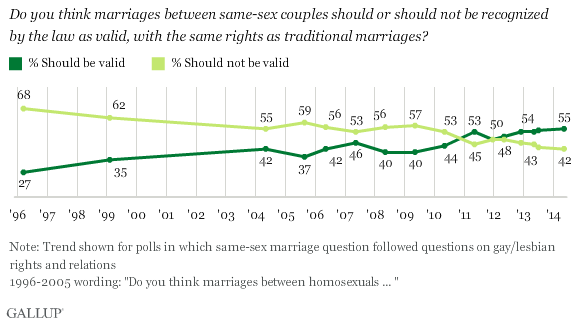
Lemieux argues that marriage equality’s success demonstrates the importance of court victories:
There’s no evidence that the public responds to judicial opinions differently than it responds to legislation. … The lesson is that political conflict cannot be avoided merely by avoiding particular means of affecting social change. When proponents of social reform win, they will likely generate a backlash by supporters of the status quo — no matter what institution creates the policy change. The only way to avoid backlash is simply to not win.
At this point, the success of the gay marriage litigation campaign should be clear. Public opinion has trended in a remarkably positive direction, ultimately reaching the politically cautious occupant of the White House. Same-sex marriage rights have continued to advance at the state level, and such marriages now have federal recognition thanks to the Supreme Court’s Windsor decision last year. Arguments that the judicial decisions favoring same-sex marriage would be a major liability for the Democratic Party have proven to be unfounded.
The first documented case of a nanotechnology-related workplace injury is raising questions about how little we understand the health risks of nanoparticles:
There is no requirement to label nano stuff as nano even though these extraordinarily small things have extraordinary properties which makes them useful and valuable. Nor are there nano-specific regulations about how to safely handle many of them. Within a week of simply measuring out the one or two grams of powder, the chemist’s throat became congested, her nose dripped and face became flushed. Then her skin began to react to her earrings and belt buckle. Her symptoms continued even after she stopped working with the material and moved to another floor. Once outside her workplace the symptoms improved.
“She can never work inside that building again,” said Dr. Shane Journeay, a medical doctor and nanotoxicologist at the University of Toronto. Journeay coauthored the case study with Dr Rose Goldman of the Harvard School of Public Health. It was just published in the American Journal of Industrial Medicine.
Andrew Maynard thinks the case study overstates its own significance:
For more than a decade now, there has been a massive global investment in research into the health and environmental impacts of engineered nanomaterials. Between 2004 and 2013 more than 6,000 academic papers were published on how these materials possibly cause harm, and how it might be averted. And for decades before this, researchers were studying the health impacts of nanoscale particles arising from natural processes, and as by-products of industrial processes. As a result, we now know quite a lot about how nanoscale materials behave in the human body and how to reduce the chances of harm occurring.
We know, for instance, that inhaled or injected nanoparticles can get to places in the body that larger particles cannot go; that the surface of nanoparticles is important in determining how harmful they are; and that nanoparticles are sometimes less harmful than the chemicals they’re made of. We also know that our bodies have evolved over millennia to handle nanoparticles, and that fine particles are integral to many biological and environmental systems. These studies have also indicated how much we don’t know, which is why research in this area remains a priority. And one area we know less about than many would like is: How dangerous is the stuff people are actually exposed to, as opposed to the pure materials that researchers often use in their studies?
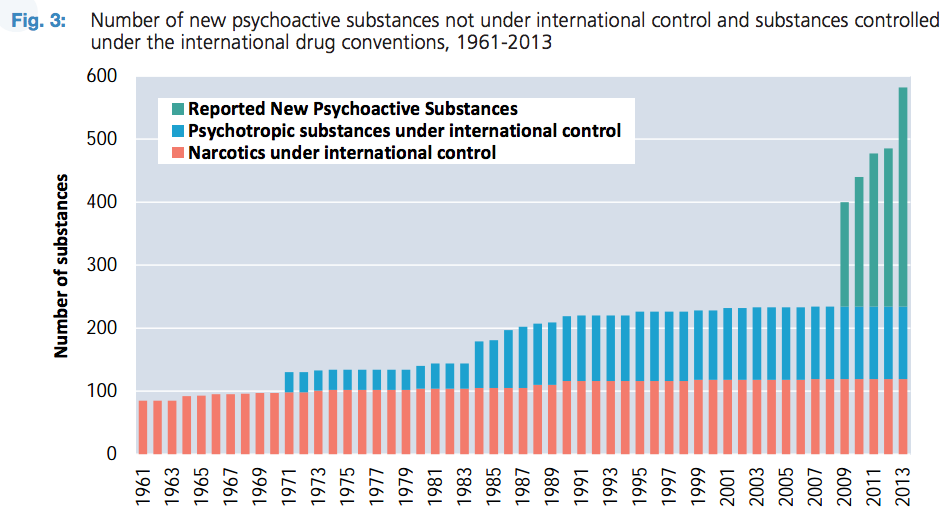
The world has seen an “unprecedented” surge in the production of new synthetic drugs, according to a report released [this week] by the United Nations Office on Drugs and Crime (UNODC). In its latest Global Synthetic Drugs Assessment, the agency says it identified 348 new synthetic drugs in 94 countries as of last year, with the majority emerging between 2008 and 2013. The UNODC received reports on 97 new synthetic drugs in 2013 alone, though it acknowledges that the true number of substances on the market could be much higher.
The agency defines new psychoactive substances as drugs that are not controlled under international conventions, but may pose public health risks. Synthetic cannabinoids — drugs designed to mimic the psychoactive effects of cannabis — comprised the majority (28 percent) of such substances reported to the UNODC between 2008 and 2013, followed by synthetic cathinones, including bath salts, at 25 percent.
Abby Haglage traces the origins of “Spice” aka “K2,” a form of synthetic marijuana. She also looks at how the DEA is cracking down these drugs:
In March 2011, the U.S. Department of Justice placed the five most widely abused synthetic cannabinoids—including Huffman and Pfizer’s—on its Schedule 1 List of banned substances.
The DEA is focusing on moving forward to try to curb the spead of Spice—not back at its origins. On May 7, 45 DEA agents armed with 200 search warrantslaunched a massive nationwide program to eradicate synthetic designer drugs like spice (called “Project Synergy.”) In a matter of hours, the agents had confiscated hundreds of thousands of packets of synthetic drugs and over $20 million in cash. “The chemical aspect of Spice is unique and new,” Rusty Payne, spokesperson for the DEA tells me. “We have to not only establish that someone is trafficking something but we have to go undercover and get it so we can test it. Sometimes it’s a game of whack-a-mole.”
As [Dallas ABC station WFAA] explains, “K2 is difficult to regulate because manufacturers switch up the ingredients frequently.” And why do they do that? To stay ahead of the law. The upshot is that a relatively benign ingredient may be replaced on the sly with something less fun or more toxic. And as the DEA implicitly admits, legal restrictions on marijuana—a well-researched drug that humans have been consuming for thousands of years, a drug that the president of the United States correctly calls safer than alcohol—are encouraging people to experiment with novel chemicals that may prove far more dangerous.
Scientists have proposed a way to make lab-grown meat commercially viable:
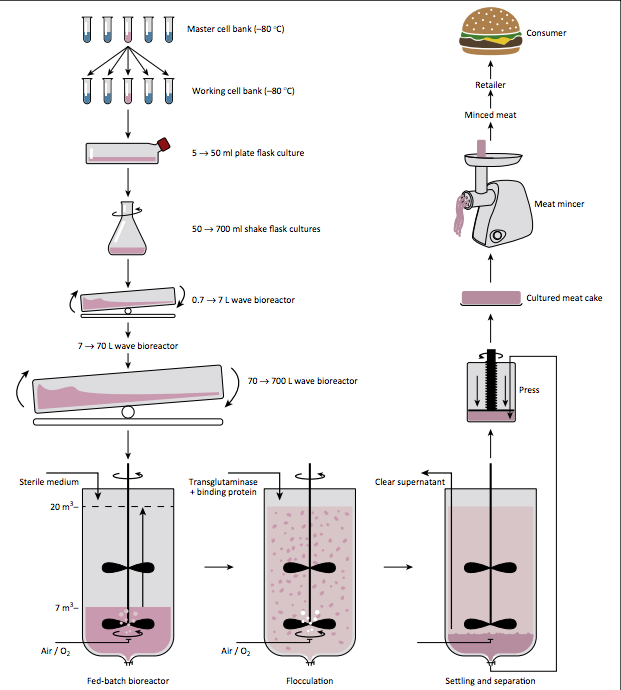
As noted, it’s already possible to make meat from stem cells. The technique was devised by Maastricht University physiologist Mark Post, who assembled a 5-oz beef patty from thousands of tiny meat strips cultured from the stem cells of a single cow. It’s a technological advance that ScienceNow‘s Kai Kupferschmidt believes could kickstart “the biggest agricultural revolution since the domestication of livestock.”
But according to biologists Cor van der Weele and Johannes Tramper in a new Science & Society paper, though the potential advantages of cultured meat are clear, there’s no guarantee that people will want to eat it. The mode of production, they argue, makes a difference for appreciation. To that end, they’ve developed an eco-friendly model for producing greener, ethical meat — one that involves small-scale local factories that are not only technologically feasible, but also socially acceptable. As per the title of their paper, they’re hoping to see “every village [with] its own factory.”
Tramper estimates that a normal 20-cubic meter bioreactor, which is the standard for growing cultured animal cells, could easily supply a village of roughly 2,560 people with meat for a year. But creating and selling the meat at the Netherlands’ price of about €5 per kilogram would only yield €128,000 a year “hardly enough to pay the salary of one ‘butcher’ and his/her assistant.” Adding in costs of of growth medium and lab equipment, the price for cultured minced meat would go up to at least €8 per kilogram, which complicates things further.
But at the end of the day, you’re looking at paying roughly $5 a pound for hamburger meat—that’s not totally insane, and that’s with current technology. Cultivating and growing animal muscle cells is a well-understood process, and the technical challenges have been mostly surmounted. It’s also a far superior option to factory-farmed meat, morally speaken. Given all that that, is there any doubt that someone in Brooklyn sets up a lab-grown meat club in the next couple years? I’d be down, and I’d bet that 2,500 other New Yorkers would be, too.
Not everyone is on board with the lab-meat movement, though:
Some critics of industrial livestock operations are intensely skeptical that cultured meat is the solution. Food activist Danielle Nierenberg thinks the “huge yuck factor” is going to limit the future of “petri dish meat.”
“People who wouldn’t eat tofu a few years ago, now they’re going to eat meat grown in a lab?” she asks. A better future, Nierenberg and others argue, would require some degree of returning to the past—eating less meat, as we used to, and producing it in a less intensive way, on farms rather than feedlots.
Chait acknowledges “where the politics of climate change stand at the outset of Obama’s new climate offensive”:
The scientific consensus is stronger and more urgent than ever, while the political consensus is weaker than ever. Republicans are not even considering the notion of asking Americans to spend money to mitigate climate change, and are increasingly uncertain about the notion of even saving money to mitigate climate change. And into this simmering pot of reflexive opposition and anti-empiricism Obama will plop a highly ambitious and not very cuddly scheme to clean up the power-plant sector. It has already drawn strong opposition from the major business lobbies. It is likely to become the major point of conflagration of Obama’s second term.
He compares the climate fight to Obamacare:
The grimmest contrast between power-plant regulation and health care is that regulating carbon emissions creates almost no winners. There will be no equivalent of the millions of people newly granted access to medical care, no heartwarming stories of long-suffering patients seeing a doctor for the first time in years. Climate regulation doesn’t create a benefit. It doesn’t even prevent a loss. Its only goal is to mitigate the extent of the damage.
And this is why, unlike carefully selected election-year issues like the minimum wage or equal pay, Obama is not picking this issue to help his party save Senate seats. He is doing this because, given the enormity of the stakes for centuries to come, there is no morally defensible alternative.
But Nate Cohn notes that El Niño could change the political calculus somewhat:
The return of El Niño is likely to increase global temperatures. [Kevin Trenberth, a climate scientist at the National Center for Atmospheric Research] believes it is “reasonable” to expect that 2015 will be the warmest year on record if this fall’s El Niño event is strong and long enough.
That could make a difference in the battle for public opinion. One-third of Americans don’t trust climate scientists, according to Jon Krosnick of Stanford University, and they make their decisions about climate change “based on very recent trends in warming.” Belief in warming jumps when global temperatures hit record highs; it drops in cooler years.
In case you missed the meme, young people around the world have taken to making videos of themselves dancing around their cities and countries to the tune of Pharrell Williams’s “Happy” and posting them on YouTube. Anyone who isn’t already sick of the song can watch kids dance and lip-sync to it in Paris, in Okinawa, in Amman… Cute and eminently harmless, right? But apparently not in Tehran, where some kids got arrested for it:
Iran‘s state-run national TV on Tuesday broadcast a programme showing men and women, apparently Pharrell fans from Tehran, confessing on camera. They were supposedly involved in a video clip based on Pharrell’s song. The original has been viewed almost 250m times on YouTube and has inspired people from all over the world to make their own version of the video, which shows people dancing in the street to the song.
Human rights activists have repeatedly condemned what they see as the state TV’s common fashion of airing confessions made under duress, usually misrepresented as interviews. It was not clear if Pharrell’s fans in jail in Iran had access to their lawyer before appearing on television. They have not yet been tried. In recent years, many activists and political prisoners have appeared on the Iranian national TV making confessions.
John Allen Gay notes that the reaction to the video is part and parcel of Iran’s culture war:
Many had noted the risks taken in the original video—women without veils (though wearing wigs), men and women dancing together. And while the Rouhani administration has tried to strike a conciliatory tone on the culture front, full openness has not been forthcoming. A very active band of conservative agitators has been busy pushing against any sign of change. Just this week, Iranian actress Leila Hatami (star of the Oscar-winning A Separation) was in hot water after she shook hands with, and then was kissed on the cheek by, the president of the Cannes Film Festival. Senior Iranian leaders regularly speak of the central importance of culture in the Islamic Republic’s survival. That’s a perpetual source of friction in a country with thousands of years of rich civilizational history (stretching back long before the arrival of Islam) and a strong literary tradition. Iranian art once plumbed the depths of the mind and the soul. Now it’s risky to make a music video whose message is simple, almost childish: that joy is still possible in Iran.
Jason Rezaian examines how this squares with Rouhani’s professed desire to give a little on freedom of expression:
By making these arrests, other centers of power could be sending a reminder to Rouhani that controls on media are likely to stay in place and are not under the executive’s power. According to his own words, if it were up to Rouhani, social media and other communication outlets that are currently blocked would be opened up. But it is not up to him. While many think of Iran’s power structure as a monolith, it is anything but, with many checks and balances, some of them official and some blurrier.
While the video seems innocuous enough, several laws of the Islamic Republic of Iran were apparently broken. Among them: women appearing without hijab head coverings, dancing to Western pop music, and using an illegal Web site to disseminate an unlicensed video. All of these offenses regularly go ignored in Iran. But this time around, it could be the fact that the video is part of a global pop culture trend and it that it had taken off, with tens of thousands of views, that prompted Iranian authorities to take action.
Dostoevsky and Tolstoy are Vladimir Putin’s two favorite writers – but the wrong one has influenced his understanding of Russia’s role in world affairs:
Dostoevsky believed that Russia’s special mission in the world is to create a pan-Slavic Christian empire with Russia at its helm. This messianic vision stemmed from the fact that Dostoevsky thought Russia was the most spiritually developed of all the nations, a nation destined to unite and lead the others. Russia’s mission, he said in 1881, was “the general unification of all the people of all tribes of the great Aryan race.”
This sort of triumphalist thinking was anathema to Tolstoy, who believed that every nation had its own unique traditions, none better or worse than the others.
Tolstoy was a patriot—he loved his people, as is so clearly demonstrated in War and Peace, for example—but he was not a nationalist. He believed in the unique genius and dignity of every culture. One of the hallmarks of his writing from the beginning was his capacity to uncover the full-blooded truth of each one of his characters, no matter their nationality. In his Sevastopol Tales, which were inspired by his own experiences as a Russian soldier fighting against the combined forces of the Turks, French, and British in the Crimean War of the 1850’s—in the very region recently re-annexed by Russia—Tolstoy celebrates the humanity of all his characters, whether Russian, British, or French.
Unfortunately, amid all the spiritual turmoil following the fall of the Soviet Union, Russians have tended to cling more to the starker, messianic vision of Dostoevsky than the calmer vision of universal humanity Tolstoy espoused, finding the latter perhaps a tad too democratic, humanistic, and soft for their hardened tastes. After all the tragedies of 20th century Russian history, and the humiliations of the past 20 years in particular, many ordinary Russians are seeking unequivocal proof of their national worthiness—indeed superiority—among the family of nations.
Jordain Carney and Stacy Kaper call the broken veterans’ health system “a failure with many silent fathers,” including Congress, the VA leadership, and the past ten presidential administrations:
In many ways, the Obama administration is paying for the negligence of past administrations, dating all the way back to President John F. Kennedy, who authorized the decade-long use of Agent Orange in Vietnam. But it wasn’t just Kennedy. Under President Johnson, Agent Orange was the dominant chemical used during the war. President Nixon halted its use, but a long line of presidents either refused to acknowledge the damage done or failed to address it.
President Carter’s VA created the Agent Orange registry, where veterans who were worried about potential side effects could be examined. But four years later, a GAO report found that 55 percent of respondents felt that the VA’s Agent Orange examinations either weren’t thorough or they received little or no information on what long-term health impacts exposure could cause. … The government’s long-standing failure to address the damage done to veterans by Agent Orange mirrors the larger failure of the VA. It spans generations and party affiliations, and every effort to fix it comes with unintended consequences.
But Tuccille claims that the VA hospitals’ wait list problem is just what happens when you have socialized medicine:
This should surprise nobody. Canada’s government-run single-payer health system has long suffered waiting times for care. The country’s Fraser Institute estimates “the national median waiting time from specialist appointment to treatment increased from 9.3 weeks in 2010 to 9.5 weeks in 2011.”
Likewise, once famously social democratic Sweden has seen a rise in private health coverage in parallel to the state system because of long delays to receive care. “It’s quicker to get a colleague back to work if you have an operation in two weeks’ time rather than having to wait for a year,” privately insured Anna Norlander told Sveriges Radio[.] An article in The Local noted that “visitors are sometimes surprised to learn about year-long waiting times for cancer patients.”
Joan Walsh finds it pretty rich that Republicans in Congress are trying to make political hay out of the VA’s problems while doing nothing to fix them:
There’s real trouble at the VA, but there’s bigger trouble for the Republican Party, which purports to love veterans but does little to help them. Thom Hartman recently ran down the list of pro-veteran measures the GOP has blocked. Earlier this year Senate Republicans filibustered a bill to boost VA funding by $21 billion and restore military pensions cut in the Murray-Ryan budget deal. They opposed President Obama’s $1 billion jobs bill to put unemployed vets to work in 2012. They’ve killed bills to help homeless veterans and promote vets’ entrepreneurship.
And in the current crisis, there’s yet to be a genuine GOP answer to the problems at the VA, beyond anti-Obama grandstanding. Do they want to voucherize veterans’ health care, like they do Medicare? Abolish the VA entirely? “Privatize” it, whatever that would mean?
John Dickerson also asks, “Does anyone have faith that this outrage will be answered by serious action?”
One primary reason to despair is that we’re already living at peak outrage. Fake umbrage taking and outrage production are our most plentiful political products, not legislation and certainly not interesting solutions to complicated issues. We are in a new political season, too—that means an extra dose of hot, high stakes outrage over the slightest thing that might move votes. How does something get recognized as beyond the pale when we live beyond the pale?
What makes the VA scandal different is not only that it affected people at their most desperate moment of need—and continues to affect them at subpar facilities. It’s also a failure of one of the most basic transactions government is supposed to perform: keeping a promise to those who were asked to protect our very form of government. … In this time of political purity tests, let’s require a purity test for the constant state of alarm. The next time someone turns their meter up to 11—whether it’s a politician, a pundit, or your aunt on Facebook—their outrage should be measured against what has already happened at the VA.
Jonnelle Marte examines a new study that uses GPA to predict future earnings:
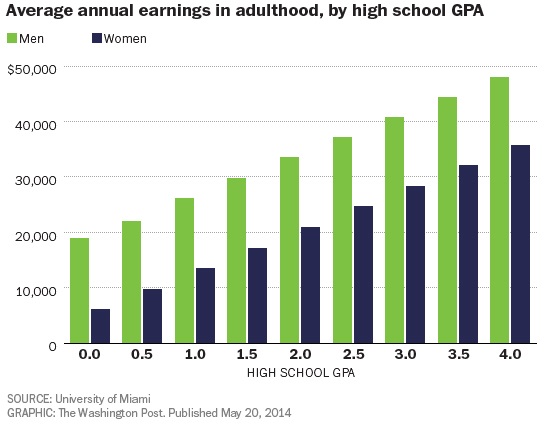
A report published Monday in the Eastern Economic Journalby researchers from the University of Miami found that a person’s grade-point average in high school not only indicates the person’s chances of getting into college and whether he or she will finish college or graduate school. It could also be an indicator of how much that person will earn later in life.
Indeed, for a one-point increase in a person’s high school GPA, average annual earnings in adulthood increased by about 12 percent for men and about 14 percent for women, the report found. (Men and women were looked at separately since women have lower average earnings than men, making about $30,000 on average in adulthood compared with the average of $43,000 for men.)
The team of University of Miami researchers found that a one-point increase in GPA means a 12 percent boost in earnings for men and a 14 percent boost for women. Even so, there’s a big gender gap in total earnings. A woman who got a 4.0 GPA in high school will only be worth about as much, income-wise, as a man who got a 2.0. A woman with a 2.0 average will make about as much as a man with a 0 GPA. The data also show that average high school GPAs are significantly higher for women, but men will still end up having significantly higher income later on.
It also found that high school grades can indicate the likelihood of going to college, and that a one-point increase doubles the chances of completing a degree for both genders.
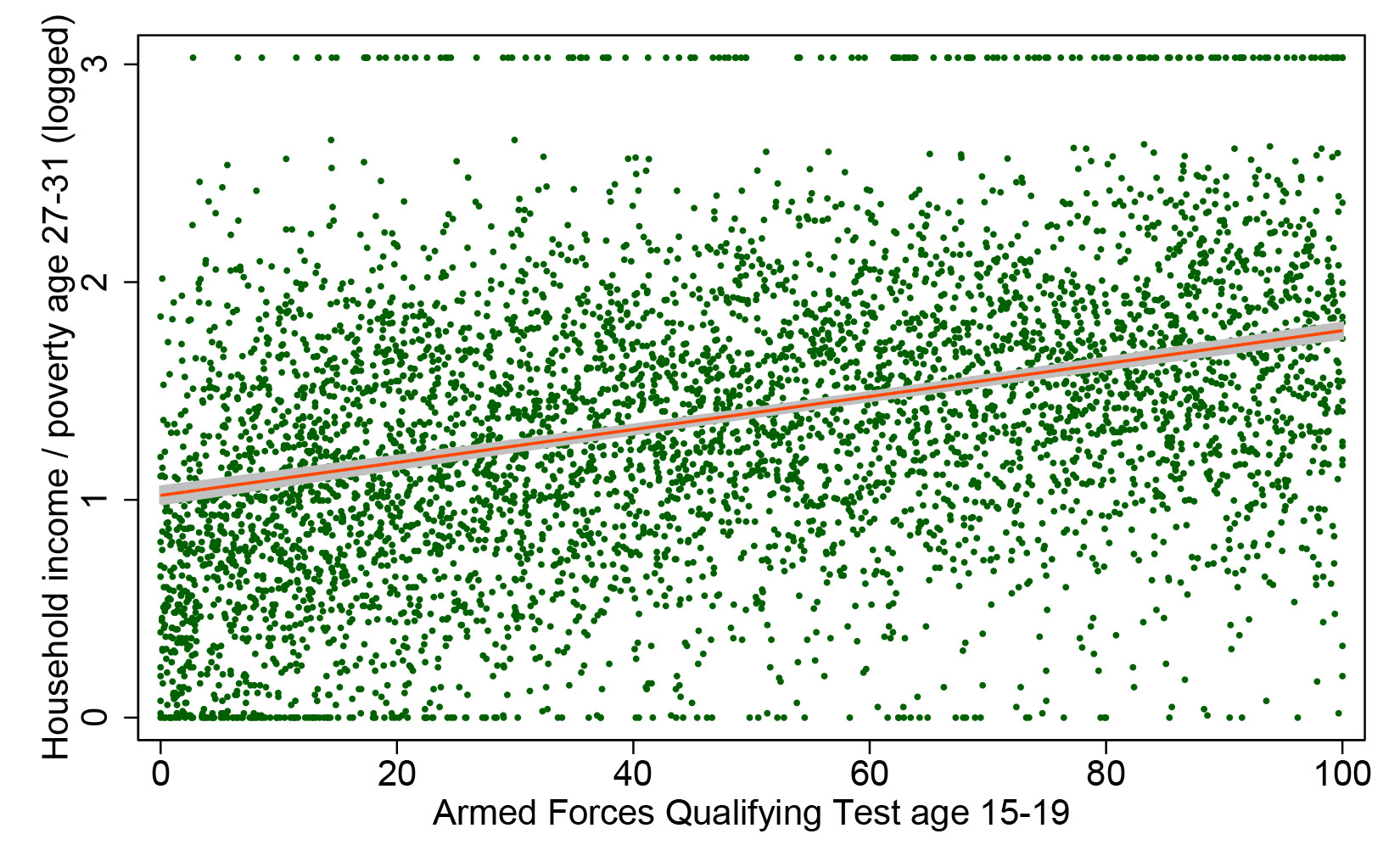
Last week, Philip N. Cohen put these kinds of studies in context. He used the National Longitudinal Survey of Youth to compare the “Armed Forces Qualifying Test scores, taken in 1999, when the respondents were ages 15-19 with their household income in 2011, when they were 27-31.” He found “a very strong relationship—that correlation of 0.35 means AFQT explains 12 percent of the variation in household income”:
But take heart, ye parents in the age of uncertainty: 12 percent of the variation leaves a lot left over. This variable can’t account for how creative your children are, how sociable, how attractive, how driven, how entitled, how connected, or how white they may be. To get a sense of all the other things that matter, here is the same data, with the same regression line, but now with all 5,248 individual points plotted as well (which means we have to rescale the y-axis):
Each dot is a person’s life—or two aspects of it, anyway—with the virtually infinite sources of variability that make up the wonder of social existence. All of a sudden that strong relationship doesn’t feel like something you can bank on with any given individual.
There is a reason you leave out the discussion of sexual pleasure in the sex talk with your kids: they are KIDS! They still think the other gender is yucky. Even when people kiss, kids are grossed out. You should get a jump on the game and tell them the facts of life BEFORE they are interested in sex. After I told my son the facts he stated “I’m NEVER doing that!” My daughter’s response was “That sounds really uncomfortable.” The basic facts are so preposterous to them they would never believe that people do it for fun!
Another reader notes:
Several year ago, the Unitarian Universalist Association and the United Church of Christ developed a series of sexuality programs that provide age-appropriate information for children, adolescents, and adults called “Our Whole Lives”. For example, the 27-session program for grades 7 thru 9 dedicates a class session to lovemaking and pleasure. This curriculum also dedicates a class session to masturbation, including the myths and facts about masturbation (e.g. the fact that masturbation is one of the safest sexual activities that a younger adolescent can engage in).
Another:
Three quick anecdotes:
1) Mom told me flat out, “Well, it feels really, really good. Of course God made it feel really really good! If it was boring like brushing your teeth, no one would ever get around to making babies!”
2) The first non-parental person whose opinion on the subject made me TRUST them was my Sunday school teacher in high school, who also said flat-out, “Sex is FANTASTIC. You’re going to love it, trust me!” (And then went on to explain how we should be married first, but still … it was so refreshing to hear someone tell the truth!)
3) As a kid, I knew my dad had a vasectomy because it was all part and parcel of my adoption story – Mom and Dad had children before me who died stillborn, and that was apparently going to keep happening (this was the 1960s), so dad got “fixed” and they adopted. Then when I was about nine, we had a male cat who got “fixed”, and while petting him, I discovered he had an erection. I went to Mom: “Hey, I thought when we ‘fixed’ him, he couldn’t do that anymore.” And Mom laughed really hard and turned a bit red, and said, “Well, no, what man would sign up for THAT?!” – which is when I realized we weren’t talking about the cat anymore …
Another anecdote from a reader:
My middle school science teacher (at my Catholic school) always made it a point, when we got to intercourse and reproduction, to tell us that “God made sex fun for a reason.” Whether you replace that with “nature,” “evolution,” “spaghetti monster,” or “Allah,” the point stands. I never really appreciated how progressive that was, much less in a Catholic school in the South, but the more time goes on the more I respect what she did. She was a phenomenal teacher all-around, and a big part of that was complete honesty with her students. What’s the best way to make humans reproduce? Make the method of doing so a complete blast!
Keep up the good work. I’m on my second year of subscription and have no regrets!