Gay Geography

by Patrick Appel

Gays Settle Down

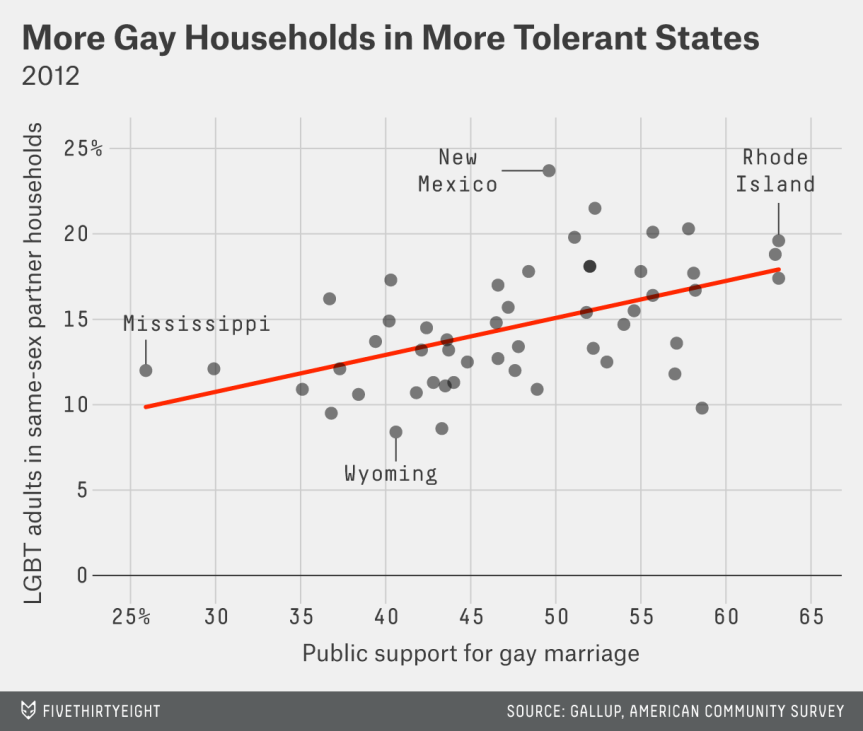
Silver finds that gays tend to settle down in more gay-friendly states:

The regression line in the chart implies that, in a state where 30 percent of the adult population supports gay marriage, about 11 percent of LGBT adults will live together as couples. By comparison, in a state where support for gay marriage is 60 percent, 17 percent will.

These results probably should not be surprising: forming a household with a same-sex partner is a fairly visible and public act, if not quite as public as marriage. By comparison, disclosing one’s LGBT identity to a pollster in an anonymous survey is more private and might depend less on perceived support from one’s community. There are also some LGBT Americans who are so closeted that they won’t tell pollsters about it.

Meanwhile, below is a GIF that shows the progress marriage equality has made over the past ten years (it’s already out of date because it was created before the Oregon news):

same-sex_marriage_gif

Lastly, for a perspective on the state of gay rights around the world, check out this interactive Guardian graphic.

A Push For Gender Equality In The Lab

by Jonah Shepp

No, not the scientists: the animals. Francie Diep explains:

The U.S. National Institutes of Health—one of the biggest funders of biomedical research in the U.S. and the world—will now require the studies it funds to have equal numbers of male and female lab animals. It’s even requiring gender balance in studies done in cells in petri dishes. Yep, that means female and male lab rats will now have equal opportunity to die for science.

All kidding aside, this is actually an important moment for the way medicines are developed in America. All new drugs and treatments are first tested in cells in a petri dish, as well as lab mice, rats, monkeys and other animals. If those studies go well, then they’re tested in people. Late-stage human studies of medicines in the U.S. are now required to recruit at least some women. (This wasn’t always true and, on the whole, it’s still not 50-50.) Gender parity in clinical trials is important because men and women are known to react differently to some medications. Just check out this example, or this one, or all these ones.

Marcotte adds:

That you shouldn’t exclude half a species in your testing seems obvious, but there are understandable, if not really defensible, reasons that scientists have typically stuck to male-only studies.

Roni Caryn Rabin at the New York Times explains: “Researchers avoided using female animals for fear that their reproductive cycles and hormone fluctuations would confound the results of delicately calibrated experiments.” But while this tradition makes it easier to come up with clean results, the long-term effect is that drugs are being released that women are going to take without researchers always knowing exactly how those drugs will work on them. (After all, human females have reproductive cycles and hormone fluctuations, too.)

Feminists in science have long been advocating for an end to the habit of male-only studies for just this reason. That’s part of why the University of Wisconsin started a feminist biology program to help critique and improve biology by targeting some of the unquestioned gender bias that sadly continues to flourish in the field.

A Human Zoo

by Jessie Roberts

European Attraction Limited, a project by artists Mohamed Ali Fadlabi and Lars Cuzner, seeks to re-enact a human zoo that Norway hosted in 1914:

Three years ago we stumbled upon information about a human zoo that had taken place in the heart of Oslo in 1914. Not being from this country, naturally, we assumed that this was common knowledge among natives, so, in an interest to learn more about the general consent on the exhibition, we started asking around. As it turned out pretty much no one we talked to had ever heard about it (even if they had heard of human zoos in other countries). Given how popular the exhibition was (1.4 million visitors saw it at a time when the population of Norway was 2 million) the widespread absence of at least a general knowledge was surprising. It is hard to understand the mechanisms of how something could be wiped from the collective memory.

The original zoo was explicitly racist:

[F]or five months, 80 people of African origin (Senegalese) lived in “the Congo village” in Oslo, surrounded by “indigenous African artefacts”. More than half of the Norwegian population at the time paid to visit the exhibition and gawp at the “traditionally dressed Africans”, living in palm-roof cabins and going about their daily routine of cooking, eating and making handicrafts. The king of Norway officiated at the opening of the exhibition.

Bwesigye bwa Mwesigire notes that some are taking offense to the restaging:

Muauke B Munfocol, who lives in Norway and is originally from DRC, thinks that the project does not recognise the “racial order and systems of privilege in the country”. She says: “One might wonder why at such a time, rather than putting its efforts to acknowledge the existence of racism, paying reparations, and changing the historical-political and cultural relationship to other non-white countries, the Norwegian government chooses to finance a project that reaffirms their part in a global white domination system where black people are dehumanised spiritually, economically, socially and culturally.”

Muauke’s argument is that the re-enactment of the human zoo as exactly as how it was presented in 1914 means “a re-enactment of the fantasies about exoticism and bestiality that have been historically linked to the black body in the colonial mind”. The re-enactment will be a living reality for her, as an African living in Norway. … Muauke is not alone in her indignation. Rune Berglund, head of Norway’s Anti-Racism Centre says: “The only people who will like this are those with racist views. This is something children with African ancestry will hear about and will find degrading. I find it difficult to see how this project could be done in a dignified manner.”

Jillian Steinhauer also has doubts about what the new zoo will achieve:

For their contemporary update … Fadlabi and Cuzner have altered things slightly but significantly: participants are not limited to one race or nationality. “We chose volunteers based on the texts they submit as their application to participate,” Fadlabi told Hyperallergic; the volunteer form is posted online and includes an invitation — “We welcome anybody from anywhere in the world who believes in the importance of the discussion about colonialism, the evolution of racism, equality” — as well as caveats like “You will most likely be asked to defend your participation.” …

On one hand, it’s a relief that the artists have omitted the horrific racism of the original exhibit — it’s hard to imagine how a restaging of those stereotypes could advance a productive conversation of any kind. On the other, it’s hard not to wonder if the change renders the whole project too vague to achieve the intended effect. What will the takeaway be — that putting humans in zoos is bad? …

When I asked [the artists] specifically about the races, nationalities, and/or ethnicities of the zoo volunteers, Fadlabi turned the query on me: “The question itself poses another question – is it different for you if all the volunteers are black? Is it different for you if 2 out of 80 are white?” My response was that if we’re attempting to talk about racial dynamics and prejudices, then yes, these things do matter. I do not wish for Fadlabi and Cuzner to recruit 80 Norwegian residents of African descent and build a zoo for them in the name of art and a wished-for national conversation; but I am uncertain, and curious, about how “European Attraction Limited” will inspire thoughtful conversation of any kind.

(Video: Footage from the 1914 exhibition)
 

Calling In Female

by Patrick Appel

Emily Matchar points out that “in several, mostly East Asian, countries, so-called ‘menstrual leave’ is a legally enshrined right for female workers.” She considers the appeal of such policies:

[E]ven in countries with well-intentioned menstrual leave policies, many women don’t feel comfortable taking it. They’re understandably embarrassed to tell their superiors they have their period, and they worry they’ll be viewed as weak for taking time off.

The fact is, menstruation is not debilitating for most women. But for up to 20 percent of women, period pain interferes with daily activities just as surely as a nasty cold or flu. Ample paid sick leave would seem to take care of the problem just as well without forcing women to share their lunar cycles with their bosses. It’s no coincidence that several of the countries with menstrual leave also have lackluster sick leave policies—neither Japan nor Korea mandate paid sick leave for non-serious illness.

But then again, neither does the United States. Perhaps we should start agitating for the Boxer-McConnell American Menstrual Leave Act after all?

Katy Waldman dislikes the idea:

Matchar is more fair-minded than I, weighing whether period leave amounts to “reverse sexism or a reasonable human rights move.” Does the time off have to perpetuate weird myths about our traumatic, crazy cycles—or can it just cut us some slack when we feel drained and low?

The problem is that it does both, and whether or not we deserve the extra slack (we don’t), we definitely don’t deserve the added attention to—or annoyingly reverent theorizing around—our ovaries. They will be fine! Nor is menstrual leave analogous to maternity leave, as Matchar suggests. While the first addresses a real need to care for a living person you have expelled from your body, and care for your own body out of which a living person was just expelled, the second recasts cramps and crankiness as mysterious ailments beyond the therapeutic powers of aspirin. One moment your boss is giving you days off to menstruate, the next he’s hiring a witch doctor to bless your uterus thrice upon the full moon.

If Memory Serves

by Jessie Roberts

Reviewing literature that explores “the intersection between memory, memoir-writing, and science,” Cara Parks praises contemporary attempts to investigate identity:

“Autobiographers flush before examining their stools,” wrote William H. Gass, and the tendency exists even this super-sensitive mode of memoir to skip the boring bits in the search for self-justification. But these memoirs serve a valiant role:

they force questions of memory and illness out of abstraction and into a temporal context, demonstrating how the search for identity, the struggle for sanity, and our comprehension of our own minds will change as scientists look more deeply into the dark recesses of the brain. “We are comfortable with the idea that physical health is not just a single number but a multiplicity of factors,” [Michael] Kinsley concludes in his New Yorker piece. “That’s where we need to arrive about mental problems.”

Perhaps the most engaging element of these books of memories lost and memories found is their focus on questions instead of answers (forgetting everything seems to shake one’s sense of certainty). “Our fate is to face the world as orphans, chasing through long years the shadows of vanished parents,” Kazuo Ishiguro wrote in his novel When We Were Orphans. “There is nothing for it but to try and see through our missions to the end, as best we can, for until we do so, we will be permitted no calm.” We do not yet have answers to our biggest questions about memory, but with the help of science and narrative, we are slowly discovering the path we will take toward them.

Safer Smack?

by Jonah Shepp

John Knefel explores the controversy over harm reduction as an approach to heroin addiction:

Though some advocates in the U.S. express hope that their country will one day have supervised injection facilities, even less controversial methods are by no means universally accepted. Needle exchanges, for example, are still effectively illegal in about half of the states, and federal money can’t be used to fund them. President Obama lifted that ban in 2009, but Republicans in 2011 fought successfully to reinstate it. …

Other observers criticize exchange programs for not being aggressive in promoting detox and rehab for heroin users, and suggest a harsher approach.

“Using the criminal justice system to force them to go into treatment has proven to be very productive,” David Evans, special adviser to the Drug Free America Foundation, tells me. “The drug courts that do that have an outstanding record of success of freeing people from their addictions.” (Critics of drug courts argue coerced rehabilitation actually expands, rather than lessens, a punitive approach to drug treatment.)

Some opponents of harm reduction also express skepticism about expanding naloxone access to family and friends of drug users. “Naloxone can save lives in an overdose situation, but many opioid users do not use with their family,” John Walters, who was drug czar under President George W. Bush, writes in an email. “[T]hey may use alone or in the company of other users, who may not be a reliable source of emergency medical care.” Using alone is dangerous, without question, but available data largely contradicts fears that other users can’t administer naloxone effectively. A 2013 scholarly study found that overdoses are overwhelmingly witnessed by other users, and, in the study, administration of naloxone was 98% effective in reversing the overdose.

“Refined Religion”

by Jessie Roberts

In an interview with Gary Gutting, philosophy professor Philip Kitcher – who describes himself as “a humanist first and an atheist second” – offers a view of religion he calls a “halfway house” between belief and thorough secularism (NYT):

P.K.: … I think there’s a version of religion, “refined religion,” that is untouched by the new atheists’ criticisms, and that even survives my argument that religious doctrines are incredible. Refined religion sees the fundamental religious attitude not as belief in a doctrine but as a commitment to promoting the most enduring values. That commitment is typically embedded in social movements — the faithful come together to engage in rites, to explore ideas and ideals with one another and to work cooperatively for ameliorating the conditions of human life. The doctrines they affirm and the rituals they practice are justified insofar as they support and deepen and extend the values to which they are committed.

But the doctrines are interpreted nonliterally, seen as apt metaphors or parables for informing our understanding of ourselves and our world and for seeing how we might improve both. To say that God made a covenant with Abraham doesn’t mean that, long ago, some very impressive figure with a white beard negotiated a bargain with a Mesopotamian pastoralist. It is rather to commit yourself to advancing what is most deeply and ultimately valuable, as the story says Abraham did.

G.G.: And so, since they don’t regard them as factual, refined believers don’t have to deny the stories and metaphors of other religions.

P.K.: Right, they don’t have to pick and choose among the religions of the world. They see all religions as asserting that there is more to the cosmos than is dreamed of either in our mundane thoughts or in our most advanced scientific descriptions. Different cultures gesture toward the “transcendent” facets of reality in their many alternative myths and stories. None of the myths is factually true, although they’re all true in the sense that their “fruits for life” are good. Prominent examples of refined believers include William James, Martin Buber and Paul Tillich, and, in our own day, Karen Armstrong, Robert Bellah and Charles Taylor. When refined religion is thoroughly embedded, religious tolerance thrives, and often much good work is done.

Should Future Generations Have A Vote Now?

by Tracy R. Walsh

Arguing that our current political system doesn’t do enough to take the interests of future citizens into account, philosopher Thomas Wells calls for 10 percent of all votes to be set aside for “trustees” acting in their interests:

Trusteeship has played a political role before – indeed it is the very model for the role of elected legislators that Burke himself advocated, as did the British political economist John Stuart Mill a century later. All the same, we would certainly need to introduce some new rules and legal instruments to ensure the success of this novel kind of political trusteeship by organizations, and especially to protect them from improper ‘presentist’ influence by partisan or commercial interests. To ensure their independence, these organizations might have to demonstrate popular support (say 50,000 unique citizen members), be non-profit-making, comply with electoral campaign financing legislation and so forth. …

[T]he presence of trustee voters has the potential to benefit democratic deliberation in general. They would make sustainability an unavoidable political topic, one that politicians have to treat in a way that is credible to these cognitively sophisticated agents. The improved quality of politicians’ attention to the future would also help the merely human voters who struggle to turn their moral concern for the future into effective political choices. At least to some degree, the myopia built into the institutions of democracy would be overcome.

Alex Tabarrok favors a different mechanism:

Robin Hanson’s government of prediction markets (“futarchy”) is a better approach. It is now well understood that relative to other institutions, prediction markets draw on expertise to produce predictions that are far-seeing and impartial. What is less well understood is that through a suitable choice of what is to be traded, prediction markets can be designed to be credibly motivated by a variety of goals including the interests of future generations. …

We can also incorporate into our measure of welfare predictions of how future generations will define welfare. We could, for example, choose a rule such that we will pass policies that increase future environmental quality unless a prediction market in future definitions of welfare suggests that future generations will change their welfare standards. It sounds complicated, but then so is the problem.

Meanwhile, Corey Robin Robin Hanson is dismissive of the whole idea:

We could also give votes to people in the past. While one can’t change the experiences of past folks, one can still satisfy their preferences. If past folks expressed particular preferences regarding future outcomes, those preferences could also be given weight in an overall welfare definition.

We could even give votes to animals. One way is to make some assumptions about what outcomes animals seem to care about, pick ways to measure such outcomes, and then include weights on those measures in the welfare definition. Another way is to assume that eventually we’ll “uplift” such animals so that they can talk to us, and put weights on what those uplifted animals will eventually say about the outcomes their ancestors cared about.

We might even put weights on aliens, or on angels. We might just put a weight on what they say about what they want, if they ever show up to tell us. If they never show up, those weights stay set at zero. Of course just because we could give votes to future folks, past folks, animals, aliens, and angels doesn’t mean we will ever want to do so.

Wife, Mother, And Novelist

by Matthew Sitman

In an interview about her debut novel, Cutting Teeth, which follows a group of thirty-something Brooklyn parents and their young children on a weekend trip to the beach, Julia Fierro explores how being a woman and young mother informed the story she told:

The focus of the book is on relationships, and I’m always surprised when women writers complain about their book being tagged by bookstores, book sites, and blogs with “relationships” and “women.” I understand the larger issue that’s upsetting them, and thank goodness we have the VIDA numbers to act as a neon sign broadcasting the truth about gender inequality in the literary world, but I am a woman, and I will always write about relationships. I am inspired by psychology and emotion, conflict and drama. The world is most significant to me as a web of relationships. If a story isn’t filtered through a psychological lens, you’ll have trouble keeping my attention. Humanity’s individual, and collective, fears and needs and desires are the only religion I’ve got and I am obsessively devoted. So I try to embrace the fact that I am a woman writer writing (mostly) about women, although the male characters in my work are often “liked” most by readers (even if they commit the worst crimes—how about that?). Recently, I even had a brief thought—maybe I am writing with women readers in mind? I am, after all, living a life that only another woman could truly understand. I am going through a phase of life—early motherhood—that is complex in a way that is unique to a woman’s experience. What I feel in my body, in my thoughts, and the ways I interpret the world uniquely, all stem from my experience as a woman. But I have to think more on that before I commit.

In a self-interview, Fierro explains how she wrote a novel and founded the Sackett Street Writers’ Workshop, all while raising two children:

My lifelong insomnia has been a blessing in disguise. I pretty much sleep four hours a night, and am doing my best to ignore conspiracy theories like this, that simultaneously attempt to cut my productivity in half and promise my inevitable doom.

It is amazing what you can accomplish if you abandon all household chores that aren’t absolutely essential. Sure, we’re living in chaos, but mom’s making great progress on her next novel and the number of Sackett Street writers attending classes has doubled in the last three years. It turns out that women can “have it all”—they might be miserably tired, suffer from high blood pressure, and not have enough time to eat well, exercise or have meaningful relationships, but you can do anything when you don’t give yourself a reason not to.

Read a sexy excerpt from Cutting Teeth here.

Before And After

by Jessie Roberts

Kate Good shares the story of her husband’s physical transition from female to male, writing that she’s “learned that ‘transgender’ is a ridiculously large catch-all”:

There’s no such thing as gender reassignment surgery, despite what various government and news agencies seem to think. There’s a menu of therapies, medications, and surgeries, and people pick what combination works for their body, their health, their mental and emotional needs and, not least, their finances. The government as a whole doesn’t have a good grasp on what it means to be transgender, and definitions and regulations vary wildly from office to office and day to day. What it really takes to get a passport issued is anyone’s guess. Even in the time we’ve been together these things have improved, thanks to hard-working activists, but there’s still a lot of work to do both in writing new regulations and clarifying existing ones.

There’s not a line — before here he was female, after he is male.

I think he’s still deciding on how to think about the person he was before transitioning. Every once in a while I see a picture of him before he cut his hair and changed his name and how he dressed, before he was the man I married. It’s an odd feeling. It’s him but not him. I don’t dwell on it.

I don’t dwell on my own sexuality either. I’m straight. I wasn’t attracted to him when he started transitioning, when there was still a feminine curve to his cheeks and hips. If you had asked me then if we would ever date I would have said no. It took two years of being friends before I realized I liked him (liked liked him). One day he asked me out and I thought well, why not? And then we fell in love, fast. We were almost immediately talking about our future, marriage, kids. His being transgender faded to the background.

It sounds unbelievable but I still sometimes forget. He has to remind me that people he met in the past might not know who he is now. I don’t know, or care, what loving him means for my placement on the Kinsey scale, or whatever spectrum is the going standard. If I lost him I would undoubtedly date cis-men. I love him, and I love being his wife. Figuring out what that labels me as seems like a waste of time.