Why Was Geithner So Easy On Wall Street?

Neil Irwin mulls the question:

Mr. Geithner spent his youth largely abroad and his early adulthood working on international trade and economics in the United States Treasury Department. Only starting in 2003 did he have much of anything to do with the financial industry, and that was as its overseer at the helm of the Federal Reserve Bank of New York. He is now the president of Warburg Pincus, a private equity firm, but he has held that job for all of 10 weeks. He was never an investment banker like his predecessors Hank Paulson and Robert Rubin, or even a hedge fund consultant like Larry Summers.

As far back as college, as he puts it in his new memoir, “I had never thought of finance as a particularly special or prestigious profession.” All of which makes the fact that he earned a reputation as a tool of big financial interests that much more intriguing. After covering Mr. Geithner for the better part of a decade and reading the memoir, I think here’s the best way to make sense of him: Timothy Geithner isn’t captured by Wall Street. He’s captured by working within systems as they exist.

Sheiber puts forward a different theory:

What always bothered me about Geithner, and which Sorkin’s piece draws out, is that he often seemed more dedicated to the banks than the bankers were to their own cause. While reporting my book about Obama’s economic team, plenty of bankers confided to me that the bailouts were shockingly generous. Many of them tended to take a “these f—king guys” view of their colleagues and puzzled over how Geithner could be so deferential. It made me suspect Geithner would have been much more of a hard-ass had he spent a few years toiling on Wall Street before joining government.

Instead, as Geithner tells Sorkin, “My jobs mostly exposed me to talented senior bankers, and selection bias probably gave me an impression that the U.S. financial sector was more capable and ethical than it really was.” Bummer for the rest us. But I guess that means at least one good thing may come out of Geithner’s recent move to Wall Street: He’ll actually get to know the place this time.

Andrew Huszar wishes that Geithner had more strongly reformed the financial services industry:

[L]ooking out at the U.S. economy little more than five years after Mr. Geithner’s becoming U.S. Treasury Secretary, what do we see? The more things are said to have changed, the more they’ve stayed the same. Nursed back to health by massive government support, the U.S. financial sector is once again America’s largest enterprise, accounting for more than 30 percent of the nation’s corporate profits. Moreover, Wall Street’s six biggest banks—the so-called “too big to fail” ones—have gotten 37 percent bigger.
From Their Cold, Blackened Hands

Yesterday, the worst mining disaster in Turkey’s history claimed the lives of at least 282 coal miners (the death toll expected to rise). In his initial statement on the incident, which happened in the western town of Soma, Prime Minister Erdogan sparked outrage by claiming that explosions in mines happen all the time and that there wasn’t much the government could do about it. Michael Koplow explains why this “don’t blame us” attitude is getting Erdogan in such hot water:

As Erdoğan said in opening his press conference today, accidents happen. In this case, however, there is the extremely inconvenient fact that only two weeks ago, the AKP rejected a motion in the Grand National Assembly brought by the opposition CHP – and supported by the MHP and BDP – calling for an investigation into the legion of mine accidents in Soma.

In 2013, for instance, 4500 workplace accidents were reported in Soma mines alone. There is also this picture making the rounds of two AKP ministers chatting away two weeks ago during an opposition parliamentary speech about safety concerns in Soma coal mines. In other words, serious concerns were raised within the last month about this particular mine, the government chose to ignore them, and now has a terrible public relations disaster on its hands on top of the fact that 238 Turkish citizens are dead after an accident that might have been avoided had the government taken the warnings about Soma more seriously.

A serious and responsible government would only have one logical response under these circumstances. It would acknowledge a terrible mistake, apologize, vow to get to the bottom of what went wrong, and generally act in a contrite fashion. But as we all know by now, the AKP under Erdoğan neither acknowledges mistakes nor apologizes, and is never contrite about anything.

The Bloomberg editors don’t make much of Erdogan’s excuse:

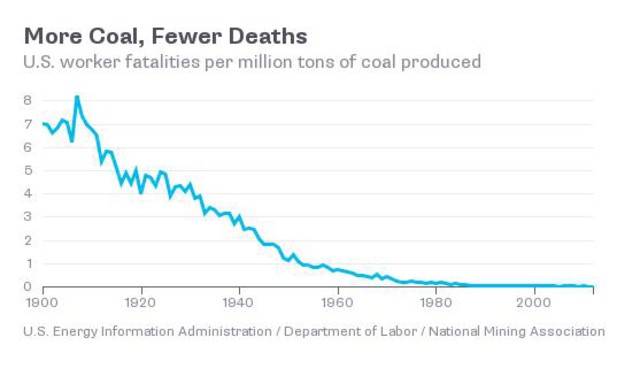
The history of coal mining in the U.S. shows what can be done. Mining disasters were once far more common in the U.S., as Erdogan noted, as well as in the U.K. No longer:

iZsiC6BXW6BU

And it’s not just developed countries that have improved their mine-safety record and reduced the human cost of extracting coal. China’s coal industry averaged 6,151 deaths a year from 2000 to 2005, falling to a still-horrendous 1,049 last year. Much of that was due to reduced production and the closure of illegal mines as demand has fallen since the financial crisis; China remains in a far worse position than Turkey. Still, the Chinese government has acknowledged the problem and has been shutting down unsafe mines in response.

Karen Graham highlights some of Wednesday’s protests against Erdogan’s government:

Taksim Square’s Gezi Park, the site of anti-government protests a year ago, was shut down on Wednesday. The number of law enforcement officers in Istanbul’s historic square was increased as thousands of protesters were met with water cannons and pepper spray wielding police.

In the Turkish capital of Ankara, several protests were staged, including one where students from the Middle East Technical University (ODTU) tried to march on the Energy and Natural Resources Ministry to protest the deaths of the miners and unsafe work conditions. They too, were met with water cannons and tear gas. Other people staged sit-ins in neighborhoods housing diplomatic buildings.

When Prime Minister Recep Tayyip Erdogan visited Soma, rocks were thrown at police protecting the leader’s car as he passed through the crowds. The Prime Minister was booed after speaking about the mine, with the crowd chanting “Resign! Resign!” Reuters reported that at least 10 protesters were taken away by the police.

Could The Senior Vote Break Left?

David Frum warns the GOP against taking the over-65s for granted. An important point:

Among all voters 65-plus, women outnumber men only slightly: In 2010, for every 100 women older than 65, the Census counted 95.5 men. The political result? The mild preference in favor of President Obama among older women voters was swamped by the intense hostility of older men.

As we advance from age cohort to age cohort, however, the men dwindle away. At 75, the Census counts 80.2 men for every 100 women; at 85, 58.3 men for every 100 women. The good news for men: Our survival prospects are rising! In 1990, the Census counted only 45.6 men for every 100 women older than 85. The bad news for the Republicans: The disparity in sex-survival rates has huge political effects on the way the old vote.

But Trende continues to downplay the GOP’s demographic challenges:

Obama’s vote share in 2012 was less than it was in 2008; the Republican coalition expanded, which is actually unusual when taking on an incumbent — along with Andrew Jackson and Franklin D. Roosevelt (twice), Obama is the only other incumbent president to not win a larger raw share of the popular vote in a reelection win. Republicans are at, or near, all-time highs in their performances in the House, among governors, and in the state legislatures. While it is true that the midterm electorates are different than presidential electorates, they’re subject to the same long-term trends and should demonstrate a gradual GOP decline.

For decades, political scientists have argued that elections are largely about a few fundamental factors, and that other factors come out in the proverbial wash. Both parties tend to elect competent candidates who raise a lot of money, commit gaffes and play within the 40-yard lines of American politics. Attempts to add one group to a party’s coalition inevitably pushes some other group out, resulting in a regression-to-mean. We might have to abandon this model in the future, but so far the “old” model hasn’t had sufficient failures to justify looking elsewhere for explanations of elections.

The Gender Divide On Elder Care

Kathleen Geier addresses it:

[W]omen are the majority of those who provide unpaid care for ill, disabled, or elderly friends and relatives. The burden of unpaid care work that women continue to shoulder plays a major role in women’s persistent economic inequality. Directly, there is the opportunity cost that comes when women cut back hours or drop out of the paid labor force to provide care; economist Nancy Folbre has referred to this cost as the “care penalty.” Indirectly, unpaid care work affects women’s compensation in the paid labor market. Research has shown that a portion of the gender pay gap is attributable to the fact that women with children are, on average, paid less than their otherwise identical counterparts. Another study found that working in a caregiving occupation is associated with a 5- to 10-percent wage penalty, even when skill levels, education, industry, and other observable factors are controlled for.

She calls the push for paid family leave occurring in several states “grossly underreported, even in the feminist media that you’d think would be most interested in them”:

Feminist issues around the body, reproductive rights, rape culture, and so on are always going to be sexier, and easier to sell to mainstream media outlets, than feminist issues around work. The carnivalesque appeal of a feminist demonstration like “Slutwalk” is obvious – but a “Shitwork Walk,” if one were to be organized, not so much. … Even within the spectrum of feminist care issues, care for the elderly tends to be neglected. Child care tends to be a happier burden; you’re nurturing someone at the beginning of life and seeing them grow and develop. But care for an elderly person occurs at the end of that person’s life. Instead of seeing them develop their abilities, you often witness them losing those abilities – a difficult and lonely process.

Previous Dish on the wage gap hereherehere, and here.

How To Woo A Spider

Bring her a gift:

The scientists collected 53 male spiders from the wild who were found to be carrying gifts for females. Amazingly, 70% of these males were holding worthless gifts such as prey leftovers, presumably after having eaten the prey themselves. … The researchers then brought all of these spiders (both the ones holding worthless gifts and what I like to think of as the more earnest males carrying genuine gifts) into the lab. The male spiders were then given either a real gift to give to a female spider (a big juicy housefly), a worthless gift (an insect skeleton), or no gift at all.

So how did the females react?

Females were equally likely to mate with males who carried real gifts as those who carried leftovers from their dinners. This is not surprising, given that since the gift was cleverly wrapped by the male, the female may not have been able to tell what the package contained before ‘agreeing’ to mate with her male suitor. Instead, females much preferred to mate with males in good body condition rather than skinny, underfed males. Therefore, those males that ate their gifts were actually the ‘smart’ ones (whether they knew this or not) as it was better to be in good shape having had a full meal, but courting the female with the equivalent of an empty box of chocolates than to court her looking wan but holding the equivalent of a roast dinner. The well-fed males not only had a higher chance of mating a female, but females also let them mate with them sooner and for a longer period of time.

More surprisingly, females also didn’t seem to care about whether males even carried a gift at all. They were actually as likely to mate with males without a gift as males with a gift (as long as their bodies were in good condition).

Make Dark Money Darker? Ctd

A reader suspects that anonymizing political donations wouldn’t do much good:

Ayers’ and Ackerman’s proposal on campaign financing makes sense on its face, but it would be pretty easy to exploit. Quoting Dylan Matthews on the plan:

It sounds batty until you realize the authors’ key insight: for a quid pro quo to work, the paid-off party doesn’t just have to receive a kickback. They have to know they’ve received a kickback.

Hiding who made the donation might work if there was no other way to determine who the donor was. If you have a conversation with a potential donor and they say they are going to send you $100,000 tomorrow, and then you get $100,000, it’s pretty obvious where it came from. Worse, it’s more obvious the larger the donor. Sure, any given $20 donation would get lost in the shuffle. But big money would be quite clear.

Even for smaller amounts, there’s been a long running practice of adding cents at the end of a donation to indicate the source. So if a group tries to put together a big money bomb for a candidate, they could tell donors to add .02 at the end of each donation to indicate where it came from.

Another adds:

It’s not going to help when the “quid pro quo” benefits an entire sector instead of just a handful of company. For example, the coal industry and the oil industry will donate to carbon-friendly groups or PACs, and they will in turn help elect respective politicians that would help further assistance for their particular industry. Do you honestly think it’d make a difference if the Koch Brothers’ money becomes even darker? The grand purpose is still served to help benefit and enrich them. The only thing that they might not get is an ambassadorship from a GOP president.

Update from a reader:

I obviously don’t expect you to embed the entire Dylan Matthews piece on Ayers’ and Ackerman’s proposal, but it does appear as if the readers you quoted expressing skepticism about the idea didn’t click through to get the full picture. Ayers and Ackerman have anticipated the concerns raised by your readers and their plan includes two key provisions to address them.

The first is to distribute donation funds to candidates on a periodic basis (weekly for example) rather than passing them through immediately as they come in.  That process would happen based on:

an algorithm which would smooth out sudden spikes in donations in a given week or month (or whatever other interval at which donations are released to campaigns), so they don’t appear to be spikes to campaigns. “We could just have a randomization algorithm, so that if a huge amount kicks in, you get it over 14 weeks,” Ackerman says.

So no one’s getting a check that says “$100,000.22 Love the Koch Brothers.”

The second idea is basically to use public financing to dilute the proportional influence of private campaign contributions:

every registered voter in America gets $50 per election cycle to give to candidates for federal offices, whether they’re running for president, the Senate or the House. Ackerman and Ayres call these vouchers “Patriot Dollars.”

The goal is for federal elections to be roughly two thirds financed by public dollars, with those funds allocated at the discretion of individual voters.

I’d encourage people to read the whole Matthews piece, because I have to say the idea is pretty damn elegant.  Obviously it won’t fix every problem we’re facing due to money in politics, but the fund distribution algorithm combined with the dilution of private money’s proportional influence would stand a good chance, it seems to me, of meaningfully altering the landscape of campaign finance.

Iran: Still Not A Free Country

Sune Engel Rasmussen looks at the state of censorship in Hassan Rouhani’s Iran and finds that, while the restrictive policies of former president Mahmoud Ahmadinejad have been rolled back, much remains the same as always:

Authorities continue to close media outlets with the stroke of a pen. Social media is banned, and millions of websites are still blocked. Scores of political prisoners including the aging Mir-Hossein Mousavi and Mehdi Karroubi, who inspired the 2009 Green Movement, remain locked up. In the first two months of 2014 alone, Iran executed almost 100 people.

The government is not solely to blame.

Executions are administered by the judiciary, which answers to Supreme Leader Ali Khamenei. The same goes for freedom of the press, as [culture minister Ali] Jannati pointed out after the closure of the popular reformist weekly Aseman: “Shutting down the newspapers is out of our hands.” As for opening wide the gates to the internet, the president needs to maneuver the 22-man Supreme Council for Cyberspace, which is dominated by conservatives.

Although it is possible for the government to challenge other pillars of power, Rouhani may gauge that he doesn’t have the political capital to do so, given domestic opposition to the nuclear negotiations. Everyone remembers President Mohammad Khatami’s failed attempts at reform in the late 1990s. Yet, some don’t believe Rouhani had real intentions in the first place. There’s a Persian saying, “The yellow dog is the brother of the jackal,” which means: One ruler is just as bad as the next one.

Getting To Know The Dylanologists

Meet a few of the Bob Dylan obsessives portrayed in David Kinney’s new book:

In quasi-narrative fashion, Kinney begins his story in Dylan’s hometown of Hibbing, Minnesota, then globetrots chapter by chapter through the lives and half-lives of various self-proclaimed Dylanologists. There’s a kind of gradation to the subjects: On the extreme end is a figure like the notorious A.J. Weberman, originator of the term “Dylanologist,” a hippie holdover and hard drug repository, who “‘spent hours and hours listening to Dylan, taking Ritalin, LSD, mescaline, smoking joint after joint trying to figure it out,'” eventually digging through Dylan’s garbage, staging “birthday parties” outside Dylan’s apartment, and essentially stalking the artist with increasing paranoia.

Most of the other subjects aren’t nearly this frightening: They’re restaurant owners (at one establishment, Zimmy’s, one can get a “Simple Twist of” sirloin for $15.99), professional tape collectors/archivists like Mitch Blank (whose apartment is a kind of Dylan museum), bootleggers, PhD’s, academic and popular bloggers, and other fans who’ve sunk into the rich well of Dylan’s music only to never come up. These are the people who camp in general-admission lines for hours or even days on end, then rush the stage to get “on the rail,” that is, front-row center where they can bask or bake under Dylan’s withering disregard.

John MacDonald argues that the drive to decipher the meaning of Dylan’s lyrics sets apart the true Dylanologist from the type of fans many other musicians attract:

It’s only when Kinney turns to the Dylanologists that have devoted their lives to ferreting out the meanings behind Dylan’s music and art — rather than collecting his grandmother’s candy bowls — does he get at what makes Dylan so singularly attractive, and infuriating.

When Dylan arrived in New York in 1961 at the age of 19 (“a rough little pixie runt with a guitar,” according to Ramblin’ Jack Elliott) he was already a shape-shifter — a Jewish kid from nowheresville Minnesota who had transformed himself into Woody Guthrie. By the time people made up their minds about whether Dylan was putting them on, he had donned another mask and released a new batch of songs that suggested hidden truths, a new language to describe the world. But Dylan copped to nothing, gave up no secrets — he was a protest singer one minute and a drugged-out cynic the next.

Such radical transformations, paired with Dylan’s kaleidoscopic poetry, have only fed his myth — and spurred on his most dedicated fans to do what cannot be done: figure him out. “The more people dug into the songs, or into the mysteries of his life,” Kinney writes, “the deeper they went; the deeper they went, the more they dug.”

John Dickerson’s unhappy takeaway from the book:

After reading this series of profiles, it’s hard not to share Bob Dylan’s feelings about his most devoted fans. “Get a life, please,” he told one interviewer about the devotees. “You’re not serving your own life well. You’re wasting your life.” Kinney doesn’t make this argument explicitly. His book is not unlike a Bob Dylan song—he paints a picture and then you’ve got to interpret it yourself—but the conclusion seems plain: The life of the Dylanologist is often a wasted one.

One woman who hitchhikes from show to show winds up the victim of a serial killer. Another superfan commits suicide. Others become disillusioned and wonder what they did with their lives. “Why am I such a mess?” asks Charlie Cicirella during a nervous breakdown in line for a Dylan show in December of 2005. “Why is my life such a mess?” Cicirella tells Kinney that listening to Dylan for the first time “was the first time he could ever remember not feeling alone.” But what did that inspire him to do? Based on the book, the answer is: Attend lots of Dylan concerts and fight for a spot in the front. Others can quote Dylan’s words but don’t have much to say on their own. A.J. Weberman’s dumpster-diving search for the ultimate Dylan sends him off the deep end. He concludes that “Blowin’ in the Wind” is actually a racist screed: “I wasted my fucking life on this shit.”

(Video: A clip from the 1967 documentary about Dylan, Don’t Look Back)

Beautiful Ruins

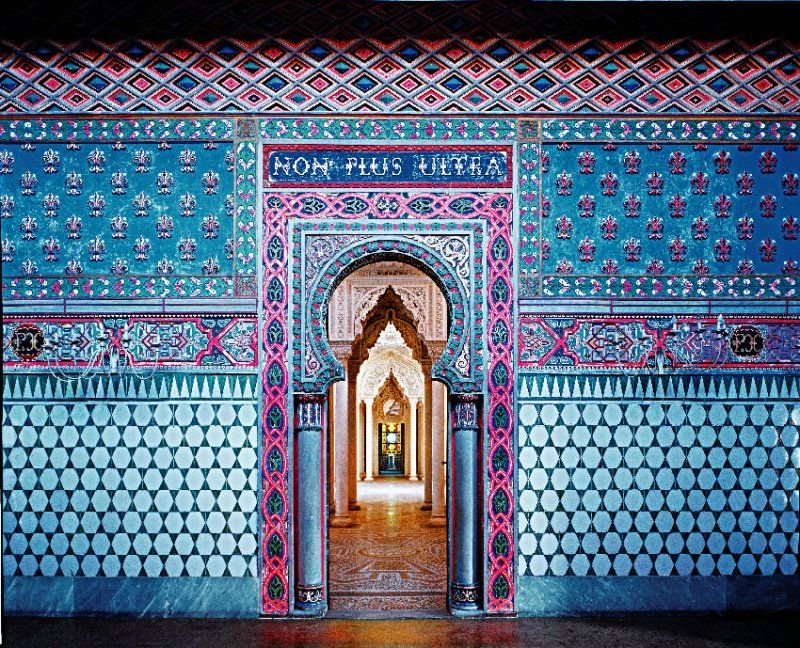
dish_castle1

MessyNessy spotlights photographs of a gorgeous, eccentrically-designed castle that was left abandoned until recently:

The Castello di Sammezzano is a show-stopper, a jaw-dropper. Hidden away in the Tuscan hills of Northern Italy, this electrifyingly beautiful Moorish castle was built a whopping 400+ years ago in 1605, but for more than two decades, it’s been sitting empty, neglected, vulnerable to vandalism and to the elements.

There are 365 rooms in the Castello di Sammazzano, one for every day of the year. The Moroccan-style palatial villa is a labyrinthe of exquisitely tiled rooms, each one intricately unique. Originally built by a Spanish noble, Ximenes of Aragon in the 17th century, it wasn’t until the 19th century that the castle would find its arabian identity and be transformed into the etherial palace it resembles today.

This is all owed to its inheritor, Marquis Ferdinando Panciatichi Ximenes, a largely forgotten but key cultural, social and political figure in Florence when the city was the capital of Italy. Ferdinando, who lived and died at the property, spent 40 years planning, financing and realizing this exotic castle that would become the most important example of orientalist architecture in Italy– only to be left to ruin at the hands of modern-day investors.

A new development group recently purchased the property, but the beauty of its present state lives on in photographs. Another striking picture after the jump:

dish_castle2

(First photo by Massimo Listri. Second photo by Dan Marbaix, whose work is also here and here.)

More Than A Billion Anti-Semites?

Bershidsky looks at a new survey:

It’s hard to believe that in 2014, 26 percent of the world’s population is anti-Semitic. That, however, is one of the findings of a poll the Anti-Defamation League conducted among 53,100 people in 102 countries, who were asked if they agreed with 11 anti-Semitic statements, including nuggets like, “Jews still talk too much about what happened to them in the Holocaust”; “Jews think they are better than other people”; and “People hate Jews because of the way Jews behave.” To be counted among the 26 percent, one had to accept six of the 11.

The general finding is, however, a simplistic reflection of a highly varied global picture of ethnic and religious prejudice. The ADL study, the first one conducted on such a wide scale, picked up indications of anti-Semitism’s antipode, Islamophobia, and other related forms of bigotry, but did not go into too much detail on them. I suspect that if it had, global bigotry levels would have evened out at a higher number than 26 percent.

Jonathan Tobin calls the headline number “hardly remarkable”:

Nor is the fact that this hate is largely concentrated, but not exclusive to the Middle East and North Africa, where 74 percent hold such views, and is most prevalent among Muslims (49 percent worldwide and 75 percent in the Middle East and Africa), who are, ironically, held in even lower esteem by those polled than the Jews.

The survey did not directly establish whether the persistence and widespread nature of anti-Semitic attitudes could be directly linked to hostility to Israel. Indeed, some of the results may point in another direction since the people of Holland have one of the lowest indexes of anti-Semitic attitudes (5 percent) in the world while also harboring great hostility to Israel. Similarly, Iran has become Israel’s most virulent and potentially dangerous foe in the Middle East while actually having the lowest level of anti-Semitic views in the region, albeit a still alarmingly high rate of 56 percent.

But Jesse Singal points out some major flaws in the survey:

According to Ryan D. Enos, a political scientist at Harvard who studies inter-group relations, this sort of binary system is problematic. It “creates strange claims, such as a person that expresses these attitudes on five questions about Jewish stereotypes is okay, but a person that answers six affirmatively is an anti-Semite, same as a person that answers affirmatively on 11,” he wrote in an email. “Most people would think that is [a] strange way to label the people holding those attitudes.” Moreover, he argued, “researchers don’t tend to believe that people can usefully be split into people that simply either do or do not have prejudice against another group.” Prejudice “operates on a continuum, not [as] a yes or no.”

Jeni Kubota, an NYU researcher who studies stereotypes and prejudice (and who praised the report for the impressively large swath of the world it covered), pointed out that researchers generally allow for a range of responses on these sorts of questions so as to build a more nuanced view of respondents’ beliefs. “[A]n individual might STRONGLY support two of these statements,” she said in an email. “Would a score of 2 out of 11 mean that the individual was not anti-Semitic? I would argue no.” That makes it hard to interpret some of the results of the ADL study, she argued.