Rand Paul’s Latest Heresy

Senators Gather To Caucus Over Hagel Nomination

Last week, the Senator from Kentucky suggested (NYT) that Republicans might want to dial down their rhetoric on voter ID laws in order to stop alienating black voters. However, after a predictable firestorm of criticism, his spokesman walked it back on Monday, stressing that Paul had never come out against voter ID as a matter of policy. Chait doesn’t see what all the fuss is about:

Paul’s original heterodoxy didn’t take him very far out on a limb. What he told the Times was, “Everybody’s gone completely crazy on this voter ID thing. I think it’s wrong for Republicans to go too crazy on this issue because it’s offending people.” Paul was not arguing against vote suppression on moral grounds but practical grounds (“it’s offending people”). He wasn’t asking Republicans to stop engaging in vote suppression altogether. Taken literally, he wasn’t even asking them to stop being crazy about vote suppression. He was just asking them not to be too crazy.

But James Poulos calls Paul’s recent comments on race “the most important development of the nascent presidential campaign”:

Our ambitious activists of all stripes have just about sucked the last drop of pathos out of “raising awareness.” But for years, the GOP’s establishmentarian leaders have come to think of Hispanics and minority outreach as virtual synonyms. Despite the occasional Condi Rice, Herman Cain, or Michael Steele, the fact is that Republicans have all but written off black Americans. They are on the verge of giving up on them, of trying to forget they exist.

For the men and women who seem invisible to the GOP, what Rand Paul is doing may or may not be a canny effort to outflank his party’s complacent elite and its cantankerous base. (Paul’s counsel is to cool it on Voter ID, not oppose it.) What it is, no matter what else, is genuine awareness.

Yes, this is a relatively new look for Paul. Yes, it has taken a while for him to find his footing. But his approach is working.

Weigel thinks everyone is missing the big picture, which is that Paul wants to restore voting rights to felons:

The irony is that Paul’s felon-voting stance is plenty radical all by itself. Go back to the stories of felon-voting laws from after the 2000 election. The reaction to the 1970s/1980s crime waves have a long tail, turning plenty of minor-looking crimes (listening in to a police radio in Florida, for example) into felonies. This ended up being a net benefit to Republicans, and, being in the business of winning elections, few hurried to change the laws. As recently as 2012, Mitt Romney could run ads scorching Rick Santorum for daring to support felon voter restoration. Paul didn’t “evolve” on voter ID, but he really has developed a daring policy change after talking extensively to black voters and leaders.

Allahpundit muses on Paul’s strategy here:

Above all, righties want someone in office whom they can trust will defend their values. The more Paul takes positions like this one — let’s be for voter ID but not talk about it — the harder that is. But now I wonder if maybe I’m missing the point of what he’s trying to do. All along, I’ve thought his chief appeal was as a man of principle — libertarian on many issues, conservative on a few, but unafraid to buck either side to defend his beliefs. I thought that’s how he’d run in 2016, precisely because he’s interested in showing righties that he’ll defend their values relentlessly in office. Maybe, though, he’s starting to re-position himself the same way that Rubio’s re-positioning as an establishment candidate. Maybe Paul’s new brand is less about standing on principle than about (as strange as it is to say it for a member of the Paul family) electability, forging an unorthodox new right-wing platform that supposedly gives the GOP its best chance in the general.

(Photo by Alex Wong/Getty Images)
The Pot President

US-URUGUAY-POLITICS-OBAMA

Last week, Uruguay released the details of its legalization program:

Uruguayans will be allowed to buy enough marijuana to roll about 20 joints a week at a price well below the black market rate, the government said on Tuesday as it detailed a new law legalizing the cannabis trade. … It says Uruguayans will be able to buy up to 10 grams of marijuana a week at between $0.85 and $1 dollar a gram, a low price designed to compete with black-market cannabis that mostly comes from Paraguay. Activists who have backed the measure said legalized marijuana would be high-grade and affordable.

In a profile of President Jose Mujica, who also goes by “Pepe,” Krishna Andavolu found the 78-year-old former guerrilla to be both charming and politically savvy – and fine with lighting up:

I asked Pepe whether he minded if I smoked a joint. I fully understood the implications of smoking weed in front of a head of state, but of all presidents, I thought, he’d be game. After my translator relayed my request, Pepe smiled broadly and exclaimed, “Por favor!” I sparked up a joint, and Pepe shrugged and smiled. “I have no prejudice,” he said, “but let me give you something juicier to smoke.”

He got up, went back into his house, and emerged with a cigar. “This is a cigar given to me by Fidel Castro.” His wife, Lucía, followed behind and showed me a portable humidor, a large box shaped like a house filled with Castro-length Cohibas. …

To be clear, Uruguay’s legalization is not aimed at allowing bozos like me to get high indiscriminately. It’s a serious legislative experiment designed to dismantle what pretty much everyone agrees is a horrid failure of public policy: the war on drugs. And while Pepe has an almost too-good-to-be-true avuncular charm, he’s a carefully calculating statesman with a keen sense of how to capture the limelight. A small country of 3.4 million legalizing weed is, on the global scale, a tiny occurrence, but it might just be that crucial example, the hiding-in-plain-sight truth, that all it takes is bold decisions and bold leadership to turn ideas into action.

Mujica had little to say about marijuana when he met with Obama on Monday, but he had some harsh words for American tobacco companies:

“In the world per year, 8 million people are dying from smoking. And that is more than – worth more than World War I or II. It is murder! We are in an arduous fight, very arduous. And we must fight against very strong interests. Governments must not be involved in private litigation, but here we are fighting for life,” said Mujica.

In 2006, Uruguay became the first Latin American country to enact a ban on smoking in enclosed public places. The South American nation requires large health warnings on tobacco packages.  But US tobacco giant Philip Morris is suing Uruguay over the rules for $25 million at the World Bank’s International Center for Settlement of Investment Disputes.

Alfonso Serrano has more:

The world’s largest tobacco company argues that a 2009 Uruguayan anti-tobacco law – which requires that graphic health warnings cover 80 percent of cigarette packets – violates its intellectual property rights. The Uruguayan daily El País last week stated that Philip Morris’s goal is to make the tiny nation a “test case” to keep other countries – the company is also suing Australia and Thailand – from implementing restrictive tobacco policy.

Previous Dish on Uruguay herehere, and here.

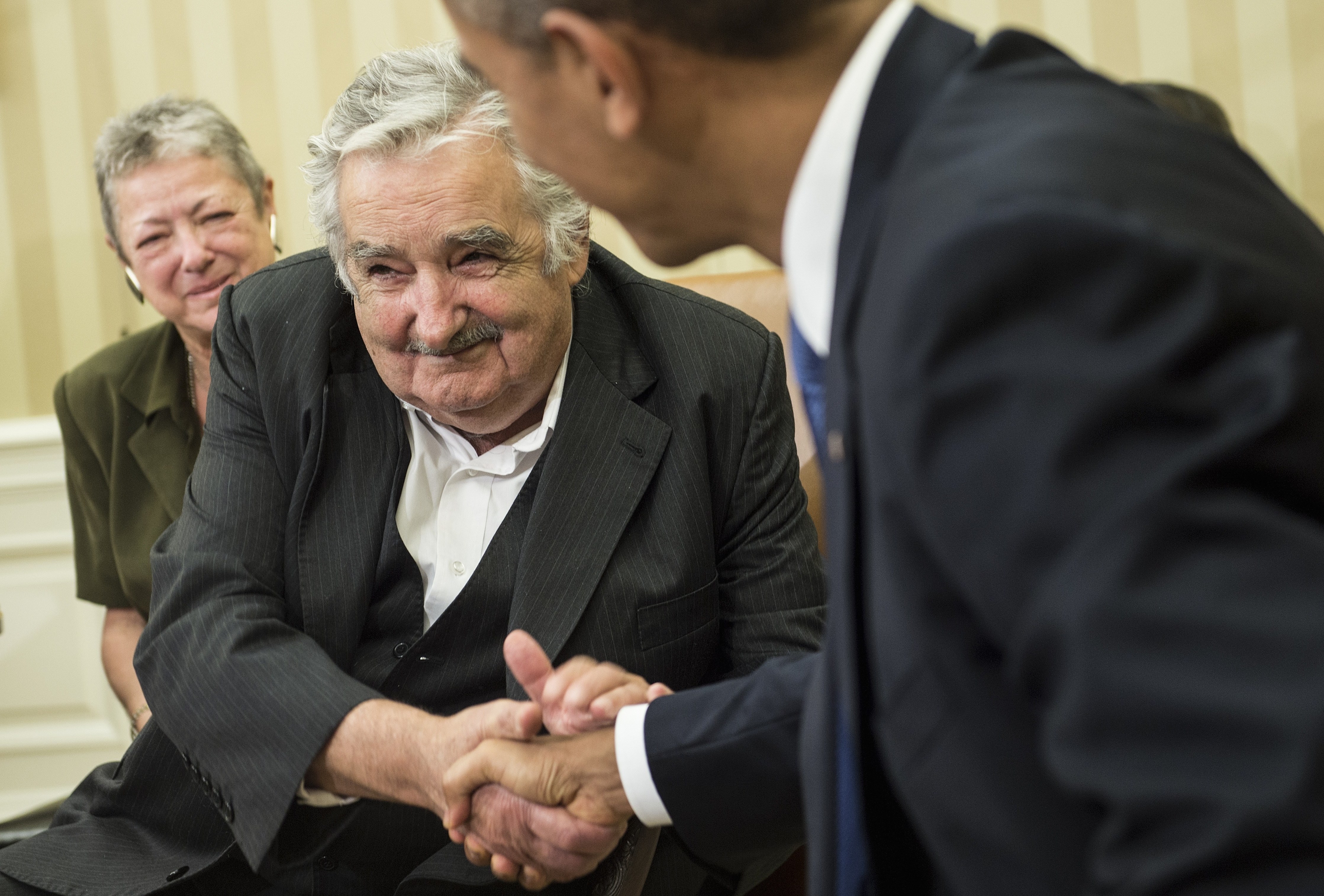
(Photo: US President Barack Obama (R) shakes the hand of Uruguay President Jose Mujica Cordano before a meeting in the Oval Office of the White House May 12, 2014. By Brendan Smialowski/AFP/Getty Images)

Will We Intervene In Nigeria?

USinvolvementAll

Congress is considering authorizing the deployment of special forces to help rescue the kidnapped schoolgirls:

President Barack Obama has sent in an intelligence, logistics and communications team that includes 16 military personnel. On Monday, National Security Council and Pentagon officials told TIME that that the U.S. has begun sharing commercial satellite imagery with the Nigerians and is flying manned aircraft over Nigeria with the government’s permission for intelligence purposes.

The top ranking Senators on the Intelligence Committee, Dianne Feinstein (D-Calif.) and Saxby Chambliss (R-Ga.) told TIME that they would support sending in special forces under certain conditions: Feinstein would send in the additional assistance only if Nigeria requests it, and Chambliss would do so with our allies. Retired General Chuck Wald, former deputy commander of the U.S. European Command, said that America would need to send “several hundred” Special Operations troops “to get it done right.”

John McCain, true to form, wants to send in the troops whether Nigeria asks for help or not. To which Allahpundit sighs:

So McCain’s now fully embracing the “Uncle Sam, world cop” vision, huh?

Intervention anywhere, with or without the governing regime’s permission, with or without any compelling U.S. national-security interest at stake, with no authorization needed beyond the assertion that a crime against humanity is taking place. (Somewhere right now, Putin’s conferring with his inner circle about “crimes against humanity” being committed against ethnic Russians in Kiev.) I’m tempted to ask whether he’d at least require the president to get an AUMF from Congress, but we all know the answer — of course not. That would only impede the mission. In a sense, all he’s doing here is extending the drone philosophy a few steps further: If we can blow up Boko Haram from the sky with the permission of the Nigerian government, we shouldn’t let the regime’s cowardice or corruption stop us from blowing them up without permission. And if we can blow them up without permission, why couldn’t we blow them up from the ground by sending in U.S. troops with grenades?

Larison declares that this idea is “unduly reckless even by McCain’s low standards”:

It takes a great deal for granted to assume that the mission would be successful with minimal loss of life for the captives and U.S. forces. Obviously nothing would be gained from a botched or failed raid, especially if it resulted in the deaths of many of the innocents held captive. Even a successful raid would carry substantial risks, and those risks would be even greater if this were done without the Nigerian government’s cooperation.

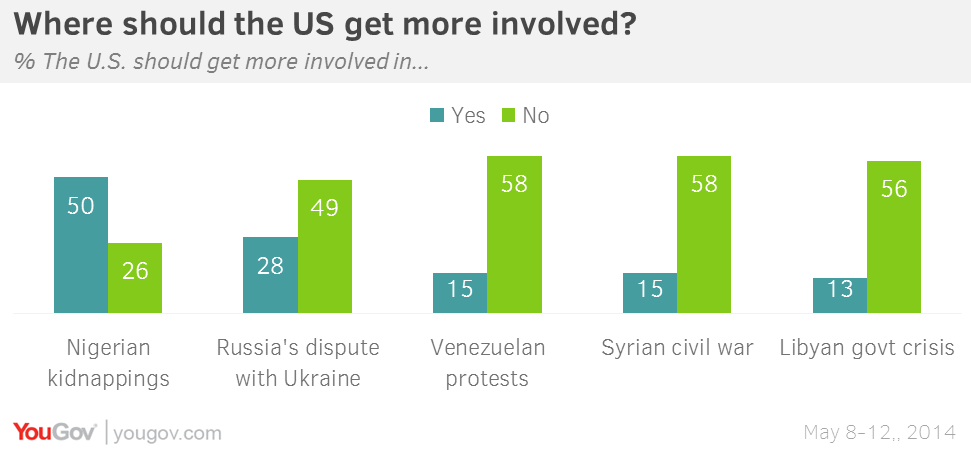
But the American public, as the chart above indicates, are relatively willing to get involved:

Support for involvement in the Nigerian kidnappings is greatest among Democrats. Nearly two-thirds (63%) of Democrats support greater US involvement in rescue efforts, compared to 41% of Republicans and 45% of Independents. Nevertheless, however, every group is more likely to support rather than oppose great US involvement in Nigeria.

Worth pointing out: the poll didn’t ask how Americans would like to “get more involved.” Doug Bandow wants the US to stay the hell out:

So far Boko Haram has restricted its murderous activities to Nigeria. Active U.S. involvement, however, risks turning the conflict into one of international jihad, when Boko Haram may broaden its attacks to Americans. Finally, what is the end point for American involvement?  What if the girls aren’t located? With failure almost inevitable, there will be pressure on the U.S. to do more, even enter the conflict directly.  Secretary of State John Kerry already has talked of doing “everything possible to counter the menace of Boko Haram.”

Sarah Margon focuses on the unsavory record of the Nigerian military with which we’d be cooperating:

The tactics of the government security forces are barely more palatable than those of the militants themselves. Nigerian security forces are known for raiding local communities, executing men in front of their families, arbitrarily arresting and beating people, burning residential property and stealing money while searching homes. Nigerian authorities also routinely hold suspects incommunicado without charge or trial in secret detention facilities and abuse and torture them. Unsurprisingly, due process rights for detainees are often absent.

Keating points out that such rescue operations often fail, although the alternative—negotiating with Boko Haram—isn’t very attractive either:

The best outcome would be for government forces—now working with military assistance from the U.S. and other countries—to rescue the girls. But these operations don’t have a great track record of getting the prisoners back alive. In 2012, for instance, when the Nigerian military aided by British special operations forces attempted to rescue a Briton and Italian being held hostage by Boko Haram, both were killed by their captors before they could be rescued. A rescue operation in the case carries the very real risk that not all of the girls will survive. On the other hand, a French family of seven kidnapped by the group in Cameroon in 2013 was released unharmed after a $3 million ransom was paid by unknown parties.

But negotiating with the group after a crime this dramatic sets a very bad precedent and could encourage more acts like this in the future. Taking a cynical political view, it would also make Jonathan’s government look extremely weak at a time when it’s already under intense domestic and international scrutiny for having failed to prevent the kidnapping.

The latest Dish on Nigeria here, here, here, and here.

Maybe Red Wine Isn’t So Good For You

Resveratrol, an ingredient in red wine, might not be as healthy as advertised:

Initially, resveratrol was identified as a possible explanation for the “French paradox”— the surprising fact that, despite consuming high amounts of saturated fat, French people have much lower rates of heart disease than Americans. Soon, resveratrol was being hailed as a magic bullet against heart disease, cancer and aging, and is now sold as a concentrated supplement in health stores across the land.

But the first study on the long-term effects of resveratol on people was just published in the Journal of American Medicine, and its findings are pretty damning. After tracking 783 older Italians over the course of 11 years, researchers found that resveratrol consumption had absolutely no positive impact on rates of heart disease, cancer, or mortality.

Virginia Hughes criticizes how this study has been covered in the media:

So I read that study and thought, this is important: My readers who buy or are thinking of buying resveratrol might appreciate knowing that its benefits haven’t panned out in people, at least not yet. Sure, a future study in people might report some benefit of resveratrol, but for now all I can do is offer the current state of knowledge. And that’s better than nothing, right?

But then…maybe it’s not. Take a look at those headlines again. I suspect a general reader is not coming away from those saying, “Gee whiz, look at the long and bumpy road to scientific progress!” They’re more likely to be saying, “When will those scientists get their act together?” Or worse, “Why do we keep dumping money into this capricious discipline?”

What’s Rove’s Game?

Yesterday, Karl Rove defended his recent comments that suggested Hillary Clinton could have brain damage:

Chotiner expects the attack to backfire:

Rove has always been overrated as a strategist. (If the Florida recount had gone the other way, Bush’s decision to campaign in New Jersey and California in the week before the 2000 election would have gone down as one of the great blunders in campaign history.) But, as with Rand Paul’s comments about Monica Lewinsky, Republicans seem completely confused as to how to run against Hillary Clinton. The two times Clinton has been most popular or politically robust were during the Lewinsky mess and parts of the 2008 campaign, when she came to be seen as a victim of media sexism. Perhaps Rove is so Machiavellian that for some reason he wants Clinton to win in 2016, thus ensuring…who knows what? Either that or his comments are simply dumb as well as nasty.

Beinart isn’t so sure:

Why does Rove allegedly smear his opponents this way? Because it works.

Consider the Clinton “brain damage” story. Right now, the press is slamming Rove for his vicious, outlandish comments. But they’re also talking about Clinton’s health problems as secretary of state, disrupting the story she wants to tell about her time in Foggy Bottom in her forthcoming memoir.

Assuming she runs for president, the press will investigate Clinton’s medical history and age no matter what Rove says. But he’s now planted questions—about the December 2012 blood clot that forced her into the hospital, and about her mental condition as she ages—that will lurk in journalists’ minds as they do that reporting. If she has a moment of Rick Perry-like forgetfulness sometime between now and the fall of 2016, Rove’s comments make it more likely that voters will wonder whether she’s still with it mentally.

Kleiman makes related points:

My high-school biology textbook told me that the paramecium is the lowest form of animal life. Obviously, the author of that textbook had never encountered Karl Rove. He knows how to play the media like a violin, half-saying things he can later deny, getting a story each time that plants a nasty suspicion about an opponent, and reporters don’t know how to resist.

Waldman weighs in:

Here’s one way to understand Rove’s comments: They might be a way of testing how allegations about Clinton’s health — or about anything else — play out in the press. Will the news media pick them up and run with them? How far can Republicans go in making unsubstantiated charges? What kind of blowback will there be, and would it outweigh the benefits to Republicans of making Clinton answer uncomfortable questions? After all, while Rove may not be quite the political genius many believe, he doesn’t make statements like that without a reason.

Cillizza adds:

Rove is not exactly the ideal messenger to carry the “Is Hillary healthy enough to be president?” argument. “Having Karl Rove lead the charge will only solidify Democratic support behind Hillary, and risks alienating independents who think personal attacks are out-of-bounds,” said one Democratic consultant granted anonymity to speak candidly about the political impact from Rove’s comments.

In the end, Clinton’s health and age will only be an issue if there is a re-occurrence (or some new occurrence) of a medical problem that suggests she may not be able to carry out the duties of the office. If Clinton is actively moving around the country — speaking, raising money and, eventually, campaigning — without incident, the age and health questions will likely disappear.

Adapting To Global Warming

Noah Millman argues that although “a rise in sea levels and an increased incidence of extreme weather are the easiest parts of climate change to understand, they aren’t actually the most important.” He makes some reasonable points:

Human beings adapt pretty readily to flooding. We know how to build sea walls, and ecologically-sophisticated systems of flood control. In the extreme, we know how to move – we are a highly mobile species.

It’s less clear how well we’d adapt to wholesale changes in the ecology attendant on changes in CO2 levels. An increase in the acidity of the oceans, for example, could significantly disrupt the marine food chain (what’s left of it after over-fishing). A wide variety of land-based species are also sensitive to changes in the climate; global changes could have an unpredictable global impact on overall biodiversity. The earth, of course, will adapt just fine; the terrestrial climate has seen some pretty huge swings over geological timescales, and the diversity of life has recovered from multiple mass-extinctions. Human beings, though, have only been around for a million or so years (much less depending on how picky you are about what counts as “human”), and large-scale civilization is only a few thousand years old. We have no idea how well that civilization would adapt to widespread ecological disruption.

Moreover, there is a synergy between efforts to reduce the impact of human activity on the environment and efforts to repair or adapt to the consequences of that activity. The slower the rate of CO2 and methane emissions, the slower these changes will progress; in effect, we’d be buying time to adapt.

American Decline Is Real

With regard to height:

For centuries, Americans were the NBA players of the world. We were two inches taller than the Red Coats we squared off against in the American Revolution. In 1850, Americans had about two and a half inches on people from every European country. But our stature plateaued after World War II, and since then, other countries shot past us. White Americans have grown a bit taller since the early 1980s, but African Americans haven’t.

And the tallest in the world?

[T]he Dutch are the tallest, at an average of six feet for men and five-foot-seven for women. They’ve come a long way: In 1848, a quarter of Dutch men were rejected from military service because they didn’t meet the five-foot-two height limit. “Today, fewer than one in 1,000 is that short,” the Associated Press noted in 2006.  (The tallest people on record, though, are apparently the people of the Dinaric Alps, in the former Yugoslavia, where adolescent males are, on average, six-foot-one monoliths.)

The Danes, Norwegians, and Germans stack up right under the Dutch. American men and women, meanwhile, measure just 5’9″ and 5’4″, respectively, barely edging out the Southern Europeans.

Burning Out The Candle At Both Ends

Noting that only 30 percent of American workers say they are engaged with their jobs, Krystal D’Costa wants us to start taking the problem of burnout seriously:

Burnout is a work-related disorder that results from prolonged experiences of stress, which can stem from work overload, role ambiguity, a lack of autonomy, and low social support. It’s characterized by a lengthy list of symptoms including exhaustion, disinterest, boredom, heightened irritability, feeling unappreciated, loss of concentration and feelings of detachment. And if allowed to fester, burnout can result in depression, substance abuse, and make you more susceptible to illnesses overall. …

Search for “burnout” and the majority of the news results you’ll found are Canadian or based in the EU. The scarce recognition of burnout in the United States is noticeable and what exists reads like the same general piece over and over again.

We’re dancing around the topic despite the potentially serious impact of burnout because there is also be a degree of stigma in the assignment, particularly in a market where jobs are still somewhat difficult to come by and employees may feel pressure to perform (or appear as if they are). Burnout suggests you don’t fit with the company—that you can’t cut it. It implies that you’re not a prime candidate.

Denial, which is a huge factor in the progression of burnout, is also at work on a larger social level: we acknowledge the problem with general self-help articles, but place the burden of diagnosis and treatment largely on the individual with suggested tips for identifying and managing symptoms. This overlooks the ways in which organizational and social structures can create a setting for burnout.

Our Precarious Power

Hugh Byrd and Steve Matthewman warn that electrical blackouts are “becoming increasingly common” across the globe and “will only get more frequent and severe”:

Electricity systems are complex, high-tech assemblages in which small failures can interact in unanticipated and often incomprehensible ways. The North American grid, for example, is blackoutarguably the world’s largest machine, but is highly fragmented. It crosses borders and regulatory zones and has no single owner or manager. Over 3,100 utility companies are on it.

Other continent-scale grids have similar weaknesses. The vulnerability of such systems is demonstrated by the Italian blackout of 2003. The event began when a falling tree broke a power line in Switzerland; when a second tree took out another Swiss power line, connectors towards Italy tripped and several Italian power plants failed as a result. Virtually the whole country was left without power. It says something when a nation can be brought to a halt by two trees falling outside its borders. …

Resource depletion is already having an effect on countries that rely on fossil fuels such as coal for electricity generation. Countries with significant renewable resources are not immune, either. Weather is not predictable and is likely to become less so, courtesy of climate change: in the past decade shortages of rain for hydro dams has led to blackouts in Kenya, India, Tanzania and Venezuela. Deregulation and privatization have created further weaknesses in supply as there is no incentive to maintain or improve the grid. Almost three-quarters of US transmission lines and power transformers are more than 25 years old and the average age of power plants there is 30 years.

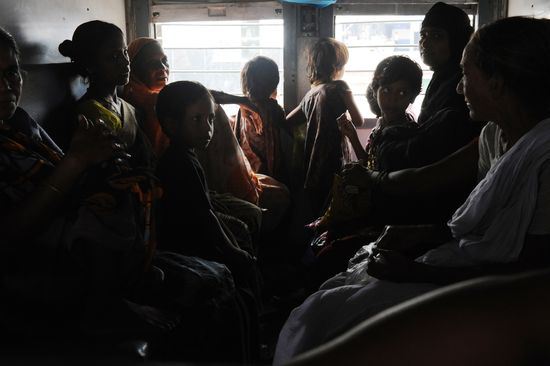
(Photo: Indian women and children wait inside a darkened train carriage at a railway station in New Delhi on July 31, 2012. A massive power failure hit India for the second day running as three regional power grids collapsed. By Roberto Schmidt/AFP/Getty Images. Dish coverage of the blackouts here.)

Is A Genocide Afoot In Burma?

Rohingya Refugees Face Health Crisis As Myanmar

Earlier this month, Jane Perlez reported (NYT) on the mounting crisis facing Burma’s Rohingya Muslim minority, who are being denied access to lifesaving aid as they languish in displaced persons camps and face sporadic pogroms carried out by radical Buddhists:

The crisis began with the government’s expulsion of Doctors Without Borders, one of the world’s premier humanitarian aid groups and the lifeline to health care for more than a million Rohingya increasingly denied those services by their own government. But the situation has grown more dire in recent weeks, as local Buddhist officials began severely restricting other humanitarian aid to the camps and the rest of Rakhine State, where tuberculosis, waterborne illnesses and malnutrition are endemic. Some aid workers fear they are being kept away so there are fewer witnesses to rampant mistreatment and occasional bloodletting; the doctor’s group was expelled from Rakhine State after caring for victims of a violent assault on a Rohingya village that the government denies ever happened.

Sir Geoffrey Nice and Francis Wade warn that all signs point to genocide:

The situation has been allowed to fester — and actively encouraged — for too long. What were once horrible but sporadic bursts of violence have become sustained and deeply sinister.

The government has done little to help and much to harm the conditions in Rakhine state. It has rendered the Rohingya stateless, impeded aid, failed to punish perpetrators of violence and hate-speech, and thereby created an environment that allows violence to flourish. But all the while, it maintains the pretense that the mobs are operating on their own whim, and that the violence is purely communal. The tactic is familiar to state crime scholars: Policies are devised by leaders at the top, and delivered by those on the ground, with the puppeteer’s strings rarely visible. Now tensions are at a point where even small disputes are erupting into mass violence, with attacks on Rohingya occurring because of who they are, and not what they have done. All leaders in Burma must know that this is the mental state that enables genocide. And they also must know that once the genocidal mindset is free to act, it is rarely possible to stop, save by another greater force.

Previous Dish on the plight of the Rohingya here and here.

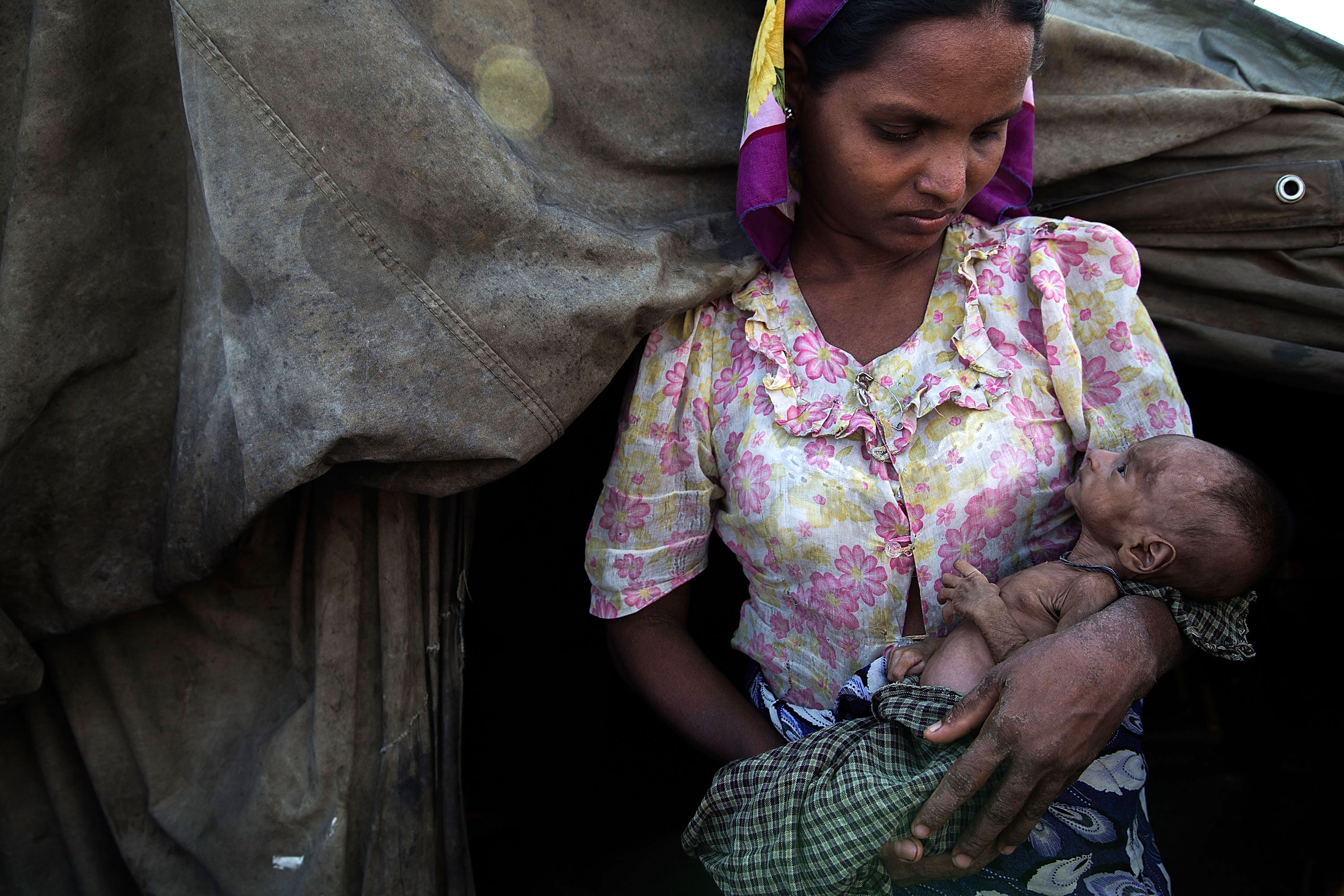
(Photo: Rosheda Bagoung holds her malnourished child outside a tent at Dar Paing refugees camp on May 10, 2014 in Sittwe, Burma. 150,000 Rohingya IDP (internally displaced people) are currently imprisoned in refugee camps outside of Sittwe in Rakhine State in Western Myanmar. Medecins Sans Frontieres (MSF), the primary supplier of medical care within the camps, was banned in March by the Myanmar government. Follow up attacks by Buddhist mobs on the homes of aid workers in Sittwe put an end to NGO operations in the camps. Though some NGOs are beginning to resume work, MSF remains banned and little to no healthcare is being provided to most Rohingya IDPs. One Rohingya doctor is servicing 150,000 refugees with limited medication. Several Rakhine volunteer doctors sporadically enter the camps for two hours a day. Births are the most complicated procedures successfully carried out in the camps. Requests to visit Yangon or Sittwe hospitals for life threatening situations require lengthy applications and are routinely denied. Malnutrition and diarrhea are the most widespread issues, but more serious diseases like tuberculosis are going untreated and could lead to the rise of drug resistant tuberculosis. By Lam Yik Fei/Getty Images)