The View From Your Window

image

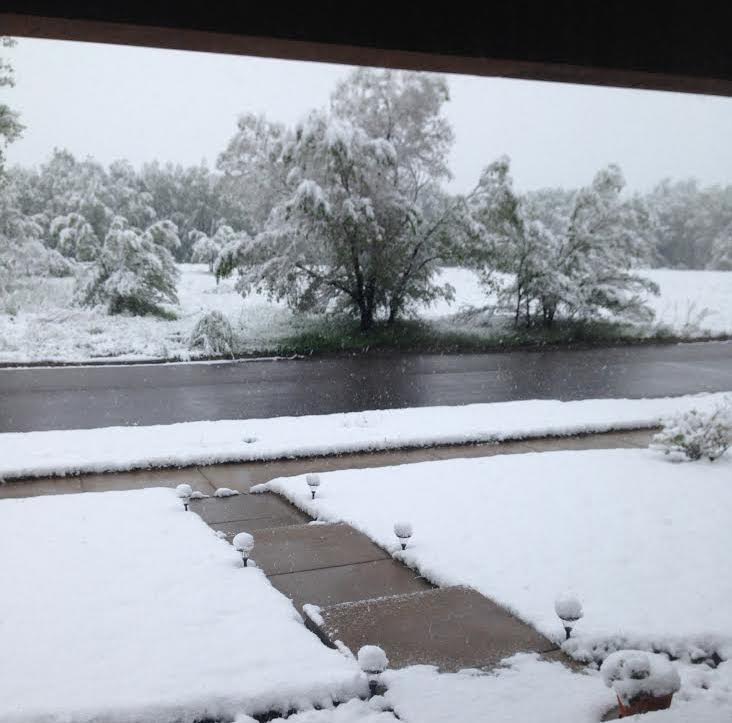
Denver, Colorado, 8.10 am. “Middle of May. 30 degrees. Sigh.” Similar scenes after the jump:

640am-Boulder-Colorado

Boulder, Colorado, 6.40 am

denver2

Denver, Colorado, 10.48 am. “That’s the setup for America’s Ninja Warrior in Civic Center Park, along with May snow.”

Frisco-Colorado-824am

Frisco, Colorado, 8.24 am. “Happy spring from a loyal reader in Colorado!”

The Neuroscience Of Buzz

What makes videos like the one above go viral? To answer the question, Nicholas Hune-Brown looks into research investigating what the “buzzy,” trend-predicting brain looks like:

[P]sychologists recruited 19 undergraduates and asked them to pretend they were interns at a TV studio. With their brains hooked up to an fMRI machine, which measured activity in various neurocognitive networks, they then read through ideas for TV pilots and decided whether or not to pass the pitches on to their “producers” (79 other students). After the scan was over, the interns created video interviews about each pilot idea, rating the pitches. The videos were sent to the producers, who then had to decide whether or not they would recommend the pitch to other individuals. A pitch that the producers approved of, an idea that had been successfully passed from one person out into the wider world, was “buzzy.” …

The researchers found that when encountering a future viral hit, people who were able to successfully create buzz showed significant activity in the temporoparietal junction, or TPJ.

There was more activity in the TPJ compared to people who weren’t able to convince the producers—poor pushers of viral content—and compared to themselves, when they were reading a dud of a pitch.

The TPJ is part of the brain’s “mentalizing network,” which we use to think about the thoughts and feelings of others. It’s the part of the brain that sparks during successful conversations, when we’re trying to figure out how to communicate, or when we read a book and try to put ourselves in the mind of the main character. While reading the most successful pitches, the interns weren’t just concerned about enjoying a pitch themselves—they were anticipating what others might enjoy. The people most able to make something “go viral” were those who instantly began thinking about how to make the information useful to a larger community.

He glimpses the future:

As my editor said, it’s easy to see where this is going: a dystopian, Philip K. Dickian future in which BuzzFeed is edited by a group of precogs endlessly fed story ideas—“tiny salamanders wearing tiny capes,” “tiny mice riding medium-sized frogs”—while researchers hover above, waiting for the TPJ to light up like a slot machine with the next viral hit.

The Tao Of Cool

In another installment of his series on hip-hop culture, Questlove considers what it means to be “cool,” arguing that “black cool, when it comes right down to it, is everyone’s cool.” He cites a passage from the anthology Black Cool to make his point:

When I read through the book, I locked into an essay by Helena Andrews. It’s called “Reserve,” Andrews’s piece, and it’s about the mask that black women learn to wear as girls. She imagines a black woman moving through a city, negotiating the looks of others on the subway.

She seems to be doing more than everyone else by doing so much less. Your eye is drawn to her. She acknowledges your presence by ignoring it. She is the personification of cool by annihilating your very existence.

What drew me to Andrews was these four sentences, which articulated, in a different way (gender-specific, subway-specific), something that I have thought about black cool for a long time, which is that it doesn’t exist in a vacuum. Black cool is part of society in general, part of white society. Black cool is the tip of African-American culture’s engagement with the broader white culture. Black cool only works the way it works because it’s part of a relationship. Look at Andrews’s scene more closely. The woman, getting attention, rejects that attention, and as a result gets more attention. Cool has an additional dimension, too, which is that it buys time. In an uncertain social situation, where the wrong decision can have disastrous consequences, cool lets you stay a beat behind while you settle on the path of least destruction. Taken to the extreme, cool can be sociopathic; taken to the right levels, it’s a supremely intelligent mix of defense mechanism and mirroring.

Don’t Blame New Yorkers For Baby Brooklyns

CBOX_BlattName_Map_2.jpg.CROP.original-original

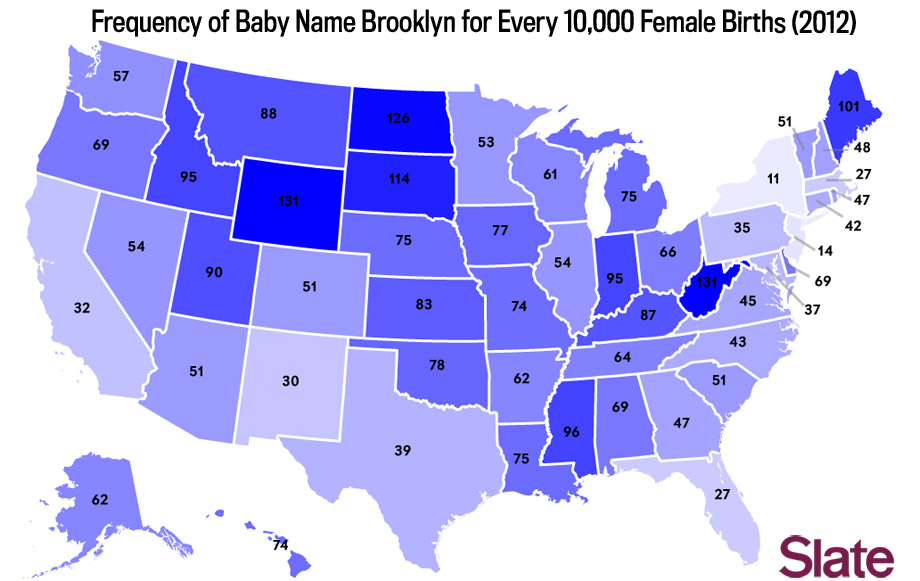
They’re not the ones naming their daughters after the borough:

In 2012, roughly 5 out of every 10,000 baby girls from Brooklyn, New York, were named Brooklyn, while roughly 131 out of every 10,000 baby girls born in West Virginia were named Brooklyn. You can see examples of this same trend elsewhere. In 2012, four of the most popular 100 girls’ names were also cities with a metro area of greater than 250,000 people. One of those names is Madison, the capital of Wisconsin. Only one other state (California) names its children Madison less often than parents from the Badger State.

Gays Don’t Stray Far

Screen Shot 2014-05-09 at 12.28.17 PM

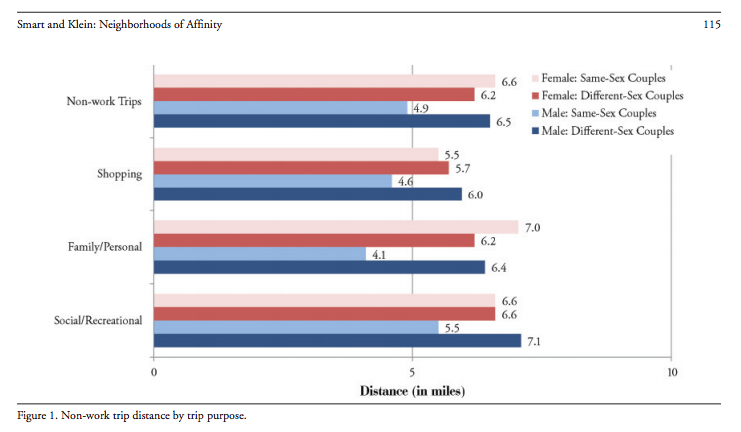
At least not when they live in “gayborhoods,” according to a recent study:

In their simplest model, comparing the travel patterns of members of gay, lesbian, and straight couples, the authors found that travel for non-work purposes were shorter in neighborhoods with more gay and lesbian couples. But this was especially true for gay men. Travel distances of trips made by straight men and women and lesbian women decreased by 6.2 percent for each percentage-point increase in the share of same-sex couples in the census tract. For gay men, trips decreased in length at nearly twice that rate, at an incredible 12.2 percent. …

So what’s behind this connection between shorter travel distances and gay neighborhoods?

The authors suggest that it reflects a broader concept of “neighborhoods of affinity,” where people live in neighborhoods because they share common interests and are drawn to similar features and amenities, as well as, potentially, the kinds of jobs that are available. In other words, in addition to our search for jobs, services and amenities, and transportation access, it is the very fact that we sort and cluster together that defines the way we move around a neighborhood. And these travel patterns can inadvertently reinforce the forces of sorting and segregating, as shorter travel patterns create even more self-contained worlds for some city residents.

So why doesn’t the pattern hold for lesbians? As the authors speculate (gated paper),“Gay neighborhoods are often located closer to the urban core and are typically denser than lesbian neighborhoods … This may be because gay men have the capital to locate in more expensive areas; moreover, being less likely to have children, gay men may have the disposable income to live in high-amenity locations.” Update from a reader:

I certainly think there’s some value in appreciating how social networks create certain neighborhood identities. In geography, my discipline, the emphasis would be on the reciprocal nature of this relationship: how communities create spaces that reflect their own interests and identities but also how those spaces in turn help solidify or further influence individuals’ social identity. Gay men didn’t just go to the Castro because they were gay. In some sense, living there may have defined for them what being gay meant.

However, I’m also struck in this article by the almost complete absence of any literature on segregation and external factors that limit the mobility of individuals. Certainly, when we consider race or poverty, high concentrations of minority groups aren’t just a matter of similar populations preferring to live in close proximity (though that can’t be completely discounted as a factor). In my own research on food access, I talked to several individuals who shopped at stores in the neighborhoods, but only because they lacked the resources to go elsewhere. One summed it up this way: “I live in the ‘hood, but I hate it.” In the case of Smart and Klein’s article, a focus on neighborhoods of affinity leaves largely unstated what seems an equally significant issue: these communities are necessary in part because the people and spaces found there remain socially unacceptable in many other communities.

In case you’re interested, I’m also sending along a couple of articles done by a couple of geographers on census maps of gay/lesbian households in San Francisco [pdf – here and here]. They similarly found that gay men were highly clustered at a neighborhood scale, but that lesbian households were much more dispersed and thus more “invisible” in conventional mapping approaches. They ask how the concentration of same-sex couples in urban areas might affect both their political power and their sense of their own sexual identities.

Books Over Baghdad

Ahmed Saadawi’s novel Frankenstein in Baghdad won the 2014 International Prize for Arabic Fiction (I.P.A.F.), known as the “Arabic Booker.” Ursula Lindsey discusses the role of the award in the rise of Arab literature:

When I attended the Cairo International Book Fair, earlier this year, several bookstores and publishers were promoting I.P.A.F. winners. A salesgirl practically ordered me to buy last year’s winner, “The Bamboo Stalk,” which tells the story of a young man born to a Kuwaiti father and his family’s Philippina maid, dealing, along the way, with the second-class-citizen status of immigrants in the Persian Gulf.

Across the Arab world—where literacy rates remain low, copyright law is hard to enforce, and a print run of three thousand is considered a success—the lack of fiction readers is regularly bemoaned. But this does not seem to discourage writers here, who focus on the conflicts and cities they know, of course, but to whom the increased possibility of a regional and international audience may act as an added encouragement. Prizes like the one “Frankenstein in Baghdad” received lead to lively literary discussions and an increased awareness of new writers and trends across the region, in which books do not circulate nearly as freely as one would expect, owing to censorship, bureaucracy, and a struggling publishing business. The prize committee has added a writers’ workshop to its activities; Saadawi is a graduate.

Arab states have never been more in crisis than they are today, whether they have been destabilized by outside intervention, sectarian strife, religious extremism, or the demands of fed-up citizens. The governments’ ideologies, which once held out the promise of dignity and advancement, have become threadbare covers for corruption and repression; the spectre of their own dissolution is one of their main mobilizing tactics. One can only regret the staggering waste, chaos, and suffering this has entailed. But Arab writers are stitching the pieces back together again; what emerges may not be pretty, but it is already fascinating.

Meanwhile, in an interview, Hassan Blasim – the Iraqi author of The Corpse Exhibition: And Other Stories of Iraq – explains why he’s not especially interested in achieving recognition in his native country:

Some Iraqi writers are more daring today and have excellent imaginations and their material is rich in human experience. But the Arab prizes … are part of the context of life in the Arab world—anarchy, confusion, and corruption. I’m not much interested in prizes, whether from the Arab world or from the Western world. … For the International Prize for Arabic Fiction in 2014, one of the judges works in the Saudi Shura Council. The Saudi Shura Council is not a parliament that is elected and free and that defends the interests and rights of Saudi citizens. It’s an obscurantist council that is a tool of oppression in the hands of the king of Saudi Arabia and his family. How can someone who doesn’t speak out about all the human rights violations in his country judge a literary prize?

Putting Your Faith In Science

In a profile of Aubrey de Grey, author of Ending Aging: The Rejuvenation Breakthroughs That Could Reverse Human Aging in Our Lifetime, Charlotte Allen considers the tension between empiricism and belief in the “live-forever movement”:

The current fascination with achieving immortality via science seems to track the general loss of religious faith in the modern West. Since the New Testament phrase “death hath no more dominion” no longer resonates with many people as a promise of heavenly survival, scientific life extension can be explained as an effort to achieve transcendence and eternal life by other means. Aldous Huxley explored those themes satirically in his 1939 novel, After Many a Summer Dies The Swan. … Interestingly, today’s living-forever movement involves precisely the same two themes that animated Huxley’s novel: advanced medical technology and primitive living. And also faith of a steadfastness to rival that of a medieval saint.

Living-forever people tend to display a consistent cluster of traits and fixations, of which de Grey’s major benefactor Peter Thiel is a quintessential example. Among them are: political libertarianism (a New Yorker profile of Thiel in 2011 explains that he built PayPal​ – ​since sold to eBay​ – ​in part because “he wanted to create an online currency that could circumvent government control”); boundless optimism regarding a technically enhanced utopian future (for Thiel, according to the New Yorker, it’s “sea-steading” – floating city-states on the high seas; for others, it’s colonizing Mars); and a preoccupation with one’s food intake. Nearly all living-forever people are on one version or other of the currently fashionable carb-free “Paleo diet,” if not cutting back on eating altogether. … Finally, most living-forever people seem to be confident that they personally will be around long enough to take advantage of the biomedical breakthroughs that Aubrey de Grey predicts lie just around the corner. Thiel told New Yorker writer George Packer that he expected to live until age 120​ – which, because he’s just 46 right now, should give him plenty of time to become that man of de Grey’s prophecy who lives until age 1,000.

Previous Dish on de Grey and longevity herehere, and here.

Mother’s Day Without Mom

John Dickerson reflects on the death of his mother, and what her absence has come to mean as he himself ages:

My mother died when I was 29, and though it has been 17 years, I still have the instinct to call her. She was also a journalist, so there’s the news to talk about, and there are the anniversaries of big events that she covered, and now that I have kids, there’s the larger set of conversations we could have about ambition, faith, fear, and generally trying to keep it all together.

He offers this advice to parents: “Write to your children now for when they’re older. Leave them some writing for after you’re gone.” For him, his mother’s words have proved invaluable:

I have [my mother’s] childhood journals, her letters to her parents when she was just starting out, and her journals as an adult. There was so much in what she left after her death, I had to write a book to figure out what it all meant. In those artifacts I’ve learned about grace during times of struggle and self-doubt. I’ve seen examples of a joyful spirit alive in each day. This window into her inner life offers a more global lesson: People are always more complicated than they seem. Your guesses about what motivates them are often wrong. This is both true about her and true about the people she judged. Not all the lessons I’ve learned from these papers are behaviors I’d emulate.

Mom also kept letters she wrote to me…. I don’t remember getting them when they were originally sent (“I get the feeling you don’t read my letters,” she wrote to me, saying it was a line her mother wrote to her), but they’re full of wisdom as I reread them. And instruction: “always keep smiling and making people happy,” she wrote on my copy of her letter about her will. This kind of thing reminds you of yourself later in life when maybe you need to be put back on course.

Why Atheists Need To Come Out, Ctd

Atheists

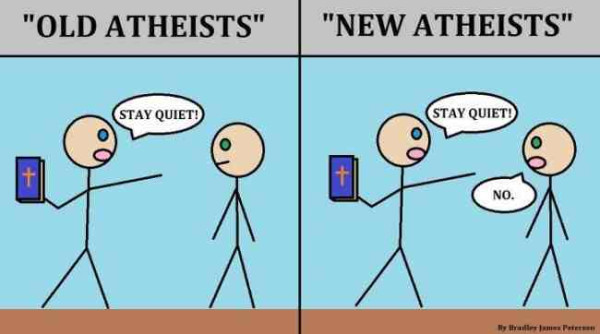
A reader shares the above image via GSpellchecker, adding, “I think this just about sums it up.” Another reader would agree:

The problem is that atheism by its nature is silent. You tend not to talk about something you don’t believe in unless it specifically comes up as a topic. If you’re in a group of friends and you want to indicate you’re a Christian, you can mention something about church. How do I casually indicate my status as an atheist? Mention that I’d like to go mountain climbing but I don’t want to risk death because I don’t believe in an afterlife?

The joy of Dawkins is that he comes out and tells us we’re not the only ones, that there are lots of other really smart and sane people out there who realize that the entire religion thing is completely ridiculous.

Another:

In the discussion of atheists “coming out,” I’m surprised no one has mentioned The Out Campaign promoted by – wait for it – The Richard Dawkins Foundation for Reason and Science. (There is a similar project for closeted atheist clergy.) In my opinion, the New Atheists are trailblazing in the culture wars, pushing the so-called Overton window for religious opinions. They are also alerting closeted atheists that there are more like-minded people out there than they may realize. This all makes it possible for mild-mannered atheists to simply come out in their own boring way.

Another argues that militancy is more than justified:

The accusation of the strident atheist is similar to the “angry black man” trope in that it is designed to get people to shut up and disenfranchise people who are saying things that the accuser does not like.

The irony is that the worst Dawkins, Dennett, Maher, and Hitchens say about religion is quite mild in comparison to what the religious say about atheists. The core belief of Christianity and Islam is that atheists will be tortured in hell for eternity. This is not some Old Testament throwaway line but is integral to belief itself.

I would remind the reader who wrote about their grandmother who lost a son and uses the promise of heaven as a coping mechanism that she is saying in the same sentence that you (an atheist) are going to hell to be tortured for all eternity. You can’t have the kingdom of heaven without the damnation of hell; that’s an implicit bargain.

But a few readers suggest that strategy might backfire:

I’m as secular-lefty as they come (hell, I’m a professor of social theory; it’s practically a professional requirement), but the tone-deaf pompousness, the lack of regard for nuance, and the circular arguments that the New Atheists sometimes display have pushed me towards a much more sympathetic regard for religion – what it does for societies, and what it does for individuals. From someone who was unthinkingly a little scornful by default of religious belief, I’ve found myself becoming more understanding of the meaning it can have in people’s lives. And in large part that was due to dismay at some of those New Atheist writings – they served as a kind of reductio ad absurdum of my original position, and so forced me to move away from it.

Another:

While I’m a fan of Bill Maher, Richard Dawkins, Sam Harris, and of course, The Hitch, it always bothered me that the most prominent and vocal representatives of atheism were these bright, oratorial, privileged, condescending, caustic, and sarcastic middle-aged white men who have publicly (and quite literally) sneered at people with the audacity to believe in God. I don’t think they realize how poorly they actually represent their cause, or the majority of moderate, more inclusive non-believers out there. They certainly don’t appeal to most women or minorities. It’s as though their target demographic is a Redditor.

Where’s the Ellen Degeneres of atheism? Where’s the easy-going, non-threatening, relentlessly charming atheist who realizes that atheism isn’t a very big deal at all? Where’s the happy-go-lucky personality on TV that casually confirms, “Yes, I’m an atheist. Now, tell me what you’ve been up to lately …”

Well, as far as minorities like African-Americans, they simply “outrank every other group where piety and religiosity are concerned,” so of course there are fewer outspoken black atheists – a subject the Dish has covered quite a bit. Regarding female atheists, there’s a thread for that, and the Dish has also given an Ask Anything platform to one of the most prominent female atheists, Jennifer Michael Hecht, author of Doubt: A History: The Great Doubters and Their Legacy of Innovation from Socrates and Jesus to Thomas Jefferson and Emily Dickinson. Of the three “doubters” she praises in the following video, two are women:

Previous Dish on the need for atheists to come out hereherehere and here.

One Nation, Under Gods

In a review of Jeff Sharlet’s Radiant Truths, an anthology of literary journalism about American religion that ranges from Walt Whitman to Occupy Wall Street, Jonathan Fitzgerald praises the book for what it tells us about our culture:

Having these stories gathered into one eminently readable anthology makes Radiant Truths an important book. I know people say that a lot about all kinds of books, but this one really is important, particularly if you take into account a couple influential trends in American culture. The first, the broader trend, is that American religious identity, which has always been more fragmented than some like to believe, is becoming even more so. That is, religion has always been important to Americans, but it used to be possible to pretend that the United States was a “Christian nation.” But, as Sharlet and Peter Manseau showed in their 2004 religious travelogue Killing the Buddha: A Heretic’s Bible—an excerpt of which appears in this collection—it is completely ridiculous to talk in singular terms about American religion.

The other trend perhaps has a narrower reach; it has to do with changes within journalism in the age of the Internet. Though a decade ago everyone seemed certain that the nature of reading news online would all but guarantee that reportage would become shorter and shallower, in many ways, the opposite has been true. Of course, there are plenty examples of the short and shallow, but we are also seeing a trend toward “long reads,” in-depth literary journalism-type pieces published online and read and shared far beyond the reach of the print magazines who used to be the only place to find such writing. As was the case in the 1800s, it is precisely the changes in the medium through which journalism is delivered that contribute to these trends. In the 19th century, it was the proliferation of the penny press and today it has a lot to do with the ubiquity of mobile devices. But Sharlet takes us back to 1863 in a piece by Walt Whitman, who, along with Thoreau (the second author in the collection) Sharlet sees as forming the “hybrid creation of modern literary journalism.”

Jonathan Kirsch walks us through some of the collection’s essays:

The first selection is a fragment from Walt Whitman’s Specimen Days, an account of a Civil War battle that took place at Chancellorsville in 1863. After describing the grim carnage of the battlefield, Whitman allows us to witness his encounter with a young soldier named Oscar, “low with chronic diarrhoea, and a bad wound also,” who asks Whitman to read aloud the account of the crucifixion and resurrection from the New Testament. The dying soldier “ask’d me if I enjoy’d religion,” to which Whitman answers: “Perhaps not, my dear, in the way you mean, and yet, may-be, it is the same thing.” Yet the visit ends in what may or may not be a moment of agape: “He behaved very manly and affectionate,” writes Whitman. “The kiss I gave him as I was about leaving he return’d fourfold.”

The irony that pervades Whitman’s encounter with a dying soldier can be traced throughout the collection, which includes the work of such famous curmudgeons as Mark Twain, whose rollicking Innocents Abroad is briefly excerpted (but, curiously, omitting Twain’s most sharply sarcastic passages), and H. L. Mencken, who contributes a piece written from the scene of the Scopes trial: “An Episcopalian down here in the Coca-Cola belt is regarded as an atheist,” writes Mencken, although the final piece by Francine Prose is as close as we get to old-fashioned witnessing. Sharlet himself contributes “Heartland, Kansas” (co-written with Peter Manseau), an account of “the Heartland Pagan Festival,” which they describe as a “campout for witches and assorted other heathens in rural Kansas,” in which he now detects his own “nervous giggles” and “the gentle absurdity inherent to the documentation of things unseen.”

In an excerpt from his introduction to the anthology, Sharlet explains the questions that shaped his approach to the project:

If you write about religious people, even your friends may start making certain assumptions about the state of your soul. That is, they’ll imagine that you’re either a scholar or a seeker. That you write about religion for the sake of scientific inquiry or that you write about religion because you’re searching for one. That you’re devising a theory, or pursuing a process of elimination. That, sooner or later, you’ll arrive at an answer.

I prefer the questions posed by anthropologist Angela Zito. “What does the term ‘religion,’ when actually used by people, out loud, authorize in the production of social life?” she asks in an essay called “Religion Is Media.” The production of social life—that’s the kind of phrase anthropologists use to draw attention to the ways in which we compose “the stories we tell ourselves in order to live,” as literary journalist Joan Didion famously wrote in The White Album. We are so busy living these stories that we rarely consider their fabrication, a term I use literally: Every story is “made up,” to the extent that stories exist only if we make them. … What do we set in motion when we say religion, out loud? “What acts can then possibly be performed?” Zito asks. “What stories can be told?”