America’s Favorite New Frenchman

As popular as Piketty is here all of a sudden, he’s pretty passé in his home country:

Although Amazon.fr now puts [Capital in the 21st Century] at the top of its current best-selling books, it did not feature at all in the top 100 in 2013 and did not grab headlines when the 970-page French version came out in August last year. Across all outlets, the French version of Capital is currently in 192nd place, according to Edistat, the French book-publishers’ ranking.

The French seem almost bemused by the sudden international fame of their home-grown economist. “Thomas Piketty, une star américaine,” ran the headline of an article in La Tribune, a business newspaper.

Tyler Cowen and Veronique de Rugy explain why Capital has been such a bigger deal in America:

First, Mr. Piketty has been on the intellectual scene, and the darling of the French Socialist party and intellectuals, for some time already. An early appointment as an economic adviser to Ségolène Royale, the Socialist presidential candidate in 2007, gave him a platform to present his ideas to the news media. He also has had access to President François Hollande and many other leaders for a while, so Mr. Piketty is older news to the French political elite and journalists alike. Besides, in France, unlike in the United States, most people take for granted the notion that income inequality is growing and destructive. A book that tells people what they already believe may receive approval without generating adulation.

But as Piketty’s American editor observed recently, Capital’s huge stateside success and the ensuing publicity have “re-energized interest in France.” That’s capitalism for you.

Recent Dish on Piketty here, here, here, here, and here.

Sponsored Content Watch: “Propaganda, If You Will”

Greater Israel edition:

Zionists are having to think of new, more subtle ways to defend the occupation and dispossession of Palestinians. A new battlefield has opened up in an unlikely place: BuzzFeed, the fast-growing soft Screen Shot 2014-04-29 at 2.32.16 PMnews website that rose to prominence by disseminating videos of cute animals, but now has pretensions to serious journalism.

A group called reThink Israel has paid for eleven articles on BuzzFeed in the last two months. The content of the articles — all written in the typical BuzzFeedlisticle” style — is at first glance relatively harmless and apolitical. One is headlined “12 Neighborhoods That’ll Stop You In Your Tracks.” It features photos of trendy neighborhoods in such cities as London, Montreal and Melbourne, along with “Tel Aviv, Israel” and “Haifa, Israel.” Another article promises readers “12 Sounds From Israel You’ll Soon Be Obsessed With,” and then there is “17 reasons Jaffa is the Brooklyn of Israel.” …

The financier of reThink Israel is the American casino billionaire Sheldon Adelson.

At Yeshiva University last October, as reported by Philip Weiss for Mondoweiss, Adelson described reThink Israel as as “an NGO for hasbara” — the Hebrew word Israel uses to describe its official outreach and propaganda. He added: “We’re going to provide information, propaganda if you will. We also say that we’re cool. The beaches are cool, the clubs are cool.” Adelson wants Israel to be “cool” to distract young Americans from Israeli policy.

Update: A reader points to a somewhat related story:

On Wednesday, after the Israeli antitrust authority approved his purchase of two more news outlets, the Jewish American billionaire upped his ante in the country’s media market. Adelson already owns one of the four mainstream newspapers here, a free daily tabloid called Israel Hayom (Israel Today). He started that newspaper in 2007 and helped it grow to have the largest circulation in the country. With his latest purchases, Adelson will now also control the main religious daily, Makor Rishon, which caters to Israel’s Zionist religious right, and NRG, the news Web site of the Maariv newspaper, which has faced a multitude of financial woes in the past few years. While the antitrust authority decided that Adelson’s acquisitions are not crossing any competitive red lines, media watchdogs (and not a few political pundits) worry about Adelson’s growing influence.

Pfizer Wants To Expatriate

Jia Lynn Yang explains why the pharma giant is trying to acquire its British rival AstraZeneca:

It’s no secret that one of Pfizer’s motivations in its $100 billion bid for AstraZeneca is to save big on U.S. taxes. By purchasing a foreign company with company cash being held overseas, the pharmaceutical giant avoids getting hit by the U.S. federal corporate tax rate of 35 percent.

As part of the deal, Pfizer is also seeking to incorporate in Britain, a break from the company’s American roots — and the American corporate tax rate. But Pfizer isn’t picking just any country as a potential new home for incorporation. The British government has been tweaking its tax code in recent years to make it easier for businesses to lower their tax bills — especially for multinationals with byzantine accounting structures. And in the pantheon of companies that do this, few are more adept than tech and pharmaceutical companies. Companies exactly like Pfizer.

Peter Waldman describes how Pfizer could finagle the acquisition, which AstraZeneca has so far rebuffed, to avoid US taxes entirely:

[H. David] Rosenbloom [director of the international tax program at New York University School of Law] expects Pfizer to use a foreign subsidiary to borrow against the untaxed earnings overseas, and to use the borrowings to purchase AstraZeneca. That way the money may never technically land on U.S. shores and may never be subject to U.S. tax, and Pfizer could take a tax deduction on the interest expense, Rosenbloom says.

Barro suggests a way to counter the UK’s efforts to lure tax-averse corporations:

It’s counterintuitive, but Congress could avoid this problem by abolishing the tax on corporations’ profits and much more aggressively taxing their American shareholders – who are unlikely to flee to London along with Pfizer’s incorporation documents.

A Dropping Number Of Dropouts

And an unprecedented number of diplomas:

Screen Shot 2014-04-30 at 3.03.29 PM

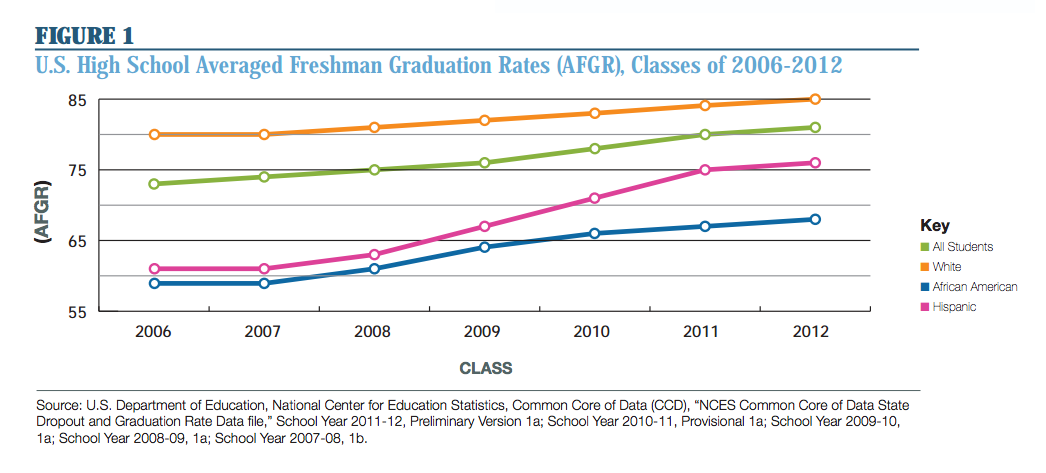
Stephanie Simon reports that the high-school graduation rate in the US has topped 80 percent for the first time in history, and that “if states can keep up their rapid pace of improvement, the rate could hit 90 percent by 2020”:

The improvement has been driven by steep gains among African-American and Hispanic students and by progress in shutting down hundreds of troubled urban schools dubbed “dropout factories.” And it’s not confined to one region of the country. Rural states such as Iowa, Vermont and Nebraska are among the best at keeping kids in school until graduation – but other top performers include Texas, Tennessee and Missouri, all of which serve large numbers of low-income students in densely populated cities. The practical result: Over the past decade, 1.7 million more students received diplomas than would have been expected if graduation rates had remained flat.

However, as the above chart makes clear, not all the news is good:

[W]hile low-income and minority students have made a lot of progress, wide gaps in achievement persist. Graduation rates increased 15 percentage points for Hispanic students and 9 points for African-American students from 2006 to 2012. But only 76 percent of Hispanic students and 68 percent of African-American students graduated in 2012, compared with 81 percent of white students, the report said. …

[In addition,] disparities are still great between special education students in different states. Students with disabilities make up about 15 percent of students nationally and have a graduation rate 20 percentage points lower than the overall rate. In Montana, 81 percent of high school students with disabilities graduated, while in Nevada, only 24 percent did.

Chris Kardish has more on the variations at the state level:

Overall graduation rates in states range from 59 percent in Nevada to 93 percent in Vermont. A number of states are graduating even low-income students above the 80-percent mark, including Texas, Nebraska, Iowa, Tennessee and Indiana. For other states, the graduation rate even among students who aren’t living in poverty stands below 80 percent. Those include Georgia, Louisiana, New Mexico, Arizona, Nevada and Oregon. Tennessee in particular has been a leader in raising graduation rates. The state boosted graduation rate 17 percent from 2003 to 2010 and reached 87 percent in 2012.

(Graph from Building A Grad Nation: Progress and Challenge in Ending The High-School Dropout Epidemic)

The View From Your Obamacare: Job Freedom

The popular thread continues:

You wrote, “When you are a long-term HIV survivor, that kind of health security and independence is, well, priceless.” Take out “long-term HIV” and replace it with “person with diabetes” or “person with a seizure disorder” or “person with a heart condition” and all of us feel that same security and independence and relief that you describe. I’ve had well-controlled diabetes for almost 30 years, which includes President Obama Visits Boston To Talk About Health Caremy entire working life. And for my entire life, I’ve known that I had to get and keep a job that offered a group insurance plan (or be married to someone who had that) in order to take care of myself and be financially stable (i.e., in the middle-class).

So that’s what I’ve done; I worked when my ex-husband was in graduate school (his school coverage didn’t cover pre-existing conditions); I put off having children until he had a job with group insurance; I worked at in the most toxic law firm environment I can imagine for 6 1/2 years because I was divorced and had to provide my own coverage; I finally left when I was hired by the federal government (admittedly, a lot of benefits came with that move, not just good health coverage).

But in the last few months, another sense of freedom has crept up on me and I realize that NEVER AGAIN will I feel trapped by my job as I have for my entire working life.

If I decide to leave the law, I can. If I want to piece together several part-time jobs that that allow me to use my other skills and would provide me with the minimum income, I can do it. It’s all up to me. I have no more excuses. It almost feels like personal responsibility and freedom and adult behavior all wrapped up together. But that doesn’t make sense, because then the Republicans would be all for it, right? I am so thrilled that Obamacare exists and I use the name proudly whenever I can. Another meep-meep for the ages!

Another also quotes me:

[The ACA’s] assurance of a stable insurance market that does not screen out someone with a pre-existing condition made me far more comfortable starting my own business. It gave me a baseline of security that simply didn’t exist before. It helped make entrepreneurialism possible.

Amen. I live in Silicon Valley.

As dynamic as this place is, I can’t tell you how many former colleagues have stayed in jobs just for the benefits. I really don’t understand why employers don’t want to get out of the healthcare business. It’s not a core competency and it’s nothing but a headache. This American Life had a story about how medical benefits became a way to lure workers during the WWI’s government-mandated frozen wages.

I’m currently in a struggling startup with no benefits. I have them through a partner, so I’m one of the lucky ones. I wonder how much innovation is being locked up by employer-based healthcare.

Another has part-time job freedom:

I am a 27-year-old freelance photographer and writer who works in the skateboard industry. I’m also a semi-professional downhill skater. It’s pretty much my dream job, and I wouldn’t have been able to chase it down without Obamacare. The ability to stay on my parents’ insurance until I was 26 gave me the freedom to move across the country and participate in a risky physical activity without fear of financial ruin. Later, when I aged out of my parents’ insurance, the lower premiums made it possible to afford insurance, without which I could not skate. (Thankfully, my sponsors pay for it.)

If the ACA hadn’t passed, I would be working a boring, stable office job instead of traveling the world pursuing my creative passion. Obama disappointed me on civil liberties and accountability for torture, but the Affordable Care Act has made a real and important difference in my life.

And this reader has freedom from jobs altogether:

I got health insurance through Covered CA. I’m 64 and Obamacare allowed me to retire a year earlier. Before Obamacare I would have been uninsurable and have to keep working to get employer-based coverage. I worked as an RN for 38 years and was wearing out fast. It’s the best thing that could have happened.

(Photo by Yoon S. Byun/The Boston Globe via Getty Images)

Dirty Dreams And Reproductive Schemes

WLA_moma_Henri_Rousseau_The_Dream

Neurologist Patrick McNamara believes our nighttime reveries are “directly related to long-term sexual strategies”:

If dreaming somehow reflects our sexual wish-fulfillment, then dream recall, dream content and dream sharing should be relatively lower in those who are satisfied with their current attachment orientation (secure, dismissive, and avoidant) and relatively higher among those who want to change their status (the preoccupied/anxious group). To test this idea, my team at Boston University recruited hundreds of volunteers until we had enough in each attachment category. We asked them about their dreams, and coders who were blind to the purpose of the study painstakingly analyzed them.

When we collated the results, we were startled by what we found.

The anxious, preoccupied group was far more likely to recall dreams than the securely attached; they took less time to enter REM sleep and had many more dreams featuring aggression against competitors. But both the anxious and the securely attached recalled more dreams than avoidant participants. That is precisely the pattern one would predict if dream sleep were directly related to long-term sexual strategies. The anxious individual is passionately interested in getting into a relationship with a romantic target, and thus recalls more especially vivid and emotional dreams filled with content concerning intimacy. The avoidant individual, conversely, suppresses the subconscious call for sexual closeness as reflected in dreams.

(Henri Rousseau’s The Dream, 1910, via Wiki Commons)

Is The Death Penalty On Its Way Out?

Death Penalty

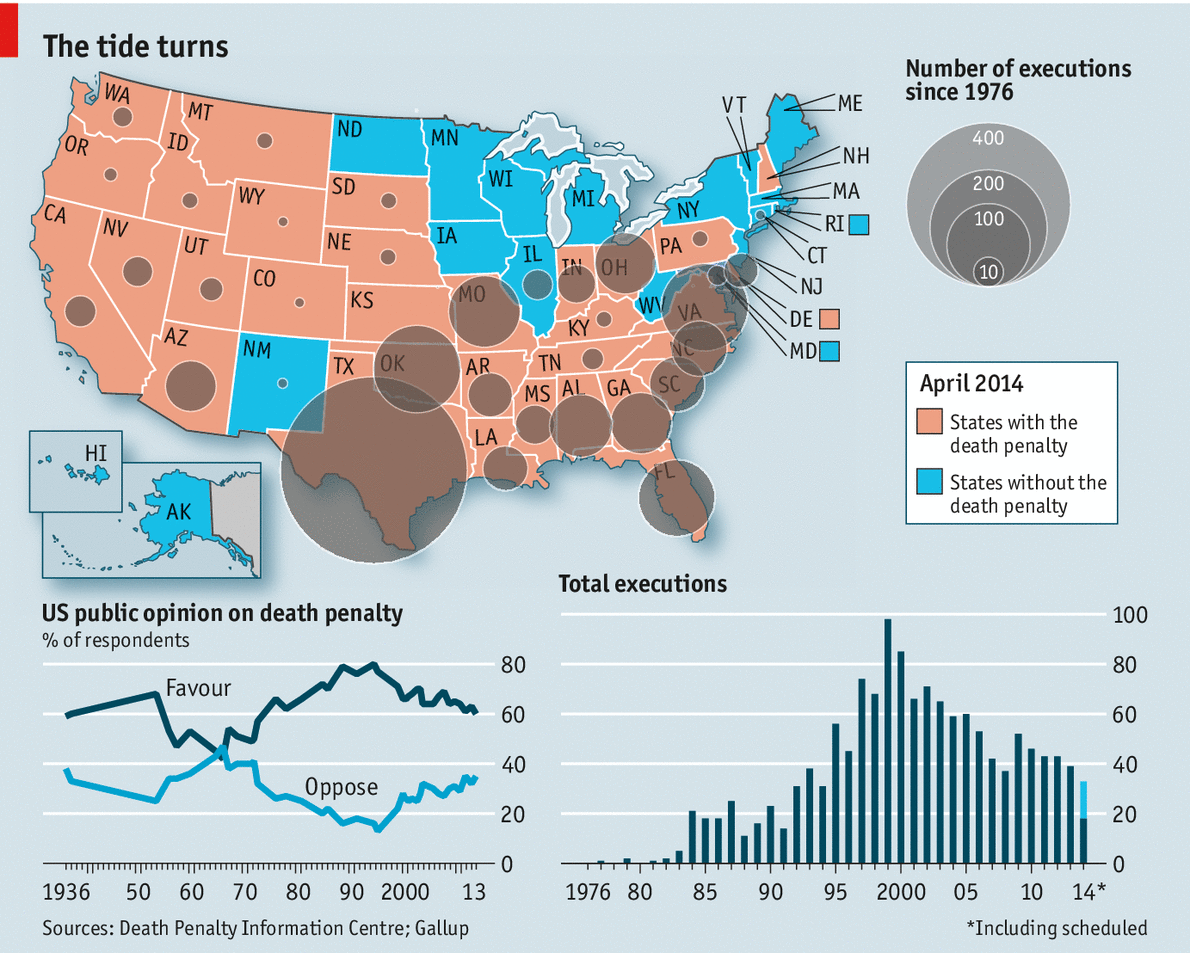
Here’s hoping. The Economist examines US capital punishment trends:

Even if all the executions scheduled for this year are carried out—which is unlikely—a total of 33 would be the lowest since 1994, and would have fallen by two-thirds from the peak of 98 in 1999 (see chart). In 2013 American juries handed out just 80 death sentences: a slight increase from the previous year, but still close to the lowest level in 40 years. As of October 1st 2013, 3,088 Americans were on death row—down from a peak in 2000 of 3,593.

Update from a reader:

The Economist‘s chart fails to note that many of the states listed as still having the death penalty have actually instituted moratoria. Those states include: California, Colorado, North Carolina, Arkansas, Oregon, Kentucky and Washington.

An accompanying piece from the magazine has more on the subject:

America is unusual among rich countries in that it still executes people. It does so because its politicians are highly responsive to voters, who mostly favour the death penalty. However, that majority is shrinking, from 80% in 1994 to 60% last year. Young Americans are less likely to support it than their elders. Non-whites, who will one day be a majority, are solidly opposed. Six states have abolished it since 2007, bringing the total to 18 out of 50. The number of executions each year has fallen from a peak of 98 in 1999 to 39 last year …

Its advocates insist that it deters murderers, thereby saving lives. If this were true, it would be a powerful argument, but there is scant evidence that it is. The murder rate is far higher in America than in the European Union, which has no death penalty. It is also higher in American states that carry out executions than in states that do not. Granted, some studies have found that, if you control for other factors that also influence crime rates, you can make the case that each execution prevents three murders, or five, or even 18. But such studies are based on thin data and questionable assumptions. There were nearly 15,000 murders in America in 2012. The chance of any individual killer being executed is thus microscopic—and distant, since the appeals process can grind on for decades.

One In 25

That’s how many prisoners on death row are likely innocent, according to a new study. Dara Lind explains:

At least 4 percent of people who receive death sentences in the United States are likely innocent, a new study finds. The paper, in the Proceedings of the National Academy of Sciences, borrows a technique from biomedical research to estimate the number of prisoners sentenced to death who are falsely convicted. The study, by Samuel R. Gross of the University of Michigan and Barbara O’Brien of Michigan State University, finds that at least 4 percent of people who get sentenced to death when they’re convicted would ultimately be exonerated if their cases were closely examined for the next 21 years.

That doesn’t just include current death row inmates: many people who initially get death sentences end up getting their sentences reduced to life in prison. And no prisoner serving a life sentence gets the same level of scrutiny as someone on death row. For this reason, the authors conclude that the rate of false convictions in life-imprisonment cases is probably much higher.

Virginia Hughes elaborates on the study:

Gross and his colleagues collected data on the 7,482 people who were sentenced to death between 1973 – the first year of modern death-penalty laws – and 2004. Of these, 117 were exonerated, or 1.6 percent. But among these, 107 were exonerated while they were still on death row, whereas only 10 were exonerated after their sentence had been reduced to life in prison. This leads to a bizarre situation. If you’re on death row and your sentence is reduced to life in prison, you’re suddenly much less likely to be exonerated than someone who stays on death row.

Steven Hsieh shakes his head:

The study refutes much lower false conviction rates cited by judges and lawyers in the past. Perhaps most notably, Supreme Court Justice Antonin Scalia suggested in 2007 that the wrongful conviction rate is “.027 percent—or, to put it another way, a success rate of 99.973 percent.”

“This would be comforting, if true. In fact, the claim is silly,” Gross writes. “Scalia’s ratio is derived by taking the number of known exonerations at the time, which were limited almost entirely to a small subset of murder and rape cases, using it as a measure of all false convictions (known and unknown), and dividing it by the number of all felony convictions for all crimes, from drug possession and burglary to car theft and income tax evasion.”

SCOTUS Allows The EPA To Do Its Job

Serwer highlights some good news for environmentalists coming out of the court yesterday:

Environmentalists scored a big win at the Supreme Court Tuesday when the high court upheld an Environmental Protection Agency rule meant to reduce interstate air pollution. Chief Justice John Roberts and Justice Anthony Kennedy sided with the high court’s Democratic appointees. …

States are obligated to meet certain emissions standards under the Clean Air Act, but sometimes pollution from neighboring states affects their ability to meet those standards. Those upwind states are supposed to adopt practices that prevent their pollution from affecting downwind states. That pollution can be nothing short of lethal, a brief filed in the case from the American Thoracic Society noted that “Air pollution measurably and substantially shortens lives.”

Rebecca Leber explains why this matters:

Simply put, the Supreme Court has effectively helped save lives.

The EPA estimated that the rule in question would prevent up to 34,000 premature deaths, 15,000 non-fatal heart attacks, 420,000 respiratory symptom cases, and 400,000 aggravated asthma cases each year, mostly in the states that bear the brunt of the cross-state pollution. With this rule and other EPA air quality regulations still on hold, national air quality has actually grown worse. According to the American Lung Association’s State of the Air report, almost 150 million people breathe unhealthy air in 2014, an increase of 16 million since 2013.

Chait looks to the battles ahead:

The Clean Air Act simply requires the cleanest feasible technology, which would require shuttering all coal-burning plants, imposing huge costs. The EPA wants to tailor its standards to curtail emissions without a blunt-force ban on coal.

Whatever plan emerges will venture onto newer legal ground. Conservatives have adopted the paradoxical strategy of denying the EPA any flexibility to craft regulations, the theory being that forcing it to issue only massively expensive (and therefore politically toxic) regulations will result in them being overridden. Conservative suits to bring about such a result are already heading toward the Supreme Court.

Yesterday’s ruling, which concerns different sections of the Clean Air Act, provides some clues to the Court’s disposition. And for those of us uncomfortable with unleashing runaway temperatures upon future generations, those clues seem encouraging.

Cutting The Tornado Body Count

Tornado Deaths

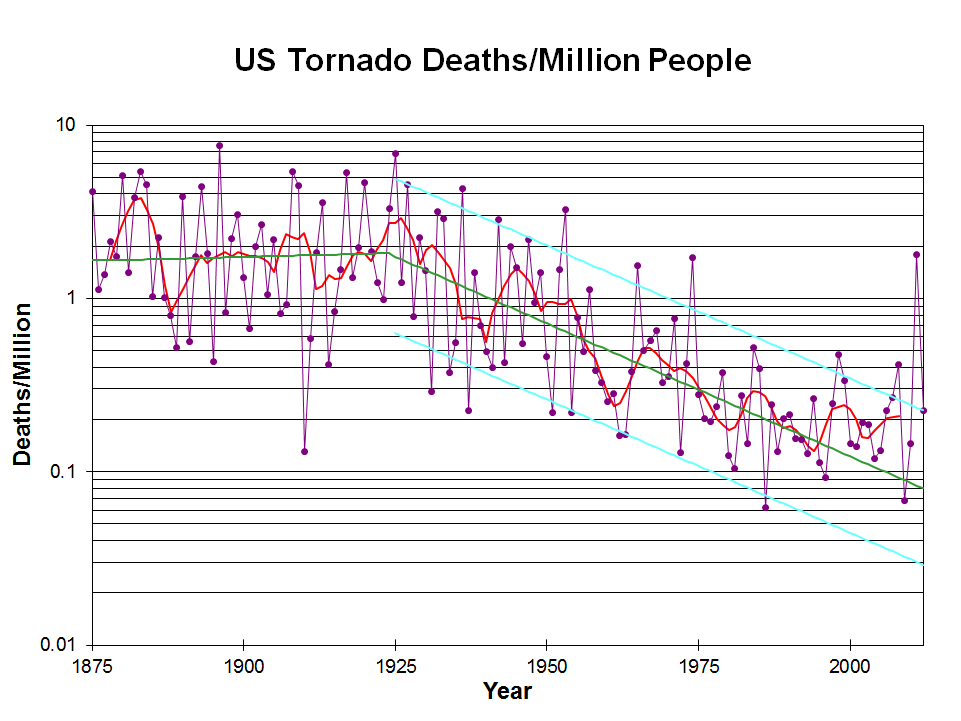
After the recent spate of tornados, Plumer takes a close look at when twisters kill:

The chart above comes from Harold Brooks of the National Oceanic and Atmospheric Administration (NOAA). Even though more and more Americans are living in areas where twisters roam, the number of tornado deaths per capita has declined in the last century.

One reason? Better early warning systems. Back in the 1980s, forecasters could only give about five minutes warning before a tornado hit, on average. Today, that’s up to around 14 minutes, thanks to new radar systems and better forecasting. That gives people more time to seek shelter.

But improving warning times to a full hour might not lower fatalities:

[I]f people do seek shelter for an hour and the warning turns out to be false, that may make them far more skeptical of future warnings. [Economist Kevin] Simmons’ research has found that areas with more false tornado alarms have higher levels of fatalities when twisters do hit — presumably because people ignore the warnings.

Chris Mooney wonders whether climate change will mean more or bigger tornados:

[I]t would be very premature to say that scientists know precisely what will happen to tornadoes as global warming progresses. However, they have come up with some interesting new results, which point to potentially alarming changes. More generally, the upshot of this research is that tornadoes must change as a result of climate change, because the environments in which they form are changing.

And Allison Kopicki finds that people don’t plan well for tornadoes:

Despite past encounters with extreme weather and expectations for more, nearly 6 in 10 of those in the South and more than 7 in 10 in the Midwest said they had not created a disaster plan that all of their family members knew. More Southerners (44 percent) than Midwesterners (27 percent) said they had created an emergency supply kit.