Scientists at the Goddard Space Flight Center in Maryland and Yale University in Connecticut used satellite imagery to track light patterns in 1,200 cities over two and a half years. They found that increased light correlated perfectly with the holiday seasons for Ramadan in the Middle East, as well as Christmas and New Year’s Eve worldwide. They also saw variations in how cities and neighborhoods within those cities celebrate these holidays, the team announced this week at the American Geophysical Union’s annual meeting in San Francisco.
“What’s happening during the holidays is our patterns are changing,” says Miguel Román, a physical scientist at NASA Goddard. In the West, we’re staying up late drinking eggnog and going home from work early. “Those changes in behavior are changes in the locations of demand for energy services.” Understanding such seasonal shifts might ultimately tell us what’s driving carbon emissions at a local level.
Chris Mooney elaborates on the findings about Ramadan:
[The researchers] examined three years, from 2012 through 2014, and saw a marked lighting increase in Cairo:
This time, of course, the lighting isn’t Christmas lights. Rather, it’s people changing their schedules due to the religious holiday. “It’s a change in the timing of human activity, because people are fasting from dawn to dust,” says Yale’s Eleanor Stokes. “So activity, commerce, heating, family gatherings are all being pushed later into the night.”
The Cairo picture shows something else interesting as well, notes Stokes — economic differences. The researchers found that in poorer areas, people were still celebrating Ramadan but were not using more energy at night, presumably instead choosing to conserve and save money.
Matt Novak looks into how humans would feed themselves following an apocalyptic disaster:
In the event of a super-volcano, asteroid impact or nuclear winter, the sun would be completely blocked out and it could be up to five years of darkness before we might start up agricultural systems again. A five-year supply of food would take up an enormous amount of space and cost about $12,000 for a family of four, according to the researchers. So what will be our options? “We came up with two primary classes of solutions,” [Feeding Everyone No Matter What co-author Joshua] Pearce said in a release. “We can convert existing fossil fuels to food by growing bacteria on top of it—then either eat the bacterial slime or feed it to rats and bugs and then eat them.” Rats and bugs can also consume wood products, which would likely be plentiful in a disaster scenario. The researchers also included ideas about creating tea out of pine needles, which they insist would “provide a surprising amount of nutrition.”
Pearce and co-author David Denkenberger admit to having tried out these post-apocalyptic provisions:
A lot of it was just to make sure that the taste wasn’t so bad that it would never happen. Stuff like pine needle tea is really not that bad. Many insects are, I would even go so far as to say, tasty? If you get by the initial sort of gag reflex. Let’s say we grow mushrooms on logs and everybody’s eating mushrooms. Of course, that’s not too scary. And then the waste product from that goes to feed ruminants like cows, and then [you’ve got] beef so you know, you can still have hamburger. It’s not that bad. We might be eating more of the cow than we do now, but it’s not that bad.
Matthew Dennison argues that painting snowy scenes poses a particularly vexing challenge even for great artists, suggesting that a “sense of something lacking characterises much ‘snowy’ art”:
It’s as if the technical challenges of recording the fluffy white stuff convincingly are so debilitating, there’s no room left for inspiration.
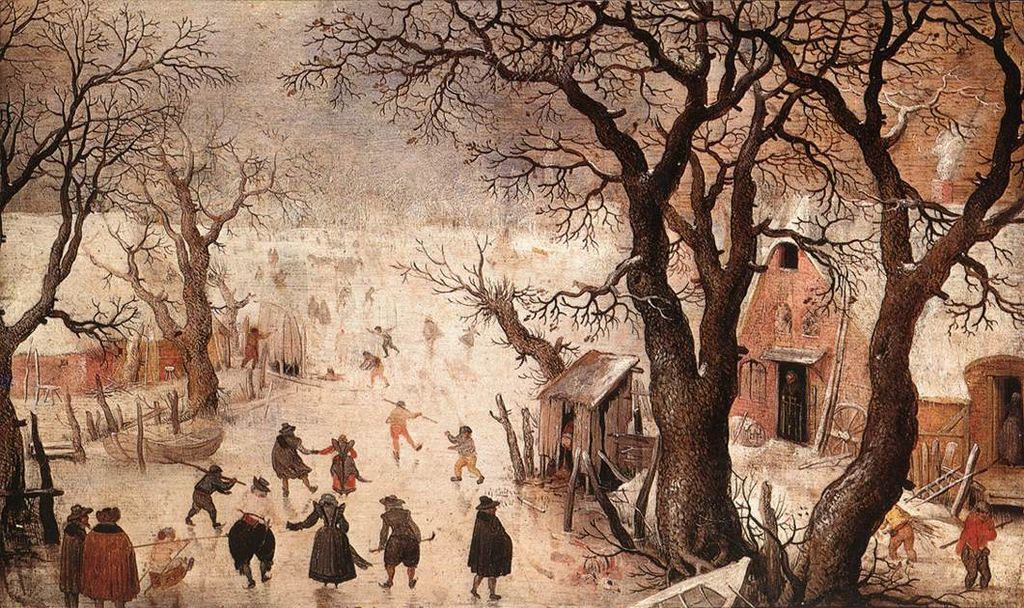
For Dutch artist Hendrick Avercamp, who painted landscapes teeming with ice-skaters early in the 17th century, unusual climatic conditions liberate a holiday spirit among his stolid burghers. Avercamp’s snow is theatrical backdrop, much as in the ballet Les Patineurs, and every bit as tinselly. Invigorated by the freeze, his skaters do not reflect on the irony that what temporarily quickens their pulses is itself a deadening force: trees stand black-branched, birds wheel in search of non-existent food. Later in the century, Dutch landscapists explored the stillness snow imposes, sometimes by moonlight. Such scenes invite reflection, as if the association of snow and Christmas were firmly established 400 years ago, the snow a metaphor for the physical hardships of the Nativity. Alternatively these images may simply be exercises in tonality, like the later wintry cityscapes of Childe Hassam.
Monet painted more than 100 snow paintings, including ‘The Magpie’ of 1868–9, Argenteuil views and, inevitably, soggy haystacks. Several surprise on account of the breadth of the artist’s palette. Snow proved an ideal foil for ‘impressions’ of light, sunshine that is pink, blue-grey, palest buff or white. Yet, while many successfully capture aspects of the reality of the snowy experience, it is the artist’s prowess, rather than a deeper profundity, that impresses the viewer.
(Image: Hendrick Avercamp’s “Winter Scene on a Canal,” early 17th century, via Wikimedia Commons)
This summer, we notedresearch that found a significant percentage of subjects preferred to suffer an electric shock rather than be alone with their thoughts. Alva Noë revisits the results, asserting that “there is good reason to doubt some of the findings of the study”:
Take, for example, the most widely discussed result: that some significant percentage of subjects administered a minor non-painful shock to themselves — like familiar household static electricity — when they might otherwise have spent six to 15 minutes quietly in the presence of their own thoughts alone. Notice, to begin with, that the subjects were wearing a self-shocking apparatus. Under those conditions, it strikes me that exploring the effects of shocking oneself, testing and reflecting on one’s responses, simply indulging in curiosity about it, should be counted as a form of engagement with one’s thoughts rather than a flight from them.
He zooms out to consider thinking’s complicated relationship with pleasure:
We tend to think of thinking as cerebral and inward looking and we contrast that with a kind of selfless outward orientation to what is going on around us. But this is confused. Is the mathematician working out a problem on paper looking out or in? And what about the visitor to a gallery concentrating on a painting. Isn’t this kind of looking (at the painting) or doing (writing on the paper) one of the forms that thinking can take for us?
And something similarly goes for the idea that we can simply range complex human psychological attitudes and choices along a spectrum from aversive to extremely pleasurable. As Fox et al. explain, “just thinking” can be valuable, meaningful and important in ways that are tied to, but not the same as, being simply pleasurable. The same is true, perhaps, of any form of what we call exercise. It can be hard to make yourself do your work out. But that doesn’t mean that it isn’t highly pleasurable. And even when it is, in some sense, aversive, that doesn’t mean that you don’t value it highly.
Will Wilkinson recently shared why, as an atheist, he plans to teach his son to believe in Santa. Rob Stennett, a man of faith, also weighs the pros and cons. He argues that believing in Santa is good for kids, but notes that “many of my Christian friends don’t look at it this way”:
They think teaching about Santa can damage your child when it comes to believing in God. It’s not a stretch to see why. We teach our kids to believe there is a bearded man in the sky who knows you by name and cares about how you act. I think that’s why it’s so important to be careful about how I talk to my kids about Santa Claus. But I’m just never sure what to say. This year, I’ve decided to say nothing at all.
This morning, my daughter asked, “Dad, how does Santa get in our house when we don’t have a chimney?”
I was searching for the words when I decided I didn’t need to answer. I asked, “How do you think he comes in?” She gave me an elaborate answer, and I said, “That’s a very good theory.” It was a good theory. I didn’t lie to her — I just gave her room to discover the answers on her own.
Meanwhile, Michael Brendan Dougherty calls himself “unpersuaded by the more principled anti-Claus chorus.” He suggests that “there is something too flatly literalistic, even Puritanical, about their arguments”:
Radical Protestants of an older stripe thought holy days like Christmas were offensive because God is with us every day, and because they hated the “mass” in Christ’s Mass. How this translated in practice was that around the time other people began making merry, the dour low churchman marked the time with especially strenuous sermons against holy days.
Similarly, just as parents are conjuring a model of abundant generosity and joy, today’s killjoys make it a season of rote sermonizing against materialism. This misses the point entirely. A materialist looks under the tree and sees the year’s economic surplus, badly invested. It takes a spiritual person to see it as the work of St. Nick, as a recurrence of the Magi, or an imitation of the great generosity of the God-child born to us. Only the devil wants your Christmas to be just like all the other days. Save the mortifications for Lent. …
Heather Havrilesky offers advice to a stressed-out millennial revisiting a contentious relationship with her mother. She recommends serious self-care and being “prepared to serve the common good”:
Now, why should you be prepared to serve the common good? Because this is the realistic, adaptive, self-protective behavior of a mature adult. Instead of focusing on your own drama, you should focus on helping others. Because, look, part of you still believes that you might be able to right the wrongs of the past. The Jekyll-and-Hyde mother is tricky for this reason; her good days fool you into believing that you might be able to shake her out of her irrational attacking state. Listen to me: Your mother will never change. Going home for the holidays is not about “fixing” her or the past. It’s about tolerating the freaks you grew up with, making them dinner, giving them your unconditional love, and keeping your mouth shut. Realizing this might seem to serve them, but trust me, it serves you the most, by keeping you safer from heartbreak.
So help with the homework. Go out and buy some groceries. Do the dishes. Pour the wine. Listen. Laugh. Do the dishes again. Listen some more. Don’t expect to be in the best mood as you do these things. Do them anyway.
Meanwhile, Berit Brogaard explains what makes Christmas a hard time for divorced parents:
When sane parents separate, many judges, thankfully, divide custody equally. Each parent gets his or her fair share of custody, if at all possible. Even when it’s not possible to share the time with the children equally, judges will usually attempt to divide up the holidays evenly. The kids spend every other holiday with mom and every other holiday with dad. It certainly is in the children’s best interest to get to spend some time with each parent. Most kids, with decent moms and dads, would prefer to spend every holiday with both parents. The precious little ones secretly hope for the impossible: That their divorced or separated parents will get back together. But despite their wishes, they adjust to the situation. They have no other choice.
Nor do the parents. As we face the holidays many single parents face a very lonely time. They may be with dear family members: parents, brothers, sisters, nieces, nephews, aunts and uncles. Yet they may nonetheless feel a profound pain in their hearts, even as they watch close relatives savor the pecan pie or scream in delight when they rip open their Christmas presents. Their own children are far away.
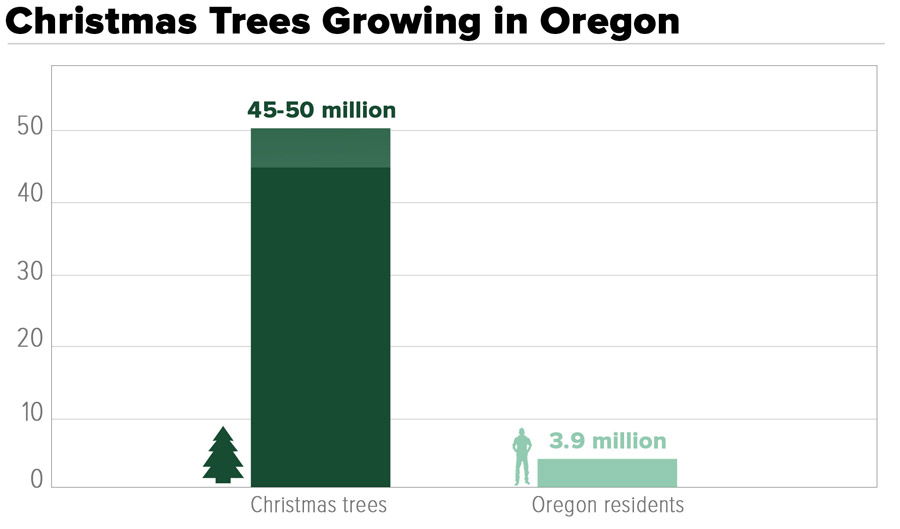
Oregon is the biggest producer in the country, and arguably the world. In this green and gray state, there are 45 to 50 million Christmas trees in the ground at any given time, which means Christmas trees outnumber humans 12 to 1.
It’s not just that Oregon has a the right climate to grow the trees (though it does) or that a state historically reliant on logging would continue to produce trees as products. Oregon is where the modern Christmas tree industry in America was born, thanks to a Nebraskan-born farmer named Hal Schudel.
In 1955, Hal had an enormous idea: Perhaps Christmas trees, like corn, wheat or soybeans, could be a crop. They could be bred selectively, attended to and fertilized, sheared each year into the perfect cone. A tree’s nooks and crannies that perfectly showcase your ornament collection didn’t happen by accident. They were designed. Like every agricultural product, Christmas trees are now selectively bred and groomed for what the consumer wants: the perfect color; needle retention to minimize vacuuming; dense, bushy branches that can hold the heaviest ornament; and perhaps most importantly, the scent that wafts gently through a home and announces the presence of Christmas.
Hal’s insight became Holiday Tree Farms, which started as 300 acres and now reaches 8,500 acres, is one of the two largest Christmas tree operations in the world, trading off with McKenzie Farms, also in Oregon. Holiday Tree Farms is still held by Hal’s family, and this year will ship over one million Christmas trees. Today, 98% of Christmas trees come from farms like the one first envisioned by Hal.
Dish readers have been sharing their memories of discovering that Santa isn’t real. Then there’s this famous dark tale:
A reader shares a real-life tragedy:
I remember clearly when I lost faith in Santa. My sister, at just over a year old, was diagnosed with a catastrophic illness. The presents before her birth had been many, more than the large litter of children to which I was born could aspire – new bicycles and erector sets, BB guns and Pong. The year after her diagnosis there were only a scant few gifts – three Hardy Boys books and a little robot FM radio. Why would Santa abandon my family when it needed a little joy the most? Logic answered that question. My parents had been in the hospital with her, not able to work, so time and money to shop were scarce.
There were no complaints from my siblings or me. We just wanted our family’s only little girl to be well. But it was not long after that Jesus went the way of Santa. I figured if there weren’t a jolly old man at the North Pole who brought requested gifts, there surely wasn’t a Jesus in heaven answering prayers. He certainly hadn’t answered ours.
Another reader:
As a child, my family did the whole Santa thing. But later in my youth my father told me that when he was a child, his father had adamantly refused to promote the Santa story. My grandfather’s reasoning was that if his children found out that Santa was a myth, then they might extrapolate that Jesus was also a myth. Uh. Hmm. Yup.
Another:
I stopped believing in Santa Claus the way that every good atheist should:
I looked up Santa in the encyclopedia when I was six.
Another fact-based reader:
I had a resurgence of faith at 6 when the local news reported NORAD’s tracking of Santa. Because the news! And radar! It had to be true.
A parent is befuddled:
I find myself wondering if my almost 12 year old still believes or is faking it. He has never asked about Santa‘s authenticity and still talks about him as if he is real. He even wants one of those damn Elf on the Shelf things. Maybe just to see what I would do with it every day? It is quite disconcerting. I hope he knows Santa isn’t real but I don’t want to be the one to break the news if he does not.
Strangest of all, he is so into science he is quite agnostic when it comes to God, often saying, “IF there is a God…”. I don’t know what to make of it.
A few more readers flip the script:
Having been raised in a Jehovah’s Witness household, we never believed in Santa. In fact, my younger brother got into trouble in very early grade school for for letting the cat out of that particular bag with classmates. Bah humbug!
BTW, I’m playing Santa in full regalia at our company’s holiday party tomorrow night.
The other:
I was actually raised an a-Santa-ist: Jesus was the reason for the season in my house. Thus, there wasn’t a moment when I lost that particular faith – rather, I was the kid who had to have a parent-teacher conference because I told all the other kindergartners that there was no Santa. I’m congenitally incapable of keeping my mouth shut while falsehoods are uttered in my presence, and tact is not my forte, but let’s be honest: it’s the OTHER parents who should have been called in. I got chastised for telling the truth, and they were indignant at a five-year-old who called the lies they told their children.
Back to an atheist:
I was six, and my brother was eight. We were sleeping in my mother’s old bedroom at my grandparents house. I remember rolling over in my bed and whispering to my brother, “How long do you think until Santa gets here?” My brother, who was probably tired just said, “Don’t be silly, there’s no such thing as Santa,” and he rolled over in his bed and went right to sleep.
It was quite a shock for all of about 15 seconds, and then I thought about it for a bit and realized, of course there was no such thing as Santa. It was a preposterous idea. And so I went to sleep myself and never gave it much of a second thought.
But I’ve often wondered if I would have been more upset if I were brought up with the idea of faith somewhere else? We were brought up amongst athiests and agnostics. There was no expectation that we believe in God or Jesus or the Flying Spagetti Monster, so the idea of not believing in a magic elf/man who traversed the globe giving out random presents wasn’t really a tough idea to swallow. I already didn’t believe in a supreme being. And it’s not like I wouldn’t get presents; I knew they were down there. I’m shocked when I find out someone was scared from the reveal. Of course it was fiction! How could anyone think otherwise?
Now that I am the mother of five year olds, we keep the fiction alive for them, but they have begun to question. I won’t lie to them about it. I figure I have another year and if they ask me directly, I will tell them what my brother told me, there is no such thing as Santa, but it is a fun story.
I am a mainline Protestant preacher, married with a 7-year-old son and a 5-year-old daughter. We debated about teaching the kids the Santa myth, but in the end decided that since it is such a part of popular culture, we would go along for as long as they wanted. It is all just fun, right?
Their mother, though, decided that she would never directly lie to them about Santa – or anything for that matter. So while she does fill stockings and has distinct wrapping paper for some presents that do not come from anyone else, she won’t say “This is from Santa.” When the kids ask questions about it, she says “What do you think?”
As we were decorating the tree this year, the boy announced in a soft voice “I don’t think Santa is r-e-a-l.” His mother and I both looked at each other in panic and pride. We didn’t think we would reach this point yet, but we are pleased at his reasoning skills, and his apparent understanding of the power of myth. We both praised him for spelling out the key word, and in doing so showing consideration for his sister (though another month of public school Kindergarten and she will be able to decode that word.) His mother asked “what do you think?” Then we handed him another ornament to put on the tree and left it alone.
A few days later I took the kids to a public showing of “Arthur Christmas,” in which Santa is a family title that is passed on through generations. On the way home the girl started asking questions. She was concerned, because, she reasoned, “if Santa can grow old, then maybe Santa can die!” I tried her mother’s solution: “What do you think?” Her bother quickly responded “Santa IS dead!” That landed with a thud.
I started to think of how I could save this without lying. I got ready for the tears. Then my son continued: “He is dead in that he isn’t like you or me. I think he died a long time ago, but now he can live forever and do things that normal people can’t do. That’s how he can be in so many places at once, and get presents all around the world in one night!”
I am glad that my boy has worked things out in a way that allows him to believe. I am delighted that he cares enough for his sister to speak the truth as he knows it to her in a compassionate way. I am glad that he is obviously hearing, comprehending, and applying the concept of the incarnation and resurrection. I am also very concerned about his conflation of Santa and Jesus.
So yes, in some way the myth of Santa may allow for children to later comprehend the mythic nature of Christian truth. And my kids will sort it out in time. But I don’t think that finding out that Santa isn’t R-E-A-L will keep him from discovering that Jesus IS. In fact, I think that he is learning the difference by singing Christmas carols to shut-ins, serving meals to the hungry, and working to keep up the homeless shelter we support. That isn’t Santa at work in his heart. Yes, I am a preacher, whose kids still believe, in their own way, in Santa Claus. But I am confident that they will be able to understand, eventually, that at Christmas Santa=presents and Emmanuel=presence.
As always, many thanks to you and your staff for the lively and wide-ranging discussions. I often bring you all into the pulpit with me!
The surrealist designed the Nativity scene above for Hallmark in 1959. Colin Marshall has more:
[Professor Rebecca] Bender cites Patrick Regan’s book Hallmark: A Century of Caring as describing Dalí’s “take on Christmas [being] a bit too avant garde for the average greeting card buyer.” But tastes, even mainstream tastes, seem to have broadened quite a bit over the past 55 years. The time may have come where every man, woman, and child in America could do with a little surrealism stirred into their Christmas spirit. If you agree, make sure to read and see everything else Bender has gathered from Dalí’s Christmas-card career, all of which will inspire you to make the Yuletide more aesthetically daring.
Bender points to a 1981 article about “The Dali Christmas Story” which reveals behind-the-scenes insight into Dali’s partnership with Hallmark:
[Hallmark head] Donald Hall felt that only two [of Dali’s ten designs] would have public appeal and put them into production. Feverish printing work brought them to the racks nationwide for Christmas of 1960. Both of these were surrealist renditions of the Christ Child; one with the Madonna, the other with the Holy Family. All figures were featureless and formless. All had symbols of divinity as halos, stars and crowns.
But they didn’t sell, caused a public outcry, became controversial and were pulled from the racks. Several hundred were unrecovered and have become collectors’ items. Offering these powerful interpretations of a sacred religious theme was a courageous act of Donald Hall. In an art gallery, their acceptance was assured, but as greeting cards the public rejected them.
Martin Filler received an unpleasant surprise on a recent trip to Chartres Cathedral:
Carried away by the splendors of the moment, I did not initially realize that something was very wrong. I had noticed the floor-to-ceiling scrim-covered scaffolding near the crossing of the nave and transepts, but had assumed it was routine maintenance. But my more attentive wife, the architectural historian Rosemarie Haag Bletter—who as a Columbia doctoral candidate took courses on Romanesque sculpture with the legendary Meyer Schapiro and Gothic architecture with the great medievalist Robert Branner—immediately noticed that large areas of the sanctuary’s deep gray limestone surface had been painted.
The first portion she pointed out was a pale ochre wall patterned with thin, perpendicular white lines mimicking mortar between masonry blocks. Looking upward we then saw panels of blue faux marbre, high above them gilded column capitals and bosses (the ornamental knobs where vault ribs intersect), and, nearby, floor-to-ceiling piers covered in glossy yellow trompe l’oeil marbling, like some funeral parlor in Little Italy.
More on the ghastly decision:
In 2009, amid a rising wave of other refurbishments of medieval buildings, the French Ministry of Culture’s Monuments Historiques division embarked on a drastic, $18.5 million overhaul of the eight-hundred-year-old cathedral.
Though little is specifically known about the church’s original appearance—despite small traces of pigment at many points throughout the interior stonework—the project’s leaders, apparently with the full support of the French state, have set out to do no less than repaint the entire interior in bright whites and garish colors that are intended to return the sanctuary to its medieval state. This sweeping program to “reclaim” Chartres from its allegedly anachronistic gloom is supposed to be completed in 2017.
The belief that a heavy-duty reworking can allow us see the cathedral as its makers did is not only magical thinking but also a foolhardy concept that makes authentic artifacts look fake. To cite only one obvious solecism, the artificial lighting inside the present-day cathedral—which no one has suggested removing—already makes the interiors far brighter than they were during the Middle Ages, and thus we can be sure that the painted walls look nothing like they would have before the advent of electricity.
Back in 2009, the Independent published an upbeat report on the repainting, which had just begun. Excerpt:
Mr Fresson [the historian overseeing the renovation] expects some visitors to Chartres to be taken aback – maybe even angered – by the transformation. “There is no doubt that we will lose something, even if we gain a great deal,” he said. “The sense of mystery, the sense of the passing ages, which you receive when you enter the dark interior of today will be replaced by something fresher and much more dynamic.”
Yes, we cannot have a sense of mystery. Freshness and dynamism, that’s the ticket. Good Lord. You expect this in America, but in France?
I am grateful that I was able to see the cathedral as it was. My children will live their entire lives without that privilege.
(Photo of the interior of Chartres Cathedral by Daniel Stockman)



 The Dish
