Our Planet-Hunting Skills

They’ve improved:

Planets

Joseph Stromberg passes along the above GIF on the 736 planets we’ve identified so far this year:

That fact alone is remarkable. But it’s even more amazing when you consider that we didn’t find a single one of these exoplanets until 1989, and only found 1045 of them in total in the 23 years following that. … The Kepler space telescope — which orbits the sun, taking high-resolution images of distant stars so scientists can look for planets surrounding them — was responsible for these 715 planets [announced at once], along with 246 planets announced at other times, including the potentially Earth-like planet announced last week.

Unfortunately, the Kepler telescope was shut down in May 2013, because of an equipment failure. It’s not collecting any more data, so we probably can’t look forward to such ginormous hauls of new planets in the next few years.

Megan Garber has more:

A couple of years ago, I talked with Geoff Marcy, the astronomer whose work identifying habitable-zone exoplanets has earned him the nickname of “the planet hunter.” When he started searching for exoplanets in the 1990s, Marcy told me, that search had the air of the quixotic about it. The Times, at the time, noted that “a few skeptics still question whether these objects, called exoplanets, qualify as true planets.”

Marcy put it more bluntly: “Everybody,” he said, “said I was crazy.”

Update from a reader, who quotes Stromberg:

Unfortunately, the Kepler telescope was shut down in May 2013, because of an equipment failure. It’s not collecting any more data, so we probably can’t look forward to such ginormous hauls of new planets in the next few years.

This is incorrect on a few points. The telescope was not shut down; it continues to take data! The equipment failure ended its nominal mission because it could no longer reliably point at its appointed targets, but it is now looking at different stars, and will continue to do so if NASA decides to keep funding it (fingers crossed).

There actually may be similarly ginormous hauls of planets in the near future for another reason, as well: Of the more than 4,000 planet candidates Kepler has already discovered, some 3,700 remain to be validated in addition to the 736 that created tat big spike in your animated GIF. We’re still working on the rest!

Sanctions Redux

The US imposed new sanctions against Russia this morning, targeting seven cronies of Putin and 17 Russian firms:

Among those sanctioned were Igor Sechin, head of state energy firm Rosneft, and Deputy Prime Minister Dmitry Kozak. A Russian deputy foreign minister was quoted as expressing “disgust” at the White House announcement. The European Union, with more to lose than Washington from sanctions against Russia, a major energy supplier and trading partner for the EU, is also expected to announce new penalties after member governments reached a deal, diplomats said.

The United States will deny export licenses for any high-technology items that could contribute to Russian military capabilities and will revoke any existing export licenses that meet these conditions, the White House said. It was the third round of sanctions that the United States has imposed over Crime and troop build-up on the border. All the sanctions have been aimed at individuals and businesses.

Max Boot sums up the emerging criticism from the right, that only sanctions on Putin himself will have any effect:

If you want to know why Putin is able to get away with his brazen aggression, here it is in a nutshell: a fundamental failure of will on the part of the U.S. and its European allies. Obviously nobody favors nuclear or even conventional military retaliation–we are not going to war with Russia unless it crosses some future line. But surely Putin has already crossed enough lines to justify the most severe possible economic sanctions we can inflict–including doing everything possible to deny him and his cronies the use of their illicitly acquired fortunes. The fact that we are willing to impose limited sanctions on some Putin pals but not on the master of the Kremlin himself says volumes about how fecklessly we are acting in the face of continuing and escalating aggression.

Considering Putin’s grand strategy, Posner doubts there’s much we can do to stop him meddling in Ukraine:

Putin is not interested in conquering his neighbors, which would be difficult to rule. He just wants them to be in Russia’s orbit. … This strategy is a less ambitious version of the Soviet Union’s strategy, and also not much different from what the United States did during the cold war, in places like Cuba and Nicaragua. It’s perfectly logical, and also likely to succeed because a big country cares more about its neighbors than other countries do, and can exert influence over them more easily than other countries can.

The implications for the West are also clear. It needs to decide whether the benefits of attracting Russia’s neighbors into the Western orbit are worth the risks of disorder that result from Russia’s retaliation.

But if Putin isn’t trying to conquer Ukraine, Andrew Foxall and Ola Cichowlas point out, he’s doing a terrible job of showing it:

Over recent weeks, Ukraine’s security agency has detained over a dozen individuals suspected of collecting intelligence for Moscow. Some were Ukrainian nationals, while others are suspected of being Russian “war tourists.” At least one was a Russian “spy” (albeit one apparently unaware that posting a photograph of herself holding an automatic rifle to VKontakte, Russia’s equivalent of Facebook, is not a usual part of espionage). Kiev has begun to limit the access of such individuals to Ukraine; it has ended unrestricted travel for Russians to the country and begun to turn away Russian journalists at the border. The rather farcical way Ukraine has gone about this, however, illustrates just how hard it will be for Kiev to find a workable approach. …

Russian tanks may not yet have crossed the Ukrainian border, but the Kremlin has already begun to invade eastern Ukraine. Moscow has infiltrated the Donetsk region with weapons more effective than Kalashnikovs: a new generation of Russian “liberators.” These men — convinced that Russia is surrounded by enemies and that only they understand what is needed to save it — are working overtime to restore “stolen” lands to the Kremlin. And they will not stop at Ukraine.

Meanwhile, Jamie Dettmer provides a reality check, recapping what has transpired since a deal to end the violence was signed last week:

Since the signing of the accord pro-Russian separatists in Slovyansk led by the thuggish former Soviet soldier Vyacheslav Ponomaryov have kidnapped more than two dozen people – including the town’s mayor; American reporter Simon Ostrovsky, roughing him up and holding him captive for two days; two Maidan activists; and five members of an official military mission from the OSCE, along with five Ukrainian military personnel accompanying them. Ponomaryov claimed responsibility for a successful grenade attack Friday on a military helicopter, injuring the pilot, in a nearby town.

In Kramatorsk, the police chief was kidnapped and the deputy mayor is languishing in hospital reportedly after being beaten up by pro-Russian militants for refusing to go along with a takeover last weekend of the town’s municipal building. There have been other reports of abductions across eastern Ukraine.

The most egregious separatist violence came early last week when the tortured bodies of Volodymyr Rybak, a local pro-Kiev politician, turned up along with the corpse of an unknown man. Ukrainian authorities blame Ponomaryov and Russian military intelligence officers they name as Ihor Strielkov and Ihor Bezlier for the murders. Ukrainian SBU officials say the Russians decided to kill the politician after he tried to raise the national flag on the municipal building in the town of Horlivska and he was transported to Slovyansk, they claim, where he was tortured and  Ponomaryov was ordered to dump the body.

Recent Dish on Ukraine here, here, and here.

Donald Sterling’s Personal Foul

The seriously, surreally racist remarks allegedly made by Clippers owner Donald Sterling:

Josh Marshall weighs in:

Race and racism are complex. White families who were the linchpins of white supremacy in the Jim Crow South and in the days of slavery could still have deep and intimate relationships with African-Americans. And I’m not just talking about the well-known and often brutally exploitative sexual relationships. (After all, remember that Strom Thurmond had a mixed race daughter.) Obviously, in this day and age you can work with, have civil relationships with black people, even employ African-Americans and still be totally racist. But in this day and age it’s a little hard to figure how you can have such visceral racism (as opposed to just having a low opinion of black people) and manage to operate in the pretty black world of the NBA.

Jazz Shaw compares Sterling to last week’s racist, Cliven Bundy:

What do Bundy and Sterling have in common? First of all – aside from the obvious fact that they are white – they are old. And I don’t mean old like me… we’re talking really old. And second, each in their own way are old men who live in a form of isolation. Bundy lives in a geographically isolated, rural region. Sterling lives in the rather insular world of the very wealthy. They also come from a different generation, growing up among attitudes which were common beyond notice in their day but which would probably shock many people today. Without going into graphic detail, I’ll just say that I can relate to that, being raised by a member of that same generation in a rural, farming area.

Matt K. Lewis also considers the age factor:

Bundy is 67 and Sterling is 80. In a way, the age disparity makes sense; you could argue that an urban (and rich) 80 equates to a rural 67. So age does seem to be a common denominator — and if one accepts this theory, it is a bit of good news, inasmuch as it implies a lot of this stuff will be resolved through attrition.

Chotiner argues that the story “shines a light on an uncomfortable fact: society reacts much more forcefully to lone outbursts like Sterling’s than larger, institutional racial problems”

Sterling was accused of two of the most institutionally harmful forms of racism in our society: hiring/firing discrimination and housing discrimination. And yet’s it’s fair to say that the housing discrimination case, no matter how it had played out in court, would not have caused the stir that these comments did.

This is partially because there is audio of his recent remarks, and they are thus easier to react against. But it also shows how much more at ease people are responding to something so easy to grasp, and so unthreatening to the status quo. Institutional racism is just too daunting and widespread. A lot of people who don’t consider themselves racists nevertheless don’t particularly want to live in minority neighborhoods, or send their kids to overwhelmingly non-white schools. And they may hold certain stereotypes about minorities. Confronting all this is complex and fraught. Sterling’s alleged comments are just so…simple.

Ambinder focuses on Sterling’s enablers:

An article about Sterling in ESPN’s magazine called his life “uncontested.” That’s an apt description. The reporter followed Sterling to an NAACP gathering, where he proceeded to brag about how easy it was to pull the wool over the eyes of the organization. Referring to the reporters tailing him, he asked other attendees, “Do you know why they’re here? They want to know why the NAACP would give an award to someone with my track record.”

Yeah. Good question.

The answer is apparently that he gave the organization money. In fact, he gave a lot to organizations devoted to the poor and to helping minority groups.

Peter Dreier expands upon the NAACP’s money-grubbing culpability:

Of course, many nonprofit groups rely on charitable donations from wealthy donors and corporations. Often their philanthropy is altruistic and heartfelt, but sometimes their gifts are self-serving, designed to help a company or a billionaire cleanse a soiled reputation or peddle influence with politicians. Many donors expect to see their names on buildings or to be rewarded with public celebrations of their philanthropy, including receiving awards. The NAACP-Sterling relationship raises the larger question of whether nonprofit organizations should have any standards for bestowing honors on their donors. When is a donor such a disreputable person or corporation that its donation — and the strings attached to it — soils the reputation and moral standing of the nonprofit group, despite its many good deeds?

Marc Tracy zooms out:

As the league begins to move against its longest-tenured owner, the moment feels positively catalytic. The National Basketball Association is the sports world’s most progressive league. Its 30 teams are 30 businesses out to make money, but they do it in a game that finds its greatest popularity among the lower and middle classes and as a league with the second-highest proportion of Democratic fans. More specifically, the NBA is society’s cutting edge as far as race is concerned—it’s the league that birthed the first black head coach (Bill Russell, with due respect to football’s Fritz Pollard); first black superstar (Wilt Chamberlain); first black sneaker brand (Air Jordan); first black general manager (Wayne Embry); and only black owners (the Charlotte Bobcats were owned by Bob Johnson and are now owned by Michael Jordan). Its recent surge in popularity and value has been due primarily to an unusually talented and charismatic inventory of superstars who are overwhelmingly young black men.

Over the past several years, NBA players have seized the athletic and cultural zeitgeist, in the process making a ton of money for themselves but even more for ownership, who have seen their properties appreciate at rates not normally experienced outside the top echelons of Silicon Valley and Wall Street—according to Forbes, franchise values have increased 25 percent just in the past year. This imbalance—between who is responsible for the profit and who reaps the profit—makes less sense with each passing year, and incidents like Sterling’s make it seem absurd. So this is a moment of reckoning for the league, and, since the league has always seemed to represent more than just itself on matters of race and of labor, it’s a moment of reckoning for everyone. Will Sterling be allowed to stick around just because he’s the guy who owns the team? Or will the laborers responsible for Sterling’s success get their way? To put it more bluntly: Will the moribund old white guys win another round, or will the young wealth-creators triumph?

Flights Of Fancy

David Owen chronicles the evolution of luxury air travel:

In the early nineties, the best seats on airplanes were still just seats, even if they reclined almost all the way back. Then, in 1995, in first class on some long flights, British Airways introduced seats that turned into fully flat beds, and within a relatively short period airborne sleeping became a potent competitive weapon. The carriers that fly the wealthiest passengers on the longest routes have been especially aggressive about adding comforts, in both first and business (while also often shrinking the seats in economy and squeezing them closer together). A first-class passenger on the upper deck of some Lufthansa 747s gets to hop back and forth between a reclining seat and an adjacent full-length bed. On some of Singapore Airlines’ A380s, a couple travelling in first can combine two “suites” to create an enclosed private room with a double bed and sliding doors. On some flights on Emirates, first-class passengers who make a mess of the treats in their personal minibar can tidy up with a shower before they land.

But the real money is in business class:

Premium cabins contribute disproportionately to an airline’s economic performance—both directly, through higher ticket prices, and indirectly, by solidifying relationships with big-budget customers who fly all the time. Business class is especially valuable; first class can be problematic, because first-class ticket holders require extra pampering and won’t tolerate overbooking. Web sites like SeatGuru enable picky fliers to compare seats on many routes, and keeping such fliers loyal is expensive: new first-class seating units can cost more than half a million dollars each. Jami Counter, a senior director at TripAdvisor, which owns SeatGuru, told me, “The true international first-class cabin actually keeps shrinking, because the international business-class cabin has become such a great product, to the point where you’re differentiating more on things like food and service.”

The Bee’s Beginnings

In an excerpt from A Sting in the Tale: My Adventures with Bumblebees, Dave Goulson describes their gory genesis:

The first bees evolved from wasps, which were and remain predators today. The word ‘wasp’ conjures up an image of the yellow-and-black insects that often build large dish_bee nests in lofts and garden sheds and which can be exceedingly annoying in late summer when their booming populations and declining food supplies force them into houses and on to our picnic tables. Actually, there are enormous numbers of wasp species, most of whom are nothing like this. A great many are parasitoids, with a gruesome lifestyle from which the sci-fi film Alien surely took its inspiration. The female of these wasps lays her eggs inside other insects, injecting them through a sharply pointed egg-laying tube. Once hatched, the grubs consume their hosts from the inside out, eventually bursting out of the dying bodies to form their pupae. Other wasp species catch prey and feed them to their grubs in small nests, and it is from one such wasp family, the Sphecidae, that bees evolved.

In the Sphecidae the female wasps stock a nest, usually an underground burrow, with the corpses, or the paralysed but still living bodies, of their preferred prey. They attack a broad range of insects and spiders, with different wasp species preferring aphids, grasshoppers or beetles. At some point a species of sphecid wasp experimented with stocking its nest with pollen instead of dead insects. This could have been a gradual process, with the wasp initially adding just a little pollen to the nest provisions. As pollen is rich in protein, it would have provided a good nutritional supplement, particularly at times when prey was scarce. When the wasp eventually evolved to feed its offspring purely on pollen, it had become the first bee.

Update from a reader:

Check out the Cicada Killer Wasps. These beauties are so large they can be mistaken for hummingbirds. I had an infestation for several years and tried to use a tennis racket against them. It worked well when you actually hit them, but I became embarrassed about my antics being watched by neighbors. To watch these bees carrying a big, green cicadas back to their nest was to watch something that seemed to be physically impossible to do. I finally took care of the problem by simply pouring boiling water into each burrow.

Video of a wasp viciously attacking a cicada after the jump:

Another reader:

The guy killing the wasps with boiling water is foolishly panic stricken. Sure they’re huge, but the males, who are bigger than the females, don’t even have a stinger. I have a 50-year-old flagstone patio in which they burrow, and when they show up usually at the end of July there’s never been a problem with them ever. They’re just huge and fun to watch.

An entomologist from the in-tray backs this up:

Precisely. Aside from a somewhat similar appearance, they aren’t the least bit like hornets (a group that includes the yellow jackets that mess with your Labor Day picnics) or paper wasps that are so vigorously defensive and aggressively hostile to even little disturbances. Cicada killers nest communally (in patches of soil that have the right characteristics for them to dig their annual nests), but each nest is one tunnel built by one female. Unlike with hornets and paper wasps, each adult female cicada killer is on her own.

In my experience, it’s the social stinging insects (or pretty much just the honey and bumblebees, ants, hornets, and paper wasps – where there is one fertile queen and an army of sterile daughter “workers” defending and caring for the eggs she lays) that are really unpleasant to deal with. The solitary stinging species are far, far less likely to sting people, even when people are near their nests. Mostly they hardly even notice you’re there.

(Photo of a Leafcutter bee by Bob Peterson)

An Overblown Problem

Kevin Drum is fed up with misinformation about the danger wind turbines pose to birds:

Wind turbines can be noisy and they periodically kill some birds. We should be careful with them. But the damage they do sure strikes me as routinely overblown. It’s bad enough that we have to fight conservatives on this stuff, all of whom seem to believe that America is doomed to decay unless every toaster in the country is powered with virile, manly fossil fuels. But when environmentalists join the cause with trumped-up wildlife fears, it just makes things worse. Enough.

Tom Randall looks into the stats:

The estimates above are used in promotional videos by Vestas Wind Systems, the world’s biggest turbine maker. However, they originally came from a study by the U.S. Forest Service and are similar to numbers used by the U.S. Fish and Wildlife Service and the Wildlife Society — earnest defenders of birds and bats. No matter whose estimates you use, deaths by turbine don’t compare to cats, cars, power lines or buildings. It’s almost as if there’s been a concerted effort to make people think wind turbines are more menacing than they actually are.

This perception can delay project permitting. An expansion of the world’s largest offshore wind farm was recently scrapped after the U.K. would have required a three-year bird study. Only recently did the U.S. Interior Department loosen restrictions on wind farms, which according to the Wildlife Society kill dozens of federally protected eagles and about 573,000 birds a year. Other manmade killers take out almost a billion.

Update from a reader, who summarizes this pdf on the subject:

Just to be clear, the problem isn’t total bird deaths with turbines, but the fact that they tend to disproportionately kill soaring birds, think eagles, hawks, and falcons, which are rarely killed by your other techniques in the chart, and which are much smaller in numbers than pigeons and sparrows.

What’s Fair Is Fair

But who can say what “fair” means? Nicholas Hune-Brown wonders whether cross-cultural standards of fairness exist, drawing on a study of the Pahari Korwa tribe in central India. Anthropologists asked participants to play the “ultimatum game,” in which two players decide how to split up a given sum. The first player proposes a division, and if the second player disagrees, neither player receives anything:

The researchers visited 21 villages, inviting 340 people to play the game (each person could only play once, as either “proposer” or “responder”). The [sum to be divided], in this case, was 100 rupees, equivalent to about two days of work in the region. If fairness is a cultural norm, you’d expect there to be some consistency across a culture; bargainers playing the ultimatum game should act similarly. With the Pahari Korwa, researchers found that responders across each of the villages indeed reacted the same way: they took the money. Whether the offer was five percent of the pot or 80, in all but five cases the responders took what was available. The proposers, however, varied substantially in their suggested splits. The modal offer across all villages was 50 percent, but there was no consistency. Some villages offered around 30 percent, while others, bafflingly, went as high as 70 percent.

The Pahari Korwa were all over the map. There was no single idea of fairness, no cultural conformity. The researchers argue that this could be because fairness isn’t a cultural norm, or at least not one that is shared across an entire ethno-linguistic group. They write that “the variation in cooperative and bargaining behaviour across human populations that is currently ascribed to culturally transmitted fairness norms may, in fact, be driven by individuals’ sensitivity to local environmental conditions.” That is, maybe a sense of fairness isn’t something that exists in something as large as a “culture.” Maybe it’s only shared between neighbours—the people you’ve chosen to live next to, presumably because you’re able to cooperate and share the same sense of what is fair.

The Horny Tory

oakeshott

If you want to read one brief essay on the work of Michael Oakeshott, my old friend Jesse Norman offers the best short account I’ve ever read. It’s gorgeously written and betrays, with light erudition, a profound understanding of the most original political thinker of the last century. Its only flaw is a somewhat too-brief summary of something quite astounding in the exploding area of Oakeshott studies: the publication of Oakeshott’s decades of private writing, Notebooks, 1922-1986:

The present volume has been culled from a vast array of journals written by Oakeshott between 1922 and 1986. These include his own reflections, quotations and passages transcribed from other writers, as well as mini-essays and purely personal cris de coeur. They were not written for publication, and have not now been assembled into anything remotely resembling a single line of thought (how could they be? Oakeshott described them as “a Zibaldone – a written chaos”). Their editor, Luke O’Sullivan, has worked wonders to bring them to book.

The result is a treasury of apothegm, ideas and wisdom. Nearly every one of its more than 500 pages contains some pungent and arresting thought: “Citizenship is a spiritual experience, not a legal relationship.” “To lose youth, vitality, power, love, a friend – all are deaths & they are felt & suffered as deaths . . . these lesser deaths, the mortal material of our life – are the worst.” “In love is our existence made intelligible. For in love are all contraries reconciled.” And, no less in character, “In pretty girls moral qualities are not so awfully relevant.”

Olive Letwin finds that while the journals don’t offer any revelations about Oakeshott’s philosophy, they do “reveal quite a lot about the man”:

Oakeshott’s philosophical eccentricity was matched by eccentricity in many other aspects of his life. He played mah-jong with enthusiasm but refused the winds (or was it the dragons?) because he idiosyncratically conceived them to be inferior. In the same vein, he refused all honours (including the very highest) on the grounds that honours should be awarded to those who want them most. He was as shrewd as the shrewdest street-trader when it came to things like running his beloved department at the LSE; but his private life was notably quixotic. In short, much of his charm lay in his capacity for unexpected romance.

The Notebooks bring out this quality, letting us into some of the smouldering passions that lay behind the extreme delicacy of his conversational manner. There is much reflection on God, and on the history of man’s relation to the numinous in nature. In 1923, we find Oakeshott pondering (over successive days) on the ‘experience of the Red Sea in the history of the Jews’ and on the sea as the symbol of the ‘mightiness of God’. ‘The stars have lost much of their mystery — but who would dare to say that he had discovered the secret of the sea?’

I just bought the Kindle edition of the book – and recommend it to anyone with a curious and open mind who is interested in a conservative thinker far removed from the deranged ideology of the American right.

When I wrote my doctoral dissertation on his thought, Intimations Pursued, in 1989, it was only the second dissertation ever written about him. The philosophical work – in particular his bookend masterpieces, Experience And Its Modes, and On Human Conduct – is so rigorous, unique and penetrating that it sometimes obscures those moments of aphorism, wit, asides and humor that punctuate them. I learned to examine all the footnotes, if only because they took my breath away with their aphoristic, almost Nietzschean, surprise and wit. But they also hinted at a brilliant conversationalist, with a chaotic but always serendipitous life of love and loss and adventure, whose unscripted thoughts might be even more revelatory than the exquisitely composed published work.

I spent one long winter’s afternoon with him months before he died and all that wit and humor and gentleness and mischief was undimmed in his late eighties. But I always knew that for him, life was as important as thought, love far surpassing philosophy in making life worth living, and sex an endlessly fascinating series of adventures and exploits and passions and love. Yes, this was a conservative committed to eros. He was pathological about love. Jesse Norman again:

For the truth is that Oakeshott was not merely an Apollonian, but a Dionysian. He was married three times and had an extensive but often unsuccessful and rackety love life. A man of enormous charm, brilliant conversation and few pretensions, he admired and respected many women, yet had periods in which he behaved with great cruelty to those who loved and depended on him.

The Notebooks include a remarkable sequence, dating from 1928-34, named after “La Belle Dame Sans Merci” by Keats, in which the thirtysomething Oakeshott veers from profound observations on love and loss to obsessional grumbling about his principal girlfriend, Céline (his diaries attest to an interest then in at least nine further women), interspersed with melodramatic screams of sexual frustration. He said of himself, “I am like the River Jordan, my course has ended in a Dead Sea.” And of his first wife, “To know is to lose.”

No wonder the theocons and the neocons regard this Don Juan of a deep thinker with such deep suspicion. But he towers above all of them – in work and in life.

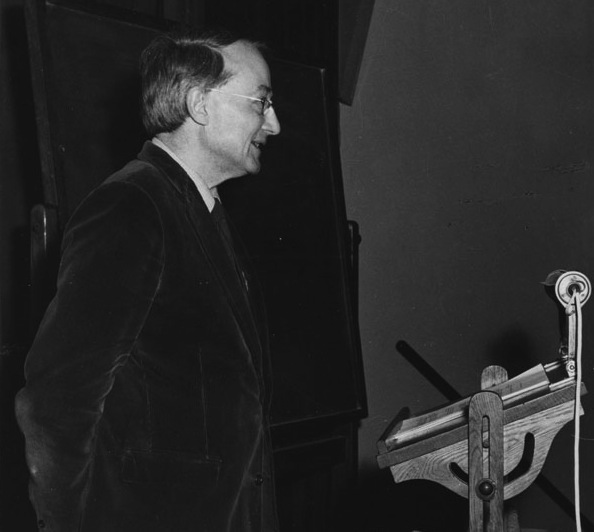
(Photo of Oakeshott lecturing in 1964 via the archives of the London School of Economics)

Empathy Within Reason

Stephen Sparks talks to Leslie Jamison, author of The Empathy Exams, about the connection between shame and empathy:

SS: Do you think that your sensitivity to shame can lead one to be more empathetic? To take an example from the book, I think of “Devil’s Bait,” on Morgellons disease. Many of the people with Morgellons suffer from a double burden of shame: the physical toll of the disease (apparent on their skin) and the fact that it’s not officially recognized, that it’s written off as psychological—it’s real, but not quite. In reflecting on their suffering, you also reflect on your response to that suffering, which moves you into a consideration of the role that reason plays in empathizing. This is another big question: where does reason stand in relation to shame? To empathy? I want to say that thinking through another’s suffering will move one closer toward an understanding of it, but there’s a nagging part of me that’s skeptical. …

LJ: I think you’re so right about the double shame of Morgellons, and it’s fascinating to parse it that way because the two shames are both simultaneous and oppositional—physical damage promises the possibility of proof that suffering is “real” but also compounds and deepens the isolating effects of that suffering. Which gets back to the question of reason—whether it always deepens empathy or whether it sometimes gets in the way.

I felt how strange it was to look at scarred skin and feel several reactions at once—the brute, gut feeling of sadness; the scars proof that suffering had happened, no matter why or how—but also the curiosity of those scars, how they had gotten there, to what extent we might call them self-inflicted. And in those moments, the reasoning mind did feel like radio static interrupting the reception of pain with its nagging questions. This was a nice word of yours: nagging. So often good ethical impulses start as nagging—like a little kid tugging on a shirt or a finger, until we stop and pay attention.

Have you read Paul Bloom’s piece in The New Yorker, “The Baby in the Well: A Case Against Empathy”? He posits a very different kind of relationship between reason and empathy. Basically, he argues that empathy can get in the way of sound moral reasoning, and we ought to supplant it—or at least leaven it—with reasoning. Often the situations that call forth our instinctive sympathies aren’t really the ones we should be acting towards: a little girl caught in a well arouses more collective sympathy than the anonymous millions starving in Africa—but we owe so much to the suffering that hasn’t been or can’t be compressed neatly into narratives that tug our heartstrings.

Previous Dish on Jamison and The Empathy Exams here and here.

The Little Boy Who Cried Heaven

Heaven is for Real, which opened last weekend, is the story of Colin Burpo, the four year-old son of a small town pastor who supposedly glimpsed heaven during an emergency appendectomy. The film is based on a book of the same title. When Jeb Lund compared the book and the movie, he found much more doubt and uncertainty in the big screen adaptation:

The film version of Heaven Is for Real seems to have been written in anticipation of the audience’s doubt. Screenwriter and director Randall Wallace—the guy behind Braveheart and the bridge-less Battle of Stirling Bridge—makes up a lot of dissonantly secular elements that don’t appear in the book and that spoil the tone of the movie.

A fictional church elder played by the reliably excellent Margo Martindale dislikes Colton’s story because she has seen pastors manipulate people with stories of heaven and threats of hell. The only reason for her character to exist is to inform the audience, “See? This story isn’t being manipulative.” Then, when Todd becomes too fixated on Colton’s story despite mounting medical bills and no income, his wife (played with a kind of impishly spirited good humor by Kelly Reilly) throws dishes in the sink and castigates him for thinking so much about the next life instead of this one. In addition to never appearing in the book, this scene thuds in the middle of the movie. This is Wallace screaming, “I KNOW WHAT YOU’RE THINKING, GODLESS AMERICAN MOVIEGOER.”

On the other hand, Kenneth Morefield argues that the presence of doubt in the film, including that of Colton’s father, Todd Burpo, actually makes it a better movie:

By distributing skepticism evenly across all the characters, even the Christians, Heaven is For Real avoids much of the smugness that marred God’s Not Dead. Like that film, Heaven is For Real has a token atheist/skeptic who is actually angry at God rather than dubious of his existence.

But unlike that film, Heaven is For Real doesn’t force a conversion on the skeptic as a means of declaring its own intellectual victory. This film looks inward, using Colton’s story to ask Christians to think through what they really believe, rather than focusing all their energy on how to get non-Christians to believe it too. Its dramatic highlight is a graveside conversation between Todd and Nancy (the always reliable Margo Martindale) that at least attempts to wrestle with the “why” questions. Why Colton? Why do so many prayers go unanswered? Why, if heaven is real, does death still sting so much, even for Christians?

Drew Dyck points out the gap between Colton’s vision of heaven and what we find in the Bible:

Some may be surprised that the Bible contains not one story of a person going to heaven and coming back. In fact Jesus’ own words seem to preclude the possibility: “No one has ever gone into heaven except the one who came from heaven the Son of Man” (John 3:13).

Scripture does contain several visions of heaven or encounters with celestial beings, but they’re a far cry from the feel-good fare of the to-heaven-and-back genre.

In Scripture, when mortals catch a premature glimpse of God’s glory, they react in remarkably similar ways. They tremble. They cower. They go mute. The ones who can manage speech express despair (or “woe” to use the King James English) and become convinced they are about to die. Fainters abound.

But, in another review of the film, Kyle Rohane reminds us that “ecstatic experiences are valuable, not because of the precise, objective details they reveal, but because they are subjective and personal”:

In 1224, Francis of Assisi witnessed a figure descending from heaven. This figure appeared to be a man but also a six-winged Seraph. He was affixed to a cross with two wings extended over his head, two covering his body, and two stretched out in flight. As Francis observed the figure’s radiant face, the figure smiled down at the monk. Francis was both overjoyed by the figure’s beauty and grieved by his suffering on the cross.

Do you think Francis pondered over the type of wood the cross was made of? Do you think he analyzed the ethnicity of the glorious figure? No, Francis understood his ecstatic experience to mean he would be made like the crucified Christ in mind and heart. The vision left him with a renewed commitment to and love of Christ.