Iran’s “Terrorist” UN Envoy

Iran’s new ambassador to the UN, Hamid Aboutalebi, served as a translator for the students who stormed the US embassy in Tehran in 1979. Ted Cruz and Chuck Schumer’s bill barring Aboutalebi from entering the country passed both houses unanimously last week. On Friday, the White House announced that Aboutalebi would not receive a visa. Scott McConnell sees through Cruz and Schumer’s concern trolling:

Of course the target here is not Iran’s ambassador to the UN. Cruz and Schumer aim to destroy the Obama/ P5+1 negotiation with Iran, which aim for a reduction and monitoring of Iran’s nuclear energy program in return for lifting of Iran sanctions. I presume Schumer does this because he wants Israel to be the only state in the Middle East permitted to enrich uranium—the senator often vows that his main purpose is to serve as Israel’s “guardian.” Cruz is implementing the current Republican campaign to depict Obama as a weak “Jimmy Carter like” figure in foreign affairs. Introducing a bill which evokes the frustrated emotions of the long ago hostage crisis while tossing rocks into the gears of American diplomacy thus serves as a kind of twofer. Both senators know well that there are hard-liners in Iran who oppose a successful nuclear negotiation with the United States as much as they do. Cruz and Schumer are thus playing to a dual audience, Americans immersed in Iran hatred and their Iranian counterparts.

Elias Groll and Colum Lynch explain the controversy in more detail and preview the legal battle to come:

The decision sets up a potential clash with the United Nations, whose 1947 agreement with the United States governing the body’s New York headquarters clearly forbids Washington from prohibiting the entry of U.N. ambassadors.

“The federal, state or local authorities of the United States shall not impose any impediments to transit to or from the headquarters district of representatives of Members,” the agreement reads. Under the terms of that agreement, disputes between the United States and the body are to be settled through arbitration. … Though the United States has previously attempted to bar the participation of certain groups at the U.N, this is the first time Washington has prevented a U.N. ambassador from taking up his position, according to Julian Ku, a law professor at Hofstra University and an expert on international law. In 1988, the United States barred Yasser Arafat, the chairman of the Palestinian Liberation Organization, from addressing the U.N. General Assembly. In response, the U.N. temporarily relocated its proceedings to Geneva. A year earlier, Congress attempted to force the PLO to close its offices at U.N. headquarters, an effort that ultimately failed.

John Bellinger argues that America’s agreement with the UN carved out an exception that allows us to deny Aboutalebi a visa:

[U]nder this so-called “security reservation,” Congress limited the U.S. obligation to allow representatives of other U.N. members to enter the U.S. if necessary to “safeguard its own security.”  Some observers, including my friend Kevin Heller over at Opinio Juris, have read Section 6 as reserving the authority of the Executive branch only to control the travel of foreign nationals into areas of the United States outside the U.N. “headquarters district” and not to deny absolutely the entrance of foreign nationals into the United States. Although this is one possible reading of Section 6, an equally plausible reading of Section 6 is that it reserves a general and absolute right for the U.S. to “safeguard its own security” as well as a more specific right to limit travel outside the U.N. district. It is hard for me to believe that Congress in 1947 would have acceded to an unfettered obligation to allow any foreign national to come to the U.N. headquarters district, as long as they did not travel outside that district.

But Heller contends that Bellinger is misreading the law:

Section 6 contains two separate provisions. Provision 1 permits the US to prohibit individuals who have a right of entry under the Headquarters Agreement but are considered a security threat from traveling anywhere other than other than “the [UN] headquarters district and its immediate vicinity.” Provision 2 then permits the US to deny entry completely to anyone who does not have a right of entry under the Headquarters Agreement. Section 6 thus does not permit the US to deny entry completely to someone who has a right of entry.


The Annexation Of Eastern Ukraine, Ctd

Things are getting pretty hairy over there:

Protesters seized another police station in eastern Ukraine Monday, as the government’s latest deadline for pro-Russian militia to leave the government offices they have occupied for the past week passed without signs of withdrawal or crackdown. In a televised Sunday address, acting Ukrainian President Oleksandr Turchinov set a deadline of 9 a.m. for protesters to pull out. CNN reports that there was no sign of movement from occupied buildings in the regional capital, Donetsk, or the flashpoint city of Slovyansk. And at least 100 armed protesters stormed the police headquarters in Horlivka, a small city about 20 miles northeast of Donetsk, in a clash that apparently injured several people, Reuters reports.

Linda Kinstler recaps the developments over the weekend:

[A] Ukrainian Berkut officer was killed Sunday night after a shootout broke out in the eastern Ukrainian city of Sloviansk, in the already unstable Donetsk region. Five others were injured in the first reported gun fight in eastern Ukraine, which started after armed men seized the town’s state security office and police station, AP reports. Ukrainian Interior Minister Arsen Avakov also reported “an unclear number of casualties among the militia.” …

Ukrainian Berkut police forces in Donetsk sided with pro-Russian protesters occupying government buildings in the city. “We will not submit to Kiev, because we do not think that anyone [in the government] is legitimate,” one officer said according to RIA Novosti. Police in Lugansk also said they are no longer taking orders from the Ukrainian government, Gazeta.ru reports.

Oleg Shynkarenko claims that Russians are being actively recruited to stir up trouble across the border:

One of the Kremlin’s key tactics is to obscure the origins of those forces spearheading its operation in east Ukraine, and one of the ways it’s doing that is to promote what might be called insurrectional tourism.

“Russian Spring,” as it turns out, is not only a revanchist motto out of Moscow, which we started hearing before the Crimea annexation, it’s a website, too. Adventure seekers who dream about reviving the U.S.S.R. can go online to share information about how to travel to Ukraine and, well, make a terrible mess there. Before their departure soldiers of fortune are advised to familiarize themselves with the slogan, “Leave for the front! Glory to Russia!” along with rules of behavior for a Russian tourist who wishes to get to “the territory of brotherly Ukraine”[.]

Jamie Dettmer suspects that Putin’s long game is to re-assert control over Ukraine without going to war:

“Putin’s objective remains to regain control of Ukraine, but I suspect he now thinks he can do this without ordering in the tanks,” says Andrei Illarionov, a former Putin economic policy advisor and now an unstinting critic of the Russian leader.

Illarionov tells The Daily Beast he expects Putin to maintain an intimidating offensive build-up of Russian forces along the Ukraine border, nonetheless, and that there will be no let-up in the fomenting of separatist agitation in the eastern Ukraine towns of Donetsk, Kharkiv, Lugansk and now Sloviansk. The aim is to destabilize Ukrainian politics, weaken Ukrainian state institutions and help Putin’s political allies reassert their power in Kiev.

Previous Dish on eastern Ukraine here, here, and here.

The Burgeoning Israel-Russia Alliance

Meeting of Vladimir Putin with Benjamin Netanyahu in Kremlin

The Jewish state’s decision to abstain in the UN on the question of Russia’s annexation of Crimea did not go unnoticed in Washington:

“We have good and trusting relations with the Americans and the Russians, and our experience has been very positive with both sides. So I don’t understand the idea that Israel has to get mired in this,” Lieberman told Israel’s Channel 9 television when asked about the Ukraine crisis.

When White House and State Department officials read these comments, they nearly went crazy. They were particularly incensed by Lieberman’s mentioning Israel’s relations with the United States and with Russia in the same breath, giving them equal weight. The United States gives Israel $3 billion a year in military aid, in addition to its constant diplomatic support in the UN and other international forums. Russia, on the other hand, supplies arms to Israel’s enemies and votes against it regularly in the UN.

The White House is disappointed, but it surely cannot be surprised. Israel has treated the US with contempt since Obama came to office, humiliating the president whenever it could, sabotaging any conceivable progress toward a two-state solution, while pocketing all the aid it can and trying to stymie Washington’s key diplomatic initiative in the Middle East. I cannot think of an alliance quite this perverse: the US gives Israel vital protection at the UN, vast amounts of intelligence and military assistance, $3 billion a year in aid and in return is opposed in most of its foreign policy initiatives, and its officials routinely slimed and attacked by members of the Israeli government. Name any other “ally” that behaves this way.

A much more plausible alliance for Israel in the future is surely with Putin’s Russia.

Russia could enable Israel’s annexation of its neighbors at the UN, since it is bent on exactly the same strategy of territorial expansion, based on ancient land claims and the ethnic composition of its borderlands. Larison:

Even if a significant number of the current government’s supporters weren’t Russian-speakers with connections to Russia and other former Soviet republics, Israel has no particular interest in upholding the sanctity of other states’ sovereignty and territorial integrity. Israel has violated both on more than a few occasions over the decades and reserves the right to do so in the future, so why exactly is it going to denounce Russia for doing things that are in some ways less egregious than its own past actions?

Russia, like Israel, has no real commitment to diplomacy unless it can act as a cover for military expansionism or as a delaying tactic while it entrenches its grip on the West Bank and makes it permanent. Large swathes of the Israeli corporate and political establishment have extremely close ties to Russia, in the wake of the post-Soviet influx, and the Russian immigrants are among the most hardline with respect to the Palestinians. And you can see the rapport between Netanyahu and Putin as clearly as you can see the lack of chemistry between Netanyahu and Obama.

This is unlikely to happen formally in the near future. But informally, it has been gathering momentum. As Putin preps for what may well be an invasion of Ukraine proper, Israel’s increasingly close ties to Russia may face a moment of reckoning:

Officials in Jerusalem attribute Israel’s cautious behavior over the Ukrainian crisis to Netanyahu and Lieberman’s desire to preserve what they see is a good and close relationship with Putin. In fact, fear is a significant motivation. “Russia’s ability to cause damage with regard to issues that are important to us, such as Iran and Syria, is very great,” a senior Israeli official noted, stressing that Israel did not want to get into a confrontation with Russia over an issue that did not directly concern it.

Or to put it another way, Russia’s ability to impound Syria’s chemical weapons still matters, if only to leave Jerusalem as the sole Middle East power with WMDs, and  Russia’s ability to derail the talks with Iran may also be a real life-line for those in Israel seeking military conflict. So the Israelis, as is their right of course, are treating Russia and the US as equal forces in their foreign policy, pivoting between one and the other in order to maximize their national interests in attacking Iran and preventing a Palestinian state. The question is not why Israel would act this way, but why the US cannot get as good and as cheap a relationship with Israel as Moscow has. Why do the Israelis regard Moscow with fear and Washington with contempt?

(Photo: Israeli Prime Minister Benjamin Netanyahu and Russian president Vladimir Putin appear during the Security Council meeting in the Kremlin on November 20, 2013. Netanyahu was on a one-day visit to Russia. By Dmitri Azarov/Kommersant via Getty Images.)

Throwing The Kitchen Sink At Climate Change

That’s the subject of the IPCC’s latest report (pdf). Plumer summarizes key points:

Global greenhouse-gas emissions from fossil fuels and other sources are rising rapidly — putting the world on pace for significant temperature increases by century’s end. To meet its climate goals, the world would have to act quickly, cutting emissions until they were 41 to 72 percent below today’s levels by mid-century. That won’t be easy. And the task gets much harder if we rule out any technologies, like nuclear power or carbon capture for coal plants.

Why an all-of-the-above strategy is vital:

Right now, about 17 percent of the world’s energy is “low-carbon” — a little bit of wind and solar power, some nuclear power plants, a bunch of hydroelectric dams. Countries would have to ramp those sorts of technologies up dramatically — tripling or quadrupling their share.

That means two things. First, it’s tough to rule out any particular technologies. For instance, some environmentalists are opposed to nuclear power. But the IPCC estimates that the task of cutting emissions becomes 7 percent more expensive if we shuttered all our nuclear plants. Likewise, the technology to capture carbon emissions from coal plants and bury it underground is still in its infancy. But if that technology proves unworkable, then the task of cutting emissions becomes twice as expensive.

Jim Skea highlights other parts of the report:

Cost is a critical question that needs to be addressed in any proposals for action, or inaction. In the report, the IPCC has suggested that action to cut greenhouse gas emissions could reduce global growth by 0.06% per year over the 21st century, leading to a 1.7% reduction in global consumption by 2030 and 3.4% by 2050 relative to a business as usual strategy. Is this affordable? It does not sound much when set against the impact of climate change. And other benefits from improved air quality and reduced dependence on imported fossil fuels are not costed in. However, expenditure would fall heavily on energy bills rather than being spread imperceptibly across the economy. The political leadership challenge is clear.

Victoria Turk worries that such leadership will never materialize:

The AP reported that diagrams in leaked drafts of the report that showed that a main force behind rising emissions were the increasing energy needs of fast-growing countries like China were deleted from the final version.

And that’s where a more pessimistic response to the report rears its head. After all, it’s not like it’s news that we need to reduce emissions from fossil fuels to stem global warming, but until governments can agree on a course of action, we’ll never see the kind of united progress that would be the most effective solution.

For the moment, the outlook continues to look pretty bleak, and the IPCC also wrotethat emissions continue to rise despite our efforts to reduce them. They wrote that “emissions grew more quickly between 2000 and 2010 than in each of the three previous decades,” and put this down to the disproportionate growth in economies and populations.

The Risks Of A GOP Senate

To illustrate them, Chait imagines what would happen if one of the conservative Supreme Court Justices died unexpectedly:

It may seem implausible that Republicans would simply refuse to allow Obama to appoint any justice to such a vacancy. That is only because things that haven’t happened before are hard to imagine. But such a confrontation is not only a logical outcome but the most logical outcome. Voting to flip the Supreme Court would be, if not a political death warrant for a Republican Senator, then certainly taking one’s political life into one’s own hands. Politicians do not like political death warrants — certainly not for the benefit of the opposing party’s agenda.

The modern pattern in American politics is that tactics that are legally available, but never used for reasons of custom, eventually become used. The modern pattern is also that the Republican Party, which is the most ideologically cohesive and disciplined party, leads the way. McConnell did not create this pattern, but he is an important innovator. … It stands to reason that if and when new powers are laid at his disposal, McConnell will once again deploy them creatively. A potential Supreme Court crisis, in which the Senate simply refuses to let the president fill a vacancy on any remotely normal terms, is one possibility. Others may be brewing at this moment deep within McConnell’s extensive imagination.

Why Aren’t Gay Men On The Pill? Ctd

In another video from Dave Cullen, Truvada user and bestselling author, he addresses the anticipated backlash from Fox News and Limbaugh when PrEP drugs are more widely used:

The idea that gay sex requires more justification than straight sex is deeply embedded in the culture – even within gay culture. Two other themes have emerged as well in talking about this with my fellow homos. The first is that taking a Truvada pill means, for some, the taking of an HIV pill. And being HIV-negative is sometimes defined as not having to take an HIV pill. So taking Truvada as a preventative means, for some, crossing the HIV divide, when they have spent an entire adult life-time keeping their distance from HIV culture. This makes no logical sense  – taking Truvada as well as using safer sex helps you stay free of HIV more effectively than any other method (think of it as combination therapy). But it does make psychological sense for the countless who remain traumatized by the memory of the plague.

I think there’s also a resistance to the good news in the same way that there was intense resistance to the good news of the cocktail therapy eighteen years ago. Perhaps the most controversial piece I’ve ever written was my “When Plagues Endtruvadacover-essay for the New York Times magazine. It was assailed as empirically wrong, dangerous and complacent. But every single factual claim in it has been borne out – and then some. The truth is: we become wedded to the status quo, even if that status quo is terrifying. Camus grasped this in his great novel, “The Plague.” He showed how no one wanted to believe the good news that the plague was ending – because they were too scared to hope, too terrified of getting their hopes up, too conditioned by terror to change quickly. That psychological insight is invaluable – even as the truth now is that no one with undetectable virus can infect anyone, and no one on Truvada can get infected. Instead of embracing that, we shy from it.

Meanwhile, readers are responding in droves via Facebook and the in-tray:

Thank you so much for your writing on Truvada and celebrating it for the godsend that it is. I’m in a serodiscordant couple and to hear it described as a “party drug” makes me feel ill. If eliminating fear at the heart of a relationship is a party, then, yeah, that’s a party I’ll go to. If wanting to fuck the person I love safely makes me a whore, well then I suppose I’m a whore. The names can’t hurt our community as much as HIV has. So if takes being called names to finally end this virus, then let them call us whatever they want.

Another:

I’m a married straight guy. I had known somewhat vaguely about Truvada before your posts – though I didn’t really know anything about the drug and had no idea about the reputation. That said, the backlash is absolutely mind-boggling. There is a drug that would prevent the transmission of a drug that has killed millions over the past three decades, and people are called whores for taking it? I mean it literally when I call it mind-boggling; I simply cannot wrap my mind around that logic.

Another:

I have to say, I almost physically attacked my computer screen when I read the quote from the AIDS Healthcare Foundation president, Michael Weinstein, who called Truvada a “party drug.”

I have sex. I’m human. Condoms come off. It happens. I’m a working professional, not a raver on molly who dabbles in the gay meth scene. But I am single, in my 20s, sexually active, gay, live in San Francisco and I am HIV-. Why isn’t this the simple litmus test for potentially being prescribed Truvada?

After an “HIV scare” last year when a partner of mine tested positive (he was the first person I’d been with since moving to San Francisco), I raced to the doctor to get an RNA HIV test. I was fortunate. Tests came back negative. So next week, I will be going into to consult an HIV/AIDs specialist at my HMO about Truvada. I’ve passed all the blood/urine pre-screens, so I think it’s mainly for me to understand the importance of taking it daily, sign an agreement to get my blood work done every three months, still use condoms, etc. If I don’t keep up with the blood work, I’d imagine they may remove me from their PrEP program, which is completely reasonable to me, considering the potential side effects and needing to know the HIV status of the patient.

My general practitioner is the reason why I haven’t done this sooner. He may share the same views of Mr. Weinstein. After my HIV scare, which he helped me through, he was reluctant to recommend the drug for me. When I brought it up, the conversation was just shot down with “it’s not like a contraceptive pill” with a shake of the head. Ironically, during in the same conversation he mentioned that many people don’t know or lie about their HIV status. His other concern seemed to be there’s only been one solid, long-term study on Truvada in regards to effectiveness and side effects. This may be a valid concern.

But I have one life to live. Spare me the lectures and finger wagging.

And another:

I was infected in 1985. Those were the days of no available treatments and the best you could hope for was eighteen months – if you were lucky. Anybody remember drinking aloe vera juice? How about melting down a pound of butter and mixing in lecithin powder and then freezing it in ice cube trays to be mixed into juice? I do.

How about going to a bar and no longer looking for the tell-tale KS lesions but the cheap digital watches that beeped every four hours screaming “take your AZT!” I do, and that is why I do not wish this illness on anybody.

I am open to any and all available treatments, and the hateful rhetoric and name-calling on both sides is not doing either side any good. All I can do is be honest and tell my story and try to explain my fears, but I get immediately shouted at as some old guy who does not know anything about modern treatments. If you want to sell me something, educate me and try to understand my fears; don’t lecture me. Truvada, as well as a whole host of drugs, exist because my friends died. Don’t belittle my loss.

My biggest fear is maintenance. All I can say is that I have been taking pills since 1987 when AZT came out. There have been many, I am sad to say, times in the almost 30 years that I skipped a dose. Sometimes even weeks would go by. I can’t tell you why. You just get tired. You have a headache, you take an aspirin and it goes away. You take a handful of drugs and you do not have that immediate payoff and it just gets hard to keep up. I am clean and sober, have great insurance, and a long-term and loving relationship for support and it is still hard.

We don’t know the long-term effects, especially for the post-HAART infected. Even though the virus may not be detectable in your bloodstream, it can be quite active in your brain fluid. I have just been diagnosed with AVN and will need to have both of my hips and shoulders replaced. Google AIDS and aging and see what is happening. Most of the time it is not the virus, but the medicine that is responsible.

So do whatever it takes. Life is far too short to be worried about what anybody thinks of you.

How We See Our Overseers

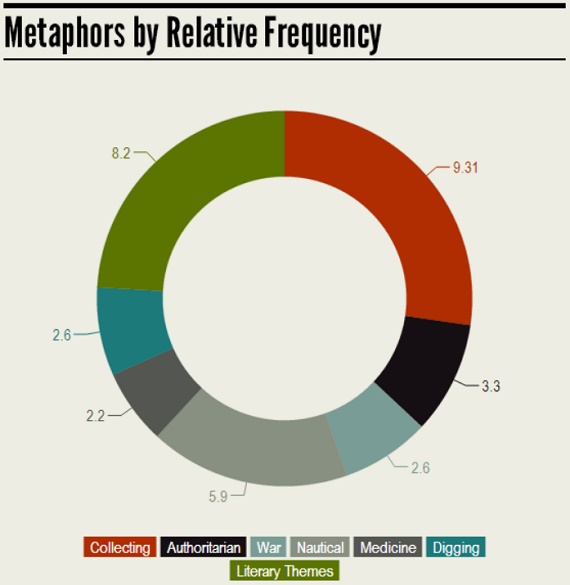
dish_surveillancemetaphors

In a study of how news media talks about surveillance, PEN found evidence of “rich thematic diversity in the types of metaphors that are used, but … also a failure of imagination in using literature to describe surveillance”:

[S]cholars and activists have observed that relating U.S. government surveillance regimes to Big Brother overstates the case, because the U.S. is a more open society than the one 1984 describes and, despite the NSA’s overreach, the country should not be labeled authoritarian. Scholar Daniel J. Solove, for example, pointed out in a seminal article that Kafka’s novella The Trial is probably better suited:

We are not heading toward a world of Big Brother or one composed of Little Brothers, but toward a more mindless process — of bureaucratic indifference, arbitrary errors, and dehumanization — a world that is beginning to resemble Kafka’s vision in The Trial.

Other activists prefer to use Jeremy Bentham’s notion of the panopticon, an institution that allows those with power to create the perception that their subjects are under surveillance at all times. But for journalists and bloggers, the rich variety of literature that has tackled surveillance — from science fiction to modern novels — is rarely invoked. Orwell is the reigning king of the surveillance state.

What do these results mean? The fact that 91 percent of articles contain metaphors suggest that writers will continue to use metaphors to help us understand advances in technology. They also use a diverse range of metaphors. However, as advocates develop new messaging on surveillance and look to literature for inspiration, they should not stop at Orwell: there are many more literary treasures to be explored. … Aaron Santesso and David Rosen, for example, have shown that the Eye of Sauron in J.R.R. Tolkien’s Lord of the Rings better captures the current surveillance state, but so too do plays by Shakespeare, such as The Tempest.

The Politics Of Sprawl

Richard Florida compared “rankings of sprawling and compact development to voting patterns, as well as other significant economic and demographic variables”:

In recent decades, America’s politics have exhibited a new trend, where Red America finds its home base in some of the country’s most sprawling places, while Blue America is centered in denser, more compact metros and cities. … The connection between sprawl and conservatism come through loud and clear in our analysis of more than 200 of America’s metro areas. Our correlations suggest that sprawled America is Red America, while Blue America takes on a much more compact geography. The Sprawl Index was negatively associated with the share of voters in a metro who voted for Mitt Romney in 2012 (with a correlation of -.44); and it was positively associated with the percentage who voted for Barack Obama (.43). These were among the strongest correlations in our analysis.

This is in line with other research that connects sprawl or density and political affiliation. Researchers have identified a tipping point of roughly 800 people per square mile where counties shift from Red to Blue, as I noted in the weeks following Barack Obama’s reelection. Princeton historian Kevin Kruse similarly explained this spatial link between a spread-out landscape and Republican political positions to the New Republic. “There are certain things in which the physical nature of a city, the fact the people are piled on top of each other, requires some notion of the public good,” he said. “Conservative ideology works beautifully in the suburbs, because it makes sense spatially.”

Recent Dish on sprawl here. More from the archives here and here.

Embrace The Boredom

Shane Parrish challenges the notion of idleness as a moral failing, quoting from Andrew Smart’s Autopilot: The Art And Science Of Doing Nothing:

Our brain, much like an airplane, has an autopilot, which we enter when resting and “relinquishing manual control.”

The autopilot knows where you really want to go, and what you really want to do. But the only way to find out what your autopilot knows is to stop flying the plane, and let your autopilot guide you. Just as pilots become dangerously fatigued while flying airplanes manually, all of us need to take a break and let our autopilots fly our planes more of the time.

Yet we hate idleness don’t we? Isn’t that just a waste?

Our contradictory fear of being idle, together with our preference for sloth, may be a vestige from our evolutionary history. For most of our evolution, conserving energy was our number one priority because simply getting enough to eat was a monumental physical challenge. Today, survival does not require much (if any) physical exertion, so we have invented all kinds of futile busyness. Given the slightest or even a specious reason to do something, people will become busy. People with too much time on their hands tend to become unhappy or bored.

Yet, Smart agues, boredom is the key to self-knowledge.

What comes into your consciousness when you are idle can often be reports from the depths of your unconscious self— and this information may not always be pleasant. Nonetheless, your brain is likely bringing it to your attention for a good reason. Through idleness, great ideas buried in your unconsciousness have the chance to enter your awareness.

Meanwhile, researchers recently found that “procrastination and impulsiveness are both at least moderately heritable.”

Life-Sized Origami, Ctd

rhino_magenta

A reader adds to this post, which went pretty viral on Facebook:

I certainly agree that Sipho Mabona’s work is fantastic. He is extremely intelligent, as you can see in this YouTube video. However, what Dish readers may not realize is that we are in the middle of a huge revolution inorigami, as new techniques are allowing origami artists to create ever more sophisticated creatures. Dr. Robert Lang, a Cal Tech Ph.D who left physics to do origami as a living, has been at the forefront of many of these new techniques, many of which come out of mathematics or computers. The result is a life-like depiction of animals and insects that are uncanny: it could be a bull moose, or a panther, a red-tailed hawk or a life-sized pteranodon – they are all made from just one piece of paper, with no cuts. Origami is considered to be a Japanese art form, but it has gone world-wide in the last 25 years, as Mr. Mabona and Dr. Lang show.

The rhino seen above is by Mabona as well. See more of his amazing work here. Update from a reader:

I watched Between the Folds on Netflix about a year ago and was fascinated by the many different techniques, styles, etc. It’s several years old, but really good. I’ll always love the paper swans I made in 3rd grade, but there’s a whole world of origami out there that I knew nothing about.

The whole documentary is also available on YouTube: